Moedim

Moonbeams and the Moedim Part I

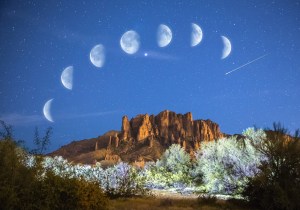
                       © Printezis | Dreamstime.com

Women, Cycles, and Time

Have you ever considered why many of the families that have returned to the seventh day Sabbath and YHWH’s festivals began with the prompting of the woman or wife?[1] Or have you ever wondered why there is so much physical preparation (domestic and relational requirements) that a woman must do in order for the family to keep Shabbat and the Feasts? What about the rabbinical ruling that women are “exempt” from certain time related commandments; what is this about? Why do women seem to be associated with TIME again and again? Hopefully, we will begin to answer these questions in this post.

I think I’ve figured out why I’ve struggled to start this next series of posts. They each deal with time. And time, like  light, is still very much a mystery to mankind (and modern science). There are several ways that people try to understand time. Some think of it as a linear line with an infinite beginning and end. Each end of this line is constantly moving away from the other. Others view time as a circle with the beginning also being the end. And still others believe that while time is indeed cyclical, that it is much more akin to the double helix of our DNA. It is connected, but with rungs that progress upward on a twisted ladder. Lower parts touch higher rungs repeating the information in new and more dynamic ways with each cyclical step.

The latter view will be the way in which I present this material. This part will present the base line and it will spiral and spread throughout the following posts, but will twist back to touch this post again. To put it simply, I will present this in a “spiral” form of teaching. I just don’t see any other way to do it. (:

Cycles

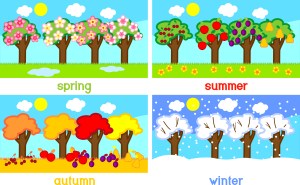
© Luayana | Dreamstime.com

There is an important difference between Hebrew and Greek thought in the worldview of time. While Greek derived mindsets tend to think more linearly, Hebrew thought is more cyclical. Creation (nature) testifies of the latter.  As an example, the seasons are pictured in the graphic. They occur again and again in a cycle. Like the seasons, time and even prophecy is thought of as cycle with recurring themes rather than the common linear timeline that moves from the indefinite left that progresses to the indefinite right. Everything we can see moves in cycles, and Adonai uses cycles to teach us about unseen (spiritual) things (1 Cor. 15:46).

God’s calendar, His appointed times, are also cyclical. Before we delve into how women are connected to these cycles, let’s first look at how God has revealed time.

Adonai’s calendar is primarily based on the lunar cycle.[2] New months begin with sighting the first sliver of a new moon and mark out the appropriate timing of our festivals, fasts, and harvests. In other words, the moon keeps or guards our weeks, months, and years. The passage below chronicles Day 4 of creation. Those of you that have been following my posts or that are Creation Gospel students will notice that as the fourth day, God is establishing His government or authority in the luminaries. (And in His calendar.)

Then God said, “Let there be lights in the expanse of the heavens to separate the day from the night, and let them be for signs and for seasons and for days and years; and let them be for lights in the expanse of the heavens to give light on the earth“; and it was so. God made the two great lights, the greater light to govern the day, and the lesser light to govern the night; He made the stars also. God placed them in the expanse of the heavens to give light on the earth, and to govern the day and the night, and to separate the light from the darkness; and God saw that it was good. There was evening and there was morning, a fourth day. (Gen. 1:14-19)

Verse 14 states that one of the governing actions of the luminaries is to serve as signs, seasons, days, and years. I believe “days” and “years” are pretty self-explanatory, so let’s look at the “signs” and “seasons”. The Hebrew word for signs is ot (aleph, vav, tav). It literally means a mark, signal, omen, or flag. The heavenly lights declare not only the glory of God, but give us signals or warnings of things to come. So while they may help us to keep track of time (past), they can also point to or warn us of future events (prophesy).

The Hebrew word for seasons in verse 14 is moedim. I expect that most of my readers will be familiar with this word. These are our feasts and festivals.[3] Notice that in the very Beginning, Adonai established His calendar or His time clock on day four of creation. This is significant because our calendars govern our day to day lives. They dictate when we celebrate, when we rest, when we work, and when we gather together. If the Creator felt that His calendar required the actual sun, moon, and stars to guard, protect, keep, and mark His time, how much more should His people regard His calendar?

These appointments with the Creator give us LIGHT much in the same way that the sun, moon, and stars give us natural light. They truly separate the light from the darkness. If we ignore these appointments, we will have less light, less revelation. Remember, the natural things are meant to reveal spiritual truths. The guardians of God’s calendar speak to every creature on earth summoning us to come and meet with the King. David said it this way:

The heavens declare the glory of God; And the firmament shows His handiwork. Day unto day utters speech, And night unto night reveals knowledge. There is no speech nor language Where their voice is not heard. (Ps. 19:1-3)

In the very Beginning, the Creator preordained that we meet with Him certain times of the year. You only need to look up at the majestic sun, moon, and stars to see and know the season. Notice that at night the heavens reveal “knowledge.” This is the Hebrew word da’at. This type of knowledge is an intimate knowing and carries with it the idea of sacrificial love. It is the “bone of my bone and flesh of flesh” that Adam experienced with Chavah (Eve) and she conceived and bore a son. It is the loving knowledge that provoked Yeshua to become the sacrifice for His people. Because of the intimate nature of da’at, it cannot be completed without a woman. This type of sacrificial love needs a vessel to pour itself into and women are the natural imagery of a receiving vessel. (Hopefully, you can see men too in this imagery as part of the Bride.)

There is a cycle at work here that is meant to be a guide to God’s people. For our purposes, we will limit our study to the lesser light of the moon. Both men and women as the people of Elohim can be compared to the moon. But women have a unique association that I’d like to focus on. Since both the male and the female are revealed in The Woman in Scripture, we will see some overlaps in the two sex roles.

Moonbeams

He made the moon for the seasons (moedim)… (Ps. 104:19)

The moon has a special role to play in the guardianship role of the moedim (feasts). It is a master timekeeper of sorts. While the sun and stars also share in this responsibility, the moon beckons us to watch it a little more closely. As the nearest heavenly body to earth, the moon has mesmerized mankind since time immemorial. Sadly, many have fallen victim to the idolization of these heavenly bodies. They have failed to realize that these luminaries serve us, we are not meant to serve them.

The moon’s closeness and the fact that it governs our moedim make it quite mysterious. This becomes even more mystical when we consider that the brightest light in the night sky has no light of its own – it can only reflect the light of the sun. We will come back to this concept in a later post.

Since women’s bodies follow a lunar cycle (menses), the Sages have long concluded that women are uniquely associated with not only the moon and Adonai’s Festivals, but with time itself.[4] Let’s review what we’ve covered so far. As you read through my enumerations, ask yourself if any of these remind you of the role of women.

The moon:

  1. Sets boundaries for our months.
  2. Keeps or guards the moedim.
  3. Warns of things to come.
  4. Reflects the light of the sun.

I hope some of these facts caused you to think of the neqevah (female) and the ezer kenegdo from the Biblical Role of Women Part I and Part II. Or perhaps even the prophetic nature of women from Part V. One of the more obvious links between women and the moon is seen in the various PHASES in which both continually go through.

The regular arrival of the new moon and its growth to fullness, followed by its soon disappearance has long been a visible symbol of life, death, and rebirth. With every new moon, we see the necessity of being renewed (born again). This rhythmic clock sets our calendars with each cycle marked as a new month (moonth).

Like clockwork, women also go through phases each month. Similar to the moon, a woman’s phases are directly linked to life, death, and rebirth. Each month a woman’s womb prepares its “soil” for life and then sheds it (death) if no viable seed is planted — only to renew itself once again. This cycle repeats again and again. When a woman’s body is in the shedding stage of menses, blood appears. When the moon gives us a warning of judgment (death), it appears red. It’s not a coincidence that we call this a blood moon.

Not surprisingly, there are four primary phases of the moon with more elaborate depictions showing eight (a factor of 4). You can watch a quick video about these phases here.  Due to the length, we will examine each of the four primary moon phases and their relationship to the feast days and women’s cycles in Part II.


[1] Obviously, this isn’t always the case. However, in most of the families I have met, this is true. Whether she was home schooling the children and discovered these truths through in-depth Biblical and historical studies or by the gentle prompting of the Holy Spirit, it is usually the wife that first “sees” God’s calendar as relevant for the family.

[2] The Hebrew calendar does take the solar cycle into account to maintain the seasons. For an interesting article about this, click here.

[3] See Lev. 23

[4] These two articles speak to women and the moon. Women of the Wall and Aish. Women being associated with time in general is a two-fold concept. The first is simply what we’ve been discussing. Women are tied to time because YHWH made their bodies to mimic His time clock. Secondly, the rabbis ruled that women are exempt from certain TIME related mitzvot. We will explore this idea in a later post.

Categories: Moedim, Women | Tags: , , , , , , , , , | 24 Comments

The Rivers of Eden

Why does Torah portion Bereshit seem to interrupt the natural flow of the creation narrative to interject the telling of the rivers of Eden? Does this break in the story seem strange to you? In her commentary on Bereshit in The Creation Gospel Workbook 5 Volume 1, Dr. Hollisa Alewine expounds on the odd placement (or is it?) of the details of the one river that divides into four in Genesis chapter two. Dr. Alewine’s commentary on Bereshit delves deeply into the rivers of Eden (about 50 pages worth!).  Obviously, this is a much more comprehensive treatment than I will offer here. If you have the time, I urge you to study the Creation Gospel model and her commentary on Bereshit. I hope to give you a summary of these fascinating rivers and a taste of Dr. Alewine’s work along with some thoughts of my own.

Gen 2:10-14  Now a river flowed out of Eden to water the garden; and from there it divided and became four rivers.  (11)  The name of the first is Pishon; it flows around the whole land of Havilah, where there is gold.  (12)  The gold of that land is good; the bdellium and the onyx stone are there.  (13)  The name of the second river is Gihon; it flows around the whole land of Cush.  (14)  The name of the third river is Tigris; it flows east of Assyria. And the fourth river is the Euphrates.

One River

First, what is a river in Hebrew? In our passage above, the Hebrew word translated as river is nahar. According to Brown, Driver, and Briggs’ Hebrew Definitions, nahar is a stream, river, or underground stream. It comes from the root verb nahar meaning to shine, beam, light, burn, be radiant, to flow, and stream. Please keep this imagery of a river as flowing water and flowing light at the forefront of your mind as we continue.

From the Garden of Eden (paradise) the “head” or beginning of the ONE river divided into four other rivers. Before we get into the details of these four rivers, let’s first explore what we know about the number four. As I’ve explained in other places on this blog, four can be a representation of seven or completeness. Day four of creation establishes for us the “governing” aspect of this number.

Other examples:

  • There are four corners of the earth.
  • Four corners (horns) are on the brazen altar.
  • Four living creatures surround the Throne.
  • Four seasons mark the year.
  • The fourth commandment is about Shabbat, the seventh day.
  • Four gospels testify of Messiah.
  • The fourth born son, Judah, receives the scepter (authority, government, rule).
  • Four horsemen complete judgment in the earth.
  • Four species are waved at Sukkot, the seventh feast (Lev. 23).
  • Four corners of a garment carry tzit-tziot (fringes) representing all the commandments.

There are many places in the creation (nature) and the Holy Scriptures that speak to the imagery of four depicting completeness and authority much in the way that the number seven does. The seven branched menorah displays this imagery (in the natural) better than any other motif. Consider that the source or center branch is the fourth branch no matter which direction you begin your count. Messiah Yeshua stands at the center of this lampstand as He is the source from which all things flow. This brings us back to the beginning or Bereshit.

John 1:1-5  In the beginning was the Word, and the Word was with God, and the Word was God.  (2)  He was in the beginning with God.  (3)  All things came into being through Him, and apart from Him nothing came into being that has come into being.  (4)  In Him was life, and the life was the Light of men.  (5)  The Light shines in the darkness, and the darkness did not comprehend it.

It is through the divine Light of Messiah (He as our menorah) that all things came into being and are held together. As the source of LIGHT, He rescues us from the darkness and redeems and saves us. He is the beginning of “in the beginning.”

Col. 1:13-18  For He rescued us from the domain of darkness, and transferred us to the kingdom of His beloved Son,  (14)  in whom we have redemption, the forgiveness of sins.  (15)  He is the image of the invisible God, the firstborn of all creation.  (16)  For by Him all things were created, both in the heavens and on earth, visible and invisible, whether thrones or dominions or rulers or authorities–all things have been created through Him and for Him.  (17)  He is before all things, and in Him all things hold together.  (18)  He is also head of the body, the church; and He is the beginning, the firstborn from the dead, so that He Himself will come to have first place in everything.

As LIGHT, He is the source branch or trunk of the menorah tree, and the fullness thereof extending into the six branches for a completion of “seven.”

Rev 1:12-15  Then I turned to see the voice that was speaking with me. And having turned I saw seven golden lampstands;  (13)  and in the middle of the lampstands I saw one like a son of man, clothed in a robe reaching to the feet, and girded across His chest with a golden sash.  (14)  His head and His hair were white like white wool, like snow; and His eyes were like a flame of fire.  (15)  His feet were like burnished bronze, when it has been made to glow in a furnace, and His voice was like the sound of many waters.

Rev. 2:1  “To the angel of the church in Ephesus write: The One who holds the seven stars in His right hand, the One who walks among the seven golden lampstands…

The primordial Light of day one in Genesis 1:3 was not the natural light of the sun, moon, and stars (created later on day 4), but was the glorious spiritual Light of Messiah. He is the Light in the darkness and the Life of men.

While “light” is certainly a symbol for God given in Genesis 1:3, there is another symbol that precedes this primordial “light.” In Genesis 1:2, the Spirit of God is hovering or moving upon the face of the waters. This movement in Hebrew is rachaf (H7363), which is the brooding, fluttering motions a mother bird makes over her nest. From the beginning, the Spirit of God is characterized by movement, the nurturing care a mother bird has for her young, and with WATER. Does Messiah have any associations with water? The Beloved disciple John, the one who points us to the beginning and the primordial light, also points us to the ancient waters as the source for eternal life.

John 4:10  Jesus answered and said to her, “If you knew the gift of God, and who it is who says to you, ‘Give Me a drink,’ you would have asked Him, and He would have given you living water.” (see also vs. 14)

John 7:37-38  Now on the last day, the great day of the feast, Jesus stood and cried out, saying, “If anyone is thirsty, let him come to Me and drink.  (38)  “He who believes in Me, as the Scripture said, ‘From his innermost being will flow rivers of living water.'”
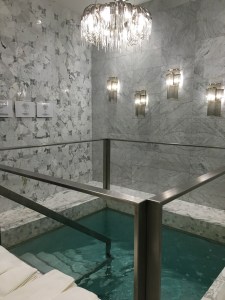
Modern Day Mikvah Mk17b, CC BY-SA 4.0, via Wikimedia Commons

Immersing in living waters, mayim chayim, removes ritual impurity, marks a change of status, and figures being born anew (conversion). In the days of the Temple, one couldn’t approach the Temple without first entering a mikvah (baptismal pool). The picture shows a modern mikvah in NY. When Yeshua was immersed in the Jordan River in the first century, the Holy Spirit alighted on Him like a dove, a bird, just like the hovering action of Day One of creation.

Matthew 3:16-17 (CJB) As soon as Yeshua had been immersed, he came up out of the water. At that moment heaven was opened, he saw the Spirit of God coming down upon him like a dove, [17] and a voice from heaven said, “This is my Son, whom I love; I am well pleased with him.”

As the image of the invisible God, Yeshua is also the source for the living waters of eternal life. Jeremiah declares that these living waters are from the beginning and find their source in the glorious throne of YHWH.

Jer. 17:12-14  A glorious throne on high from the beginning Is the place of our sanctuary.  (13)  O LORD, the hope of Israel, All who forsake You will be put to shame. Those who turn away on earth will be written down, Because they have forsaken the fountain of living water, even the LORD.  (14)  Heal me, O LORD, and I will be healed; Save me and I will be saved, For You are my praise. (See also Jer. 2:13)

Thus, we see the Living waters in the beginning… before all things. Time doesn’t run on some infinite straight line, it is a circle or a cycle according to the witness of creation, Hebraic thought, and the Bible. What is happening in the beginning will also happen at the end, completing the divine pattern or cycle. What do we see at the end?

Rev. 7:17  for the Lamb in the center of the throne will be their shepherd, and will guide them to springs of the water of life; and God will wipe every tear from their eyes.”

Rev. 21:6  Then He said to me, “It is done. I am the Alpha and the Omega, the beginning and the end. I will give to the one who thirsts from the spring of the water of life without cost.

Rev. 22:1  Then he showed me a river of the water of life, clear as crystal, coming from the throne of God and of the Lamb,

Though the river in Genesis chapter two isn’t named, I bet you can guess what it is called. It is the Source, the Head, and the Beginning. It is none other than the River of Life. The Holy Spirit inspired Scriptures captures this imagery in a perfect circle from beginning to end. The River of Life (like Messiah) is, was, and is to come. It has always been there flowing from the Throne of YHWH. Does the Genesis narrative about the rivers have a little bit more significance in your mind now? Perhaps learning about them can bring greater insight into not only the beginning, but the end.

The River that pours forth from Eden (paradise) and the Throne of YHWH divides into four other heads. Now, let’s go back to our menorah motif again. Imagine the River of Life as the source or center branch, fueling or feeding the outer six branches, giving them Life. In the natural, this river would be the Euphrates. Now, this doesn’t mean that the Euphrates IS the River of Life; instead, it is a metaphor for it.

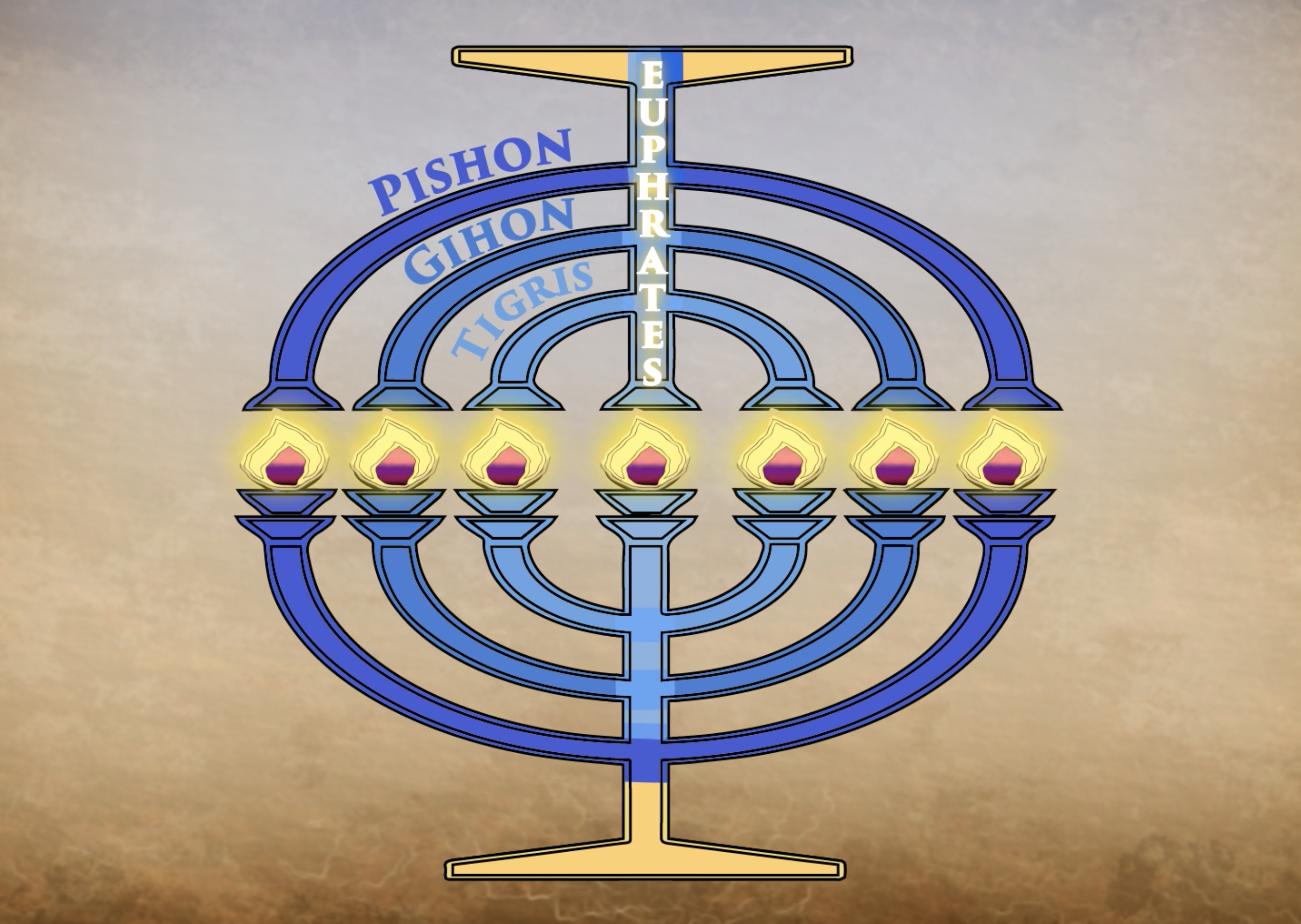
The rivers are given in the following order in Genesis chapter two: Pishon, Gihon, Tigris, and Perat (Euphrates). Every word, and every letter, is divinely placed in the Torah by the Holy Spirit. The order of the four rivers is no exception. Again, imagining a menorah, Pishon would be on the first branch, Gihon on the second, the Tigris on the third, and the Euphrates on the fourth branch. Since four represents the whole or seven, the first three rivers connect chiastically to their counterpart on the other side of the menorah. Creation Gospel students will understand this from their study in Workbook 1, but for clarity, look at this graphic:
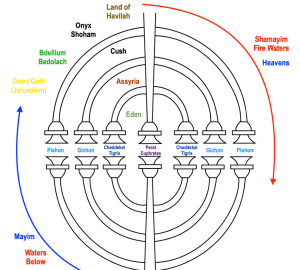
 

Notice how one and seven mirror one another as do two and six and three and five. Moreover, you can trace with your finger how they are indeed connected at the base; yet the source for them all is the Messiah or the River of Life. By the way, this “mirroring” or chiastic structure is also true for the seven days of creation, the seven Spirits of God, the seven feast days, and the many sevens found in the Book of Revelation. You can learn all about these fascinating truths by studying the Creation Gospel by Dr. Hollisa Alewine. If you are interested in joining a study group with a Trainer, email me at: kisha@graceintorah.net

Perhaps it is a little clearer now why Moses gave more information about the river Pishon than he did for the other three rivers. Looking at the graphic again, you can see how the Pishon encompasses the entire menorah as the outer shell or boundary, showing the complete or whole menorah. Before we move onto the meaning of the names

© The Creation Gospel, Hollisa Alewine

of each river and their significance, look at the graphic one more time. Now, imagine if there were a second menorah upside down on the top of this one. What would you see then? It would be a complete circle with smaller circles on the inside! Perhaps a wheel in the middle of a wheel? (That connection is a whole other study in itself.) For now, it is important to see the complete picture or the whole circle or cycle. In fact, two of the rivers of Eden are described with Hebrew words that mean to surround, encompass, and circle. For another example, google pictures of complete rainbows. They are a circle when viewed from an elevated (heavenly) perspective. On earth, we only see “half” of it – a “bow” that very much looks like a menorah with seven branches or colors. But a true rainbow makes a complete circle like the menorah on top of a menorah graphic above.

Euprates (Perat)

Do you recall from the beginning of this post how in Hebrew a river is not only water, but a mechanism for carrying light? Do you also remember the crystal clear waters flowing from the throne of God? (Dan. 7:10) Could these same “fiery” waters be life to the righteous and yet a “lake of fire” to the wicked? This is something to consider since the end has been declared from the beginning. Moreover, fire and water are paired together in multiple places in the Bible as symbols for God and for judgment.[1] For our study, consider that these waters from Eden are both flowing fire and water. Whether they burn or cleanse is determined by whether you are wicked or righteous. These flowing waters from Eden are like the Holy Spirit blowing and flowing around, among, and in His people. Like with Daniel and his companions, the fiery furnace of the Holy Spirit is a cool cleansing heat from heaven that protects the righteous, but burns the wicked.

Instead of starting with the first river listed in Genesis, we will begin with the last or what sits at the center of the menorah. This is the River Euphrates or in Hebrew Perat. The word perat comes from the word pri, or fruit. (You might recall the latter from the Kiddush blessing.) The source branch (river) on the menorah is meant to represent the Holy Spirit of Messiah. It is akin to the moed (feast) of Shavuot (Pentecost), the feast of first FRUITS.

The Bible doesn’t describe “how” the Perat flows, but the other three are described. Why? Perhaps this emphasizes the hidden action of the Holy Spirit. We cannot see Him, but we can feel His presence like the wind. Perat means “breaking forth.” Power and permanence are two words that would describe this river and the Holy Spirit. For now, think of Perat as the source, head, fruitfulness, and increase. The other rivers will reinforce these ideas.

Tigris (Cheddekel)

Moving to the third and fifth branches on the menorah, we come to the third river mentioned, the Tigris or in Hebrew, the Cheddekel. This river is said to be “going” or quite literally in Hebrew, “walking.” Creation Gospel students will draw the connection to the “running feet” of the birds and fish created on day five. Cheddekel means rapid, roaring, or noisy. This river isn’t a quiet, gentle stream – it is noisy and loud and fast moving! This should also remind you of the shouting and blowing of trumpets during the fifth feast of Rosh HaShanah that arouses sleepers from spiritual slumber and even from the grave in resurrection. Connected to this fifth branch is the third day and third feast when Yeshua rose from the grave with great power. Dry bones rattle and move as God brings them to life like the River Cheddekel!

Think of noisy movement, awakening from sleep, and (the Spirit of) power when you think of the Tigris.

Gihon (Gichon)

Again working toward the beginning, we next come to the River Gihon. It resides on the second and sixth branches on the menorah. Gihon means to burst forth, give birth, or to gush. In Hebrew, this river encompasses (savav) the whole land of Ethiopia (Cush). Do you see the circling or surrounding aspect of this river? Cush means dark or black. It can easily symbolize the darkness of burial as pictured in the Messiah’s burial during the days of Unleavened Bread. Moses, the one “drawn forth” from the water, married a Cushite woman. This is likened to the Torah being drawn from the eternal waters of Eden and the Bride being, “black, but comely.”[2] We are truly in darkness until our bridegroom redeems us with His Light and Fire. Only then can we be portrayed with white linen like the High Priest wore on Yom Kippur. The surrounding flow of the Gihon washes and renews us like the watery grave of baptism, which are mirrored in the second and sixth feasts of Matzah and Yom Kippur.

Remember to associate the surrounding flow of the Gihon and its ability to transform from darkness to light like its gushing/birthing name implies.

Pishon

The Pishon sits on the outer edges of our menorah motif, correlating to branch one and seven. We are given more information about this river than all of the others combined. Seeing that it encompasses or surrounds the entire menorah, this isn’t surprising.

Within the Hebrew word Pishon, we have the idea of dispersing, spreading, scattering, or as Brown, Driver, and Briggs’ Hebrew Definitions notes for H6376, increases.[3] Notice that this river flows around (encompasses) the whole land of Havilah, where there is good gold, bdellium, and onyx.

Havilah and its root, chul, are defined as: to circle, twist, writhe, travail, dance, or whirl. Within this word is the idea of birth pangs and tribulation. But like the Israelites travail in Egypt, the more they were afflicted, the more they increased and spread out. This led to the birth of the nation of Israel in the exodus to the wilderness. These themes are associated with the first and last feasts of Pesach and Sukkot. Moreover, to make this connection even more apparent, the rabbinical teachings say that Pishon is synonymous with the Nile River in Egypt.[4]

But what is the point in telling us about the good gold, bdellium, and onyx?

Gold (Zahav)

I probably don’t have to reiterate what many have done before me in explaining the Biblical significance of gold. What Dr. Alewine astutely points out is that the text specifies that the gold is GOOD in Havilah. Why does this matter? Because for all the “good” symbolism the Bible has for refined gold, it does have a contranym (a word meaning its own opposite). Gold may very well represent heaven, spiritual wealth, and the removal of impurities, but conversely it can represent idolatry as seen in the golden calf or Nebuchadnezzar’s gold statue. The gold in Havilah was GOOD. In other words, like the pilgrimage festivals of Pesach, Shavuot, and Sukkot, the impurities of leaven and sin have been removed. There is no malice; the streams are pure and gather together the pilgrims to the Holy City of Gold: Jerusalem. (Ever hear the song Jerusalem of Gold?) And let’s not forget that the golden menorah we have been using as a model for all of our fours and sevens is also made from pure gold (Ex. 25).

Bdellium (Bedolach)

Bdellium is a fragrant gum much like myrrh. It comes from a thorn tree which produces a small particle of resin that appears to “tear” or liquefy when the sun (light) shines upon it. Does this description remind you of anything or anyone? Wasn’t Yeshua a sweet smelling aroma to the nostrils of His Father as He died on the tree? Did Yeshua not weep for us before His appointed time?

This special resin in Hebrew literally means to divide, separate, distinguish, or even be set apart. Day one and two of creation and the first two feasts of Pesach and Unleavened Bread mirror this separation process. Like the good gold, impurities are what need to be removed or separated. But this process isn’t GOOD unless it leads to gathering together of like kind and like mind as fulfilled in the Jerusalem of Gold. While this is a glorious prospect, it may also be painful as it requires the weeping tears of repentance to enter.

Rashi likened bedolach with crystal and its ability to take pure white light and separate it into the seven colors of the rainbow or visible light.[5] Can you see this same picture on the menorah? One source (Light) streaming into seven beautiful colors that surround the entire menorah like the light refracted from a prism.  Aren’t we told that there truly is such a rainbow encompassing the throne of God? (Rev. 4:3) Could this rainbow of Light be revealed in the seven festivals of gathering in Jerusalem? Is that not their purpose; to bring light unto His people and clear paths for them to walk in?

Dr. Alewine also points out that the manna from heaven had a white look and appeared as dew upon the ground. Have you ever seen light refracted in the tiny water droplets of dew? Do you suppose it was any different when the children of Israel picked their manna up every morning? Could this have been a reminder to the children of Israel of  the Throne of God and its rainbow canopy? In a sense, they were consuming both bread and light at the same time! After all, Yeshua is said to be both!

Onyx (Shoham)

Shoham comes from a word that means to “blanch” or “make white.” What an oxymoron! The onyx stone is usually black or dark in color. Spiritually speaking, this “whitening” is the process of sanctification or holiness. This idea is similar to the land of Cush mentioned earlier. Dr. Alewine compares this whitening to the “bleached” linen garments of the priests. These garments were made of shesh (shin, shin). Figuratively this connects the priests’ linen garments with man (six –shesh) and with fire (shin – aysh).

Do you recall what the high priest wore on his shoulders? Yes, two onyx stones! These were connected to the breastplate by GOLD chains. When we are told that the government will rest on the shoulders of our Messiah (and High Priest), these onyx stones should come to mind. Engraved on these stones are the names of the twelve tribes of Israel. These are the holy ones that testify to Yeshua’s government of heaven and earth. And it is He alone that takes what was once inscribed in darkness and turns it into light. These will be robed in white, for they have washed their (dark) robes and made them white in the blood of the Lamb. (Rev. 7:14)

Is the River of Life pictured in the four rivers of Eden, the seven days of creation,  the seven Spirits of God, and the seven moedim (feast days) for Gentiles as well as Jews?

Rev 7:9-10  After these things I looked, and behold, a great multitude which no one could count, from every nation and all tribes and peoples and tongues, standing before the throne and before the Lamb, clothed in white robes, and palm branches were in their hands;  (10)  and they cry out with a loud voice, saying, “Salvation to our God who sits on the throne, and to the Lamb.”

Yes! Dr. Alewine points one to John 10:16.

“I have other sheep, which are not of this fold; I must bring them also, and they will hear My voice; and they will become one flock with one shepherd.

She goes on to say:

“Did Yeshua come to dismiss his Gentile flock from the appointed feasts? Did Yeshua come to create division between or among the folds at the appointed times, or did he come to make them one flock with one shepherd?” [6]

The rivers of Eden are one more testimony that from the beginning, YHWH has declared the end. The first letter of the Bible is an ENLARGED beht, meaning house or tent. From the onset of all things, the Father’s desire is to build and enlarge His House. Within the rivers and moedim (feast days) the good news of the gospel is proclaimed. This is the only place where the nations will find their healing and rest.

Conclusion

The rivers of Eden surround and flow around the creation days, feasts, spirits of God, and our menorah motif. But they are meant to flow and move through you and me too! By keeping the appointed times set by the Creator on day four, we are equipped to produce the good gold of Havilah (increase). This refining process is a sweet smelling aroma (bedolach) to our Father as we are proclaiming His government (onyx) throughout the earth.

Moving inward to the surrounding river of Gihon, the darkness (Cush/Ethiopia) is pierced as the sons of God prepare to burst forth in their unveiling. By the time the Tigris (Cheddekel) begins to flow through us, we are primed for new life and resurrection; because like the Tigris, we “walk” in the paths of the Creator. The gospel moves with rapid force throughout the earth.

Finally, the Perat (Euphrates) produces abundance and fruitfulness as a great multitude from every tribe and tongue wave palm branches at the great Feast of Sukkot in worship of the King of kings! These are those that will rejoice with the four living creatures under the rainbow canopy of God’s Throne. Below the Throne, the River of Life flows freely to nourish and cleanse the righteous with the cool fire waters of heaven. The wicked will experience the same flow of this river, but it will be unto them a lake of fire (judgment). The end is the beginning and the beginning is the end! Selah.


[1] Examples: Baptism of water and fire, earth destroyed with water and later with fire, God was a pillar of cloud (water) and a pillar of fire to Israelites in the desert, the Hebrew word for heavens is shemayim, a word that literally means “fire-water”, etc.

[2] See the Song of Songs 1:5 and Dr. Alewine’s Creation Gospel Workbook 5 Volume 1, p. 16

[3] Brown, Driver, and Briggs’ Hebrew Definitions: H6376 פּישׁון pee-shone’ From H6335; dispersive; Pishon, a river of Eden: – Pison.

H6335 פּוּשׁ poosh A primitive root; to spread; figuratively act proudly: – grow up, be grown fat, spread selves, be scattered.

[4] See Dr. Alewine’s Creation Gospel Workbook 5 Volume 1, pages 15 and 20.

[5] See Dr. Alewine’s Creation Gospel Workbook 5 Volume 1, p. 18.

[6] Dr. Alewine’s Creation Gospel Workbook 5 Volume 1, pages 34-35.
Categories: Biblical Symbols, Moedim, Torah Portions | Tags: , , , , , , , | 15 Comments

Why Jonah?

© Biblebox | Dreamstime.com

Why Do We Read Jonah During Yom Kippur?

Is this book about repentance (teshuvah)? Is it about second chances? Does the story focus on Nineveh or Jonah? Do you find Jonah’s attitude unwarranted? What is it about that plant or gourd that grows up and shades Jonah and then dies and withers from a worm? What does this all really mean for us at Yom Kippur?

These questions are always on my mind (lev) as we read Jonah on Yom Kippur. But this year, I had some new information come to my attention that has finally answered some of the paradoxes I’ve felt when I’ve read Jonah’s story in the past. I mean, how could Jonah literally want to die because God pardoned Nineveh? What was happening that I don’t understand? What’s the REAL message I am to receive from this story? Is it just about second chances or is there more to it than that?

When my boys were younger, we used to watch the Veggie Tales movie “Jonah” around Yom Kippur. The song “God of Second Chances” rings in my ears still to this day when I think of Jonah. I believe that Rabbi David Fohrman has finally put that ear worm to rest this year. In his segment of teachings on Jonah at AlephBeta Academy, Rabbi Fohrman digs deeply into the Hebrew of the narrative to bring forth quite a few rubies and diamonds. I really hope you will take the time to listen to all 6 segments as you afflict your soul this Yom Kippur.

Rabbi Fohrman has a way of teaching and speaking that just affects me greatly. (Or as the Veggie Tale tomato would say, “It moved me Bob”.) With this series on Jonah, Rabbi Fohrman has once again peeled back the layers of a familiar story to reveal a simple yet profound truth to me. In total, the segments are only about 40 minutes long— an easy feat for Yom Kippur. Why do we need both Justice and Compassion? Find out why in these segments.

Segment 1  “What’s Jonah really About?” by Rabbi David Fohrman  (You can move to the next segment by clicking the arrow button pointing to the right under the display window at AlephBeta Academy.)


But WAIT, there’s more!

I have one more sweet treat for you on Yom Kippur. Dr. Hollisa Alewine has two great teachings that she has posted on the Creation Gospel Facebook page related to Yom Kippur. Obviously, you facebookers can go to her page and read these articles there. But for those of you that don’t do Facebook, I’ve provided the links to the posts below. These require some chewing, but they are a timely message about the True Spirit of the Moedim (Feasts). Enjoy!!

A Letter from Hollisa Alewine

Yom HaKippurim: A Day Like Purim


May you have an easy fast (tzom kal)!


Categories: Moedim, News Flash | Tags: , , , , , , | Leave a comment

Miriam’s Cup Part III

For the best context, read Part I and Part II of Miriam’s Cup. This little study on water, the heavens, the Holy Spirit, Miriam, Baptism, and Pesach can only take us to one place: the fountain of Living Waters found in our Messiah! Please join me in drinking deeply from this wonderful well of life.

© Kevin Carden | Dreamstime.com

Before we proceed to the Living Waters and the Messiah, I would like to revisit Baptism or immersing in a Mikvah. While many believe that this ritual began in the New Testament, it actually began long before the first century. Genesis begins with water and Revelation ends with a river. The Spirit broods over the Creation waters and the angel shows John (Rev. 22: 1-2) “A river of water of life, clear as crystal, coming from the throne of God and of the Lamb.” Notice that it is the Spirit AND the Bride that say, “Come!” They call to the thirsty and freely allow them to partake of the waters of life (Rev. 22:17). This calling action echoes the woman of wisdom in the Book of Proverbs. Later Solomon compares this woman to a precious fountain.[1]

The words of a man’s mouth are deep waters; the fountain of wisdom is a bubbling brook. (Pr. 18:4)

From the beginning, water has been associated with Adonai’s Spirit. What better imagery is there for the Spirit of God than that which causes all plant life to grow, nourishes all livestock, cleanses our bodies and garments, and sustains our overall well-being? Aryeh Kaplan, in his book Waters of Eden, states that, “Water is the primary connection that we have with the Garden of Eden.”[2] We seem to have been given a mystical link to this truth in the Genesis narrative. (Gen. 2) This story is strangely interrupted by an account of a river that is sourced in Eden. It breaks off into 4 tributaries that surround and water the entire garden. There may be a scarlet thread that runs throughout the Bible, but there is also a river of life,  for those that look for it.

There is an old Midrash that says fallen Adam repented by sitting in a river. Whether or not this is literally true is not the point. The emphasis is on the cleansing power of water. The waters of Eden are the waters that flow from the throne of God. Therefore, physical water is both literally and figuratively a cleanser. This is the same imagery used with Baptism’s washing away sins.[3] We repent because we desire to return to a clean state. Ultimately, our hope is resurrection unto eternal life and a permanent residence in the Kingdom from which crystal waters flow.

Water, Water, Everywhere, but Not a Drop to Drink

Have you ever been on a ship in the ocean so far from shore that you can no longer see land? It’s quite an eerie feeling the first time you experience this wonder. There is an overwhelming sense of smallness and vulnerability. The fear of what would happen if you became stranded is daunting. Perhaps you’ve watched movies or read books where this happened to someone. Not long ago, I watched the Life of Pi where an Indian boy is trapped for weeks on a small life boat with a tiger (he had been travelling with zoo animals on a ship that sank). Though he was surrounded by water, there was not a drop to drink. Dependence on condensation and rain water became a very real source of life for the boy and the tiger.

I think we often feel as spiritually thirsty as this unlikely pair. We perceive that the waters of salvation are everywhere, yet here we are dying from dehydration. We scramble to suck up the little bit of condensation we find and pray for rain. What we wouldn’t give to have a river of fresh water to quench our insatiable thirst!

Now, you may believe I’ve described an unbeliever or a lost person, but if you’re like me (human), then you too know this “dry soul” feeling even after coming to Messiah. Whether you find yourself in this place because of sin or because of testing, it is a very real campsite for the people of Adonai.[4] But the good news is that it is a temporary stop along the journey. Once we repent or learn the lesson, He refreshes us with the only thing that can really satisfy our souls, which is the Springs of Salvation, the Living Waters.

Is. 12:1-6  Then you will say on that day, “I will give thanks to You, O LORD; For although You were angry with me, Your anger is turned away, And You comfort me.  (2)  “Behold, God is my salvation, I will trust and not be afraid; For the LORD GOD is my strength and song, And He has become my salvation.”  (3)  Therefore you will joyously draw water From the springs of salvation.  (4)  And in that day you will say, “Give thanks to the LORD, call on His name. Make known His deeds among the peoples; Make them remember that His name is exalted.”  (5)  Praise the LORD in song, for He has done excellent things; Let this be known throughout the earth.  (6)  Cry aloud and shout for joy, O inhabitant of Zion, For great in your midst is the Holy One of Israel.

Women and Wells

             © Inmicco | Dreamstime.com

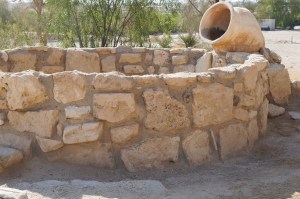
We live in a world of chaos. The waters offered by the world and false religion leaves us dry and thirsty. But the Father knew this from the very beginning. His Spirit brings order and Living Waters to our chaos if only we will drink. In Genesis, these waters are brooded over by the “woman” of the Holy Spirit. Therefore, we would expect a significant amount of prophetic testimonies to occur at wells (especially with women). Consider the most famous Biblical woman at a well, the Samaritan. Speaking to her, Yeshua says:

John 4:10-14  Jesus answered and said to her, “If you knew the gift of God, and who it is who says to you, ‘Give Me a drink,’ you would have asked Him, and He would have given you living water.”  (11)  She *said to Him, “Sir, You have nothing to draw with and the well is deep; where then do You get that living water?  (12)  “You are not greater than our father Jacob, are You, who gave us the well, and drank of it himself and his sons and his cattle?”  (13)  Jesus answered and said to her, “Everyone who drinks of this water will thirst again;  (14)  but whoever drinks of the water that I will give him shall never thirst; but the water that I will give him will become in him a well of water springing up to eternal life.“

The Samaritan woman gets all the press as being the “woman at the well” because Yeshua spoke very plainly to her about not only who she was, but who He is! However, that doesn’t mean that her story is the only story of a woman at a well that we should appreciate. In fact, I don’t believe we can fully grasp the Samaritan’s encounter unless we first understand her predecessors. The first century people that heard the testimony of this woman or even those that had just heard a retelling of these events would have had a very specific paradigm in which they would filter this story. That paradigm was the Torah of Moses.

Yeshua’s encounter with this woman is meant to remind you of other stories of women at wells. Have you ever considered that Isaac, Jacob, and Moses all found their WIVES at a WELL of WATER? We’ve already looked at Miriam’s connection to water and wells. I don’t think this repetitive theme is arbitrary. If you are the Bride of Yeshua, He will meet you at a well also. Perhaps this is why so many have a hard time separating Baptism and Salvation.


© Bakusova | Dreamstime.com

Yeshua tells the Samaritan woman that He can give her “living water”. What makes water “living”? And why and how does this water become a “well that springs up eternal life” once it is ingested? In order for waters to be considered “living”, they must be moving or flowing. Stagnant or still pools do not have “life” in Hebraic thought. Mayim Chayim (living waters) are characterized by MOVEMENT. Does this remind you of the Spirit of Elohim in Genesis?

We looked at the Song of Songs in the Biblical Role of Women Part III. As we discovered in that post, the imagery in this book is of both a complete and restored MAN and WOMAN. Both are functioning in their purpose and living righteously in the Garden (of Eden). Notice in the verse below that there is yet another association of a woman and life giving water. This is one of the godly functions of the female. A holy and restored woman will reflect the Holy Spirit by giving “water” and nurture to the seed that promotes growth and maturity.[5] Speaking of the woman, the man calls her:

A fountain of gardens, a well of living waters, and streams from Lebanon. (SOS 4:15)

Since the Song of Songs portrays a redeemed man and woman, we could say that both men and women as Yeshua’s Bride are a well of Living Waters. This is, in fact, exactly what Yeshua tells the Samaritan woman. We are often so focused on receiving Living Waters, that we forget that we are to be Living Waters! We water YHWH’s people just as the matriarchs gave drink to the patriarchs and watered the livestock. You are a Spring of Salvation and a fountain of Living Waters, because you belong to Messiah. We already have everything we need, but we still have a choice to make. Will we live it out, today? The choice is ours.

“He who believes in Me, as the Scripture said, ‘From his innermost being will flow rivers of living water.'” But this He spoke of the Spirit, whom those who believed in Him were to receive; for the Spirit was not yet given, because Jesus was not yet glorified. (John 7:38-39) 

This truth is why both blood and water gushed from the “side” of Messiah as He hung on the tree. Like the first Adam, Messiah’s Bride comes forth from His side.

But one of the soldiers pierced His side with a spear, and immediately blood and water came out. (John 19:34) 

John later describes three things that testify who Messiah is.

It is the Spirit who testifies, because the Spirit is the truth.  (7)  For there are three that testify:  (8)  the Spirit and the water and the blood; and the three are in agreement. (1Jn 5:6b-8) 

Since Messiah is returning for a Bride of like kind, we also will have these three witnesses: spirit, water, and blood. He meets us at well. We drink from the fountain. Like the Samaritan woman, we drop our water pots and run and witness to as many as we can about Messiah; thus, we become the springs leading others to Salvation. This theme is repeated again and again. We can see it in the Creation Days. We can see it in the Moedim (Feast Days). We can see it in the movement of the 7 Spirits of Elohim (Is. 11:2). The ancient matriarchs teach us how to be His Majesty’s Bride. We first give water to the patriarchs (minister to YHWH), and then we water the livestock (YHWH’s people). This is the essence of the Cup of Miriam.

Applying the Cup

Miriam’s Cup is filled with WATER, not wine. Wine can represent joy, judgment, or even the blood of Messiah. But there are three that testify. Water symbolizes both mayim and the Holy Spirit. By incorporating the Cup of Miriam into our Seder or even our weekly kiddush, we partake of all three symbols. Since the Cup of Elijah comes near the end of the Seder, we include the Cup of Miriam just after the candle lighting. This way, our four cups of wine will be flanked by the prophetess Miriam and the prophet Elijah. Miriam will represent the presence of the Holy Spirit in our lives as we are continually watered and washed by the Word as we journey throughout this life, and Elijah will remind us of our coming complete redemption at the Messianic Age.

Hopefully, Miriam’s Cup will be a spring board for you to do more study. I would love to hear your thoughts on this tradition and any “connections” you may find. What does Miriam mean to you? How will can Miriam contribute to your families’ understanding of the Exodus?

Haggadah Ideas

  • After the women (or a woman) lights the Shabbat Candles, Have everyone partake of the WATER of Miriam’s Cup. Explain all the wonderful imagery in the patriarchs meeting their brides at wells.
  • Correlate this with the Holy Spirit, Baptism, the Springs of Salvation, Yeshua’s pierced side, the 3 that testify, and the Living Waters.
  • Relate all of this imagery with Pesach and Sukkot (The beginning and the end).
  • Praise YHWH for the women at your Seder and their contribution in rebelling at Pharaoh’s evil decrees.
  • Praise Yeshua for choosing you to be a spotless Bride.


[1] Proverbs 9:1-6

[2] Kaplan, Aryeh, Waters of Eden, New York (2003) p. 35

[3] ‘Now why do you delay? Get up and be baptized, and wash away your sins, calling on His name.’ (Acts 22:16)

[4] Remember the bitter waters at Marah? They were to test the people.

[5] Dr. Skip Moen teaches that the “living waters” provided by the woman are also a picture of her role as the ezer kenegdo: http://skipmoen.com/2009/11/28/connections/


Categories: Moedim, Women | Tags: , , , , , , , , , , , , , , , , | 7 Comments

Blog at WordPress.com.