Moedim

Miriam’s Cup Part II

In Miriam’s Cup Part I, we looked at the rather new custom of drinking WATER from a goblet inscribed with Miriam’s name during the Passover Seder. We explored where this tradition originated and why it may be important to incorporate into your own Seder. We also discovered the strong connection of Miriam with water. In this post, we will look at how the Holy Spirit is also linked to the imagery of water, wisdom, Pesach, and women.

The Three Leaders of Israel and the Godhead

“Indeed, I brought you up from the land of Egypt And ransomed you from the house of slavery, And I sent before you Moses, Aaron and Miriam. (Micah 6:4)

The rabbis teach us that there are three good gifts that were extended to the children of Israel– the well, the clouds, and the manna.  The well was provided due to the merit of Miriam, the clouds of glory because of Aaron, and the manna on account of Moses.[1]

The link between the clouds of glory and Aaron is understandable when considering his specific role. Aaron officiated as High Priest in the Mishkan (Tabernacle) that was perpetually covered with the protective pillar of cloud that shielded it by day.  He also ministered daily at the burning altar, just as the parallel pillar of fire hovered over the Mishkan at night.[2] Moses’ association with the heavenly manna is equally fathomable. He was the lawgiver and became synonymous with the Torah or Word of God. Bread (manna) has long been a symbol for the Torah and the Word.
© Jdanne | Dreamstime.com

What might not be immediately apparent is why the rabbis attribute the well or rock that gushed forth water in the wilderness with Miriam. In the Brit Chadashah (N.T.), we learn that the rock that followed them was in fact, Messiah.

For I do not want you to be unaware, brethren, that our fathers were all under the cloud and all passed through the sea; and all were baptized into Moses in the cloud and in the sea; and all ate the same spiritual food; and all drank the same spiritual drink, for they were drinking from a spiritual rock which followed them; and the rock was Christ. (1Cor. 10:1-4)

Is there a contradiction between what Paul teaches in 1 Corinthians and what the rabbi’s say about this “rock” or “well”? I hope to show you the harmony in their teachings with all three leaders (Moses, Aaron, and Miriam) and the glorious gifts (clouds, manna, and the well). In Part I, we started building the foundation as to why Miriam is linked to water. I hope to continue with this premise here. In the Book of Numbers, the water from the rock dries up immediately following Miriam’s death.

Then the sons of Israel, the whole congregation, came to the wilderness of Zin in the first month; and the people stayed at Kadesh. Now Miriam died there and was buried there. And there was no water for the congregation, and they assembled themselves against Moses and Aaron. (Num. 20:1-2)

The Torah seems to beg one to ask the question as to why the congregation had no water immediately following the death of Miriam. In Hebrew, these thoughts run together with a rhythmic flow. Indeed, the people viewed her as a source of life giving waters. Hopefully, you too can make this connection after reading Part I.

Moses, Aaron, and Miriam represented the King of the Universe on the earth. Is it not fitting that there were 3 of them? Isn’t the godhead most often manifested in 3 (Father, Son, Holy Spirit)? Perhaps what may be eating at you is that Elohim would choose a female to represent one of His roles. Moses is clearly the strong father figure to Israel (as Law giver), Aaron is clearly a mediator and priest (like the Son, Yeshua), so Miriam and the life giving waters must represent the Holy Spirit. If you’ve read the Role of Women, this idea isn’t as threatening as it may first appear.

Hebrew students are fully aware that the Spirit of Elohim is always in the feminine form. (This is true of all spirits.) Thus, its not surprising to find God’s Spirit paired with feminine attributes or given to feminine metaphors quite frequently in the Bible. YHWH is neither male nor female, yet He has qualities that we would associate with each sex. This is why it takes BOTH a male and a female to display the image of Elohim in the natural.

The Ruach Hakodesh in Heaven and Earth

To better understand how Miriam, water, and the Holy Spirit can be equivalent expressions, review the first occurrence of Elohim’s Spirit is in Genesis.

The earth was formless and void, and darkness was over the surface of the deep, and the Spirit of God was moving over the surface of the waters. (Gen. 1:2)

What is the Spirit of Elohim doing in the beginning? It is hovering or moving over the WATERS. Thus, our first association of the Ruach Hakodesh is with water. The primordial waters are separated into earthly waters (mayim) and heavenly waters (shamayim). Did you notice how waters and heavens sound alike in Hebrew? Can you see mayim in the shamayim?

Interestingly, the word for heavens, shamayim, denotes “fire waters” as it is a compound of the word water (mayim) and fire (esh).[4] We will explore this idea some more in a moment. But first,  look at the word for Spirit in Hebrew: ruach. Most of you already know that ruach is also the word for wind or breath. What might not be immediately obvious is that the air and wind are the heavenly counterparts to the earthly water currents. Wind powers most ocean and air currents. In Hebraic thought these “currents” of the mayim and shamayim reflect one another. Or you could say that “it is on earth as it is in heaven”.

Consider how the birds and fish move, migrate, school, or flock as they follow these currents across the globe — carrying seed. If you find these connections fascinating, I urge you to study Dr. Hollisa Alewine’s Creation Gospel.[5] You’ll never look at creation week or the whole of scripture again without noticing these often repeated themes. Waters and heavens are mirrors of one another; therefore, the notion that the Holy Spirit is both like wind and water is natural in Hebraic thought.

In the Gen. 1:2 verse above, God’s Spirit is moving, hovering, or brooding over the waters. Indeed, the Spirit of YHWH is active like the wind/birds and the water/fish. The Hebrew verb used is rachaph; the AHLB[6] defines it as the following:

Strongs #7363: AHLB#: 2763 (V) Flutter: The stirrings and shakings of a bird in the nest – Flutter: [freq. 3] (vf: Paal, Piel) |KJV: shake, move, flutter| {str: 7363}

Did you notice the tangible picture of a mother bird fluttering, shaking, and stirring her nest? Does this bring other verses to mind about Elohim being a protective mother bird?

“Like an eagle that stirs up its nest, That hovers over its young, He spread His wings and caught them, He carried them on His pinions. (Dt. 32:11)

Like flying birds so the LORD of hosts will protect Jerusalem. He will protect and deliver it; He will pass over and rescue it. (Is. 31:5)

“Jerusalem, Jerusalem, who kills the prophets and stones those who are sent to her! How often I wanted to gather your children together, the way a hen gathers her chicks under her wings, and you were unwilling. (Mt. 23:37)

These movements are mimicked in the word for Passover, Pesach. It is a derivative of the protective fluttering actions of a mother bird.[7] [8] Indeed, our Great Elohim moves, flutters, leaps, and hovers over His Creation and His people like a mother protecting her precious chicks. This nurturing aspect of YHWH is divinely displayed in the female creatures of His creation. The Exodus story and the original Passover speak to our initial redemption, which is the Father calling us out for Himself. The “immature” state of the people (and us!) at this initial point of salvation necessitates the tenderness that can only be offered by a mother. Thus, we see YHWH’s Spirit pesach(ing) over the homes of His newborn chicks in Israel.

Pesach and Baptism

By carefully examining what happened when the “death angel” came through Egypt, we see that the same Spirit of YHWH that protected the Israelites also killed the first born of Egypt.

‘The blood shall be a sign for you on the houses where you live; and when I see the blood I will pass over you, and no plague will befall you to destroy you when I strike the land of Egypt. (Ex. 12:13)

Now it came about at midnight that the LORD struck all the firstborn in the land of Egypt, from the firstborn of Pharaoh who sat on his throne to the firstborn of the captive who was in the dungeon, and all the firstborn of cattle. (Ex. 12:29)

The Ruach HaKodesh can nurture and protect and at the same time bring destruction on His enemies. The Spirit is truly like the “waters” that we discussed in Part I. The difference is that the Holy Spirit is always acting with righteousness, even in judgment. After the Children of Israel are released from the grip of Pharaoh, they flee to the wilderness. Without a constant and considerable food and water source, the fledgling nation would be sure to die.

What happens is follows:

  • After 3 days without water, they reach Marah. The waters are bitter (undrinkable). Moses casts a branch in the waters and they are “sweetened”. (Ex. 15) This was YHWH testing the people.
  • They then find an oasis at Elim where 12 streams water the 12 tribes. (Ex. 15)
  • The people begin to cry out for food. YHWH provides them with the heavenly manna. (Ex. 16)
  • They reach Rephidim and again cry out for water. YHWH instructs Moses to strike the rock at Mt. Horeb and water gushes out for the people. (Ex. 17)

A person can live far longer without food than water. The beginning of Israel’s wilderness journey seems to center around issues of water. Miracles and judgments happen with water. Rejoicing and praise are performed by the edge of water. Bitter water is sweetened as a test. The twelve tribes each find their own refreshing stream at Elim. A miraculous “rock” becomes a well that can sustain millions. That same rock FOLLOWS them!

Water, water everywhere! Though the children can’t see it in the natural, they are surrounded with life giving water. (Does this remind you of the Rivers of Eden?) Is this not just like the Holy Spirit? We can’t see the “Spirit”, yet it is everywhere. One connection to the Spirit and water that is tangible to most all Believers is Baptism (or immersing in a Mikveh).
© Gijsvdabeele
| Dreamstime.com

Baptism is a natural picture of the work of the Holy Spirit in the very beginning. The movement and separation of the mayim (water) and shamayim (fire waters) is the same moving and separating that happens when we experience this ritual.[9] It may be an outward symbol of an inward work, but to assume the Holy Spirit isn’t directly involved (and often in a very visible way) is not true. The washing and filling is pictured by both the water and the holy fire! Sometimes these are simultaneous experiences, and sometimes they are separate. Nevertheless, they reflect one another like the waters and the heavens and like the pillar of cloud and the pillar of fire. Unlike some, I fully believe this process is in continual motion and cyclical even in our individual lives.

But this still leaves us with our original question. Why are Messiah and Miriam both equated to the rock or well of water in the wilderness? Speaking of Messiah, Paul also has this to say:

  For in him dwelleth all the fulness of the Godhead bodily. (Col. 2:9 KJV)

Elohim is One (Shema Dt. 6:4). When Yeshua walked the earth, He was the tangible form of the fullness of YHWH. Thus, we see Him in numerous places attributing an action to Himself and then declaring that the same action is really from the Holy Spirit or the Father.

Yeshua will not leave us comfortless, He will come to us, yet the comforter is the Holy Spirit.[10] Yeshua gives us Living Waters, but then proclaims that these waters are the Holy Spirit.[11] Just as Moses and even Aaron were prefigures of the Messiah, so is Miriam. The analogies are similar to both Moses and Yeshua being the Law giver. Or both Aaron and Yeshua being the High Priest. Why would it be any different for both Miriam and Yeshua to be the well in the rock?  Therefore, who is right? The rabbis or Paul? The answer is both!

Stay tuned for one last post in this series. My hope is to conclude by filling Miriam’s Cup with the Living Waters and the Mashiach in Part III.


[1] Talmud Bavli (Babylonian Talmud), Tractate Ta’anit 9a:  R. Jose the son of R. Judah says: Three good leaders had arisen for Israel … Moshe, Aaron and Miriam, and for their sake three good things were conferred [upon Israel], namely, the Well, the Pillar of Cloud and the Manna; the Well, for the merit of Miriam; the Pillar of Cloud for the merit of Aaron; the Manna for the merit of Moshe.

[2] Exodus 40:38

[3] See my post The Biblical Role of Women Part V for more on the feminine aspects of the Holy Spirit.

[4] The roots of the word shamayim are אש (esh, fire) and מים (mayim, water) The beginning letter א (aleph) is a silent stand-in for a beginning consonant, nothing more. Dropping it does not change the meaning of the two-letter word. So the Hebrew שמים literally means fire in water. The great Jewish commentator Rashi  says this about Genesis 1:8: The word shamayim is a contraction of [a word for] carrying of water, also [a word meaning] there is water, also esh and mayim, [meaning] fire and water. He blended them with one another and made the heavens from them. For more imagery of fire, see The Biblical Role of Women Part XI.

[5] Thecreationgospel.com

[6] Ancient Hebrew Lexicon of the Bible by Jeff Benner

[7] They share the two letter parent root chet, pey; which means to cover (in protective action).

[8] See my post on the Meaning of Passover.

[9] John answered and said to them all, “As for me, I baptize you with water; but One is coming who is mightier than I, and I am not fit to untie the thong of His sandals; He will baptize you with the Holy Spirit and fire. (Luke 3:16)

[10] John 14

[11] John 7:38-39
Categories: Moedim, Women | Tags: , , , , , , , , , , , , , , , | 7 Comments

Miriam’s Cup Part I


          © Daniel Million | Dreamstime.com

This Passover season, I have given an often overlooked custom a second glance — well more like a long hard stare! Many of you incorporate the mystical and prophetic Cup of Elijah in your Passover Seders. For Believers in Messiah, this cup takes on even more significance because of John the Baptist. He truly paved the Way for Messiah at His first coming. Since we have already seen this “cyclical” prophecy fulfilled once, hopefully we will better be able to discern the spirit of Elijah in these last days.

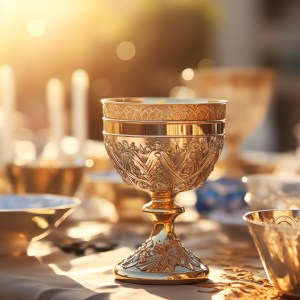
If you’ve purchased a special goblet with Elijah’s name written on it to use at your Passover Seder, you may have noticed another more obscure goblet inscribed with Miriam’s name. What is this cup for? Is it just to satiate liberals and feminists? Does this “new” ritual have any redeeming value? My hope is to show you the richness and beauty that this tradition can bring to your Passover table, and perhaps even to your weekly Kiddush.

The Cup of Miriam is not part of a traditional Seder, and I can find no mention of it in any of the feast books that I own. (But, don’t let that deter you from reading on!) According to Risa Borsykowsky[1] , the practice of drinking WATER from a special kiddush cup called Kos Miriam, began with Stephanie Loo Ritari and her Rosh Chodesh Boston group in the late 1980s. Reading through the Exodus, one can find numerous righteous women that played significant roles that led up to the redemption of Israel from Egypt.[2] Mrs. Ritari decided to bring these “hidden” women into the “retelling” of the Passover story to not only honor the matriarchs, but as a tool to make the Seder more comprehensive for women and girls. The most prominent woman of the Exodus story is Moses’ sister, Miriam. Therefore, she will be our focus in this study.

The Bible calls Miriam a prophetess of Israel.[3] She alone ensured that baby Moses would live by following him as he floated down the treacherous Nile River.[4] She watched as Pharaoh’s daughter drew Moses from the water, and then cunningly secured Moses’ own mother as his wet-nurse. She helped sustain the Israelites during their trek across the wilderness and she led them in joyous song and dance to praise YHWH for the miracle of parting the Red Sea. Upon her death, the Israelites grumbled against Moses and Aaron for a lack of life giving water.[5]

Did you notice the many connections of Miriam with water?[6]

Though her name can mean bitterness or even rebellion, the Hebrew also reveals that there is another (positive) side to Miriam. This should give hope to us all, as we each have both a good and evil inclination that wars for supremacy. To learn the duality of Miriam is to understand the ancient contradiction of what it is to be human. We all share the life long struggle between spirit and flesh.

Moreover, we would be wise to consider that other than one bad instance, Miriam’s portrayal of rebellion and bitterness was toward the anti-torah decrees of Pharaoh.[7] She and her family risked their lives by rebelling against Pharaoh. The midwives Puah and Shifrah acted similarly by defying Pharaoh’s edict to kill Hebrew male babies. It is interesting that it was the fearlessness of WOMEN that initially ignited the courage of all Israel. These brave lionesses stood firm and earned a spot forever in the Torah of our Elohim. Why would we leave their stories out of our maggid (retelling of the Passover story)?  Would our daughters not be strengthened to hear year after year that they too have this great potential residing within them?

Miriam and Water

As I was studying the many links between Miriam, water, wells, fountains, the Holy Spirit, the Word, Yeshua, and Living Waters, I could hardly contain my excitement! Miriam is spelled mem, resh, yod, mem. Water is spelled mem, yod, mem.

Did you notice how similar these words are in Hebrew? Miriam is water with an added resh, which is pictographically a head. Thus, her name is literally head or lead waters. This meaning can also be demonstrated another way in Hebrew by looking at Miriam as a compound of two words: mar and yam. These words mean bitter/strong and sea (waters) respectively. Hence again, Miriam is associated with the idea of strong (head) waters.

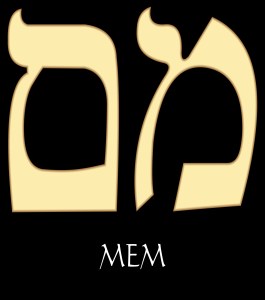
But what do strong waters imply and what are we to learn from this association? In order to get the full impact of Miriam’s role and name, we must first understand WATER from a Hebraic perspective. Mayim (mem, yod, mem) is a word bookended with two mem(s). The Hebrew letter mem is likened to water, a womb (it’s full of water), strength (as in gushing waters), chaos (again like an ocean), and as a preposition “to come forth from or out of”. This letter is one of a handful that has a sofit or final form when it is written at the end of a Hebrew word. A regular mem is open on the bottom, whereas the final form is closed.

    © Shalom3 | Dreamstime.com

Rabbi Michael L. Munk, in his book The Wisdom of the Hebrew Alphabet on the letter mem, states, “The word mayim, water, with its initial and end mem, one open and one closed, depicts the accessible and the inaccessible – an allusion to the waters at Creation.” Thus, mem also illustrates what is revealed and what is concealed. Add to that the letter at the heart of mayim, yod (a hand, work, or deed), and the Creation waters (and all water thereafter) become the same contradiction that we see in Miriam’s name: a work or deed that has the potential for life (strong living waters) or death (bitterness and rebellion).

Water is a place of darkness and yet, great potential in Creation and in a woman’s womb. It can be as powerful and destructive as a roaring ocean and as gentle and satisfying as a trickling stream. It is at the same time both a life giving necessity and a place where chaos and death reign (like at sea). If you read my posts on Crate Trained Believers and The Devouring Lion, you may have noticed the similar imagery. Gentle AND Fierce.

Interestingly, the Hebrew word for mother, em (aleph, mem), also has the pictographic meaning of strong waters.[8] It seems as though the very fact that women have a womb that can fill with life giving waters connects them to Miriam.[9] Females made in the image of Elohim are “mothers” of all living. However, like our sisters Chavah (Eve) and Miriam, we also have the potential to bring chaos and death. (Like a tumultuous ocean.) One must learn to turn life’s bitter unruly waters into sweet waters of refreshing. By the way, this is also something men need to learn as well, for both men and women are revealed in the woman as the wife and bride of the Lamb.

This is the real Biblical portrayal of Miriam, the sister of Moses. She is truly a mother to the Israelites and a leader of her people.[10] Since the force and strength of her name is better understood, does this lend fresh insight about Mary (Miriam), mother of Yeshua? Isn’t it fitting that Yeshua should come forth from a womb such as this? How about the many other “Mary’s” mentioned in the Brit Chadashah (N.T.)? Will their stories speak a little louder the next time you read them?

There has been a tendency for us to forget that the Body needs both masculine and feminine leadership to keep us in balance and to display the whole image of Elohim (God). It is females that bring qualities such as comfort, nurture, protection, and mothering to the Body of Messiah. They are fierce AND gentle. Without these essentials, we raise nothing more than Devouring Lions.

Miriam is a representation of strength, the womb, mercy, prophecy, and praise. The ancient sages recognized the vital role of women in the Exodus in the Babylonian Talmud, Sotah 9b:

“If it wasn’t for the righteousness of women of that generation we would not have been redeemed from Egypt”

The rabbis recognized the very thing examined above: women were the progenitors of Israel’s redemption from Egypt.[11] I hope that you will include Miriam’s Cup in your Seder or even in your weekly Kiddush as a commemoration of her vital role in the Exodus and as a role model to your daughters, sisters, mothers, and wives. But, if this isn’t enough to convince you, there is so much more! In Part II, we will look at how water is associated with the rock in the wilderness, the Holy Spirit, Wisdom, and Pesach.


[2] There is Yocheved, the brave midwives (Puah & Shifrah), Miriam, and Tzipporah. See also footnote 6.

[3] Ex. 15:20

[4] Obviously, the Holy Spirit is what provoked Miriam to do this!

[5] Num. 20:1-2  Then the sons of Israel, the whole congregation, came to the wilderness of Zin in the first month; and the people stayed at Kadesh. Now Miriam died there and was buried there.  (2)  There was no water for the congregation, and they assembled themselves against Moses and Aaron.

[6] D. Hollisa Alewine’s Workbook 5 The Torah Portions Volume 2 –Shemot p.7-21 (2013) offers an interesting perspective on the women of the Exodus and Miriam in particular. If you’re ready to dig deep, buy this series and uncover a multitude of treasures.

[7] Numbers Chapter 12.

[8] See Hebrew Word Pictures by Frank T. Seekins (2003) p. 62

[9] The Hebrew word for womb, racham, ends with the letter mem. This is the same Hebrew word for mercy or compassion. Indeed the watery womb is a place of protection, growth, maturity, and nurture. This word shares the resh and mem with Miriam only adding a chet, which is a fence or boundary that protects.

[10] Micah 6:4  “Indeed, I brought you up from the land of Egypt And ransomed you from the house of slavery, And I sent before you Moses, Aaron and Miriam.

[11] This makes perfect sense considering the “birthing” nature of women.


Categories: Moedim, Women | Tags: , , , , , , , , , , , , , , , | 9 Comments

Under the Covers

Taking Refuge in the Fall Feast Days

            © Alefbet26 | Dreamstime.com

“The LORD is my rock and my fortress and my deliverer, My God, my rock, in whom I take refuge; My shield and the horn of my salvation, my stronghold.” Psalm 18:2

All quotes taken from the NASB unless otherwise noted.

One thing that all people have in common is the desire to feel safe, secure, protected, and sheltered. As a matter of fact, one of our strongest survival instincts is to find or build a shelter. We desire a covering to protect us from the wind, rain, cold, wild beasts, and other elements of nature. Our Creator placed these instincts within each one of us. These desires prolong our lives and ensure the survival of mankind. If the natural world, including our innate instincts, is to teach us spiritual truths[1], then what do these most basic drives teach us about our relationship to God?

When do we desire to be “covered”? Is it not when we are cold, sick, tired, frightened, distressed, or even depressed? Conversely, we may desire to be “covered” when we are praying and worshipping, and when we are nursing a child or being intimate with our spouse. Ironically, all of these instances are related when we look into the Word of God. Certain aspects of our emotional, spiritual, and physical lives require a shield of protection. Whether the “covering” protects us from danger, comforts our ailments, or covers our nakedness, it is a type of shield, hedge, and defense. In other words, it is the protection that we all need and desire. Abraham, our father in faith, was assured that this “shield” he desired would be provided.

After these things the word of the LORD came to Abram in a vision, saying, “Do not fear, Abram, I am a shield to you; Your reward shall be very great. (Gen. 15:1)

The Hebrew word for shield in this verse is magen (mem, gimel, nun) and it does indeed mean a shield of protection. What is fascinating is that it comes from the same root as garden or gan (gimel, nun). The Ancient Hebrew Lexicon of the Bible describes this word pictographically as “a gathering of seeds”. This is easy to relate to a garden, but how does it relate to a shield and other cognates like protection and a basin? A garden, such as the Garden of Eden, is a protected place; it is surrounded on all sides. Likewise, a basin has a ledge or hedge about it. These concrete images give us a vivid picture of what it means for Adonai to “shield” or protect us.

You see, it is not that there is no danger, predators, or enemies; rather, it is that there is a covering of protection that surrounds us. This shield is clearly depicted when HaSatan observes the life of Job.

Then Satan answered the LORD, “Does Job fear God for nothing? “Have You not made a hedge about him and his house and all that he has, on every side? You have blessed the work of his hands, and his possessions have increased in the land. (Job 1:9-10)

The Hebrew word for hedge in this verse is suk, the root for sukkah (booth, shelter, covering). Our gracious Father had placed a “spiritual” sukkah around Job and all that was his. Since we are in the Season of our Joy, the Feast of Tabernacles or Sukkot, I find that it is most appropriate that we understand how the moedim (particularly the fall feasts) portray this heavenly covering that Adonai provides for us.

Tight Places

Before we explore the heavenly hedge of Adonai, it is imperative that we understand what is outside the protected place. Nowhere in the Bible are we promised a life without trials, tribulations, and hardships. While some naïvely teach the contrary, the truth is that without the proverbial “thorn in our side” we would never learn to rely on God’s grace and mercy. Sadly, our trust would be nothing more than self-reliance which would result in an empty, anxious, and lifeless walk.

The Hebrew word tsar is usually translated as enemy(-ies), adversaries, trouble, distress, affliction, and tribulation. But what it really implies is a “tight place.” It is literally something that presses or weighs upon you. In fact, it is the root word for Mitzrayim (Egypt). Egypt was certainly a place where the Israelites had heavy burdens laid upon them. Adonai redeemed them from this bondage with a mighty hand and brought them into the wilderness with a promise: a land flowing with milk and honey.

This is what happens to us when the LORD redeems us from the bondage of sin and death. We, like our ancient Israelite counterparts, have the promise of the “Land” that flows with milk and honey. What we tend to skip over in our theology and in our thinking is the wilderness. Once we are “saved”, we assume all is well — heaven awaits our arrival. But this isn’t the end of the story; it is the beginning! We must first endure the wild and dangerous wilderness. It is harsh, hot, and dry. It is treacherous. It is uncultivated and infertile. It will require us to relinquish everything over to a holy God just to survive. And the testimony of our ancient brethren proves that not everyone endures the trials of the desert.

The seemingly broadness of the wilderness becomes a tight place of pressing. But this “pressing” isn’t like the bondage of Egypt, sin, or death (though sometimes it may feel that way). Instead, we find ourselves being squeezed and molded by the Potter’s Hands into the image of the Son. While we may have left Egypt, we discover that Egypt is still in us. And so we have similar adages even in English to express this all too painful truth: “You can take the girl out of the country, but you can’t take the country out of the girl”. But our Great Elohim sets out to do what we consider impossible. He not only removes us physically from the bondage of Egypt, He also removes Egypt from within us.

If we pay close attention, it becomes evident that while it is amazingly miraculous how He redeems a whole nation from the bondage of slavery, it is even more amazing how He removes Egypt from us! This is the lesson of the wilderness. And this is the reason we celebrate Sukkot, the last pilgrimage festival on YHWH’s holy calendar.

‘You shall thus celebrate it as a feast to the LORD for seven days in the year. It shall be a perpetual statute throughout your generations; you shall celebrate it in the seventh month. ‘You shall live in booths for seven days; all the native-born in Israel shall live in booths, so that your generations may know that I had the sons of Israel live in booths when I brought them out from the land of Egypt. I am the LORD your God.'” (Lev. 23:41-43)

By yearly walking out Adonai’s cycle of divine appointment times (feast days), we are reminded not only of our past and present, but of our future hope. These guideposts encourage and strengthen us; thus, providing the coverings and shelters that protect us from the scorching heat of the desert. They press us to be sure, but they also shield us as we are molded into the image of Yeshua.

Those of you that have committed to follow our Holy Elohim and walk in His “ancient paths” have most likely discovered that while there is great joy and fulfillment in meeting the Creator at His appointed times, there is also great testing, pressing, and often distress. It is hard! Our immaturity may cause us to assume that perhaps the difficulty is a sign that we are on the “wrong” path. But Yeshua reminds us that the true path is “narrow”; it is a tight place! We must expect to be pressed. We learn that the easy way is in reality the “broad” path.

“Enter through the narrow gate; for the gate is wide and the way is broad that leads to destruction, and there are many who enter through it. “For the gate is small and the way is narrow that leads to life, and there are few who find it. (Mat. 7:13-14)

I am always baffled by the multitudes that teach the opposite of what Yeshua and Scripture clearly reveals. Therefore, if you find yourself being pressed in on all sides when Adonai’s appointments come around, rejoice! You are indeed on the narrow and tight path! Consider that the Father is pruning and shaping you into the image of Yeshua and at the same time He is expelling the Egypt that remains in your members. This brings new meaning to the phrase, “It hurts so good!”

The Hedge

Our tight places cause us to cry out to the Most High and He becomes the Strong Tower of Refuge that satisfies our distressed souls.

To the chief Musician on Neginoth, A Psalm of David. Hear me when I call, O God of my righteousness: thou hast enlarged me when I was in distress (tzar); have mercy upon me, and hear my prayer. (Ps. 4:1 KJV)

The above verse depicts David crying out to God when he finds himself in a tzar (a tight place of pressing). Many translations simply say God brings “relief” to his distress, but the King James Version actually captures the Hebrew much better. Notice it says that God enlarges or broadens David. This is exactly what Adonai does for you and me. Just when we think we can take no more, He broadens us just enough that we sigh with relief. The Refiner’s Fire is hot, but it is fueled by the cool spiritual heat of heaven. Unlike the pressing of sin and death, the hot coals of heaven’s altar only burns our impurities. There is a promise of Life, not death.

The hedges found in the fall moedim (feast days) teach us all about the cool heat of the shamayim (heavens in Hebrew, but literally “fire-waters”). These fires burn wickedness and flesh in righteous judgment. When we are covered by the blood of the Lamb, we can withstand these fiery trials.

Now if any man builds on the foundation with gold, silver, precious stones, wood, hay, straw, each man’s work will become evident; for the day will show it because it is to be revealed with fire, and the fire itself will test the quality of each man’s work. If any man’s work which he has built on it remains, he will receive a reward. If any man’s work is burned up, he will suffer loss; but he himself will be saved, yet so as through fire. Do you not know that you are a temple of God and that the Spirit of God dwells in you? (1Cor. 3:12-16)

Thus, we must learn to rejoice when we find ourselves in the heavenly fire. If you have heard the great blast from the heavenly shofar and eternity burns in your heart, you are already aware that the Feast of Trumpets (Yom Teruah) has awakened you to the approaching bridegroom. But, in order to have enough oil, you will be pressed and crushed like the olives that fuel our lamps. Therefore, rejoice Bat Tzion (Daughter of Zion)!

Though it may seem odd that part of our covering is in fact heavenly fire, and that it sometimes hurts, we know that it cleanses us so we may eventually enter the bridal chamber. This brings us to the most solemn and holy day on Adonai’s calendar, the Day of Atonements. This is judgment day. If you are burning in a holy fire right now, rejoice, for your judgment day will also be your wedding day. Like the High Priest, you are covered and clothed in the red blood of the slain Lamb that appears as pure white light. Anointed with precious oil, enveloped with rich, sweet clouds of incense, eyes illuminated with only the holy seven tongues of fire of the golden menorah of the LORD’s Spirit, the bride is brought under the heavenly chuppah[2] and is forever bound in matrimony to her King. This hope is why we endure. And there is more to this promise; Sukkot awaits us.

The Sukkah

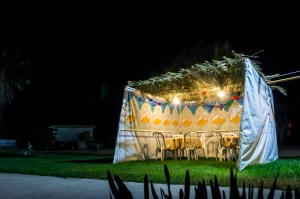
The fragile and flimsy appearance of the sukkah is the epitome of weakness to the natural man. See through walls and a leaky roof do not scream comfort or security — the thing we most long for. But, this is the structure that God beckons us to enter. Outside there are real threats, real enemies, and real elements. When we look at the sukkah, we cannot possibly see how this rickety thing is going to protect us from so many dangers. Surely the more permanent house we’ve built with our own hands offers more protection.

“Not everyone who says to Me, ‘Lord, Lord,’ will enter the kingdom of heaven, but he who does the will of My Father who is in heaven will enter. “Many will say to Me on that day, ‘Lord, Lord, did we not prophesy in Your name, and in Your name cast out demons, and in Your name perform many miracles?’ “And then I will declare to them, ‘I never knew you; DEPART FROM ME, YOU WHO PRACTICE LAWLESSNESS.’ “Therefore everyone who hears these words of Mine and acts on them, may be compared to a wise man who built his house on the rock. “And the rain fell, and the floods came, and the winds blew and slammed against that house; and yet it did not fall, for it had been founded on the rock. “Everyone who hears these words of Mine and does not act on them, will be like a foolish man who built his house on the sand. “The rain fell, and the floods came, and the winds blew and slammed against that house; and it fell–and great was its fall.” (Mat. 7:21-27)

Only the House that Adonai builds is founded upon the Rock. All other structures are built on sand. When testing, trials, and storms arise (and they always do), only Adonai’s sukkah will remain standing. Thus, we are faced with a seeming paradox. What appears strong to us is in fact weak, and what appears weak is strong!

We must be willing to leave the “appearance” of security and embark on a treacherous journey through the wild with our bridegroom. He is mysterious and magnificent. He isn’t safe or tame. The real question is, “Do you trust Him anyway?” His promise isn’t a life sheltered from life itself. No, the promise is abundant life. An abundant life is abundantly full. But full of what?

It’s not full of worldly riches and things that will pass away. It’s full of experiences, challenges, and well… life. The Hebrew letter nun means life and its pictograph is a fish in movement. The journey is wild and rushing like a river. It tosses you here and there. Up and down. Side to side. Are you afraid? Don’t be. Adonai’s love is relentless and constantly moving. It is exciting, but it is not comfortable. Comfort is complacent and lifeless.

Our natural man and instincts hates this “uncontrolled” God that we serve. It is foolishness to them. Yet, this reckless abandon is exactly what YHWH desires from us. He calls us into the wilderness, the great unknown wild. It is there He speaks tenderly to us — in the midst of our vulnerability.

“Go and proclaim in the ears of Jerusalem, saying, ‘Thus says the LORD, “I remember concerning you the devotion of your youth, The love of your betrothals, Your following after Me in the wilderness, Through a land not sown. (Jer. 2:2)

This is our covering at Sukkot. Following Adonai in the wilderness, through a land not sown. If we love Him, we will follow. Though we are vulnerable to the wildness, our little movable shelter sustains us with the promise that One day, we will have a permanent home with our Beloved.

Is this not what real faith (trust) is all about? Are we not called to be strong and courageous in the face of life’s many uncertainties? Do you trust Him…anyway? In light of all this, the sukkah becomes a beacon, a landmark for what faith actually is! When you sit in your sukkah this year, look at its flimsy walls, partially thatched roof, and open door. It may look like it offers little protection and is anything but secure, yet we know the LORD’s sukkah is the perfect shelter for the wild world He created. Experience it with Him. The promise isn’t a life without danger; the promise is that He will walk through it with you. Follow wherever He goes, for there is a special prize for those that serve and follow Him with reckless abandonment.

And I heard a voice from heaven, like the sound of many waters and like the sound of loud thunder, and the voice which I heard was like the sound of harpists playing on their harps. And they *sang a new song before the throne and before the four living creatures and the elders; and no one could learn the song except the one hundred and forty-four thousand who had been purchased from the earth. These are the ones who have not been defiled with women, for they have kept themselves chaste. These are the ones who follow the Lamb wherever He goes. These have been purchased from among men as first fruits to God and to the Lamb. (Rev. 14:2-4)

Oh dear one, don’t you want to learn this song and serenade the King of Kings? It will cost you everything, but you will be given all. The sukkah will be replaced with the New Jerusalem. Enjoy it while you can. Experience the wild and untamed King that we serve. Do hard things. Be stubborn in only one thing: in your reckless abandon to the Most High. Run into the flapping tents walls and snuggle up under the canopy of the stars and palm branches. Smell the sweet incense and look for the golden glow of the menorah. It’s all here—right now. Just open your eyes and ears. When the bottom drops out from under you, know that you are simply moving onto a new and exciting adventure with Adonai. Our duty is to remain steadfast, period. We don’t have to understand all the “whys” of life; we must simply trust Him like a child.

There is good news. Jerusalem of Gold awaits the pitter-pat of your precious little feet! Every tear will be wiped away! Then those things that are hidden will be revealed; we will realize that the LORD had every second, every circumstance, and every nuance under His direction and control. And we will know that all along we were indeed covered in perfect security with His heavenly pinions.

Fear not son or daughter of Abraham, for I, Adonai, am a shield and a covering sukkah to you. Your reward for walking through the tight places and trusting me even when your circumstances appeared bleak will be great. For you will see my sukkah with new spiritual eyes and know that no other earthly structure could have ever sustained you. — my paraphrase of Gen. 15:1


[1] 1 Cor. 15:46

[2] The wedding canopy or covering. The chuppah is meant to symbolize the sukkah: http://www.jweekly.com/article/full/30529/think-of-sukkot-as-a-joyous-wedding-under-the-chuppah/

Categories: Moedim | Tags: , , , , , , , , , , , , , , , | 1 Comment

Hoshiana!

Save us!

Spiritual Imagery of the Lulav & Etrog

© Dreamstimelirika
| Dreamstime.com


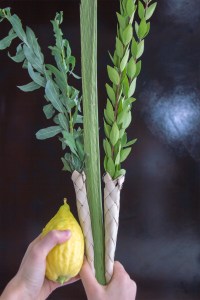
In Jewish tradition, the 7th day of Sukkot is called the “Great Hoshana (Hosanna)” or Hoshana Rabbah. There is a special Hoshana service on this day with song and chanted prayers. In the hands of each worshiper are the branches from “goodly” trees as Leviticus 23 commands. These branches are waved and shook as worshipers move in a procession shouting, “Hoshi a na!” This heartfelt cry is translated as “Save us now!”

The arba minim (branches/4 species/ lulav and etrog) are directly associated with this cry and the service prayers. We can see this type of exclamation by the Psalmist in Psalm 118: 25-26:

(Hoshi’ana) Save
now, I pray, O LORD;
O LORD, I pray, send now prosperity.
Blessed is he who comes in the name of the
LORD!
We have blessed you from the house of the LORD.

If we look carefully, we can see the relationship of the people waving palm branches[1] and crying “hosanna” when Yeshua rode into Jerusalem for Pesach (Passover). Although this custom was reserved for the season of Sukkot (Tabernacles), the people nonetheless were compelled to honor Yeshua in this manner.

The untrained eye may see the people’s reaction as disconnected; but, the real beauty of their demonstration is made clear in the simple recording of what Sukkot commemorates.[2] The fall moedim (feasts) look forward to the coronation of our Lord and King. Sukkot particularly portrays the culmination of our faith as it also looks back to the beginning of our redemption with the Pesach sacrifice. Yeshua IS the Lamb that was slain on our behalf and one day we will see Him crowned as our King! The following is the customary imagery attributed to the  arba minim. Examine each “species” carefully.


SPECIES TYPE IMAGERY
Etrog sweet taste & smell, (Citron- a citrus fruit that looks like a lemon) People who read Torah (the Word) and do good.
Lulav Sweet taste no smell (Date palm branches/ leaves) People who read Torah (the Word) but don’t do good.
Hadas no taste sweet smell (Myrtle branches/leaves) People who don’t read Torah (the Word) but do good.
ARaVah no taste or smell (Willow branches/leaves) People who don’t read Torah (the Word) or do good.

This seems to mirror the Parable of the Sower[3] and the four different types of soil or people. The Seed is the Word of God. The Sower is the Messiah. Therefore, the Sower and that which is sown are the same thing. Carefully examine the types of soil mentioned in this parable and compare them to the 4 species above.

Seed Type Imagery
1. Seeds fell by the roadside and birds ate the seed. Person doesn’t perceive the Word and the enemy steals anything that may have been sown in their heart. Aravah
2. Seeds fell on rocky places and they sprang up, but died due to lack of roots. Person receives Word with joy, but having no root (Yeshua, i.e.Life), affliction or persecution causes them to fall away. Hadas
3. Seeds fell among the thorns and the thorns choked the new seedlings. Person hears the Word, but the worries of the world or the deceitfulness of wealth chokes the Word, and it produces no fruit (no good deeds). Lulav
4. Seeds fell on good soil and produced 100, 60, and 30-fold. Person hears the Word, understands it and brings forth fruit (good deeds). Etrog

Clearly, the imagery of the Etrog (the fruit) and its Seed that fell on good soil are the “people” that we desire to be. We want to release a pleasing aroma, taste sweet in the mouth, and yield many more seeds that will produce the same fruit. That fruit and its beginning, the Seed, is Yeshua. When we are obedient to the Word, we are a living testimony of His goodness. If we’ve truly received the Seed, then we will naturally begin to produce the fruit!

2012-10-08 18.33.07

©Kisha Gallagher

Joshua Aaron has a beautiful song called Hoshiana:


[1] Mt. 21, Mark 11, Jn. 12. Read in context, this was clearly the time of Pesach (Passover).

[2] Lev. 23:39-44

[3] Mt. 13, Mark 4, Lk. 8

Categories: Moedim | Tags: , , , , , , , , | 4 Comments

Blog at WordPress.com.