“Grief is the one pain that heals all others. It is the most important pain there is.”[1] —Dr. Henry Cloud and Dr. John Townsend
Av is a month of both grief and comfort. It begins in the narrow place of the Three Weeks and carries us through Tisha B’Av, the great day of communal mourning over the destruction of the Temples and other tragedies in Jewish history. The Three Weeks begin on the 17th of Tammuz and culminate on the 9th of Av, a period often called Bein HaMetzarim, “between the straits” or “between the narrow places.”
We are not left with only grief in Av. It is also called Menachem Av, meaning “Comforting Father” or “Father of Comfort.” This gives the whole month a redemptive arc: we do not enter grief to stay there. We enter grief truthfully so comfort can be real and not merely cosmetic.
We all experience grief. Webster’s 1828 dictionary defines grief as the pain of mind produced by loss, misfortune, injury or evils of any kind. This pain can also come through sorrow, regret, and repentance when we recognize that our own choices have caused harm.
The phrase that Webster used, pain of mind, is salient because grief is not just an emotion. It encompasses a spectrum of emotions, thoughts, and processes that involve the mind, heart, and body.
We obviously experience grief when a loved one dies, but sometimes the loss is a relationship, a job, a business, a dream, or even the life we imagined we would have. We might lose our nervous system’s sense of safety due to a health crisis or immense stress. Sometimes we lose our ability to hear God, hear others, or hear ourselves clearly.
Av is not only a month of sorrow; it is a month of healing sorrow. It teaches us not to rush past grief, but also not to build a permanent identity around destruction. We remember. We lament. We tell the truth. We listen. And in that honest place, comfort can begin to meet us, and repair can begin in truth.
The Pain That Heals
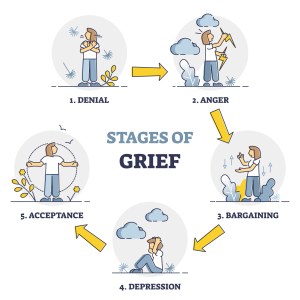
There are five commonly named stages of grief:
- Denial: “This can’t be happening to me.”
- Anger: “Why is this happening? Who is to blame?”
- Bargaining: “Make this not happen, and in return I will ____.”
- Depression: “I’m too sad to do anything.”
- Acceptance: “I’m at peace with what happened.”
ID 217077374 © VectorMine | Dreamstime.com
Cloud and Townsend write, “Grief is the one pain that heals all others.” When I first read that statement, it stopped me in my tracks. The obvious question was: Why? Why would grief—the pain most of us avoid, resist, minimize, or rush through—be the very pain that heals all others?
Their answer is both simple and profound. Grief is not merely an emotion. It is a progression that requires time. It is never a “one and done” as much as we would prefer that. God designed our souls and our brain, and He knows what is needed for us to come to terms with a reality we don’t like or want.
So, though painful, grief is the process that enables the mind, body, and soul to heal. Neuroscience helps us understand why: grief is a form of learning. The brain must slowly update its inner map of reality when someone or something we counted on is no longer available in the same way. The brain is predictive; it uses past experience to anticipate what should happen next.
When our new reality violates that prediction, the nervous system often reacts with alarm, confusion, denial, anger, or attempts to regain control. This is the mind and heart saying, “I do not want this to be true.” Protest and bargaining are not signs of immaturity by themselves. They are part of the system trying to resolve the mismatch between the old map and the new reality. Until that inner map changes, the mind will keep searching, bracing, protesting, or reaching for what has been lost.
The body is also involved. Bereavement research shows that grief can affect stress physiology, inflammation, immune regulation, sleep, cardiovascular function, mood, and behavior. The body can remain organized around threat, longing, vigilance, or protest until the loss is processed and integrated. Thus, unprocessed grief can keep the body in a state of physical stress, while honest mourning gives the nervous system a path toward release, regulation, and rest.
Something has been lost. Something has died. It may be a person, but it may also be a dream, a season, a relationship, a plan, a role, a hope, or an image of who we thought we would become.
At first, we protest. We do not want the loss to be true. We may deny it, numb ourselves, become angry, or bargain with reality. We may keep trying to make someone love us, understand us, choose us, approve of us, or become who we needed them to be. We may try to resurrect a dream, a season, or a relationship that has already ended.
Eventually, if we allow grief to do its work, we come to the painful surrender: this really is true. This is not what I wanted, but it is reality. The wish and the truth stand in the same room. This is the moment we often avoid, but it is also the doorway to healing.
Then comes grief proper. We cry. We tell the truth. We let go. We say goodbye to what cannot be. We stop demanding that the dead thing act alive. We allow the soul to finish what it was designed to finish.
Av does not invite us to despair. It invites us into the kind of sorrow that heals. It teaches us to stop bargaining with ruins and begin receiving comfort in truth.
Shimon: Hearing the Grief
Shimon, or Simeon, is the tribe traditionally associated with the fifth Hebrew month. His name comes from the language of hearing. When Leah named him, she said, “‘Because the LORD has heard that I am unloved, He has therefore given me this son also.’ So she named him Simeon” (Genesis 29:33). That gives Av a profound connection to hearing, especially listening from a place of pain.
I cannot help but wonder what grief Leah carried as the “unloved one.” Scripture tells us her eyes were weak, and whether that detail was physical, symbolic, or both, the text makes her pain clear: Jacob preferred Rachel. How painful it would be to accept that your life, your reality, was to always be second in the eyes of your husband. Most of us would do exactly what she did to try to get our need for love met. We would try to earn, buy, and negotiate our way into the heart of the one with whom we are in covenant.
Maybe you are doing that now (with Adonai) because you believe you are the unloved one despite the truth that He is no respecter of persons. Grief heals the mind and heart of falsehood if we enter the gates of sorrow in earnest. Unprocessed grief keeps us in a dangerous mind loop of emotional, spiritual, and physical pain.
Simeon, the one named after hearing and listening to pain teaches us what happens when we ignore that crucial voice. In Genesis 34, Simeon and Levi respond to Dinah’s violation with violent retaliation. Their pain is real. The injustice is real. But their response was not merely reactive rage. It was planned, strategic, deceptive, and vengeful, resulting in the massacre of the men of Shechem.
Jacob later rebukes Simeon and Levi in Genesis 49:5–7, calling them vessels or instruments of chamas, cruel violence. He declares that his soul, his nephesh, should not enter their secret council and that his glory should not be joined to their assembly, because in fierce anger they slew men and in lustful passion they hamstrung oxen.
That phrase, “hamstrung oxen,” is striking. To hamstring an animal is to cut the large tendons behind the leg, making it lame and unable to walk properly. It is an act that does not merely kill; it disables, wounds, and renders something powerless.
This is how Jacob described Simeon and Levi’s deception of Shechem. They used circumcision, the sign of the Abrahamic covenant, to weaken the men so they could kill them. Something meant for life and covenant became chamas, violence, and death.
So many things go wrong in this story. Dinah’s pain should have been heard. The injustice should have been acknowledged and addressed. But instead, unprocessed pain became a destructive force.
Sometimes it is uncomfortable to enter someone else’s story and sit with their pain, especially when we have categorized the other person as outside our group. There is “us,” and there is “them.” Jacob’s silence could be interpreted as passivity, but it could also have been wisdom.
“The fence around wisdom is silence.” (Pirkei Avot 3:13)
This does not mean injustice is ignored. It means pain does not always need immediate answers; sometimes it needs presence, compassion, and sensitivity. It means understanding that we do not understand. This is active silence. It is not hasty or brash. It does not rush to fix, explain, defend, or retaliate.
Av asks us to listen to grief instead of suppressing it. To listen, we must silence our base reactions. The tribe of Shimon reminds us that healing begins when pain is heard. But Simeon’s story also warns us that pain left unheard can become reactive, violent, deceptive, or destructive. Grief must be listened to, but it must also be brought before the Father so it does not become vengeance in disguise.
The Lion of Av
This same pattern is reflected in the mazel of Av: Aryeh, the lion. In an immature state, the lion roars to dominate, intimidate, devour, or defend territory. But in a refined state, the lion represents courage, dignity, protection, and strength under righteous authority.
Yeshua is called the Lion of the tribe of Judah in Revelation 5:5, but what is striking is that when John looks, he sees a Lamb standing as slain. Lion strength is revealed through Lamb surrender. True power or strength is power under authority. It is holy restraint. It is power that is also humble.
In Av, we ask God to help us hear our grief before it becomes a roar that harms others or ourselves. Grief, when brought into the presence of God, can become wisdom, compassion, courage, and repair.
Giving Grief a Rhythm
Jewish tradition wisely gives grief a proper rhythm. Mourning is not treated as something we rush through, hide, or handle alone. It is given time, structure, witnesses, and repeated moments of remembrance.

ID 2404973
© Ashley Whitworth
| Dreamstime.com
There is the first intensity of grief, often pictured in the seven days of shiva, when the mourner sits with the loss and the community comes near. There is the longer adjustment of sheloshim, the thirty-day period in which life begins to resume, but not as though nothing has happened. And there is the longer cycle of remembrance, where grief is carried through seasons, holy days, anniversaries, and ordinary moments when the absence is felt again.
These rhythms are most clearly practiced after the death of a loved one, but they also teach us something about figurative losses. Dreams die. Expectations die. Seasons end. Relationships change form. A role that once gave us identity may no longer fit. A version of the future we imagined may have to be released. Even an illusion can die when truth finally breaks through the ether.
When these losses happen, we may not need the formal practices of mourning, but we often still need the wisdom beneath them. We need time to sit with what has changed. We need safe people who can witness the loss without rushing us to feel better. We need space to name what mattered, what hurt, what disappointed us, and what will never be the way we hoped.
Av becomes a sacred invitation to stop rushing the soul.
A Funeral Before a Burial
When something has died, even if it is the death of a dream, an expectation, a season, a relationship, or an illusion, do not bury it too quickly. First, hold a funeral.
The “funeral” is where we sit with what was lost. We feel it. We name it. We tell the truth. We let others witness it. We remember the goodness, the hope, the disappointment, and the cost. We allow the heart to catch up with the new reality. Then, when the grief has been honored, we can move toward burial.

ID 9349076
© Michael Beckerman
| Dreamstime.com
The “burial” is the act of release. It is where we stop pretending the dead thing is still alive. We stop dragging it into the next season. We stop demanding that it rise from the dead. We bless what can be blessed, grieve what must be grieved, and surrender it to God.
This is not giving up in despair. It is agreeing with truth so that life can grow again. We do not bury what has died because it did not matter. We bury it because it did.
Do Not Rush the Comfort
One of the ways we rush grief is through spiritual bypassing. Spiritual bypassing happens when we use spiritual language, practices, or explanations to avoid pain instead of honestly entering it. It can sound holy on the surface, but it often dismisses what the soul is trying to tell the truth about.
This can happen when someone is grieving and we quickly say, “They are in a better place,” or “God has a plan,” before we have truly sat with the ache of the loss. It can happen when someone is angry over a real violation and we tell them to “stop being negative,” “rise above it,” or “just forgive,” before justice, truth, and lament have been allowed to speak. The problem is not faith. The problem is using faith to escape honesty.
Biblical hope does not require denial. Trusting the Father does not mean pretending something did not hurt, that a loss did not matter, or that an injustice should not be named. In Scripture, lament gives sorrow a voice before God. The Psalms do not sanitize grief, nor do the prophets rush past ruin. Even Yeshua wept at the tomb of Lazarus, though He knew resurrection was coming.
Spiritual bypassing also happens when we silence someone who is wrestling with faith, doubt, disappointment, or confusion. A person may still love God and yet struggle to understand where He was in their suffering. They may still trust Him and yet need to cry, “How long?” To shame that struggle is not spiritual maturity. It is fear dressed in religious language.
It can also happen when someone’s misfortune is quickly attributed to sin. Scripture does teach that choices have consequences, and suffering can invite honest self-examination. But not every wound or sickness is the direct result of personal sin. Job’s friends thought they were defending God’s justice when they explained his suffering as evidence of hidden wrongdoing. Yet in the end, God rebuked them because they had not spoken rightly of Him. Their explanations may have sounded theologically lofty, but they lacked wisdom, humility, and compassion.
This matters because comfort that comes too quickly can feel like erasure. When someone offers an answer before they have offered presence, the grieving person may feel that their pain is too much, too inconvenient, too faithless, or too uncomfortable to be heard. What was meant to comfort can actually create loneliness. The person may learn to hide their grief, not because it has healed, but because it has no safe place to go.
Prayer, Scripture, worship, and meditation can steady the soul, renew the mind, and lift our eyes. But even holy practices can be misused when they become a shield against honesty. The question is not only, “Is this spiritual?” but, “Is this helping me tell the truth before God, or is it helping me avoid what hurts?”
This also applies when we are the ones listening. Sometimes we reach for spiritual answers because another person’s pain makes us uncomfortable. We want to fix it, explain it, correct it, or move them toward hope before we have really entered the weight of what they are carrying. But grief often needs witness before it can receive wisdom. It needs someone willing to sit in the ashes without immediately trying to bring beauty.
Av teaches us that true comfort does not bypass grief. It comes after grief has been given room to speak. “Comfort, comfort My people” is not spoken as a denial of devastation, but after the ruins have been faced. The comfort of the Father is not a platitude. It is not a spiritual Band-Aid. It is the holy nearness that meets us in truth and slowly teaches the wounded heart how to hope again.
The House of Mourning
Now we have context for the words of Kohelet, the Preacher:
“Grief is better than laughter, for though the face is sad, the heart may be glad. The heart of the wise is in a house of mourning, but the heart of fools is in a house of pleasure.” —Ecclesiastes 7:3–4
This does not mean sorrow is pleasant, and it does not mean every painful thing is good. It means honest mourning can do something in the heart that avoidance cannot. The house of mourning teaches wisdom because it brings us into contact with reality, humility, love, limits, and eternity.
The house of pleasure is not wrong in its proper season. Laughter, joy, feasting, and celebration are gifts from God. But pleasure can become a hiding place when we use it to avoid grief. When we run too quickly to distraction, entertainment, busyness, or even premature celebration, the soul may never have the funeral it needs.
Av calls us into the house of mourning long enough for the heart to become wise. This process is preserved through tradition on the Jewish calendar. Every year at this time, the destruction of the first and second Temples and the great sins of the nation (golden calf and sin of the ten spies) are remembered and mourned. How does this (and the succeeding seven weeks of comfort) prepare one’s soul for Rosh Hashanah, Yom Kipper, and Sukkot?
Seven Weeks of Comfort
For much of the year, the haftarah is connected in some way to the weekly Torah portion. But after Tisha B’Av, the prophetic readings begin a different movement: seven weeks of consolation leading up to Rosh Hashanah.

ID 463094459
© Arun David
| Dreamstime.com
This season is known as the Shiva d’Nechemta, the seven haftarot of comfort. Beginning with Shabbat Nachamu, the Sabbath after Tisha B’Av, we hear the words of Isaiah: “Comfort, comfort My people.” From there, week by week, the prophetic readings carry the community from devastation toward consolation, restoration, and renewed hope.
This matters for Av because it shows us that comfort is not instant. The calendar does not move from destruction to celebration in one leap. It gives us seven weeks of comfort. After the narrow places, after the mourning, after the ruins have been faced, the soul is led gently toward the new year, a new beginning, and the season of joy.
The Av Grief Path
If you are walking through grief this month, or if an old loss is still speaking through your body, reactions, relationships, or speech, consider this path:
- Reality/Truth: What has been lost?
- Protest: How have I resisted or denied this reality?
- Bargaining: What have I been doing to make this not true?
- Surrender: What truth am I being invited to accept?
- Sadness: What needs to be felt, named, and witnessed?
- Goodbye: What must I release instead of carrying it as though it is still alive?
- Comfort: What do I need from the Father of Comfort?
- New Life: What space might grief eventually open?
This path is not always linear. Grief often circles back through protest, sadness, surrender, and comfort many times as the mind, body, and soul slowly learn how to live in the new reality. That is why there is great wisdom in the Jewish tradition of mourning for seven days, thirty days, and even a year. These rhythms do not rush the mourner. They give grief time to move from shock, to acknowledgment, to integration, allowing the loss to be carried through the ordinary and sacred cycles of life.
If you or someone you love is in the house of mourning, remember these steps and sit with them in their pain, even if it is in silence. Allow your or their mind and heart the time it needs to learn how to walk through life without the person or thing they lost. Comfort them with your presence. That’s the closest thing to Yeshua sitting with them.
“Blessed are those who mourn, for they shall be comforted.” (Mat 5:4, NAS95)
Receiving the Comfort of Av
Av teaches us that grief is not the absence of faith. It is the sacred pain that allows the soul to finish what has ended. We need this individually, of course, but we also need this as a people.
This is the mercy hidden inside the mourning of Av. Grief does not heal because loss is good. Grief heals because it allows the soul to stop fighting what is true and begin releasing what it was never meant to carry. It goes beneath anger, anxiety, control, shame, bitterness, and numbness, and gently leads the heart back to the original wound where the Comforting Father can meet us in truth.
And then, in His care, the soil of our hearts becomes fertile again.
Sacred Pain Reflection Questions
[1] How People Grow: What the Bible Reveals About Personal Growth (p. 206)






 Recently, I joined Caleb Gee of