Earth and Water
“But a mist came up from the land and watered the whole surface of the ground. Then Adonai Elohim formed the man out of the dust from the ground and He breathed into his nostrils a breath of life—so the man became a living being.” (Gen 2:6-7, TLV)[1]
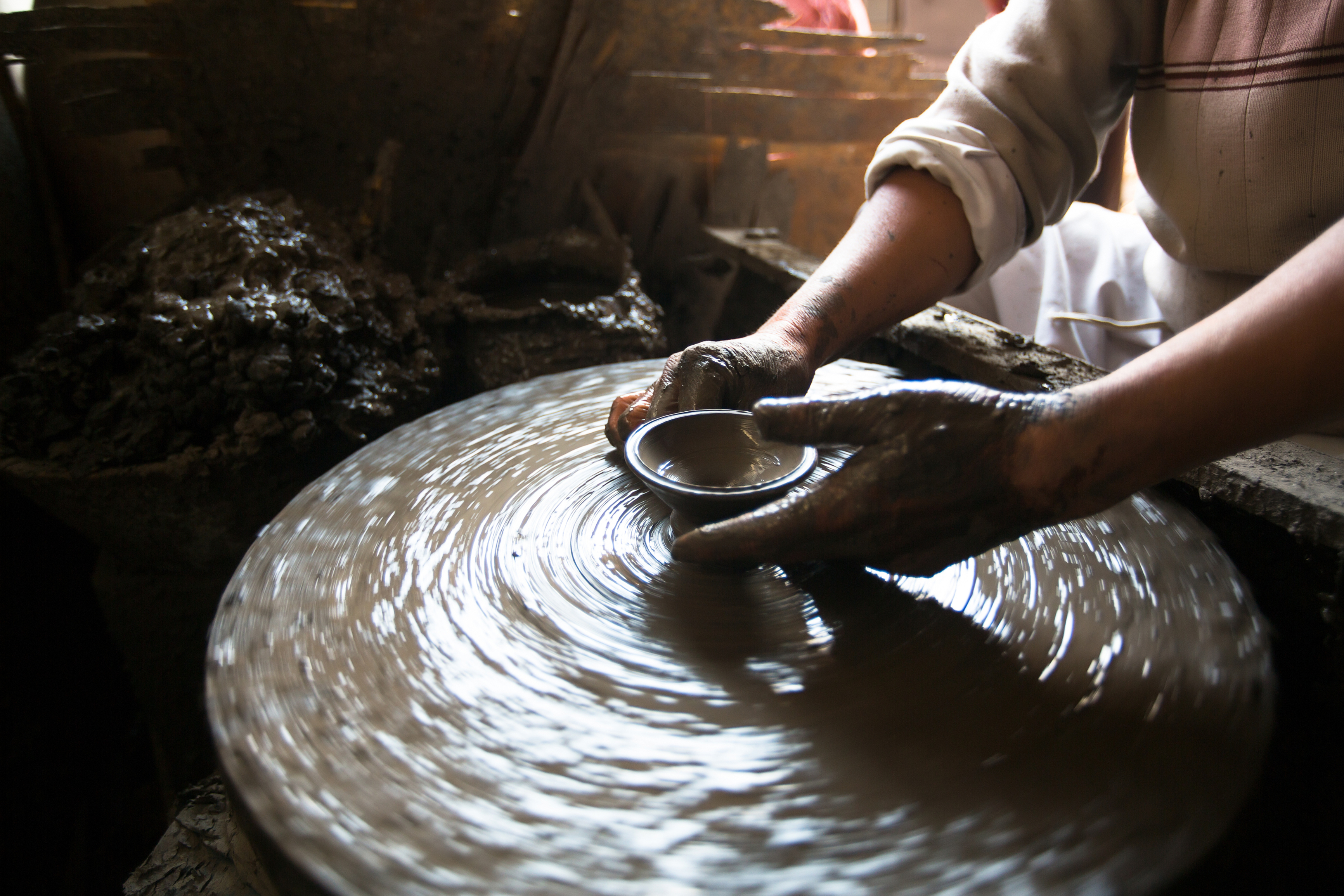
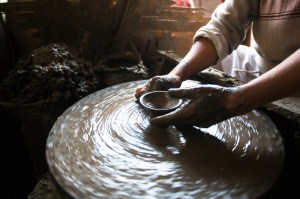
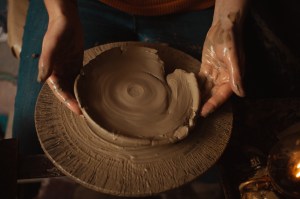
A potter begins with earth and water. He takes a weight of clay into his hands, kneading and pressing it until hidden pockets of air are released and the whole mass becomes pliable beneath his touch. The sense of touch is traditionally associated with the month of Tishri. He places the clay at the center of the wheel, wets his palms, and sets the wheel in motion. As the clay turns, his hands remain steady. One braces the outer wall while the other presses inward, opening a hollow at the heart of the vessel.
ID 36696413 © Dimaberkut | Dreamstime.com
Water glistens across his fingers, allowing them to move without tearing what is still forming. With each revolution, he senses what the eye cannot yet see: where the clay is uneven, where it resists, where the wall is thinning, and where it can be drawn higher. To an observer, the wheel appears to be traveling the same circle again and again. Beneath the potter’s hands, however, the clay is not merely going in circles. It is being transformed.
Water is not an incidental part of this process. Dry earth will not yield to the potter’s hands. Water makes it responsive, allowing it to be pressed, opened, raised, and reshaped without breaking apart. The water does not determine the form of the vessel, and the clay does not shape itself. The potter uses water to work with the clay according to the form already held within his intention.
This gives us a fitting picture for the seventh month, Tishrei. Scripture calls the seventh month yerach ha’etanim, “the month of Etanim,” when Solomon gathered Israel to dedicate the Temple during the feast (1 Kings 8:2). Etanim evokes that which is enduring or continually flowing and has traditionally been associated with streams that do not dry up, alluding to the Living Waters of eternity. During Sukkot, water was drawn from the Pool of Siloam and carried to the Temple in the joyful water pouring ceremony.[2] As the agricultural year turned, changed, or ended in the seventh month,[3] Israel looked toward heaven for the early rains upon which the next harvest depended. The Mishnah says that during the festival the world is judged concerning water.[4]
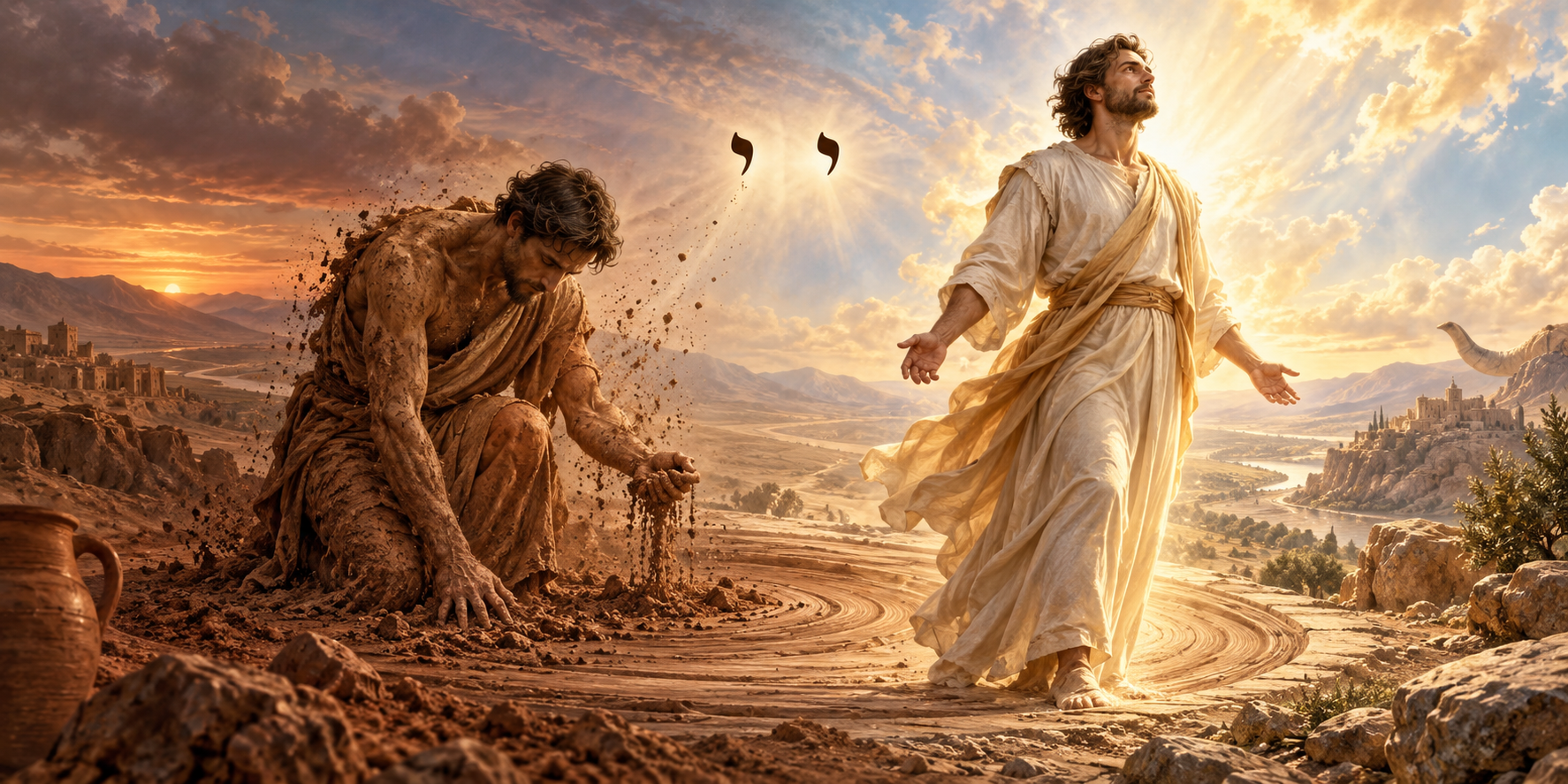
The month also returns us to the waters of creation. According to the tradition we considered last month for Elul, the original creation week began on the twenty-fifth day of that month.[5] This makes Tishri 1, Yom Teruah, align with the sixth day of creation, when Adonai formed the human from the ground and then blew the breath of life into Adam. In this sense, the first day of the seventh month is the birthday of mankind.[6]
Yom Teruah is called a zikkaron in Leviticus 23:24, a remembrance or memorial accompanied by the sound of the teruah – a shouting or great cry. [7] When Adonai speaks to Job from the whirlwind, He asks, “Where were you when I laid the foundation of the earth?” He then recalls the morning stars singing together and the sons of God shouting for joy (Job 38:4–7).[8] The verb translated “shouted” comes from the same root as teruah. The sound that marks the beginning of Tishri carries an echo of creation and the joy that accompanied it.[9]
Genesis 2:6–7 brings water and earth together in the formation of humanity. Water rises and moistens the face of the adamah. Then Adonai forms the adam from its dust. The text does not explicitly describe God mixing clay at a wheel, but the rest of Scripture repeatedly interprets human formation through the work of a potter.
Job says, “I, too, have been formed out of the clay” (Job 33:6). Isaiah addresses Adonai directly: “We are the clay, and You our potter; and all of us are the work of Your hand” (Isaiah 64:8). Jeremiah is sent to the potter’s house to watch a spoiled vessel being worked again in the potter’s hands (Jeremiah 18:1–6). We are earth that has been made responsive by water and then animated by divine breath. Our bodies carry the substance of the ground (adamah), yet our life depends upon what comes from God from the heavens above.
Jewish tradition draws the altar into this scene of human formation. According to Genesis Rabbah 14:8, Adam was created “from the place of his atonement,” an interpretation grounded in the command, “An altar of earth you shall make for Me” (Exodus 20:24).[10] Rashi makes the location explicit, explaining that God took Adam’s dust from the place where the altar would stand so that he might receive atonement and be able to endure.
Adam was formed from the adamah, and Israel later built a mizbach adamah, an altar of earth. In this reading, Adonai’s provision for human frailty was already present within the story of our formation. He knew the mercy Adam and his children would need in order to stand before Him.
Every human body still carries the testimony of that beginning. We are animated dust, both resilient and vulnerable, capable of bearing glory while remaining dependent upon the breath and provision of our Creator. According to the tradition, our clay also carries a memory of the altar, the place where sin is answered by mercy and the fallen are enabled to stand. The water imagery of Tishrei brings us back to the place of our first formation and prepares us to consider what the Potter intends for the clay.
Two Formations
The Hebrew text of Genesis 2:7 preserves a unique spelling that gives this reflection prophetic depth. The word translated “and He formed” is vayyitzer, from the verb yatsar, which is often used for the shaping work of a potter. Only here, in the account of Adonai forming the human, is vayyitzer written וַיִּיצֶר with two yods. Everywhere else this form of the verb is written with one yod. The unique spelling invited the sages to ask what the second yod might reveal about humanity’s formation.
Rashi interprets the two yods as two formations appointed for the mankind: one for this present world and another for the resurrection of the dead. The first is described in Genesis, where Adam receives breath and becomes a living being. The second looks beyond mortal life toward resurrection. According to Rashi and Bereshit Rabbah, the unusual spelling carries both the origin and destiny of humanity.[11]
Created with AI
The Potter who formed Adam from the dust has another formation in view. This is especially striking in Tishrei. The month begins on the anniversary of humanity’s first formation, while its appointed times reach toward the second (and last) formation of man in Messiah, the last Adam, at the resurrection.
“So also it is written, ‘The first man, Adam, became a living soul.’ The last Adam became a life-giving spirit. However, the spiritual is not first, but the natural; then the spiritual. The first man is from the earth, earthy; the second man is from heaven… Just as we have borne the image of the earthy, we will also bear the image of the heavenly.” (1 Corinthians 15:45-47, 49, NAS95)
The first Adam was formed from the dust and received life, while the Last Adam is from heaven and became a giver of life. All humanity is descended from the earthly Adam and remains subject to corruption and death. In Yeshua, however, the destiny of Adam’s children is no longer confined to the dust.
“For as in Adam all die, so also in Messiah will all be made alive.” (1Co 15:22, TLV)
Though Rashi was not reading through a New Testament lens, his understanding of two formations based upon the doubled yod in humanity’s creation aligns remarkably well with the Pharisaic Rabbi Paul’s argument concerning the two Adams. Only a few verses later, Paul connects humanity’s promised transformation with the sound of the last trumpet:
“Behold, I tell you a mystery; we will not all sleep, but we will all be changed, in a moment, in the twinkling of an eye, at the last trumpet; for the trumpet will sound, and the dead will be raised imperishable, and we will be changed.” (1 Corinthians 15:51-52, NAS95)
1 Corinthians 15 is one of Scripture’s clearest summaries of the Gospel proclaimed through the moedim (feast days). Paul begins with Messiah’s death, burial, and resurrection, identifies Him as the Firstfruits of those who sleep, and carries the reader forward to the last trumpet and the resurrection harvest. The chapter gathers the redemptive pattern of the appointed times into one sweeping movement, from death to life and from the image of the earthly man to the image of the heavenly.
This promised change is especially fitting at the turn of the year. The Hebrew root shanah means “year,” while the root carries the sense of repetition or change. Paul wrote in Greek, but his promise that “we will all be changed” resonates beautifully with this Hebrew wordplay. Each shanah returns us to the appointed cycle, yet the Potter’s wheel does not return the clay unchanged. He continues drawing His work toward completion.
Tishrei holds the beginning and end of this mystery together. The month begins on the traditional anniversary of the first Adam’s formation and sounds the shofar that anticipates humanity’s final transformation in the Last Adam, Messiah Yeshua. The seventh month remembers the dust from which we came while announcing the glory we are destined to bear.
The In-between Space
For now, we live between the two formations represented by the doubled yod. We bear the image of our Creator while remaining subject to corruption and death. Genesis 3 shows the adam hiding from the One whose breath gives him life. The man and woman become ashamed of the bodies God fashioned, turn against one another through accusation, and find themselves estranged from the ground from which they were taken. The dust that received God’s breath now fears His voice.
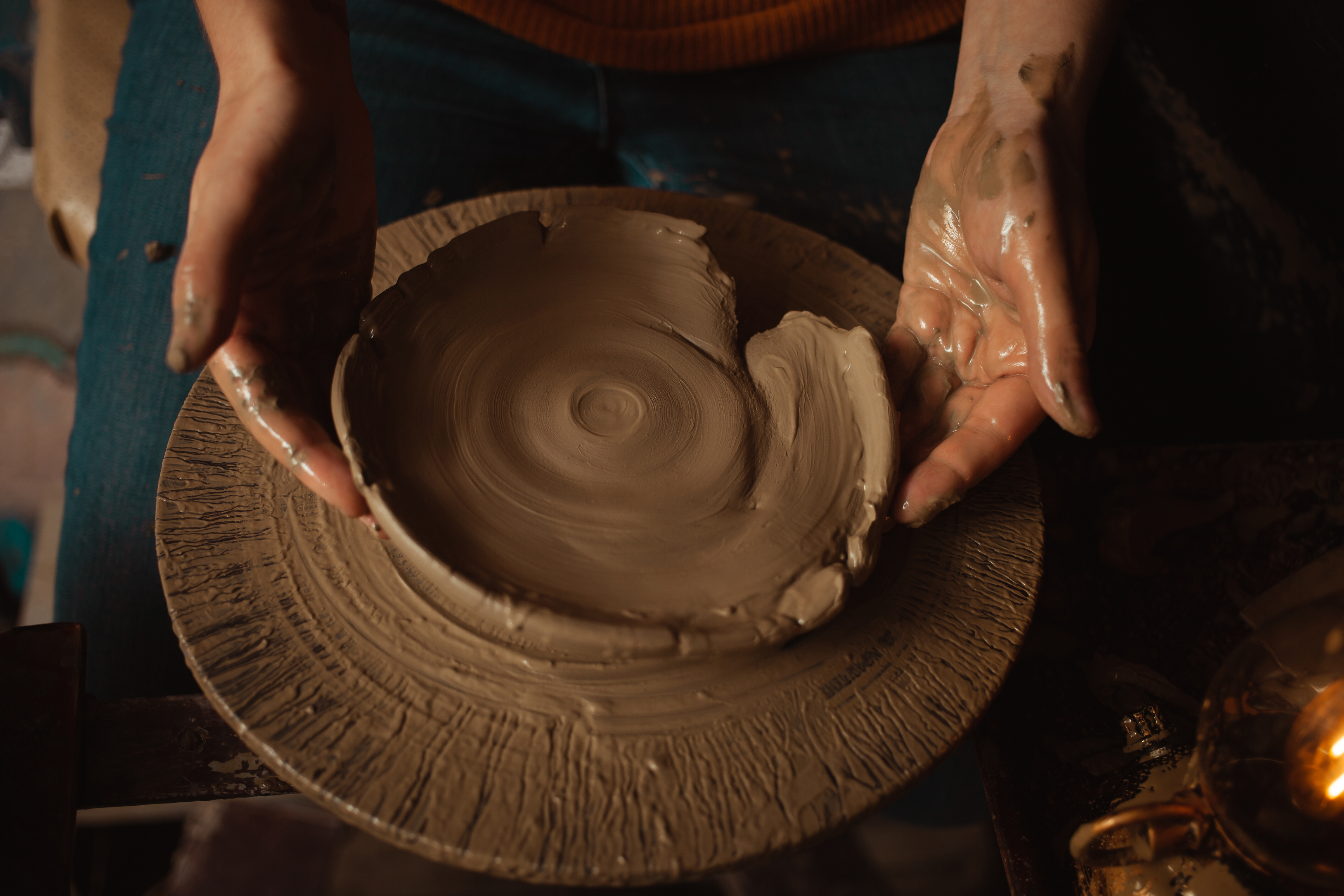
Every generation enters the world within that fracture. We add our own choices to its damage and receive impressions from histories already bent by the fall. Human clay is shaped by other human clay; we bear marks we did not choose and inflict marks we do not fully understand. Even so, we remain image-bearers, and the Potter has not relinquished His claim upon the clay.
ID 246367216 © Valeria Titarenco | Dreamstime.com
Jeremiah encountered this mystery at a potter’s house. He watched a vessel become marred in the potter’s hand and then saw the potter work it again “into another vessel, as it seemed good to the potter to make” (Jeremiah 18:4, NAS95). The image warns Israel that Adonai retains the right to uproot or rebuild according to their response, yet the warning itself is a mercy.
When we encounter malformation, we often begin by searching for someone to blame. We examine the damaged place, decide why it happened, and begin identifying the person with whatever has gone wrong. A failure becomes an identity. A wound becomes a destiny. Once the label has been applied, it becomes difficult to imagine another form. The Potter sees the damage more clearly than any observer ever could, but He also sees what the clay may yet become. This difference in perception becomes especially clear in the Gospel of John.
The Last Adam Stoops to the Dust
There is a moving description of formative mercy in the account of the woman caught in adultery in John 8. As the story stands in the traditional text of John, it unfolds in the atmosphere of Sukkot in the seventh month. The religious leaders place the woman before Yeshua and demand a judgment that would return her body to the dust.
David Stern locates the encounter more specifically within the final day of the feast: “The interchange with the woman caught in adultery took place after daybreak (Jhn 8:2) the next day, which was still Hoshana Rabbah (7:37), since Jewish days begin at sunset. Later the same day he said, ‘I am the light of the world,’ which relates to Hoshana Rabbah customs (Jhn 8:12).”[12]
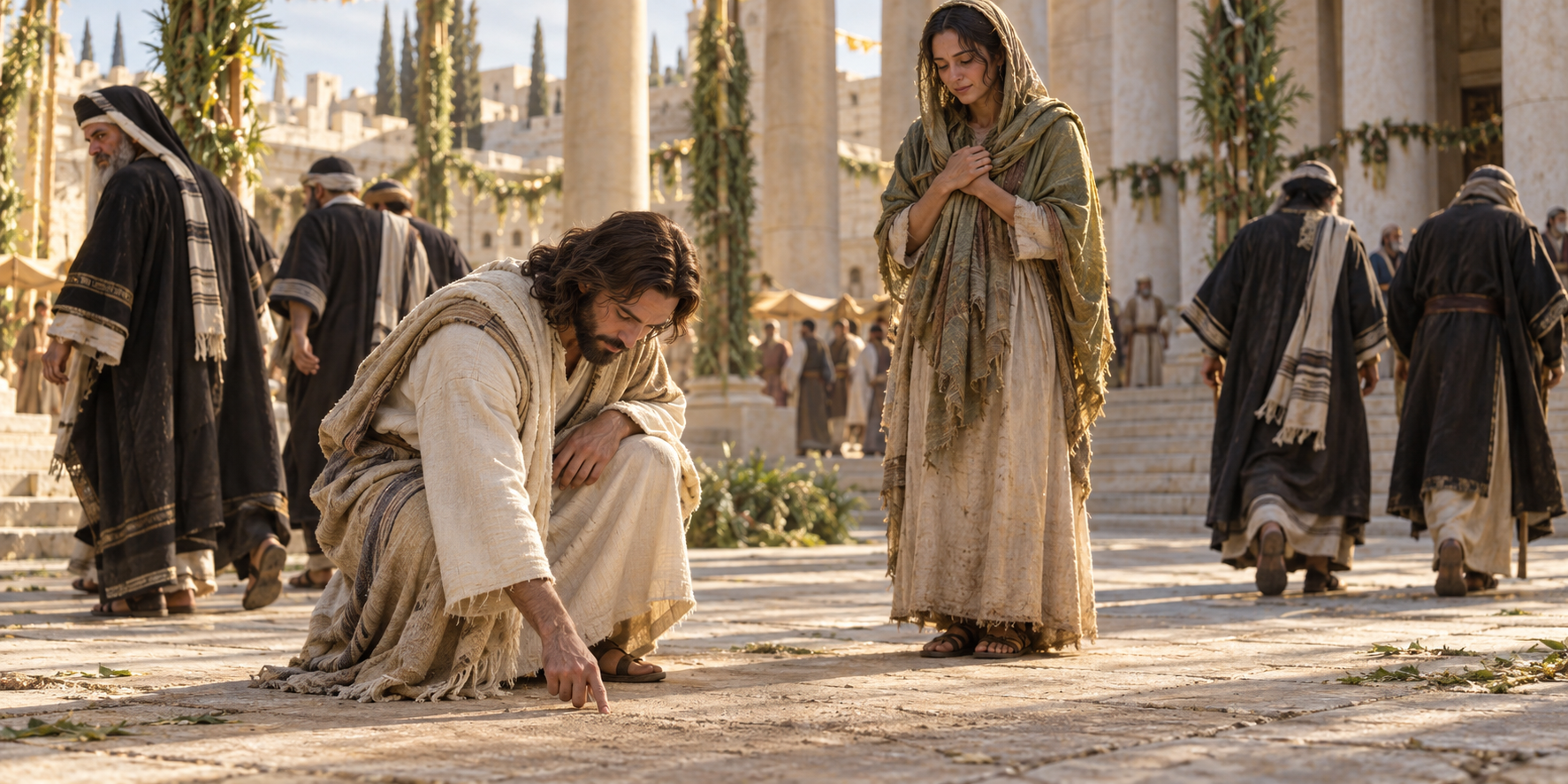
Created with AI
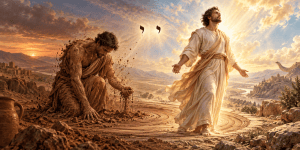
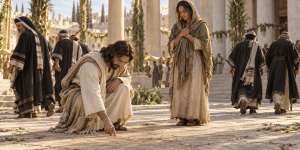
Yeshua responds by stooping toward the ground and writing with His finger. The text never tells us what He wrote, yet the gesture itself invites us to linger. The One who formed humanity from the ground bends toward that same earth while a daughter of Adam stands threatened with destruction. The finger that inscribed the covenant upon tablets of stone now traces words in the dust. And those who invoke Torah against the woman suddenly find its light turned upon their own hearts.
Yeshua rises and says, “He who is without sin among you, let him be the first to throw a stone at her.” Then He stoops again. One by one, her accusers leave. When Yeshua rises the second time, the woman discovers that the One who knows the truth about her does not expose her further or ask her to defend herself. Instead, He asks where her accusers have gone, and then speaks the words that return her life to her:
“Straightening up, Yeshua said to her, ‘Woman, where are they? Has no one condemned you?’ ‘No one, Master,’ she said. Then Yeshua said, ‘Neither do I condemn you. Go, and sin no more.'” (John 8:10-11, TLV)
His words recall the tradition that Adam was formed from the place of the altar so that atonement might enable him to stand. The woman had been made to stand in the midst of her accusers, and she remains standing after they have gone. Yeshua takes her sin seriously without allowing it to become her final form. His mercy preserves her future, while His instruction gives that future direction.
Many of us know what it is to stand inwardly accused. We remember what we have done, where we have failed, and whom our choices have wounded. Shame tells us that the marred place has revealed our truest identity and that nothing new can be made from us. This woman allows us to see with better eyes. When she looks up from the dust, the only One qualified to condemn her remains, and He has made room for her to walk forward.
Immediately afterward, Yeshua declares, “I am the Light of the world. The one who follows Me will no longer walk in darkness, but will have the light of life” (John 8:12, TLV). Then the ground (adamah) appears again in the next chapter, where the Light of the world encounters a man who has been blind since birth (John 9:1).
The disciples ask, “Rabbi, who sinned, this man or his parents, that he would be born blind?” Their question reveals the human impulse to explain visible brokenness by locating guilt. Yeshua refuses to interpret the man’s blindness through blame. While the disciples search for the sin that explains his condition, He directs their attention toward the work God is about to reveal in him: “It was so that the works of God might be displayed in him” (John 9:3, NAS95).
Then Yeshua repeats His declaration from before: “While I am in the world, I am the Light of the world” (John 9:5, TLV). Afterwards, he spits on the ground, makes clay, and applies it to the man’s eyes. The action is startlingly physical. The One through whom all things came into being[13] bends toward the earth again, joins moisture to dust, and works the substance into clay. Genesis described the ground being watered before Adonai formed the human. In John 9, moistened earth is again worked by the hands of the Creator, and a human body is brought closer to wholeness.
Yeshua tells the man to wash in the Pool of Siloam. John pauses to explain that Siloam means “Sent.” The location carries particular significance in the atmosphere of Sukkot.[14] Only a short time earlier in John’s account, Yeshua had stood on the last great day of Sukkot and cried, “If anyone is thirsty, let him come to Me and drink” (John 7:37, NAS95). Now the One sent from the Father sends a man bearing clay upon his eyes to those same waters. The man goes, washes, and returns seeing.
The accounts in John 8 and 9 mirror one another. Both encounters begin with people trying to interpret another person through sin, but Yeshua redirects their attention from assigning guilt to revealing “the works of God” in a human life. He refuses to treat either person as a theological problem to be solved. While we become preoccupied with the malformation of our neighbors, Yeshua remains concerned with their transformation.
As the people continue interrogating the healed man, another kind of sight opens within him. At first, he refers to “the man who is called Yeshua.” Later, he calls Him a prophet and argues that He must be from God. Finally, when Yeshua finds him after he has been cast out, the man addresses Him as Lord and bows before Him. His healing continues beyond physical sight as courage, testimony, and spiritual perception take form within him. Meanwhile, the leaders who are certain that they can see become increasingly unable to recognize the One standing before them.
“Yeshua said, ‘For judgment I came into this world, so that those who don’t see may see, and the ones who do see may become blind.’” (Jhn 9:39, TLV)
This is the sharp irony running through the two chapters. During the season when everyone should be “altogether joyful,” people remain occupied with judgment, blame, and traps. Yeshua continues into the next chapter by contrasting the one who destroys life with the purpose for which He came: “I have come that they might have life, and have it abundantly!” (John 10:10, TLV)
The haftarah reading for Yom Kippur confronts us with a similar irony. Jonah, whose name means “dove,” knows that Adonai is “a gracious and compassionate God, slow to anger and full of kindness, and relenting over calamity” (Jonah 4:2, TLV). Yet he sits beneath his shelter awaiting Nineveh’s destruction and becomes angry when malformed people receive mercy.
His response raises an uncomfortable question during the season of judgment: Can we rejoice when the mercy that preserved us is extended to someone else? We may sit with Jonah and watch for the destruction of the world, or we may stand beside the woman and the man who received room to live, see, and change. The Last Adam stoops toward the dust because He still sees the potential within the clay.
Created with AI
Treasure in Jars of Clay
Paul gathers the images of light, sight, glory, and human clay into one remarkable passage:
“For God, who said, ‘Let light shine out of darkness,’ is the One who has shone in our hearts, to give the light of the knowledge of the glory of God in the face of Messiah. But we have this treasure in jars of clay, so that the surpassing greatness of the power may be from God and not from ourselves.” (2 Corinthians 4:6–7, TLV)
The imagery closely follows what we have seen in John. Yeshua, the Light of the world, works clay with His hands and opens the eyes of a man who has never seen. Paul takes those elements inward: the light of Messiah gives spiritual sight to an earthen vessel. The work of new creation has already begun within bodies that still bear the frailty of the first Adam.
ID 150712673 © Biblebox | Dreamstime.com
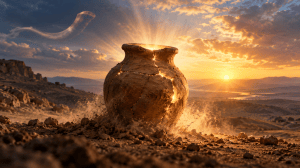
Paul does not speak of that frailty with shame. An earthen vessel is vulnerable to pressure and easily damaged, but its weakness makes the source of the treasure unmistakable. The life within the vessel does not arise from the strength of the clay. It comes from the One who inhabits it. Even where mortality remains visible, the resurrection life of Yeshua is already at work.
This is why Paul can describe himself as “hard pressed in every way, yet not crushed; perplexed, yet not in despair; persecuted, yet not forsaken; struck down, yet not destroyed” (2 Corinthians 4:8–9, TLV). His sufferings do not mean that the Potter has discarded him. They reveal the sustaining presence of Yeshua within a vessel that could not preserve itself by its own strength. Paul says that he carries the dying of Yeshua in his body “so that the life of Yeshua may also be revealed in our mortal body” (verse 11).
Formation into the image of Messiah occurs within this tension. Our bodies remain mortal, our histories remain part of us, and places within us still need healing. At the same time, the Spirit is renewing the inner person and making the life of Yeshua increasingly visible through the vessel. Paul speaks of Messiah being formed in us (Galatians 4:19), of our being conformed to the image of God’s Son (Romans 8:29), and of our transformation into that same image “from glory to glory” (2 Corinthians 3:18).
Paul carries this work toward resurrection. “We know that the One who raised the Lord Yeshua will raise us also with Yeshua and bring us along with you into His presence” (2 Corinthians 4:14, TLV). For now, the outer person experiences the weakness and decay of mortal clay while the inner person is “being renewed day by day.” Beyond this present formation waits “an eternal weight of glory far beyond all comparison” (verses 16–17).
Until the Vessel Is Complete
Tishri gives us courage to look honestly at what has taken shape within us. The seventh month may reveal places where the clay has hardened, collapsed, or become misshapen beneath the pressures of life. Our assessment remains incomplete if it accounts for the damage without accounting for the Potter. He sees what has become marred, remembers what He intended, and knows how to continue working with the clay in His hands.
Those hands formed Adam from dust taken from the holy altar as a testimony that He will complete the work. Yeshua knows what we have done and what has happened to us without confusing the marred place with the finished vessel. The dust is real, but it is not our final destiny.
We presently bear the frailty and mortality of the first Adam while the Spirit renews us inwardly, forming the life of the Last Adam within us. When the last trumpet sounds, the Potter’s intention for humanity will be revealed in fullness. Those who have borne the image of the earthly man will also bear the image of the heavenly.
Until that complete redemption, we can yield without fear to the hands that know us. The pressure we feel is not evidence that we have been abandoned, and the places still unfinished are not proof that His work has failed. The Potter has not lost sight of the glory for which your clay was formed.
I pray you have a blessed seventh month. As the Potter searches and shapes our hearts during the High Holy Days and Sukkot, may our attention be drawn toward what He desires to form within us. May we repent and receive His mercy without begrudging that same mercy to our neighbors. May we become more like Yeshua most especially in the ability to see the potential that still remains in other jars of clay.
“I am sure of this very thing—that He who began a good work in you will carry it on to completion until the Day of Messiah Yeshua.” (Philippians 1:6, TLV)
I’ll leave you with this song by David Crowder (one of my favorites!):
Glory Glory (God Is Able)
[1] Bereshit, the first Torah portion of the new reading cycle, is read during the seventh month on the Shabbat after Simchat Torah. This will fall on October 7th in the year 2026. The verses quoted are part of the Bereshit portion, which is Genesis 1:1-6:8.
[2] Sukkah 4:9 describes the water libation and the drawing of water from Siloam.
[3] See Exodus 23:16; 34:22, Deuteronomy 14:28; 31:10-11.
[4] Rosh Hashanah 1:2 associates Sukkot with judgment concerning water.
[5] See Rosh Hashanah 11:10b -11:1a and 11:3a or check out this article.
[6] Vayikra Rabbah 29:1.
[7] Complete Word Study Dictionary: OT and NT for e-Sword: H2146 זִכָּרוֹן zikkārôn: A masculine noun meaning memorial, remembrance, record, reminder. This word conveys the essential quality of remembering something in the past that has a particular significance. H8643 תְּרוּעָה terû‛āh: A feminine noun indicating a shout of joy; a shout of alarm, a battle cry.
[8] “Then the LORD answered Job from the whirlwind and said, “Who is this who darkens the divine plan By words without knowledge? “Now tighten the belt on your waist like a man, And I shall ask you, and you inform Me! “Where were you when I laid the foundation of the earth? Tell Me, if you have understanding, Who set its measurements? Since you know. Or who stretched the measuring line over it? “On what were its bases sunk? Or who laid its cornerstone, When the morning stars sang together And all the sons of God shouted for joy?” (Job 38:1-7, NASB)
[9] A few examples: Leviticus 23:40 – Rejoice before Adonai for seven days. Deuteronomy 16:14 – You shall rejoice in your feast.Deuteronomy 16:15 – You shall be altogether joyful.
[10] Bereshit Rabbah 14:8.
[11] Rashi on Genesis 2:7. See also Genesis Rabbah 14:5.
[12] David H. Stern, Jewish New Testament Commentary, commentary on John 8:2 and 8:12.
[13] Colossians 1:16-17
[14] The Mishnah describes water being drawn from Siloam in a golden flask and carried through the Water Gate with blasts of the shofar before it was poured at the altar during the feast. (Sukkah 4:9)