Posts Tagged With: Av

Sacred Pain: The Month of Av 2026

“Grief is the one pain that heals all others. It is the most important pain there is.”[1] —Dr. Henry Cloud and Dr. John Townsend

Av is a month of both grief and comfort. It begins in the narrow place of the Three Weeks and carries us through Tisha B’Av, the great day of communal mourning over the destruction of the Temples and other tragedies in Jewish history. The Three Weeks begin on the 17th of Tammuz and culminate on the 9th of Av, a period often called Bein HaMetzarim, “between the straits” or “between the narrow places.”

We are not left with only grief in Av. It is also called Menachem Av, meaning “Comforting Father” or “Father of Comfort.” This gives the whole month a redemptive arc: we do not enter grief to stay there. We enter grief truthfully so comfort can be real and not merely cosmetic.

We all experience grief. Webster’s 1828 dictionary defines grief as the pain of mind produced by loss, misfortune, injury or evils of any kind. This pain can also come through sorrow, regret, and repentance when we recognize that our own choices have caused harm.

The phrase that Webster used, pain of mind, is salient because grief is not just an emotion. It encompasses a spectrum of emotions, thoughts, and processes that involve the mind, heart, and body.

We obviously experience grief when a loved one dies, but sometimes the loss is a relationship, a job, a business, a dream, or even the life we imagined we would have. We might lose our nervous system’s sense of safety due to a health crisis or immense stress. Sometimes we lose our ability to hear God, hear others, or hear ourselves clearly.

Av is not only a month of sorrow; it is a month of healing sorrow. It teaches us not to rush past grief, but also not to build a permanent identity around destruction. We remember. We lament. We tell the truth. We listen. And in that honest place, comfort can begin to meet us, and repair can begin in truth.

The Pain That Heals

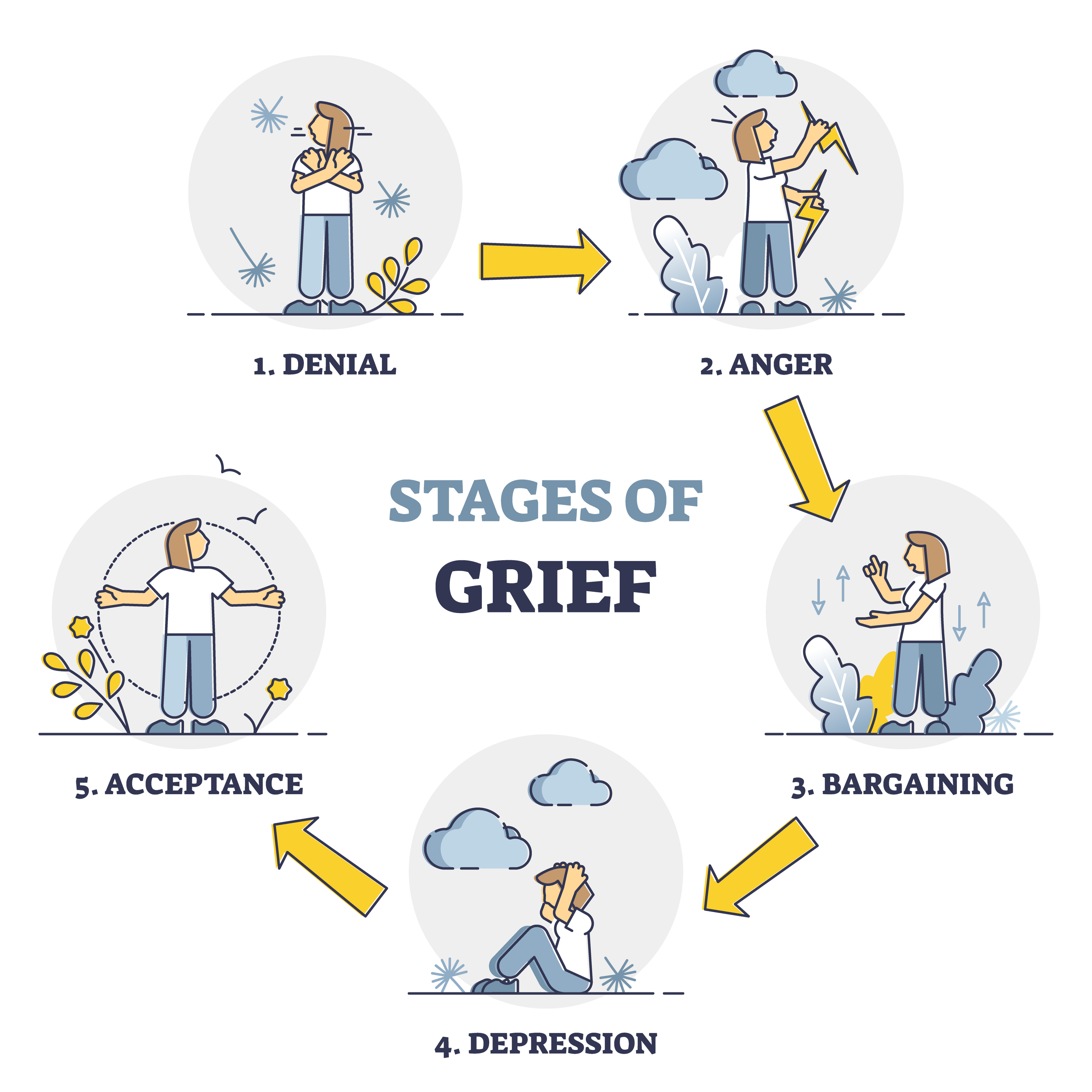
There are five commonly named stages of grief:

  • Denial: “This can’t be happening to me.”
  • Anger: “Why is this happening? Who is to blame?”
  • Bargaining: “Make this not happen, and in return I will ____.”
  • Depression: “I’m too sad to do anything.”
  • Acceptance: “I’m at peace with what happened.”
ID 217077374 © VectorMine | Dreamstime.com

Cloud and Townsend write, “Grief is the one pain that heals all others.” When I first read that statement, it stopped me in my tracks. The obvious question was: Why? Why would grief—the pain most of us avoid, resist, minimize, or rush through—be the very pain that heals all others?

Their answer is both simple and profound. Grief is not merely an emotion. It is a progression that requires time. It is never a “one and done” as much as we would prefer that. God designed our souls and our brain, and He knows what is needed for us to come to terms with a reality we don’t like or want.

So, though painful, grief is the process that enables the mind, body, and soul to heal. Neuroscience helps us understand why: grief is a form of learning. The brain must slowly update its inner map of reality when someone or something we counted on is no longer available in the same way. The brain is predictive; it uses past experience to anticipate what should happen next.

When our new reality violates that prediction, the nervous system often reacts with alarm, confusion, denial, anger, or attempts to regain control. This is the mind and heart saying, “I do not want this to be true.” Protest and bargaining are not signs of immaturity by themselves. They are part of the system trying to resolve the mismatch between the old map and the new reality. Until that inner map changes, the mind will keep searching, bracing, protesting, or reaching for what has been lost.

The body is also involved. Bereavement research shows that grief can affect stress physiology, inflammation, immune regulation, sleep, cardiovascular function, mood, and behavior. The body can remain organized around threat, longing, vigilance, or protest until the loss is processed and integrated. Thus, unprocessed grief can keep the body in a state of physical stress, while honest mourning gives the nervous system a path toward release, regulation, and rest.

Something has been lost. Something has died. It may be a person, but it may also be a dream, a season, a relationship, a plan, a role, a hope, or an image of who we thought we would become.

At first, we protest. We do not want the loss to be true. We may deny it, numb ourselves, become angry, or bargain with reality. We may keep trying to make someone love us, understand us, choose us, approve of us, or become who we needed them to be. We may try to resurrect a dream, a season, or a relationship that has already ended.

Eventually, if we allow grief to do its work, we come to the painful surrender: this really is true. This is not what I wanted, but it is reality. The wish and the truth stand in the same room. This is the moment we often avoid, but it is also the doorway to healing.

Then comes grief proper. We cry. We tell the truth. We let go. We say goodbye to what cannot be. We stop demanding that the dead thing act alive. We allow the soul to finish what it was designed to finish.

Av does not invite us to despair. It invites us into the kind of sorrow that heals. It teaches us to stop bargaining with ruins and begin receiving comfort in truth.

Shimon: Hearing the Grief

Shimon, or Simeon, is the tribe traditionally associated with the fifth Hebrew month. His name comes from the language of hearing. When Leah named him, she said, “‘Because the LORD has heard that I am unloved, He has therefore given me this son also.’ So she named him Simeon” (Genesis 29:33). That gives Av a profound connection to hearing, especially listening from a place of pain.

I cannot help but wonder what grief Leah carried as the “unloved one.” Scripture tells us her eyes were weak, and whether that detail was physical, symbolic, or both, the text makes her pain clear: Jacob preferred Rachel. How painful it would be to accept that your life, your reality, was to always be second in the eyes of your husband. Most of us would do exactly what she did to try to get our need for love met. We would try to earn, buy, and negotiate our way into the heart of the one with whom we are in covenant.

Maybe you are doing that now (with Adonai) because you believe you are the unloved one despite the truth that He is no respecter of persons. Grief heals the mind and heart of falsehood if we enter the gates of sorrow in earnest. Unprocessed grief keeps us in a dangerous mind loop of emotional, spiritual, and physical pain.

Simeon, the one named after hearing and listening to pain teaches us what happens when we ignore that crucial voice. In Genesis 34, Simeon and Levi respond to Dinah’s violation with violent retaliation. Their pain is real. The injustice is real. But their response was not merely reactive rage. It was planned, strategic, deceptive, and vengeful, resulting in the massacre of the men of Shechem.

Jacob later rebukes Simeon and Levi in Genesis 49:5–7, calling them vessels or instruments of chamas, cruel violence. He declares that his soul, his nephesh, should not enter their secret council and that his glory should not be joined to their assembly, because in fierce anger they slew men and in lustful passion they hamstrung oxen.

That phrase, “hamstrung oxen,” is striking. To hamstring an animal is to cut the large tendons behind the leg, making it lame and unable to walk properly. It is an act that does not merely kill; it disables, wounds, and renders something powerless.

This is how Jacob described Simeon and Levi’s deception of Shechem. They used circumcision, the sign of the Abrahamic covenant, to weaken the men so they could kill them. Something meant for life and covenant became chamas, violence, and death.

So many things go wrong in this story. Dinah’s pain should have been heard. The injustice should have been acknowledged and addressed. But instead, unprocessed pain became a destructive force.

Sometimes it is uncomfortable to enter someone else’s story and sit with their pain, especially when we have categorized the other person as outside our group. There is “us,” and there is “them.” Jacob’s silence could be interpreted as passivity, but it could also have been wisdom.

“The fence around wisdom is silence.” (Pirkei Avot 3:13)

This does not mean injustice is ignored. It means pain does not always need immediate answers; sometimes it needs presence, compassion, and sensitivity. It means understanding that we do not understand. This is active silence. It is not hasty or brash. It does not rush to fix, explain, defend, or retaliate.

Av asks us to listen to grief instead of suppressing it. To listen, we must silence our base reactions. The tribe of Shimon reminds us that healing begins when pain is heard. But Simeon’s story also warns us that pain left unheard can become reactive, violent, deceptive, or destructive. Grief must be listened to, but it must also be brought before the Father so it does not become vengeance in disguise.

The Lion of Av

This same pattern is reflected in the mazel of Av: Aryeh, the lion. In an immature state, the lion roars to dominate, intimidate, devour, or defend territory. But in a refined state, the lion represents courage, dignity, protection, and strength under righteous authority.

Yeshua is called the Lion of the tribe of Judah in Revelation 5:5, but what is striking is that when John looks, he sees a Lamb standing as slain. Lion strength is revealed through Lamb surrender. True power or strength is power under authority. It is holy restraint. It is power that is also humble.

In Av, we ask God to help us hear our grief before it becomes a roar that harms others or ourselves. Grief, when brought into the presence of God, can become wisdom, compassion, courage, and repair.

Giving Grief a Rhythm

Jewish tradition wisely gives grief a proper rhythm. Mourning is not treated as something we rush through, hide, or handle alone. It is given time, structure, witnesses, and repeated moments of remembrance.

ID 2404973
© Ashley Whitworth
| Dreamstime.com

There is the first intensity of grief, often pictured in the seven days of shiva, when the mourner sits with the loss and the community comes near. There is the longer adjustment of sheloshim, the thirty-day period in which life begins to resume, but not as though nothing has happened. And there is the longer cycle of remembrance, where grief is carried through seasons, holy days, anniversaries, and ordinary moments when the absence is felt again.

These rhythms are most clearly practiced after the death of a loved one, but they also teach us something about figurative losses. Dreams die. Expectations die. Seasons end. Relationships change form. A role that once gave us identity may no longer fit. A version of the future we imagined may have to be released. Even an illusion can die when truth finally breaks through the ether.

When these losses happen, we may not need the formal practices of mourning, but we often still need the wisdom beneath them. We need time to sit with what has changed. We need safe people who can witness the loss without rushing us to feel better. We need space to name what mattered, what hurt, what disappointed us, and what will never be the way we hoped.

Av becomes a sacred invitation to stop rushing the soul.

A Funeral Before a Burial

When something has died, even if it is the death of a dream, an expectation, a season, a relationship, or an illusion, do not bury it too quickly. First, hold a funeral.

The “funeral” is where we sit with what was lost. We feel it. We name it. We tell the truth. We let others witness it. We remember the goodness, the hope, the disappointment, and the cost. We allow the heart to catch up with the new reality. Then, when the grief has been honored, we can move toward burial.

ID 9349076
© Michael Beckerman
| Dreamstime.com

The “burial” is the act of release. It is where we stop pretending the dead thing is still alive. We stop dragging it into the next season. We stop demanding that it rise from the dead. We bless what can be blessed, grieve what must be grieved, and surrender it to God.

This is not giving up in despair. It is agreeing with truth so that life can grow again. We do not bury what has died because it did not matter. We bury it because it did.

Do Not Rush the Comfort

One of the ways we rush grief is through spiritual bypassing. Spiritual bypassing happens when we use spiritual language, practices, or explanations to avoid pain instead of honestly entering it. It can sound holy on the surface, but it often dismisses what the soul is trying to tell the truth about.

This can happen when someone is grieving and we quickly say, “They are in a better place,” or “God has a plan,” before we have truly sat with the ache of the loss. It can happen when someone is angry over a real violation and we tell them to “stop being negative,” “rise above it,” or “just forgive,” before justice, truth, and lament have been allowed to speak. The problem is not faith. The problem is using faith to escape honesty.

Biblical hope does not require denial. Trusting the Father does not mean pretending something did not hurt, that a loss did not matter, or that an injustice should not be named. In Scripture, lament gives sorrow a voice before God. The Psalms do not sanitize grief, nor do the prophets rush past ruin. Even Yeshua wept at the tomb of Lazarus, though He knew resurrection was coming.

Spiritual bypassing also happens when we silence someone who is wrestling with faith, doubt, disappointment, or confusion. A person may still love God and yet struggle to understand where He was in their suffering. They may still trust Him and yet need to cry, “How long?” To shame that struggle is not spiritual maturity. It is fear dressed in religious language.

It can also happen when someone’s misfortune is quickly attributed to sin. Scripture does teach that choices have consequences, and suffering can invite honest self-examination. But not every wound or sickness is the direct result of personal sin. Job’s friends thought they were defending God’s justice when they explained his suffering as evidence of hidden wrongdoing. Yet in the end, God rebuked them because they had not spoken rightly of Him. Their explanations may have sounded theologically lofty, but they lacked wisdom, humility, and compassion.

This matters because comfort that comes too quickly can feel like erasure. When someone offers an answer before they have offered presence, the grieving person may feel that their pain is too much, too inconvenient, too faithless, or too uncomfortable to be heard. What was meant to comfort can actually create loneliness. The person may learn to hide their grief, not because it has healed, but because it has no safe place to go.

Prayer, Scripture, worship, and meditation can steady the soul, renew the mind, and lift our eyes. But even holy practices can be misused when they become a shield against honesty. The question is not only, “Is this spiritual?” but, “Is this helping me tell the truth before God, or is it helping me avoid what hurts?”

This also applies when we are the ones listening. Sometimes we reach for spiritual answers because another person’s pain makes us uncomfortable. We want to fix it, explain it, correct it, or move them toward hope before we have really entered the weight of what they are carrying. But grief often needs witness before it can receive wisdom. It needs someone willing to sit in the ashes without immediately trying to bring beauty.

Av teaches us that true comfort does not bypass grief. It comes after grief has been given room to speak. “Comfort, comfort My people” is not spoken as a denial of devastation, but after the ruins have been faced. The comfort of the Father is not a platitude. It is not a spiritual Band-Aid. It is the holy nearness that meets us in truth and slowly teaches the wounded heart how to hope again.

The House of Mourning

Now we have context for the words of Kohelet, the Preacher:

“Grief is better than laughter, for though the face is sad, the heart may be glad. The heart of the wise is in a house of mourning, but the heart of fools is in a house of pleasure.” —Ecclesiastes 7:3–4

This does not mean sorrow is pleasant, and it does not mean every painful thing is good. It means honest mourning can do something in the heart that avoidance cannot. The house of mourning teaches wisdom because it brings us into contact with reality, humility, love, limits, and eternity.

The house of pleasure is not wrong in its proper season. Laughter, joy, feasting, and celebration are gifts from God. But pleasure can become a hiding place when we use it to avoid grief. When we run too quickly to distraction, entertainment, busyness, or even premature celebration, the soul may never have the funeral it needs.

Av calls us into the house of mourning long enough for the heart to become wise. This process is preserved through tradition on the Jewish calendar. Every year at this time, the destruction of the first and second Temples and the great sins of the nation (golden calf and sin of the ten spies) are remembered and mourned. How does this (and the succeeding seven weeks of comfort) prepare one’s soul for Rosh Hashanah, Yom Kipper, and Sukkot?

Seven Weeks of Comfort

For much of the year, the haftarah is connected in some way to the weekly Torah portion. But after Tisha B’Av, the prophetic readings begin a different movement: seven weeks of consolation leading up to Rosh Hashanah.

ID 463094459
© Arun David
| Dreamstime.com

This season is known as the Shiva d’Nechemta, the seven haftarot of comfort. Beginning with Shabbat Nachamu, the Sabbath after Tisha B’Av, we hear the words of Isaiah: “Comfort, comfort My people.” From there, week by week, the prophetic readings carry the community from devastation toward consolation, restoration, and renewed hope.

This matters for Av because it shows us that comfort is not instant. The calendar does not move from destruction to celebration in one leap. It gives us seven weeks of comfort. After the narrow places, after the mourning, after the ruins have been faced, the soul is led gently toward the new year, a new beginning, and the season of joy.

The Av Grief Path

If you are walking through grief this month, or if an old loss is still speaking through your body, reactions, relationships, or speech, consider this path:

  • Reality/Truth: What has been lost?
  • Protest: How have I resisted or denied this reality?
  • Bargaining: What have I been doing to make this not true?
  • Surrender: What truth am I being invited to accept?
  • Sadness: What needs to be felt, named, and witnessed?
  • Goodbye: What must I release instead of carrying it as though it is still alive?
  • Comfort: What do I need from the Father of Comfort?
  • New Life: What space might grief eventually open?

This path is not always linear. Grief often circles back through protest, sadness, surrender, and comfort many times as the mind, body, and soul slowly learn how to live in the new reality. That is why there is great wisdom in the Jewish tradition of mourning for seven days, thirty days, and even a year. These rhythms do not rush the mourner. They give grief time to move from shock, to acknowledgment, to integration, allowing the loss to be carried through the ordinary and sacred cycles of life.

If you or someone you love is in the house of mourning, remember these steps and sit with them in their pain, even if it is in silence. Allow your or their mind and heart the time it needs to learn how to walk through life without the person or thing they lost. Comfort them with your presence. That’s the closest thing to Yeshua sitting with them.

“Blessed are those who mourn, for they shall be comforted.”  (Mat 5:4, NAS95)

Receiving the Comfort of Av

Av teaches us that grief is not the absence of faith. It is the sacred pain that allows the soul to finish what has ended. We need this individually, of course, but we also need this as a people.

This is the mercy hidden inside the mourning of Av. Grief does not heal because loss is good. Grief heals because it allows the soul to stop fighting what is true and begin releasing what it was never meant to carry. It goes beneath anger, anxiety, control, shame, bitterness, and numbness, and gently leads the heart back to the original wound where the Comforting Father can meet us in truth.

And then, in His care, the soil of our hearts becomes fertile again.


Sacred Pain Reflection Questions


[1] How People Grow: What the Bible Reveals About Personal Growth (p. 206)


Categories: Ethics, new moon | Tags: , , , , , | 3 Comments

Rosh Chodesh Av 5779

Another month has nearly passed! The fifth Hebrew month has a lot to teach about hearing, balance, obedience, and building Adonai’s House. May you have a very blessed fifth month, may you have ears to hear the Words of Messiah, and may your mourning be transformed into joy.

Video

Audio Only


Av Video Notes 2019


Links of Interest for this Month


Crate Trained BelieversThe Devouring Lion

Chodesh Tammuz & The Three Weeks

Month of Av: Tisha B’Av & Tu’B’Av

Chodesh Av 2018

Torah Portion: Shlach L’cha (The Ten Spies)

The Repairer of the Breach 

Categories: new moon | Tags: , , , , , , , , , , , | 4 Comments

Chodesh Av 2018

I wanted to get this posted at the beginning of the month of Av, but I’ve been too busy to edit! Every year as I am intentional about celebrating the Moonthly Cycle, Abba has me focus on a particular area, a lot of which is not in my book on celebrating the New Moon. I plan to share my monthly notes from our local gatherings with you, but changing my notes to a blog post that makes sense to a reader requires quite a bit of editing. Better late than never! 

          © Kalina Vova | Dreamstime.com

Chodesh Av

  • Month: Five (11th month on civil calendar)
  • Tribe: Shimon
  • Sense: Hearing
  • Seasons/Feasts: Three Weeks (Dire Straits – from Tammuz 17 to Av 9), Transition by Tu B’Av (Av 15), Fast on Av 9.
  • Theme: From destruction and mourning to comfort and joy, especially in relation to the House of Adonai.

Month five has correlations with day five of creation. That is the day that the birds and fish were created to swim and fly through the wind and water currents of the earth. These are also those that rapidly spread Seed from continent to continent. Seeds can be likened to words or even THE Word. Words can destroy or words can bring Good News, a comfort to the world. In the following offering, see if you can pick out the themes of day five of creation.

Months four and five are connected by the Three Weeks. The sense of Tammuz was sight/seeing/vision, and the sense of Av is hearing/listening. Let’s consider the differences. The sense of seeing is more akin to having spiritual vision or being able to “see” the truth and promises of God despite what one’s circumstances and natural vision suggests. (Ex. The evil report of the ten spies. Joshua and Caleb saw the same thing as the other spies; and yet, Caleb declared, “Let us go up at once and take possession, for we are well able to overcome it.”   [Num. 13:30, Jos. 14:6-15])

This implies that we will face spiritual forces, like giants that have fortified cities, which are people and circumstances that are much stronger than we are during Av (beginning in Tammuz). And yet, the lesson to be learned is to choose to believe the promises of YHWH despite what one sees or hears in the natural. The One in you is stronger than any enemy or circumstance. Fear not.

In light of that, I have a few questions for you to ponder from last month.

  1. How many of you were tested in the sense of “seeing” during the month of Tammuz?
  2. What giant did you face?
  3. What enemy within a fortified (strong) city sought to discourage you?
  4. Based on the Torah portions of Tammuz, did you struggle with proper or improper authorities?

From Seeing to Hearing

Gen. 29:33 (NASB) Then she conceived again and bore a son and said, “Because the LORD has heard that I am unloved, He has therefore given me this son also.” So she named him Simeon.

Shimon means to hear, shema. “We will hear and we will do.” The irony of the sense of seeing coming before hearing in the months is that we cannot see without hearing first. Even a baby in the womb hears before he sees. Biblical or Spiritual vision is the ability to see what is heard: the WORD of YHWH.

       © Nipa74 | Dreamstime.com

What voice have you been listening to? Protect your ears! When things “look” bad in the natural do you hear a voice that says that you deserve calamity? That says, you are worthless, that you are not good enough, that you are UNLOVED by your Husband, like Leah?

If so, it’s time to give birth to Shimon. Adonai hears you, you must hear Adonai. In the Torah, Simeon and Levi act rashly with their swords on account of their sister Dinah. This cost each of these tribes a true portion or inheritance in the Land. They would be scattered in Israel. (Gen. 49) Thus, patience and waiting for the authority over us to give instruction is a test in one’s “hearing.” Just because you know something, doesn’t mean you have the authority to be the judge and executioner. A much better example of a godly Shimon is found when baby Yeshua is presented in the Temple or House of Adonai:

Luke 2:25-35 (NASB) And there was a man in Jerusalem whose name was Simeon; and this man was righteous and devout, looking for the consolation (comfort) of Israel; and the Holy Spirit was upon him.  26 And it had been revealed to himby the Holy Spirit that he would not see death before he had seen the Lord’s Christ.  27  And he came in the Spirit into the temple; and when the parents brought in the child Jesus, to carry out for Him the custom of the Law,  28  then he took Him into his arms, and blessed God, and said,  29  “Now Lord, You are releasing Your bond-servant to depart in peace, According to Your word;  30  For my eyes have seen Your salvation,  31  Which You have prepared in the presence of all peoples,  32  A LIGHT OF REVELATION TO THE GENTILES, And the glory of Your people Israel.”  33 And His father and mother were amazed at the things which were being said about Him.  34 And Simeon blessed them and said to Mary His mother, “Behold, this Child is appointed for the fall and rise of many in Israel, and for a sign to be opposed—  35 and a sword will pierce even your own soul—to the end that thoughts from many hearts may be revealed.”

In the above passage, there is a righteous man named Simeon, one who hears. Simeon believed what he HEARD. Go back and look at the bolded and underlined words and phrases above. Do you “see” the words associated with hearing and seeing? Shimon was LOOKING for the consolation of Israel, that is their comfort, which ties perfectly into the themes of the Three Weeks, and the consolation of Tu B’Av. By following the moonthly cycle, we practice and prepare for this flow of time (that is, was, and is to come) in the seasons each year. Consider these verses:

Jer. 31:9-14 (NASB) “With weeping they will come, and by supplication I will lead them; I will make them walk by streams of waters, on a straight path in which they will not stumble; For I am a father to Israel, And Ephraim is My firstborn.”  10 Hear the word of the LORD, O nations, and declare in the coastlands afar off, and say, “He who scattered Israel will gather him and keep him as a shepherd keeps his flock.” 11 For the LORD has ransomed Jacob and redeemed him from the hand of him who was stronger than he.  12 “They will come and shout for joy on the height of Zion, and they will be radiant over the bounty of the LORD—Over the grain and the new wine and the oil, and over the young of the flock and the herd; And their life will be like a watered garden, and they will never languish again. 13 “Then the virgin will rejoice in the dance, And the young men and the old, together, For I will turn their mourning into joy and will comfort them and give them joy for their sorrow.  14 “I will fill the soul of the priests with abundance, And My people will be satisfied with My goodness,” declares the LORD.

 From weeping and mourning to consolation and joy. That is the connection between Tammuz and Av. We should expect our own walk each year to reflect the same. Simeon’s reward for believing and obeying – true HEARING-  the Word of God was that he could SEE the Comforter, Yeshua, the Consolation of Israel. And even then, the revelation was not complete as we are still awaiting His return and the fullness of the passage above. Until then, we practice. We remember. We see, and we hear.

Destruction of the House

Closely related to the above is remembering the destruction of the Temple, mourning its loss, and believing for its renewal. Thus, I offer a little review. According to tradition, the first Temple was destroyed because of idolatry, and the second Temple was destroyed on account of baseless hatred among brothers. Essentially, this is God’s people breaking the two greatest commandments of loving Him and our neighbor as ourselves. Not doing so, destroys His House and ours!

            © Liorpt | Dreamstime.com

Since Tammuz 17th marks the beginning of the Three Weeks leading up Tisha B’Av (9thof Av), the date that both Temples were destroyed, we should expect to have tests and trials in this area, at this season.

What is the “House” or “Temple”?

  • The Body of Messiah
  • Our physical bodies
  • The Temple Mount/Zion/place of physical Temple
  • Your family
  • Your Assembly

Were any of you tested (or still being tested) in one of these areas? Have you been in a battle to keep these things from being destroyed? What is the purpose in this testing?

The Hidden Goodness in Av

When we see war, calamity, destruction, and unfavorable circumstances with people or life in general, we have a choice to make. If God is truly for us, and we really believe that, then we must adjust our vision, outlook, and attitude to align with the Good News that we have HEARD.

Ps. 119:91-92 (NASB) They stand this day according to Your ordinances, For all things are Your servants.  92 If Your law had not been my delight, Then I would have perished in my affliction.

 Mat. 19:26 (NASB) And looking at them Jesus said to them, “With people this is impossible, but with God all things are possible.”

 Eph. 1:11 (NASB) also we have obtained an inheritance, having been predestined according to His purpose who works all things after the counsel of His will

Do we really believe that ALL things are in God’s hands and control? That even the bad and hard things serve His purposes and are meant for our good, BECAUSE He loves us? There is a story in the Mishnah about a certain Rabbi called Nahum Gamzu that can help one adjust their attitude. I’ve written in other places about the month of Av being referred to as Menachem Av, or Comforting Father. The rabbi in the story below shares this name, Nachum, comforter. It is meant to not only redirect one’s vision or perception of life’s circumstances, but bring one consolation or comfort.

The Gemara inquires: And why did they call him Naḥum of Gam Zu? The reason is that with regard to any matter that occurred to him, he would say: This, too, is for the good [gam zu letova]. Once, the Jews wished to send a gift [doron] to the house of the emperor. They said: Who should go and present this gift? Let Naḥum of Gam Zu go, as he is accustomed to miracles. They sent with him a chest [sifta] full of jewels and pearls, and he went and spent the night in a certain inn. During the night, these residents of the inn arose and took all of the precious jewels and pearls from the chest, and filled it with earth. The next day, when he saw what had happened, Naḥum of Gam Zu said: This, too, is for the good.

When he arrived there, at the ruler’s palace, they opened the chest and saw that it was filled with earth. The king wished to put all the Jewish emissaries to death. He said: The Jews are mocking me. Naḥum of Gam Zu said: This too is for the good. Elijah the Prophet came and appeared before the ruler as one of his ministers. He said to the ruler: Perhaps this earth is from the earth of their father Abraham. As when he threw earth, it turned into swords, and when he threw stubble, it turned into arrows, as it is written in a prophecy that the Sages interpreted this verse as a reference to Abraham: “His sword makes them as the dust, his bow as the driven stubble” (Isaiah 41:2).

There was one province that the Romans were unable to conquer. They took some of this earth, tested it by throwing it at their enemies, and conquered that province. When the ruler saw that this earth indeed had miraculous powers, his servants entered his treasury and filled Naḥum of Gam Zu’s chest with precious jewels and pearls and sent him off with great honor.

When Naḥum of Gam Zu came to spend the night at that same inn, the residents said to him: What did you bring with you to the emperor that he bestowed upon you such great honor? He said to them: That which I took from here, I brought there. When they heard this, the residents of the inn thought that the soil upon which their house stood had miraculous powers. They tore down their inn and brought the soil underneath to the king’s palace. They said to him: That earth that was brought here was from our property. The miracle had been performed only in the merit of Naḥum of Gam Zu. The emperor tested the inn’s soil in battle, and it was not found to have miraculous powers, and he had these residents of the inn put to death. – Taanit 21a

 If we want to transition to the comfort of Av, or find the joy that comes after mourning, we must be able to “see” the world with eyes like Nachum Gamzu. Can we really say, “This, too, is for the best”? In every situation? Even the bad ones?

We currently see only dimly. We must mourn destruction and exile (both physically and spiritually). But we must also try to “hear” the goodness that is hidden in the bitterness of any destruction we encounter in this life and KNOW that Mashiach will come to comfort us, One Day showing us how “this too was really for the best.”

Paul mirrors this sentiment in Second Corinthians. Tu B’Av or the fifteen of Av just passed a few days ago on the calendar. I hope that you are beginning to see the Light after a period of darkness and heavy trials. Be encouraged dear one, in ALL things, rejoice, O daughter of Zion, for your King is Coming to you!

And in ALL things, be able to say, “Gam zu l’tovah!” (This, too, is for the good!)


            © Samrat35 | Dreamstime.com

2Co 4:7-18 (NASB) But we have this treasure in earthen vessels, so that the surpassing greatness of the power will be of God and not from ourselves; 8 we are afflicted in every way, but not crushed; perplexed, but not despairing; 9 persecuted, but not forsaken; struck down, but not destroyed; 10 always carrying about in the body the dying of Jesus, so that the life of Jesus also may be manifested in our body.  11 For we who live are constantly being delivered over to death for Jesus’ sake, so that the life of Jesus also may be manifested in our mortal flesh.  12 So death works in us, but life in you.  13 But having the same spirit of faith, according to what is written, “I BELIEVED, THEREFORE I SPOKE,” we also believe; therefore, we also speak, 14 knowing that He who raised the Lord Jesus will raise us also with Jesus and will present us with you.  15 For all things are for your sakes, so that the grace which is spreading to more and more people may cause the giving of thanks to abound to the glory of God.  16 Therefore we do not lose heart, but though our outer man is decaying, yet our inner man is being renewed day by day.  17 For momentary, light affliction is producing for us an eternal weight of glory far beyond all comparison, 18 while we look not at the things which are seen, but at the things which are not seen; for the things which are seen are temporal, but the things which are not seen are eternal.


*** By the way, those of you that decided to share your journal of the months with me, please feel free to email me at gracentorah@gmail.com with your monthly results. (I will not make you or your notes public.) Please do not include personal names or organizations when describing trials, issues, or circumstances. Thank you!


Categories: Moedim, new moon | Tags: , , , , , , , | 3 Comments

Month of Av: Tisha B’Av and Tu B’Av

“The Lord has rejected all my strong men In my midst; He has called an appointed time [moed] against me to crush my young men; The Lord has trodden as in a wine press The virgin daughter of Judah. (Lam. 1:15 NASB)

Chodesh AvThe month of Av is the eleventh month on the Hebrew civil calendar and the fifth month on the Hebrew biblical calendar. This corresponds to July/August. Av literally means “father” (aleph-beht). It is customary to add the name Menachem to Av, which means “comforter” when speaking about this month because it is associated with many tragic events, yet our Father brings comfort. Thus, many refer to this month as “Menachem Av” (Comforting Father). We will explore this in more detail below.

According to tradition, each of the twelve (or thirteen) months on the Hebrew calendar correspond to one of the tribes of Israel. The month of Av is associated with Simeon (Shimon). Shimon’s name means to “hear.”[1] By examining the themes of the month of Av, it becomes increasingly obvious that one’s sense of hearing (or lack thereof) is the vehicle by which one will find themselves mourning or rejoicing. The question and consequent meditation for the month of Av is:

 “Will we heed the voice (Word) of YHWH? Or will we listen to evil reports and the desires of the flesh?

History and tradition records many events where the Children of Israel’s “hearing” was tested in the month of Av. Sadly, the testimony is usually a lack of hearing which resulted in great judgment. Consider the following list that is said to have occurred on the ninth of Av or Tisha B’Av.

  • During the time of Moses, the people believed the evil report of the 10 Spies, and the decree was issued forbidding them from entering the Land of Israel. (1312 BCE)
  • The First Temple was destroyed by the Babylonians, led by Nebuchadnezzar. 100,000 Israelites were slaughtered and millions more exiled. (586 BCE)
  • The Second Temple was destroyed by the Romans, led by Titus. Some two million Jews died, and another one million were exiled. (70 CE)
  • The Bar Kochba revolt was crushed by Roman Emperor Hadrian. The city of Betar – the Jews’ last stand against the Romans – was captured and liquidated. Over 100,000 Jews were slaughtered. (135 CE)
  • The Temple area and its surroundings were plowed under by the Roman general Turnus Rufus. Jerusalem was rebuilt as a pagan city – renamed Aelia Capitolina – and access was forbidden to Jews.
  • The Spanish Inquisition culminated with the expulsion of Jews from Spain on Tisha B’Av in 1492.
  • World War One broke out on the eve of Tisha B’Av in 1914 when Germany declared war on Russia. German resentment from the war set the stage for the Holocaust.
  • On the eve of Tisha B’Av 1942, the mass deportation began of Jews from the Warsaw Ghetto, en route to Treblinka.

These details from history makes one wonder if the timing of these calamities is mere coincidence. Does the LORD have an appointed time to “break” us?[2] According to Jewish tradition, He does, and that date is associated with the ninth of Av. Reread the verse from Lamentations quoted at the beginning of this post. In Hebrew, YHWH indeed has a “moed” or appointed time to break His wayward people. The LORD allows these calamities to come upon those that are His in order to bring them to repentance. It is our rebellions, shortcomings, and stiff-necks that provokes His hand against us. Like any loving parent, YHWH uses punishment in order to guide, teach, and protect His children. And like Him, we often set aside a particular time to mete out certain reprimands to our own children.

Just as a father has compassion (mercy) on his children, So the LORD has compassion on those who fear Him. (Ps. 103:13) 

Though the month of Av is connected with judgment and tragedy, it is equally linked to God’s mercy. The good news is that even when we are stiff necked or have closed ears, YHWH still loves us. So, though the focus of Tisha B’Av is denying oneself and repentance, there should be a transition in the observer from mourning to celebration.  One may grieve over past tragedies and rebellions, but hope is always in the Menachem Av (Comforting Father). It is His divine mercies that give one a hope for a good future. This is the essence of Tish b’Av. Remember the past, but move forward with an attitude of gratitude and a burning hope for a better future.

How to Listen

Most of my readers are aware of what it means in Hebrew to Shema. It means to hear/listen AND obey what is heard. The Jewish response to the tragedies enumerated above was to mark this infamous date as a day of fasting and repentance. It is important that one remembers, so they do not repeat the mistakes of our predecessors. But, one’s attitude in these matters is paramount. Listen to the question YHWH asks in Zechariah:

“Say to all the people of the land and to the priests, ‘When you fasted and mourned in the fifth and seventh months these seventy years, was it actually for Me that you fasted? ‘When you eat and drink, do you not eat for yourselves and do you not drink for yourselves? (Zec. 7:5-6) 

Our mourning, fasting, and rejoicing must be sincere. Notice how hearing and a lack thereof leads to punishment and exile in the rest of this passage:

Then the word of the LORD came to Zechariah saying, “Thus has the LORD of hosts said, ‘Dispense true justice and practice kindness and compassion each to his brother; and do not oppress the widow or the orphan, the stranger or the poor; and do not devise evil in your hearts against one another.’ “But they refused to pay attention and turned a stubborn shoulder and stopped their ears from hearing. “They made their hearts like flint so that they could not hear the law and the words which the LORD of hosts had sent by His Spirit through the former prophets; therefore great wrath came from the LORD of hosts. “And just as He called and they would not listen, so they called and I would not listen,” says the LORD of hosts; “but I scattered them with a storm wind among all the nations whom they have not known. Thus, the land is desolated behind them so that no one went back and forth, for they made the pleasant land desolate.” (Zec. 7: 8-14)

It seems that most every Word from the LORD leads back to the two greatest commandments: Love YHWH and love your neighbor. You want to really listen? You want to really hear the LORD? You want “ears that hear”? The Torah, the commandments, and the Word teach how to love YHWH and one’s neighbor. But, one must be humble enough to heed His voice.

How Not to Listen

Shimon, as the tribe of Av, and the name associated with hearing, has much to teach this month. Let’s see if we can learn from Shimon’s and his descendant’s mistakes. I find it fascinating that the man whose name means to “hear” seemed to often have closed ears. It seems ironic, but is it? Are we any different?

First, if you will recall, it was Shimon and Levi that decided to take justice into their own hands when Shechem violated their sister Dinah.[3] This enraged Jacob and he reprimanded his sons for their rash behavior.[4] Later, when Jacob blessed his sons, Shimon and Levi receive more of a rebuke than a blessing:

“Simeon and Levi are brothers; Their swords are implements of violence. “Let my soul not enter into their council; Let not my glory be united with their assembly; Because in their anger they slew men, And in their self-will they lamed oxen. “Cursed be their anger, for it is fierce; And their wrath, for it is cruel. I will disperse them in Jacob, And scatter them in Israel. (Gen. 49:5-7)

Notice that Jacob’s rebuke is similar to YHWH’s edicts against us when we are wayward. Exile or scattering, is one result of sin. Shimon and Levi acted in unholy anger when they attacked the Shechemites. We must be careful when someone kindles anger in us (right or wrong), for more often than not, we become the greater sinner when we allow our actions to be ruled by inflamed flesh. A reddened face full of rage makes one more like an Esau (red), and no better than a hairy beast. This will only bring wrath upon our own head and division in our camps.

Later, it seems that the Levites find favor from HaShem; but, as the LORD’s inheritance, they remained scattered throughout the tribes. When Moses hands out the tribal blessings, he says of Levi:

Of Levi he said, “Let Your Thummim and Your Urim belong to Your godly man, Whom You proved at Massah, With whom You contended at the waters of Meribah; Who said of his father and his mother, ‘I did not consider them’; And he did not acknowledge his brothers, Nor did he regard his own sons, For they observed Your word, And kept Your covenant. “They shall teach Your ordinances to Jacob, And Your law to Israel. They shall put incense before You, And whole burnt offerings on Your altar. “O LORD, bless his substance, And accept the work of his hands; Shatter the loins of those who rise up against him, And those who hate him, so that they will not rise again.” (Dt. 33: 8-11)

Shimon doesn’t fair quite as well. Moses skips over Simeon altogether when he blesses the tribes of Israel.[5] Rashi says that this is because of what happened in Shittim when Israel played the harlot with the daughters of Moab. Two particular characters in this drama were Zimri (a Simeonite) and Cozbi (a Midianite). They were in the throes of passion when Pinchas skewered them at the doorway of the Tent of Meeting, which stayed the plague. (Numbers 25)

Again, we see the one that should have had ears to hear given over to the passions of the flesh. Instead of boiling with anger, this time we see a Simeonite inflamed with a perverted sexual desire. Can you see a pattern developing here? The one that should have ears to hear is deaf to the instructions of the Creator. He is ruled by desire, his lower nature, making him no better than a beast of the field.

Unlike the other tribes (save Levi), Shimon didn’t receive a separate neighboring portion in the Promised Land. Instead, Shimon was scattered in various towns and cities within Judah’s allotment.[6] Jacob’s rebuke held true for both Levi and Shimon. Some of our actions have long lasting and dire consequences, even though we have found forgiveness.  This takes us back to the other themes for this month (Av): mourning, repentance, remembrance, and finally, joy. The good news is that one day, YHWH will turn all of our fast days into joyful celebrations for those that love truth and peace.

“Thus says the LORD of hosts, ‘The fast of the fourth, the fast of the fifth, the fast of the seventh and the fast of the tenth months will become joy, gladness, and cheerful feasts for the house of Judah; so love truth and peace.’ (Zec. 8:19)

Meanwhile, We Remember

Interestingly, there is only one person that the Torah records the exact date of their death. That man was the High Priest, Aaron.

Then Aaron the priest went up to Mount Hor at the command of the LORD, and died there in the fortieth year after the sons of Israel had come from the land of Egypt, on the first day in the fifth month. (Num. 33:38) 

Aaron passed from this life on the new moon of the fifth month of Av. It seems that from this point forward, Av would be associated with mourning. Since Aaron is directly connected to the Tabernacle and later Temple, I find it incredible that both Solomon’s and Herod’s Temples were later destroyed in the very month that her original High Priest passed away. There are many reasons for us to mourn these losses, but there are also reasons to wipe our tears away and look forward to a better hope/future.

The move from mourning to celebration is mirrored in the traditional haftarah reading for the Shabbat following Tisha B’Av. This Sabbath is called “Shabbat Nachamu” or the Sabbath of Comforting. The haftarah reading is from Isaiah 40: 1-26 and speaks of comforting God’s people after their suffering.

Moreover, by the time the moon gets full during the month of Av, another traditional holiday emerges: Tu B’Av (fifteenth of Av). After all the mourning of Tisha B’Av, the people begin to rejoice. Like the ninth of Av, there are several events that are associated wih this date in history; but instead of destruction, this date brought great reprieve and comfort to the people.

The first mention of Tu b’Av is in the Mishna (Taanit), where it says , “There were no better days for the people of Israel than the Fifteenth of Av and Yom Kippur, since on these days the daughters of Jerusalem go out dressed in white and dance in the vineyards. What they were saying: Young man, consider who you choose (to be your wife).” (Taanit 4:8). According to the Gemara, on this day the “tribes of Israel were permitted to mingle with each other.” (Taanit 30b)

Here are few things that are said to have occurred on Tu B’Av:

  • The death of the generation that left Egypt ended. (Ending the judgment for believing the report of the 10 evil spies.)
  • The daughters of Zelophehad were granted an inheritance like sons.
  • Members of the Tribe of Benjamin were readmitted to the community (Judges 19-21)
  • King Hosea, the king of the Northern Kingdom, removed the restrictions of King Jeroboam that prohibited the northerners from making pilgrimages to Jerusalem.
  • The Romans permitted the Jews to bury their dead who fell at Beitar.

As you can see, the month of Av ebbs and flows with the themes of destruction (judgment) and renewal. While Jews refrain from marrying during the mourning period of Av, the later part of the month, beginning with the fifteenth, marks a strong transition in their countenance. So much so, that many do marry on or just after this date. (Or new courtships are started.) This is the epitome of mourning turning into joy! As such, Tu B’Av is said to be a festival of love, quite a contrast to Tisha B’Av.

I encourage you to do your own research on Chodesh Av, Tisha B’Av, and Tu B’Av. There is a wealth of information at your fingertips you need only use them. For now, I thought it best to leave you with a few bullet points for ways to celebrate and meditate during the Rosh Chodesh of Av and the fast of Tisha B’Av.

Chodesh Av

  • Meaning: Av means Father. Mazel for this month is aryeh (the lion).[7] (A clever eye will notice that this month pictures both the Father and the Son.)
  • Major theme: Destruction and Renewal.
  • Meditation: Hear (Shema) the voice of Adonai. Discern between the voice of YHWH and the desires of the nephesh (flesh). Misplaced zeal can quickly become the latter.
  • Remember: The Tabernacle, fallen Temples, and other rebellions of the past. Learn from them.
  • Look Forward: To our heavenly High Priest, Yeshua, the third Temple, and the eventual New Jerusalem.

Tisha B’Av

  • Fast from sundown to sundown on the ninth of Av (unless it falls on Shabbat, then fast the following day). Feel free to look up other traditional things to avoid during the fast such as not wearing leather shoes, perfume, and avoiding baths. (These are ways to “afflict your soul/nephesh” as you focus on lamenting and repentance.)
  • Confess your sins and the sins of our forefathers. (Remember that many of the atrocities that happened to the Jewish people on Tisha B’Av came by the hand of Christians.) Daniel 9 gives a model of confessing the sins of others.
  • Read through Lamentations.
  • Search for Scriptures that speak about God’s mercy on His people and passages that deal with fasting and repentance.


For more understanding of why nine (Tisha B’Av) is associated with both judgment and blessings click here and here. For more on the significance of five, as in the fifth month and fifteenth day (Tu B’Av), click here and here


[1] Gen. 29:33

For the month of Av being associated with Shimon, see Artscroll’s Wisdom in the Hebrew Months.

[2] The Hebrew word translated as “crush” in the Lamentations verse above is Strong’s number: H7665. It literally implies breaking or brokenness. Brown, Driver, and Brigg’s Hebrew defines it thusly:

שׁבר

shâbar

BDB Definition:

1) to break, break in pieces

1a) (Qal)

1a1) break, break in or down, rend violently, wreck, crush, quench

1a2) to break, rupture (figuratively)

1b) (Niphal)

1b1) to be broken, be maimed, be crippled, be wrecked

1b2) to be broken, be crushed (figuratively)

1c) (Piel) to shatter, break

1d) (Hiphil) to cause to break out, bring to the birth

1e) (Hophal) to be broken, be shattered

[3] Gen. 34:25

[4] Gen. 34:30

[5] Dt. 33. Shimon is absent from the blessings.

[6] It appears to me that Judah takes authority and care over the Simeonites. This is likened to Yeshua taking care of and covering us for our sinful mistakes. In other words, we didn’t “shema,” hear.

[7] This is NOT astrology! The enemy has twisted the monthly constellations into a perverted way to divine the future and/or disposition of a person. But, YHWH says the stars were put in the sky to mark the seasons (moedim), to be as signs, to distinguish day and night, and to give LIGHT upon the earth. The heavens declare the glory of God. This includes the stars and the constellations. A careful look at the Creator’s handiwork will reveal that the constellations proclaim the Gospel, and were never meant to divine one’s personal finances, love life, or the like.

Categories: Moedim | Tags: , , , , , , | 12 Comments

Blog at WordPress.com.