Posts Tagged With: women

Submission and Authority Part II

I’ve been going through tons of drafts and cleaning them up for publishing. This particular series began as answers to emails, so if they read a little odd, that’s why. (: 

Click here for Part I

Are Women Required to be Quiet? 

“…that even if some do not obey the word, they, without a word,

may be won by the conduct of their wives.” (1 Pet. 3:1-2)

Does this passage and others like it command women to remain silent, quiet, or unquestioning in the assembly and with their husbands? Peter’s audience was primarily former pagan gentiles. Apparently, more women had turned to Messiah in this assembly than had their husbands, and they needed some instruction.

© Karl Daniels | Dreamstime.com

Peter’s suggestions for these wives wasn’t something new. The Word of YHWH is always concerned with our deeds, not our creeds. Actions really do speak much louder than words. This is because we act out what we really believe or what is really in our hearts. A person can talk to another until they’re blue in the face, but it is the deeds and actions that reveal the truth (or lack thereof) of what someone says.

Thus, Peter’s advice for wives to lead their husbands to Messiah by their walk/actions/lifestyle is true for far more than just “husbands.” This works on people in general because it reveals authentic faith, love, and respect. “You will know them by their fruit”, not their words or creeds. As new believers in the Jewish Messiah, these women would have been walking and living contrary to the culture around them. Hopefully, their husbands would see a stark change in their behavior and the ensuing blessings as a result, and this would win them to Messiah. But hopefully, this would win far more than their husbands — family members, friends, and neighbors!

Peter doesn’t say that these women never SPOKE a word, became mute, or took a vow of silence. Wise women don’t incessantly harp on their men to “know Jesus”, nag, or give childish guilt trips. These tactics are forms of manipulation. They are not of Elohim, nor do they produce godly fruit. This is true no matter the situation, circumstance, or predicament. Neither a man nor a woman should use their mouth for this purpose regardless of whether they have a believing or unbelieving spouse.

How does an ezer kenegdo follow this example and still “oppose” her husband when necessary? To oppose doesn’t mean that a wife becomes a vessel of strife, contention, aggression, or the like. Those are all issues of the flesh, which should be in subjection to the renewed spirit-man (ruach) of a believer. Perhaps an example will be helpful.

What if a man comes home to his wife and says, “I’m going to take our life savings to the casino.” Does YHWH expect this woman to say, “Yes lord, do with it whatever you please.” If this is their entire life savings, a decision like this is indeed an unwise and ungodly way to spend the provision YHWH has provided. By remaining silent, the woman is agreeing to this decision. If the woman points out the folly of his foolish choice, it might bring him to his senses and spare them from the consequences of a very bad decision. (Obviously, the example above is an extreme case, but even small decisions can have huge consequences.)

If Esther had remained silent when her husband signed the edict to kill the Jewish people, this article would have never been written. Esther’s methods should be noted as a good example. She respectfully approached the king (though unannounced, against his “rules”, and at the risk of her life). YHWH had already prepared the heart of the king, as he was willing to give Esther up to half of his kingdom. (Talk about equality!) She then invited him to a private wine banquet. Twice! — Before SPEAKING her heart. She didn’t oppose him by berating, yelling, or scorning him for making such a detrimental decree. Instead, she wined and dined him, which created some mystery and intrigued the king.

Peter would have been familiar with the many women of the Tanakh that used their voices, so what did him mean by a meek, gentle, and quiet spirit?

But let it be the hidden person of the heart, with the imperishable quality of a gentle and quiet spirit, which is precious in the sight of God. (1 Pet. 3:4)

The Greek word hesuchios is often translated as “quiet” in this verse. Strong’s defines it as:

G2272 ἡσύχιος A prolonged form of a compound probably of a derivative of the base of G1476 and perhaps G2192; properly keeping one’s seat (sedentary), that is, (by implication) still (undisturbed, undisturbing): – peaceable, quiet.

Peter isn’t talking about not talking. He doesn’t expect these women to not speak to their husbands. Those that follow the G-d of Israel should be known by their gentle, meek, quiet, peaceable, and tranquil spirits or dispositions. In other words, Messiah’s disciples shouldn’t be the ones that are causing strife, divisions, or arguments. This is true for men and women, king and layperson as this very SAME Greek word is used in the following in verse 2:

1Ti 2:1 First of all, then, I urge that entreaties and prayers, petitions and thanksgivings, be made on behalf of all men,
1Ti 2:2 for kings and all who are in authority, so that we may lead a tranquil and quiet life in all godliness and dignity.
1Ti 2:3 This is good and acceptable in the sight of God our Savior,
1Ti 2:4 who desires all men to be saved and to come to the knowledge of the truth.

Paul said the same thing that Peter said in 1 Peter 3. Our BEHAVIOR (regardless if we are male or female) is what wins the lost. We should be known for our kind, gentle, and peaceable (quiet) lifestyle. Paul expresses his heartfelt prayers for this to be especially true in the lives of those in AUTHORITY. Their example is a witness to even more lives that YHWH desires to come to the truth.

In both cases with the Greek word hesuchios, translated as quiet, the meaning has nothing to do with “not speaking.” The basic sense of the word is to “keep one’s seat.” Know Your Place. In other words, true followers of YHWH are not those that rise up in offense and cause disturbances. They are not trouble makers. They do not offend easily. Rather, they are peacemakers that desire a tranquil lifestyle. It is the nephesh (flesh/emotions/instincts) that gets a person all fired up to cause harm, mischief, debauchery, or endless disputations. These (if they indeed even believe at all) need milk because their flesh controls their actions rather than the spirit-man. Peter and Paul remind us that the fruit we should produce is peaceable, tranquil, and quiet. This isn’t about gender, it’s about godly character.

But what about…

The Infamous 1 Timothy 2:11-15 Passage

Let the woman learn in silence with all subjection. But I suffer not a woman to teach, nor to usurp authority over the man, but to be in silence. For Adam was first formed, then Eve. And Adam was not deceived, but the woman being deceived was in the transgression. Notwithstanding she shall be saved in childbearing, if they continue in faith and charity and holiness with sobriety. (1 Tim. 2:11-15 KJV)

If you scroll back up a few paragraphs, you’ll notice that I’ve already quoted from 1 Timothy 2. The same Greek word, hesuchios, is translated as silence and quiet life in 1 Tim 2:2 and 2:11. I think you understand what the meaning of hesuchios is at this point. But you might be disappointed to discover that I have no intentions of trying to reinvent the wheel in verses 11-15. Many great scholars have done a wonderful job of explaining the many nuances of the Greek of these verses, the context of the culture, and the fact that this is a LETTER of which we have only half of the conversation. (I’ve linked to one of my favorites below.)

No matter what, there are going to be many that refuse to let go of their theological paradigms in regard to the role of women — context, culture, language be damned. Like the disciples (pre-Messiah intervention) the Gospel from the lips of women is nonsense to them.

And as the women were terrified and bowed their faces to the ground, the men said to them, “Why do you seek the living One among the dead? “He is not here, but He has risen. Remember how He spoke to you while He was still in Galilee, saying that the Son of Man must be delivered into the hands of sinful men, and be crucified, and the third day rise again.” And they remembered His words, and returned from the tomb and reported all these things to the eleven and to all the rest. Now they were Mary Magdalene and Joanna and Mary the mother of James; also the other women with them were telling these things to the apostles. But these words appeared to them as nonsense, and they would not believe them. (Luke 24: 5-11)

Thus, if one deems the messenger or vessel unfit, only Messiah can open their eyes. The 1 Timothy 2:11-15 passage is typically used as “trump” verses to silence women from proclaiming the Gospel. This tactic is a repeat of Luke 24. But, we serve an amazing Elohim. He uses those called despised, foolish, and weak to confound the wise and strong!

But God has chosen the foolish things of the world to shame the wise, and God has chosen the weak things of the world to shame the things which are strong, and the base things of the world and the despised God has chosen, the things that are not, so that He may nullify the things that are, so that no man may boast before God. (1 Cor. 1:27-29)

There have been many women throughout the centuries that were deemed weak, silly, or foolish that YHWH chose to deliver the Good News. The verses in Luke above cite numerous women that “were telling” and “reported” what they witnessed at the Tomb to the apostles. Here are the Greek words used:

Lego = “were telling”

λέγω   legō

G3004 Thayer Definition: 1) to say, to speak 1a) affirm over, maintain 1b) to teach 1c) to exhort, advise, to command, direct 1d) to point out with words, intend, mean, mean to say 1e) to call by name, to call, name 1f) to speak out, speak of, mention Part of Speech: verb A Related Word by Thayer’s/Strong’s Number: a root word

Apaggello = “reported”

ἀπαγγέλλω  apaggellō

G518 Thayer Definition:

1) to bring tidings (from a person or a thing), bring word, report

2) to proclaim, to make known openly, declare

Part of Speech: verb A Related Word by Thayer’s/Strong’s Number: from G575 and the base of G32

How in the world does one escape the conclusion that these women were, in fact, proclaiming and teaching the men and apostles the Good News, Messiah is Risen? If we jump straight to 1 Timothy 2:11-15 without the context of the rest of the Bible, we are only fooling ourselves. Worse, vessels chosen by Messiah are rebuked, shunned, and silenced due to ignorance, stubbornness, or flat out misogyny. Luke 24 is only one example. I wanted to get you thinking about the big picture rather than the tiny part that is 1 Tim. 2:11-15.

1 Timothy 2:11-15 doesn’t define the whole Bible, rather the rest of the Bible defines 1 Timothy 2. While I have no desire to hash out the details of these verses in their cultural context, the link below is thorough and succinct. Enjoy!

The Consensus and Context of 1 Timothy 2:12


Submission & Authority Part I

For more information, see The Biblical Role of Women

Categories: Women | Tags: , , , , , , , | 7 Comments

The Biblical Role of Women Part X

Role of Women Main Page

In Part VIII and Part IX, we discovered that women (and men as the bride of Messiah) either build the House of Adonai or they tear it down. We also looked at how YHWH sovereignly chose to first entrust the Torah and the Gospel with His daughters. Again, this is about building His House. It is the mother who first teaches a child the Torah. Then later, as the child matures, the Father brings the stronger correction (mussar).

Hear, my son, your father’s instruction (mussar) And do not forsake your mother’s teaching (torah). (Pro. 1:8)

My son, observe the commandment (mitzvah) of your father And do not forsake the teaching (torah) of your mother. (Pro. 6:20)

In both of the proverbs mentioned above, the father is mentioned first, but it is the Torah of the mother that is not to be forsaken. To forsake is to abandon or forget – implying something that was learned beforehand. Infants begin life by receiving the nourishing milk of the mother in both the physical and in the spiritual through her teaching. In light of this simplicity, it is easy to understand why the women were the first to receive and proclaim the Torah and the Gospel. The tender mercies of a mother’s teaching are balanced by the stricter judgment/correction of the Father. Both are necessary to bring a child to maturity. (This is true physically and spiritually.)

The Hidden Woman and Time

I hope that you have noticed a common theme emerging throughout my posts on women. The woman is often “hidden” within the biblical narratives, much like she was once “hidden” within Adam. There is good reason for this when we take the whole of Scripture into account. Righteous women are a living representation of the Holy Spirit; and as such, they also portray the prophetic or what is future.

If that sounds too far fetched for your liking, let us first consider the Hebraic concept of time. Westerners typically view the past as being what is “behind” us, whereas the future is what is in “front” or ahead of us. Thus, to encourage someone to stop dwelling on past mistakes, we might tell them to “stop looking back” (past) or to “focus on what is ahead” (future). But in Hebraic thought, these expressions are reversed. The past is what you can see; it’s in front of you (and your eyes). The future (what you can’t see) is behind you. Perhaps the following illustration will flesh out this notion.

© Karel Noppe | Dreamstime.com

Imagine someone rowing a boat down a river. The river is time. In order to row a boat, a person must face backwards while rowing forward down the river. What the rower can see with his eyes is the area he has already travelled. (past) Because he doesn’t face in the direction he is headed, he cannot see what is ahead (future). This is truly how mankind experiences time. What has already happened (past) is clearly seen and understood, but the future is unclear and unknown. I know this totally reverses the definitions of hindsight and foresight, but I’ve found that most things in western thought compared with Hebraic thought are (sadly) reversed! Things like this shouldn’t surprise us any more.

Do you recall the function or role of the male from Part I? He is to remember (zakar). In order to remember or recall something, the thing being referred to would have already happened. In other words, it requires looking at what’s in front of you on the river of time. (Past) Everything that YHWH has said, the male is to remember and act on that Word. (This doesn’t excuse women from doing the same! The two become ONE flesh.) The man guards and protects all those things that are clearly “written.” Moreover, what is “past” is evident; there is no ambiguity. In other words, the past is firm or set in stone. Just like the written Word of God, it does not change. Can you see how this makes the male a picture of not only a firm foundation on which to build, but also associates him with time past? (Both are firm, set, solid, and reliable.)

As the male’s counter balance, the female should then represent the other side of this coin or what is “future.” Does Scripture indicate that this might be true? I believe that it does. Before we look at the Biblical text, let’s first consider the things that women do. They birth, nurture, and build the House or the future of God’s people. The stories involving women in the Bible are more hidden (or obscure) in the text. When we do encounter women in the Biblical record, prophetic (future) things are often being revealed. In the picture above, the woman is facing forward and looking ahead. She can see things that are coming, while the man in the boat sees where they have been.

In Part I, we looked at the neqevah or female as a protector and setter of of boundaries. But when we examine the context of this word in its further uses, something awesome is revealed. Often neqevah is juxtaposed with sound alike Hebrew words that deal with future expectation. For example, qevah without the nun prefix means to wait, expect, or hope. All of these words imply looking toward something that is future. [1] But even more interesting, if we add the nun back to qevah as a prefix, it indicates the collective future tense! Reread Jeremiah 31:22 with this in mind and the prophetic picture is heightened to include an expectation for a good future.

Jer. 31:22 (NASB) “How long will you go here and there, O faithless daughter? For the LORD has created a new thing in the earth—A woman will encompass a man.”

Sometimes, at first glance, the motives of women are uncertain. Women usually have a strong sense of “knowing” or great intuition into things that are hidden or concealed from plain sight. They can often pick up on things in the spiritual realm easier than men. This is why most of the great women referenced in the Bible are called “prophetesses.” [2] They represent the future and the prophetic. I could go on, but you get the point. It takes both a male and female to display the image of Elohim in the earth. And life cannot be understood separately from time.

© Adonis1969 | Dreamstime.com

The Most Holy Name of our Elohim, YHWH (yohd, hey, vav, hey), is the very essence of time. As a form of the verb “to be,” the I Am, He is the One who was, who is, and is to come. In other words, He is our past, our present, and our future. YHWH is time itself. Thus, it is no coincidence that mankind (male and female) as His image in the earth also typify time.

Men portray the past. Women picture the future. Together, as male and female, they build in the present with YHWH. Both men and women are equally important in displaying the image of God and His time clock. YHWH’s calendar masterfully weaves together both the past (remember) and the future (what is to come) in His holy moedim (feasts). Women are intrinsically connected to the rhythms and cycles of the Creator’s calendar. You can read more about this in my series entitled Moonbeams and the Moedim.

YHWH has plainly told us that His desire is to REVEAL Himself unto His people. Men, in the image of God, represent what YHWH has already revealed of Himself (past). Women represent how YHWH works behind the scenes of our lives and the many promises and plans He has for us (future). If we could just grasp the enormity of what will happen when the woman is revealed, then we’d all be screaming from the rooftops, “The Spirit and the Bride say, ‘Come!’”

Key #1 Men portray the past. Women picture the future. Together, 
as male and female, they build in the present with YHWH.


The Revealed Man and Time

For the most part, men (and their role) have stood out in the Biblical text, in history, and within marriages and families. This is to be expected since men are a picture of the past and what is REVEALED. We don’t have to “look” for the masculine. The role of the man stands out, just as they do physically. Nothing is hidden.

Conversely, women represent what is HIDDEN. If the role of women were easy to “see” or discern, there would be no need for this series. In the natural, this truth is likewise expressed to us in our most intimate parts that create life. I know this is rather crude, but consider that a woman’s reproductive organs are “hidden,” whereas a man’s reproductive organs stand out. Men are clearly revealed; women are concealed. Do you think this is just happenstance? Can this natural picture also be speaking a spiritual truth?

If so, why would we ever consider that one supersedes the other? It takes both male and female “parts” to create life in the natural. Do you suppose it is any different in the spiritual realm? I submit to you that it is not. The ideal function of both man and woman is to express the image of God in the earth. While their “parts” or roles are different, it takes both working together to create New Life. If one side of this coin is shunned, regulated, oppressed, usurped, or gagged Abundant Life cannot grow.

“The thief comes only to steal and kill and destroy; I came that they may have life, and have it abundantly.” John 10:10

Why Does This Matter?

Abundant life includes happy and healthy marriages. It also includes the entire Body of Messiah (men and women) being able to function within the full capacity of their roles in our assemblies. My hope in the remaining articles of this series is to emphasize the fact that YHWH’s ideal for men and women is to work together. Each is one half of the whole.

The problem is with our fallen natures or our evil inclinations. The old man operates from a place of fear rather than love. This is why we struggle greatly not only with the role of the sexes, but in every other area of life as well. But, our Redeemer beckons us to walk in New Life. May our marriages truly become the living parable of Messiah and His Assembly.


For past articles in this series, click here. For Part XI click here.

Key #1 Men portray the past. Women picture the future. Together,
as male and female, they build in the present with YHWH.


 [1] See The Scarlet Harlot and the Crimson Thread Workbook Four, page 140 (2012) by Dr. Hollisa Alewine. Also see Strong’s number H6960 (qevah or kavah). 

[2]  Examples include Miriam, Deborah, Huldah, and Anna.

See also Dr. Hollisa Alewine’s The Creation Gospel Workbook 3: The Spirit-Filled Family, p. 40


Categories: Women | Tags: , , , , , , , , , | 9 Comments

Moonbeams and the Moedim Part II

We discussed the LORD as the Master Time keeper and the relationship between women and the moon in Part I. This post will compare the four primary moon phases to the feast days and women’s cycles. 

Quick Review

The Creator’s purpose for placing the great luminaries in the sky is to govern our TIME (and calendars).

Then God said, “Let there be lights in the expanse of the heavens to separate the day from the night, and let them be for signs and for seasons and for days and years; and let them be for lights in the expanse of the heavens to give light on the earth“; and it was so. God made the two great lights, the greater light to govern the day, and the lesser light to govern the night; He made the stars also. God placed them in the expanse of the heavens to give light on the earth, and to govern the day and the night, and to separate the light from the darkness; and God saw that it was good. There was evening and there was morning, a fourth day. (Gen. 1:14-19)

© Kalina Vova | Dreamstime.com

The moon is given a unique role in setting our calendars; it keeps, guards, protects, and marks out our moedim or appointed times with the Creator. These roles mirror those of the female and the ezer kenegdo.[1] These “appointed times” or appointments with God were meant to be important and relevant to God’s people in all generations (Lev. 23).

He made the moon for the seasons (moedim)… (Ps. 104:19)

In this post, we are going to focus on the various moon phases that mark out our months. Have you ever considered what phase the moon is in at various biblical festivals? Do you think it’s possible that the Creator meant for us to consider not only the season of each feast, but also the phase the moon would be in? Since the moon was given for the moedim, I believe there is great significance to be gleaned by these observances.

The moon actually changes (from our perspective) a little each night. Science generally categorizes these changes into four principal lunar phases. In between each of these quarters, there are also four intermediate phases.[2] All together, they are:

  • New moon (astronomical)
  •      Waxing crescent
  • First quarter
  •      Waxing gibbous
  • Full moon
  •      Waning gibbous
  • Last quarter
  •      Waning crescent

                                                           © Igor Korionov | Dreamstime.com

For our purposes here, I will be using the four principal lunar phases as section titles. Where a feast day falls during an intermediate phase, it will be noted. But first, let’s define the new moon more clearly.[3]

As I’m sure most of my readers understand, there is a difference between the astronomical new moon and the biblical new moon. The astronomical new moon occurs when the moon is completely invisible or dark. Most of the time, you can see this phase with the naked eye. The moon appears “full” but it has no illumination. This may help us to understand a fascinating contranym (a word that can mean its own opposite) in Hebrew with regard to the moon. That word is the Hebrew keseh. This Hebrew word may sound familiar to you in the form Yom HaKeseh, the Hidden Day — a day referring most particularly to the new moon feast of Yom Teruah (Rosh Hashanah).

Truly, the moon is “hidden” just before the first sliver of the new crescent reveals the return of light and the biblical new moon. But the word keseh means much more than “hidden”. It is used here in the Psalm 81:

Blow the trumpet at the new moon (chodesh), at the full moon (keseh), on our feast day (chag). (Ps. 81:3)

Chodesh (New Moon) is a Hebrew word derived from the root meaning new or renew.[4] The Crescent New Moon is called chodesh precisely because it is the first time the moon is seen anew after being concealed in darkness. What seems to cause confusion is the uncertainty of the root behind the Hebrew word keseh (translated as full moon). This is Strong’s definition followed by its root.

H3677 כּסה    כּסא kese’  keseh Apparently from H3680; properly fullness or the full moon, that is, its festival: – (time) appointed.

H3680 כּסה kâsâh A primitive root; properly to plump, that is, fill up hollows; by implication to cover (for clothing or secrecy): – clad self, close, clothe, conceal, cover (self), (flee to) hide, overwhelm. Compare H3780.

Obviously, keseh means to be full or fully covered. Is not the full moon full of light and the new moon covered in (partial) darkness? Can you detect the contranym in keseh? This word denotes both revealed fullness and concealed coverings. Keseh is like kos, cup. The full moon is like a cup overflowing with abundance. Likewise, the new moon is “covered” with the same abundant force. Thus, the moon (from our perspective) is in a continual state of keseh. Like many Hebrew words, keseh can mean its own opposite. The moon is both revealed and concealed in a cycle. This activity is mirrored by women, both in their appearances in the biblical narratives (their movement in and out of the text) and in their physical bodies (menses/flow).

According to the Bible and Hebraic history, sighting the very first sliver of the waxing moon crescent marks a biblical new moon. This makes sense considering that when the moon is still black, there is not yet an indication of renewal. Only when the first visible sign of light returns can the moon be considered “renewed”. Historically, each new month began with the sightings of two reliable witnesses. Once announced, two silver trumpets heralded the day. Signal fires were then lit from mountain to mountain to spread the news throughout the Kingdom. And a new moonth began.

Rosh Chodesh (New Moon)

Phase One

The Biblical New Moon honors God as the Creator, the Master of TIME and new beginnings. The moon is a symbol that emphasizes our move from darkness unto light. At the head of every new month, we have an opportunity to live out this truth anew. The moon’s cycle of waxing and waning reminds us that even in our failings, when our light decreases, there is always hope for renewal. Rosh Chodesh offers us the opportunity to begin anew every month. This is just one more way that we may join YHWH as masters of TIME in the wheel in the middle of the wheel.

In Jewish tradition, women are given special honor during Rosh Chodesh. Some women celebrate it as a special Shabbat from certain types of labor and gather together with other women for study. There are several stories from tradition that make these associations quite fascinating. You can read about them in the links in this footnote.[5] Regardless of whether the traditional stories are true or not, the physical nature of women’s cycles weren’t lost to the Sages. Though shrouded in some mystery, women’s bodies align themselves with YHWH’s mystical lunar clock.

Yom Teruah

Although Chanukah extends into a new moon phase, there is only one feast day that begins at the New Moon: Yom Teruah or Rosh Hashanah (Trumpets). It may now be very obvious why trumpets are blown at this date. Since weather can affect the sighting of a new moon sliver, this day has been dubbed, Yom HaKeseh, the Hidden Day at which no man knows the hour or the day of its occurrence. Yom Teruah heralds the seventh month, the coming Day of Atonement, and the Feast of Ingathering.

This day calls the ones sleeping in darkness to hear the great alarm of the shofar. Wake from slumber and know the season and phase you are entering. The Father desires that none perish, but many will choose otherwise. There are exactly ten days between Rosh Hashanah and Yom Kippur. These days are called the Days of Awe and throughout this time, the moon grows fuller and fuller. In other words, the new moon brings promises of more light, more awareness. There is an escalation that begins with this New Moon Feast that will culminate at Sukkot. Remember that first sliver of light is visible at this feast and moon phase. It brings with it the potential for growth and restoration.

Women

Many women have their menses either during the dark/new moon or during the full moon. They shed the old, so they can begin building the new. Obviously, menses can occur at any time during the month, but when a woman bleeds during the new moon, she will be fertile at the full. And when she bleeds at the full moon, she will be fertile during the new moon. Studies show that the more women are exposed to natural light (rather than artificial), the more consistent their cycles align with the moon phases.[6] The new moon is certainly a type of renewal, just as the woman’s womb continually renews itself.

To simplify our analogy with women and the moon, let’s consider a woman that ovulates during the new moon. If the egg is met with seed, new life will begin to form.

First Quarter

Phase Two

 As soon as the first sliver of the new moon reveals itself, the moon begins to grow increasing fuller in the night sky.

Shavuot and Yom Kippur

Shavuot (Pentecost) is the fourth feast on the LORD’s calendar. It is the holiday that commemorates the giving of the Torah and the Holy Spirit. Every year, this spring harvest festival falls at the waxing moon. The implication is that this season and phase of the moon is a time of growth, harvest, and blessing.

Yom Kippur, the Day of Atonement, also falls at this time as the sixth feast. As the most holy day of the year, it behooves us to ask why it arrives during the waxing moon. I believe the answer is revealed when we also consider the other two festivals that sandwich this feast (fast) day in the seventh month. We’ve already looked at Rosh Hashanah as the new moon. It calls us to awaken from our slumber and to hear the shofar’s call, warning us of coming Judgment. Ideally, the call will lead us to life.

Yom Kippur is the Day of Judgment. Too often we associate judgment with finality. The moon speaks to us that that is not what the Creator has in mind. There is more to the story. His desire is that we are judged favorably as pictured in this waxing/growing moon phase. Judgment leads us to something. It points us to eternity as visualized in the following feast of Sukkot (Tabernacles).

Women

If an egg was fertilized at the new moon, then at this phase, the zygote will be implanted into the womb and growth will rapidly occur. Conversely, if no seed was received, the womb will prepare to shed in menses.

The Full Moon

Phase Three

The full moon falls around the fourteenth or fifteenth day of Hebrew months. The important thing to remember is that when the moon is full, we have the most light in the darkness. It’s easier to SEE.

Pesach and Sukkot

Two of the three pilgrimage festivals, Pesach (Passover) and Sukkot (Tabernacles), occur at the full moon. If we looked at all seven festivals together, these feasts would bookend Adonai’s entire calendar. The light of the moon offers a bright night sky for worshippers and pilgrims to gather together. Interestingly, Sukkot commemorates the original Passover and the succeeding wanderings in the wilderness. The two feasts with the most light in the darkness are linked and connected by their memorials, light, and completeness.

Mystically speaking, there is more “spiritual” light on the earth at these appointed times. In my experience, it is the two festivals of Passover and Tabernacles that people are more curious about and willing to participate in.

Women

If a woman ovulated during the new moon, she will begin menses at this time if she didn’t receive seed. If she did conceive, her body will pause her cycle at this moon and full gestation will begin. I believe Passover and Sukkot both impregnate the true spiritual seeker with a desire to seek the Creator more diligently through obedience.

Last Quarter

Phase Four

The moon’s light begins to decrease.

Unleavened Bread, Early Firstfruits, Shemini Atzeret, and Chanukah

Holidays that fall during the waning days of diminishing light include Chanukah (which extends into the new moon) and Shemini Atzeret/Simchat Torah, the eighth day of Sukkot. This holiday also marks the end of the Torah cycle and its beginning. These are holidays of new beginnings, cleansing and renewal, and portals from death into life.

In the spring, just after the full moon of Passover, come the days of Unleavened Bread and Early Firstfruits. The moon light begins to gently decrease during these days as well. The theme of these festivals mirrors Shemini Atzeret and Chanukah. This isn’t surprising since they all occur during the same waning moon phase. Harvest, rebirth, resurrection, and renewal are all present.

While decreasing in light can be considered a negative thing, sometimes it is a very necessary and holy act. Perhaps that is why more feast days occur at this moon phase than any other. Consider John the Baptist’s words:

John answered and said, “A man can receive nothing unless it has been given him from heaven. “You yourselves are my witnesses that I said, ‘I am not the Christ,’ but, ‘I have been sent ahead of Him.’ “He who has the bride is the bridegroom; but the friend of the bridegroom, who stands and hears him, rejoices greatly because of the bridegroom’s voice. So this joy of mine has been made full. “He must increase, but I must decrease. “He who comes from above is above all, he who is of the earth is from the earth and speaks of the earth. He who comes from heaven is above all. (John 3:27-31)

I wonder if John had the analogy of the moon in mind when he said these words. If you carefully read the above passage, you can clearly see the moon phases. John was sent ahead of the Messiah as the “sent one”. His job was to testify (reflect) the true light:

 There came a man sent from God, whose name was John. He came as a witness, to testify about the Light, so that all might believe through him. He was not the Light, but he came to testify about the Light. (John 1:6-8)

The imagery of the moon reflecting the true light of the sun (Son) is unmistakable here. The fact that the Hebrew month begins in the evening with the moon in the sky also testifies to this. The moon precedes the sunlight just as John preceded the Messiah. His job? To testify or reflect the coming Light. This is the job of all “sent ones”. Remember to think cyclically and not linearly. In Hebraic thought, this imagery doesn’t occur once, it is ongoing and repetitive. This cycle didn’t begin with John the Baptist nor will it end with him; just as the daily cycles of evening and morning repeat every day and the moon phases repeat every month.

In Jewish literature, the moon is not only associated with women, but with Israel as a nation. This shouldn’t surprise us since God’s people are often given feminine metaphors in the Bible. Israel and Judah are sisters; Israel/Judah is a bride, a woman, and a wife. As I’ve mentioned many times, both men and women are revealed in the Woman of Scripture. This is true whether you are a harlot or a righteous woman.

John knew that he had no real light of himself. The people didn’t need to be distracted by him, a mere man. The Mashiach, the Light of the World, was in their midst. To Him alone all glory belongs. This is a test for all “sent ones”. The moment a “sent one” believes that people must come to them for “light” is the moment they pass from truth to the realm of a false apostle.

This brings us to the other side of the coin of diminishment. Not all light is good or holy light. We know that the enemy masquerades as an “angel of light” and Messiah told us to “watch out that the light that in you is not darkness”. (Luke 11:35) The first wicked spirit that lights a dark lamp is pride.[7] We all suffer from this malady and it must be diminished as a wicked or dark lamp. Repenting and humbling ourselves, we have the promise of renewal and rebirth as seen in the coming new moon.

Women

Women also have this same promise if the conception of life didn’t occur earlier in the month. The new moon is coming, but not before darkness. I believe this is true for women desiring to conceive children and for those trying to birth other (good) things into the world. The cycle teaches us that sometimes we must endure the darkness. Sometimes our light is dim. But praise Adonai; the promise of His light is near. We need only to look up. Our salvation draws nigh.

“For just as the new heavens and the new earth which I make will endure before Me,” declares the LORD, “So your offspring and your name will endure. “And it shall be from new moon to new moon And from Sabbath to Sabbath, All mankind will come to bow down before Me,” says the LORD. (Is. 66:22-23)

Recap

Women connect us to sacred time. Their bodies tell the same story as the great luminaries in the sky. It is a message of life, death, and renewal. It is the gospel spoken through the flesh. Let’s put together what we know about the moon, the feasts, and women thus far. Here, I’ve given the analogy of a woman that is in menses at the new moon. Here are the festivals and their associated moon phase. I’ll let you make your own assessments for the feasts of the people: Chanukah and Purim.

Passover/Full Moon = Shedding of blood. Death is cleansed by blood, so new life can begin. All people must pass through the bloody opening of their mother’s womb, just as people of faith must leave Egypt through the bloody door of the covenant. Light is separated from the darkness. A woman is separated (niddah) by the blood, whether it is menstrual or from birth. Both speak to life, birth, and renewal.

Unleavened Bread/Waning Moon = Leaving an old life for a new one is difficult. All must eat the bread of affliction and struggle with this phase of repentance and cleansing. The light may “appear” dimmer as we walk through this process. As the uterus continues to shed death and decay, a woman experiences a level of discomfort and separation.

Early Firstfruits/Waning Moon = The moon continues to wane during this week. But the darkness of the tomb has light. The separation process isn’t indefinite. Gathering unto life is promised. (As pictured in Isaac and Messiah’s resurrection.) Though the days ahead may be dark, a new dawn is coming. The waters of immersion wash us in the Red Sea just as a woman is cleansed from her blood flow in the mikveh. Newness and cleansing preps us to receive life. We begin to count our days to fullness, to Shavuot.

Pentecost/Waxing Moon = When the day of Pentecost has “fully come”, the moon waxes toward fullness and we begin to overflow with the fullness of the Torah and the Holy Spirit. This likened to a woman that has received Seed. There is promise that a New Life is forming. This is why the moon isn’t yet full. We have our instructions and the filling of the Holy Spirit to see us through to the harvest.

Rosh Hashanah/New Moon = During the long hot summer, the harvest grows and ripens. Eventually, the darkness of this present world seems as if it will engulf us in wickedness. Alas, the trumpet sounds (Rosh Hashanah) announcing the arrival of the king. The tiny new sliver brings with it the promise of the bright full moon to come. But first, judgment must come to pass. The shofar calls the Bride to make herself ready. She is fertile and ready to receive her King.

Yom Kippur/Waxing moon = As the moon begins to reach fullness, Yom Kippur, the Day of Atonement arrives. The harvest is gathered, bundled, and placed in the covering of the Master’s barn, but the chaff is burned outside. Likewise, two goats are marked. One for Adonai and the other is sent into the wilderness of sin to die for Azazel. The woman has been judged. Will she bear fruit fit for the Kingdom or will she only have the curse of a swollen belly because of the bitter waters?

Sukkot/Full Moon = After judgment, the marriage feast takes place under the bright harvest moon. What was promised in the betrothal at Shavuot is consummated under the chuppah. The bridegroom is joined with his bride. She recalls their time in the wilderness of her youth and her redemption from slavery. Everything about this festival recalls the great work and preparation of her Maker, her husband. Though He seemed to delay, the harvest is great. The guests are dressed in clean white linen. What was once a seed has become new and eternal life.

Shemini Atzeret /Waning Moon = The last great day occurs. Though the moon is waning once again, it won’t last long. The cycle will continue, but the moon’s light will no longer be diminished. YHWH is making all things new. There will be no need for the light of the earthly luminaries. He is our Light and His people know their appointed times. The trees (His people) will produce fruit every month because they are nourished from the River of Life that flows from the throne of God. (Ezek. 47:12, Rev. 22:2)

Chanukah = Waning Moon and New Moon

Purim = Full Moon

My hope is that you will now begin to meditate on the moon phase as you celebrate the moedim cycle. While men do not have a menstrual cycle that keeps their physical body attune with the moon, they no doubt have women in their lives that do. As a part of the greater assembly, both men and women (as a Bride) go through cycles of shedding death and nourishing good seed. In a very real sense, both men and women birth things in both the natural and the spiritual realms. The next post in this series will take this concept a bit further by examining the moedim within the framework of a human gestation cycle.

Part III


[1] The Biblical Role of Women Part I and Part II.

[2] The word crescent refers to the phases where the moon is less than half illuminated. The word gibbous refers to phases where the moon is more than half illuminated. Waxing means “growing” or expanding in illumination, while waning means “shrinking” or decreasing in illumination.

[3] In the camps of those returning to the Torah, the moon can cause a bit of controversy in the realm of calendar keeping.  Many divisions and splits have resulted from differing opinions and research of new moon sightings. Many a paper and teaching have sought to prove that their view of when a “new moon” actually occurs is the right one. There are others that adamantly claim that once the new month begins, the count for the weekdays should begin. This makes the weekly Shabbat, fall on the 7th, 14th, 21st, and 28th of a month instead of the usual reckoning of Saturday (Sabbath). Confused yet?

We can truly act like LUNATICS in our pursuit of truth. I encourage you to seek balance in these areas through humility. Our Greek mind-sets desire absolutes, black and white answers, and “rightness”. But Hebraic thought allows for more than one understanding even when they appear contrary to our finite minds. Be careful when you feel the need or desire to draw line in the sand. No one has yet cornered the truth no matter how thoroughly researched the topic may be. Ask yourself what type of fruit will be manifested by your “belief” or “actions”. Will your stand produce life or death in the Body? Will your conviction build or destroy? I’m not calling for compromise, but sacrificial love. We don’t have to sacrifice our convictions in order to love others or respect their conclusions. We will be known by our fruit. May our fruit NOT reek of division, confusion, bickering, self-righteousness, and pride.

So, in regards to the “right” way to observe, mark, or calculate the new moon, humbly follow your convictions, but be careful when you judge someone else’s if it is contrary to yours. If your local Body doesn’t keep the moedim on the dates you do, I encourage you to join with them anyway. Separation that doesn’t lead to gathering is DEATH. (You can always keep the dates you feel are most accurate at home.) In this same spirit, be careful when you “judge” Jewish laws in this area as well. In light of this, I will not engage or allow others to mete out their fierce convictions on this issue in the comments on my blog. I see nothing but rotten fruit in such endeavors.

[4] Strong’s Definitions: H2320 חדשׁ chôdesh From H2318; the new moon; by implication a month: – month (-ly), new moon.

       H2318 חדשׁ châdash A primitive root; to be new; causatively to rebuild: – renew, repair.

[5]  http://www.myjewishlearning.com/holidays/Jewish_Holidays/Rosh_Chodesh/Women/Moon.shtml

http://www.aish.com/jl/hol/o/48972041.html

[6] See The Garden of Fertility by Katie Singer

[7] See Proverbs 6:6-8 and The Creation Gospel Workbook Two, by Dr. Hollisa Alewine.

Categories: Moedim, Women | Tags: , , , , , , , , | 13 Comments

Moonbeams and the Moedim Part I

                       © Printezis | Dreamstime.com

Women, Cycles, and Time

Have you ever considered why many of the families that have returned to the seventh day Sabbath and YHWH’s festivals began with the prompting of the woman or wife?[1] Or have you ever wondered why there is so much physical preparation (domestic and relational requirements) that a woman must do in order for the family to keep Shabbat and the Feasts? What about the rabbinical ruling that women are “exempt” from certain time related commandments; what is this about? Why do women seem to be associated with TIME again and again? Hopefully, we will begin to answer these questions in this post.

I think I’ve figured out why I’ve struggled to start this next series of posts. They each deal with time. And time, like  light, is still very much a mystery to mankind (and modern science). There are several ways that people try to understand time. Some think of it as a linear line with an infinite beginning and end. Each end of this line is constantly moving away from the other. Others view time as a circle with the beginning also being the end. And still others believe that while time is indeed cyclical, that it is much more akin to the double helix of our DNA. It is connected, but with rungs that progress upward on a twisted ladder. Lower parts touch higher rungs repeating the information in new and more dynamic ways with each cyclical step.

The latter view will be the way in which I present this material. This part will present the base line and it will spiral and spread throughout the following posts, but will twist back to touch this post again. To put it simply, I will present this in a “spiral” form of teaching. I just don’t see any other way to do it. (:

Cycles

© Luayana | Dreamstime.com

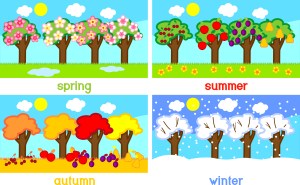
There is an important difference between Hebrew and Greek thought in the worldview of time. While Greek derived mindsets tend to think more linearly, Hebrew thought is more cyclical. Creation (nature) testifies of the latter.  As an example, the seasons are pictured in the graphic. They occur again and again in a cycle. Like the seasons, time and even prophecy is thought of as cycle with recurring themes rather than the common linear timeline that moves from the indefinite left that progresses to the indefinite right. Everything we can see moves in cycles, and Adonai uses cycles to teach us about unseen (spiritual) things (1 Cor. 15:46).

God’s calendar, His appointed times, are also cyclical. Before we delve into how women are connected to these cycles, let’s first look at how God has revealed time.

Adonai’s calendar is primarily based on the lunar cycle.[2] New months begin with sighting the first sliver of a new moon and mark out the appropriate timing of our festivals, fasts, and harvests. In other words, the moon keeps or guards our weeks, months, and years. The passage below chronicles Day 4 of creation. Those of you that have been following my posts or that are Creation Gospel students will notice that as the fourth day, God is establishing His government or authority in the luminaries. (And in His calendar.)

Then God said, “Let there be lights in the expanse of the heavens to separate the day from the night, and let them be for signs and for seasons and for days and years; and let them be for lights in the expanse of the heavens to give light on the earth“; and it was so. God made the two great lights, the greater light to govern the day, and the lesser light to govern the night; He made the stars also. God placed them in the expanse of the heavens to give light on the earth, and to govern the day and the night, and to separate the light from the darkness; and God saw that it was good. There was evening and there was morning, a fourth day. (Gen. 1:14-19)

Verse 14 states that one of the governing actions of the luminaries is to serve as signs, seasons, days, and years. I believe “days” and “years” are pretty self-explanatory, so let’s look at the “signs” and “seasons”. The Hebrew word for signs is ot (aleph, vav, tav). It literally means a mark, signal, omen, or flag. The heavenly lights declare not only the glory of God, but give us signals or warnings of things to come. So while they may help us to keep track of time (past), they can also point to or warn us of future events (prophesy).

The Hebrew word for seasons in verse 14 is moedim. I expect that most of my readers will be familiar with this word. These are our feasts and festivals.[3] Notice that in the very Beginning, Adonai established His calendar or His time clock on day four of creation. This is significant because our calendars govern our day to day lives. They dictate when we celebrate, when we rest, when we work, and when we gather together. If the Creator felt that His calendar required the actual sun, moon, and stars to guard, protect, keep, and mark His time, how much more should His people regard His calendar?

These appointments with the Creator give us LIGHT much in the same way that the sun, moon, and stars give us natural light. They truly separate the light from the darkness. If we ignore these appointments, we will have less light, less revelation. Remember, the natural things are meant to reveal spiritual truths. The guardians of God’s calendar speak to every creature on earth summoning us to come and meet with the King. David said it this way:

The heavens declare the glory of God; And the firmament shows His handiwork. Day unto day utters speech, And night unto night reveals knowledge. There is no speech nor language Where their voice is not heard. (Ps. 19:1-3)

In the very Beginning, the Creator preordained that we meet with Him certain times of the year. You only need to look up at the majestic sun, moon, and stars to see and know the season. Notice that at night the heavens reveal “knowledge.” This is the Hebrew word da’at. This type of knowledge is an intimate knowing and carries with it the idea of sacrificial love. It is the “bone of my bone and flesh of flesh” that Adam experienced with Chavah (Eve) and she conceived and bore a son. It is the loving knowledge that provoked Yeshua to become the sacrifice for His people. Because of the intimate nature of da’at, it cannot be completed without a woman. This type of sacrificial love needs a vessel to pour itself into and women are the natural imagery of a receiving vessel. (Hopefully, you can see men too in this imagery as part of the Bride.)

There is a cycle at work here that is meant to be a guide to God’s people. For our purposes, we will limit our study to the lesser light of the moon. Both men and women as the people of Elohim can be compared to the moon. But women have a unique association that I’d like to focus on. Since both the male and the female are revealed in The Woman in Scripture, we will see some overlaps in the two sex roles.

Moonbeams

He made the moon for the seasons (moedim)… (Ps. 104:19)

The moon has a special role to play in the guardianship role of the moedim (feasts). It is a master timekeeper of sorts. While the sun and stars also share in this responsibility, the moon beckons us to watch it a little more closely. As the nearest heavenly body to earth, the moon has mesmerized mankind since time immemorial. Sadly, many have fallen victim to the idolization of these heavenly bodies. They have failed to realize that these luminaries serve us, we are not meant to serve them.

The moon’s closeness and the fact that it governs our moedim make it quite mysterious. This becomes even more mystical when we consider that the brightest light in the night sky has no light of its own – it can only reflect the light of the sun. We will come back to this concept in a later post.

Since women’s bodies follow a lunar cycle (menses), the Sages have long concluded that women are uniquely associated with not only the moon and Adonai’s Festivals, but with time itself.[4] Let’s review what we’ve covered so far. As you read through my enumerations, ask yourself if any of these remind you of the role of women.

The moon:

  1. Sets boundaries for our months.
  2. Keeps or guards the moedim.
  3. Warns of things to come.
  4. Reflects the light of the sun.

I hope some of these facts caused you to think of the neqevah (female) and the ezer kenegdo from the Biblical Role of Women Part I and Part II. Or perhaps even the prophetic nature of women from Part V. One of the more obvious links between women and the moon is seen in the various PHASES in which both continually go through.

The regular arrival of the new moon and its growth to fullness, followed by its soon disappearance has long been a visible symbol of life, death, and rebirth. With every new moon, we see the necessity of being renewed (born again). This rhythmic clock sets our calendars with each cycle marked as a new month (moonth).

Like clockwork, women also go through phases each month. Similar to the moon, a woman’s phases are directly linked to life, death, and rebirth. Each month a woman’s womb prepares its “soil” for life and then sheds it (death) if no viable seed is planted — only to renew itself once again. This cycle repeats again and again. When a woman’s body is in the shedding stage of menses, blood appears. When the moon gives us a warning of judgment (death), it appears red. It’s not a coincidence that we call this a blood moon.

Not surprisingly, there are four primary phases of the moon with more elaborate depictions showing eight (a factor of 4). You can watch a quick video about these phases here.  Due to the length, we will examine each of the four primary moon phases and their relationship to the feast days and women’s cycles in Part II.


[1] Obviously, this isn’t always the case. However, in most of the families I have met, this is true. Whether she was home schooling the children and discovered these truths through in-depth Biblical and historical studies or by the gentle prompting of the Holy Spirit, it is usually the wife that first “sees” God’s calendar as relevant for the family.

[2] The Hebrew calendar does take the solar cycle into account to maintain the seasons. For an interesting article about this, click here.

[3] See Lev. 23

[4] These two articles speak to women and the moon. Women of the Wall and Aish. Women being associated with time in general is a two-fold concept. The first is simply what we’ve been discussing. Women are tied to time because YHWH made their bodies to mimic His time clock. Secondly, the rabbis ruled that women are exempt from certain TIME related mitzvot. We will explore this idea in a later post.

Categories: Moedim, Women | Tags: , , , , , , , , , | 24 Comments

Blog at WordPress.com.