Posts Tagged With: pesach

Miriam’s Cup Part I


          © Daniel Million | Dreamstime.com

This Passover season, I have given an often overlooked custom a second glance — well more like a long hard stare! Many of you incorporate the mystical and prophetic Cup of Elijah in your Passover Seders. For Believers in Messiah, this cup takes on even more significance because of John the Baptist. He truly paved the Way for Messiah at His first coming. Since we have already seen this “cyclical” prophecy fulfilled once, hopefully we will better be able to discern the spirit of Elijah in these last days.

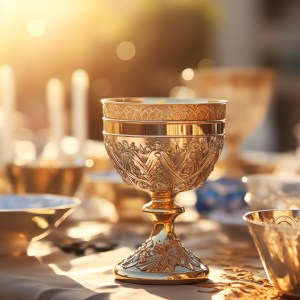
If you’ve purchased a special goblet with Elijah’s name written on it to use at your Passover Seder, you may have noticed another more obscure goblet inscribed with Miriam’s name. What is this cup for? Is it just to satiate liberals and feminists? Does this “new” ritual have any redeeming value? My hope is to show you the richness and beauty that this tradition can bring to your Passover table, and perhaps even to your weekly Kiddush.

The Cup of Miriam is not part of a traditional Seder, and I can find no mention of it in any of the feast books that I own. (But, don’t let that deter you from reading on!) According to Risa Borsykowsky[1] , the practice of drinking WATER from a special kiddush cup called Kos Miriam, began with Stephanie Loo Ritari and her Rosh Chodesh Boston group in the late 1980s. Reading through the Exodus, one can find numerous righteous women that played significant roles that led up to the redemption of Israel from Egypt.[2] Mrs. Ritari decided to bring these “hidden” women into the “retelling” of the Passover story to not only honor the matriarchs, but as a tool to make the Seder more comprehensive for women and girls. The most prominent woman of the Exodus story is Moses’ sister, Miriam. Therefore, she will be our focus in this study.

The Bible calls Miriam a prophetess of Israel.[3] She alone ensured that baby Moses would live by following him as he floated down the treacherous Nile River.[4] She watched as Pharaoh’s daughter drew Moses from the water, and then cunningly secured Moses’ own mother as his wet-nurse. She helped sustain the Israelites during their trek across the wilderness and she led them in joyous song and dance to praise YHWH for the miracle of parting the Red Sea. Upon her death, the Israelites grumbled against Moses and Aaron for a lack of life giving water.[5]

Did you notice the many connections of Miriam with water?[6]

Though her name can mean bitterness or even rebellion, the Hebrew also reveals that there is another (positive) side to Miriam. This should give hope to us all, as we each have both a good and evil inclination that wars for supremacy. To learn the duality of Miriam is to understand the ancient contradiction of what it is to be human. We all share the life long struggle between spirit and flesh.

Moreover, we would be wise to consider that other than one bad instance, Miriam’s portrayal of rebellion and bitterness was toward the anti-torah decrees of Pharaoh.[7] She and her family risked their lives by rebelling against Pharaoh. The midwives Puah and Shifrah acted similarly by defying Pharaoh’s edict to kill Hebrew male babies. It is interesting that it was the fearlessness of WOMEN that initially ignited the courage of all Israel. These brave lionesses stood firm and earned a spot forever in the Torah of our Elohim. Why would we leave their stories out of our maggid (retelling of the Passover story)?  Would our daughters not be strengthened to hear year after year that they too have this great potential residing within them?

Miriam and Water

As I was studying the many links between Miriam, water, wells, fountains, the Holy Spirit, the Word, Yeshua, and Living Waters, I could hardly contain my excitement! Miriam is spelled mem, resh, yod, mem. Water is spelled mem, yod, mem.

Did you notice how similar these words are in Hebrew? Miriam is water with an added resh, which is pictographically a head. Thus, her name is literally head or lead waters. This meaning can also be demonstrated another way in Hebrew by looking at Miriam as a compound of two words: mar and yam. These words mean bitter/strong and sea (waters) respectively. Hence again, Miriam is associated with the idea of strong (head) waters.

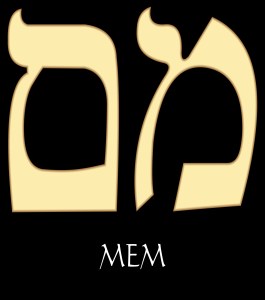
But what do strong waters imply and what are we to learn from this association? In order to get the full impact of Miriam’s role and name, we must first understand WATER from a Hebraic perspective. Mayim (mem, yod, mem) is a word bookended with two mem(s). The Hebrew letter mem is likened to water, a womb (it’s full of water), strength (as in gushing waters), chaos (again like an ocean), and as a preposition “to come forth from or out of”. This letter is one of a handful that has a sofit or final form when it is written at the end of a Hebrew word. A regular mem is open on the bottom, whereas the final form is closed.

    © Shalom3 | Dreamstime.com

Rabbi Michael L. Munk, in his book The Wisdom of the Hebrew Alphabet on the letter mem, states, “The word mayim, water, with its initial and end mem, one open and one closed, depicts the accessible and the inaccessible – an allusion to the waters at Creation.” Thus, mem also illustrates what is revealed and what is concealed. Add to that the letter at the heart of mayim, yod (a hand, work, or deed), and the Creation waters (and all water thereafter) become the same contradiction that we see in Miriam’s name: a work or deed that has the potential for life (strong living waters) or death (bitterness and rebellion).

Water is a place of darkness and yet, great potential in Creation and in a woman’s womb. It can be as powerful and destructive as a roaring ocean and as gentle and satisfying as a trickling stream. It is at the same time both a life giving necessity and a place where chaos and death reign (like at sea). If you read my posts on Crate Trained Believers and The Devouring Lion, you may have noticed the similar imagery. Gentle AND Fierce.

Interestingly, the Hebrew word for mother, em (aleph, mem), also has the pictographic meaning of strong waters.[8] It seems as though the very fact that women have a womb that can fill with life giving waters connects them to Miriam.[9] Females made in the image of Elohim are “mothers” of all living. However, like our sisters Chavah (Eve) and Miriam, we also have the potential to bring chaos and death. (Like a tumultuous ocean.) One must learn to turn life’s bitter unruly waters into sweet waters of refreshing. By the way, this is also something men need to learn as well, for both men and women are revealed in the woman as the wife and bride of the Lamb.

This is the real Biblical portrayal of Miriam, the sister of Moses. She is truly a mother to the Israelites and a leader of her people.[10] Since the force and strength of her name is better understood, does this lend fresh insight about Mary (Miriam), mother of Yeshua? Isn’t it fitting that Yeshua should come forth from a womb such as this? How about the many other “Mary’s” mentioned in the Brit Chadashah (N.T.)? Will their stories speak a little louder the next time you read them?

There has been a tendency for us to forget that the Body needs both masculine and feminine leadership to keep us in balance and to display the whole image of Elohim (God). It is females that bring qualities such as comfort, nurture, protection, and mothering to the Body of Messiah. They are fierce AND gentle. Without these essentials, we raise nothing more than Devouring Lions.

Miriam is a representation of strength, the womb, mercy, prophecy, and praise. The ancient sages recognized the vital role of women in the Exodus in the Babylonian Talmud, Sotah 9b:

“If it wasn’t for the righteousness of women of that generation we would not have been redeemed from Egypt”

The rabbis recognized the very thing examined above: women were the progenitors of Israel’s redemption from Egypt.[11] I hope that you will include Miriam’s Cup in your Seder or even in your weekly Kiddush as a commemoration of her vital role in the Exodus and as a role model to your daughters, sisters, mothers, and wives. But, if this isn’t enough to convince you, there is so much more! In Part II, we will look at how water is associated with the rock in the wilderness, the Holy Spirit, Wisdom, and Pesach.


[2] There is Yocheved, the brave midwives (Puah & Shifrah), Miriam, and Tzipporah. See also footnote 6.

[3] Ex. 15:20

[4] Obviously, the Holy Spirit is what provoked Miriam to do this!

[5] Num. 20:1-2  Then the sons of Israel, the whole congregation, came to the wilderness of Zin in the first month; and the people stayed at Kadesh. Now Miriam died there and was buried there.  (2)  There was no water for the congregation, and they assembled themselves against Moses and Aaron.

[6] D. Hollisa Alewine’s Workbook 5 The Torah Portions Volume 2 –Shemot p.7-21 (2013) offers an interesting perspective on the women of the Exodus and Miriam in particular. If you’re ready to dig deep, buy this series and uncover a multitude of treasures.

[7] Numbers Chapter 12.

[8] See Hebrew Word Pictures by Frank T. Seekins (2003) p. 62

[9] The Hebrew word for womb, racham, ends with the letter mem. This is the same Hebrew word for mercy or compassion. Indeed the watery womb is a place of protection, growth, maturity, and nurture. This word shares the resh and mem with Miriam only adding a chet, which is a fence or boundary that protects.

[10] Micah 6:4  “Indeed, I brought you up from the land of Egypt And ransomed you from the house of slavery, And I sent before you Moses, Aaron and Miriam.

[11] This makes perfect sense considering the “birthing” nature of women.


Categories: Moedim, Women | Tags: , , , , , , , , , , , , , , , | 9 Comments

Torah Portion: Shlach L’cha

Torah Portion for June 1st, 2013

Numbers 13:1-15:41; Joshua 2:1-24; Heb. 3:7-19

Hebrew Names

Anytime there is a long list of Hebrew names or genealogies given in scripture, many are tempted to just skip over them and move on to the “meat” of the story. How sadly mistaken they are! Hebrew names have meaning and they usually tell a beautiful story. The list of names given for the spies is no exception. First, the tribes are not listed in their birth order, a hint that should stand out to the reader. Here is the list with the corresponding Hebrew meaning.

  • Shamua —-  Name, character
  • Shaphat —-   To judge
  • Caleb —-     Like the heart
  • Yigal —-     He redeems
  • Hoshea —-   Salvation; saves
  • Palti —-  My deliever
  • Gadiel —-  El (God) of the assembly; troop; army
  • Gadi —- My good fortune
  • Amiel —-  El (God) of my people
  • Setur —- Hidden, concealed
  • Nakhbi —- Refuge
  • Geuel —- El (God) is exalted; lifted high

This is the story hidden in the Hebrew names of the 12 spies.

The Name of the judge of our hearts redeems and saves, for He is our deliverer. The God of our assembly is our good fortune. The God of our people conceals us in His refuge. Exalted be our El (God)!

Thus, Hebrew never ceases to amaze me….

The Spies and a Pinch of Fear

Shlach L’cha literally means “send for yourself.” In this case, it refers to Moses sending out twelve men to “spy out” the land of Canaan. The Hebrew word for “spying out” in verse two is “toor” (tav, vav, reysh). It would be better defined as “seeking out, touring, or exploring.” In fact, our English word “tour” sounds exactly like the Hebrew word in question. Could it be derived from “toor”? Perhaps. Consider for a moment the difference between touring or exploring and spying. The latter implies something much more strategic and militant while the former implies something much more casual.

The irony is that Moses actually did send the men out as “spies” on a military reconnaissance mission regardless of the true meaning of the Hebrew “toor.” (Num. 13:17-20) This mission will end up costing Israel a 40 year longer stay in the wilderness. What I hope to show you is that this mission was doomed from the start. While our portion seems to be unclear as to whose idea this mission is attributed to, Deuteronomy 1:22-23 gives more details. Once again, it was the people’s lack of faith in the promises of YHWH that cost them dearly. Even though YHWH had told them to go and take possession of the land and to do so without FEAR, they did exactly the opposite. (Just as we often do!)

Even Moses was caught up in their “fear.” In Dt. 1:23, Moses says their idea of a recon mission also pleased him. The problem was that their spiritual eyes were closed. In the natural, the people of Canaan were strong and many. Their cities were large and fortified. Yet the land was good, flowing with milk and honey, just as YHWH had promised. But, the majority couldn’t see past the obstacles. There was a GIANT stumbling block in their path: the enemy. The problem seemed too large and too difficult for them to overcome.

How often do we feel this way about various circumstances and problems in our own lives? How often are we like the ten spies after taking a survey of our own circumstances? Things seem impossible from our perspective. We justify our lack of faith by telling ourselves or saying that we are being sensible or realistic. Perhaps we even conclude that the promise isn’t really for us.

The real enemy is FEAR. This Shavuot (Pentecost 2011), Dr. Hollisa Alewine taught our congregation The Creation Gospel. One point that really stuck out for me was the seventh branch on the menorah. This branch in her thematic study corresponds to the seventh day of creation (Shabbat), the feast of Sukkot, the Spirit of Yirat Adonai (Fear of YHWH), and the church of Laodicea in the Book of Revelation. She pointed out that when we fear anything other than YHWH, we are operating from the wicked lamp.[1] In other words, when we fear man or circumstance we can only produce rotten fruit.

How I struggle with this! There is fear of the unknown, fear for the future, fear for our children, fear for our nation, fear for our finances, fear for our health, fear of death, fear of what others think, fear of ridicule, fear of weather, fear of government, fear of our enemies, fear of…  you name it. I personally suffer from occasional anxiety. This is a form of fear whether it begins with physical imbalances or not. But, we are called to be overcomers and we are told over and over in scripture to “fear not!” I dare say that this is one commandment that even Torah keepers struggle with regularly. Sadly, ungodly fear is usually justified one way or another. As Dr. Alewine said on Shavuot, “There are boogers around every corner!”

Once again we find ourselves wearing the very shoes of our Israelite counterparts. We are just like them. Although we like to think that we are like Caleb or Joshua, we really are more likely to be one of the ten bringing a bad report and causing even more of our brothers and sisters to falter with us.

There is only one remedy of our malady: we must learn to fear YHWH and fear Him alone. After all, the beginning of wisdom is the fear of YHWH. (Ps. 111:10; Pr. 9:10)

Creation Gospel’s Seventh Branch

Shabbat

This portion has caused me to mediate on the menorah and the thematic counterparts to Yirat Adonai (Fear of YHWH). I’d like to begin with Shabbat. Shabbat is the day YHWH set apart for rest. It is holy, it is a sign, and it is the seventh day of the week. Yeshua declares Himself  “Adonai (Lord) of the Shabbat day” (Mt. 12:8; Mk. 2:28; Lk. 6:5) What are we really resting in on this day? The finished work of Messiah. There can be no fear when we are resting in Him. Selah. There is nothing like entering in to worship the King of the Universe at His appointed time: Shabbat. Sure we can experience sweet worship any day and at any time, but there is something different about that worship when He appoints it, when He has declared that time sacred. There is absolutely no fear (of man & circumstance) when we adore and show our love to our King. (1 Jn. 4:18)

Sukkot

Sukkot (Feast of Tabernacles) is the seventh feast and it lasts for  seven days. Therefore, it is thematically linked to the 7th branch of the menorah and Shabbat, in The Creation Gospel model. It is not a coincidence that this feast commemorates the children of Israel living in tents or booths in the wilderness. Since the setting of our portion is the wilderness and the sin of the evil report by the ten spies, it becomes even more apparent that we need to learn from their example. (Heb 4:11; 1 cor. 10:5-6; Heb. 3:8-10)

Sukkot is also called the Season of our Joy. It is the last of the 3 pilgrimage feasts and looks forward to the future millennium when the overcomers shall rule and reign with Yeshua for 1000 years. This is pictured in Caleb and Joshua. We desire to persevere and come into the Promised Land! We cannot do this without Yirat YHWH.

Yirat YHWH

The seven spirits of God are given in:

Is. 11:1-2  And there shall come forth a rod out of the stem of Jesse, and a Branch shall grow out of his roots:  (2)  And the spirit of YHWH shall rest upon him, the spirit of wisdom and understanding, the spirit of counsel and might, the spirit of knowledge and of the fear of YHWH

These are the attributes of the one Spirit of God. As stated earlier, the fear of YHWH is the beginning of wisdom. Therefore, we cannot reach the last branch of the menorah without first experiencing the first branch: wisdom. This branch is thematically linked to Pesach (Passover), day one of creation, and the church at Ephesus. We all must first apply the lamb’s blood to our doorposts to begin our journey of redemption, sanctification, and eventual restoration.

Fear of anything other than YHWH is of the enemy. It is a lack of trust and faith in our Adonai. The following quote comes from the corresponding Deuteronomy text for our portion. Moses is recapping the mistake of the spies.

Dt. 1:28-32  Whither shall we go up? our brethren have discouraged our heart, saying, The people is greater and taller than we; the cities are great and walled up to heaven; and moreover we have seen the sons of the Anakims there.  (29)  Then I said unto you, Dread not, neither be afraid of them.  (30)  YHWH your God which goeth before you, he shall fight for you, according to all that he did for you in Egypt before your eyes;  (31)  And in the wilderness, where thou hast seen how that YHWH thy God bare thee, as a man doth bear his son, in all the way that ye went, until ye came into this place.  (32)  Yet in this thing ye did not believe YHWH your God

If the children of Israel had feared YHWH and not the inhabitants of the land, things would have been much different. How often would our circumstances have been different if we had only trusted in our God, YHWH? Perhaps we too are often left in our own wildernesses for an extended amount time when our breakthrough was just past the Canaanites that we were too afraid to fight.

Laodicea

Laodicea was the seventh and last assembly written to in Revelation. Please read Revelation 3:14-22. Laodicea means “justice of the people”. Already we have a problem; YHWH/Yeshua is our law-giver, He is our judge, and He metes out the only righteous judgment. Laodicea is thematically linked to Shabbat, Sukkot, and the spirit of the Fear of YHWH.

Notice that Yeshua mentions no clean works for this assembly. Instead, He says they are neither hot nor cold and this makes Him want to vomit. Wow. Essentially, they are lukewarm; lukewarm is a mixture of hot and cold. The Laodiceans probably feel they are “just right” or very comfortable. As a matter of fact they say just that:

Rev. 3:17-19  For you say, I am rich, I have prospered, and I need nothing, not realizing that you are wretched, pitiable, poor, blind, and naked.  (18)  I counsel you to buy from me gold refined by fire, so that you may be rich, and white garments so that you may clothe yourself and the shame of your nakedness may not be seen, and salve to anoint your eyes, so that you may see.  (19)  Those whom I love, I reprove and discipline, so be zealous and repent.

The assembly of Laodicea believes she is prospering and doing well. Sadly, she is seriously mistaken and is quite blind. Because this assembly has material wealth, their every need is met by their own works or prosperity. Having great prosperity is synonymous with godliness in the eyes of this church. (Sound familiar, America?) Yet, Yeshua couldn’t commend them on even one clean or good work.

Their worldly desire for prosperity had actually left them wretched, miserable, poor, blind, and naked. Yet they didn’t even know it!! Think about this. Yeshua is obviously speaking of their spiritual condition. They think all is well and they don’t even have clothes to wear! He encourages this church to buy “gold” (a play on their worldly lust for $$) refined by His fire.

What is this gold Yeshua speaks of?

Ps. 19:7-10    The law (Torah) of YHWH is perfect, converting the soul: the testimony of YHWH is sure, making wise the simple. (8)The statutes of YHWH are right, rejoicing the heart: the commandment of YHWH is pure, enlightening the eyes.  (9)  The fear of YHWH is clean, enduring for ever: the judgments of YHWH are true and righteous altogether.  (10)  More to be desired are they than gold, yea, than much fine gold: sweeter also than honey and the honeycomb.

It was almost as if David wrote this Psalm just for the Laodiceans. He tells us what is perfect and converts our souls: YHWH’s Law (Torah). This is because the Torah defines what sin is. Therefore, one may turn and repent. What is the remedy for blind eyes? According to David, it is the commandments of Adonai. It is apparent so far that even though the Laodiceans believed that they were “good” and lacked nothing, they didn’t have YHWH’s Torah in their hearts. Otherwise, their eyes would be open to their sin and they would realize their wretched condition and repent.

Moreover, this Psalm speaks of YHWH’s judgments. The very name of this assembly (Laodicea means “justice of the people”) speaks volumes about their source of authority: the people. The people decide what is best, what is good, what is prosperous. But, they are blind! YHWH is the only righteous judge. He decides what is good, not us. He decides what is holy, not us. He decides how He is to be worshipped, not us. Doing things His way, walking out His Torah (instructions), fearing Him and not man, and setting Him as our judge and not man or religious institutions is more desirable than much fine gold and sweeter than honey. Repent! Turn back to Him, His ways, His Torah, and receive fresh white garments and salve for your eyes.

Yeshua has more to say to Laodicea. He stands at the door and knocks and desires to “dine” with the Loadiceans. In Hebrew thought, this is a direct reference to a covenantal meal. What meal does Yeshua desire to eat with us? The marriage Supper of the Lamb at a future Sukkot. This meal is also thematically linked to the Pesach (Passover) seder, the beginning of our redemption where a meal is first shared. Passover is our redemption, Shavuot is our betrothal, and  Sukkot is our marriage and consummation. This is all three pilgrimage festivals.

Rev. 22:14  Blessed are they that do his commandments, that they may have right to the tree of life, and may enter in through the gates into the city.

Rev. 22:17  And the Spirit and the bride say, Come. And let him that heareth say, Come.

Caleb & Joshua

Caleb and Joshua saw the exact same things as the other ten spies, yet their report was positive. They tried to quiet the fear of the people with their optimism, but the people would rather wallow in their own fears. They even  prepared to stone Caleb and Joshua  just to get them to shut-up. (14:10) Misery truly does love company, and Caleb and Joshua were uninvited guests. But the people didn’t govern the lives of Caleb & Joshua; YHWH did, and it was His glory that came to their rescue.

Again, we are just like the Israelites. I know many people that truly wish to shut the mouths of those that are eternally optimistic. They would rather discuss the new scary booger they spotted on the internet and the big booger in the White House or the millions of boogers in the Middle East. Some think that big black helicopter boogers are watching their every move; others are worried about one world boogers, and even more fear famine and stock pile so green slimly boogers never touch them. Boogers are everywhere and they are big, they have fortified cities, and they even live in the Land of milk and honey. Just change booger to Canaanites or name your own favorite scary booger. They are all fear of man or circumstance.

One thing is certain: Caleb and Joshua were more afraid of YHWH than big, slimly, green boogers. They are our positive model and example. In order to be like Caleb and Joshua, we don’t have to walk around with our head in the clouds; we see everything the other ten see. The difference is in whom we fear most. If we fear YHWH more than men or our circumstances our spiritual eyes will be open and we too will say, “We should by all means go up and take possession of it, for we will surely overcome it!” (13:30)

We will also encourage our brethren, “Only do not rebel against YHWH. And do not fear the people of the land, for they are bread for us. Their protection is removed from them, and YHWH is with us; do not fear them.”

If we would fear YHWH, that obstacle would become our “bread.” It will feed us! It will give us strength and sustain us. Why? Because any time we trust YHWH we exercise our faith, which prospers one spiritually. Hence, our faith removes the shadow of protection from our enemies and we become victorious.

I know I still have much to learn in this area, but I desperately want to be like Caleb and Joshua. We can’t let our eyes deceive us or focus on what “appears” to be happening in the natural. Just because I can see that big gooey booger hanging over my head doesn’t mean that it’s there to harm me. If I start telling everyone that any day that booger is going to fall on my head, well then, it just might! I fear the booger more than YHWH.

However, if I believe YHWH loves me and has my best interest at heart and that He would never let a booger hang there day after day without a GOOD reason, then my fear is alleviated, I’m not spreading fear to my fellows, and one day YHWH might just show me that the booger was the glue that kept the chandelier from falling on my head. In this way, it sustained me (it became my bread).

The truth is that anything we fear we have made holy. We have set that thing apart. Think about something you fear or worry about often. By focusing on the circumstance and not Elohim, we have made that thing holy or set apart. It has displaced YHWH’s rightful place in our lives. When we are tempted to dwell on our circumstances we must remind ourselves that YHWH sits on the throne, not our past, not our finances, not our health, not our job, not our enemies, and not our families.

There is one last important detail about this story. After the ten evil spies died from a plague sent by YHWH, the people repented and decided they would now do what YHWH had said and take possession of the Land. BUT, the consequence to their sin was forty more years in exile in the wilderness. Actually, their lack of faith cost them the Promised Land altogether; in as much as those twenty years and older would die in the desert before their children would enter the Land.

I think this happens with us as well. YHWH tells us to do something. We are afraid. We take a survey of the situation and we are even more afraid. Boogers are everywhere; we’ll never make it. We begin telling others of the booger danger. We are out of line and in sin. We suffer because of our lack of trust. Suffering brings us to our senses and we repent. Now we think we will go and do what YHWH said. But, it’s too late. YHWH is no longer with us in this matter. He has moved on to something else. If we go anyway, the boogers will beat us down as far as Hormah. (14:45)

Tzit-tziot

We must follow the cloud. Turn when it turns, stay when it stays. In the last part of this Torah portion, the commandment of wearing the tassels, fringes, or tzit-tziot are given. This is a physical commandment about an article one wears on the four corners of their garment. YHWH is clear as to “why” He initiates this statute.

Speak to the sons of Israel, and tell them that they shall make for themselves tassels on the corners of their garments throughout their generations, and that they shall put on the tassel of each corner a cord of blue. “It shall be a tassel for you to look at and remember all the commandments of the LORD, so as to do them and not follow after your own heart and your own eyes, after which you played the harlot, so that you may remember to do all My commandments and be holy to your God. “I am the LORD your God who brought you out from the land of Egypt to be your God; I am the LORD your God.”(Num. 15:38-41)

Do you remember the Hebrew word “toor” translated as “spies” at the beginning of our portion? The high-lighted text above uses the same Hebrew word “toor” for seek, follow after, search, or go about. Moses sent men to “spy” out the land of Canaan. YHWH issues us a command to wear a cord of blue on the four corners of one’s garment, so that in seeing the blue cords one is reminded NOT to “spy” with their own hearts and eyes. Doing so makes one a harlot. When we fear anything other than YHWH it becomes our god, thus we commit spiritual adultery.

Though our eyes and hearts might perceive boogers or enticing lusts, we mustn’t stray from our God or His commandments. Wearing tzit-tziot is a physical reminder of a spiritual reality. The blue cord is a reminder of the heavenly tabernacle, our heavenly high priest, and our heritage as a kingdom of priests. Priests are witnesses to YHWH, not boogers. We can choose to see boogers or we can choose to fear YHWH our Elohim.

It is important also to realize that when we trust in YHWH our savior, He protects us. He is truly our deliverer and our refuge. Remember the story told in the Hebrew names of the spies? YHWH conceals us from all the boogers. We are His special treasure, if we will learn to fear Him.

If we look at Caleb and Joshua’s names in Hebrew, the message of the good spies is clear. Joshua is a cognate of the Hebrew word Yeshua or “salvation.” Caleb’s name (kalev) is a contraction of two words: kal, meaning all and lev meaning heart. If we put these names together, we get “Yeshua, salvation, is for all hearts.”

Caleb’s name has even deeper implications. The lev in Hebrew is not the physical blood-pumping heart but is more akin to the mind. Truly it is our minds that need saving. Joyce Meyers is right about one thing: the battle truly does begin in the mind. A saved mind CAN overcome as Joshua and Caleb did!

Even more interesting is that the name kalev (Caleb) is a derivative of the Hebrew word for ‘dog’ (kelev). Remember, Caleb’s name means “all heart.” You see, Caleb followed YHWH wholly with all his heart. Caleb’s name certainly fits his character. Is that not also the nature of (good) dogs? They always come back to their master, ready to serve Him with all their heart. Where He goes, they go, without nary a complaint.

While dogs often have negative connotations in scripture, this sheds new light on Yeshua’s comments about the “dogs eating the crumbs that fall from the master’s table.[2] Could this be an allusion to the fact that no matter who you are or where you are from, if you seek the Master with all your heart, you too, will have bread from the Master’s table? And, what about our two “good” spies, Caleb and Joshua? They are two faithful witnesses. Only their tribes, Judah and Ephraim/Israel, are mentioned by name in the New Covenant.[3] Together, their names suggest that YHWH’s witnesses follow Yeshua with all their heart!

May we become a generation of Caleb’s and Joshua’s!


[1] Proverbs 6:16-19

[2] Mt. 15:22-28; Mark 7:24-30

[3] Jer. 31:31; Hebrews 8:8 I’m not implying here that the other tribes or even those from among the nations are lost and don’t have a covenant, but rather as these verses attest, that we are joined (grafted-in) with one of these two houses of Israel which the Father is making into one New Man. (Rom. 11; Eph. 2)

Categories: Torah Portions | Tags: , , , , , , , , , , , , , , , , , , , , , | 3 Comments

The Biblical Role of Women Part III

Role of Women Main Page 

In order to properly follow my thoughts in this section, please first read Part I and Part II. I’m sure the last section elicited some pretty strong emotions in most readers. If my conclusions made you angry or perhaps even fearful, I suggest you prayerfully study the Genesis text yourself with a good Bible program. (There are free ones online!) Even if you don’t understand a lick of Hebrew, these tools will enable you to investigate the original language. It is amazing what a little effort lends to proper interpretation and understanding. I fully believe that YHWH made each of us with the ability to question. While questioning tradition and the Biblical text may feel like an irreverent act, I assure you that it is not. How else does one arrive with an answer unless one first asks a question? As any good teacher will tell you, there are no stupid questions, only stupid answers.

Modern Christianity and her many denominations usually frown at questions that challenge her set doctrines, creeds, and traditions. Don’t rock the boat; we don’t handle storms very well. But our Adonai (Lord) has no fear of storms; He is fully capable of calming the raging winds and rains with a simple Word. Moreover, it is in the midst of these strong winds that He invites us to join Him to walk on the water[1]. And, we are fully capable as long as our focus remains on Him and not the swirling circumstances around us. I invite you to challenge your current doctrine and tradition. Our thoughts are not Adonai’s thoughts;[2] He is infinitely greater than we can possibly imagine. Only fear and pride would cause one to think they have cornered Him with theology and tradition. Didn’t Paul say that we currently only see in the mirror dimly?[3] We must always be willing to let the Word mold and change us (and our doctrine, beliefs, and traditions).

Teshukah Revisited

This section was updated and revised 2/2022.

Teshukah was discussed in the last section, but it deserves a deeper treatment for the best understanding. Below, is Strong’s definitions for teshukah and its root, shook. Then, below that is the entry from the Ancient Hebrew Lexicon of the Bible.

H8669    תּשׁוּקה tesh-oo-kaw’ From H7783 in the original sense of stretching out after; a longing: – desire.

H7783     שׁוּק shook A primitive root; to run after or over, that is, overflow: – overflow, water.

AHLB#: 1479-J (V) ac: Drink co: River The pictograph “shin” is a picture of the two front teeth representing the idea of two, the “Quf” is a picture of the sun at the horizon that cycles around the earth. Combined these mean “repeat a cycle”. During the rainy season, repeated each year, the riverbeds become full of water. The surrounding land is soaked with water allowing for the planting of crops. Rushing: From the rushing of a river. [freq. 1] |kjv: running| {str: 4944} Drink The life giving water from the rivers. Overflow: The overflowing of the banks of a river. [freq. 3] (vf: Hiphil) |kjv: overflow| {str: 7783} Desire: As a course. [freq. 3] |kjv: desire| {str: 8669}

In Hebrew, teshukah is rooted in the action of running and overflowing. It is also related to repeating a cycle, which is like a habit or in our case, a habitual or seasonal overflowing. It can also denote a habitual running toward something (or someone). While often translated as desire, the sense is more akin to a powerful turning toward. The imagery of water flowing powerfully in a flood depicts the destruction that teshukah can take if one’s focus or affection is set on the wrong thing. Consider the work of Katherine Bushnell, God’s Word to Women:

The Pentateuch of the Septuagint… renders teshuqa into the Greek word apostrophe in both passages in Genesis [3:16, 4:7]: and epistrophe in Canticles [Song of Songs]. The former word, apostrophe, is familiar to us all: it means “turning away,” and the latter, “turning to.” The teaching is, that Eve is turning away from God to her husband, and, as a consequence of that deflection, Adam will rule over her. Next in order of excellence is the SYRIAC PESHITTO of the second, or perhaps first, century after Christ. This version gives the same sense, rendering, “thou shalt turn,” (Genesis 3:16); “will turn” (Genesis 4:7), and “turning” for the third passage. We have only the Pentateuch in the SAMARITAN version. It translates both the passages in Genesis, “turning.” The OLD LATIN version gives “turning” in all three places. We have a COPTIC (Sahidic), of not great value, which gives the same rendering for the first and third passage; and the more valued BOHAIRIC COPTIC which so renders the passage in the first two. These two copies are not complete Bibles, but fragments. The AETHIOPIC version of about 500 A. D. renders all three passages by words signifying “turning.” In fact, as regards the third passage, all the ancient versions without any exceptions whatever, give no other sense but “turning” for teshuqa.

Bushnell says, “The teaching is, that Eve is turning away from God to her husband, and, as a consequence of that deflection, Adam will rule over her.” Look at Genesis 3:16 again and remember that God is telling Eve about the consequences of her sin. He wasn’t speaking to Adam. According to Bushnell’s research on teshukah, Genesis 3:16 could be translated as: “Your turning shall be toward your husband, and he shall master you.”

Instead of turning to God, Eve’s propensity will be to turn to Adam, and when she does, he will rule over or master her. I find this most disturbing because I have witnessed this happen in the lives of some of the women that I love. A woman’s husband was never meant to be her god, mediator, or her master (not in the enslaving sense). Even Yeshua emphasized this when He said, “No one can serve two masters…” (Mt. 6:24) It is a curse to put your husband on the throne of your heart. This lofty place is reserved for Adonai  alone.

A woman must be careful that her desire, longing, and turning is first and foremost toward God. Only then can she be the wife she was designed to be. The moment she longs for, desires, and turns to her husband to provide the needs that only God can fulfill, he will rule or master her as surely one’s emotions or lower nature will do the same. Sadly, there are plenty of deluded men (and women) out there, claiming to serve YHWH, that will tell you that it is their God given duty to do just that.

Walter Kaiser puts it this way:

Rather than viewing this as a normative and prescriptive text found in the Mosaic Law and revealed by God, it is in a curse passage that predicts what will happen when women “turn” toward their husbands instead of turning to God.  In effect, if God were explaining this in today’s plain speech, God might have phrased it thus: “The truth is that, as a result of the fall, do not be surprised, my good lady, if that guy just plain lords it over you.”[4]

So, what is the difference between Chavah’s desire and the desire of Cain’s anger?

Mashal

This section was added 2/2022.

“Your desire shall be toward your husband, and he will rule (mashal) over you.” – Gen. 3:16

“Its desire is for you, but you must master (mashal) it.”  – Gen. 4:7

Mashal means to rule or master, and it is the word used in the account of Chavah’s desire and Cain’s anger. But, this word also means parable. In Hebrew, the Book of Proverbs is called Sefer Mishlei, from mashal. It is literally, the Book of Parables. Parables are designed to rule or master one’s thinking. They are meant to turn one from worldly wisdom and toward godly wisdom. They are a tool used to teach a spiritual, higher message to those with ears to hear. Parables bypass the natural man, and turn him toward the heavenly design. Thus, it is not a coincidence that God used mashal in Genesis 3:16 and 4:7. These passages are centered on relationships, the core of family dynamics which move outward into the greater realm of societies. Thus, there is a VERY important spiritual truth in these passages that is meant to guide or rule one’s thinking process. If one is ruled by worldly wisdom and selfish ambition (James 3), they will miss the point of the parable.

Ecc. 12:9-11 (NASB)  In addition to being a wise man, the Preacher also taught the people knowledge; and he pondered, searched out and arranged many proverbs.  10  The Preacher sought to find delightful words and to write words of truth correctly.  11  The words of wise men are like goads, and masters of these collections are like well-driven nails; they are given by one Shepherd.

Parables offer one DISCERNMENT between two like things, that are in reality world’s apart. For example, the Book of Proverbs personifies wisdom and folly as two women. They have similarities, but also great differences. One must learn to discern the difference in their own heart or they will fall into the many traps of woman folly.

In The Scarlet Harlot and the Crimson Thread, Dr. Alewine teaches the dichotomy between the righteous woman and the harlot, and between the man and the beast. The beast and the harlot are ruled by the lower nature. They are earthy, natural, and spiritually dull. One must come to understand the similarities that they share with the beasts of the world. They like to eat, to sleep, to procreate, play games, and expand territory. None of these things are evil. They are God given instincts that ensure the continuation of life in a beast. Mankind has all of these drives and inclinations too. The difference is that man was designed to live  by every Word that proceeds from the mouth of God. In other words, man has a need for more input or instruction.

Man’s beast like instincts, desires, emotions, and intellect are to be governed by God’s Word. The Torah (instructions) sets forth rules, regulations, and boundaries that govern when a man eats, sleeps, procreates, plays games, and expand’s territory. Without God’s input (His Word), man will live solely by the instincts of the beast. This is the question of Day 6, the number of the beast and of the man: Are you the image of a beast? Or, are you a man created in the image of Elohim? That is the essence of the parable or mashal in the Book of Proverbs, and in these passages of Genesis.

God specifically told Cain to rule or master his anger. Emotions are wonderful servants, but wicked masters. They come from the realm of the lower nature (flesh), and must be governed by the Word of God or they will lead to great sin. In Cain’s case, his anger led to murder. What many fail to recognize is that Adam was also angry. He was angry at Chavah because he ate the fruit, and he was mad at Adonai because He gave the woman to him. Anger is a secondary emotion of fear. When one is afraid, the hind brain governs thinking and actions, which is akin to the beast/lizard brain. If we look closely at the responses of the man and the woman after the fall, both blamed someone else for their actions. Neither took responsibility for what they did. We have all inherited this inclination.

Consider that God questioned Adam and Chavah before He ever mentioned the “curses” or consequence of their sin. What would have happened if Adam and Chavah had taken responsibility for their own actions and choices, and sought to rectify the damage they had caused the other person instead of blaming others out of self preservation? Would the consequences of their sin have been different too?

In the account of the fall, neither Adam or Chavah demonstrated teshuva or repentance. Neither sought to restore or cover the other’s transgression. The path they chose was death, not life. On this path, their God given functions, roles, and purposes would be frustrated. Their thinking, attitudes, and actions would have to change and turn back toward God’s design (repentance) for blessings to flow forth. Isn’t that what God told their son, Cain?

“Then Adonai said to Cain, “Why are you angry? And why has your countenance fallen? If you do well, it will lift. But if you do not do well, sin is crouching at the doorway. Its desire is for you, but you must master it.”” (Genesis 4:6-7, TLV)

If you do well (tov -good), your feelings will change. Anger will lift. We must make decisions based on, “It is written,” not on “I feel.” Emotions have teshukah as they are part of the nephesh/soul. This is a powerful force that turns one toward the whims of the flesh and away from the Word of God. Fear and shame have the same power. Everything within a beast seeks to preserve its own life, even if costs other people theirs. If one chooses to live by this image, curses will continue. Cain did not rule over his anger, and it escalated to murder. This caused an even worse consequence or curse. He became a vagabond and a wanderer, Hebrew words related to quivering, being tossed around, shaking, and groaning (Gen. 4:12). That is one miserable soul, wallowing in guilt, which is the opposite of shalom.

The path of Life offers a better Way. The very essence of teshuva or repentance is to turn away from the sin (nature), and back towards God. We can choose differently. But, it too has cost, a very great cost. Just ask Yeshua. He commands us to follow Him. We are to take up our own cross, and not seek to save our life or we will lose it.

Matthew 16:24-25 (TLV) Then Yeshua said to His disciples, “If anyone wants to follow after Me, he must deny himself, take up his cross, and follow Me. [25] For whoever wants to save his life will lose it, but whoever loses his life for My sake will find it.”

The Kingdom of Heaven has always been based on sacrificial love. That was not the way Adam, Chavah, or Cain walked in these accounts. Thus, God clearly told them what would occur if they remained on this course. The curses were descriptive, not prescriptive. Repentance has always been the solution for fallen man. One can choose life or death, blessings or curses.

Deuteronomy 30:19-20 (TLV) I call the heavens and the earth to witness about you today, that I have set before you life and death, the blessing and the curse. Therefore choose life so that you and your descendants may live, [20] by loving Adonai your God, listening to His voice, and clinging to Him. For He is your life and the length of your days, that you may dwell on the land that Adonai swore to your fathers—to Abraham, to Isaac and to Jacob—to give them.

God never intended for a man to mashal his woman. By controlling and reigning over women, men become testimonies of fallen Adam. Adonai designed the man and woman to rule creation together as one flesh, each lending their strengths to that endeavor. And more importantly, each serving the other sacrificially. That is the Way revealed throughout the Word and lived out in the flesh of Yeshua. If either party seizes control, dominates, manipulates, betrays, or places their desires before/over the other, then more curses (consequence to sin) will abound. While such activities will appease the fearful lower nature and give it a false sense of safety, this “way” leads to turmoil, chaos, and death. Without true restoration (and reconcilation), men and women are doomed to relive this vicious cycle again and again. So, how do we bring godly balance and renewal back into strained relationships?

Song of Songs

The Song of Songs, which is Solomon’s. (Song of Songs 1:1)

I believe the answer to our restoration is prophetically pictured in the most passionate of all the books of Holy Writ. Therefore, I’m going to devote some space to the background of this book. The Song of Songs or the Song of Solomon has an interesting name in Hebrew. I believe it is worth pointing out here because of its allusion to redemption. This insinuation is why this book is typically read during the feast of Pesach (Passover) and Matzah (Unleavened Bread). These connected feasts are the first of the seven Feasts of YHWH and occur in the spring, the same season of the setting of the Song of Songs. The theme of redemption and unmerited favor flows through these feast days and in a profound way, the Song of Songs reflects this focus.
© Houchi | Dreamstime.com

Shir Ha-Shirim or the Song of Songs is a Hebrew grammatical construction denoting the superlative; that is, the title attests to the greatness of the song, similar to “the Lord of lords,” “King of Kings,” or “Holy of Holies.” Jewish sages explain the title (and first verse) of this book with the phrase, “Which is leShlomo.”  Shlomo means “The King of Peace,” and also “The King Who is Whole.”[7]

Since Solomon comes from the Hebrew word shalom (peace), and Biblical peace denotes completeness and wholeness, the image that the title invokes is striking. The male figure in this poem is complete or whole. This is amplified by the fact that the word Shulamite (the woman character in the story) is the Hebrew feminine form of Solomon! A spectacular picture emerges; one of a whole and complete MAN and WOMAN – echad – oneness. This is real unity and marriage at its best. This truly is the Song of all Songs; it is a return to Eden!

The author of this book is generally attributed to King Solomon. However, there are several factors as to why a growing number of scholars are rejecting this view. First, if Solomon authored the Song of Songs, he wrote it in the voice of the Shulamite woman.[8] This would be an odd thing for any male to do in the Biblical era. Rev. Dr. Renita J. Weems has a great point about this: “It’s the only book in the Bible where a woman’s voice predominates and is in the first person. The imagery, the language, and the emotions that are expressed are ones that one would expect and associate with a woman.” Secondly, there is a debate about the dating of the book. Many modern Christian[9] and Jewish[10] scholars think the evidence clearly points to a postexilic work from the Persian period.

Regardless of who penned the Song of Songs, it still remains the only book of the Bible written from the perspective of a woman. And, it is within its pages that we find the third and final use of the Hebrew word, teshukah.

“I am my beloved’s, and his desire is for me.” (SOS 7:10)

Immediately one’s attention should be drawn to the obvious reversal of the edict against Chavah (Eve) in Genesis 3:16. In the fallen nature, Chavah’s desire or turning is toward Adam. Here, his desire (teshukah) is for her! What kind of desire from fullness does the man have for a woman? What does it mean for a man to “turn toward” a woman? This IS the redemptive work of Yeshua toward His Bride. The language is pointing us back to the Garden, the place of complete redemption and restoration.

There are many interpretations given for this unique book of scripture. Most often it is regulated to an allegory about God and His people by both Jews and Christians. But, there is a minority literal view that the book is exactly what it seems to be: a sensual love poem written by a woman. In fact, some of its verses are so erotic that its pages are banned by Judaism until reaching the age of thirteen. Others view it as prophecy.

For those of you that have been studying the difference between the Hebrew and Greek mindset, an obvious thought should come to mind. Identifying who is right or wrong on the proper interpretation of the Song of Songs is a moot point. Since Hebrew uses block logic rather than linear Greek logic, this book can be an allegory about God and His people, a literal love poem, and prophecy all rolled into one dynamic book.

Since the first level of Hebraic Bible interpretation is literal, I suggest reading the Songs of Songs in this way first, ignoring the allegorical flashes and hints of prophecy. Only after one has discovered the richness of the physical love between man and woman, can one properly appreciate the spiritual significance of the book. They are both equally important to the Hebrew mindset. Besides, it is the natural things that teach us the greatest spiritual truths.

The Woman

Interestingly, the Shulamite woman in this little book[11] of scripture challenges most ancient and modern characterizations of the ideal woman. She is not quiet, meek, passive, or reserved. Without shame, she describes her desire for her lover and seeks after him. Her voice is filled with unbridled passion and determination. The text doesn’t demonize, criticize, or chastise her behavior. Dr. Weems says, “There’s no kind of moral voice, third-person voice that inserts itself into the story that suggests that women like this come to a bad end. That they’re punished, that they are killed.”[12]

The Shulamite’s directness cannot be understated. Her proclamation in 7:10, is extended by another apparent role reversal from cultural norms in chapter 8:

“Put me like a seal over your heart, like a seal on your arm. For love is as strong as death, jealousy is as severe as Sheol; its flashes are flashes of fire, the very flame of the LORD. Many waters cannot quench love, nor will rivers overflow it; if a man were to give all the riches of his house for love, It would be utterly despised.” (SOS 8:6-7)

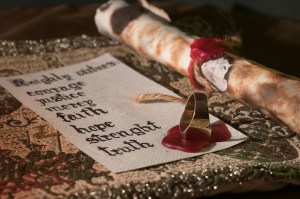
A signet ring bears the image of its owner’s seal. Anything with the seal’s image pressed upon it becomes property of or a decree of the owner. The ancient seal
© Arvacsaba | Dreamstime.com

that the Shulamite woman refers to, is most often associated with royalty. Can you see the imagery of ownership in the seal? In this case, the reversal is that it is a woman that requests this of her man. She, as true ezer kenegdo, is assuming responsibility for her man (in an opposite but equal way that he takes responsibility for her). This is a return to God’s original design. The man and woman take possession of one another, because they are one flesh. The lack of responsibility and selfishness of the first couple has been completely reversed.

This concept is further solidified by the woman comparing love with jealousy. The Hebrew word for jealousy, kinah, implies possession and right of property.[13] Since the fall, men have had no issue with seeing their wives as property or possessions to do with as they please. These attitudes are earthly wisdom from the Beast Kingdom, not the heavenly realm. In God’s Kingdom, taking possession of a spouse is sacrificial; it is not about meeting fleshly desires, but bearing responsibility.

The man in the Song of Songs has relinquished his fallen nature of domination, and restores the woman to the role of ezer kenegdo. Both the man and the woman are functioning in their purpose. No longer does the ground resist Adam; no longer does Adam resist Chavah. They are one. They are equal. This reunion can have only one result: an erotic love affair. Do you find it as intriguing as I do that this prophetic glimpse of restoration is in the midst of the most explicit book of love in all of Scripture?

What does all this mean for the ezer kenegdo or the woman? What does her role actually entail compared to man’s? Biblically, how are men and women meant to function in the believing community? What does redeemed marriage look like? There is still more to come on this captivating topic. We will start with the Proverbs 31 woman in Part IV.


[1] Mt. 14:23-33

[2] Is. 55

[3] 1 Cor. 13:12

[4] Correcting Caricatures: The Biblical Teaching on Women by Walter C. Kaiser Jr

[5] Fohrman, Rabbi David, The Beast that Crouches at the Door. Baltimore: HFBS Publishing, 2011. Kindle file.

[6] Dr. Moen fully explores this concept in Guardian Angel.

[8] Patsy Rae Dawson, a Christian marriage and sex counselor, agrees with my sentiments: http://patsyraedawson.com/?page_id=6#woman

[9] Coogan, Michael. A Brief Introduction to the Old Testament. Oxford: Oxford University Press, 2009, p. 394

[11] It’s only 117 verses long.

[13] See the Ancient Hebrew Lexicon of the Bible under the entry: Strong’s #7068: AHLB#: 1428-E (N1).
Categories: Women | Tags: , , , , , , , , | 10 Comments

Meaning of Passover

I’ve been revising our family Haggadah this year. Today while I was doing some housekeeping, I was listening to an old Bill Cloud teaching. He briefly touched on the Hebraic understanding of Pesach. I was excited because I’ve been praying that the Father would bring to my mind all those little details that are not only useful, but edifying to include in our Haggadah. This is one of those “little” details that I always seem to remember “after the fact;” so, I file it away for the next Pesach. Not this year!

The Hebrew meaning of the word Pesach is one of those pearls that often gets trampled underfoot. When you open your concordance or bible software to search out this most important word, it becomes more than a little confusing to the English speaking mind. What really transpired in that crucial hour of the original Pesach?

Here is how Strong’s defines Pesach:

H6452

pâsach

A primitive root; to hop, that is, (figuratively) skip over (or spare); by implication to hesitate; also (literally) to limp, to dance: – halt, become lame, leap, pass over.

Jeff Benner’s lexicon is usually what I reference for deeper meaning, but his only has this for the Pesach entry:

AHLB#: 2618 (V)

Hop: To hop from one place or another. Also to be lame as one who hops on one leg. [freq. 7] (vf: Paal, Niphal, Piel) |kjv: pass over, halt, lame, leap| {str: 6452} – Lame: As one who hops one leg. [freq. 14] |kjv: lame| {str: 6455}

Hop? Lame? What does Passover have to do with lameness? If one looks at Strong’s #6455 as referenced, they will indeed find that to be lame is a derivative of this word:

H6455

pissêach pis-say’-ak

From  H6452; lame: – lame.

Now, if you are unaware as to how this could possibly reference the Passover, read on. I just love it when the LORD shows out; and I assume you do too or you wouldn’t be reading this post. Do you recall the old adage “a picture is worth a thousand words?”

Well, that is exactly what the Father has done with the Hebrew word, Pesach. Pesach describes the hopping or fluttering that a mother bird makes as she protects her nest. She hops back and forth from branch to branch or from one side of the nest to the other. This is the action that is portrayed in the word Pesach, and it is indicative of how Adonai spared His people during the tenth plague.

While the angel of death swept through the land of Egypt killing all the first-borns, Adonai was “pesaching” His people who had obediently applied the Lamb’s blood to their doorposts. Thus, the miracle of Pesach isn’t exactly how we often envision it. Adonai hovered, fluttered, and hopped about the homes of the faithful, protecting them as judgment came to Egypt. (Ex. 12:12) Did you catch the subtle difference? The death angel didn’t just skip over their homes; instead, the Creative Holy Spirit hovered and fluttered about their doorways like a mother bird protecting her chicks.

This brings fresh meaning to the following verses:

You yourselves have seen what I did to the Egyptians and how I bore you on eagles’ wings, and brought you to Myself. (Ex. 19:4)

For YHWH’s portion is His people; Jacob is the allotment of His inheritance. He found him in a desert land, And in the howling waste of a wilderness; He encircled him, He cared for him, He guarded him as the pupil of His eye. “Like an eagle that stirs up its nest, That hovers over its young, He spread His wings and caught them, He carried them on His pinions” YHWH alone guided him, And there was no foreign god with him. (Dt. 32:9-12)

“O Jerusalem, Jerusalem, the city that kills the prophets and stones those sent to her! How often I wanted to gather your children together, just as a hen gathers her brood under her wings, and you would not have it! “Behold, your house is left to you desolate; and I say to you, you will not see Me until the time comes when you say, ‘BLESSED IS HE WHO COMES IN THE NAME OF YHWH!'” (Lk. 13:34-35)

Adonai protects His people by hovering, fluttering, or hopping around them, forming an impenetrable fortress of protection. This mirrors the Spirit of God hovering over the faces of the waters on Day One of creation, a day akin to Passover. This is the true Hebrew meaning and context of the word Pesach in Exodus. It draws one’s attention back to One Day, Yom Echad, and the Holy Spirit of creation; it is both a beginning and an eternal end. Chaos and darkness are pierced with His light that both judges and delivers.


Categories: Moedim | Tags: , , , | 3 Comments

Blog at WordPress.com.