Parched Ground

How do we display the image of Elohim (G-d) in the earth?

© Marina Bombina | Dreamstime.com

Recently, I participated in an online correspondence class with a rabbi. In it, he made mention of the davar (word) and its relationship to the midbar (wilderness/desert). I know many of you are already familiar with this connection, but for the sake of those who are not, I will briefly explore this notion. In Hebrew, the root of midbar (desert) is davar (word). In other words, the wilderness comes directly from the Word. Being in the desert is akin to receiving the Word. Or to be more precise, the wilderness is where Adonai’s Word is tested in us. In the Torah, the Book of Numbers chronicles the Children of Israel’s wanderings in the desert. Thus, quite fittingly, this book is called BaMidbar or “in the wilderness” in Hebrew.

When God miraculously removed ancient Israel from Egypt or when He rescued us from the figurative house of slavery (sin and death), where did He take them or us? Was it straight to the Promised Land? Or was it into the desert or wilderness? The fact that we all must face a literal or figurative desert upon being saved sounds counterintuitive at first. What do we need to learn in wilderness? I think Bill Cloud said it best (I’m paraphrasing Bill here): “God can remove us from Egypt, but we find that Egypt is still in us.” In other words, salvation, deliverance, and sanctification are ongoing processes. The desert becomes a type of threshing floor for our souls. All that offends is refined, purified, and threshed in the scorching sands of the desert. The Word that began a good work in us continues its commission to test and humble us. The difficulty and the pain of the wilderness “does good” for us in the end. For Abba, this is a labor of love.

“He led you through the great and terrible wilderness, with its fiery serpents and scorpions and thirsty ground where there was no water; He brought water for you out of the rock of flint. “In the wilderness He fed you manna which your fathers did not know, that He might humble you and that He might test you, to do good for you in the end. (Dt. 8:15-16)

But the desert has one more vital message to teach us. It is in our wilderness where G-d speaks. In the ups and downs of the desert, we learn to discern the difference between the Shepherd’s voice and the enemy’s crafty imitation. When we are stripped of all the comforts of Egypt, we finally reach the end of self. It is there, in the midst of what appears to us as chaos and disorder, that the G-d of order speaks kindly to us and lifts our weary heads. With no more worldly distractions, the Word reveals what is in our hearts. Each revelation offers us an opportunity to repent and return to the Master’s loving embrace.

Ones That Speak

While all the above is fascinating, even if a little scary, that’s not what struck me in the Rabbi’s lesson. He mentioned that one way we are like G-d is in the fact that we have the faculty of speech. We are the only creatures in His vast creation that, like Him, have words. We are medeber (ones that speak). Think about this for moment. In the same way that davar and midbar are connected, so is medeber. This means that we are not ONLY “ones that speak”, but “ones like a desert.

Have you ever thought of yourself as a desert? Maybe our souls have felt dry or parched during a great trial, in the midst of mourning, or while suffering for righteousness sake or on account of our own sins. But have you ever considered that our wilderness journey should be as close and familiar to us as speech?

We were not only meant to speak, but we were meant to drink like the parched earth of a desert. Consider the many passages that urge us to partake of the Living Waters.[1] Or think about how the Word of G-d is figuratively referred to as rain or water.[2] We should be like the thirsty ground, eagerly waiting for the gentle rain of Abba’s Word. Considering that Adam was formed from the dust of the ground, this makes perfect sense. Mankind is essentially dirt or dust. And the ground NEEDS the heavenly rains like we NEED the words of our heavenly Elohim.

Dirt and Seeds

             © Nitsuki | Dreamstime.com

We are, at our core, the substance (dirt) in which seeds can be planted in order for New Life to grow. The Word is equivalent to a Seed in Scripture.[3] Coincidence? I don’t think so. If words are seeds, we should be careful what we allow to take root in our soil or dirt. I believe these words or seeds can come from three places: G-d, the enemy, and ourselves.

Thus, the enemy’s word is a seed. The words we speak are seeds. The words others speak are seeds. But the only Seed that is always truth and always produces life is the Word of YHWH. The question is how do we know, and I mean without a doubt know that we know, whether the seed we are receiving is G-d’s Seed?

This is where the dry, dirty side of our essence comes in to play. In order to hear or receive the Word of Adonai, we must become like a desert. All distractions and things that vie for our attention must be removed in order for us to really hear or shema YHWH. In the wilderness, our nephesh (flesh) is denied worldly pleasures and conveniences. One reason that fasting is so effective is because it strips the nephesh of gratification. Any time our nephesh (with all its thoughts, desires, and appetites) is ruled over by our younger (new) spirit-man, our connection to YHWH is strengthened. And our flesh serves us rather than us serving it.

Whose Voice?

Many times, we listen to the voice of our own desires rather than the Word of the LORD. Like the Tree of Knowledge, it speaks both good and evil. We know this voice so well that we often mistake it for the Holy Spirit (especially when it’s speaking “good”). Let’s face it, when it seems as if we will get to avoid suffering in a dry desert, our voice (or even the voice of the enemy) sounds like good counsel to our itching ears. This is why various people can all claim to be hearing from the One Holy Spirit, yet will have conflicting ideas, agendas, and doctrine. We are ones that speak, but rarely are we willing to become a desert. We must learn to submit to the wilderness and allow the Word to test us.

Emptying ourselves of our own desires (even those we deem good and profitable or even godly) is the key to becoming the image of Elohim in the earth. You want to love YHWH with all your heart and love your neighbor like yourself? It will cost you flesh and bone. Are we willing to suffer for YHWH and our neighbor?[4] Or would we rather cause others to suffer so that we can have things our way? Do we open our mouths and speak life (healing/shalom) to others or do we use our speech to persuade others to do things the way we like it or see it? Which voice is the Holy Spirit and which is the voice of our own nephesh (soul)?

The acquisition of treasures (desires of our hearts/flesh) by a lying tongue is a fleeting vapor, the pursuit of death. (Pr. 21:6 added parenthesis mine)

If anyone thinks himself to be religious, and yet does not bridle his tongue but deceives his own heart, this man’s religion is worthless. (Jam. 1:26)

Watch Your Mouth

He who guards his mouth and his tongue, Guards his soul from troubles. (Pr. 21:23)

Our mouths cause us more trouble than any other member of our bodies.[5] Is this because we only desire to be ones that speak and not ones like a desert? After all, you can’t speak AND drink at the same time! Interestingly, if we fail to choose to become a humble desert before YHWH, He will take us there kicking and screaming. Our only choice in the matter is the method of how we arrive and how we act once we get there. YHWH’s Word is ALWAYS tested in the wilderness/desert.[6] Consider the many judgments that result with the people and the land becoming desolate. In these cases, Abba’s judgment has in effect “shut our mouths”.[7]

Is Adonai just an angry tyrant or does He know something that we desperately don’t want to accept? The Bible says that G-d is Love and that He chastises those whom He loves.[8] He takes us to the desert because He knows that the testing of the wilderness will reveal our hearts. We need to face the serpent on the pole, so that we may be healed and saved. The serpent is the voice of our own selfish desires. It is the crafty forked tongue that whispers both good and evil. When we heed its voice rather than Adonai’s, we are stung with its venom and take the fast track toward death.

This is why we must die daily like the lamb offerings in the Tabernacle and the Temple. Our beast must be brought to the altar. Like all creatures, the beast doesn’t submit easily. It is excellent at convincing us (with its mouth) that all is well. The smooth words of the serpent appeals to our feelings of entitlement, self-righteousness, and piety. The beast does not like to identify with suffering or humility. But like Cain, we are told to MASTER this impulse.

We do this by becoming what we were created to be. We are a desert; a vast wilderness laid bare for all of heaven to see and judge. In this position, we are no longer mouths that speak to justify or coerce; rather, we become a sponge that soaks up the words of life. Though the Living Word kills the flesh, it quickens the spirit.

This is the key to humility, hearing from Abba, and loving our neighbor sacrificially. It is also what molds and shapes our clay vessels into the image of our great and loving Elohim. If we really got this we would no longer scorn our fiery trials or fear the seemingly empty places of life. Instead, we would prostrate ourselves under the heavens and allow the Word to truly divide between our soul (nephesh) and spirit.

For the word of God is living and active 
and sharper than any two-edged sword, and 
piercing as far as the division of soul and spirit,
 of both joints and marrow, and able to judge 
the thoughts and intentions of the heart. 
And there is no creature hidden from His sight, 
but all things are open and laid bare 
to the eyes of Him with whom we have to do. 
(Heb. 4:12-13)

[1] Jer. 2:13; 17:13, John 4:10-11, Rev. 7:38

[2] This post speaks about the early and latter rains.

“For as the rain and the snow come down from heaven, And do not return there without watering the earth And making it bear and sprout, And furnishing seed to the sower and bread to the eater; So will My word be which goes forth from My mouth; It will not return to Me empty, Without accomplishing what I desire, And without succeeding in the matter for which I sent it. (Is. 55:10-11)

“So let us know, let us press on to know the LORD. His going forth is as certain as the dawn; And He will come to us like the rain, Like the spring rain watering the earth.” (Hos. 6:3)

So that He might sanctify her, having cleansed her by the washing of water with the word. (Eph. 5:26)

[3] Luke 8:11

[4] Suffering for Righteousness’ Sake

To sum up, all of you be harmonious, sympathetic, brotherly, kindhearted, and humble in spirit; not returning evil for evil or insult for insult, but giving a blessing instead; for you were called for the very purpose that you might inherit a blessing. For, “THE ONE WHO DESIRES LIFE, TO LOVE AND SEE GOOD DAYS, MUST KEEP HIS TONGUE FROM EVIL AND HIS LIPS FROM SPEAKING DECEIT. “HE MUST TURN AWAY FROM EVIL AND DO GOOD; HE MUST SEEK PEACE AND PURSUE IT. “FOR THE EYES OF THE LORD ARE TOWARD THE RIGHTEOUS, AND HIS EARS ATTEND TO THEIR PRAYER, BUT THE FACE OF THE LORD IS AGAINST THOSE WHO DO EVIL.” Who is there to harm you if you prove zealous for what is good? But even if you should suffer for the sake of righteousness, you are blessed. AND DO NOT FEAR THEIR INTIMIDATION, AND DO NOT BE TROUBLED, but sanctify Christ as Lord in your hearts, always being ready to make a defense to everyone who asks you to give an account for the hope that is in you, yet with gentleness and reverence; and keep a good conscience so that in the thing in which you are slandered, those who revile your good behavior in Christ will be put to shame. For it is better, if God should will it so, that you suffer for doing what is right rather than for doing what is wrong. (1 Peter 3:8-17)

[5] James 3

[6] Think about Moses and Yeshua. Were they each not tested in the wilderness? What about Paul? Can you recall a period where he was tested in the desert? Consider the Children of Israel, Job, David, Jeremiah, John the Baptist, and others. Can you connect these righteous men with both suffering and the desert/wilderness? Does the Bible give us examples of those who willingly flee to the desert and those who are taken there against their will? What is the difference between these two experiences? What is similar about these experiences? It seems as though we ALL must experience the wilderness. The question is: Will we go willingly or by force?

[7] Now we know that whatever the Law says, it speaks to those who are under the Law, so that every mouth may be closed and all the world may become accountable to God. (Rom. 3:19)

[8] FOR THOSE WHOM THE LORD LOVES HE DISCIPLINES, AND HE SCOURGES EVERY SON WHOM HE RECEIVES.” (Heb. 12:6)

Categories: Musings | Tags: , , , , , , , , , , , , , , | 8 Comments

The Biblical Role of Women Part XI

Role of Women Main Page

dreamstime_l_47405125 copy

© Nomadsoul1 | Dreamstime.com

Man, Woman, and Fire


Up until now, we have only explored the roles of the male (zakar) and the female (neqevah).[1] In this post, we will look at what it means to be a man or husband (ish) and a woman or wife (ishshah).

For this reason a man (ish) shall leave his father and his mother, and be joined to his wife (ishshah); and they shall become one flesh. (Gen. 2:24)

Let’s begin by looking at the ish and ishshah in Hebrew.[2] Below are Brown, Driver, and Brigg’s Hebrew definitions.

אישׁ

BDB Definition: (ish) 1) man 1a) man, male (in contrast to woman, female) 1b) husband 1c) human being, person (in contrast to God) 1d) servant 1e) mankind 1f) champion 1g) great man 2) whosoever 3) each (adjective)


אשּׁה

BDB Definition: (ishshah) 1) woman, wife, female 1a) woman (opposite of man) 1b) wife (woman married to a man) 1c) female (of animals) 1d) each, every (pronoun)

Man אישׁ and woman אשּׁה share two Hebrew letters: aleph and shin. The difference between the two is that man has the letter yohd and woman has the letter hey. Interestingly, if we put these two together, it spells Yah (yohd, hey). Yah is the poetic form of God’s Name.[3] In other words, the man and the woman each have a piece of the name and authority of God, but only when they come together as one flesh, can we see the Creator’s Name.

יהּ = Yah

This shouldn’t be surprising considering that it takes both the male and the female to display the image of Elohim (God) in the earth. But before we take this further, let’s see what the ish and ishshah share in common. What does aleph and shin spell in Hebrew?


אשׁ = Fire

 Man and woman are beings of fire without the yohd and hey (Yah/God).[4] What does this mean? I believe this depicts two different yet complimentary things to us. I want to explore both. The most obvious side of this issue and the one most often taught is the negative aspect. Fire, burning, and consuming are rarely seen as something positive. In the case of men and women or husband and wife, we understand this all too well. If we say that our marriage is burning, we most likely mean that it is falling apart, collapsing from within, or turning into ashes. Thus, let’s consider this for a moment.

Fire is Destructive

Fire burns. Fire is hot. Fire consumes. Fire can destroy life. If you touch a flame, the effects are painful long after you remove your hand. Nothing hurts quite like a burn. And nothing scars our flesh in a worse way. Flesh can literally melt in a fiery furnace. And yet, at the core of our being, you and I (man or woman) ARE fire (aish). Does that sound scary? You see, we can easily (or maybe not so easily) relate to YHWH as being a “consuming fire,” but how often have you thought of yourself as one?

© Olegs Petuhovs | Dreamstime.com

The truth is that with or without YHWH, we are still FIRE. We are truly made in the image of our “fiery” Creator. Do you recall from Part IX how we are either a builder or a destroyer? The analogy is the same here. The question is: “What will you do with your fire?”

If we are fueled by the motives and desires of the flesh, we will burn and consume ourselves and our relationships with a destructive heat. Even if we manage to put the flames out, irrevocable damage and scarring is left in our wake. We must be very careful and intentional with the power the Creator has granted unto us.

Men and women are “hot,” and not in a sexy way. The fact that our FLESH naturally produces heat has a spiritual message to teach. If we live by the “flame” of our desires, we are sure to find ourselves in the Refiner’s fire of correction.[5] (How’s that for a living parable?)

Fire Cleanses and Refines

On the other hand, fire can cleanse and refine. Fire can give warmth. Fire can tenderize and cook meat. Fire can form, shape, and create new land. Fire and can refine precious metals. Fire can transform dead soil into a rich fertile environment. Fire can preserve life.

Fire, when handled properly and surrounded by definite boundaries, is a very good thing. Thus, we use phrases such as “I’m on fire” to describe our zeal, compassion, blessed efforts, and the like. We even use it to express a winning streak in life or in a game. Not all fire is destructive.

In fact, there are certain seeds that will not germinate and sprout to life without the intense heat from fire. The giant redwoods (sequoias) are a fine example of this. This is interesting considering that most seeds will sprout in the presence of just water. If we look at this natural picture from a spiritual standpoint, the seeds (Word of God) sprout or produce life in the presence of both water and fire. (Does this remind you of baptism in water and fire? The pillar of cloud and pillar of fire? The judgment of water (flood) and of fire? The river of life and the lake of fire?)

At first glance, water and fire seem like polar opposites. But if Hebraic thought has taught me anything it is that every word has the potential to be a contranym and that two diametrically opposed concepts often have a mighty truth to teach if we will just wrestle with the opposites.

The contrast of water and fire was first given in Genesis chapter one. The first reference to the Holy Spirit is on Day one of creation where He is hovering or moving upon the faces of WATER. (Gen 1:2). Then, God says, “Let there be light.” Light can easily be associated with fire. We see a repeat of this contrast of water and fire on day two when the heavenly waters (shamayim) are separated from the earthly waters (mayim). (Gen. 1:6-8)

© Maryna Kriuchenko | Dreamstime.com

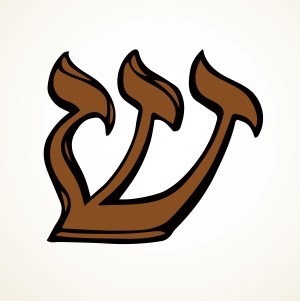
The shamayim (heavens) are quite literally waters (mayim) with a shin prefix. As we mentioned above, shin is not only one of the two letters that make the Hebrew word for fire, but it also physically looks like tongues of fire. Thus, it is quite easy to deduce (as Rashi did) that the heavens are indeed waters of fire or fire waters.[6] For our purposes here, the main point is that from the very beginning until the very end, God uses the imagery of both water and fire to not only express His nature, presence, Word, creativity, judgment, and harvest, but also to express similar things in us. The fact that the Hebrew words ish and ishshah depict the heart of men and women as fire and the scientific fact that our “hot” bodies of flesh are composed of mostly water only reiterates this apparent dichotomy.

Are you fire or are you water? The answer is yes. And both water and fire can either destroy life or preserve it. When our lifeblood begins to boil, will it be in lust? In anger? With envy? Or will we give our warmth over to preserve life? To clothe or feed the naked? To defend the helpless?

The truth is that our fire can only be fueled from two places. We either fan the flames with that which is below the expanse or that which is above the expanse. Will our fire come from our lower earthly nature or from the cool, blue, fiery heavens? Both burn with intense heat, both can destroy or purify, but only one does so with a soothing heat that promises everlasting life.

Your kingdom come. Your will be done, on earth as it is in heaven. (Mat 6:10)

Back into the Frying Pan

Man

I think you get the analogy now. But I want to zoom back in on the differences between the ish and ishshah one more time. Remember that the word for man or husband contains fire (aish) and the letter yohd. The yohd is a pictograph of a hand (yahd) or a fist. It has the numerical value of ten and carries the idea of working or creating.[7]

© Alba Molera | Dreamstime.com

This is similar to the function of the zakar (male), but with more emphasis. A man or a husband is for all intents and purposes “a hand on fire.” The fire within a man needs to be channeled into working or creating. (Perhaps this is why so many men love to collect tools. Or why they and boys love mission oriented video games.) A man with idle hands will always find trouble and destruction.[8] Thus, a man’s (and a husband’s) greatest strength is found in what he does with his hands. It is his actions that show YHWH to his wife, to his children, and the world at a large. (And actions really do speak louder than words!)

Do you recall from Part I how the zakar literally serves YHWH when he works the ground? A man’s career will bring him the most fulfillment when he labors to till, guard, and keep what YHWH has given him to tend. In marriage, one way that a man serves his wife and children is by reaping the produce of his labor. Ideally, the provision he provides sustains the family. In this way, his “contained” fire preserves life.

The “hand on fire” or the man has great potential. Those fiery fists can accomplish mighty things. If they are fueled by the cool heavenly flames, his hands will become callused and strong by putting food on the table, building the house, leading and blessing his family, and sometimes even wielding a rod that gently corrects the children. All feel safe, secure, and loved by the large worn hands that create and protect a home that is warmed by his fire.

But as you’ve already surmised, this great strength is also a man’s or husband’s biggest test. Hands that strike and abuse, hands that withdraw when they should caress, hands that fail to work, hands that deal under the table, hands that touch what is forbidden… all these things are a misuse of a man’s fire, but are no less powerful. No one is safe, secure, or loved by a man that gives his fire to these destructions. It won’t take long before his house turns to ashes and all of his labors are consumed.

The good news is that we always have a choice to change fuel sources. A man that finds himself wearing sack cloth and sitting in ashes can rebuild. And if he stays the course, those very ashes will make the ground doubly fruitful. There is always hope. YHWH desires reconciliation. And He loves even the fallen.

Woman

 In the case of the ishshah, a woman or wife is fire with the addition of the letter hey. Hey has a numerical value of five and means a breath or to behold.[9] Pictographically, the letter hey portrays a person with arms lifted up or of an open window. Both imply making something known by drawing attention to it. In other words, the fire of a woman is meant to REVEAL something. I hope you recall from Part X that while women are the epitome of what is hidden, they do in fact reveal (prophetic).

They also draw attention to what isn’t easily seen. For example, YHWH is a Spirit. Though we can’t physically “see” Him, it is usually a woman (mother, grandmother, wife, sister, or the like) that first reveals our hidden God to others. (See Part IX for more on this.) As a wife, a woman can often intuit certain motives of people or circumstances that affect her husband and children. Again, this is her revealing something that is hidden. To make these things known, she must use her hey or breath.

© Konstantin Iuganov
| Dreamstime.com

Thus, for all intents and purposes, a woman is a “fiery breath.” Yikes! That sounds too much like a dragon for my liking! Yet, the fact remains that a woman who is not walking uprightly can sure depict this flaming beast. Just ask any man with a nagging, controlling, or contentious wife.

Ideally, a woman’s gentle breath will be a flame of fervent prayers, praises, and edification. In fact, the hey pictures this very thing. In ancient Hebrew, hey looked more like a person standing with arms lifted high. This is a worship pose. It is certainly one of praise! Perhaps this is why so many women are such valiant worshippers, dancers, counselors, and prayer warriors.

In marriage, this strength carries over to her husband as well. How many of you have read in multiple self help books on marriage that one of man’s greatest desires from his wife is praise? Well, the Hebrew is one more witness to this truth. A man is motivated to work even harder and to stoke the flames brighter when he has a woman that gushes his praises.

Like it or not, we were created to function this way as one flesh. When a man functions in his righteous role as that loving hand of fiery work,[10] the woman feels “safe and secure,” which compels her mouth to sing fiery praises to her man.[11] The converse is also true. Actually, the jury is out on which comes first here… the chicken or the egg. What I do know is that the roles are reciprocal and one fans the flames of the other. If we do our part, even when it seems futile or even if it’s the last thing we “feel” like doing, and we don’t grow weary, the other half naturally changes. Change always starts with YOU, not your spouse. But I digress… let’s continue with the woman.

The strength of a wife or woman is in how she expresses the praises of both Adonai and her man. With words women reveal the will and Word of God to their husband and children. Words can encourage, inspire greatness, and motivate others. Words can bind up wounds and brokenness. Words can uncover the heart of a matter or situation. Women are far more relational than men by divine design. Their lives focus and center around their family and friends, and to maintain these relationships they use words in person, on the phone, and through social media. There’s a reason women are known for “talking.”

© Alena Brozova | Dreamstime.com

But like their counterpart, the ish, it is also their greatest test. The Refiner’s fire isn’t fun, but it is better to suffer for the sake of righteousness than for the sake of unrighteousness.

Beloved, do not be surprised at the fiery trial when it comes upon you to test you, as though something strange were happening to you. But rejoice insofar as you share Christ’s sufferings, that you may also rejoice and be glad when his glory is revealed. (1 Pet. 4:12-13 ESV)

I wonder how many of these “fiery trials” occurs within marriages? I suspect a great deal. And ladies, how often is your strength (mouth) the reason for your troubles? Dr. Alewine says that women have trouble with “delivery.” She intends the pun because it encompasses childbirth and delivering a message. How we say things, the way it comes off of our lips, MATTERS.

Women can be gossipy, cheeky, and manipulative with words. Women know how to say all the right things, but say it in a way that undermines the very message they are conveying. With a look, sigh (breath), or even a smile, they can tell you everything you need to know about what they are really thinking. That old adage “sticks and stones may break my bones, but words will never hurt me” is a lie from the pit of hell. Words give or destroy life! And, words are associated with fire in the Bible.[12]

When a woman speaks solely from her emotions or feelings, her fire can race out of control. The flood from her lips can consume an entire forest. (People are trees!) And because women are gifted with juggling multiple tasks and holding numerous issues, topics, and stressors in the forefront of their mind at one time, this flood can touch EVERY area of the person she spews on at once. Somebody yell, “FIRE!”

We need some water on aisle 9! The good news is that all this destruction can be redeemed. Perhaps, a giant sequoia will grow from the ashes. But of course, the better path is to allow the seeds to sprout after a gentle rain. My prayer is that we LEARN the difference and choose to be a breath of shalom. (By the way, the breath can be another symbol for the Holy Spirit, the ideal role model for the female. See Part V for more detail.)

One Flesh

Now, none of this is meant to limit an ish or ishshah to a one-size-fits-all box. Obviously, men use words and women use their hands! But what this does teach is that men have more proclivities toward work that involves their hands, physical labor, or just “rolling up their sleeves” to conquer a task (literally and figuratively); whereas, women usually shine brighter when they are able to interact with others in a relational way. There will always be some cross over between the roles of men and women. My thoughts are expressing the general rule based on what I see in real life, the Hebrew language, and the Bible.

Remember, you are not just a light, but also a fire. Burn responsibly.

For previous posts in this series click here

See also Dr. Hollisa Alewine’s The Creation Gospel Workbook 3: The Spirit-Filled Family, p. 39


[1] See Part I.

[2] These transliterations are pronounced eesh and eesh-shah. There is no short English “i” sound in Hebrew. Every time you see an “i” in a Hebrew transliteration, it is marking the long double “e” (ee) sound, unless it falls at the end of a word. For example, Elohim (God) does not sound like the English word “him” at the end. It sounds like “heem.” As my Hebrew teacher taught me, Hebrew uses strong, pure vowels. I guess she was implying that English is impure, lol.

[3] For example, see Psalm 77:11. ( Strong’s H3050) Many translations simply translate the poetic name Yah with LORD as they do for the Most Holy Name YHWH. You can search online Bibles to see the poetic version for yourself.

[4] Fire is often transliterated as aish, esh, or aysh. Make the English letter “a” say it’s name then add “sh” to the end and you’re saying it correctly.

[5] But who can endure the day of his coming, and who can stand when he appears? For he is like a refiner’s fire and like fullers’ soap. He will sit as a refiner and purifier of silver, and he will purify the sons of Levi and refine them like gold and silver, and they will bring offerings in righteousness to the LORD. Then the offering of Judah and Jerusalem will be pleasing to the LORD as in the days of old and as in former years. (Mal. 3:2-4 ESV)

[6] The great Jewish commentator Rashi asserts that in Genesis 1:8, “God mingled fire with water and of them made the heavens.” He bases this on an etymological analysis of the Hebrew word for heavens. Rashi explains that shamayim is a compound of the words for fire (esh) and water (mayim).

I wrote about the spiritual aspect of water (and somewhat on fire) in Miriam’s Cup Part I, Part II, and Part III.

You can also read more about the creation days, including the mayim and shamayim, by studying Dr. Hollisa Alewine’s The Creation Gospel Workbook One.

[7] For more on the value of ten, see Hebrew Numbers 1-10.

[8] Pro. 19:15

[9] For more on the number five, see Hebrew Numbers 1-10.

[10] This implies much more than a “job,” I mean work in the fullest sense of the word. Work at work. Work at home. Work for YHWH. Work in marriage. No man does this without LOVE.

[11] This is respect or reverence.

[12] Think of YHWH’s Ten Words coming from a “smoking” Mt. Sinai and the tongues (words/language) of fire that rested upon the disciples in Acts 2. If good and righteous words are akin to fire, you better believe that there is a counterfeit! What do you think the watery river that flows from the mouth of the dragon in Revelation 12:15-16 is metaphorically speaking about? Remember, water and fire mirror one another. (You can see this comparison in my post on The Rivers of Eden.)

Categories: Women | Tags: , , , , , , , , , , , , | 20 Comments

The Biblical Role of Women Part X

Role of Women Main Page

In Part VIII and Part IX, we discovered that women (and men as the bride of Messiah) either build the House of Adonai or they tear it down. We also looked at how YHWH sovereignly chose to first entrust the Torah and the Gospel with His daughters. Again, this is about building His House. It is the mother who first teaches a child the Torah. Then later, as the child matures, the Father brings the stronger correction (mussar).

Hear, my son, your father’s instruction (mussar) And do not forsake your mother’s teaching (torah). (Pro. 1:8)

My son, observe the commandment (mitzvah) of your father And do not forsake the teaching (torah) of your mother. (Pro. 6:20)

In both of the proverbs mentioned above, the father is mentioned first, but it is the Torah of the mother that is not to be forsaken. To forsake is to abandon or forget – implying something that was learned beforehand. Infants begin life by receiving the nourishing milk of the mother in both the physical and in the spiritual through her teaching. In light of this simplicity, it is easy to understand why the women were the first to receive and proclaim the Torah and the Gospel. The tender mercies of a mother’s teaching are balanced by the stricter judgment/correction of the Father. Both are necessary to bring a child to maturity. (This is true physically and spiritually.)

The Hidden Woman and Time

I hope that you have noticed a common theme emerging throughout my posts on women. The woman is often “hidden” within the biblical narratives, much like she was once “hidden” within Adam. There is good reason for this when we take the whole of Scripture into account. Righteous women are a living representation of the Holy Spirit; and as such, they also portray the prophetic or what is future.

If that sounds too far fetched for your liking, let us first consider the Hebraic concept of time. Westerners typically view the past as being what is “behind” us, whereas the future is what is in “front” or ahead of us. Thus, to encourage someone to stop dwelling on past mistakes, we might tell them to “stop looking back” (past) or to “focus on what is ahead” (future). But in Hebraic thought, these expressions are reversed. The past is what you can see; it’s in front of you (and your eyes). The future (what you can’t see) is behind you. Perhaps the following illustration will flesh out this notion.

© Karel Noppe | Dreamstime.com

Imagine someone rowing a boat down a river. The river is time. In order to row a boat, a person must face backwards while rowing forward down the river. What the rower can see with his eyes is the area he has already travelled. (past) Because he doesn’t face in the direction he is headed, he cannot see what is ahead (future). This is truly how mankind experiences time. What has already happened (past) is clearly seen and understood, but the future is unclear and unknown. I know this totally reverses the definitions of hindsight and foresight, but I’ve found that most things in western thought compared with Hebraic thought are (sadly) reversed! Things like this shouldn’t surprise us any more.

Do you recall the function or role of the male from Part I? He is to remember (zakar). In order to remember or recall something, the thing being referred to would have already happened. In other words, it requires looking at what’s in front of you on the river of time. (Past) Everything that YHWH has said, the male is to remember and act on that Word. (This doesn’t excuse women from doing the same! The two become ONE flesh.) The man guards and protects all those things that are clearly “written.” Moreover, what is “past” is evident; there is no ambiguity. In other words, the past is firm or set in stone. Just like the written Word of God, it does not change. Can you see how this makes the male a picture of not only a firm foundation on which to build, but also associates him with time past? (Both are firm, set, solid, and reliable.)

As the male’s counter balance, the female should then represent the other side of this coin or what is “future.” Does Scripture indicate that this might be true? I believe that it does. Before we look at the Biblical text, let’s first consider the things that women do. They birth, nurture, and build the House or the future of God’s people. The stories involving women in the Bible are more hidden (or obscure) in the text. When we do encounter women in the Biblical record, prophetic (future) things are often being revealed. In the picture above, the woman is facing forward and looking ahead. She can see things that are coming, while the man in the boat sees where they have been.

In Part I, we looked at the neqevah or female as a protector and setter of of boundaries. But when we examine the context of this word in its further uses, something awesome is revealed. Often neqevah is juxtaposed with sound alike Hebrew words that deal with future expectation. For example, qevah without the nun prefix means to wait, expect, or hope. All of these words imply looking toward something that is future. [1] But even more interesting, if we add the nun back to qevah as a prefix, it indicates the collective future tense! Reread Jeremiah 31:22 with this in mind and the prophetic picture is heightened to include an expectation for a good future.

Jer. 31:22 (NASB) “How long will you go here and there, O faithless daughter? For the LORD has created a new thing in the earth—A woman will encompass a man.”

Sometimes, at first glance, the motives of women are uncertain. Women usually have a strong sense of “knowing” or great intuition into things that are hidden or concealed from plain sight. They can often pick up on things in the spiritual realm easier than men. This is why most of the great women referenced in the Bible are called “prophetesses.” [2] They represent the future and the prophetic. I could go on, but you get the point. It takes both a male and female to display the image of Elohim in the earth. And life cannot be understood separately from time.

© Adonis1969 | Dreamstime.com

The Most Holy Name of our Elohim, YHWH (yohd, hey, vav, hey), is the very essence of time. As a form of the verb “to be,” the I Am, He is the One who was, who is, and is to come. In other words, He is our past, our present, and our future. YHWH is time itself. Thus, it is no coincidence that mankind (male and female) as His image in the earth also typify time.

Men portray the past. Women picture the future. Together, as male and female, they build in the present with YHWH. Both men and women are equally important in displaying the image of God and His time clock. YHWH’s calendar masterfully weaves together both the past (remember) and the future (what is to come) in His holy moedim (feasts). Women are intrinsically connected to the rhythms and cycles of the Creator’s calendar. You can read more about this in my series entitled Moonbeams and the Moedim.

YHWH has plainly told us that His desire is to REVEAL Himself unto His people. Men, in the image of God, represent what YHWH has already revealed of Himself (past). Women represent how YHWH works behind the scenes of our lives and the many promises and plans He has for us (future). If we could just grasp the enormity of what will happen when the woman is revealed, then we’d all be screaming from the rooftops, “The Spirit and the Bride say, ‘Come!’”

Key #1 Men portray the past. Women picture the future. Together, 
as male and female, they build in the present with YHWH.


The Revealed Man and Time

For the most part, men (and their role) have stood out in the Biblical text, in history, and within marriages and families. This is to be expected since men are a picture of the past and what is REVEALED. We don’t have to “look” for the masculine. The role of the man stands out, just as they do physically. Nothing is hidden.

Conversely, women represent what is HIDDEN. If the role of women were easy to “see” or discern, there would be no need for this series. In the natural, this truth is likewise expressed to us in our most intimate parts that create life. I know this is rather crude, but consider that a woman’s reproductive organs are “hidden,” whereas a man’s reproductive organs stand out. Men are clearly revealed; women are concealed. Do you think this is just happenstance? Can this natural picture also be speaking a spiritual truth?

If so, why would we ever consider that one supersedes the other? It takes both male and female “parts” to create life in the natural. Do you suppose it is any different in the spiritual realm? I submit to you that it is not. The ideal function of both man and woman is to express the image of God in the earth. While their “parts” or roles are different, it takes both working together to create New Life. If one side of this coin is shunned, regulated, oppressed, usurped, or gagged Abundant Life cannot grow.

“The thief comes only to steal and kill and destroy; I came that they may have life, and have it abundantly.” John 10:10

Why Does This Matter?

Abundant life includes happy and healthy marriages. It also includes the entire Body of Messiah (men and women) being able to function within the full capacity of their roles in our assemblies. My hope in the remaining articles of this series is to emphasize the fact that YHWH’s ideal for men and women is to work together. Each is one half of the whole.

The problem is with our fallen natures or our evil inclinations. The old man operates from a place of fear rather than love. This is why we struggle greatly not only with the role of the sexes, but in every other area of life as well. But, our Redeemer beckons us to walk in New Life. May our marriages truly become the living parable of Messiah and His Assembly.


For past articles in this series, click here. For Part XI click here.

Key #1 Men portray the past. Women picture the future. Together,
as male and female, they build in the present with YHWH.


 [1] See The Scarlet Harlot and the Crimson Thread Workbook Four, page 140 (2012) by Dr. Hollisa Alewine. Also see Strong’s number H6960 (qevah or kavah). 

[2]  Examples include Miriam, Deborah, Huldah, and Anna.

See also Dr. Hollisa Alewine’s The Creation Gospel Workbook 3: The Spirit-Filled Family, p. 40


Categories: Women | Tags: , , , , , , , , , | 9 Comments

Hebrew Numbers 11-30

This is another reference post to help with Bible study, symbolism, dream interpretation, etc. Related articles can be found on the Misparim page. For numbers 1-10, click here. Studying Dr. Hollisa Alewine’s The Creation Gospel has been extremely helpful in making many of these determinations. I hope you will take the time to learn her material for yourself. You will see her work reflected in numbers 1-7 in regard to the seven creation days, seven Spirits of Adonai, seven Feast days, seven Churches, and in the seven abominations. 


© David Castillo Dominici | Dreamstime.com

Eleven achat esre [f.] echad asar [m.] Eleven is a tricky number, and the one in which I receive the most questions. People have a tendency to notice the clock when it is 11:11, and wonder what it means. If one feels plagued by seeing the number eleven, I suggest a careful read of Deuteronomy 1. From Mt. Sinai to the Promised Land was an eleven day journey, but due to Israel’s rebellion, they were in the wilderness for a total forty years. This message was reiterated to them in the eleventh month, Shevat, in the fortieth year. Hence, the full redemption and entry into the “Land” is connected to the number eleven, but also what prevents it.

So, eleven requires one to discern between the spirit of anti-messiah and the Messiah – remaining in rebellion or submitting to the King of kings. For example, Joseph was the eleventh son born to Jacob, and is a type of the Messiah – the Redeemer. Joseph was called the “master of dreams,” or mysteries/secrets. His life depicts many aspects of Yeshua with the number eleven playing a role in his prophetic dreams. (The sheaves and stars that bowed to Joseph were eleven. – Gen. 37) In the life of Yeshua, eleven disciples witnessed and revered the resurrected Messiah. Judas betrayed Him and then killed himself before the resurrection, making the disciples number eleven. (Mt. 28:16, Mark 16:14, Luke 24:9,23)

Most often, eleven has negative connotations. Stories with this number often revolve around rebellion, disorder, judgment, betrayal, idolatry, bribery, lack of trust in YHWH, being incomplete, and false authority/government. For example, lack in (12-1) or excess (10+1), both signify imperfection. There is an eleven day difference between the lunar and solar year (cycles). The lunar year is eleven days shorter and the solar year is eleven days longer. Interesting, considering the Jewish calendar favors neither, as it lunisolar. Esau produced eleven chieftains. He is characterized by the excess of eleven as he ruled by his appetite for more than he needs. One driven to amass wealth or excess of any kind needs to recognize that this beast/fleshly behavior actually achieves less, not more in the spiritual realm. Poor in the natural is akin to being rich in the spiritual realm; and being rich in the natural figures being poor in the spiritual realm. Messages of prosperity are dangerous for the Body as it leads to the spiritual depravity and lack of Esau, who is willing to sell his birthright for a bowl of “red stuff.” This concept is emphasized in the brother’s views:

Genesis 33:9-11 And Esau said, I have plenty, my brother. Let what you have be to yourself. [10] And Jacob said, No, please, if I now have found favor in your eyes, take my present from my hands. For I have seen your face, like seeing the face of God; and you are pleased with me. [11] Please take my blessing which has been brought to you, because God has favored me, and because I have everything. And he urged him; and he accepted.

Most translations use the same English word (typically: enough) in the bolded phrases in the above passage. But, Esau and Jacob use two different words to express their abundance. Esau says, “I have rav.” Whereas, Jacob attributes his wealth to God’s blessing and favor and says, “I have kol.” Having abundance, much or plenty alludes to the conclusion that there is still more to be gained. That was Esau’s choice of words. Whereas Jacob declared he had everything. This implies he had no lack and no need to strive for more due to God’s blessing and favor. There is a world of a difference between these two perspectives and ideologies. Again, which one describes you?

Eleven can also figure transition (moving back to 10 or ahead to 12). Consider the curtains that covered the Holy and Most Holy Place. There were FOUR curtains. The first (innermost) was made of linen, the second of goats’ hair, the third of rams’ skins, and the fourth of badgers’ (KJV) or marine animal skins. The second (goat’a hair) layer had eleven total curtains. (See Exodus 26.)

Exodus 36:14-16 (NASB) Then he made curtains of goats’ hair for a tent over the tabernacle; he made eleven curtains in all. [15] The length of each curtain was thirty cubits and four cubits the width of each curtain; the eleven curtains had the same measurements. [16] He joined five curtains by themselves and the other six curtains by themselves.

These four coverings were over the Holy and Most Holy Place of the Mishkan (Taberncale). What is the significance of the second layer having eleven curtains? The extra (excess) curtain in this case (the linen underneath had ten curtains) was doubled so it hung down and over the front and back of the Tabernacles. In this way, it concealed in the inner linen curtains. Linen figures holiness, righteousness, and purity. The covering of goat’s hair is reminiscent of one’s flesh, something that conceals the former. When a hairy Esau and his eleven chieftains submit themselves to Adonai, it is a very beautiful thing. The old nature must die for this this occur, like the goat’s that became part of the Mishkan.

Hence, eleven can figure the prophetic realm, but also its counterfeit, divination. Eleven often signals that one is doing what is “right in your own eyes,” the extreme opposite of the Holy Place. It’s action based on “I feel,” not “It is written.” It is ego and power driven to get one’s way. The Tabernacle teaches the opposite: dying to self.

In Daniel 7, a “little horn” arises from the ten horns of the terrible fourth beast, making it the 11th horn. This horn was epitomized in evil Antiochus Epiphanes, which is a type of the beast and antichrist, and the abomination that makes desolation. According to Daniel, this man and the spirit of the anti-christ seeks to CHANGE the times and law, that is the Torah and the Feast Days.

‘He will speak out against the Most High and wear down the saints of the Highest One, and he will intend to make alterations in times and in law; and they will be given into his hand for a time, times, and half a time. (Dan 7:25) 

These are the “changes” that Antiochus decreed for Israel:

You shall profane the Sabbath.
You shall profane the festivals and holy days.
You shall set up idols.
You shall eat unclean animals.
You shall not circumcise your sons.
You shall forget the Torah.

Thus, if the “prophetic” word one receives mirrors the actions of Antiochus and seeks to abrogate God’s Holy Law or His Holy Feast Days… run! It is not a Word from the LORD. It is a message for itching ears that seeks to please the appetites and lusts of the flesh. (A hairy Esau.)

Eleventh Hebrew Letter: Khaf Numerical value of twenty. Pictograph meaning an open hand or container, like a cup or a spoon. As a suffix, it shows possession or ownership. An open hand is one that receives, kabbalah. It’s interesting that Jewish mysticism or kabbalah depicts both sides of the number eleven. There are true prophetic things in kabbalistic teachings, but there is also a much more popular form that is mere divination. The number/letter also can mean similar. Our job is to discern the difference between two similar, yet different ideologies. Keter, the Hebrew word for crown, begins with the letter khaf, hinting at the place of authority. Who is the authority/crown of your life? Messiah or anti-messiah? The root of the Hebrew word for spoon is kafaf, which means to bend. Who are we bending/bowing to? In this sense, khaf has to do with submission.

  • Jacob had to face Esau while his family was incomplete with 11 sons (Benjamin wasn’t yet born). He had to fight an “Angel of the LORD” all night long.
  • Esau’s chieftains were eleven (Gen. 36:40-43) compared to Jacob’s twelve. Just reviewing the history of Esau’s lineage (Edom) makes it abundantly clear that he is associated with rebellion and living by the nephesh (beast/flesh).
  • The wilderness journey was only eleven days, but rebellion cost Israel forty more years in the desert. Moses recounted this punishment to them on the first day of the eleventh month (Dt. 1).
  • Eleven disciples were incomplete until a twelfth was chosen. (Acts 1:21-26)
  • Story of rebellion in building the Tower of Babel occurs in Genesis 11, which resulted in the confusion of tongues/languages – babble.
  • Delilah betrayed the judge Samson by taking the bribe of 5 lords of the Philistines. Each offered her 1100 pieces of silver. (Jud. 16:6, 3:3)
  • Right after Samson’s story in Judges, the remaining chapters (17-21) depict the moral and political decay of Israel. All of it is contrary to God’s order. And amazingly, it all begins with a story about another 1100 pieces of silver. Here are the highlights and I believe they are indicative of the number 11:

The word to describe the state of affairs in these chapters is “confusion“: Stolen money is used for idols, the Lord is invoked to bless the thief, individual shrines replace worship at the tabernacle, Levites and common people are consecrated as priests, idols are used in the worship of Jehovah. And Micah supposed the Lord would bless him in all of this! Moreover, as the story continues, A Levite’s concubine is raped to death, a civil war ensues, and the tribe of Benjamin is almost wiped out. This verse begins and ends the entire series of chapters: In those days there was no king in Israel; everyone did what was right in his own eyes. (Jdg. 17:6 & 21:25)

  • 5 + 6 = 11. Look back at the meaning of numbers five and six. If power and strength (5) is added to man and beast (6), a twisted counterfeit emerges unless that man (or woman) is ruled by the Spirit of Adonai. In the case of the latter, eleven can symbolize a place of godly transition. Sadly, many believe that Adonai rules them, but it is their nephesh/flesh that really has the upper hand. Where this is true, their life will be characterized by confusion, disorder, an extreme of lack or excess, duplicity, corruption, divination, and the like.
  • Messiah was “cut off” (crucified) because of our rebellion (sins) when He was about 33 years old (3 x 11). (Dan. 9:26) In His case, this was obviously a godly “transition” as He overcame the grave!
  • There are 22 Hebrew letters in the alephbet. (2×11). Overcoming and proper discernment come from the Word of Adonai, which is composed of 2×11 letter in the Holy Language of Hebrew.

Twelve shtayim esre [f.] shnayim asar [m.] perfect government, order, organization, united, perfect subdivisions of time (12 hours in day, 12 months in a year, 12 primary constellations) and of people (12 tribes of Israel, 12 Disciples/Apostles). This demonstrates a holy people serving a holy God based on the Creator’s clock and calendar.

  • Twelfth Hebrew Letter: Lamed Numerical value of thirty. Pictographic meaning shepherd’s hook/staff, teaching, learning, goading, protection, yoke, bind. Infinitive prefix for verbs, meaning to or for or belonging to.
  • 12 foundations in the heavenly Jerusalem
  • 12 Gates
  • 12 Pearls
  • At age 12, Yeshua first appears in public and engages with the teachers in Jerusalem. (Luke 2:42, He was at Bar Mitzvah age.)
  • In Luke 8, a woman that had an issue of blood for 12 years touches Yeshua’s tzit-tzyiot (tassels/fringes) and she is healed. This occurred while He was on His way to heal a 12 year girl.
  • 2×10= 12. If we look at the ideal for numbers two and ten, then we can see that 12 is about a united (2) and perfect congregation (10).
  • 3×4=12. Again, looking at the ideal for numbers three and four, we can see that when the seed is ripened (3) with the Holy Spirit (4), it produces resurrection life (3) that is powered by divine government (4).
  • 2×6=12. If we review numbers two and six, twelve will ideally picture a unified relationship (2) that is serving in the image of Elohim (6). The beast is being ruled by the two in one flesh of restored Adam (mankind).
  • Multiples of twelve, such as 24 or 144,000 will carry these same ideas.

Thirteen shlosh esre [f.] shlosha asar [m.] Thirteen is associated with the mercies of God, love, unity (oneness), and eternity. It is the 6th prime number, so it will have some of the same meanings as the number six. Thirteen has the stigma of being an “unlucky” number. I don’t believe in luck, nor do I believe that thirteen ONLY has negative connotations. The idea that the number 13 is bad luck comes from pagan influences. The Hebrew word for love (ahavah) and oneness (echad) share the numerical value of 13. Thus, one would expect to see 13 linked with love and unity, and a careful look shows that it is. However, on the negative side, there are connections to the opposite of love, which is not hate, but apathy, indifference, and fear.

  • Thirteenth Hebrew Letter: Mem Numerical value of forty. Pictographic meaning of water, chaos, immersion, womb, blood. Mem is the “center” of the Hebrew alefbet. Mem has two forms: the open and closed (final/sofit), depending on where it appears in a word. Mystically, mem is associated with Moses and Messiah (both begin with the letter mem), and the revelation of God’s instructions (Torah). As such, Moses is represented by the open mem, as the revelation is open or revealed; whereas, Messiah represents the closed mem or the revelation of that which is concealed. This is mirrored in the imagery of the womb: it is both open and closed, depending on the stage of a child’s development. In grammar, mem shows the masculine plural for nouns. As a prefix, is the preposition from, out of, or the means by which. In light of this, what is the means by which love and unity (13)  are accomplished? Perhaps some of the following points will help demonstrate the answer.
  • God expresses His glory with 13 attributes. (Ex. 34:6-7, Micah 7:18-20)[1]
  • In Hebrew, the combined letters in the names of the 3 patriarchs (Abraham, Isaac, and Jacob) reduce to 13.
  • In Hebrew, the combined letters in the names of the 4 matriarchs (Sarah, Rebekah, Rachel, and Leah) reduce to 13.
  • The Tetragrammaton (Yod, hey, vav, hey) equals the number 26, or 13 x 2.
  • 13 is considered the age of a youth for becoming a Bar and Bat Mitzvah (son and daughter of the commandments). In other words, this is point at which a child should be mature enough to take on more responsibility for their own spiritual welfare.
  • There are 13 rules of Torah interpretation in Jewish hermeneutics.
  • There are 12 tribes of Israel, yet there are 13 if one counts Ephraim and Manasseh instead of Joseph.
  • There are 12 Hebrew months, but occasionally there is an added 13th month to keep the lunar-solar Hebrew calendar in sync.
  • There are 613 Torah commandments. (600 + 13). Six is the number of a man made in the image of Elohim and 13 is the number of love. Truly, all the commandments hang on one: LOVE – ahavah = 13 (First God, and then your neighbor as yourself, because we are truly to be One – echad = 13).
  • The thirteenth chapter of 1 Corinthians teaches one about the actions of  LOVE.
  • 6+7=13. The ideal for the number 6 (man expressing the image of God and sacrificial love) added to the number 7 (divine rest, completeness, and reverence), produces both love and unity.
  • The negative side of 6 (man following the image of the beast) added to 7 (one who separates or causes strife between brothers), produces rebellion, destruction, and apathy. It is fear based, rather than being rooted in perfect love. This is best depicted by the seventh church of Revelation: Laodicea (The people lack love; they are apathetic, indifferent, or “lukewarm.”)

Fourteen arbah esre (f) arba’ah asar (m) Multiple of SEVEN, a double measure. The number of the Messiah. To reproduce, recreate, disciple, servant, bond-servant. The moon is nearly full on the fourteenth day of each Hebrew month, symbolizing fullness, revelation, and increased (spiritual) light.

  • Fourteenth Hebrew Letter: Nun Numerical value of 50. Pictographic meaning life, fish, seed, heir, productiveness, continuity, permanence, prophetic, multiplication.
  • Jacob served Laban for fourteen years to marry Leah and Rachel. (Gen. 31:41)
  • After the rebellion of Korah, the people accused Moses of killing the LORD’s people. A plague then consumed 14,700 of them. (Notice the 7s). (Num. 16:49)
  • Every day of Sukkot (Tabernacles), a 7-day feast, 14 lambs were offered. (Num. 29)
  • Solomon celebrated Sukkot for fourteen days when he dedicated the first Temple of YHWH. (1 Kings 8)
  • The genealogy of the Messiah is divided up and given in two sets of fourteen (Mt. 1). David’s name has a numeric value of 14 (dalet, vav, dalet). This is one way that Matthew connected Messiah with David in his gospel.
  • Paul says that he waited fourteen years to go up to Jerusalem a second time to meet with the Jerusalem council in Acts 15. (Gal. 2:1) This speaks to one being patient and gaining wisdom and experience before pushing ahead with an agenda — even if it is from Elohim!

Fifteen chamesh esre (f) chamish’a asar (m) A multiple of FIVE. The short or poetic form of God’s most holy Name (Yahyohd, hey) has a numerical value of fifteen. Because of this, the number fifteen is not written out in its most straight forward form (yohd [10] + hey [5] = 15) in order to not desecrate a holy Name of Adonai. Instead, it is written as tet [9] + vav [6] = 15.

Fifteen implies salvation, healing, redemption, prolonging, stepping up, ascending, and fullness (like the LIGHT of the full moon). The number fifteen also represents the elevation from the physical to the spiritual. For example, the Pesach Seder has fifteen steps, and there are fifteen stanzas of Dayenu. The Aaronic Benediction (Priestly Blessing) consists of fifteen Hebrew words. (Num. 6:24-26) One had to ascend fifteen steps to enter the Temple. There are fifteen Shir Haamalot (Psalms of Ascent, Psalms 120-134)

  • Fifteenth Hebrew Letter: Samech Numerical value of 60. Pictographic meaning thorn, to surround, support, protect, wheel, snake.
  • There are fifteen Psalms of Ascent. (Ps. 120-134) These Psalms were sung as travelers made their way to the three pilgrimage festivals in Jerusalem. In the Holy Temple courtyard, there was an ultra wide stairway that consisted of fifteen large, semi-circular steps that “ascended” into the inner section of the courtyard. The Levites would play music on these steps and sing these fifteen Psalms.
  • YHWH prolonged the life of King Hezekiah by healing him and adding fifteen years to his life. (2 Kings 20, Is. 38:5)
  • Hosea redeemed his wife with fifteen shekels of silver. (Hos. 3)
  • The fifteenth day of (biblical lunar) months always falls on the full moon. The most LIGHT in the night sky occurs when the moon is full. The first day of Unleavened Bread, and the first day of Sukkot, both begin when the moon is full. (See more on this in Moonbeams and the Moedim.)
  • When a man (ish) becomes one with a woman (ishsha), Yah is (should be) at the heart of their marriage. Thus, fifteen (Yah -15) is the bond between a man and wife in holy matrimony. Without Yah, they are left with fire. (See the linked article.)

Sixteen shesh esre (f) shisha asar (m) Multiple of eight. Without boundaries or limits. New beginning. Olam Olam. Outside of time as we know it. Lingering with the Father. Can also picture the completeness of seven (16= 1+6=7) that leads to new beginnings. Covenant. (See eight for more information.)

  • Sixteenth Hebrew Letter: Ayin Numerical value 70. (70 is the number of the nations.) Pictographic meaning eye, well (of water), vision (literal and prophetic), perception, seven Spirits of God (as eyes roaming to and fro).

Seventeen shva esre (f) shiv’a asar (m) Seventeen is the 7th prime number, thus some meanings will mirror seven. 7+10=17 indicates the meaning of the number ten will also inform seventeen. While completeness, divine order, and a congregation are related to this number, the Scriptures also reveal that even those that are called to walk in these attributes can act presumptuously in their immaturity. Joseph was seventeen when he brought the evil report about his brothers to his father Jacob. (Gen. 37:2) Seventeen is close to adulthood (age 20), but not quite. Thus, immaturity, childishness, underdevelopment, and naivety can be indicative of seventeen as pictured in young Joseph and King Rehoboam.

  • Seventeenth Hebrew Letter: Peh Numerical value of 80. Pictographic meaning of mouth, opening, speech, blow, scatter. Thus, the mouth reveals whether one is mature or immature.
  • Jacob lived in Egypt for seventeen years, at the end of his life, reunited with his son Joseph. In this case, things had come full circle, a restoration (maturity).
  • The Flood of Noah’s day (judgment): fountains of the great deep and the floodgates of the sky opened up on the 17th of the second month. This a judgement from above and below, a complete cycle. The restoration began in like fashion: on the 17th of the 7th month, the Ark rested on Mt. Ararat, but the mountaintops couldn’t be seen until the 10th month.
  • King Rehoboam reigned for 17 years in Jerusalem as the first king over the southern kingdom of Judah. His immature, selfish actions resulted in rebellion and the split of the united Israel.
  • The 17th of Tammuz begins the mourning period for the destruction of the 1st and 2nd Temples, ending on the 9th of Av. This three week period is called the “Dire Straits.”

Gen. 47:27-28 (LITV) And Israel lived in the land of Egypt, in the land of Goshen. And they owned in it, and were fruitful, and multiplied exceedingly.  28  And Jacob lived in the land of Egypt seventeen years. And the days of Jacob, the years of his life were a hundred and forty seven years.

This shows the full circle of completion that seventeen implies. When the immature grows to maturity, reunification and restoration (7) are figured. It results in the use of the “peh” or mouth for a promise:

Gen. 47:29-31 (LITV) And the days of Israel to die drew near. And he called to his son Joseph and said to him, Now if I have found favor in your eyes, please put your hand under my thigh, and do kindness (chesed) and truth (emet) with me. Please do not bury me in Egypt;  30  but let me lie with my fathers, and carry me from Egypt, and bury me in their burying place. And he said, I will do according to your words.  31  And he said, Swear to me. And he swore to him. And Israel bowed on the head of the bed.

Eighteen shmoneh esre (f) shmonah asar (m) In Hebrew, the word for LIFE, chai (chet, yohd) is also the number eighteen. Both prayer and Temple worship are related to the number eighteen. Meanings are related to life, prayer, worship, devotion, offerings, charity, being loosed or freed, and sacrifice. Conversely, when one is rebellious to YHWH, it can relate to the opposite of life: judgment, destruction, captivity, and bondage.

  • Eighteenth Hebrew Letter: Tzaddi Numerical value of 90. Pictographic meaning trail, journey, hunt, righteous (upright) one, justice.
  • In Jewish law, Matzah (Unleavened Bread) is baked for no more than eighteen minutes to be considered Kosher for Pesach (Passover).
  • The Amidah or the Shemoneh Esrei is a standing prayer with eighteen benedictionsThese prayers were formulated to correspond to the daily (continual) offerings at the Temple. These are the “calves of our lips.” (Hosea 14:2)
  • The future New Jerusalem (from Ezekiel’s vision) will be 18,000 cubits: “The city shall be 18,000 cubits round about; and the name of the city from that day shall be, ‘The LORD is there.'” (Ezek. 48:35)
  • In Luke 13:4, the Tower of Siloam fell on eighteen people in judgement. 
  • Yeshua healed a woman bound with an infirmity that caused her to be bent over for eighteen years (Luke 13:10-17). Someone “bent over” with an infirmity is figuratively the opposite of someone “upright” or righteous. Yeshua released (loosed) this woman from the bondage of the enemy. Whatever was preventing her from walking uprightly for 18 long years was removed.
  • The Israelites were punished for periods of eighteen years for idolatry and rebellion in the time of the Judges. (Judges 3:14; 10:8; 20:44)

Nineteen tsha esre (f) tish’a asar (m) 10+9=19, meanings of ten and nine will inform the number nineteen. Divine order, judgment, truth revealed or concealed. Nineteen is the 8th prime number, which also indicates links to the number eight.

  • Nineteenth Hebrew Letter: Koof Numerical value of one hundred. Pictographic meaning sun on the horizon, time, imitation (of God or enemy), circle.
  • Chavah or Eve has a Gematria value of 19. (See how the woman is associated with the number nine here.)
  • The Jewish calendar follows a 19 year (Metonic) Cycle. 19 solar years are equivalent to 235 lunar months.

Twenty esrim (n) Manhood. The age of accountability for those counted among the people for service, war, and worship. (Ex. 30:14; 38:26, Lev. 27:3, Num. 1, 1 Chron. 23:24; 27:23. Doubling of the number ten. Maturity, accountability, being counted, expectation.

  • Twentieth Hebrew Letter: Reish Numerical value of two hundred. Pictographic meaning a man’s head, authority, beginning, first, top.
  • Humans have 10 fingers and ten toes, which together are 20 and symbolize a person’s deeds and walk (lifestyle/where they go).
  • 1 shekel is equal to 20 gerahs. (Ex. 30:13)

Twenty-One esrim v’achat (f) esrim v’echad (m) Can denote a tripling of seven (3×7=21). This can be good as in a multiplication of rest, holiness, or the seven Spirits of God, but can also depict judgment and the spirit of anti-messiah as seen in the triplets of sevens from the Book of Revelation. Can also represent delay or to stand against as seen in Daniel below.

  • Twenty First Hebrew Letter: Shin Numerical value of three hundred. Pictographic meaning of teeth, to devour, chew on, destroy, think about, ponder, fire, tongues of fire, sharpen, press, eat, consume.
  • The Prince of Persia delayed the message Daniel had prayed about for twenty-one days. Then he said to me, “Do not be afraid, Daniel, for from the first day that you set your heart on understanding this and on humbling yourself before your God, your words were heard, and I have come in response to your words. “But the prince of the kingdom of Persia was withstanding me for twenty-one days; then behold, Michael, one of the chief princes, came to help me, for I had been left there with the kings of Persia. (Daniel 10:12-13) The message was about the latter or end days (vs. 14).

Twenty-Two esrim v’shtayim (f) esrim v’shnayim (m) There are 22 letters in the Hebrew alphabet; hence this encompasses the whole of the Word of God, the beginning and the end, the aleph and the tav, and the alpha and the omega. It also represents the LaShon HaKodesh (Holy Tongue). On the negative side, it can picture something wholly wicked as the doubling of eleven (disorganization, doing what is right in your own eyes, anti-christ). Likewise, 22 can picture something highly prophetic or something divined by sorcery. Either way, positive or negative, sacred or profane, it involves WORDS. Other positive meanings: totality, creation, life, and order. Other negative meanings: disorder, destruction or break down, missing components, distress, banishment.

  • Twenty Second Hebrew Letter: Tav Numerical value of four hundred. Pictographic meaning the seal (of God) or the mark of the enemy, completion, signal, symbol, monument. As a multiple of four, government and authority (whether holy or wicked) are also insinuated.
  • YHWH spoke the Universe into existence. He used Words and words are made from letters. Thus, the Hebrew letters are the building blocks to all life.
  • The 22 letters are like human DNA. Each cell has Twenty-two pairs of chromosomes, called autosomes, with an additional pair of sex chromosomes.  The sex chromosomes are the only difference between males and females. Females have XX, while males have XY.
  • David used an acrostic featuring all 22 Hebrew letters when he penned Psalm 119. Eight verses are devoted to each of the Hebrew letters to praise YHWH for His Torah, commandments, and precepts. It’s as if he were “counting the ways” of his love for YHWH and His WORD.


Twenty-Three esrim v’shalosh (f) esrim v’shlosha (m) Based on the few Biblical passages that refer to this number, it appears that twenty-three has much to do with immorality, stubbornness, grumbling, complaining, wickedness, idolatry, etc. 

  • Jeremiah preached repentance to an obstinate people for 23 years as the Word of YHWH came to him. (Jer. 25:3, Read this passage for context)
  • Paul reminds about the fall of 23,000 in the wilderness: Now these things happened as examples for us, so that we would not crave evil things as they also craved. Do not be idolaters, as some of them were; as it is written, “THE PEOPLE SAT DOWN TO EAT AND DRINK, AND STOOD UP TO PLAY.” Nor let us act immorally, as some of them did, and twenty-three thousand fell in one day. Nor let us try the Lord, as some of them did, and were destroyed by the serpents. Nor grumble, as some of them did, and were destroyed by the destroyer. (1 Cor. 10:6-10)

Twenty-Four esrim v’arba (f) esrim v’arba’a (m) Multiple of twelve. Heavenly government and worship, dividing of time (24hrs in a day), priesthood, watchmen, all parts working together in service to YHWH. On the negative end are those that oppose the government, authority, and worship of the true God. The giant with 24 fingers and toes described below best depicts this.

  • The priests were divided into 24 courses to perform their service in the Tabernacle/Temple. (1 Chron. 24)
  • There are 24 elders around the heavenly throne in John’s vision in the Book of Revelation. (Doubling of 12)
  • Time is daily divided into 24 hour periods.
  • Watchmen (Levites, but not priests) were divided into 24 orders to guard the sanctity of the Holy Mount.
  • The Holy Land was divided into 24 districts.
  • The word shalom (peace) is found 24 times in the Torah.
  • There are 24 books in the Tanakh (Old Testament).  [Christians divide the same books differently to form 39. For example, Jews lump all twelve of the Minor Prophets together into one “book”.]
  • 24,000 died by plague for playing the harlot with the daughters of Moab before Pinchas intervened. (Num. 25)
  • In tradition, 24,000 of Rabbi Akiva’s students died of plague during the Omer Count for not honoring and respecting one another.
  • David’s nephew, Jonathan, killed a giant with 24 fingers and toes. This meant that the giant had 6 fingers on each hand and 6 toes on each foot. Since this giant opposed YHWH and His anointed, it’s safe to assume that he followed the image of the beast (6) both inside and out. Again there was war at Gath, where there was a man of great stature who had twenty-four fingers and toes, six fingers on each hand and six toes on each foot; and he also was descended from the giants. When he taunted Israel, Jonathan the son of Shimea, David’s brother, killed him. (1 Chron. 20:6-7)

Twenty-Five esrim v’chamesh (f) esrim v’chamisha (m) Related to five, as in 5 squared or 5×5. Has to do with strength and power to go the distance to spread the Seed or the Good News. This is demonstrated by the age of the priesthood apprenticeship beginning at age 25. Negatively, it is multiplied feet set to do evil and give wicked counsel. Ezekiel’s vision below is an example of this.

  • Chanukah (Feast of Dedication & Light) is on Kislev 25th. The 25th word in the Hebrew Bible is אור “ohr” which is LIGHT. Light & Seed are equivalent expressions.
  • Levites began to apprentice or learn their service to YHWH at the age of twenty-five. (Num. 8:24) [Their ministry doesn’t officially begin until age thirty.]
  • Ezekiel saw 25 men in a vision with their backs toward the Temple and faces toward the sun (false worship). Later, Ezekiel discovers who these men are and what their judgment will be. (Ezek. 8:16; 11:1-13)

Twenty-Six esrim v’shesh (f) esrim v’shisha (m) The numerical value of the Divine and Most Holy Name: YHWH (yohd, hey, vav, hey) is twenty-six. The Torah was given on Mt. Sinai in the 26th generation of mankind. (There were 10 generations from Adam to Noach, 10 generations from Noach to Abraham, and another 6 generations from Abraham to Moses.) Means oneness (YHWH is One [Dt. 6:4]), but also carries ideas associated with the number four (The most holy Name has four letters): dominion, authority, fullness, giving of Torah and Holy Spirit.

  • 2×13=26, denoting that 26 is related to thirteen. Thirteen means covenant, love, and unity.
  • Mankind is created in the image of YHWH (26). Not coincidently, the Bible begins to describe the creation of mankind in the 26th verse on the Torah scroll in Hebrew. This is true even in English Bibles: Gen. 1:26 Then God said, “Let Us make man in Our image, according to Our likeness; and let them rule over the fish of the sea and over the birds of the sky and over the cattle and over all the earth, and over every creeping thing that creeps on the earth.”

Twenty-Seven esrim v’sheva (f) esrim v’shiv’a (m) Three cubed equals twenty-seven. Thus, review the number three for more details as to how 27 is an exponential picture of this. To gather, resurrect, seeds, trees, fruit, counsel, dry land, chaos adverted, firstfruits, harmony, and balance. 3 x 9 = 27, thus the significance of the number nine reveals traits of twenty-seven. Based on the Scripture references below, it appears that 27 is linked also to things hidden being revealed and the Seed of the Woman, which is the mystery of the Gospel (nations being coheirs with Israel).

  • Sarah lived 127 years (Gen. 23:1). She is the “mother of nations.”
  • The Persian King Ahasuerus and Esther the Jewess ruled 127 provinces [nations] (Esther 1:1). As a descendant of Sarah, Esther was truly a “mother of nations.”

Twenty-Eight esrim v’shmoneh (f) esrim v’shmonah (m) 4×7=28, indicating that twenty-eight is linked to both four and seven. As mentioned in Hebrew Numbers 1-10, four and seven are indeed connected and picture many of the same things. 14+14  equals 28, linking Messiah to this number as well. A full lunar month can occur in only 28 days. Jewish thought associates 28 with seasons as seen below. Thus, 28 has to do with holy time and the calendar.

  • King Solomon enumerated 28 times, seasons, or purposes for everything under Heaven (Ecc. 3:1-8).

Twenty-Nine esrim ve tesha (f) esrim ve tish’a (m)
 The number of accountability and expectation (20) plus the number of judgment, fruitfulness, and multiplication (9). It also has connotations of potential.

Thirty shloshim (n) Represents the life cycle in miniature. Perfect order (3 x10), maturity for official ministry or service, price of bondservant, time of mourning a life.

  • Joseph was thirty years old when he stood before Pharaoh (Gen. 41:46).
  • King David began to reign when he was thirty years old (2 Sam. 5:4).
  • Messiah was thirty years old when His ministry began (Luke 3:23).
  • Aaron was mourned for thirty days (Num. 20:29).
  • Moses was mourned for thirty days (Dt. 34:8).
  • Priests that handled the most holy things began their official service at age thirty. (Num. 4)
  • The redemption price for a bondservant gored by an ox is 30 shekels of silver (Ex. 21:32).
  • Zechariah prophetically asks Judah to estimate his value. He is valued at 30 shekels of silver (Zech 11:12-13).
  • Judas betrays Messiah for 30 shekels of silver. (Mt. 26:15)
  • Samson had thirty Philistine companions when he went to marry his wife. He put a riddle to them, offering them thirty changes of clothes if they could figure it out. But his new bride tricked Samson into revealing the riddle, so Samson slew thirty men to fulfill his wager. (Judges 14 — multiples of 3 reign in Samson’s story.)

[1] Ex. 34:6-7 And the LORD passed by before him, and proclaimed, The LORD, The LORD God, merciful and gracious, longsuffering, and abundant in goodness and truth, Keeping mercy for thousands, forgiving iniquity and transgression and sin, and that will by no means clear the guilty; visiting the iniquity of the fathers upon the children, and upon the children’s children, unto the third and to the fourth generation.

For more references, see the footnotes under the page Misparim.

Categories: Biblical Symbols, Study Helps | Tags: , , , , , | 42 Comments

Blog at WordPress.com.