Posts Tagged With: Holy Spirit

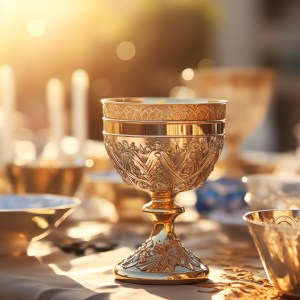
Miriam’s Cup Part II

In Miriam’s Cup Part I, we looked at the rather new custom of drinking WATER from a goblet inscribed with Miriam’s name during the Passover Seder. We explored where this tradition originated and why it may be important to incorporate into your own Seder. We also discovered the strong connection of Miriam with water. In this post, we will look at how the Holy Spirit is also linked to the imagery of water, wisdom, Pesach, and women.

The Three Leaders of Israel and the Godhead

“Indeed, I brought you up from the land of Egypt And ransomed you from the house of slavery, And I sent before you Moses, Aaron and Miriam. (Micah 6:4)

The rabbis teach us that there are three good gifts that were extended to the children of Israel– the well, the clouds, and the manna.  The well was provided due to the merit of Miriam, the clouds of glory because of Aaron, and the manna on account of Moses.[1]

The link between the clouds of glory and Aaron is understandable when considering his specific role. Aaron officiated as High Priest in the Mishkan (Tabernacle) that was perpetually covered with the protective pillar of cloud that shielded it by day.  He also ministered daily at the burning altar, just as the parallel pillar of fire hovered over the Mishkan at night.[2] Moses’ association with the heavenly manna is equally fathomable. He was the lawgiver and became synonymous with the Torah or Word of God. Bread (manna) has long been a symbol for the Torah and the Word.

© Jdanne | Dreamstime.com

What might not be immediately apparent is why the rabbis attribute the well or rock that gushed forth water in the wilderness with Miriam. In the Brit Chadashah (N.T.), we learn that the rock that followed them was in fact, Messiah.

For I do not want you to be unaware, brethren, that our fathers were all under the cloud and all passed through the sea; and all were baptized into Moses in the cloud and in the sea; and all ate the same spiritual food; and all drank the same spiritual drink, for they were drinking from a spiritual rock which followed them; and the rock was Christ. (1Cor. 10:1-4)

Is there a contradiction between what Paul teaches in 1 Corinthians and what the rabbi’s say about this “rock” or “well”? I hope to show you the harmony in their teachings with all three leaders (Moses, Aaron, and Miriam) and the glorious gifts (clouds, manna, and the well). In Part I, we started building the foundation as to why Miriam is linked to water. I hope to continue with this premise here. In the Book of Numbers, the water from the rock dries up immediately following Miriam’s death.

Then the sons of Israel, the whole congregation, came to the wilderness of Zin in the first month; and the people stayed at Kadesh. Now Miriam died there and was buried there. And there was no water for the congregation, and they assembled themselves against Moses and Aaron. (Num. 20:1-2)

The Torah seems to beg one to ask the question as to why the congregation had no water immediately following the death of Miriam. In Hebrew, these thoughts run together with a rhythmic flow. Indeed, the people viewed her as a source of life giving waters. Hopefully, you too can make this connection after reading Part I.

Moses, Aaron, and Miriam represented the King of the Universe on the earth. Is it not fitting that there were 3 of them? Isn’t the godhead most often manifested in 3 (Father, Son, Holy Spirit)? Perhaps what may be eating at you is that Elohim would choose a female to represent one of His roles. Moses is clearly the strong father figure to Israel (as Law giver), Aaron is clearly a mediator and priest (like the Son, Yeshua), so Miriam and the life giving waters must represent the Holy Spirit. If you’ve read the Role of Women, this idea isn’t as threatening as it may first appear.

Hebrew students are fully aware that the Spirit of Elohim is always in the feminine form. (This is true of all spirits.) Thus, its not surprising to find God’s Spirit paired with feminine attributes or given to feminine metaphors quite frequently in the Bible. YHWH is neither male nor female, yet He has qualities that we would associate with each sex. This is why it takes BOTH a male and a female to display the image of Elohim in the natural.

The Ruach Hakodesh in Heaven and Earth

To better understand how Miriam, water, and the Holy Spirit can be equivalent expressions, review the first occurrence of Elohim’s Spirit is in Genesis.

The earth was formless and void, and darkness was over the surface of the deep, and the Spirit of God was moving over the surface of the waters. (Gen. 1:2)

What is the Spirit of Elohim doing in the beginning? It is hovering or moving over the WATERS. Thus, our first association of the Ruach Hakodesh is with water. The primordial waters are separated into earthly waters (mayim) and heavenly waters (shamayim). Did you notice how waters and heavens sound alike in Hebrew? Can you see mayim in the shamayim?

Interestingly, the word for heavens, shamayim, denotes “fire waters” as it is a compound of the word water (mayim) and fire (esh).[4] We will explore this idea some more in a moment. But first,  look at the word for Spirit in Hebrew: ruach. Most of you already know that ruach is also the word for wind or breath. What might not be immediately obvious is that the air and wind are the heavenly counterparts to the earthly water currents. Wind powers most ocean and air currents. In Hebraic thought these “currents” of the mayim and shamayim reflect one another. Or you could say that “it is on earth as it is in heaven”.

Consider how the birds and fish move, migrate, school, or flock as they follow these currents across the globe — carrying seed. If you find these connections fascinating, I urge you to study Dr. Hollisa Alewine’s Creation Gospel.[5] You’ll never look at creation week or the whole of scripture again without noticing these often repeated themes. Waters and heavens are mirrors of one another; therefore, the notion that the Holy Spirit is both like wind and water is natural in Hebraic thought.

In the Gen. 1:2 verse above, God’s Spirit is moving, hovering, or brooding over the waters. Indeed, the Spirit of YHWH is active like the wind/birds and the water/fish. The Hebrew verb used is rachaph; the AHLB[6] defines it as the following:

Strongs #7363: AHLB#: 2763 (V) Flutter: The stirrings and shakings of a bird in the nest – Flutter: [freq. 3] (vf: Paal, Piel) |KJV: shake, move, flutter| {str: 7363}

Did you notice the tangible picture of a mother bird fluttering, shaking, and stirring her nest? Does this bring other verses to mind about Elohim being a protective mother bird?

“Like an eagle that stirs up its nest, That hovers over its young, He spread His wings and caught them, He carried them on His pinions. (Dt. 32:11)

Like flying birds so the LORD of hosts will protect Jerusalem. He will protect and deliver it; He will pass over and rescue it. (Is. 31:5)

“Jerusalem, Jerusalem, who kills the prophets and stones those who are sent to her! How often I wanted to gather your children together, the way a hen gathers her chicks under her wings, and you were unwilling. (Mt. 23:37)

These movements are mimicked in the word for Passover, Pesach. It is a derivative of the protective fluttering actions of a mother bird.[7] [8] Indeed, our Great Elohim moves, flutters, leaps, and hovers over His Creation and His people like a mother protecting her precious chicks. This nurturing aspect of YHWH is divinely displayed in the female creatures of His creation. The Exodus story and the original Passover speak to our initial redemption, which is the Father calling us out for Himself. The “immature” state of the people (and us!) at this initial point of salvation necessitates the tenderness that can only be offered by a mother. Thus, we see YHWH’s Spirit pesach(ing) over the homes of His newborn chicks in Israel.

Pesach and Baptism

By carefully examining what happened when the “death angel” came through Egypt, we see that the same Spirit of YHWH that protected the Israelites also killed the first born of Egypt.

‘The blood shall be a sign for you on the houses where you live; and when I see the blood I will pass over you, and no plague will befall you to destroy you when I strike the land of Egypt. (Ex. 12:13)

Now it came about at midnight that the LORD struck all the firstborn in the land of Egypt, from the firstborn of Pharaoh who sat on his throne to the firstborn of the captive who was in the dungeon, and all the firstborn of cattle. (Ex. 12:29)

The Ruach HaKodesh can nurture and protect and at the same time bring destruction on His enemies. The Spirit is truly like the “waters” that we discussed in Part I. The difference is that the Holy Spirit is always acting with righteousness, even in judgment. After the Children of Israel are released from the grip of Pharaoh, they flee to the wilderness. Without a constant and considerable food and water source, the fledgling nation would be sure to die.

What happens is follows:

  • After 3 days without water, they reach Marah. The waters are bitter (undrinkable). Moses casts a branch in the waters and they are “sweetened”. (Ex. 15) This was YHWH testing the people.
  • They then find an oasis at Elim where 12 streams water the 12 tribes. (Ex. 15)
  • The people begin to cry out for food. YHWH provides them with the heavenly manna. (Ex. 16)
  • They reach Rephidim and again cry out for water. YHWH instructs Moses to strike the rock at Mt. Horeb and water gushes out for the people. (Ex. 17)

A person can live far longer without food than water. The beginning of Israel’s wilderness journey seems to center around issues of water. Miracles and judgments happen with water. Rejoicing and praise are performed by the edge of water. Bitter water is sweetened as a test. The twelve tribes each find their own refreshing stream at Elim. A miraculous “rock” becomes a well that can sustain millions. That same rock FOLLOWS them!

Water, water everywhere! Though the children can’t see it in the natural, they are surrounded with life giving water. (Does this remind you of the Rivers of Eden?) Is this not just like the Holy Spirit? We can’t see the “Spirit”, yet it is everywhere. One connection to the Spirit and water that is tangible to most all Believers is Baptism (or immersing in a Mikveh).
© Gijsvdabeele
| Dreamstime.com

Baptism is a natural picture of the work of the Holy Spirit in the very beginning. The movement and separation of the mayim (water) and shamayim (fire waters) is the same moving and separating that happens when we experience this ritual.[9] It may be an outward symbol of an inward work, but to assume the Holy Spirit isn’t directly involved (and often in a very visible way) is not true. The washing and filling is pictured by both the water and the holy fire! Sometimes these are simultaneous experiences, and sometimes they are separate. Nevertheless, they reflect one another like the waters and the heavens and like the pillar of cloud and the pillar of fire. Unlike some, I fully believe this process is in continual motion and cyclical even in our individual lives.

But this still leaves us with our original question. Why are Messiah and Miriam both equated to the rock or well of water in the wilderness? Speaking of Messiah, Paul also has this to say:

  For in him dwelleth all the fulness of the Godhead bodily. (Col. 2:9 KJV)

Elohim is One (Shema Dt. 6:4). When Yeshua walked the earth, He was the tangible form of the fullness of YHWH. Thus, we see Him in numerous places attributing an action to Himself and then declaring that the same action is really from the Holy Spirit or the Father.

Yeshua will not leave us comfortless, He will come to us, yet the comforter is the Holy Spirit.[10] Yeshua gives us Living Waters, but then proclaims that these waters are the Holy Spirit.[11] Just as Moses and even Aaron were prefigures of the Messiah, so is Miriam. The analogies are similar to both Moses and Yeshua being the Law giver. Or both Aaron and Yeshua being the High Priest. Why would it be any different for both Miriam and Yeshua to be the well in the rock?  Therefore, who is right? The rabbis or Paul? The answer is both!

Stay tuned for one last post in this series. My hope is to conclude by filling Miriam’s Cup with the Living Waters and the Mashiach in Part III.


[1] Talmud Bavli (Babylonian Talmud), Tractate Ta’anit 9a:  R. Jose the son of R. Judah says: Three good leaders had arisen for Israel … Moshe, Aaron and Miriam, and for their sake three good things were conferred [upon Israel], namely, the Well, the Pillar of Cloud and the Manna; the Well, for the merit of Miriam; the Pillar of Cloud for the merit of Aaron; the Manna for the merit of Moshe.

[2] Exodus 40:38

[3] See my post The Biblical Role of Women Part V for more on the feminine aspects of the Holy Spirit.

[4] The roots of the word shamayim are אש (esh, fire) and מים (mayim, water) The beginning letter א (aleph) is a silent stand-in for a beginning consonant, nothing more. Dropping it does not change the meaning of the two-letter word. So the Hebrew שמים literally means fire in water. The great Jewish commentator Rashi  says this about Genesis 1:8: The word shamayim is a contraction of [a word for] carrying of water, also [a word meaning] there is water, also esh and mayim, [meaning] fire and water. He blended them with one another and made the heavens from them. For more imagery of fire, see The Biblical Role of Women Part XI.

[5] Thecreationgospel.com

[6] Ancient Hebrew Lexicon of the Bible by Jeff Benner

[7] They share the two letter parent root chet, pey; which means to cover (in protective action).

[8] See my post on the Meaning of Passover.

[9] John answered and said to them all, “As for me, I baptize you with water; but One is coming who is mightier than I, and I am not fit to untie the thong of His sandals; He will baptize you with the Holy Spirit and fire. (Luke 3:16)

[10] John 14

[11] John 7:38-39
Categories: Moedim, Women | Tags: , , , , , , , , , , , , , , , | 7 Comments

Miriam’s Cup Part I


          © Daniel Million | Dreamstime.com

This Passover season, I have given an often overlooked custom a second glance — well more like a long hard stare! Many of you incorporate the mystical and prophetic Cup of Elijah in your Passover Seders. For Believers in Messiah, this cup takes on even more significance because of John the Baptist. He truly paved the Way for Messiah at His first coming. Since we have already seen this “cyclical” prophecy fulfilled once, hopefully we will better be able to discern the spirit of Elijah in these last days.

If you’ve purchased a special goblet with Elijah’s name written on it to use at your Passover Seder, you may have noticed another more obscure goblet inscribed with Miriam’s name. What is this cup for? Is it just to satiate liberals and feminists? Does this “new” ritual have any redeeming value? My hope is to show you the richness and beauty that this tradition can bring to your Passover table, and perhaps even to your weekly Kiddush.

The Cup of Miriam is not part of a traditional Seder, and I can find no mention of it in any of the feast books that I own. (But, don’t let that deter you from reading on!) According to Risa Borsykowsky[1] , the practice of drinking WATER from a special kiddush cup called Kos Miriam, began with Stephanie Loo Ritari and her Rosh Chodesh Boston group in the late 1980s. Reading through the Exodus, one can find numerous righteous women that played significant roles that led up to the redemption of Israel from Egypt.[2] Mrs. Ritari decided to bring these “hidden” women into the “retelling” of the Passover story to not only honor the matriarchs, but as a tool to make the Seder more comprehensive for women and girls. The most prominent woman of the Exodus story is Moses’ sister, Miriam. Therefore, she will be our focus in this study.

The Bible calls Miriam a prophetess of Israel.[3] She alone ensured that baby Moses would live by following him as he floated down the treacherous Nile River.[4] She watched as Pharaoh’s daughter drew Moses from the water, and then cunningly secured Moses’ own mother as his wet-nurse. She helped sustain the Israelites during their trek across the wilderness and she led them in joyous song and dance to praise YHWH for the miracle of parting the Red Sea. Upon her death, the Israelites grumbled against Moses and Aaron for a lack of life giving water.[5]

Did you notice the many connections of Miriam with water?[6]

Though her name can mean bitterness or even rebellion, the Hebrew also reveals that there is another (positive) side to Miriam. This should give hope to us all, as we each have both a good and evil inclination that wars for supremacy. To learn the duality of Miriam is to understand the ancient contradiction of what it is to be human. We all share the life long struggle between spirit and flesh.

Moreover, we would be wise to consider that other than one bad instance, Miriam’s portrayal of rebellion and bitterness was toward the anti-torah decrees of Pharaoh.[7] She and her family risked their lives by rebelling against Pharaoh. The midwives Puah and Shifrah acted similarly by defying Pharaoh’s edict to kill Hebrew male babies. It is interesting that it was the fearlessness of WOMEN that initially ignited the courage of all Israel. These brave lionesses stood firm and earned a spot forever in the Torah of our Elohim. Why would we leave their stories out of our maggid (retelling of the Passover story)?  Would our daughters not be strengthened to hear year after year that they too have this great potential residing within them?

Miriam and Water

As I was studying the many links between Miriam, water, wells, fountains, the Holy Spirit, the Word, Yeshua, and Living Waters, I could hardly contain my excitement! Miriam is spelled mem, resh, yod, mem. Water is spelled mem, yod, mem.

Did you notice how similar these words are in Hebrew? Miriam is water with an added resh, which is pictographically a head. Thus, her name is literally head or lead waters. This meaning can also be demonstrated another way in Hebrew by looking at Miriam as a compound of two words: mar and yam. These words mean bitter/strong and sea (waters) respectively. Hence again, Miriam is associated with the idea of strong (head) waters.

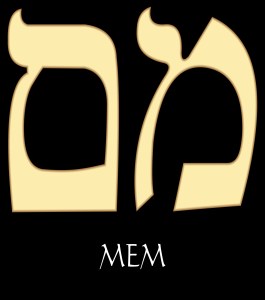
But what do strong waters imply and what are we to learn from this association? In order to get the full impact of Miriam’s role and name, we must first understand WATER from a Hebraic perspective. Mayim (mem, yod, mem) is a word bookended with two mem(s). The Hebrew letter mem is likened to water, a womb (it’s full of water), strength (as in gushing waters), chaos (again like an ocean), and as a preposition “to come forth from or out of”. This letter is one of a handful that has a sofit or final form when it is written at the end of a Hebrew word. A regular mem is open on the bottom, whereas the final form is closed.

    © Shalom3 | Dreamstime.com

Rabbi Michael L. Munk, in his book The Wisdom of the Hebrew Alphabet on the letter mem, states, “The word mayim, water, with its initial and end mem, one open and one closed, depicts the accessible and the inaccessible – an allusion to the waters at Creation.” Thus, mem also illustrates what is revealed and what is concealed. Add to that the letter at the heart of mayim, yod (a hand, work, or deed), and the Creation waters (and all water thereafter) become the same contradiction that we see in Miriam’s name: a work or deed that has the potential for life (strong living waters) or death (bitterness and rebellion).

Water is a place of darkness and yet, great potential in Creation and in a woman’s womb. It can be as powerful and destructive as a roaring ocean and as gentle and satisfying as a trickling stream. It is at the same time both a life giving necessity and a place where chaos and death reign (like at sea). If you read my posts on Crate Trained Believers and The Devouring Lion, you may have noticed the similar imagery. Gentle AND Fierce.

Interestingly, the Hebrew word for mother, em (aleph, mem), also has the pictographic meaning of strong waters.[8] It seems as though the very fact that women have a womb that can fill with life giving waters connects them to Miriam.[9] Females made in the image of Elohim are “mothers” of all living. However, like our sisters Chavah (Eve) and Miriam, we also have the potential to bring chaos and death. (Like a tumultuous ocean.) One must learn to turn life’s bitter unruly waters into sweet waters of refreshing. By the way, this is also something men need to learn as well, for both men and women are revealed in the woman as the wife and bride of the Lamb.

This is the real Biblical portrayal of Miriam, the sister of Moses. She is truly a mother to the Israelites and a leader of her people.[10] Since the force and strength of her name is better understood, does this lend fresh insight about Mary (Miriam), mother of Yeshua? Isn’t it fitting that Yeshua should come forth from a womb such as this? How about the many other “Mary’s” mentioned in the Brit Chadashah (N.T.)? Will their stories speak a little louder the next time you read them?

There has been a tendency for us to forget that the Body needs both masculine and feminine leadership to keep us in balance and to display the whole image of Elohim (God). It is females that bring qualities such as comfort, nurture, protection, and mothering to the Body of Messiah. They are fierce AND gentle. Without these essentials, we raise nothing more than Devouring Lions.

Miriam is a representation of strength, the womb, mercy, prophecy, and praise. The ancient sages recognized the vital role of women in the Exodus in the Babylonian Talmud, Sotah 9b:

“If it wasn’t for the righteousness of women of that generation we would not have been redeemed from Egypt”

The rabbis recognized the very thing examined above: women were the progenitors of Israel’s redemption from Egypt.[11] I hope that you will include Miriam’s Cup in your Seder or even in your weekly Kiddush as a commemoration of her vital role in the Exodus and as a role model to your daughters, sisters, mothers, and wives. But, if this isn’t enough to convince you, there is so much more! In Part II, we will look at how water is associated with the rock in the wilderness, the Holy Spirit, Wisdom, and Pesach.


[2] There is Yocheved, the brave midwives (Puah & Shifrah), Miriam, and Tzipporah. See also footnote 6.

[3] Ex. 15:20

[4] Obviously, the Holy Spirit is what provoked Miriam to do this!

[5] Num. 20:1-2  Then the sons of Israel, the whole congregation, came to the wilderness of Zin in the first month; and the people stayed at Kadesh. Now Miriam died there and was buried there.  (2)  There was no water for the congregation, and they assembled themselves against Moses and Aaron.

[6] D. Hollisa Alewine’s Workbook 5 The Torah Portions Volume 2 –Shemot p.7-21 (2013) offers an interesting perspective on the women of the Exodus and Miriam in particular. If you’re ready to dig deep, buy this series and uncover a multitude of treasures.

[7] Numbers Chapter 12.

[8] See Hebrew Word Pictures by Frank T. Seekins (2003) p. 62

[9] The Hebrew word for womb, racham, ends with the letter mem. This is the same Hebrew word for mercy or compassion. Indeed the watery womb is a place of protection, growth, maturity, and nurture. This word shares the resh and mem with Miriam only adding a chet, which is a fence or boundary that protects.

[10] Micah 6:4  “Indeed, I brought you up from the land of Egypt And ransomed you from the house of slavery, And I sent before you Moses, Aaron and Miriam.

[11] This makes perfect sense considering the “birthing” nature of women.


Categories: Moedim, Women | Tags: , , , , , , , , , , , , , , , | 9 Comments

The Light of the World Part III

Rainbows and the Throne of Glory

Rainbow Science

Before we look at the majestic rainbow in Scripture, let’s review what modern science teaches about this unparalleled display of “colorful” LIGHT. In order for a rainbow to occur, three particular criteria have to be met. The sun has to be shining “behind” you. A rain cloud or moisture in the air must be in “front” of you. And, the sun’s rays have to shine through the cloud at an anti-solar point of 42 degrees. (The anti-solar point is where the shadow of your head is)

When a beam of sunlight passes through a water droplet it slows down and spreads out, separating each color that makes up white light. The process of light refracting or bending can be more accurately described as the process of light changing speed as it moves through different densities. The reason why rainbows appear as an arc is because of the bending of and dispersing of light through millions of water droplets. The colors will always display in the same order due to the fact that each color has its own wavelength or intensity.


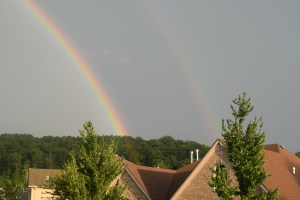
The most common rainbow is called a primary rainbow. It shows red on the outside with violet on the inside. Often this “bow” of light will have another larger but fainter arc above it. We typically call this a “double rainbow”, but scientists call it a secondary rainbow. The double bow occurs when the water droplets in the primary rainbow reflect light TWICE. Since it is the reflection of the primary bow, the colors are reversed. The “double” bow occurs at 50-53 degrees from your anti-solar point.


Adonai’s Rainbow

Gen. 9:11-17  “I establish My covenant with you; and all flesh shall never again be cut off by the water of the flood, neither shall there again be a flood to destroy the earth.”  (12)  God said, “This is the sign of the covenant which I am making between Me and you and every living creature that is with you, for all successive generations;  (13)  I set My bow in the cloud, and it shall be for a sign of a covenant between Me and the earth.  (14)  “It shall come about, when I bring a cloud over the earth, that the bow will be seen in the cloud,  (15)  and I will remember My covenant, which is between Me and you and every living creature of all flesh; and never again shall the water become a flood to destroy all flesh.  (16)  “When the bow is in the cloud, then I will look upon it, to remember the everlasting covenant between God and every living creature of all flesh that is on the earth.”  (17)  And God said to Noah, “This is the sign of the covenant which I have established between Me and all flesh that is on the earth.” (NASB)

The rainbow, according to the Creator, is THE sign of His covenant with every living creature that He will never again destroy all flesh with water. So…were their no rainbows before the flood of Noah’s day? Many Creation Scientists believe the evidence points to the possibility that before the flood it had never rained on the earth. For example, Walt Brown[1], director of the Center for Scientific Creation in Phoenix postulates that rain as we know it was unknown to preflood peoples[2]. If this theory is true, it would have been impossible for a rainbow to form “in the cloud” since there were no clouds. However, this question is not a new one. The ancient sages debated this among themselves for centuries and they likewise considered modern “science” of their day.

The Biblical commentator Ramban argued that a simple experiment proved easily enough that a rainbow is the result of light being refracted through water, which was enough proof in his mind that they were present from creation forward. He never believed that the verses we quoted above, upon close inspection, contradicted science. He states, “Whether the rainbow was created now or whether it had always been a part of nature, the reason for it representing the sign remains the same.”[3]

Regardless of whether rainbows existed pre-flood or not, the Creator plainly stated that it was AFTER the flood that He “set” His bow in the clouds as the SIGN of His covenant.

Keshet   קשׁת

The Bow and the Throne

In Biblical Hebrew, a bow as in “rainbow” and a bow as in a “bow and arrow” are the same word, keshet. The mindset behind this is similar to our English idea: they both BEND. In Noah’s day, Adonai sovereignly chose to judge the earth with a weapon or “bow” of water. Therefore, it is fitting that God chose the rain “bow” as the sign of His promise to never again judge the earth. The rainbow points toward heaven instead of earth as a sign of peace. Bible commentator John Gill puts it this way: “Though it is a bow, yet without arrows, and is not turned downwards towards the earth, but upwards towards heaven, and so is a token of mercy and kindness, and not of wrath and anger.”[4]

The Ramban (Nahmanides) has a similar idea for Adonai’s choice of a rainbow: “Ancient cultures fought their wars with the bow and arrow, and the side which surrendered, pursuing peace instead of war, would express their will to do so by raising an inverted bow that the enemy could see. Similarly, G-d places an inverted bow in the heavens as a sign that He is no longer warring against humanity.”

In most places, the word keshet denotes a bow of archery or the archers who handle bows. I could only find three[5] other references to the majestic seven colored rainbow in the Scriptures. In most of these verses, the bow is found surrounding the throne of the LORD. The first place is in Ezekiel’s vision of the FOUR living creatures. I highly suggest you read all of chapter one for context. Also, be sure to take note of all the words associated with light; there are many!

Ezek. 1:26-28  Now above the expanse that was over their heads there was something resembling a throne, like lapis lazuli in appearance; and on that which resembled a throne, high up, was a figure with the appearance of a man.  (27)  Then I noticed from the appearance of His loins and upward something like glowing metal that looked like fire all around within it, and from the appearance of His loins and downward I saw something like fire; and there was a radiance around Him.  (28)  As the appearance of the rainbow in the clouds on a rainy day, so was the appearance of the surrounding radiance. Such was the appearance of the likeness of the glory of the LORD. And when I saw it, I fell on my face and heard a voice speaking.

The vision must have been amazing! Can you imagine what this must have been like for Ezekiel? First, notice the reference to the “expanse” or as some translations say, the “firmament”. This should remind you of day 2 of creation when God placed an expanse or firmament between the heavenly and earthly waters. (Gen. 1:6-8) God’s throne and the One with “the appearance of a man” are seen ABOVE this “expanse.”

The One with the likeness of man is oddly described from His loins and upward and His loins and downward, yet both resemble fire – a form of LIGHT. This radiance is said to “surround” Him as a rainbow of colorful light. Thus, we can imagine that seeing Adonai is like seeing bright white light refracted into the 7 colors of the rainbow. Perhaps the color or refracted light is seen because our eyes cannot perceive His full nature as pure white (spiritual) light. It must be refracted, bent, or slowed down in order for our “eyes” to see it. This is something to think about. We must remember that the natural world teaches us spiritual truth.

The remaining two verses about Adonai’s throne and the rainbow are both found in the Book of Revelation.

Rev. 4:2-3  Immediately I was in the Spirit; and behold, a throne was standing in heaven, and One sitting on the throne.  (3)  And He who was sitting was like a jasper stone and a sardius in appearance; and there was a rainbow around the throne, like an emerald in appearance.

Rev. 10:1  I saw another strong angel coming down out of heaven, clothed with a cloud; and the rainbow was upon his head, and his face was like the sun, and his feet like pillars of fire.

In these verses, we get to explore the Greek word for rainbow, iris[6]. We get such words as iris, iridescent, iridium, and iridology from this Greek word. These cognates are named due to their association with a colorful appearance. What I find most interesting about this Greek word is that it is found one time in the Septuagint.[7] It is used in the recipe for the Holy Anointing Oil.

Ex. 30:22-25  Moreover, the LORD spoke to Moses, saying,  (23)  “Take also for yourself the finest of spices: of flowing myrrh five hundred shekels, and of fragrant cinnamon half as much, two hundred and fifty, and of fragrant cane two hundred and fifty,  (24)  and of cassia (iris) five hundred, according to the shekel of the sanctuary, and of olive oil a hin.  (25)  “You shall make of these holy anointing oil, a perfume mixture, the work of a perfumer; it shall be holy anointing oil.

So, the question becomes: What does the spice cassia have to do with an iris or a rainbow? The Hebrew word for cassia is kiddah and means to roll, shrivel, or contract. The spice is made from the bark of the cassia tree. Sections are rolled and dried from both sides toward the center so that they end up resembling scrolls. This rolling like a scroll is hint of creation day 2 and the expanse or firmament between the earthly and heavenly waters. One day instead of being stretched out (Is. 42:5) like a rainbow, the heavens will be rolled up like a scroll. (Is. 34:4, Rev. 6:14)

But our Hebrew word kiddah most often means bowing the head in worship or in great respect. (i.e. Gen. 24:26) Since Hebrew is a very action or verb based language, the verb form of kiddah gives us insight into why the Rabbis translating the Hebrew Tanakh into Greek chose this particular word in reference to the cassia spice.

Cassia is the FOURTH ingredient in the holy anointing oil. I don’t think it is a coincidence that the Rabbis used “iris” for “kiddah” in reference to the Holy Anointing Oil. Four is another picture of completeness or seven[8]. Yeshua the Messiah comes from the house of Judah, Jacob’s 4th son. He is the Anointed One standing in the midst of the 7 branched menorah, representing the Light of God[9]. If you read my previous two posts on the Light of the World, you also recall that the menorah is the perfect motif for not only the 7 Spirits of God, but also for light’s 7 forms in the electromagnetic spectrum and its 7 colors of visible light. The rainbow’s 7 colors is a perfect (natural) display of the splendor of His Kingdom and throne.

As a side note, this should really open our eyes to the blasphemy of His glory and Kingdom when the homosexual community uses this motif as a symbol of their rebellion. While it may appear bright and cheery, it is in reality a counterfeit wicked lamp[10] of darkness.

The Rainbow Was Upon His Head

In Revelation 10:1, we are told of a strong messenger with a rainbow upon his head. Some would envision something like a halo. But the halo doesn’t originate in Scripture. It comes from ancient sun god deities[11], the oldest form of false worship. Nevertheless, we have many places in the Bible where a shining or glowing light, even fire, emanates from either God or a person[12]. I freely admit that it is possible that this “rainbow” upon the messenger’s head in Revelation 10:1 may actually be similar to a halo. Please allow me to explain why.

A rainbow actually forms a full circle around the point directly opposite of the observer from the light source. Since the light source is usually the sun, the center of the circle is the anti-solar point (the observer’s shadow). Most often only a portion of the circle is above the ground so that the visible part is an arc or bow. When the observer is located at a considerably higher altitude, like an airplane or mountain top, the full circle of the rainbow can be seen. The picture below was taken while the observer was skydiving.


© Sureshcg1979
| Dreamstime.com

Could this circular rainbow be an allusion as to why Moses’ face shone with light after his encounter with YHWH on the mountain top? In other words, when Moses ascended up to that lofty point on the earth, his shadow didn’t block any of YHWH’s glorious light! Don’t we see this same marvel when Yeshua takes Peter, James, and John up to the mountain of transfiguration?

Mat. 17:1-6  Six days later Jesus took with Him Peter and James and John his brother, and led them up on a high mountain by themselves.  (2)  And He was transfigured before them; and His face shone like the sun, and His garments became as white as light.  (3)  And behold, Moses and Elijah appeared to them, talking with Him.  (4)  Peter said to Jesus, “Lord, it is good for us to be here; if You wish, I will make three tabernacles here, one for You, and one for Moses, and one for Elijah.”  (5)  While he was still speaking, a bright cloud overshadowed them, and behold, a voice out of the cloud said, “This is My beloved Son, with whom I am well-pleased; listen to Him!”  (6)  When the disciples heard this, they fell face down to the ground and were terrified.

Do you suppose that the faces of Moses and Yeshua were similar when they “shone”?

Ex. 34:29-30  It came about when Moses was coming down from Mount Sinai (and the two tablets of the testimony were in Moses’ hand as he was coming down from the mountain), that Moses did not know that the skin of his face shone because of his speaking with Him.  (30)  So when Aaron and all the sons of Israel saw Moses, behold, the skin of his face shone, and they were afraid to come near him.

I find it fascinating that in the natural, one must be at a high altitude, such as a mountain top in order to “see” a complete rainbow —- a picture of God’s covenant. I personally believe that the shining faces of both Yeshua and Moses would have been similar to the circular rainbow. Yeshua is the one standing in the “midst” of God’s menorah. He IS the Light of YHWH, but at the time of the transfiguration, He was not yet glorified. In other words, it is possible that the light was still “veiled” or refracted (bent or slowed down) and this enabled His disciples to perceive it — and Him.

A rainbow in all its fullness is not just a “bow” or arc, it is a circle! For those of you that have been studying the Hebraic mindset, this shouldn’t be too surprising. God and His creation, His calendar, and His Word are all cyclical in nature. Do you recall our first passage in Ezekiel with the living creatures? Earlier in chapter one, these beings are said to be powered by great sparkling “wheels” or circles.

Ezek. 1:15-20  Now as I looked at the living beings, behold, there was one wheel on the earth beside the living beings, for each of the four of them.  (16)  The appearance of the wheels and their workmanship was like sparkling beryl, and all four of them had the same form, their appearance and workmanship being as if one wheel were within another.  (17)  Whenever they moved, they moved in any of their four directions without turning as they moved.  (18)  As for their rims they were lofty and awesome, and the rims of all four of them were full of eyes round about.  (19)  Whenever the living beings moved, the wheels moved with them. And whenever the living beings rose from the earth, the wheels rose also.  (20)  Wherever the spirit was about to go, they would go in that direction. And the wheels rose close beside them; for the spirit of the living beings was in the wheels.

These shining wheels with rims full of eyes (a symbol of Adonai’s Spirit) are what powered or gave energy to the beings. This can be none other than Adonai’s Light, His Spirit that is symbolized beautifully in the 7 days of creation, the 7 Spirits of God (Is. 11:1-2), and in the 7 Feasts! This is why the 7 branched menorah and the 7 visible colors function as a LIGHT display. Creation Gospel students will instinctively perceive why there are 4 living creatures, for this is a picture of 7!

How fitting it is that the LORD chose a rainbow as the first[13] sign of the covenant with mankind and all the creatures of earth! There are more “types” of rainbows than I mentioned in this post. It is a fascinating subject to explore; I urge you to do your own research and see where it takes you. I hope we are all fortunate enough to see a rainbow very soon and take in all its symbolic glory! Imagine the shining faces of Moses and Yeshua and the gleaming Throne Room of the Most High. I leave you with a traditional blessing for when you do see one.

Blessing When Seeing a Rainbow

“Blessed are you, Adonai, our God, King of the universe, Who remembers His covenant, is trustworthy in His covenant, and fulfills His word.”

Related Post: Overcome by a Rainbow

Go back to Part I or Part II


[2] Article, “Did It Rain before the Flood? “ http://www.creationscience.com/onlinebook/FAQ29.html (7/31/13)

[4] John Gill’s Exposition of the Entire Bible, from my e-sword.org bible program on Genesis 9:13.

[5] Including the first rainbow of Noah’s day, this totals FOUR biblical references to the rainbow. Creation Gospel students will recognize once again that 4 is another picture of 7!

[6] Yes, in case you were wondering, our flower by the same name does come from this Greek word! It is aptly named because the iris flower grows in a “rainbow” of colors.

[7] The Septuagint is the Greek version of the Tanakh or Old Testament.

[8] Four also stands for the servant, government, authority, kingdom, the Feast of Shavuot (Pentecost), the door, and the fullness of the Holy Spirit. (For more information on why this is true please seek out a Creation Gospel trainer)

[9] Rev. 1:12-14  Then I turned to see the voice that was speaking with me. And having turned I saw seven golden lampstands;  (13)  and in the middle of the lampstands I saw one like a son of man, clothed in a robe reaching to the feet, and girded across His chest with a golden sash.  (14)  His head and His hair were white like white wool, like snow; and His eyes were like a flame of fire.

[10] Pr. 21:4  Haughty eyes and a proud heart, The lamp of the wicked, is sin.

[12] Ex. 34:29, Mt. 7:2, Mark 9:2, Heb. 1:3, Rev. 1:14-15, etc.

[13] While many theologians declare that YHWH’s first covenant was with Adam, Scripture doesn’t use the Hebrew word for covenant, brit, until Genesis chapter six with Noah. Many commentators assert that Noah’s covenant was merely an expanded form of God’s covenant with Adam, and perhaps this is true. Regardless of whether God’s first covenant was with Adam or Noah, the first SIGN of the covenant is the rainbow.

Categories: Biblical Symbols, Musings | Tags: , , , , , , , , , , , , , , , , , , , , , , , | 1 Comment

The Biblical Role of Women Part VII

Role of Women Main Page

The Real Thing


Back in Part V, we looked at the woman as being a metaphor for the Ruach HaKodesh (Holy Spirit). There are many reasons why this is true. If you haven’t read that post, please do so now before proceeding.

The following is a summary of some of the equal, but different roles of the man and woman. I’ve used the comparison of YHWH (the Father) and the Holy Spirit to demonstrate the ONENESS that should unify the marriage covenant. There was no hierarchy in God’s original design. YHWH purposefully created a male AND a female to display His image in the creation. The list below is by no means exhaustive; we will draw more conclusions as we continue.

Man = Woman
  • Remembers and Obeys the Word (Action)
  • Needs a (spiritual) protector (an ezer)
  • Serves the earth
  • Expresses worship in work and service
  • Man leaves his Father and Mother and is joined to his Wife.
  • Is a Valiant Warrior
  • Aware of moment to moment direction of God
  • Protects Boundaries of Obedience
  • Challenges, encourages, protects, and nourishes
  • Blesses (benefits) her husband
  • Spiritual Guide
  • Takes Ownership of the Man
  • Is a Valiant Warrior
Man shows the image of Father YHWH = Woman shows image of Ruach HaKodesh
  • Father (God) is love. 1 Jn. 4:7-8
  • Father is faithful.1 Pt. 4:19
  • Father is merciful. Titus 3:5
  • Father delights in his children. Ps. 149:4
  • Father is giving. Rom. 8:32
  • Father is patient. 2 Pt. 3:8-9
  • Father never forsakes his own. Gen. 28:15
  • Holy Spirit is Counselor Jn. 14:26
  • Holy Spirit speaks. 1 Tim. 4:1; Acts 10:19-20
  • Holy Spirit intercedes. Rom. 8:26, 34
  • Holy Spirit teaches. Jn. 14:26
  • Holy Spirit bears witness/testifies. Jn. 15:26-27
  • Holy Spirit guides, hears, tells Jn. 16:12-13
  • Holy Spirit comforts/nurtures. Jn. 14:16; 15:26
  • Holy Spirit opposes. Acts 16:6-7


Redeemed Marriage

© Elitravo
| Dreamstime.com

It is not good for man to be alone. He NEEDS an ezer kenegdo — a protector that opposes him. This is why he is the one that leaves the guardianship of his mother and father and cleaves to his wife — his new guardian. The woman will set boundaries that are necessary for the man to stay obedient. It is in this way that she takes ownership responsibility of the man like the woman in the Song of Songs. Dr. Moen expresses it this way:

She is exactly what he needs in order to be what God calls him to be…Her greatest longing is to be his greatest defense. She is built for that and it will not be denied, even if the direction is misplaced…In God’s perfect world, she takes ownership responsibility for her man, and he welcomes it because he knows she is uniquely designed to bring about what is best for him. She is ready and willing to set aside every other agenda in order to bless him with her care. (Guardian Angel p.345)

If there was no hierarchy in the beginning, then men are only the “head” in the sense of order in the creation, not rank. While this rubs against a lot of traditional theology, I urge you to explore this idea more fully before rejecting it off hand. (Dr. Moen has an article that speaks to this issue here and David H. Scholer explores Biblical Headship here.)

If man was meant to rule over or master women from the beginning, why does Paul in Ephesians chapter 5 instruct the women to submit to their husbands? Carefully consider this. We mustn’t allow current doctrine or tradition to define this for us; rather, we must take the whole of Scripture into consideration and let it interpret itself. Though the difference may be “subtle”, it has far reaching implications. The woman must choose to give her husband authority just as we must choose to give Messiah (Christ) authority over our lives. A man doesn’t naturally possess the position of head by the simple fact that he is male.

So why does the wife submit? This action only works properly if the man also does what Paul requires: love his wife. If a man really loves a woman, he’s willing to do anything for her—- even die. This is a selfless type of love. If a woman is loved in this way, she naturally gives the man authority. She trusts that he will always have her best interests at heart. The authority she gives protects her; it doesn’t control or silence her.

So why are men told to love? Men are instructed to do this because in the fallen nature they naturally distrust women. This is why they instinctively place themselves as the (dominating) authority. This is a self-preservation technique. Somewhere deep down, they fear the woman is going to betray them. Therefore, they have great difficulty in giving themselves completely to their wives. Adam must learn to trust Chavah (Eve).

In order for this to happen, Adam must first forgive Eve for misguiding him. He must literally place his life back into the hands of his ezer. This only functions as a two-way street. As many marriage self-help books attest, these two roles are reciprocal. If they fail to come together, there will be no unity. No oneness. Dr. Moen puts it this way:

The wife grants authority to the husband and voluntarily submits to him knowing that it is in her best interests to do so BECAUSE the husband sacrifices his own interest in order to offer all that he is for her wellbeing. Both of these acts of self-denial model the character of God. (Guardian Angel p.346)

 When Disputes Arise

Dr. Moen calls the restored marriage roles we’ve been discussing “Redeemed Marriage”. I like his term and will use it from this point to describe such. I added this little section to offer a few ideas of what to do when issues arise in those marriages where the man and woman are each doing their best to walk in restoration.

There are thousands and probably millions of things in our daily lives that could spark a dispute between a man and wife. Married couples are all too familiar with this truth. The difference in happy couples and unhappy couples is usually in how they speak to and treat one another when things do happen. Though everyone will have a bad day on occasion, couples of faith should have less.

© Subbotina
| Dreamstime.com

The short answer is humility—- of course, isn’t it always? Put your mate before yourself! Stop feeling sorry for yourself and having pity parties —– these emotions are coming from PRIDE. Crucify your flesh and serve your spouse. By the way, that’s the answer to far more than marriage quibbles, but I digress.

While the short answer is much easier said than done, it should be our FIRST response. Squash the flesh! But sometimes there are issues where we simply can’t “turn the other cheek”. In those situations, it is best that both parties unify and decide TOGETHER. Nobody should have a veto stamp unless one party is mentality injured, diseased, or compromised in some way.

Generally though, a man must listen to his ezer —- she can save him from a multitude of regrets. That’s her God designed purpose, remember? She is his guardian and protector. Likewise, a man that loves his wife will also have to save and protect her —and often, it will be from herself! It is in these times that she must remember why she chose to submit to her husband — he has HER best interests at heart. The bottom line is motivation. What is your motive in winning this argument or battle? Is it self-serving? Will your spouse benefit or will you?

I realize these solutions are very broad and that we are all in different places. So please keep that in mind and the fact that these actions require BOTH spouses to be in faith and agreement to walk out a Redeemed Marriage. There are many couples where only one spouse is willing or trying to reach restoration. I am praying for you and encourage you to never give up. Keep seeking after YHWH and place your focus on improving yourself, not your spouse. Though it doesn’t make sense to our natural mind, this is the only way real change is accomplished. Be the best spouse you can be.


The Real World

How do the redeemed roles of a man and woman translate outside of marriage? Are women meant to stay uneducated and at home? What about in our assemblies? Are women to keep their mouths shut lest they offend the males present? Some would scream a resounding “yes!” to all or most of these questions. But based on what we’ve learned about women from the Tanakh, is that the heart of YHWH?

My hope is that the previous six posts in this series have given you some meat to chew on. Most often, books or teachings about a woman’s biblical role begin in the end. By that, I mean they tend to ignore the entire first three quarters of the Bible (the Tanakh or O.T.) and focus solely on last quarter (N.T.).

Is there any other book in the world where people BEGIN their reading or research three quarters of the way into the material? I don’t believe there is, with the exception of an encyclopedia or a dictionary. But the Bible is not a reference book. It is the Book of Life. Only the enemy of our souls could deceive us so openly. He has done a fine job of keeping us away from the beginning and the foundation.

By focusing only on the last quarter of the Bible, one would expect multiple opposing doctrines, teachings, and positions. Each culture (nation, people, and race) would bring their own bias and traditions into practice. This would provoke a multitude of creeds, formulas, and proof texts to support their particular branch. We see all of these things in our Assemblies. Could this be because we have divorced ourselves from the foundation?

The Bible was written by Hebrews. It is within their culture, language, and tradition that our Adonai (LORD) sovereignly chose to reveal Himself. The Savior, Yeshua (Jesus), was/is a Torah observant Jew. His daily life did not deviate from this setting. A careful read of the New Testament reveals that each writer has this same testimony. While they may have challenged the traditions and laws of men, they never questioned the Law of YHWH.

This is the reason I began this series in the beginning, Bereshit (Genesis). If we don’t understand Paul’s standard (the Torah), how can we properly interpret some answer (of which we don’t even have the questions) that he gave in the first century? These are reasonable questions to consider.

Yeshua and Paul would have never strayed from the Torah, Prophets, or Writings (the only Bible available to people living in their day). Instead, they consistently point us back to the beginning for answers[1]. But, shaking off centuries of tradition is no simple feat. Even many western women struggle with the ramifications of what it means to be an ezer kenegdo or an eshet chayil. Sometimes our shackles give us a false sense of comfort and security. To add insult to injury, modern feminism is a twisted counterfeit of God’s original design.

My desire is for God’s people to repent and return to the ideal of the Garden of Eden. Women (and men) will only be truly fulfilled in their relationships when we do things God’s way. This is not to be confused with traditional church teachings or creeds. Manmade laws are NOT God’s laws.

But I must warn you: YHWH’s Word is OFFENSIVE. It offends sinners. It offends self-righteous “churchmen”; and it especially offends religious spirits. Gloria Steinem was right about one thing, “The truth will set you free, but first it will piss you off.” But that’s only if we are humble enough to allow the Word to change our hearts. So many would rather fight tooth and nail to cling onto a façade of truth rather than relent to the real thing.

A Woman Shall Encompass a Man

Instead of making a list of the roles that women fulfilled in the Bible, I think it is best to go back to the chart in the beginning of this article. Prayerfully look at the attributes of the Holy Spirit, for a woman will naturally reflect these works/roles. This will be true whether your theology accepts it or not. YHWH designed the woman in this way —- no one can change that, not even church laws and creeds. A woman will be an ezer in harmony with her husband or she will be an ezer covertly coaxing her husband. The choice is up to her Adam— for she will always be an ezer. Will he forgive her and trust her or will he continue to resist her?

As we look through the pages of Scripture, we see women functioning in nearly every role of the man. Many draw the conclusion that these instances are exceptions to the rule and that women only stepped into these positions when a man was unwilling to fulfill his role.(Please see Deborah the Bee Part I and Part II to dispel this myth.) Perhaps a better perspective is to consider that YHWH gave us these examples to ensure that fallen Adam would not be able to draw absolute control (mastership) over Eve. Maybe this was the Father’s way of protecting His daughters and their unique design and purpose.

Jeremiah 31 is a chapter of great importance. In it, we have the only plain prophecy about the New Covenant[2].  But if we go back and reread the entire section, we can easily see that the New Covenant hasn’t happened in its fullness — not yet. Not every man knows YHWH and we are still teaching the world about our great Elohim (God). We have not yet been gathered into the land, ending our exile either[3]. But there is one verse I’d especially like to draw your attention to:

How long wilt thou go about, O thou backsliding daughter? for the LORD hath created a new thing in the earth, A woman shall compass a man. (Jer. 31:22)

While Christian Bible interpretation is often limited, Hebrew is not. In other words, prophecy is multifaceted and dynamic. No interpretation supersedes another. There are usually greater and lesser fulfillments and each are true. The verse in question is often taught to mean a woman’s womb shall encompass a man — the Son of Man to be more specific. And I believe this is very true! Messiah’s work and atonement are central to not only our redemption, but also our restoration of which this passage speaks.

However, that in no way detracts from the literal interpretation of this passage. If this whole section is about our complete restoration, then what does it mean for “a woman to encompass a man”? Could this be an allusion to the Garden of Eden? A return to God’s original design for man and WOMAN? The Hebrew word for “new” in this verse is the same word for “new” in Jeremiah 31:31 in reference to the New Covenant. It is chadash. The AHLB[4] describes it this way:

Strongs #2319: AHLB#: 2151) Renew: New moon: New: The first crescent of the moon as the renewal of the moon, the first day of the month. [from: restoration] To make something like new through repair, restoration, or replacement. [freq. 10] {str: 2318} New: Something that is new, renewed, restored or repaired.  [freq. 54] |kjv: new, fresh| {str: 2319, 2323}

Chadash implies renewal, like the monthly renewal of the moon. The moon isn’t brand new every month, instead it is renewed. This is the language and understanding of the New Covenant. It is the same as the previous covenant — renewed. This is solidified by the fact that YHWH’s Torah (law) will be written on the hearts of His people[5]. In reference to the woman encompassing a man, YHWH also calls this a “renewed” thing. In other words, this is a restoration.

© Chris Rogers

Do you recall the function of the female? She is a boundary setter. She is an ezer that surrounds her husband in protection, counsel, and guidance. Her God designed purpose is to surround or encompass her man. As we progress toward our complete redemption and restoration, we come closer and closer to the garden. Adam will forgive Chavah. She will be restored to her proper role. This, I believe, is one of the prophetic layers found in Jeremiah 31:22.

Moreover, in Jewish tradition, this passage has been used for centuries during wedding ceremonies. When the bride arrives at the chuppah[6], she circles the groom seven times while the groom prays. This symbolizes the idea of the woman being a protective, surrounding light for her husband and their household. She illuminates them with understanding and love and protects them from harm from the outside.

There are several interpretations of the significance of her encircling the groom seven times. Seven is the number of days of the creation, and the wedding ceremony is the creation of a new household. Seven is the number of times the phrase “when a man takes a wife” occurs in the Bible. Seven is the number of times Joshua circled the walls of Jericho in order to bring them down, and in circling her groom a bride brings down any wall that may remain between them.

Also, on the day of his wedding, the groom is compared to a king. Just as the king is encircled by his legion, the groom is to be encircled by his bride. This symbolizes that the bride is a type of “warrior/protector” for the man. She is his eshet chayil. When the bride has finished encircling the groom, she stands at his right, as the Psalmist states, “at the right hand does the queen stand.”[7]

While all the above reasons are given in Jewish tradition for this mystical practice, I believe there is one last purpose that the bride encircles the man seven times. It is because she is a type of the Holy Spirit in the man’s life. There are seven manifestations of the Holy Spirit as we discussed in Part V. A woman of faith will walk in these spirits in order to guide and protect her husband and home.

My prayer is that we will humbly strive towards restoration and obedience to the whole counsel of YHWH in matters of faith, marriage, and community. Let us return to YHWH. Let us return to His ways. Let us return to the garden and find the original man and woman of shalom. May the two become One.

“Who is this, shining forth like the dawn, fair as the moon, bright as the sun” — but formidable as an army marching under banners?

Come back, come back, girl from Shulam (shalom, peace, safety, fullness, complete)! Come back, come back to where we can see you! What will you see in the Shulamite? As it were the dance of two army camps.

 (Song of Songs 6:10,13)

This series was originally meant to be only seven parts. However, due to the the many inquiries I get about this series, its popularity, and my continued studies, I’ve decided to add more posts to The Biblical role of Women. There is SO much more! 🙂

Here is Part VIII.


[1] Some examples:  Rom. 16:20, 1 Cor. 6:16; 11:9; 11:12; 15:22, 2 Cor. 4:6; 11:3, 1 Tim. 2:13-14; 4:3-4.

[2] Jer. 31:31-33; Heb. 8:8-12

[3] Jer. 31:8-21

[4] Ancient Hebrew Lexicon of the Bible by Jeff Benner.

[5] Jer. 31:33; Heb. 8:10

[6] A covered wedding canopy. The covering is usually a large prayer shawl (tallit).

[7] Ps. 45:9

Categories: Women | Tags: , , , , , , , , , , , , | 8 Comments

Blog at WordPress.com.