Posts Tagged With: Creation Gospel

Miriam’s Cup Part II

In Miriam’s Cup Part I, we looked at the rather new custom of drinking WATER from a goblet inscribed with Miriam’s name during the Passover Seder. We explored where this tradition originated and why it may be important to incorporate into your own Seder. We also discovered the strong connection of Miriam with water. In this post, we will look at how the Holy Spirit is also linked to the imagery of water, wisdom, Pesach, and women.

The Three Leaders of Israel and the Godhead

“Indeed, I brought you up from the land of Egypt And ransomed you from the house of slavery, And I sent before you Moses, Aaron and Miriam. (Micah 6:4)

The rabbis teach us that there are three good gifts that were extended to the children of Israel– the well, the clouds, and the manna.  The well was provided due to the merit of Miriam, the clouds of glory because of Aaron, and the manna on account of Moses.[1]

The link between the clouds of glory and Aaron is understandable when considering his specific role. Aaron officiated as High Priest in the Mishkan (Tabernacle) that was perpetually covered with the protective pillar of cloud that shielded it by day.  He also ministered daily at the burning altar, just as the parallel pillar of fire hovered over the Mishkan at night.[2] Moses’ association with the heavenly manna is equally fathomable. He was the lawgiver and became synonymous with the Torah or Word of God. Bread (manna) has long been a symbol for the Torah and the Word.
© Jdanne | Dreamstime.com

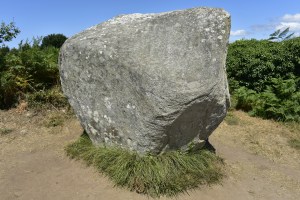
What might not be immediately apparent is why the rabbis attribute the well or rock that gushed forth water in the wilderness with Miriam. In the Brit Chadashah (N.T.), we learn that the rock that followed them was in fact, Messiah.

For I do not want you to be unaware, brethren, that our fathers were all under the cloud and all passed through the sea; and all were baptized into Moses in the cloud and in the sea; and all ate the same spiritual food; and all drank the same spiritual drink, for they were drinking from a spiritual rock which followed them; and the rock was Christ. (1Cor. 10:1-4)

Is there a contradiction between what Paul teaches in 1 Corinthians and what the rabbi’s say about this “rock” or “well”? I hope to show you the harmony in their teachings with all three leaders (Moses, Aaron, and Miriam) and the glorious gifts (clouds, manna, and the well). In Part I, we started building the foundation as to why Miriam is linked to water. I hope to continue with this premise here. In the Book of Numbers, the water from the rock dries up immediately following Miriam’s death.

Then the sons of Israel, the whole congregation, came to the wilderness of Zin in the first month; and the people stayed at Kadesh. Now Miriam died there and was buried there. And there was no water for the congregation, and they assembled themselves against Moses and Aaron. (Num. 20:1-2)

The Torah seems to beg one to ask the question as to why the congregation had no water immediately following the death of Miriam. In Hebrew, these thoughts run together with a rhythmic flow. Indeed, the people viewed her as a source of life giving waters. Hopefully, you too can make this connection after reading Part I.

Moses, Aaron, and Miriam represented the King of the Universe on the earth. Is it not fitting that there were 3 of them? Isn’t the godhead most often manifested in 3 (Father, Son, Holy Spirit)? Perhaps what may be eating at you is that Elohim would choose a female to represent one of His roles. Moses is clearly the strong father figure to Israel (as Law giver), Aaron is clearly a mediator and priest (like the Son, Yeshua), so Miriam and the life giving waters must represent the Holy Spirit. If you’ve read the Role of Women, this idea isn’t as threatening as it may first appear.

Hebrew students are fully aware that the Spirit of Elohim is always in the feminine form. (This is true of all spirits.) Thus, its not surprising to find God’s Spirit paired with feminine attributes or given to feminine metaphors quite frequently in the Bible. YHWH is neither male nor female, yet He has qualities that we would associate with each sex. This is why it takes BOTH a male and a female to display the image of Elohim in the natural.

The Ruach Hakodesh in Heaven and Earth

To better understand how Miriam, water, and the Holy Spirit can be equivalent expressions, review the first occurrence of Elohim’s Spirit is in Genesis.

The earth was formless and void, and darkness was over the surface of the deep, and the Spirit of God was moving over the surface of the waters. (Gen. 1:2)

What is the Spirit of Elohim doing in the beginning? It is hovering or moving over the WATERS. Thus, our first association of the Ruach Hakodesh is with water. The primordial waters are separated into earthly waters (mayim) and heavenly waters (shamayim). Did you notice how waters and heavens sound alike in Hebrew? Can you see mayim in the shamayim?

Interestingly, the word for heavens, shamayim, denotes “fire waters” as it is a compound of the word water (mayim) and fire (esh).[4] We will explore this idea some more in a moment. But first,  look at the word for Spirit in Hebrew: ruach. Most of you already know that ruach is also the word for wind or breath. What might not be immediately obvious is that the air and wind are the heavenly counterparts to the earthly water currents. Wind powers most ocean and air currents. In Hebraic thought these “currents” of the mayim and shamayim reflect one another. Or you could say that “it is on earth as it is in heaven”.

Consider how the birds and fish move, migrate, school, or flock as they follow these currents across the globe — carrying seed. If you find these connections fascinating, I urge you to study Dr. Hollisa Alewine’s Creation Gospel.[5] You’ll never look at creation week or the whole of scripture again without noticing these often repeated themes. Waters and heavens are mirrors of one another; therefore, the notion that the Holy Spirit is both like wind and water is natural in Hebraic thought.

In the Gen. 1:2 verse above, God’s Spirit is moving, hovering, or brooding over the waters. Indeed, the Spirit of YHWH is active like the wind/birds and the water/fish. The Hebrew verb used is rachaph; the AHLB[6] defines it as the following:

Strongs #7363: AHLB#: 2763 (V) Flutter: The stirrings and shakings of a bird in the nest – Flutter: [freq. 3] (vf: Paal, Piel) |KJV: shake, move, flutter| {str: 7363}

Did you notice the tangible picture of a mother bird fluttering, shaking, and stirring her nest? Does this bring other verses to mind about Elohim being a protective mother bird?

“Like an eagle that stirs up its nest, That hovers over its young, He spread His wings and caught them, He carried them on His pinions. (Dt. 32:11)

Like flying birds so the LORD of hosts will protect Jerusalem. He will protect and deliver it; He will pass over and rescue it. (Is. 31:5)

“Jerusalem, Jerusalem, who kills the prophets and stones those who are sent to her! How often I wanted to gather your children together, the way a hen gathers her chicks under her wings, and you were unwilling. (Mt. 23:37)

These movements are mimicked in the word for Passover, Pesach. It is a derivative of the protective fluttering actions of a mother bird.[7] [8] Indeed, our Great Elohim moves, flutters, leaps, and hovers over His Creation and His people like a mother protecting her precious chicks. This nurturing aspect of YHWH is divinely displayed in the female creatures of His creation. The Exodus story and the original Passover speak to our initial redemption, which is the Father calling us out for Himself. The “immature” state of the people (and us!) at this initial point of salvation necessitates the tenderness that can only be offered by a mother. Thus, we see YHWH’s Spirit pesach(ing) over the homes of His newborn chicks in Israel.

Pesach and Baptism

By carefully examining what happened when the “death angel” came through Egypt, we see that the same Spirit of YHWH that protected the Israelites also killed the first born of Egypt.

‘The blood shall be a sign for you on the houses where you live; and when I see the blood I will pass over you, and no plague will befall you to destroy you when I strike the land of Egypt. (Ex. 12:13)

Now it came about at midnight that the LORD struck all the firstborn in the land of Egypt, from the firstborn of Pharaoh who sat on his throne to the firstborn of the captive who was in the dungeon, and all the firstborn of cattle. (Ex. 12:29)

The Ruach HaKodesh can nurture and protect and at the same time bring destruction on His enemies. The Spirit is truly like the “waters” that we discussed in Part I. The difference is that the Holy Spirit is always acting with righteousness, even in judgment. After the Children of Israel are released from the grip of Pharaoh, they flee to the wilderness. Without a constant and considerable food and water source, the fledgling nation would be sure to die.

What happens is follows:

  • After 3 days without water, they reach Marah. The waters are bitter (undrinkable). Moses casts a branch in the waters and they are “sweetened”. (Ex. 15) This was YHWH testing the people.
  • They then find an oasis at Elim where 12 streams water the 12 tribes. (Ex. 15)
  • The people begin to cry out for food. YHWH provides them with the heavenly manna. (Ex. 16)
  • They reach Rephidim and again cry out for water. YHWH instructs Moses to strike the rock at Mt. Horeb and water gushes out for the people. (Ex. 17)

A person can live far longer without food than water. The beginning of Israel’s wilderness journey seems to center around issues of water. Miracles and judgments happen with water. Rejoicing and praise are performed by the edge of water. Bitter water is sweetened as a test. The twelve tribes each find their own refreshing stream at Elim. A miraculous “rock” becomes a well that can sustain millions. That same rock FOLLOWS them!

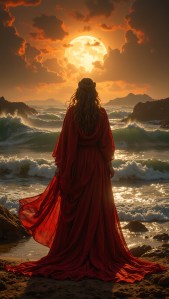
Water, water everywhere! Though the children can’t see it in the natural, they are surrounded with life giving water. (Does this remind you of the Rivers of Eden?) Is this not just like the Holy Spirit? We can’t see the “Spirit”, yet it is everywhere. One connection to the Spirit and water that is tangible to most all Believers is Baptism (or immersing in a Mikveh).
© Gijsvdabeele
| Dreamstime.com

Baptism is a natural picture of the work of the Holy Spirit in the very beginning. The movement and separation of the mayim (water) and shamayim (fire waters) is the same moving and separating that happens when we experience this ritual.[9] It may be an outward symbol of an inward work, but to assume the Holy Spirit isn’t directly involved (and often in a very visible way) is not true. The washing and filling is pictured by both the water and the holy fire! Sometimes these are simultaneous experiences, and sometimes they are separate. Nevertheless, they reflect one another like the waters and the heavens and like the pillar of cloud and the pillar of fire. Unlike some, I fully believe this process is in continual motion and cyclical even in our individual lives.

But this still leaves us with our original question. Why are Messiah and Miriam both equated to the rock or well of water in the wilderness? Speaking of Messiah, Paul also has this to say:

  For in him dwelleth all the fulness of the Godhead bodily. (Col. 2:9 KJV)

Elohim is One (Shema Dt. 6:4). When Yeshua walked the earth, He was the tangible form of the fullness of YHWH. Thus, we see Him in numerous places attributing an action to Himself and then declaring that the same action is really from the Holy Spirit or the Father.

Yeshua will not leave us comfortless, He will come to us, yet the comforter is the Holy Spirit.[10] Yeshua gives us Living Waters, but then proclaims that these waters are the Holy Spirit.[11] Just as Moses and even Aaron were prefigures of the Messiah, so is Miriam. The analogies are similar to both Moses and Yeshua being the Law giver. Or both Aaron and Yeshua being the High Priest. Why would it be any different for both Miriam and Yeshua to be the well in the rock?  Therefore, who is right? The rabbis or Paul? The answer is both!

Stay tuned for one last post in this series. My hope is to conclude by filling Miriam’s Cup with the Living Waters and the Mashiach in Part III.


[1] Talmud Bavli (Babylonian Talmud), Tractate Ta’anit 9a:  R. Jose the son of R. Judah says: Three good leaders had arisen for Israel … Moshe, Aaron and Miriam, and for their sake three good things were conferred [upon Israel], namely, the Well, the Pillar of Cloud and the Manna; the Well, for the merit of Miriam; the Pillar of Cloud for the merit of Aaron; the Manna for the merit of Moshe.

[2] Exodus 40:38

[3] See my post The Biblical Role of Women Part V for more on the feminine aspects of the Holy Spirit.

[4] The roots of the word shamayim are אש (esh, fire) and מים (mayim, water) The beginning letter א (aleph) is a silent stand-in for a beginning consonant, nothing more. Dropping it does not change the meaning of the two-letter word. So the Hebrew שמים literally means fire in water. The great Jewish commentator Rashi  says this about Genesis 1:8: The word shamayim is a contraction of [a word for] carrying of water, also [a word meaning] there is water, also esh and mayim, [meaning] fire and water. He blended them with one another and made the heavens from them. For more imagery of fire, see The Biblical Role of Women Part XI.

[5] Thecreationgospel.com

[6] Ancient Hebrew Lexicon of the Bible by Jeff Benner

[7] They share the two letter parent root chet, pey; which means to cover (in protective action).

[8] See my post on the Meaning of Passover.

[9] John answered and said to them all, “As for me, I baptize you with water; but One is coming who is mightier than I, and I am not fit to untie the thong of His sandals; He will baptize you with the Holy Spirit and fire. (Luke 3:16)

[10] John 14

[11] John 7:38-39
Categories: Moedim, Women | Tags: , , , , , , , , , , , , , , , | 7 Comments

Masters


                 © Vchalup | Dreamstime.com

 “No gods, no masters.” ― Margaret Sanger

In my last post, A Parable, we investigated the Hebrew word mashal found in Genesis 3:16 and 4:7 translated as rule and master. We discovered that mashal is also the Hebrew word for a parable or proverb and how maxims actually do have dominion and power for those that have ears to hear. In today’s post, I hope to take us a little deeper into this correlation.

In Chavah’s encounter with the serpent, she found the fruit of the Tree of Knowledge of good and evil to be three things:

  1. Good for food.
  2. A delight to her eyes.
  3. Desirable to make one wise.

When the woman saw that the tree was good for food, and that it was a delight to the eyes, and that the tree was desirable to make one wise, she took from its fruit and ate; and she gave also to her husband with her, and he ate. (Gen. 3:6)

Why did Chavah consider something that Adonai said not to eat, “good for food?” Does she believe He  is withholding something from her? Apparently, Adonai isn’t completely trustworthy in the eyes of Eve after her encounter with the serpent.

So, why did Chavah trust a walking[1], talking snake? Isn’t a serpent a created beast? As a beast, the serpent knows only what an animal is created to do. His dialogue with Chavah reveals the spirit of a beast, not a man. Anything an animal desires to do is a God given instinct. By pursuing these urges, the beast is actually being obedient to the Creator.

What are these desires? Beasts are “ruled” by the impulse to eat, sleep, procreate, and expand their territory.[2] These inborn urges drive the soul of an animal. If they see something they “desire,” they are never in disobedience by working to fulfill this want. These appetites ensure that these creatures are fruitful, multiply, and fill the earth. Therefore, an animal’s teshukah[3] (desire) is its master by the design of the Creator.

Humans and animals both have a nephesh, or a soul. Therefore, we also have appetites corresponding to an animal or beast. This part of our human nature is not evil in and of itself. The Creator made mankind this way and called it very good! Without these appetites and passions, we wouldn’t be able to accomplish our primary mandate as humans: to be fruitful, multiply, and fill the earth.

However, unlike the beasts, we are NOT to allow ourselves to be ruled by these appetites and desires. Instead, with Adonai’s help, we are meant to master them. A human created in the image of Elohim masters his flesh or nephesh. This can only be accomplished by living by every Word that proceeds from the mouth of Elohim (God).[4] Why? Because without the Word, we are ruled by the appetites of our nephesh and are no different than a beast of the field.

If our nephesh controls our actions, are we not our own masters? Isn’t that the real temptation the serpent presents to Chavah (Eve)? By allowing the nephesh to rule, one becomes like Elohim knowing good and evil and doing what is right in their own eyes. This is pure idolatry; with self being the idol.

This is the precise problem with the second and third observations Eve had of the Tree of Knowledge of good and evil.

And when the woman saw that the tree was good for food, and that it was pleasant to the eyes, and a tree to be desired to make one wise, she took of the fruit thereof, and did eat, and gave also unto her husband with her; and he did eat.(Gen. 3:6 KJV)

The Hebrew word for pleasant is ta’avah; it means to long for, desire, lust, or delight. Its root word, avah, is defined as to wish for, desire, and covet. This is the same word used in the second set of the Ten Commandments for “You shall not covet…”[5] This is not surprising; since, it is usually one’s eyes that first longs for (covets) something that isn’t his to have. This is the purpose of Adonai commanding one to wear visual reminders of His commandments.[6] One cannot trust their eyes to remain faithful.

Not by coincidence, the Hebrew word for “desired” above is chamad. While it does mean delight, desirable, and even beloved; it also means to covet. It is the Hebrew word used in the first set of the Ten Commandments where it says, “You shall not covet…”[7] What exactly was it that Chavah coveted?

“For God knows that in the day you eat from it your eyes will be opened, and you will be like God, knowing good and evil.” (Gen. 3:5)

Chavah could be her own master. She would decide what was good and evil in her own eyes and, in effect, be a better ezer kenegdo to Adam. Margaret Sanger[8] captured this human dilemma in parabolic form with her infamous words, “No gods, no masters.” She was certain that the only “master” of a woman’s body was the woman herself. In other words, Margaret’s desire was to do what seemed right in her own eyes. She was her own master or god knowing good and evil. Sadly, this is the battle of all men and women. Who shall rule us?

By listening to the walking, talking serpent or nephesh, Chavah began to have more trust not necessarily in the serpent, but in herself. This is the ultimate deception of the serpent. He is a beast perfectly designed to be ruled by instinct or nephesh. Chavah is meant to be ruled by the Word of God. So, what happened with Adam in this story?

Unlike Chavah, Adam was NOT deceived.

…and she gave also to her husband with her, and he ate. (Gen. 3:16b)

The Hebrew word for with is eem. It can mean with, by, or beside. The Hebrew allows one interpretation: Adam watched this whole debacle unfold and never protested the obvious (to him) deception of his wife. Why was Adam silent? Did he trust his ezer kenegdo to a fault? Or did he realize, as Dr. Moen suggests,[9] that he had an impossible choice to make:

  1. Eve, the only perfect one; made just for me. Bone of my bones, flesh of my flesh.
  2. Elohim. LORD. Creator of Heaven and Earth.

Regardless of why Adam remained silent, his sin was exactly the same as Chavah’s. He chose his own desires and passions instead of Adonai. In other words, Adam was mastered by his nephesh just as Eve was. The difference, I believe, is that Chavah didn’t realize (at first) what was happening, but Adam did. He was not deceived. He chose Chavah, the very delight to his eyes.

Essentially, both Chavah and Adam became their own masters. Their sin was idolatry. I don’t think we realize that this is what we are doing when choose to do what we want to do or not do. We usurp the highest authority in the Universe when we decide what is good and evil. Only YHWH has the right and authority to make these distinctions. We don’t have to understand his sovereign commandments. We simply are to obey them.

The serpent said to the woman, “You surely will not die!” (Gen. 3:4)

When we become our own god, we bring curses and death upon ourselves. Sure, the consequence may not be immediate. Adam and Chavah didn’t die… right away. This delay can only be the mercy and grace of YHWH. Sadly, when we are disobedient and nothing “bad” seems to happen, we believe the lie of the serpent and smugly think to ourselves that our DESIRE doesn’t lead to death or destruction either.

Ironically, the very thing a person ruled by their nephesh desires, to be their own master, is the very thing that enslaves them to sin and death. Meditate on that for a while…

So, what’s the parable or moral found in this story? How does this connect the two accounts in Genesis 3:16 and 4:7? What is the Creator teaching with the teshukah and mashal in Chavah and Cain’s predicaments? I hope to answer that in my next post, Slaves.


[1] I’m assuming he could walk since his curse after deceiving Chavah (Eve) would be that he would have to crawl on the ground from that point forward. Naturally, the inference is that before this encounter, he did not crawl on his belly.

[2] Dr. Hollisa Alewine, in her workbook The Scarlet Harlot, speaks to this dichotomy between the nephesh and the man made in the image of Adonai.

[3] Please see a more in-depth treatment of the Hebrew word teshukah in my series on the Biblical Role of Women.

[4] Dt. 8:3

[5] Dt. 5:21

[6] And it shall be unto you for a fringe, that ye may look upon it, and remember all the commandments of the LORD, and do them; and that ye seek not after your own heart and your own eyes, after which ye use to go a whoring: That ye may remember, and do all my commandments, and be holy unto your God. (Num. 15:39-40)

[7] “You shall not covet (chamad) your neighbor’s house; you shall not covet your neighbor’s wife or his male servant or his female servant or his ox or his donkey or anything that belongs to your neighbor.” (Ex. 20:17) 

[8] Margaret Sanger is the “mother” of Planned Parenthood. I believe she is a prime example of a woman ruled by her nephesh rather than by the Spirit of YHWH.

[9] Audio file: The Scriptural Role of the ‘Ezer by Dr. Skip Moen. You can purchase it here: http://skipmoen.com/products/ezer/

Categories: Musings, Women | Tags: , , , , , , , , , , , , | Leave a comment

The Light of the World Part III

Rainbows and the Throne of Glory

Rainbow Science

Before we look at the majestic rainbow in Scripture, let’s review what modern science teaches about this unparalleled display of “colorful” LIGHT. In order for a rainbow to occur, three particular criteria have to be met. The sun has to be shining “behind” you. A rain cloud or moisture in the air must be in “front” of you. And, the sun’s rays have to shine through the cloud at an anti-solar point of 42 degrees. (The anti-solar point is where the shadow of your head is)

When a beam of sunlight passes through a water droplet it slows down and spreads out, separating each color that makes up white light. The process of light refracting or bending can be more accurately described as the process of light changing speed as it moves through different densities. The reason why rainbows appear as an arc is because of the bending of and dispersing of light through millions of water droplets. The colors will always display in the same order due to the fact that each color has its own wavelength or intensity.

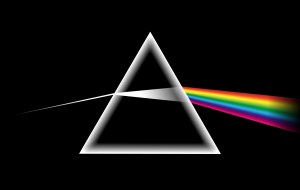
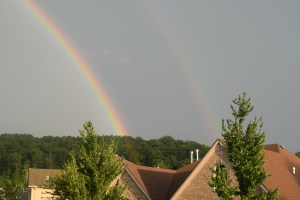
The most common rainbow is called a primary rainbow. It shows red on the outside with violet on the inside. Often this “bow” of light will have another larger but fainter arc above it. We typically call this a “double rainbow”, but scientists call it a secondary rainbow. The double bow occurs when the water droplets in the primary rainbow reflect light TWICE. Since it is the reflection of the primary bow, the colors are reversed. The “double” bow occurs at 50-53 degrees from your anti-solar point.


Adonai’s Rainbow

Gen. 9:11-17  “I establish My covenant with you; and all flesh shall never again be cut off by the water of the flood, neither shall there again be a flood to destroy the earth.”  (12)  God said, “This is the sign of the covenant which I am making between Me and you and every living creature that is with you, for all successive generations;  (13)  I set My bow in the cloud, and it shall be for a sign of a covenant between Me and the earth.  (14)  “It shall come about, when I bring a cloud over the earth, that the bow will be seen in the cloud,  (15)  and I will remember My covenant, which is between Me and you and every living creature of all flesh; and never again shall the water become a flood to destroy all flesh.  (16)  “When the bow is in the cloud, then I will look upon it, to remember the everlasting covenant between God and every living creature of all flesh that is on the earth.”  (17)  And God said to Noah, “This is the sign of the covenant which I have established between Me and all flesh that is on the earth.” (NASB)

The rainbow, according to the Creator, is THE sign of His covenant with every living creature that He will never again destroy all flesh with water. So…were their no rainbows before the flood of Noah’s day? Many Creation Scientists believe the evidence points to the possibility that before the flood it had never rained on the earth. For example, Walt Brown[1], director of the Center for Scientific Creation in Phoenix postulates that rain as we know it was unknown to preflood peoples[2]. If this theory is true, it would have been impossible for a rainbow to form “in the cloud” since there were no clouds. However, this question is not a new one. The ancient sages debated this among themselves for centuries and they likewise considered modern “science” of their day.

The Biblical commentator Ramban argued that a simple experiment proved easily enough that a rainbow is the result of light being refracted through water, which was enough proof in his mind that they were present from creation forward. He never believed that the verses we quoted above, upon close inspection, contradicted science. He states, “Whether the rainbow was created now or whether it had always been a part of nature, the reason for it representing the sign remains the same.”[3]

Regardless of whether rainbows existed pre-flood or not, the Creator plainly stated that it was AFTER the flood that He “set” His bow in the clouds as the SIGN of His covenant.

Keshet   קשׁת

The Bow and the Throne

In Biblical Hebrew, a bow as in “rainbow” and a bow as in a “bow and arrow” are the same word, keshet. The mindset behind this is similar to our English idea: they both BEND. In Noah’s day, Adonai sovereignly chose to judge the earth with a weapon or “bow” of water. Therefore, it is fitting that God chose the rain “bow” as the sign of His promise to never again judge the earth. The rainbow points toward heaven instead of earth as a sign of peace. Bible commentator John Gill puts it this way: “Though it is a bow, yet without arrows, and is not turned downwards towards the earth, but upwards towards heaven, and so is a token of mercy and kindness, and not of wrath and anger.”[4]

The Ramban (Nahmanides) has a similar idea for Adonai’s choice of a rainbow: “Ancient cultures fought their wars with the bow and arrow, and the side which surrendered, pursuing peace instead of war, would express their will to do so by raising an inverted bow that the enemy could see. Similarly, G-d places an inverted bow in the heavens as a sign that He is no longer warring against humanity.”

In most places, the word keshet denotes a bow of archery or the archers who handle bows. I could only find three[5] other references to the majestic seven colored rainbow in the Scriptures. In most of these verses, the bow is found surrounding the throne of the LORD. The first place is in Ezekiel’s vision of the FOUR living creatures. I highly suggest you read all of chapter one for context. Also, be sure to take note of all the words associated with light; there are many!

Ezek. 1:26-28  Now above the expanse that was over their heads there was something resembling a throne, like lapis lazuli in appearance; and on that which resembled a throne, high up, was a figure with the appearance of a man.  (27)  Then I noticed from the appearance of His loins and upward something like glowing metal that looked like fire all around within it, and from the appearance of His loins and downward I saw something like fire; and there was a radiance around Him.  (28)  As the appearance of the rainbow in the clouds on a rainy day, so was the appearance of the surrounding radiance. Such was the appearance of the likeness of the glory of the LORD. And when I saw it, I fell on my face and heard a voice speaking.

The vision must have been amazing! Can you imagine what this must have been like for Ezekiel? First, notice the reference to the “expanse” or as some translations say, the “firmament”. This should remind you of day 2 of creation when God placed an expanse or firmament between the heavenly and earthly waters. (Gen. 1:6-8) God’s throne and the One with “the appearance of a man” are seen ABOVE this “expanse.”

The One with the likeness of man is oddly described from His loins and upward and His loins and downward, yet both resemble fire – a form of LIGHT. This radiance is said to “surround” Him as a rainbow of colorful light. Thus, we can imagine that seeing Adonai is like seeing bright white light refracted into the 7 colors of the rainbow. Perhaps the color or refracted light is seen because our eyes cannot perceive His full nature as pure white (spiritual) light. It must be refracted, bent, or slowed down in order for our “eyes” to see it. This is something to think about. We must remember that the natural world teaches us spiritual truth.

The remaining two verses about Adonai’s throne and the rainbow are both found in the Book of Revelation.

Rev. 4:2-3  Immediately I was in the Spirit; and behold, a throne was standing in heaven, and One sitting on the throne.  (3)  And He who was sitting was like a jasper stone and a sardius in appearance; and there was a rainbow around the throne, like an emerald in appearance.

Rev. 10:1  I saw another strong angel coming down out of heaven, clothed with a cloud; and the rainbow was upon his head, and his face was like the sun, and his feet like pillars of fire.

In these verses, we get to explore the Greek word for rainbow, iris[6]. We get such words as iris, iridescent, iridium, and iridology from this Greek word. These cognates are named due to their association with a colorful appearance. What I find most interesting about this Greek word is that it is found one time in the Septuagint.[7] It is used in the recipe for the Holy Anointing Oil.

Ex. 30:22-25  Moreover, the LORD spoke to Moses, saying,  (23)  “Take also for yourself the finest of spices: of flowing myrrh five hundred shekels, and of fragrant cinnamon half as much, two hundred and fifty, and of fragrant cane two hundred and fifty,  (24)  and of cassia (iris) five hundred, according to the shekel of the sanctuary, and of olive oil a hin.  (25)  “You shall make of these holy anointing oil, a perfume mixture, the work of a perfumer; it shall be holy anointing oil.

So, the question becomes: What does the spice cassia have to do with an iris or a rainbow? The Hebrew word for cassia is kiddah and means to roll, shrivel, or contract. The spice is made from the bark of the cassia tree. Sections are rolled and dried from both sides toward the center so that they end up resembling scrolls. This rolling like a scroll is hint of creation day 2 and the expanse or firmament between the earthly and heavenly waters. One day instead of being stretched out (Is. 42:5) like a rainbow, the heavens will be rolled up like a scroll. (Is. 34:4, Rev. 6:14)

But our Hebrew word kiddah most often means bowing the head in worship or in great respect. (i.e. Gen. 24:26) Since Hebrew is a very action or verb based language, the verb form of kiddah gives us insight into why the Rabbis translating the Hebrew Tanakh into Greek chose this particular word in reference to the cassia spice.

Cassia is the FOURTH ingredient in the holy anointing oil. I don’t think it is a coincidence that the Rabbis used “iris” for “kiddah” in reference to the Holy Anointing Oil. Four is another picture of completeness or seven[8]. Yeshua the Messiah comes from the house of Judah, Jacob’s 4th son. He is the Anointed One standing in the midst of the 7 branched menorah, representing the Light of God[9]. If you read my previous two posts on the Light of the World, you also recall that the menorah is the perfect motif for not only the 7 Spirits of God, but also for light’s 7 forms in the electromagnetic spectrum and its 7 colors of visible light. The rainbow’s 7 colors is a perfect (natural) display of the splendor of His Kingdom and throne.

As a side note, this should really open our eyes to the blasphemy of His glory and Kingdom when the homosexual community uses this motif as a symbol of their rebellion. While it may appear bright and cheery, it is in reality a counterfeit wicked lamp[10] of darkness.

The Rainbow Was Upon His Head

In Revelation 10:1, we are told of a strong messenger with a rainbow upon his head. Some would envision something like a halo. But the halo doesn’t originate in Scripture. It comes from ancient sun god deities[11], the oldest form of false worship. Nevertheless, we have many places in the Bible where a shining or glowing light, even fire, emanates from either God or a person[12]. I freely admit that it is possible that this “rainbow” upon the messenger’s head in Revelation 10:1 may actually be similar to a halo. Please allow me to explain why.

A rainbow actually forms a full circle around the point directly opposite of the observer from the light source. Since the light source is usually the sun, the center of the circle is the anti-solar point (the observer’s shadow). Most often only a portion of the circle is above the ground so that the visible part is an arc or bow. When the observer is located at a considerably higher altitude, like an airplane or mountain top, the full circle of the rainbow can be seen. The picture below was taken while the observer was skydiving.


© Sureshcg1979
| Dreamstime.com

Could this circular rainbow be an allusion as to why Moses’ face shone with light after his encounter with YHWH on the mountain top? In other words, when Moses ascended up to that lofty point on the earth, his shadow didn’t block any of YHWH’s glorious light! Don’t we see this same marvel when Yeshua takes Peter, James, and John up to the mountain of transfiguration?

Mat. 17:1-6  Six days later Jesus took with Him Peter and James and John his brother, and led them up on a high mountain by themselves.  (2)  And He was transfigured before them; and His face shone like the sun, and His garments became as white as light.  (3)  And behold, Moses and Elijah appeared to them, talking with Him.  (4)  Peter said to Jesus, “Lord, it is good for us to be here; if You wish, I will make three tabernacles here, one for You, and one for Moses, and one for Elijah.”  (5)  While he was still speaking, a bright cloud overshadowed them, and behold, a voice out of the cloud said, “This is My beloved Son, with whom I am well-pleased; listen to Him!”  (6)  When the disciples heard this, they fell face down to the ground and were terrified.

Do you suppose that the faces of Moses and Yeshua were similar when they “shone”?

Ex. 34:29-30  It came about when Moses was coming down from Mount Sinai (and the two tablets of the testimony were in Moses’ hand as he was coming down from the mountain), that Moses did not know that the skin of his face shone because of his speaking with Him.  (30)  So when Aaron and all the sons of Israel saw Moses, behold, the skin of his face shone, and they were afraid to come near him.

I find it fascinating that in the natural, one must be at a high altitude, such as a mountain top in order to “see” a complete rainbow —- a picture of God’s covenant. I personally believe that the shining faces of both Yeshua and Moses would have been similar to the circular rainbow. Yeshua is the one standing in the “midst” of God’s menorah. He IS the Light of YHWH, but at the time of the transfiguration, He was not yet glorified. In other words, it is possible that the light was still “veiled” or refracted (bent or slowed down) and this enabled His disciples to perceive it — and Him.

A rainbow in all its fullness is not just a “bow” or arc, it is a circle! For those of you that have been studying the Hebraic mindset, this shouldn’t be too surprising. God and His creation, His calendar, and His Word are all cyclical in nature. Do you recall our first passage in Ezekiel with the living creatures? Earlier in chapter one, these beings are said to be powered by great sparkling “wheels” or circles.

Ezek. 1:15-20  Now as I looked at the living beings, behold, there was one wheel on the earth beside the living beings, for each of the four of them.  (16)  The appearance of the wheels and their workmanship was like sparkling beryl, and all four of them had the same form, their appearance and workmanship being as if one wheel were within another.  (17)  Whenever they moved, they moved in any of their four directions without turning as they moved.  (18)  As for their rims they were lofty and awesome, and the rims of all four of them were full of eyes round about.  (19)  Whenever the living beings moved, the wheels moved with them. And whenever the living beings rose from the earth, the wheels rose also.  (20)  Wherever the spirit was about to go, they would go in that direction. And the wheels rose close beside them; for the spirit of the living beings was in the wheels.

These shining wheels with rims full of eyes (a symbol of Adonai’s Spirit) are what powered or gave energy to the beings. This can be none other than Adonai’s Light, His Spirit that is symbolized beautifully in the 7 days of creation, the 7 Spirits of God (Is. 11:1-2), and in the 7 Feasts! This is why the 7 branched menorah and the 7 visible colors function as a LIGHT display. Creation Gospel students will instinctively perceive why there are 4 living creatures, for this is a picture of 7!

How fitting it is that the LORD chose a rainbow as the first[13] sign of the covenant with mankind and all the creatures of earth! There are more “types” of rainbows than I mentioned in this post. It is a fascinating subject to explore; I urge you to do your own research and see where it takes you. I hope we are all fortunate enough to see a rainbow very soon and take in all its symbolic glory! Imagine the shining faces of Moses and Yeshua and the gleaming Throne Room of the Most High. I leave you with a traditional blessing for when you do see one.

Blessing When Seeing a Rainbow

“Blessed are you, Adonai, our God, King of the universe, Who remembers His covenant, is trustworthy in His covenant, and fulfills His word.”

Related Post: Overcome by a Rainbow

Go back to Part I or Part II


[2] Article, “Did It Rain before the Flood? “ http://www.creationscience.com/onlinebook/FAQ29.html (7/31/13)

[4] John Gill’s Exposition of the Entire Bible, from my e-sword.org bible program on Genesis 9:13.

[5] Including the first rainbow of Noah’s day, this totals FOUR biblical references to the rainbow. Creation Gospel students will recognize once again that 4 is another picture of 7!

[6] Yes, in case you were wondering, our flower by the same name does come from this Greek word! It is aptly named because the iris flower grows in a “rainbow” of colors.

[7] The Septuagint is the Greek version of the Tanakh or Old Testament.

[8] Four also stands for the servant, government, authority, kingdom, the Feast of Shavuot (Pentecost), the door, and the fullness of the Holy Spirit. (For more information on why this is true please seek out a Creation Gospel trainer)

[9] Rev. 1:12-14  Then I turned to see the voice that was speaking with me. And having turned I saw seven golden lampstands;  (13)  and in the middle of the lampstands I saw one like a son of man, clothed in a robe reaching to the feet, and girded across His chest with a golden sash.  (14)  His head and His hair were white like white wool, like snow; and His eyes were like a flame of fire.

[10] Pr. 21:4  Haughty eyes and a proud heart, The lamp of the wicked, is sin.

[12] Ex. 34:29, Mt. 7:2, Mark 9:2, Heb. 1:3, Rev. 1:14-15, etc.

[13] While many theologians declare that YHWH’s first covenant was with Adam, Scripture doesn’t use the Hebrew word for covenant, brit, until Genesis chapter six with Noah. Many commentators assert that Noah’s covenant was merely an expanded form of God’s covenant with Adam, and perhaps this is true. Regardless of whether God’s first covenant was with Adam or Noah, the first SIGN of the covenant is the rainbow.

Categories: Biblical Symbols, Musings | Tags: , , , , , , , , , , , , , , , , , , , , , , , | 1 Comment

The Light of the World Part II

The mystery of light still baffles modern scientists and theologians alike. We explored some of the reasons why in The Light of World Part I. In this post, I hope to take the scientific and spiritual dynamics a step further.

The Electromagnetic Spectrum

The electromagnetic spectrum is the term used by scientists to describe the entire range of natural light. This spectrum is broken into seven specific regions.

© Peter Hermes Furian
| Dreamstime.com

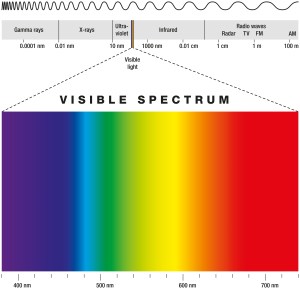
Subdividing into smaller spectra is done mostly on the basis of how each region of electromagnetic waves interacts with matter. The diagram below depicts the electromagnetic spectrum’s seven regions.

As the graphic above shows, visible light only comprises about 1.5% of the entire light spectrum. Thus, we could say that we are “blind” to the vast majority of light. And the only reason we can see visible light is because God built special receivers right into our heads: our eyes.

If the natural world teaches us about the spiritual world, then we can deduce that (left to ourselves) we are “blinded” to at least 98.5% of spiritual light as well. Since light in the Bible is often synonymous with the Torah (Law), Word, and Yeshua (Jesus), is it any wonder that God compares us to a blind person when we reject His Law, Word, and/or Yeshua? Consider the following Scripture verses:


The Torah (law), the Word and Yeshua are LIGHT

Thy word is a lamp unto my feet and a light unto my path.  (Ps.119:105)

The entrance of thy words give light; it gives understanding to the simple. (Ps.119:130)

For the commandment is a lamp; and the law (Torah) is light; and reproofs of instruction are the way of life: (Pr. 6:23)

To the law (Torah) and to the testimony: if they speak not according to this word, it is because there is no light in them. (Is. 8:20)

“This is the judgment, that the Light has come into the world, and men loved the darkness rather than the Light, for their deeds were evil.  (20)  “For everyone who does evil hates the Light, and does not come to the Light for fear that his deeds will be exposed.  (21)  “But he who practices the truth comes to the Light, so that his deeds may be manifested as having been wrought in God.” (Jn. 3:19-21) 

“I have come as Light into the world, so that everyone who believes in Me will not remain in darkness. (Jn. 12:46)


What the above verses teach us is that God’s light is the only true light. Only His light can illuminate our darkness. Therefore, it is vital that we receive His light. Sadly, many of those that claim to follow Yeshua (Jesus) reject His Torah or law, and replace it with traditions of their own making. According to Isaiah (8:20), there is no light in this type of worldview.

Perhaps Israel (God’s people — including both Jews and Gentiles), truly are “blind in part” as Paul stated in Romans 11. Something is missing. But this is a lengthy discussion best treated with its own set of posts. For now, consider that God uses the Torah (law), the Word and Yeshua as equivalent expressions throughout Scripture. Each of these concepts is what YHWH judges to be His LIGHT.  And they are NOT mutually exclusive of one another no matter what modern theology claims.

It is no coincidence that the electromagnetic spectrum has SEVEN ranges or types of natural light. Spiritually speaking, this is a perfect picture of the SEVEN branched menorah — the epitome of God’s Spiritual light that radiates through and by our Messiah, Yeshua.

Visible Light

If all the different wavelengths of visible light fall on the eye at the same time, white light is seen. However, if that light is refracted, there are SEVEN (that number keeps popping up!) possible colors visible to the human eye as shown in the figure below.


ROY-G-BIV is the acronym that represents all of the colors in the visible spectrum of light. R (red) – O (orange) – Y (yellow) – G (green) – B (blue) – I (indigo) – V (violet). Not only are those the colors we can see as humans, but they are also in the right order. Red has the longest wavelength and violet has the shortest. In other words, red is the least energetic and violet is the most energetic of the visible spectrum[1]. We will look more closely at these colors when we explore the “rainbow” in a later post.

© Vectortatu
| Dreamstime.com

The prophet Ezekiel was blessed with a colorful vision of heaven. In the verses below, notice the many colored stones, the mention of fire (a form of light), and the reference to the rainbow. All these images are given to us by the prophet to describe the throne room and glory of YHWH.

Ezek. 1:26-28  And above the firmament that was over their heads was the likeness of a throne, as the appearance of a sapphire stone: and upon the likeness of the throne was the likeness as the appearance of a man above upon it.  (27)  And I saw as the color of amber, as the appearance of fire round about within it, from the appearance of his loins even upward, and from the appearance of his loins even downward, I saw as it were the appearance of fire, and it had brightness round about.  (28)  As the appearance of the rainbow that is in the cloud in the day of rain, so was the appearance of the brightness round about. This was the appearance of the likeness of the glory of YHWH. And when I saw it, I fell upon my face, and I heard a voice of one that spake.

In a like manner, the Beloved disciple John was also given a vision of the throne room. Notice the similarities and the reference to colors and light.

Rev 4:2-3  And immediately I was in the spirit: and, behold, a throne was set in heaven, and one sat on the throne.  (3)  And he that sat was to look upon like a jasper and a sardine stone: and there was a rainbow round about the throne, in sight like unto an emerald.

Ezekiel and John could see a rainbow (refracted light) surrounding the throne of the LORD, which means the one at its center, must be pure white light. Also notice Ezekiel’s description of seeing amber. Amber has a GOLDEN look and sheen. Can you think of a symbol in scripture that is amber or golden in color and also displays light?

The Menorah

© Amigo3070
| Dreamstime.com

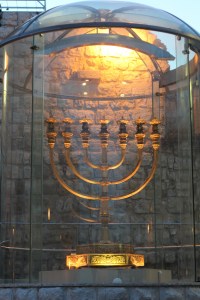
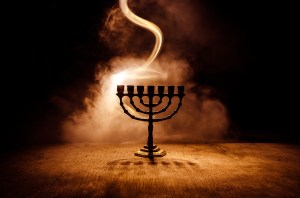
There is no better symbol in all of scripture to encompass the theme of “YHWH/Yeshua as Light” than the Menorah. The menorah was first described to us through Moses when YHWH gave him instructions for the furnishings of the holy place in the tabernacle. Menorah is the Hebrew word for a candlestick or lamp stand. This word literally denotes the means by which light comes or that which bears light. The menorah had a very specific design. Speaking of this holy piece of furniture, YHWH said:

Ex. 25:31-39  And thou shalt make a candlestick of pure gold: of beaten work shall the candlestick be made… (32)  And six branches shall come out of the sides of it; three branches of the candlestick out of the one side, and three branches of the candlestick out of the other side:  (33)  Three bowls made like unto almonds, with a knop and a flower in one branch; and three bowls made like almonds in the other branch, with a knop and a flower: so in the six branches that come out of the candlestick… (37)  And thou shalt make the seven lamps thereof: and they shall light the lamps thereof, that they may give light over against it…(39)  Of a talent of pure gold shall he make it, with all these vessels.

While other implements of the sanctuary were to be overlaid with gold, ONLY the menorah was to be made of ONE solid piece of PURE gold. In three passages of scripture, the menorah is called “the pure menorah”[2]. All the tabernacle furnishings were to be made precisely as YHWH showed Moses on the mountain[3], but He repeats the instruction only in reference to the menorah emphasizing its significance.

Ex. 25:40  “So see, and do according to the pattern which was shown to you on the mountain”

Let’s look at some facts about the menorah[4]:

  • It is fashioned out of ONE piece of hammered gold.
  • It’s designed to resemble and almond tree. (Notice its decorations)
  • It has ONE central shaft with 3 out workings on each side. (7 Branches)
  • Common Israelites, not the priests, provided the pure olive oil that kept the menorah continually burning. (Ex. 27:20-21)

One Piece of Hammered Gold

The menorah was the only piece of holy furniture that was made solely of pure gold. Even the Ark of the Covenant in the Most Holy Place was made of acacia wood overlaid in gold. The fact that it took one piece of gold measuring a talent to make the menorah speaks to the oneness of this set apart object. Since the Holy Place was completely covered, the menorah would be the only light source for the priests to perform their duties. When you look at or think of the golden menorah, your first thought should be the on its first description: One. Which is UNITY.

Dt. 6:4  “Hear, O Israel! The LORD is our God, the LORD is one.”

Almond Tree

© Nika Lerman | Dreamstime.com

God’s instructions for the menorah included decorations from the almond tree. In Hebrew, the almond is called esh’kedia, which literally translated means “to be alert, watchful, and to be awake”. Interestingly, the almond tree is the first tree to bloom or “wake-up” in Israel in the early spring. Moreover, an almond is shaped like the human eye, thus in Hebrew it is named after the function of the eye. Jeremiah has a passage that illustrates these concepts beautifully.

Jer. 1:11-12  Moreover the word of YHWH came unto me, saying, Jeremiah, what seest thou? And I said, I see the branch of an almond tree [esh kedia]. (12) Then said YHWH unto me, “Thou hast well seen: for I am watching [sho’ked] over my word to perform it.”

In this passage, YHWH uses something very tangible (the almond tree) to picture something abstract (His watchful eyes). Zechariah confirms this image.

Zec. 4:2-6  And he said to me, “What do you see?” I said, “I see, and behold, a menorah all of gold, with a bowl on the top of it, and seven lamps on it, with seven lips on each of the lamps that are on the top of it.  (3)  And there are two olive trees by it, one on the right of the bowl and the other on its left.”  (4)  And I said to the angel who talked with me, “What are these, my lord?”  (5)  Then the angel who talked with me answered and said to me, “Do you not know what these are?” I said, “No, my lord.”  (6)  Then he said to me, “This is the word of YHWH to Zerubbabel: Not by might, nor by power, but by my Spirit, says YHWH of hosts.

The angel goes on to further explain the vision.

Zec. 4:10 For whoever has despised the day of small things shall rejoice, and shall see the plumb line in the hand of Zerubbabel. “These seven are the eyes of Yahweh, which range through the whole earth.”

The seven flames of the golden Menorah are like seven eyes proceeding from YHWH (the LORD), that scan to and fro throughout the earth. In both Jeremiah and Zechariah, the emphasis is on seeing and YHWH’s continual watchfulness over the fulfillment of His Word.

Ps. 121:4 Behold, He who keeps Israel Will neither slumber nor sleep.

This motif also suggests that YHWH is the Light (the menorah itself) and that the branches are truly His eyes. These are the seven spirits that John describes in Revelation[5]. In nature, it is through the one pure white channel of visible light refracting into six branches that we are able to see glorious color; and so it is through the one main shaft of the menorah branching into six other flames that we see the glory of our Holy God. Perhaps this why Isaiah says of the BRANCH (Messiah):

Is. 11:1-2  There shall come forth a shoot from the stump of Jesse, and a BRANCH from his roots shall bear fruit.  (2)  And the Spirit of YHWH shall rest upon him, the Spirit of wisdom and understanding, the Spirit of counsel and might, the Spirit of knowledge and the fear of YHWH.

The 7 Branches and 7 Spirits of Adonai

Like the Menorah’s seven branches, there are seven Spirits of God. The fullness of the Spirit of Adonai is represented in the main shaft of the golden menorah. All the other 6 branches are rooted and spring forth from this single shaft: wisdom, understanding, counsel, power, knowledge and reverence (fear). Each of these manifestations of God’s Spirit operates as creative forces or agents in creation, restoration and renewal from Genesis to Revelation.

As I’ve mentioned in several other places on this blog, Dr. Hollisa Alewine’s The Creation Gospel explores these spirits in detail. If I could recommend one thematic study or biblical paradigm for you to learn, The Creation Gospel would be at the top of the list every time. This study helps you to build understanding by showing you how the smaller pictures found in the Scriptures fits into the greater picture. For now, consider that the 7 Spirits of God are like the 7 tongues of fire that illuminate the golden menorah.

Imagine the electromagnetic spectrum transposed with a likeness of the tabernacle menorah. The visible spectrum’s 7 colors would come forth from the main stem (central) of “white” light. Remember the heavenly throne room pictured by Ezekiel and John? What better symbolism could have been given to these men to illustrate the majesty of the God of LIGHT? He truly covers Himself with light as a garment!

  Ps. 104:2  Who coverest thyself with light as with a garment: who stretchest out the heavens like a curtain.

Conclusion

  • The electromagnetic spectrum depicts 7 forms of light. Of these 7, we can only see 1 tiny sliver equaling 1.5% of the spectrum.
  • Visible white light refracts into 7 seven colors or wavelengths that increase in intensity.
  • YHWH uses a 7 branched golden menorah to symbolize His Light.
  • Imagery in Scripture equates YHWH’s Light with the Torah (Law), His Spirit, Messiah, His Word, His Eyes, His Power, etc.

Do you think it is a coincidence that “science” describes natural light with 7 “manifestations” long after YHWH established this fact in Scripture with the menorah?

More to come on the Rainbow and Adonai’s Throne, The Menorah, the Tree of Life, Mt. Moriah and Resurrection. Click here for Part III.


[1] Creation Gospel students will find this truth rather fascinating because the “spring” side of the menorah deals more with families and individuals while the “fall” side deals with a nation or the nations. There is a direct increase in intensity as the spring feasts of YHWH progress into the fall festivals. This mimics increase in intensity of the colors energy wavelengths as they progress on the spectrum.

[2] Ex. 31:8, 39:37, Lev. 24:4

[3] Ex. 25:9

[4] Valerie Moody has an excellent workbook on the menorah called: Secrets of the Menorah. Even seasoned Hebraic Roots followers will find some treasures in its pages. Although I didn’t see this particular book at her website, you can contact her about possibly obtaining a copy. http://www.vmoody.com/

[5] Rev. 1:4

Categories: Biblical Symbols, Musings | Tags: , , , , , , , , , , , , , , | 6 Comments

Blog at WordPress.com.