Rainbows and the Throne of Glory
Rainbow Science
Before we look at the majestic rainbow in Scripture, let’s review what modern science teaches about this unparalleled display of “colorful” LIGHT. In order for a rainbow to occur, three particular criteria have to be met. The sun has to be shining “behind” you. A rain cloud or moisture in the air must be in “front” of you. And, the sun’s rays have to shine through the cloud at an anti-solar point of 42 degrees. (The anti-solar point is where the shadow of your head is)
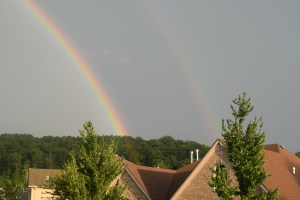 When a beam of sunlight passes through a water droplet it slows down and spreads out, separating each color that makes up white light. The process of light refracting or bending can be more accurately described as the process of light changing speed as it moves through different densities. The reason why rainbows appear as an arc is because of the bending of and dispersing of light through millions of water droplets. The colors will always display in the same order due to the fact that each color has its own wavelength or intensity.
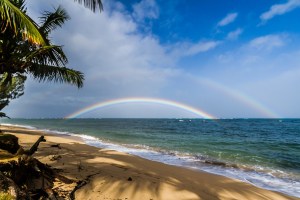
The most common rainbow is called a primary rainbow. It shows red on the outside with violet on the inside. Often this “bow” of light will have another larger but fainter arc above it. We typically call this a “double rainbow”, but scientists call it a secondary rainbow. The double bow occurs when the water droplets in the primary rainbow reflect light TWICE. Since it is the reflection of the primary bow, the colors are reversed. The “double” bow occurs at 50-53 degrees from your anti-solar point.
Adonai’s Rainbow
Gen. 9:11-17 “I establish My covenant with you; and all flesh shall never again be cut off by the water of the flood, neither shall there again be a flood to destroy the earth.” (12) God said, “This is the sign of the covenant which I am making between Me and you and every living creature that is with you, for all successive generations; (13) I set My bow in the cloud, and it shall be for a sign of a covenant between Me and the earth. (14) “It shall come about, when I bring a cloud over the earth, that the bow will be seen in the cloud, (15) and I will remember My covenant, which is between Me and you and every living creature of all flesh; and never again shall the water become a flood to destroy all flesh. (16) “When the bow is in the cloud, then I will look upon it, to remember the everlasting covenant between God and every living creature of all flesh that is on the earth.” (17) And God said to Noah, “This is the sign of the covenant which I have established between Me and all flesh that is on the earth.” (NASB)
The rainbow, according to the Creator, is THE sign of His covenant with every living creature that He will never again destroy all flesh with water. So…were their no rainbows before the flood of Noah’s day? Many Creation Scientists believe the evidence points to the possibility that before the flood it had never rained on the earth. For example, Walt Brown[1], director of the Center for Scientific Creation in Phoenix postulates that rain as we know it was unknown to preflood peoples[2]. If this theory is true, it would have been impossible for a rainbow to form “in the cloud” since there were no clouds. However, this question is not a new one. The ancient sages debated this among themselves for centuries and they likewise considered modern “science” of their day.
The Biblical commentator Ramban argued that a simple experiment proved easily enough that a rainbow is the result of light being refracted through water, which was enough proof in his mind that they were present from creation forward. He never believed that the verses we quoted above, upon close inspection, contradicted science. He states, “Whether the rainbow was created now or whether it had always been a part of nature, the reason for it representing the sign remains the same.”[3]
Regardless of whether rainbows existed pre-flood or not, the Creator plainly stated that it was AFTER the flood that He “set” His bow in the clouds as the SIGN of His covenant.
Keshet קשׁת
The Bow and the Throne
In Biblical Hebrew, a bow as in “rainbow” and a bow as in a “bow and arrow” are the same word, keshet. The mindset behind this is similar to our English idea: they both BEND. In Noah’s day, Adonai sovereignly chose to judge the earth with a weapon or “bow” of water. Therefore, it is fitting that God chose the rain “bow” as the sign of His promise to never again judge the earth. The rainbow points toward heaven instead of earth as a sign of peace. Bible commentator John Gill puts it this way: “Though it is a bow, yet without arrows, and is not turned downwards towards the earth, but upwards towards heaven, and so is a token of mercy and kindness, and not of wrath and anger.”[4]
The Ramban (Nahmanides) has a similar idea for Adonai’s choice of a rainbow: “Ancient cultures fought their wars with the bow and arrow, and the side which surrendered, pursuing peace instead of war, would express their will to do so by raising an inverted bow that the enemy could see. Similarly, G-d places an inverted bow in the heavens as a sign that He is no longer warring against humanity.”
In most places, the word keshet denotes a bow of archery or the archers who handle bows. I could only find three[5] other references to the majestic seven colored rainbow in the Scriptures. In most of these verses, the bow is found surrounding the throne of the LORD. The first place is in Ezekiel’s vision of the FOUR living creatures. I highly suggest you read all of chapter one for context. Also, be sure to take note of all the words associated with light; there are many!
Ezek. 1:26-28 Now above the expanse that was over their heads there was something resembling a throne, like lapis lazuli in appearance; and on that which resembled a throne, high up, was a figure with the appearance of a man. (27) Then I noticed from the appearance of His loins and upward something like glowing metal that looked like fire all around within it, and from the appearance of His loins and downward I saw something like fire; and there was a radiance around Him. (28) As the appearance of the rainbow in the clouds on a rainy day, so was the appearance of the surrounding radiance. Such was the appearance of the likeness of the glory of the LORD. And when I saw it, I fell on my face and heard a voice speaking.
The vision must have been amazing! Can you imagine what this must have been like for Ezekiel? First, notice the reference to the “expanse” or as some translations say, the “firmament”. This should remind you of day 2 of creation when God placed an expanse or firmament between the heavenly and earthly waters. (Gen. 1:6-8) God’s throne and the One with “the appearance of a man” are seen ABOVE this “expanse.”
The One with the likeness of man is oddly described from His loins and upward and His loins and downward, yet both resemble fire – a form of LIGHT. This radiance is said to “surround” Him as a rainbow of colorful light. Thus, we can imagine that seeing Adonai is like seeing bright white light refracted into the 7 colors of the rainbow. Perhaps the color or refracted light is seen because our eyes cannot perceive His full nature as pure white (spiritual) light. It must be refracted, bent, or slowed down in order for our “eyes” to see it. This is something to think about. We must remember that the natural world teaches us spiritual truth.
The remaining two verses about Adonai’s throne and the rainbow are both found in the Book of Revelation.
Rev. 4:2-3 Immediately I was in the Spirit; and behold, a throne was standing in heaven, and One sitting on the throne. (3) And He who was sitting was like a jasper stone and a sardius in appearance; and there was a rainbow around the throne, like an emerald in appearance.
Rev. 10:1 I saw another strong angel coming down out of heaven, clothed with a cloud; and the rainbow was upon his head, and his face was like the sun, and his feet like pillars of fire.
In these verses, we get to explore the Greek word for rainbow, iris[6]. We get such words as iris, iridescent, iridium, and iridology from this Greek word. These cognates are named due to their association with a colorful appearance. What I find most interesting about this Greek word is that it is found one time in the Septuagint.[7] It is used in the recipe for the Holy Anointing Oil.
Ex. 30:22-25 Moreover, the LORD spoke to Moses, saying, (23) “Take also for yourself the finest of spices: of flowing myrrh five hundred shekels, and of fragrant cinnamon half as much, two hundred and fifty, and of fragrant cane two hundred and fifty, (24) and of cassia (iris) five hundred, according to the shekel of the sanctuary, and of olive oil a hin. (25) “You shall make of these holy anointing oil, a perfume mixture, the work of a perfumer; it shall be holy anointing oil.
So, the question becomes: What does the spice cassia have to do with an iris or a rainbow? The Hebrew word for cassia is kiddah and means to roll, shrivel, or contract. The spice is made from the bark of the cassia tree. Sections are rolled and dried from both sides toward the center so that they end up resembling scrolls. This rolling like a scroll is hint of creation day 2 and the expanse or firmament between the earthly and heavenly waters. One day instead of being stretched out (Is. 42:5) like a rainbow, the heavens will be rolled up like a scroll. (Is. 34:4, Rev. 6:14)
But our Hebrew word kiddah most often means bowing the head in worship or in great respect. (i.e. Gen. 24:26) Since Hebrew is a very action or verb based language, the verb form of kiddah gives us insight into why the Rabbis translating the Hebrew Tanakh into Greek chose this particular word in reference to the cassia spice.
Cassia is the FOURTH ingredient in the holy anointing oil. I don’t think it is a coincidence that the Rabbis used “iris” for “kiddah” in reference to the Holy Anointing Oil. Four is another picture of completeness or seven[8]. Yeshua the Messiah comes from the house of Judah, Jacob’s 4th son. He is the Anointed One standing in the midst of the 7 branched menorah, representing the Light of God[9]. If you read my previous two posts on the Light of the World, you also recall that the menorah is the perfect motif for not only the 7 Spirits of God, but also for light’s 7 forms in the electromagnetic spectrum and its 7 colors of visible light. The rainbow’s 7 colors is a perfect (natural) display of the splendor of His Kingdom and throne.
As a side note, this should really open our eyes to the blasphemy of His glory and Kingdom when the homosexual community uses this motif as a symbol of their rebellion. While it may appear bright and cheery, it is in reality a counterfeit wicked lamp[10] of darkness.
The Rainbow Was Upon His Head
In Revelation 10:1, we are told of a strong messenger with a rainbow upon his head. Some would envision something like a halo. But the halo doesn’t originate in Scripture. It comes from ancient sun god deities[11], the oldest form of false worship. Nevertheless, we have many places in the Bible where a shining or glowing light, even fire, emanates from either God or a person[12]. I freely admit that it is possible that this “rainbow” upon the messenger’s head in Revelation 10:1 may actually be similar to a halo. Please allow me to explain why.
A rainbow actually forms a full circle around the point directly opposite of the observer from the light source. Since the light source is usually the sun, the center of the circle is the anti-solar point (the observer’s shadow). Most often only a portion of the circle is above the ground so that the visible part is an arc or bow. When the observer is located at a considerably higher altitude, like an airplane or mountain top, the full circle of the rainbow can be seen. The picture below was taken while the observer was skydiving.
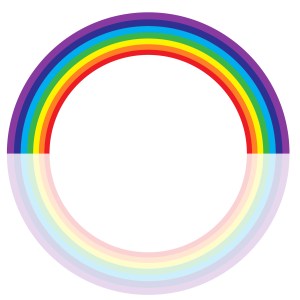
© Sureshcg1979
| Dreamstime.com
Could this circular rainbow be an allusion as to why Moses’ face shone with light after his encounter with YHWH on the mountain top? In other words, when Moses ascended up to that lofty point on the earth, his shadow didn’t block any of YHWH’s glorious light! Don’t we see this same marvel when Yeshua takes Peter, James, and John up to the mountain of transfiguration?
Mat. 17:1-6 Six days later Jesus took with Him Peter and James and John his brother, and led them up on a high mountain by themselves. (2) And He was transfigured before them; and His face shone like the sun, and His garments became as white as light. (3) And behold, Moses and Elijah appeared to them, talking with Him. (4) Peter said to Jesus, “Lord, it is good for us to be here; if You wish, I will make three tabernacles here, one for You, and one for Moses, and one for Elijah.” (5) While he was still speaking, a bright cloud overshadowed them, and behold, a voice out of the cloud said, “This is My beloved Son, with whom I am well-pleased; listen to Him!” (6) When the disciples heard this, they fell face down to the ground and were terrified.
Do you suppose that the faces of Moses and Yeshua were similar when they “shone”?
Ex. 34:29-30 It came about when Moses was coming down from Mount Sinai (and the two tablets of the testimony were in Moses’ hand as he was coming down from the mountain), that Moses did not know that the skin of his face shone because of his speaking with Him. (30) So when Aaron and all the sons of Israel saw Moses, behold, the skin of his face shone, and they were afraid to come near him.
I find it fascinating that in the natural, one must be at a high altitude, such as a mountain top in order to “see” a complete rainbow —- a picture of God’s covenant. I personally believe that the shining faces of both Yeshua and Moses would have been similar to the circular rainbow. Yeshua is the one standing in the “midst” of God’s menorah. He IS the Light of YHWH, but at the time of the transfiguration, He was not yet glorified. In other words, it is possible that the light was still “veiled” or refracted (bent or slowed down) and this enabled His disciples to perceive it — and Him.
A rainbow in all its fullness is not just a “bow” or arc, it is a circle! For those of you that have been studying the Hebraic mindset, this shouldn’t be too surprising. God and His creation, His calendar, and His Word are all cyclical in nature. Do you recall our first passage in Ezekiel with the living creatures? Earlier in chapter one, these beings are said to be powered by great sparkling “wheels” or circles.
Ezek. 1:15-20 Now as I looked at the living beings, behold, there was one wheel on the earth beside the living beings, for each of the four of them. (16) The appearance of the wheels and their workmanship was like sparkling beryl, and all four of them had the same form, their appearance and workmanship being as if one wheel were within another. (17) Whenever they moved, they moved in any of their four directions without turning as they moved. (18) As for their rims they were lofty and awesome, and the rims of all four of them were full of eyes round about. (19) Whenever the living beings moved, the wheels moved with them. And whenever the living beings rose from the earth, the wheels rose also. (20) Wherever the spirit was about to go, they would go in that direction. And the wheels rose close beside them; for the spirit of the living beings was in the wheels.
These shining wheels with rims full of eyes (a symbol of Adonai’s Spirit) are what powered or gave energy to the beings. This can be none other than Adonai’s Light, His Spirit that is symbolized beautifully in the 7 days of creation, the 7 Spirits of God (Is. 11:1-2), and in the 7 Feasts! This is why the 7 branched menorah and the 7 visible colors function as a LIGHT display. Creation Gospel students will instinctively perceive why there are 4 living creatures, for this is a picture of 7!
How fitting it is that the LORD chose a rainbow as the first[13] sign of the covenant with mankind and all the creatures of earth! There are more “types” of rainbows than I mentioned in this post. It is a fascinating subject to explore; I urge you to do your own research and see where it takes you. I hope we are all fortunate enough to see a rainbow very soon and take in all its symbolic glory! Imagine the shining faces of Moses and Yeshua and the gleaming Throne Room of the Most High. I leave you with a traditional blessing for when you do see one.
Blessing When Seeing a Rainbow
“Blessed are you, Adonai, our God, King of the universe, Who remembers His covenant, is trustworthy in His covenant, and fulfills His word.”
Related Post: Overcome by a Rainbow
Go back to Part I or Part II
[4] John Gill’s Exposition of the Entire Bible, from my e-sword.org bible program on Genesis 9:13.
[5] Including the first rainbow of Noah’s day, this totals FOUR biblical references to the rainbow. Creation Gospel students will recognize once again that 4 is another picture of 7!
[6] Yes, in case you were wondering, our flower by the same name does come from this Greek word! It is aptly named because the iris flower grows in a “rainbow” of colors.
[7] The Septuagint is the Greek version of the Tanakh or Old Testament.
[8] Four also stands for the servant, government, authority, kingdom, the Feast of Shavuot (Pentecost), the door, and the fullness of the Holy Spirit. (For more information on why this is true please seek out a Creation Gospel trainer)
[9] Rev. 1:12-14 Then I turned to see the voice that was speaking with me. And having turned I saw seven golden lampstands; (13) and in the middle of the lampstands I saw one like a son of man, clothed in a robe reaching to the feet, and girded across His chest with a golden sash. (14) His head and His hair were white like white wool, like snow; and His eyes were like a flame of fire.
[10] Pr. 21:4 Haughty eyes and a proud heart, The lamp of the wicked, is sin.
[12] Ex. 34:29, Mt. 7:2, Mark 9:2, Heb. 1:3, Rev. 1:14-15, etc.
[13] While many theologians declare that YHWH’s first covenant was with Adam, Scripture doesn’t use the Hebrew word for covenant, brit, until Genesis chapter six with Noah. Many commentators assert that Noah’s covenant was merely an expanded form of God’s covenant with Adam, and perhaps this is true. Regardless of whether God’s first covenant was with Adam or Noah, the first SIGN of the covenant is the rainbow.



 GRACE in TORAH