Posts Tagged With: women

The Biblical Role of Women Part VI

Role of Women Main Page 

Please see Part I, II, III, IV, and V for the best context.

Ruth

There is only one woman in the Bible that is specifically called an eshet chayil. That woman is Ruth, the Moabitess. If it has been a while since you’ve read the book of Ruth, please take the time right now to read its four short chapters. This will refresh your mind about the context of her extraordinary life.

“Now, my daughter, do not fear. I will do for you whatever you ask, for all my people in the city know that you are a woman of excellence (eshet chayil). (Ruth 3:11)

The book of Ruth may be a small book, but it has great significance for people of faith. There are many thematic nuggets we could explore within its few pages. The following list is only a sample.

  • Integrity & Kindness
  • Protection & Prosperity
  • Repentance & Redemption
  • The Feast Cycle (harvests)
  • Torah of Widows/Poor & Kinsmen Redeemer
  • Torah for Strangers/Sojourners (They also are in Covenant)
  • The Lineage of King David & Messiah Yeshua
  • Blessings over Children
  • Return from Exile & Restoration
  • Allusions to Wedding Feast of the Lamb

With all these rich themes, is it any wonder that the Book of Ruth is read during YHWH’s feast of Shavuot (Pentecost)? Creation Gospel students will recognize the significance immediately: Shavuot falls on the central (main) branch of the menorah. As such, it encompasses the whole. Shavuot stands as the “servant” to all the other moedim (feasts). A careful read of Ruth will demonstrate this fullness. We will try to stay focused only on those themes that directly link Ruth to an Eshet Chayil. With so many treasures in this book, that is going to be difficult!

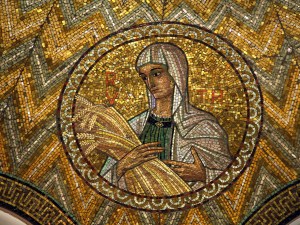
What’s in a Name? רוּת
© Zatletic
| Dreamstime.com

The meaning of Ruth (Rut) is usually referred to as a friend. But, the Hebrew root for Ruth is the word for shepherd or to tend a flock. It has the idea of a neighbor or companion, often an intimate companion.

If we stop and consider Ruth’s story, we can deduce that she was indeed a shepherdess of Israel. It is her lineage that birthed King David and Messiah Yeshua, both of whom were notable shepherds. When we think of the relationship that a shepherd has with their sheep, this notion becomes even more apparent. A (good) shepherd guards, feeds, and leads their flock. They are willing to seek out the “lost” and they will fight against dangerous predators. This sounds like the traits of an ezer or an eshet chayil, does it not?

Ruth is the only woman to receive the title eshet chayil by name in scripture. She received this designation BEFORE she was a mother and while she was a poor destitute widow, and a stranger (alien) in Israel. Ruth forsook her birth place and family to join with the God of Israel and His people. Once she made this commitment, she never wavered. Her diligence caught the attention of a wealthy relative — one that could change her and her mother-in-law’s life. That relative was Boaz. It was he that declared that Ruth was an eshet chayil.

The circumstances surrounding this encounter and proclamation however, are quite risqué. Naomi instructs Ruth in a secret seduction plan to attract Boaz. Both Ruth and Naomi were already aware that Boaz favored Ruth. This could be seen when Boaz told Ruth to only glean from his fields[1]. Naomi, the admitted bitter woman, wanted to secure the future of her beloved daughter-in-law. The favoritism that Boaz showed Ruth must have provoked Naomi’s heart to “push/guide”[2] Boaz to do the right thing—– offer them redemption.

But Naomi’s plan was anything but orthodox. Ruth risked her reputation and future by approaching Boaz in the middle of the night. Her actions were a reversal of cultural norms. Ruth pursued Boaz. It is usually the man that pursues the woman, even in today’s world. Essentially, she got all dolled up and offered herself to Boaz in a secret proposal.

It happened in the middle of the night that the man was startled and bent forward; and behold, a woman was lying at his feet. He said, “Who are you?” And she answered, “I am Ruth your maid. So spread your covering over your maid, for you are a close relative.” Then he said, “May you be blessed of the LORD, my daughter. You have shown your last kindness to be better than the first by not going after young men, whether poor or rich. “Now, my daughter, do not fear. I will do for you whatever you ask, for all my people in the city know that you are a woman of excellence –eshet chayil. (Ruth 3:8-11)

Boaz knew exactly what Ruth was asking of him. Perhaps he had already considered proposing to Ruth. However, what Naomi and Ruth did was courageous and Boaz knew it. This is why he calls her an eshet chayil. She was not only an upright woman in the eyes of the people and YHWH, but she was willingly to battle (in her own feminine way) for what she desired.

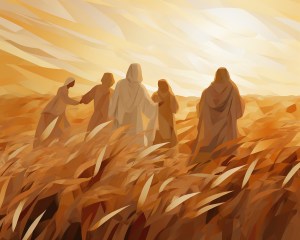
I believe Ruth’s brazenness only added fuel to the fire of Boaz’s growing fascination for her. He could clearly see her attentiveness in the care of her mother-in-law. It takes a special kind of woman to CHOOSE to care for a bitter person. He could also see her strong work ethic. She was driven and steadfast. These things revealed Ruth’s heart. And when Ruth came to Boaz in the night —— well, let’s just say that the depth of her passion was revealed. Boaz probably couldn’t wait to become her husband!
© Bualong Sadsana
| Dreamstime.com

The very next day Boaz seeks out the one person who could thwart their plans — a kinsmen that was closer to Naomi by blood than he was. But when this other man discovers that he will not only have to redeem the land but also marry Ruth, he concedes to Boaz. I imagine that Boaz was rejoicing on the inside at this news.

Take note of the process Boaz goes through to acquire Ruth. He scrupulously follows the Torah (instructions/law) of YHWH. In other words, unlike fallen Adam, Boaz puts YHWH before the woman. As much as he may desire her, he faithfully obeys the proper course of action. Boaz was functioning in his “redeemed” purpose. And by the looks of things, he had no problem with allowing Ruth to function in her purpose as ezer. He realized that he had found an eshet chayil!

An eshet chayil, who can find? For her worth is far above jewels. (Pr. 31:10)

While all this is true, Ruth’s actions and intentions could be distorted very easily. Based on some carefully placed Hebrew idioms, there are those that have concluded that Ruth’s actions were anything but holy when she approached Boaz in the middle of the night. Was Ruth acting as a righteous woman or a harlot in this scene? There is a fine line to consider when it comes to discerning her role. Please ponder on the thoughts of Dr. Hollisa Alewine on this matter.

“Feet in Scripture are sometimes used as a euphemism for genitals. To lie with a man can also be used as a euphemism for intercourse. Spreading one’s skirt over a woman carries the same implication. Lest we think Ruth was inviting something improper, be assured that sometimes a foot is just a foot! The duality and ambiguity of the expressions is what is important because it inserts the question mark as to Ruth’s virtue. Boaz clearly vindicates her righteousness, and the people and elders at the gate affirm it.”[3]

The duality that Dr. Alewine brings up is an often overlooked theme in the Scriptures. There are many cases where the actions of a righteous person appear to be portraying the contrary. Generations before Boaz, Judah is placed in a similar situation with a woman from Canaan[4].

Ruth, Tamar, and Rahab

When Boaz was at the city gates before the elders claiming his right of redemption for Naomi and Ruth, the elders blessed Boaz’s obedience.

All the people who were in the court, and the elders, said, “We are witnesses. May the LORD make the woman who is coming into your home like Rachel and Leah, both of whom built the house of Israel; and may you achieve wealth in Ephrathah and become famous in Bethlehem. “Moreover, may your house be like the house of Perez whom Tamar bore to Judah, through the offspring which the LORD will give you by this young woman.” (Ruth 4:11-12)

The elders draw our attention back to Boaz’s forefather, Judah. What is so reflective about the people’s blessing is that Tamar, like Ruth, sought redemption from her kinsmen. But Judah refused to give her what was rightfully hers. If you will recall, Tamar had married two of Judah’s sons but they died before producing an heir. Judah promised his youngest son to Tamar when he came of age. However, when the time came, Judah didn’t keep his promise. Tamar ended up tricking or manipulating Judah to get him to do what he should have done all along: obey God’s Word.

Tamar accomplished her kinsmen redemption by deceiving Judah. She dressed up as a prostitute and seduced him. Later, when Judah learned she was pregnant, he wanted to have her burned alive. However, when she proved that Judah was the father of her growing womb —- he declared her more righteous than himself. As a result, Tamar secured the lineage of the Tribe of Judah. It is through the line of Tamar’s firstborn, Perez, that Boaz, Oved, Jesse, David, and eventually the Mashiach (Messiah) would come.

It came about at the time she was giving birth, that behold, there were twins in her womb. Moreover, it took place while she was giving birth, one put out a hand, and the midwife took and tied a scarlet thread on his hand, saying, “This one came out first.” But it came about as he drew back his hand, that behold, his brother came out. Then she said, “What a breach you have made for yourself!” So he was named Perez. Afterward his brother came out who had the scarlet thread on his hand; and he was named Zerah. (Gen. 38:27-30)

© Branislav Ostojic
| Dreamstime.com

Thus far, we have uncovered two women in the ancestry of Mashiach (Messiah) that have questionable identities. And the book of Ruth points to both. This dichotomy between a harlot and a righteous woman runs deeper still. There is another harlot/righteous woman in Mashiach’s line: Rahab.

Rahab was an Amorite of the city of Jericho. She was an innkeeper and a supposed prostitute that had heard great stories about the God of Israel. When the Israeli spies came to her city, she placed her allegiance with them and YHWH by helping the spies escape safely. When the Israelites came back to take Jericho, she let down a scarlet cord from her window. The men of Israel recognized this sign and she and her family were spared. They joined Israel as sojourners. Later, Rahab marries an Israelite named Salmon, who became the father of Boaz[5].

Now we have found three women connected to the Book of Ruth and the Messiah that appeared to be doing the actions of a harlot. Yet, we know that in the end they are each really righteous. Since we have already explored this same dichotomy of a harlot and a righteous woman (wisdom) in the Book of Proverbs, a question arises.

What is YHWH teaching us in this duality? Dr. Alewine has this to say:

“Because the Revelation harlot is a woman, and perhaps because it is too easy to dismiss a troublesome woman with bad names or a bad reputation, we would do well to study the foundational roles of women in the Torah. Sometimes a troublesome woman who appears to be a harlot is a virtuous woman [eshet chayil] led by the Holy Spirit, she guides [ezer] men who stray back into the straight path.”[6] [brackets and bolding are mine]

Stay tuned. In Part VII, I hope that we can bring all these revelations together and make them applicable to our lives today.


[1] Read all of Ruth 2.

[2] I hope you didn’t miss that these are the actions of an ezer and an eshet chayil.

[3] Alewine, Hollisa, PHD, The Scarlet Harlot & The Crimson Thread. London, KY: The Creation Gospel Publishing, 2012, p. 162.

[4] This is speaking of Tamar. Though the Bible doesn’t explicitly state that she was from Canaan, the majority of scholars and commentators deduce that this was indeed the case. Judah himself married a Canaanite woman and had a Canaanite friend. This and the fact that Judah was most likely residing in Canaan, all point to Tamar’s Canaanite ancestry. (Gen. 38)

[5] Salmon was the father of Boaz by Rahab, Boaz was the father of Obed by Ruth, and Obed the father of Jesse. (Mt. 1:5)

[6] Alewine, Hollisa, PHD, The Scarlet Harlot & The Crimson Thread. London, KY: The Creation Gospel Publishing, 2012, p. 54.

Categories: Women | Tags: , , , , , , , , , , , , , , , , , , , | 1 Comment

The Biblical Role of Women Part V

Role of Women Main Page

Please view Part I, II, III, and IV for context.

Proverbs 31

In Judaism, the Proverbs 31 woman is often taught as an allegory for the Holy Spirit (Ruach HaKodesh), Wisdom, Torah, the Shekinah (Divine Presence), Shabbat, and/or the soul. At first glance this might seem odd, but most Jewish scholars and teachers read, write, and speak Hebrew. This knowledge opens the Biblical text in ways that English cannot. We will focus on two of these allegories in particular: Wisdom and the Holy Spirit.


Wisdom

“Wisdom” is the primary character in the Book of Proverbs, and she is personified as a woman. If this is a foreign concept to you, take some time to read through this book.  Proverbs  depicts two women, one righteous and one wicked, to contrast two types of people (or ways of thinking and behaving). These two “ways” are within every human being. Sometimes they are referred to as the good and evil inclinations[1] or spiritual battle between the spirit and the flesh. King Solomon personifies good and evil in order to teach his son (and us) discernment. Adonai and Solomon instruct one to choose to follow their good inclination (or one’s spirit [in Messiah], rather than the flesh).

In Hebrew, the Spirit of God and other spirits are written in the feminine form.[2] At first, it may seem strange or even blasphemous to refer to God in the feminine. But your Bible does so over and over again in reference to His Spirit in the Hebrew language. This is not goddess worship; rather, this is simply how the Hebrew language works. God is neither a man nor a woman, yet He has attributes of both genders. This is why it takes a male and a female to properly display His image.[3]

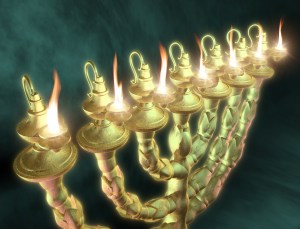
The Holy Spirit displays the feminine attributes of Adonai. Isaiah describes the Spirit of God like a tree with seven branches or characteristics (Isaiah 11:1-2).  This is not to be confused with the fruit of the Spirit. The fruit is the result of or what comes forth from this seven branched tree. In other words, fruit results from the tree; it is the goal – what secures the future.  We can use a biblical motif to describe these seven facets. In the Tabernacle in the wilderness, Adonai told

© Ampersandmiami
| Dreamstime.com

Moses to construct a menorah (lamp stand) with seven branches. The menorah was to be made of ONE piece of beaten gold.[4] The menorah would illuminate the Holy Place that leads one into the Holy of Holies. There is only ONE central branch with three branches on either side. The six outer branches are out-workings of the main, central branch. The Bible often uses the symbolism of this magnificent menorah to describe God’s Holy Spirit (Ruach HaKodesh), and for those who operate in or who are filled with His Spirit.

Like the seven branches on the ONE golden Menorah, Isaiah, Zechariah, Yeshua (Jesus), and John all write about the Holy Spirit having seven attributes (branches). If you wish to learn about the seven spirits of God in depth, I can pair you with a Creation Gospel[5] trainer who can guide through Dr. Alewine’s thematic workbook. Here are some of the verses that attest to the seven.

The Spirit of the LORD will rest on Him, The spirit of wisdom and understanding, The spirit of counsel and strength, The spirit of knowledge and the fear of the LORD. (Is. 11:2)

He said to me, “What do you see?” And I said, “I see, and behold, a lampstand all of gold with its bowl on the top of it, and its seven lamps on it with seven spouts belonging to each of the lamps which are on the top of it…Then he said to me, “This is the word of the LORD to Zerubbabel saying, ‘Not by might nor by power, but by My Spirit,’ says the LORD of hosts…”For who has despised the day of small things? But these seven will be glad when they see the plumb line in the hand of Zerubbabel–these are the eyes of the LORD which range to and fro throughout the earth.” (Zec. 4:2, 6, 10)

Out from the throne come flashes of lightning and sounds and peals of thunder. And there were seven lamps of fire burning before the throne, which are the seven Spirits of God; (Rev 4:5 see also Rev. 1:4; 3:1; 5:6)

Wisdom is not only the first of the seven manifestations of God’s Spirit, but is also personified as a woman in the Bible. It is for this reason that the Jewish Sages reading the Proverbs 31 text see the eshet chayil (Woman of Valor, Strength, Might) as a metaphor for the Holy Spirit. This may come as a relief to many women. Thank goodness! I was feeling pretty inadequate compared to this “perfect” woman.

Holy Spirit

The Holy Spirit shows one the way of wisdom which leads into the fullness of all seven Spirits of God (Is. 11:2). It teaches one not only the proper role of women, but also the strength (chayil) of her role. If we allow God’s Spirit to have reign in our hearts and lives, we will naturally produce the fruit of the Spirit mentioned in Galatians 5:22. Do you remember how the woman is designed to be an ezer, a helper? Do you know of another “helper” in scripture?

Behold, God is my helper; The Lord is the sustainer of my soul. (Ps. 54:4)

But the Helper, the Holy Spirit, whom the Father will send in My name, He will teach you all things, and bring to your remembrance all that I said to you. (Jn. 14:26)

© Gracel21
| Dreamstime.com

The Holy Spirit operates as a type of helper in the life of a believer. Sometimes He is our aid, but sometimes He opposes us in order to turn us in a different direction. This is the same function the woman often plays (on a much smaller scale) in the life of her husband. Think about the following roles that the Holy Spirit plays in our lives and compare them to the role of woman. (Note: these are generalities. Some women will function strongly in one of these roles and struggle in others. Conversely, there are men who can and do function well in some of these aspects – especially when they are filled with the Spirit of God. The point of looking at this comparison is to realize that God, who is neither a man or woman, has both masculine and feminine attributes.)

Actions

  • The Holy Spirit comforts and nurtures; so does a woman.
  • He teaches and instructs; so does woman.
  • He displays mercy and grace; so does a woman.
  • He encourages; so does a woman.
  • He leads and speaks; so does a woman.
  • He’s the unseen One; so often this is also true of the woman (she’s behind the scenes working).
  • He prepares and empowers; so does a woman.
  • He intercedes, testifies, and reproofs; so does a woman.

If you want to know what your duties are as a woman, all you have to do is consider the feminine attributes of God; for you were created as a female image bearer of the Creator of the Universe. This is also true for men. They are a male image bearer of the Creator. Men should consider masculine attributes of Adonai and mirror them in the earth. BUT, both sexes must always remember that both sides, both genders, both masculine and feminine attributes working together and in unison is required for the actual image of God to be reflected in the earth. All masculinity or all femininity will result in a lopsided, perverted understanding of the Creator.

We never find YHWH in a control battle with His Spirit; they are ONE. Therefore, male and female image bearers should work together in harmony, each displaying a facet of the image of our perfect Elohim (God). One does not dominate the other. There is no power struggle because there is no need for one. Power struggles are a sure sign of the flesh ruling and reigning, which is a false image. To break this down into easier to digest parts, we might say that males better image the Father, and females better image the Holy Spirit. And when they become one, they figure the Son, Yeshua, the last Adam (Rom. 8:29, 2 Cor. 3:18).

Atmosphere & Eshet Chayil

Like the Ruach HaKodesh, women often set the tone for the atmosphere of the home, fellowship, workplace, school, etc. When women are ruled by their emotions, mood, or fleshy desires it affects everyone around them in a negative sense. One is a true warrior of God, an eshet chayil, when she chooses to crucify her flesh and walk according to Word and the example of the Holy Spirit, instead of how their flesh feels or thinks. Any time a woman is present, she will influence the spiritual climate of that space. Thus, the fruit of self-control is something vital for women to learn (this is true for men as well, but our focus here is on the role of women).

The lower, sinful nature of men and women (especially if they are immature in physical age or spiritual maturity) often manifests as a desire turned into a demand to have their way. They will use their God given strengths, such as strong emotions and intuition, in an unhealthy and destructive way. For example, women often can intuit through their feelings, but they do not know how to express their concerns in a helpful and healthy way. Rather than being a help to their opposite, they can become a hindrance or stumbling block. Generally, whether male or female, the lower nature rises up and tries to dominate through some type of force, including manipulation, passive aggressive words or actions, outright aggression, emotional meltdowns (tantrums), etc. If fear driven or frustrated, inflamed, or offended flesh speaks, the result will be destruction.

Pro 10:11-14 (NASB) The mouth of the righteous is a fountain of life, But the mouth of the wicked conceals violence. 12 Hatred stirs up strife, But love covers all transgressions. 13  On the lips of the discerning, wisdom is found, But a rod is for the back of him who lacks understanding. 14 Wise men store up knowledge, But with the mouth of the foolish, ruin is at hand.

Pro 11:9-12 (NASB) With his mouth the godless man destroys his neighbor, but through knowledge the righteous will be delivered. 10 When it goes well with the righteous, the city rejoices, and when the wicked perish, there is joyful shouting. 11 By the blessing of the upright a city is exalted, but by the mouth of the wicked it is torn down. 12 He who despises his neighbor lacks sense, but a man of understanding keeps silent.

James 3:13-18 (NASB) Who among you is wise and understanding? Let him show by his good behavior his deeds in the gentleness of wisdom. 14 But if you have bitter jealousy and selfish ambition in your heart, do not be arrogant and so lie against the truth. 15  This wisdom is not that which comes down from above, but is earthly, natural, demonic. 16 For where jealousy and selfish ambition exist, there is disorder and every evil thing.  17 But the wisdom from above is first pure, then peaceable, gentle, reasonable, full of mercy and good fruits, unwavering, without hypocrisy. 18 And the seed whose fruit is righteousness is sown in peace by those who make peace.

© Digitalstormcinema | Dreamstime.com

Your everyday walk requires you to be a warrior. Suite up in the armor of God, for your battle is most often with yourself! Examine your fruit: your actions and words. Also consider your surroundings. Are you fostering shalom and growth, or are you contributing to the chaos and drama? Are you deeply wounded and unable to deal with others in a healthy way? Seek godly counseling. Is there a repeated pattern of fractured relationships in your life? This is a red flag that you need some healing to function as a healthy ezer. Begin by using your tongue in a healthy way – cry out to Adonai in confession and repentance, then seek counselors or mentors who can model healthy, godly fruit as a woman or man of God. Often we can’t “do” better until we “learn” better, and sadly too many were only modeled the false image, so that is what they reflect to the world. But, there is hope for real change! That is Good News. We are BEING conformed into the image of the last Adam, Yeshua, and Adonai promises to bring us to completion.

An excellent wife (eshet chayil) is the crown of her husband, But she who shames him is like rottenness in his bones. (Pr. 12:4)

Many daughters have done virtuously (chayil, valiantly, mightily), but thou excellest them all. (Pr. 31:29)

Learning more about the Biblical role of women (and men) helps one to overcome so that relationships can thrive. We will consider some Biblical examples of an ezer kenegdo next in Part VI.


[1] Christians might refer to this as the battle between the spirit and the flesh.

[2] In Hebrew, all things have either a masculine or feminine gender. There is no neuter or neutral gender like there is in English.

[3] Gen 1:27,  God created man in His own image, in the image of God He created him; male and female He created them.

[4] Read Exodus 25

[5] Please refer to Dr. Hollisa Alewine’s website: thecreationgospel.com

Categories: Women | Tags: , , , , , , , , , , , | 13 Comments

The Biblical Role of Women Part IV

Role of Women Main Page 

Woman of Valor

Please refer to Part I, II, and III of this series for the best context.

On Mother’s Day one the most quoted passages during Sunday morning services is Proverbs 31. Each mother is commended for her role as a virtuous woman. Images of Mother Theresa and other conservative humanitarian women come to mind. Most women and especially men, envision the Proverbs 31 woman to be plain, prudish, and quite frankly,  boring. Yet, both genders believe that this image of women is what God truly desires. So, we all sit in the pews extolling something that women believe they can never measure up to, and men only wish they found attractive. But no one dares to verbalize these inward thoughts. Instead, we all smile and nod and pray to God that He change our dreadful hearts.

I have some great news if you identify with my sentiments. Though the Proverbs 31 woman is often translated as the “Virtuous Woman,” that is not what the text says in Hebrew. In fact, as we investigate the original language about this “ideal” woman, you will find that she is anything but boring! Women will sigh in relief and gasp with delight in the fact that Adonai truly knows their heart. Men will rediscover that the woman Adonai made just for him is not only attractive, but exciting!


The Eshet Chayil

Who can find a virtuous woman? for her price is far above rubies. (Pr. 31:10 KJV)

The Hebrew terms for virtuous woman are “eshet chayil.” While eshet does mean woman, chayil is often translated as virtuous, excellent, good, vigorous, worthy,

© Digitalstormcinema | Dreamstime.com

capable, or valorous (valor) in this verse. Strong’s Bible definitions defines it this way: a force, whether of men, means or other resources; an army, power, might, host, wealth, virtue, valor, strength, and worth.

In nearly every one of its uses, chayil is coupled with men, particularly strong men of war. There is no room in this Hebrew term for plainness, meekness, or weakness. So why, when chayil is joined with women, do the translator’s choose to “soften the blow” with English words that hide the “strong force” of the Hebrew? What happened to all the power and might of chayil?

I submit to you that part of the reason is based in the fallen nature of Adam. Subtle (and not so subtle) misogyny has plagued the Body for far too long. The truth is that the word chayil empowers women beyond the status quo of many men’s comfort zones. I will admit however, that most of these men mean well and really believe they are in God’s will by mastering or ruling over women. They (and women) have been told and trained that this is their God given right for a very long time. My hope is to peel back the English language and centuries of church tradition to reveal the freeing reality of what YHWH and the Hebrew text really says about women.

Warrior

A chayil, in its simplest translation, is a warrior. The introduction of the Proverbs 31 woman is more accurate to the Hebrew text when it uses words like this: “Who can find a powerful, mighty, valiant woman?” This is the true “ideal” woman; but just in case you think I’m reaching, the succeeding verses (in Hebrew) reveal the same message.

Here are some examples of this courageous woman that are obscured by the English translation. In verse eleven, her husband “has no lack of gain,” the word for gain is “shalal,” which usually means booty, spoil or plunder. This is the type of gain that a warrior brings back from a successful military battle. The valorous woman knows how to prosper her family spiritually and physically. Thus, she blesses her husband and children.

In verse fifteen, “she rises while it is still night and provides food for her household,” the word translated food is “teref,” the normal word for prey. Like a lioness hunting in the night, bringing back prey for her cubs, a woman provides for her family. The suggestion of fierceness or violence adds to the woman’s portrayal as a chayil. Verse seventeen declares that “she girds herself with strength, and makes her arms strong.” The Hebrew word for strong (arms) is “amatz,” meaning courage. Can you see the warrior imagery in each instance?

© Nejron
| Dreamstime.com

Verse twenty-five is of special import to our study. The woman says, “strength and dignity are her clothing, and she laughs at the time to come.” The last phrase is yom acharon. This literally says, “She laughs in the latter days.” This is another prophetic text about the role restorations we have been exploring. This warrior woman is prepared both physically and spiritually for the last days. For as we’ve seen in the previous articles, she is most likely laughing for joy at her complete restoration in her role as ezer.

The fact that the Proverbs 31 woman is brave, mighty, valorous, and powerful cannot be denied. Think of this the next time you read this passage or are subjected to another teaching about the meek, weak, and quiet woman. God designed woman to be an ezer. Do you recall what an ezer actually is? An ezer is a help, rescuer, savior, and protector. This sounds an awful lot like an eshet chayil, does it not? What does a warrior do but fight for and protect what is theirs? This is real biblical womanhood.

Real Roles

But lest you think that all these terms are some how condoning the emasculation of men or usurping their vital role, I must explain this further. Men and women were created equal, but different. Each gender has specific roles to play in God’s design. What I have been putting forth to you is a return to God’s original plan. What must be removed are tradition, dogma, and most importantly our fallen nature if we desire to live and walk out this restoration. Our Messiah, Yeshua (Jesus), has already paved the way for us to overcome our nephesh (flesh). He has freed us from this slavery. But too often, we are still wearing shackles in the form of tradition[1] and doctrine.[2] We must choose to break free from these manmade chains.

The man is created to work and serve the creation. His domain of work or service is primarily outside of the home. He is like the man in Proverbs 31 that sits at the city gates. He is there to guard the city, give counsel, and do business. But the woman is built with the same fierceness and power as the man. Her domain or service is primarily inside the home. Her service benefits her man and her children. But what she does and how she does it is identical to the man. The difference is in the object of their service. No one gender rules or exercises dominion over the other. They are equal and equally capable both inside and outside of the home.

Deep down every woman knows she was designed to bless her husband. While he may accuse her of being a control freak or a micro manager, the truth is that she can’t help her herself. She is an ezer; and as such, she is his counselor, protector, and guide. The problem for what seems like forever is that neither the woman nor the man have known WHY she’s the way she is. I hope that by now you can answer that age old question.

In Part V, we will look at the Proverbs 31 woman on a deeper spiritual level.


[1] Mar 7:13 thus invalidating the word of God by your tradition which you have handed down; and you do many things such as that.”

[2] Mar 7:6-8 And He said to them, “Rightly did Isaiah prophesy of you hypocrites, as it is written: ‘THIS PEOPLE HONORS ME WITH THEIR LIPS, BUT THEIR HEART IS FAR AWAY FROM ME. (7) ‘BUT IN VAIN DO THEY WORSHIP ME, TEACHING AS DOCTRINES THE PRECEPTS OF MEN.’ (8) “Neglecting the commandment of God, you hold to the tradition of men.”

Categories: Women | Tags: , , , , , , , | 14 Comments

The Biblical Role of Women Part III

Role of Women Main Page 

In order to properly follow my thoughts in this section, please first read Part I and Part II. I’m sure the last section elicited some pretty strong emotions in most readers. If my conclusions made you angry or perhaps even fearful, I suggest you prayerfully study the Genesis text yourself with a good Bible program. (There are free ones online!) Even if you don’t understand a lick of Hebrew, these tools will enable you to investigate the original language. It is amazing what a little effort lends to proper interpretation and understanding. I fully believe that YHWH made each of us with the ability to question. While questioning tradition and the Biblical text may feel like an irreverent act, I assure you that it is not. How else does one arrive with an answer unless one first asks a question? As any good teacher will tell you, there are no stupid questions, only stupid answers.

Modern Christianity and her many denominations usually frown at questions that challenge her set doctrines, creeds, and traditions. Don’t rock the boat; we don’t handle storms very well. But our Adonai (Lord) has no fear of storms; He is fully capable of calming the raging winds and rains with a simple Word. Moreover, it is in the midst of these strong winds that He invites us to join Him to walk on the water[1]. And, we are fully capable as long as our focus remains on Him and not the swirling circumstances around us. I invite you to challenge your current doctrine and tradition. Our thoughts are not Adonai’s thoughts;[2] He is infinitely greater than we can possibly imagine. Only fear and pride would cause one to think they have cornered Him with theology and tradition. Didn’t Paul say that we currently only see in the mirror dimly?[3] We must always be willing to let the Word mold and change us (and our doctrine, beliefs, and traditions).

Teshukah Revisited

This section was updated and revised 2/2022.

Teshukah was discussed in the last section, but it deserves a deeper treatment for the best understanding. Below, is Strong’s definitions for teshukah and its root, shook. Then, below that is the entry from the Ancient Hebrew Lexicon of the Bible.

H8669    תּשׁוּקה tesh-oo-kaw’ From H7783 in the original sense of stretching out after; a longing: – desire.

H7783     שׁוּק shook A primitive root; to run after or over, that is, overflow: – overflow, water.

AHLB#: 1479-J (V) ac: Drink co: River The pictograph “shin” is a picture of the two front teeth representing the idea of two, the “Quf” is a picture of the sun at the horizon that cycles around the earth. Combined these mean “repeat a cycle”. During the rainy season, repeated each year, the riverbeds become full of water. The surrounding land is soaked with water allowing for the planting of crops. Rushing: From the rushing of a river. [freq. 1] |kjv: running| {str: 4944} Drink The life giving water from the rivers. Overflow: The overflowing of the banks of a river. [freq. 3] (vf: Hiphil) |kjv: overflow| {str: 7783} Desire: As a course. [freq. 3] |kjv: desire| {str: 8669}

In Hebrew, teshukah is rooted in the action of running and overflowing. It is also related to repeating a cycle, which is like a habit or in our case, a habitual or seasonal overflowing. It can also denote a habitual running toward something (or someone). While often translated as desire, the sense is more akin to a powerful turning toward. The imagery of water flowing powerfully in a flood depicts the destruction that teshukah can take if one’s focus or affection is set on the wrong thing. Consider the work of Katherine Bushnell, God’s Word to Women:

The Pentateuch of the Septuagint… renders teshuqa into the Greek word apostrophe in both passages in Genesis [3:16, 4:7]: and epistrophe in Canticles [Song of Songs]. The former word, apostrophe, is familiar to us all: it means “turning away,” and the latter, “turning to.” The teaching is, that Eve is turning away from God to her husband, and, as a consequence of that deflection, Adam will rule over her. Next in order of excellence is the SYRIAC PESHITTO of the second, or perhaps first, century after Christ. This version gives the same sense, rendering, “thou shalt turn,” (Genesis 3:16); “will turn” (Genesis 4:7), and “turning” for the third passage. We have only the Pentateuch in the SAMARITAN version. It translates both the passages in Genesis, “turning.” The OLD LATIN version gives “turning” in all three places. We have a COPTIC (Sahidic), of not great value, which gives the same rendering for the first and third passage; and the more valued BOHAIRIC COPTIC which so renders the passage in the first two. These two copies are not complete Bibles, but fragments. The AETHIOPIC version of about 500 A. D. renders all three passages by words signifying “turning.” In fact, as regards the third passage, all the ancient versions without any exceptions whatever, give no other sense but “turning” for teshuqa.

Bushnell says, “The teaching is, that Eve is turning away from God to her husband, and, as a consequence of that deflection, Adam will rule over her.” Look at Genesis 3:16 again and remember that God is telling Eve about the consequences of her sin. He wasn’t speaking to Adam. According to Bushnell’s research on teshukah, Genesis 3:16 could be translated as: “Your turning shall be toward your husband, and he shall master you.”

Instead of turning to God, Eve’s propensity will be to turn to Adam, and when she does, he will rule over or master her. I find this most disturbing because I have witnessed this happen in the lives of some of the women that I love. A woman’s husband was never meant to be her god, mediator, or her master (not in the enslaving sense). Even Yeshua emphasized this when He said, “No one can serve two masters…” (Mt. 6:24) It is a curse to put your husband on the throne of your heart. This lofty place is reserved for Adonai  alone.

A woman must be careful that her desire, longing, and turning is first and foremost toward God. Only then can she be the wife she was designed to be. The moment she longs for, desires, and turns to her husband to provide the needs that only God can fulfill, he will rule or master her as surely one’s emotions or lower nature will do the same. Sadly, there are plenty of deluded men (and women) out there, claiming to serve YHWH, that will tell you that it is their God given duty to do just that.

Walter Kaiser puts it this way:

Rather than viewing this as a normative and prescriptive text found in the Mosaic Law and revealed by God, it is in a curse passage that predicts what will happen when women “turn” toward their husbands instead of turning to God.  In effect, if God were explaining this in today’s plain speech, God might have phrased it thus: “The truth is that, as a result of the fall, do not be surprised, my good lady, if that guy just plain lords it over you.”[4]

So, what is the difference between Chavah’s desire and the desire of Cain’s anger?

Mashal

This section was added 2/2022.

“Your desire shall be toward your husband, and he will rule (mashal) over you.” – Gen. 3:16

“Its desire is for you, but you must master (mashal) it.”  – Gen. 4:7

Mashal means to rule or master, and it is the word used in the account of Chavah’s desire and Cain’s anger. But, this word also means parable. In Hebrew, the Book of Proverbs is called Sefer Mishlei, from mashal. It is literally, the Book of Parables. Parables are designed to rule or master one’s thinking. They are meant to turn one from worldly wisdom and toward godly wisdom. They are a tool used to teach a spiritual, higher message to those with ears to hear. Parables bypass the natural man, and turn him toward the heavenly design. Thus, it is not a coincidence that God used mashal in Genesis 3:16 and 4:7. These passages are centered on relationships, the core of family dynamics which move outward into the greater realm of societies. Thus, there is a VERY important spiritual truth in these passages that is meant to guide or rule one’s thinking process. If one is ruled by worldly wisdom and selfish ambition (James 3), they will miss the point of the parable.

Ecc. 12:9-11 (NASB)  In addition to being a wise man, the Preacher also taught the people knowledge; and he pondered, searched out and arranged many proverbs.  10  The Preacher sought to find delightful words and to write words of truth correctly.  11  The words of wise men are like goads, and masters of these collections are like well-driven nails; they are given by one Shepherd.

Parables offer one DISCERNMENT between two like things, that are in reality world’s apart. For example, the Book of Proverbs personifies wisdom and folly as two women. They have similarities, but also great differences. One must learn to discern the difference in their own heart or they will fall into the many traps of woman folly.

In The Scarlet Harlot and the Crimson Thread, Dr. Alewine teaches the dichotomy between the righteous woman and the harlot, and between the man and the beast. The beast and the harlot are ruled by the lower nature. They are earthy, natural, and spiritually dull. One must come to understand the similarities that they share with the beasts of the world. They like to eat, to sleep, to procreate, play games, and expand territory. None of these things are evil. They are God given instincts that ensure the continuation of life in a beast. Mankind has all of these drives and inclinations too. The difference is that man was designed to live  by every Word that proceeds from the mouth of God. In other words, man has a need for more input or instruction.

Man’s beast like instincts, desires, emotions, and intellect are to be governed by God’s Word. The Torah (instructions) sets forth rules, regulations, and boundaries that govern when a man eats, sleeps, procreates, plays games, and expand’s territory. Without God’s input (His Word), man will live solely by the instincts of the beast. This is the question of Day 6, the number of the beast and of the man: Are you the image of a beast? Or, are you a man created in the image of Elohim? That is the essence of the parable or mashal in the Book of Proverbs, and in these passages of Genesis.

God specifically told Cain to rule or master his anger. Emotions are wonderful servants, but wicked masters. They come from the realm of the lower nature (flesh), and must be governed by the Word of God or they will lead to great sin. In Cain’s case, his anger led to murder. What many fail to recognize is that Adam was also angry. He was angry at Chavah because he ate the fruit, and he was mad at Adonai because He gave the woman to him. Anger is a secondary emotion of fear. When one is afraid, the hind brain governs thinking and actions, which is akin to the beast/lizard brain. If we look closely at the responses of the man and the woman after the fall, both blamed someone else for their actions. Neither took responsibility for what they did. We have all inherited this inclination.

Consider that God questioned Adam and Chavah before He ever mentioned the “curses” or consequence of their sin. What would have happened if Adam and Chavah had taken responsibility for their own actions and choices, and sought to rectify the damage they had caused the other person instead of blaming others out of self preservation? Would the consequences of their sin have been different too?

In the account of the fall, neither Adam or Chavah demonstrated teshuva or repentance. Neither sought to restore or cover the other’s transgression. The path they chose was death, not life. On this path, their God given functions, roles, and purposes would be frustrated. Their thinking, attitudes, and actions would have to change and turn back toward God’s design (repentance) for blessings to flow forth. Isn’t that what God told their son, Cain?

“Then Adonai said to Cain, “Why are you angry? And why has your countenance fallen? If you do well, it will lift. But if you do not do well, sin is crouching at the doorway. Its desire is for you, but you must master it.”” (Genesis 4:6-7, TLV)

If you do well (tov -good), your feelings will change. Anger will lift. We must make decisions based on, “It is written,” not on “I feel.” Emotions have teshukah as they are part of the nephesh/soul. This is a powerful force that turns one toward the whims of the flesh and away from the Word of God. Fear and shame have the same power. Everything within a beast seeks to preserve its own life, even if costs other people theirs. If one chooses to live by this image, curses will continue. Cain did not rule over his anger, and it escalated to murder. This caused an even worse consequence or curse. He became a vagabond and a wanderer, Hebrew words related to quivering, being tossed around, shaking, and groaning (Gen. 4:12). That is one miserable soul, wallowing in guilt, which is the opposite of shalom.

The path of Life offers a better Way. The very essence of teshuva or repentance is to turn away from the sin (nature), and back towards God. We can choose differently. But, it too has cost, a very great cost. Just ask Yeshua. He commands us to follow Him. We are to take up our own cross, and not seek to save our life or we will lose it.

Matthew 16:24-25 (TLV) Then Yeshua said to His disciples, “If anyone wants to follow after Me, he must deny himself, take up his cross, and follow Me. [25] For whoever wants to save his life will lose it, but whoever loses his life for My sake will find it.”

The Kingdom of Heaven has always been based on sacrificial love. That was not the way Adam, Chavah, or Cain walked in these accounts. Thus, God clearly told them what would occur if they remained on this course. The curses were descriptive, not prescriptive. Repentance has always been the solution for fallen man. One can choose life or death, blessings or curses.

Deuteronomy 30:19-20 (TLV) I call the heavens and the earth to witness about you today, that I have set before you life and death, the blessing and the curse. Therefore choose life so that you and your descendants may live, [20] by loving Adonai your God, listening to His voice, and clinging to Him. For He is your life and the length of your days, that you may dwell on the land that Adonai swore to your fathers—to Abraham, to Isaac and to Jacob—to give them.

God never intended for a man to mashal his woman. By controlling and reigning over women, men become testimonies of fallen Adam. Adonai designed the man and woman to rule creation together as one flesh, each lending their strengths to that endeavor. And more importantly, each serving the other sacrificially. That is the Way revealed throughout the Word and lived out in the flesh of Yeshua. If either party seizes control, dominates, manipulates, betrays, or places their desires before/over the other, then more curses (consequence to sin) will abound. While such activities will appease the fearful lower nature and give it a false sense of safety, this “way” leads to turmoil, chaos, and death. Without true restoration (and reconcilation), men and women are doomed to relive this vicious cycle again and again. So, how do we bring godly balance and renewal back into strained relationships?

Song of Songs

The Song of Songs, which is Solomon’s. (Song of Songs 1:1)

I believe the answer to our restoration is prophetically pictured in the most passionate of all the books of Holy Writ. Therefore, I’m going to devote some space to the background of this book. The Song of Songs or the Song of Solomon has an interesting name in Hebrew. I believe it is worth pointing out here because of its allusion to redemption. This insinuation is why this book is typically read during the feast of Pesach (Passover) and Matzah (Unleavened Bread). These connected feasts are the first of the seven Feasts of YHWH and occur in the spring, the same season of the setting of the Song of Songs. The theme of redemption and unmerited favor flows through these feast days and in a profound way, the Song of Songs reflects this focus.

© Houchi | Dreamstime.com

Shir Ha-Shirim or the Song of Songs is a Hebrew grammatical construction denoting the superlative; that is, the title attests to the greatness of the song, similar to “the Lord of lords,” “King of Kings,” or “Holy of Holies.” Jewish sages explain the title (and first verse) of this book with the phrase, “Which is leShlomo.”  Shlomo means “The King of Peace,” and also “The King Who is Whole.”[7]

Since Solomon comes from the Hebrew word shalom (peace), and Biblical peace denotes completeness and wholeness, the image that the title invokes is striking. The male figure in this poem is complete or whole. This is amplified by the fact that the word Shulamite (the woman character in the story) is the Hebrew feminine form of Solomon! A spectacular picture emerges; one of a whole and complete MAN and WOMAN – echad – oneness. This is real unity and marriage at its best. This truly is the Song of all Songs; it is a return to Eden!

The author of this book is generally attributed to King Solomon. However, there are several factors as to why a growing number of scholars are rejecting this view. First, if Solomon authored the Song of Songs, he wrote it in the voice of the Shulamite woman.[8] This would be an odd thing for any male to do in the Biblical era. Rev. Dr. Renita J. Weems has a great point about this: “It’s the only book in the Bible where a woman’s voice predominates and is in the first person. The imagery, the language, and the emotions that are expressed are ones that one would expect and associate with a woman.” Secondly, there is a debate about the dating of the book. Many modern Christian[9] and Jewish[10] scholars think the evidence clearly points to a postexilic work from the Persian period.

Regardless of who penned the Song of Songs, it still remains the only book of the Bible written from the perspective of a woman. And, it is within its pages that we find the third and final use of the Hebrew word, teshukah.

“I am my beloved’s, and his desire is for me.” (SOS 7:10)

Immediately one’s attention should be drawn to the obvious reversal of the edict against Chavah (Eve) in Genesis 3:16. In the fallen nature, Chavah’s desire or turning is toward Adam. Here, his desire (teshukah) is for her! What kind of desire from fullness does the man have for a woman? What does it mean for a man to “turn toward” a woman? This IS the redemptive work of Yeshua toward His Bride. The language is pointing us back to the Garden, the place of complete redemption and restoration.

There are many interpretations given for this unique book of scripture. Most often it is regulated to an allegory about God and His people by both Jews and Christians. But, there is a minority literal view that the book is exactly what it seems to be: a sensual love poem written by a woman. In fact, some of its verses are so erotic that its pages are banned by Judaism until reaching the age of thirteen. Others view it as prophecy.

For those of you that have been studying the difference between the Hebrew and Greek mindset, an obvious thought should come to mind. Identifying who is right or wrong on the proper interpretation of the Song of Songs is a moot point. Since Hebrew uses block logic rather than linear Greek logic, this book can be an allegory about God and His people, a literal love poem, and prophecy all rolled into one dynamic book.

Since the first level of Hebraic Bible interpretation is literal, I suggest reading the Songs of Songs in this way first, ignoring the allegorical flashes and hints of prophecy. Only after one has discovered the richness of the physical love between man and woman, can one properly appreciate the spiritual significance of the book. They are both equally important to the Hebrew mindset. Besides, it is the natural things that teach us the greatest spiritual truths.

The Woman

Interestingly, the Shulamite woman in this little book[11] of scripture challenges most ancient and modern characterizations of the ideal woman. She is not quiet, meek, passive, or reserved. Without shame, she describes her desire for her lover and seeks after him. Her voice is filled with unbridled passion and determination. The text doesn’t demonize, criticize, or chastise her behavior. Dr. Weems says, “There’s no kind of moral voice, third-person voice that inserts itself into the story that suggests that women like this come to a bad end. That they’re punished, that they are killed.”[12]

The Shulamite’s directness cannot be understated. Her proclamation in 7:10, is extended by another apparent role reversal from cultural norms in chapter 8:

“Put me like a seal over your heart, like a seal on your arm. For love is as strong as death, jealousy is as severe as Sheol; its flashes are flashes of fire, the very flame of the LORD. Many waters cannot quench love, nor will rivers overflow it; if a man were to give all the riches of his house for love, It would be utterly despised.” (SOS 8:6-7)

A signet ring bears the image of its owner’s seal. Anything with the seal’s image pressed upon it becomes property of or a decree of the owner. The ancient seal

© Arvacsaba | Dreamstime.com

that the Shulamite woman refers to, is most often associated with royalty. Can you see the imagery of ownership in the seal? In this case, the reversal is that it is a woman that requests this of her man. She, as true ezer kenegdo, is assuming responsibility for her man (in an opposite but equal way that he takes responsibility for her). This is a return to God’s original design. The man and woman take possession of one another, because they are one flesh. The lack of responsibility and selfishness of the first couple has been completely reversed.

This concept is further solidified by the woman comparing love with jealousy. The Hebrew word for jealousy, kinah, implies possession and right of property.[13] Since the fall, men have had no issue with seeing their wives as property or possessions to do with as they please. These attitudes are earthly wisdom from the Beast Kingdom, not the heavenly realm. In God’s Kingdom, taking possession of a spouse is sacrificial; it is not about meeting fleshly desires, but bearing responsibility.

The man in the Song of Songs has relinquished his fallen nature of domination, and restores the woman to the role of ezer kenegdo. Both the man and the woman are functioning in their purpose. No longer does the ground resist Adam; no longer does Adam resist Chavah. They are one. They are equal. This reunion can have only one result: an erotic love affair. Do you find it as intriguing as I do that this prophetic glimpse of restoration is in the midst of the most explicit book of love in all of Scripture?

What does all this mean for the ezer kenegdo or the woman? What does her role actually entail compared to man’s? Biblically, how are men and women meant to function in the believing community? What does redeemed marriage look like? There is still more to come on this captivating topic. We will start with the Proverbs 31 woman in Part IV.


[1] Mt. 14:23-33

[2] Is. 55

[3] 1 Cor. 13:12

[4] Correcting Caricatures: The Biblical Teaching on Women by Walter C. Kaiser Jr

[5] Fohrman, Rabbi David, The Beast that Crouches at the Door. Baltimore: HFBS Publishing, 2011. Kindle file.

[6] Dr. Moen fully explores this concept in Guardian Angel.

[8] Patsy Rae Dawson, a Christian marriage and sex counselor, agrees with my sentiments: http://patsyraedawson.com/?page_id=6#woman

[9] Coogan, Michael. A Brief Introduction to the Old Testament. Oxford: Oxford University Press, 2009, p. 394

[11] It’s only 117 verses long.

[13] See the Ancient Hebrew Lexicon of the Bible under the entry: Strong’s #7068: AHLB#: 1428-E (N1).

Categories: Women | Tags: , , , , , , , , | 10 Comments

Blog at WordPress.com.