Posts Tagged With: role of women

Moonbeams and the Moedim Part I

                       © Printezis | Dreamstime.com

Women, Cycles, and Time

Have you ever considered why many of the families that have returned to the seventh day Sabbath and YHWH’s festivals began with the prompting of the woman or wife?[1] Or have you ever wondered why there is so much physical preparation (domestic and relational requirements) that a woman must do in order for the family to keep Shabbat and the Feasts? What about the rabbinical ruling that women are “exempt” from certain time related commandments; what is this about? Why do women seem to be associated with TIME again and again? Hopefully, we will begin to answer these questions in this post.

I think I’ve figured out why I’ve struggled to start this next series of posts. They each deal with time. And time, like  light, is still very much a mystery to mankind (and modern science). There are several ways that people try to understand time. Some think of it as a linear line with an infinite beginning and end. Each end of this line is constantly moving away from the other. Others view time as a circle with the beginning also being the end. And still others believe that while time is indeed cyclical, that it is much more akin to the double helix of our DNA. It is connected, but with rungs that progress upward on a twisted ladder. Lower parts touch higher rungs repeating the information in new and more dynamic ways with each cyclical step.

The latter view will be the way in which I present this material. This part will present the base line and it will spiral and spread throughout the following posts, but will twist back to touch this post again. To put it simply, I will present this in a “spiral” form of teaching. I just don’t see any other way to do it. (:

Cycles

© Luayana | Dreamstime.com

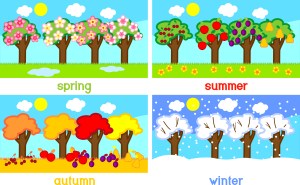
There is an important difference between Hebrew and Greek thought in the worldview of time. While Greek derived mindsets tend to think more linearly, Hebrew thought is more cyclical. Creation (nature) testifies of the latter.  As an example, the seasons are pictured in the graphic. They occur again and again in a cycle. Like the seasons, time and even prophecy is thought of as cycle with recurring themes rather than the common linear timeline that moves from the indefinite left that progresses to the indefinite right. Everything we can see moves in cycles, and Adonai uses cycles to teach us about unseen (spiritual) things (1 Cor. 15:46).

God’s calendar, His appointed times, are also cyclical. Before we delve into how women are connected to these cycles, let’s first look at how God has revealed time.

Adonai’s calendar is primarily based on the lunar cycle.[2] New months begin with sighting the first sliver of a new moon and mark out the appropriate timing of our festivals, fasts, and harvests. In other words, the moon keeps or guards our weeks, months, and years. The passage below chronicles Day 4 of creation. Those of you that have been following my posts or that are Creation Gospel students will notice that as the fourth day, God is establishing His government or authority in the luminaries. (And in His calendar.)

Then God said, “Let there be lights in the expanse of the heavens to separate the day from the night, and let them be for signs and for seasons and for days and years; and let them be for lights in the expanse of the heavens to give light on the earth“; and it was so. God made the two great lights, the greater light to govern the day, and the lesser light to govern the night; He made the stars also. God placed them in the expanse of the heavens to give light on the earth, and to govern the day and the night, and to separate the light from the darkness; and God saw that it was good. There was evening and there was morning, a fourth day. (Gen. 1:14-19)

Verse 14 states that one of the governing actions of the luminaries is to serve as signs, seasons, days, and years. I believe “days” and “years” are pretty self-explanatory, so let’s look at the “signs” and “seasons”. The Hebrew word for signs is ot (aleph, vav, tav). It literally means a mark, signal, omen, or flag. The heavenly lights declare not only the glory of God, but give us signals or warnings of things to come. So while they may help us to keep track of time (past), they can also point to or warn us of future events (prophesy).

The Hebrew word for seasons in verse 14 is moedim. I expect that most of my readers will be familiar with this word. These are our feasts and festivals.[3] Notice that in the very Beginning, Adonai established His calendar or His time clock on day four of creation. This is significant because our calendars govern our day to day lives. They dictate when we celebrate, when we rest, when we work, and when we gather together. If the Creator felt that His calendar required the actual sun, moon, and stars to guard, protect, keep, and mark His time, how much more should His people regard His calendar?

These appointments with the Creator give us LIGHT much in the same way that the sun, moon, and stars give us natural light. They truly separate the light from the darkness. If we ignore these appointments, we will have less light, less revelation. Remember, the natural things are meant to reveal spiritual truths. The guardians of God’s calendar speak to every creature on earth summoning us to come and meet with the King. David said it this way:

The heavens declare the glory of God; And the firmament shows His handiwork. Day unto day utters speech, And night unto night reveals knowledge. There is no speech nor language Where their voice is not heard. (Ps. 19:1-3)

In the very Beginning, the Creator preordained that we meet with Him certain times of the year. You only need to look up at the majestic sun, moon, and stars to see and know the season. Notice that at night the heavens reveal “knowledge.” This is the Hebrew word da’at. This type of knowledge is an intimate knowing and carries with it the idea of sacrificial love. It is the “bone of my bone and flesh of flesh” that Adam experienced with Chavah (Eve) and she conceived and bore a son. It is the loving knowledge that provoked Yeshua to become the sacrifice for His people. Because of the intimate nature of da’at, it cannot be completed without a woman. This type of sacrificial love needs a vessel to pour itself into and women are the natural imagery of a receiving vessel. (Hopefully, you can see men too in this imagery as part of the Bride.)

There is a cycle at work here that is meant to be a guide to God’s people. For our purposes, we will limit our study to the lesser light of the moon. Both men and women as the people of Elohim can be compared to the moon. But women have a unique association that I’d like to focus on. Since both the male and the female are revealed in The Woman in Scripture, we will see some overlaps in the two sex roles.

Moonbeams

He made the moon for the seasons (moedim)… (Ps. 104:19)

The moon has a special role to play in the guardianship role of the moedim (feasts). It is a master timekeeper of sorts. While the sun and stars also share in this responsibility, the moon beckons us to watch it a little more closely. As the nearest heavenly body to earth, the moon has mesmerized mankind since time immemorial. Sadly, many have fallen victim to the idolization of these heavenly bodies. They have failed to realize that these luminaries serve us, we are not meant to serve them.

The moon’s closeness and the fact that it governs our moedim make it quite mysterious. This becomes even more mystical when we consider that the brightest light in the night sky has no light of its own – it can only reflect the light of the sun. We will come back to this concept in a later post.

Since women’s bodies follow a lunar cycle (menses), the Sages have long concluded that women are uniquely associated with not only the moon and Adonai’s Festivals, but with time itself.[4] Let’s review what we’ve covered so far. As you read through my enumerations, ask yourself if any of these remind you of the role of women.

The moon:

  1. Sets boundaries for our months.
  2. Keeps or guards the moedim.
  3. Warns of things to come.
  4. Reflects the light of the sun.

I hope some of these facts caused you to think of the neqevah (female) and the ezer kenegdo from the Biblical Role of Women Part I and Part II. Or perhaps even the prophetic nature of women from Part V. One of the more obvious links between women and the moon is seen in the various PHASES in which both continually go through.

The regular arrival of the new moon and its growth to fullness, followed by its soon disappearance has long been a visible symbol of life, death, and rebirth. With every new moon, we see the necessity of being renewed (born again). This rhythmic clock sets our calendars with each cycle marked as a new month (moonth).

Like clockwork, women also go through phases each month. Similar to the moon, a woman’s phases are directly linked to life, death, and rebirth. Each month a woman’s womb prepares its “soil” for life and then sheds it (death) if no viable seed is planted — only to renew itself once again. This cycle repeats again and again. When a woman’s body is in the shedding stage of menses, blood appears. When the moon gives us a warning of judgment (death), it appears red. It’s not a coincidence that we call this a blood moon.

Not surprisingly, there are four primary phases of the moon with more elaborate depictions showing eight (a factor of 4). You can watch a quick video about these phases here.  Due to the length, we will examine each of the four primary moon phases and their relationship to the feast days and women’s cycles in Part II.


[1] Obviously, this isn’t always the case. However, in most of the families I have met, this is true. Whether she was home schooling the children and discovered these truths through in-depth Biblical and historical studies or by the gentle prompting of the Holy Spirit, it is usually the wife that first “sees” God’s calendar as relevant for the family.

[2] The Hebrew calendar does take the solar cycle into account to maintain the seasons. For an interesting article about this, click here.

[3] See Lev. 23

[4] These two articles speak to women and the moon. Women of the Wall and Aish. Women being associated with time in general is a two-fold concept. The first is simply what we’ve been discussing. Women are tied to time because YHWH made their bodies to mimic His time clock. Secondly, the rabbis ruled that women are exempt from certain TIME related mitzvot. We will explore this idea in a later post.

Categories: Moedim, Women | Tags: , , , , , , , , , | 24 Comments

The Biblical Role of Women Part VIII

IMG_2794

Role of Women Main Page

It’s been a while since I’ve written under this title. Actually, I had planned to leave the original series with seven posts; but further study and the popularity of this series, has led me to conclude two things:

  1. The Creator, in these latter days, is restoring the role of women to HIS original design.
  2. Women are desperately seeking the freedom to live out their God-given purpose within the perfect and holy boundaries of the Torah (Bible).

I’ve received many emails in regard to my original seven posts. Some were cries of elation and jubilation at the prospect of real freedom and balance. Others were notes of skepticism or a fear of women taking over the assemblies. And a few were a mixture of both, but with a heart set on openness — a sort of  “let’s wait and see.”

In light of this, I am compelled to continue with this series. While I certainly don’t have all the answers (in fact, I have more questions than anything else) I do have a heart to share my journey with you.

Woman, Builder of the House

 The wise woman builds her house, But the foolish tears it down with her own hands. (Pr. 14:1)

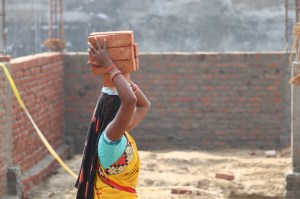
 Have you ever thought of yourself or the women in your life as “builders?” I imagine that most of us naturally think of men when construction comes to mind. After all, they are usually our contractors, carpenters, plumbers, and electricians. But, in Biblical and Hebraic thought, it is the women that build the House of Israel. Let’s once again consider the story of Ruth. Notice the words that the people and the elders at the city gate use when they bless the union of Ruth and Boaz:

 All the people who were in the court (gate), and the elders, said, “[We are] witnesses. May the LORD make the woman who is coming into your home like Rachel and Leah, both of whom built the house of Israel; and may you achieve wealth in Ephrathah and become famous in Bethlehem. (Ruth 4:11)
© Harshit Srivastava
| Dreamstime.com

While men may be the primary builders of physical houses, women build the house of their husbands and the House of the LORD. Obviously, men play a very important role in this process as well, but our focus is to explore how it is that women build. Do you recall how YHWH created the woman? In Part I, we looked at how YHWH formed/molded Adam. (He literally came from the dust of the earth.) In the beginning, both man and woman were within the one Adam.

In the eyes of the Creator, this wasn’t good or tov. So, you know the story, He took a rib from Adam and built (banah) Chavah (Eve). As a quick aside, notice that she came from his SIDE, not his feet where she would be “beneath” him. Nor did she come from his head, implying that she would be “above” him. She came forth from Adam’s side (tsala) as a perfect and coequal partner.

YHWH built Chavah. This Hebrew word for build, banah, is the same word used in both of the verses I quoted above in Proverbs and Ruth. The one who was built is the one who builds. She does this in several ways that I will enumerate shortly. But in order to grasp why this is true, we must first remember God’s design and function for women. In Part V, we discussed that women are a living parable of the Holy Spirit. Likewise, men will reflect the characteristics of our Heavenly Father. Together, they are conformed into the image of Yeshua. But as I’ve mentioned multiple times, God is One. Thus, we are NOT trying divide God into male and female. However, the ONE God did sovereignly choose to reveal Himself in ways that our little peon brains can understand.

What do we see in the witness of Creation? Nearly every creature on earth comes together as male and female to produce life. The natural things are meant to teach spiritual truths. (I Cor. 15:46) Therefore, it should not be surprising that in Hebrew, the Holy Spirit and all of His manifestations are in the feminine. Likewise, all the references to God being our Father and Husband are masculine. The One true God is neither male or female, He is a Spirit. But in order for finite humans to reflect His magnificence, it takes both a male and female.

I only belabor this point because there are some that think it is evil or some type of goddess worship to refer to God in the feminine. This is a result of ignorance of the Hebrew language. People fear what they do not understand and they like to throw stones at those that challenge the high places of their minds (tradition). Many false gods are male; does this make referring to God in the masculine something akin to Baal worship? Of course not, but the converse is also true.

To take a line from Brad Scott, if we would just look outside our window to see the natural everyday things of Creation, many of our theological debates could finally be put to rest. The natural IS a picture of the spiritual. Moreover, Scripture declares that God’s Creation does indeed testify of His power and divine nature:

For since the creation of the world His invisible attributes, His eternal power and divine nature, have been clearly seen, being understood through what has been made, so that they are without excuse. (Rom 1:20)

 In order to build and not “tear down,” a woman must walk in the Seven Spirits of God (Is.11:2). Wisdom is the first of the seven, which implies raw materials, innocence, immaturity, and potential. English speakers usually think of knowledge as the building blocks to wisdom; but in Hebrew, wisdom comes before knowledge. Wisdom leads one to the maturity of knowledge. Knowledge (da’at) is self-sacrificing, intimate, and capable of reproduction. (See the Creation Gospel for a more in depth analysis of the Seven Spirits of Adonai. Or click here for an audio introduction)

The second Spirit is binah or understanding. (Is. 11:2) Binah takes the raw materials of wisdom and begins to separate and distinguish like kind. In other words, binah begins to banah (build). As you’ve probably guessed, the Hebrew root of banah has the same consonants as the word binah. You can think of binah as organizing and counting the costs for a home construction. It is in this spirit that a woman builds.

 Key 1: A woman begins to build with the spirit of binah,
 -- the spirit that separates and discerns.

Upon What Does She Build?

Pro 4:5-9 (NASB) Acquire wisdom! Acquire understanding! Do not forget nor turn away from the words of my mouth. 6 Do not forsake her, and she will guard you; love her, and she will watch over you. 7 The beginning of wisdom is: acquire wisdom; and with all your acquiring, get understanding. 8 Prize her, and she will exalt you; she will honor you if you embrace her. 9 She will place on your head a garland of grace; she will present you with a crown of beauty.

© Stephen Coburn
| Dreamstime.com

The Spirit of Binah compels a righteous woman to discern between good and evil. But without a strong foundation, she cannot expand the House. This is where her counterbalance (the male) becomes a necessity. Men and women were meant to work and labor together in marriage and in the assembly. Each is a part of the whole. The man, being the image of the Father, is like the woman’s rock or foundation stone.

Consider the Hebrew word for rock, eben. This word is pictographically the Father (av) and the Son (ben) put together. There is no firmer foundation than that! Any other foundation would be like building upon sand.[1] Upon this foundation, a woman begins to build the home of her husband. She guards the home against evil and expands the tent with fruit (children). She is a nurturer, comforter, encourager, teacher, and revealer – all qualities of the Holy Spirit.

In Biblical thought, the tent is expanded with the birth of sons. It is sons that go forth and carry on the name of their father. But the daughters are what build upon these firm foundations. We can see this in the natural with an analogy of human reproduction. A man provides the seed (Word). The seed finds the egg (pierced heart) and once united, life begins to grow or “build” inside the womb. Both the “works” of the male and the female are necessary for life. Dr. Alewine has some brilliant insight into the “choosiness” of women in this process. It seems as though the woman’s body uses the Spirit of Binah to discern whether and if an embryo will be carried to full term. (All without the conscious knowledge of the woman!)

To carry this analogy a step further, consider the millions of seeds (words) a man gives a woman to choose from. Out of what seems to be an infinite number of possibilities, she (usually) only picks one seed (idea/word) at a time. She then devotes her full attention to see it nourished, protected, and brought to maturity. Are you beginning to see how the Spirit of Binah operates?

A woman takes the unlimited possibilities and potential of a man and surrounds it like the Holy Spirit. She is the container for his strength, his seed. Together they build their house and the House of Adonai.

Dr. Diana Dye also has some great teachings on how a “woman builds.” You can find them here and here. She uses the imagery of the Tabernacle and Temple to further the analogy we’ve been building upon (pun intended). It’s quite a fascinating prospect. The very first letter of the Bible is an enlarged bet, the pictograph for a tent or house. From the very first letter of the Bible, the Creator has made known His intent and purpose in creating us and giving us His Word.

His top desire is to enlarge, expand, and BUILD His House. In my Father’s house are MANY mansions. The Holy Spirit went through great pains to carefully delineate how the Father’s House is to be constructed. Studying the Tabernacle and the Temple gives one a foretaste in not only how to approach the King, but in how to build (or rebuild) one’s body, family, and assembly. It’s really powerful.

For our purposes here, consider the fact that the House must be carefully maintained, repaired, cleaned, and at times, even rebuilt from the foundation up. This teaches one that our homes and our temples (bodies) will require this same diligent care. This might manifest in various areas and stages of child rearing, marriage building/counsel, financial/support/growth, or even physical/spiritual cleansing. Think of all the areas that are the “house.” Working from the inside out, this is your physical body, your family, your assembly, and the greater body of God’s people. Sometimes a demolition is what is necessary in order to rebuild upon the Rock. Do you need a fresh start? A clean slate? Remove everything that offends and rebuild; it’s never too late. Rebuild your marriage. Rebuild your relationship with that family member, coworker, or assembly leader. Restore the House.

Key 2: A woman builds upon the firm foundation 
of the man (especially the Son of Man).
Key 3: Sometimes the house must be rebuilt.

What Fills the House?

As a living example of the Holy Spirit, a woman will (usually) be what sets the tone for the atmosphere of the home, assembly, and workplace. Far more than men, women determine whether the house is filled with shalom or has a lack thereof. “If mama ain’t happy, ain’t nobody happy” is a saying that speaks a truth that has not escaped the masses. As a picture of the Holy Spirit, women are called to be long-suffering with their husbands, children, and the greater assembly. They are meant to be the ones that can bring correction and instruction with tenderness, sensitivity, and gentleness. This is the very reason that YHWH entrusts women with the most fragile of all human lives: infants.

Women are designed to lead, guide, and teach the immature with patience, love, and mercy. This physical picture is also true in the spiritual realm (think: spiritual babies). The lost, seekers, new believers, and those that haven’t grown past the formative years of the faith usually respond with growth (building) when the message is delivered with the tender mercies of the feminine aspect of God. Obviously, both men and women can operate with this quality through the empowerment of the Holy Spirit. However, the natural representation of this is revealed in the female.

The Holy Spirit is commonly said to be the “wooer” of our souls. It is gentle, merciful, and tender.[2] From the heart of the Most Holy Place, the Presence of God would fill the Tabernacle/Temple of God. This “Presence” is often referred to as the “Shekinah Glory,” another feminine term that expresses the One True God. We will look more closely at the Shekinah and other feminine aspects of Elohim in a later post. For now, let’s think of the correlation between the Holy Spirit filling God’s House and a woman filling her home with her presence. There is a reason that we say “a woman is the heart of the home.” Consider the Temple:

 Now when Solomon had finished praying, fire came down from heaven and consumed the burnt offering and the sacrifices, and the glory of the LORD filled the house. (2 Chron. 7:1)

 In a similar way, a woman will fill her house, but she will be tested in the matter of what “spirit” she fills it with. Will it be the Ruach HaKodesh or will it be another spirit? A woman must choose (it’s always a choice!) to walk as a victor over her nephesh (flesh), emotions, hormones, and circumstances. When you choose to be the “victim” instead of the “victor,” you are in effect stepping on the blood of Messiah. He has either provided the Way or He hasn’t. His grace is sufficient or it isn’t. I know it doesn’t always “feel” this simple. But the truth is that we always have a choice even in areas where we feel completely out of control.

Every time a woman is able to exercise self-control over her lower nature (flesh/nephesh), she reflects the image of God as she was designed. She becomes a holy witness to her husband, children, family, friends, and assembly. Like the Holy Spirit, her presence “woos” people to the Father. Under her tender care, the immature feel safe to explore, learn, and prosper. This stage is necessary for every believer in the God of Israel to grow into maturity. If they are built up as strong panels in the house by the Spirit, they understand (binah) why the flesh must be put on the altar (death). The Father’s instructions require maturity in the Spirit, because the letter kills (the flesh). This is liberty! And it produces humble and gracious vessels that desire to set other captives free.

 The Torah is spiritual, but we are carnal. (Rom. 7:14) In order to bring liberty to the captives, we must be free from bondage. Prisoners only propagate more prisoners. Thus, allowing the letter of the law to kill anything and everything but the flesh only leads to bondage or a “Torah Terrorist.” Flesh focuses on flesh, not the Spirit.

In order to be a (spiritual) light, one must allow people the freedom to grow into the Father’s commandments. This spiritual work of the Spirit is uniquely portrayed in the natural by the nurturing aspect of women. A woman builds the House…

 That our sons may be as plants grown up in their youth; that our daughters may be as corner stones, polished after the similitude of a palace. (Ps. 144:12 KJV)


Key 4: The Holy Spirit fills the House of Adonai. 
The woman fills her house with a “spirit” as well. 
A wise woman will build with the Holy Spirit 
which brings the liberty needed to grow and mature.

 The Voice of Wisdom

 Wisdom shouts in the street, She lifts her voice in the square; At the head of the noisy [streets] she cries out; At the entrance of the gates in the city she utters her sayings: “How long , O naive ones, will you love being simple-minded? And scoffers delight themselves in scoffing And fools hate knowledge? Turn to my reproof, Behold, I will pour out my spirit on you; I will make my words known to you. (Pr. 1:20-23)

  Turning toward the feminine voice of God (as manifested through His daughters) enables one to be filled with the Spirit. And, it makes the Father’s words to be made known unto us. In other words, there is intimacy, not just rules. The sixth Spirit of God is knowledge (Da’at). (Is. 11:2) It is a mature spirit of sacrificial love. No longer is the focus on what the Lamb has done for me, but what I am willing to do for the Lamb. In order to reach this place of maturity, a person must first learn to move through and with the first Spirit of Adonai, Wisdom (chokhmah).[3] Da’at is so intimate that it causes reproduction (both physical and spiritual). Knowing this should give one a deeper understanding (binah) of Yeshua’s words in Matthew.

 “Not everyone who says to Me, `Lord, Lord,’ will enter the kingdom of heaven, but he who does the will of My Father who is in heaven will enter. “Many will say to Me on that day, `Lord, Lord, did we not prophesy in Your name, and in Your name cast out demons, and in Your name perform many miracles?’ “And then I will declare to them, `I never knew you; DEPART FROM ME, YOU WHO PRACTICE LAWLESSNESS.’ “Therefore everyone who hears these words of Mine and acts on them, may be compared to a wise man who built his house on the rock.” (Mt. 7:20-24)

 Can you see both the masculine and the feminine clues in these verses? Look at these keys words.

Masculine:                         Feminine:

  • Fruit (seed inside)             Prophesy
  • Words                                  Hears
  • Action                                  Casting out demons
  • Father                                  Performing Miracles
  • Heaven                                Wisdom
  • Lord                                     Building
  • Rock                                     House

These verses strongly hint at how the House of the LORD is built with strength. How will it remain when the storms come? The House must be operating with both the masculine and the feminine working together. Only together, as one, can the true image of Elohim be displayed in the natural realm. That is where life comes forth. This is a House of Strength. The above example in Matthew is just one testimony of the truth that was birthed in the beginning.

 God created man in His own image, in the image of God He created him; male and female He created them. God blessed them; and God said to them, “Be fruitful and multiply, and fill the earth, and subdue it; and rule over the fish of the sea and over the birds of the sky and over every living thing that moves on the earth,” (Gen. 1:27-28)

Key 5: A woman filled with the Holy Spirit enables 
the immature to hear (know) the Words of Adonai.


Have you ever noticed that most of the denominations that are leery of (or against) the Spirit’s activity such as gifts and miracles are also usually against women operating in any “seen/outward” role in the home or assembly? Do you believe that this is a coincidence? The Holy Spirit is THE feminine expression of God. If natural women are silenced, is it surprising that the supernatural Spirit is also quenched? The Spirit (feminine) is what brings the intimacy of “I know you.” She is shouting from every corner; will we heed her voice?

But the converse is also true. Those that forsake the masculine, forget that the foundation IS the Word, the Rock. The Spirit doesn’t supersede the written Word. Ignoring what has been solidly penned beforehand for our instruction (Torah) is just as detrimental to “building.” Without the hard and firm masculine foundation, one builds on sand, as a mere “hearer” only. This is what it means to be a practicer of “lawlessness.” How many assemblies do you know of that embrace the works of the Holy Spirit on the one hand, but speak evil of the law (Torah) on the other?

Without the balance of the Father’s instructions, one can become intimate with an unholy spirit. This spirit may imitate what is holy unto YHWH, but in reality only comes to steal, kill, and destroy. Only by building upon the foundation of “it is written,” will one be able to discern (binah) the difference between the harlot and the righteous woman.

 Balance is the answer. Working SIDE by SIDE as male and female, we reflect the image of Elohim. Real godly fruit increases and the tent (House) expands. The WISE woman (Bride) builds her house…

In Part IX, we will take this building aspect of women one step further by looking at those that FIRST received the Torah and the Gospel.

Here is a recap of the  5 Keys:

 Key 1: A woman begins to build with the spirit of binah — the spirit that separates and discerns.

 Key 2: A woman builds upon the firm foundation of the man (especially the Son of Man).

Key 3: Sometimes the house must be rebuilt.

Key 4: The Holy Spirit fills the House of Adonai. The woman fills her house with a “spirit” as well. A wise woman will build with the Holy Spirit which brings the liberty needed to grow and mature.

Key 5: A woman filled with the Holy Spirit enables the immature to hear (know) the Words of Adonai. Like the Holy Spirit, she brings intimacy to the relationship.


For previous articles click here; the next article in this series is Part IX.


[1] Mt. 7 and Lk. 6. Interestingly, the context of Yeshua’s parable is about being both a hearer and a DOER of His Word. This same message is repeated in the Proverbs 4 chapter that I suggested for you to read.

[2] But like a concerned mother, the Holy Spirit can also manifest with great power and fierceness. We will look at this aspect of the Spirit in a later post.

[3] See Isaiah 11:2 and The Creation Gospel workbook one by Dr. Hollisa Alewine.
Categories: Women | Tags: , , , , , , , , | 10 Comments

Deborah the Bee Part I

© Wirakorn Deelert | Dreamstime.com

The Hebrew word for bee is Devorah (Deborah). This is also the feminine form of the word davar (literally: Word). Another derivative from this Hebrew root is midbar or wilderness. Jeff Benner has this to say about our root word:

The root word is ‘davar’ and is most frequently translated as a thing or a word. The original picture painted by this word to the Hebrews is the arrangement of things to create order. Speech is an ordered arrangement of words. In the ancient Hebrew mind words are ‘things’ and are just as ‘real’ as food or other ‘things’. When a word is spoken to another it is ‘placed in the ears’ no different than when food is given to another it is ‘placed in the mouth’. The Hebrew name Devorah (Deborah) means ‘bee’ and is the feminine form of the word davar. Bees are a community of insects which live in a perfectly ordered arrangement. The word ‘midvar’ meaning wilderness is actually a place that exists as a perfectly arranged order as its ecosystem is in harmony and balance.[1]

Bees are fascinating little creatures. The structure of their colonies are perfectly ordered much like the wilderness and the Word of God. The pollination that they provide for our crops is vital to our very survival. Is it any wonder that Adonai chose the humble honey bee as a natural picture of His spiritual Torah? Both provide Life! Even more interesting is that while the bee is an unclean insect, the sticky sweet honey that they produce is not.

Perhaps that is because we are supposed to be similar to a bee. We should be building the house (colony) in unity and with order. Moreover, much of the time we are ritually unclean and/or spiritually unclean due to sin. Nevertheless, we are told to remedy our dilemma by the cleansing of the blood of the Lamb. Once we do, we can venture into the fields like the worker bees to build the Kingdom by gathering pollen from the flowers of the earth. Our efforts should produce golden sweet honey that attracts all the “whosoevers,” which is living the Word with love.

Ironically, as the world slips further away from the Creator’s Word and closer to death, the natural honey bee population is also dying.[2] This should cause us great concern because bees are directly responsible for one out of every three bites of food that you ingest![3]

“If the bee disappeared off the face of the earth, 
man would only have four years left to live.” 
― Maurice Maeterlinck, The Life of the Bee

We need to be praying not only for our nation and the world to turn back to Adonai, but also for the survival of the honey bee. But this post isn’t about the physical bee as much as it is about the spiritual picture that they represent.

Deborah the Bee and Nurse

The Book of Judges enumerates the most well-known biblical woman with the name Deborah, but before we explore her story, there is another more obscure Deborah mentioned in the Torah that I’d like to highlight. The reference is in the middle of the passage below. Please read all five verses so you can see the beauty of the context.

Gen. 35:6-10 So Jacob came to Luz (that is, Bethel), which is in the land of Canaan, he and all the people who were with him. (7) He built an altar there, and called the place El-bethel, because there God had revealed Himself to him when he fled from his brother. (8) Now Deborah, Rebekah’s nurse, died, and she was buried below Bethel under the oak; it was named Allon-bacuth. (9) Then God appeared to Jacob again when he came from Paddan-aram, and He blessed him. (10) God said to him, “Your name is Jacob; You shall no longer be called Jacob, But Israel shall be your name.” Thus He called him Israel.

This isn’t the only reference to Deborah the nurse of Rebekah. She makes a brief appearance in Genesis 24 when Abraham’s servant finds Isaac’s wife, Rebekah, at the well. When her family sends her away to marry Issac, she doesn’t go alone. They send her nurse, Deborah, with her.

Gen. 24:59 Thus they sent away their sister Rebekah and her nurse with Abraham’s servant and his men.

Though the nurse isn’t named in this passage, most of the Christian and Jewish commentaries[4] that I referenced believe that this nurse was none other than the Deborah mentioned a little later in Genesis 35. Rashi cites a tradition that Rebekah had sent Deborah to Aram to tell Jacob that it was now safe to return.[5] I find this interesting given the name of the Torah Portion this passage is found in: Vayishlach “And He Sent” (Gen. 32:4-36:43).

Genesis 35[6] comes after Jacob wrestled all night with the “angel,” his reunion with Esau, and Dinah’s violation by Shechem. Jacob has literally gone from the “fire” to the “frying pan” and back again. Life is hard. He has made both good and bad decisions and is living the consequences. Adonai tells him to return to Bethel (House of God) and build an altar. Bethel is where Adonai first revealed Himself to Jacob. It is as if Adonai is bringing Jacob full circle.

At this point in the narrative, the story is interrupted by a blurb about the nurse named Deborah. We are not given much information about her life, but the fact that the Torah mentions her at all is very telling. Deborah was Rebekah’s nurse; Rebekah is Jacob’s mother. Apparently, Deborah had been with Jacob all these years at her request. As a nurse, Deborah would have been a nurturer to Jacob, his wives, and his children. It is doubtful that this woman was married and had children of her own. Instead, she lived a life devoted to Abraham’s seed. She was like one of the worker bees ensuring the survival of the colony. I believe that Rebekah sent her nurse to watch over Jacob and to ensure his prophetic future.

Once Adonai brings Jacob back to where their relationship began, Deborah dies.[7] The importance of her role is revealed in the place and name of where she was buried: Allon-Bacuth. She’s buried under an oak tree in the land of Bethel. The people called this place “The Oak of Weeping/Mourning.” I can only imagine that for Deborah to have a permanent mention in the Torah that she was indeed a Mighty Oak in the eyes of the family. She was no mere nurse or servant. Her name implies hard diligent service in producing the sweet honey of the WORD.

Before Jacob returnsed to Bethel, he was a little reckless and immature. A person with a nature such as this needs a counselor, a guide, a helper, and a nurturer. Though the Torah doesn’t explicitly state that Deborah embodied these things to Jacob, I believe the “hints” are undeniable. Let’s look at some of the imagery.

  • Deborah = bee (busy/unity) and Word (as in Word of Elohim).
  • Nurse = (yanaq) to give milk or sustenance to the immature.
  • Oak = tree (etz) and counsel (etzah) trees are pictures of counsel and the righteous.
  • Bethel = House of El (God).

The nurse Deborah is greatly mourned because she was a mother figure, teacher of the Word, and counselor to Jacob and his family. As a woman of valor,[8] she had been a picture of the gentle guidance of the Holy Spirit in the lives of young Israel.

When Adonai brought Jacob’s life full circle, he was more mature and ready for the stronger boundaries of the Father. After Deborah dies, Adonai  “appeared” to Jacob again to reestablish the Promise and Covenant. Jacob’s sojourning had prepared him for this day. The change in his nature is marked by the change of his name. He is no longer a supplanter or heel catcher;[9] he is Israel (One who struggles/overcomes with God). As such, he no longer needed his mother’s Torah[10] (the imagery of Deborah); he was ready to walk with his Father. Nevertheless, this process is bittersweet. In this Torah Portion[11] where Deborah meets her demise, Rachel and Isaac also pass away. Thus, Jacob’s promotion comes on the heels of losing a mother figure[12], his beloved wife, and his earthly father.


Meanwhile, Back at the Hive

© Wolfhound911 | Dreamstime.com

The heart of any beehive is its queen. The hive does not exist without her. She literally builds the colony as “a wise woman builds her house.”[13] The queen releases pheromones (an aroma) that keeps the hive thriving and humming in unison. This is like the aroma of the anointing oil, and the Holy Spirit. This sweet fragrance should also be discernible on us when we meet others. I’m not one to read many Bibles that “paraphrase” the Scriptures, but I couldn’t resist these verses:

2Co 2:14-15 I am grateful that God always makes it possible for Christ to lead us to victory. God also helps us spread the knowledge about Christ everywhere, and this knowledge is like the smell of perfume. (15) In fact, God thinks of us as a perfume that brings Christ to everyone. For people who are being saved, this perfume has a sweet smell and leads them to a better life… (CEV)

I happen to follow a blog that is all about bee keeping or apiculture. Recently, an article caught my attention, but for far different reasons than the author intended. The name of the post is Roar of a Queenless Hive.[14] The bee keeper had inadvertently removed a panel from one of his hives that had a queen on it. After a few minutes, the hive began to roar with chaos and loud buzzing. He knew that he must have mistakenly removed the queen which sent the hive into a panic. His point was to warn fellow bee keepers of making the same mistake and to “listen” as well as “look” at their hives. But it was his words that really struck me with a startling revelation.

A queenless hive will most certainly roar in a way that you rarely hear otherwise.[15]

I could not help but wonder if this natural picture of bees is also true for the body of Messiah. Like the humble bee, we should be an example of the (Living) Word. The Word produces sweet honey, not bitterness or condemnation in our lives. But there seems to be something amiss from our hives. Have we been trying to build a colony without a queen?

In Judaism, the Sabbath and the Divine Presence (Shekinah) are likened to a queen or a woman. (This is also true of the Holy Spirit and Wisdom.) If physical women are to reflect these aspects of the Creator and we are limiting, restricting, or suppressing this reflection, are we not also in effect quenching the role and work of the Holy Spirit? Is this why our “hives” are often roaring with disunity and disharmony? Women are “mothers” who set boundaries to keep peace between siblings. They nurture and nurse growing babes and ensure they reach maturity.

Perhaps the Messianic movement is similar to Jacob. Adonai is turning us back full circle to where He first appeared to us at Bethel. But like Jacob, Deborah will nurse us until we fully reach the land of milk and honey. Interestingly, it is at this point that the Genesis account shifts focus from Jacob to his progeny – especially Joseph. Since Joseph prefigures the Messiah and the last days, it is reasonable to conclude that our Mashiach will return to the scene once Jacob is ready to become Israel. (A prepared Bride)

Until then, we require the “mothering” of Deborah (Holy Spirit). I suppose the real question is, “Where are we on the journey as a Body?” Are we still slaving for Laban? Are we running from Esau? Are we wrestling with the messenger (angel)? Or have we remained silent after the violation of Dinah?

Song of Songs 4:11 “Your lips, my bride, drip honey; honey and milk are under your tongue, and the fragrance of your garments is like the fragrance of Lebanon.”

More about Deborah the Judge in Part II.


Disclaimer[16]


[1] http://www.ancient-hebrew.org/27_wilderness.html

[2] http://www.ars.usda.gov/News/docs.htm?docid=15572 In a nutshell, bees are dying at an alarming rate and this has worldwide effects on our food crops. This process is called Colony Collapse Disorder.

[3] Ibid.

[4] Here is an example: Deborah had either been sent by Rebekah to take care of her daughters-in-law and grandsons, or had gone of her own accord into Jacob’s household after the death of her mistress. The mourning at her death, and the perpetuation of her memory, are proofs that she must have been a faithful and highly esteemed servant in Jacob’s house. (Keil & Delitzsch Commentary on the O.T.)

[5] See the Etz Hayim Torah and Commentary under Genesis 35:8.

[6] We are told of three deaths in this chapter of Genesis. First, the nurse Deborah, then Rachel dies in childbirth, and finally Isaac passes at a ripe old age.

[7] The mention of Deborah’s death in the Torah is extremely puzzling especially since the Torah fails to indicate how or when Rebekah herself dies. This leads many Jewish commentator’s (such as Ramban) to conclude that this was a veiled announcement of Rebekah’s death. See the Etz Hayim Torah and Commentary under Genesis 35:8.

[8] See Proverbs 31 and my post The Biblical Role of Women Part IV.

[9] These are the meanings of the name Jacob.

[10] Pr. 1:8 Hear, my son, your father’s instruction (musar) And do not forsake your mother’s teaching (Torah).

[11] Parashat Vayishlach “And He Sent”. Genesis 32:4 – 36:43.

[12] See footnote 7.

[13] Pr. 14:1 The wise woman builds her house, But the foolish tears it down with her own hands.

[14] http://organictruths.wordpress.com/2014/03/28/roar-of-a-queenless-hive/

[15] Ibid.

[16] I am NO way implying that God is a woman or that women are gods with these questions. I abhor the new age sacred feminine and goddess worship. My point is to get the reader to look into the original language and context. The Ruach HaKodesh (Holy Spirit) is always in the feminine form in Hebrew; this is true for many of the emanations of His Presence. The One (genderless) Elohim is portrayed in the Bible with both male and female attributes. This is why we are repeatedly told that it takes BOTH a man and a woman to reflect the image of God. Sadly, centuries of biased Biblical interpretation and direct misogyny have clouded our view of not only women, but also of the Holy Spirit. My desire is to bring restoration. Adonai desires us to be in Unity and to walk in Fullness. We cannot do this unless we walk in complete Truth by shaking off manmade traditions and antiquated doctrines of men. However, I believe that this also requires diligence and caution. There are a myriad of ways we can distort this message of restoration as we have seen in the mystery religions from the beginning. We must carefully weigh all things. My point is to keep the baby and toss out the bath water. Nevertheless, the motivation cannot come from a place of fear, but from the One True plumb line (Torah). In our age of information, we have no excuse to not search these things out to see if they are so. To refuse is paramount to negligence, of which we one day will have to answer.

Categories: Torah Portions, Women | Tags: , , , , , , , , | 19 Comments

Firstfruits and the Women Who First Preached the Good News

As we approach the spring moedim (feasts), it is good to reevaluate Yeshua’s Passion Week. This article by Jane Diffenderfer does just that with the festival of firstfruits and Yeshua’s resurrection. Her insights are refreshing and revealing — especially for the daughters of the King!

You can see part I of her post here.

janediffenderfer's avatarjanediffenderfer.com

The Women that Followed Messiah from Galilee

Image

In the beginning of Messiah Yeshua’s ministry, along with the Twelve Apostles, there was a  group of women that followed Him from Galilee. We read about them in Luke 8:1-3: “And it came about soon afterwards, that He [Yeshua/Jesus] began going about…proclaiming and preaching the Kingdom of God; and the twelve were with Him, and also some women…Mary who was called Magdalene…Joanna the wife of Chuza, Herod’s steward, and Susanna, and many others who were contributing to their support out of their private means” (Luke 8:1-3). These women were first-hand witnesses of the Gospel of Messiah. 

These women from Galilee, were also faithful to Him during His crucifixion. “Now the centurion…saw the earthquake and the things that were happening, became very frightened, and said, ‘Truly this was the Son of God!’  And many women were there looking on from a distance, who…

View original post 1,832 more words

Categories: Women | Tags: , , , , | Leave a comment

Blog at WordPress.com.