© Daniel Million | Dreamstime.com
This Passover season, I have given an often overlooked custom a second glance — well more like a long hard stare! Many of you incorporate the mystical and prophetic Cup of Elijah in your Passover Seders. For Believers in Messiah, this cup takes on even more significance because of John the Baptist. He truly paved the Way for Messiah at His first coming. Since we have already seen this “cyclical” prophecy fulfilled once, hopefully we will better be able to discern the spirit of Elijah in these last days.
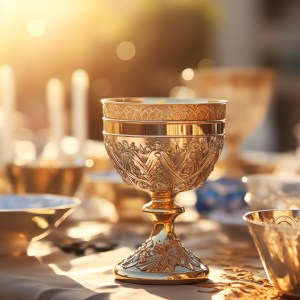
If you’ve purchased a special goblet with Elijah’s name written on it to use at your Passover Seder, you may have noticed another more obscure goblet inscribed with Miriam’s name. What is this cup for? Is it just to satiate liberals and feminists? Does this “new” ritual have any redeeming value? My hope is to show you the richness and beauty that this tradition can bring to your Passover table, and perhaps even to your weekly Kiddush.
The Cup of Miriam is not part of a traditional Seder, and I can find no mention of it in any of the feast books that I own. (But, don’t let that deter you from reading on!) According to Risa Borsykowsky[1] , the practice of drinking WATER from a special kiddush cup called Kos Miriam, began with Stephanie Loo Ritari and her Rosh Chodesh Boston group in the late 1980s. Reading through the Exodus, one can find numerous righteous women that played significant roles that led up to the redemption of Israel from Egypt.[2] Mrs. Ritari decided to bring these “hidden” women into the “retelling” of the Passover story to not only honor the matriarchs, but as a tool to make the Seder more comprehensive for women and girls. The most prominent woman of the Exodus story is Moses’ sister, Miriam. Therefore, she will be our focus in this study.
The Bible calls Miriam a prophetess of Israel.[3] She alone ensured that baby Moses would live by following him as he floated down the treacherous Nile River.[4] She watched as Pharaoh’s daughter drew Moses from the water, and then cunningly secured Moses’ own mother as his wet-nurse. She helped sustain the Israelites during their trek across the wilderness and she led them in joyous song and dance to praise YHWH for the miracle of parting the Red Sea. Upon her death, the Israelites grumbled against Moses and Aaron for a lack of life giving water.[5]
Did you notice the many connections of Miriam with water?[6]
Though her name can mean bitterness or even rebellion, the Hebrew also reveals that there is another (positive) side to Miriam. This should give hope to us all, as we each have both a good and evil inclination that wars for supremacy. To learn the duality of Miriam is to understand the ancient contradiction of what it is to be human. We all share the life long struggle between spirit and flesh.
Moreover, we would be wise to consider that other than one bad instance, Miriam’s portrayal of rebellion and bitterness was toward the anti-torah decrees of Pharaoh.[7] She and her family risked their lives by rebelling against Pharaoh. The midwives Puah and Shifrah acted similarly by defying Pharaoh’s edict to kill Hebrew male babies. It is interesting that it was the fearlessness of WOMEN that initially ignited the courage of all Israel. These brave lionesses stood firm and earned a spot forever in the Torah of our Elohim. Why would we leave their stories out of our maggid (retelling of the Passover story)? Would our daughters not be strengthened to hear year after year that they too have this great potential residing within them?
Miriam and Water
As I was studying the many links between Miriam, water, wells, fountains, the Holy Spirit, the Word, Yeshua, and Living Waters, I could hardly contain my excitement! Miriam is spelled mem, resh, yod, mem. Water is spelled mem, yod, mem.
Did you notice how similar these words are in Hebrew? Miriam is water with an added resh, which is pictographically a head. Thus, her name is literally head or lead waters. This meaning can also be demonstrated another way in Hebrew by looking at Miriam as a compound of two words: mar and yam. These words mean bitter/strong and sea (waters) respectively. Hence again, Miriam is associated with the idea of strong (head) waters.
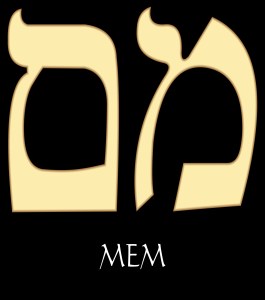
But what do strong waters imply and what are we to learn from this association? In order to get the full impact of Miriam’s role and name, we must first understand WATER from a Hebraic perspective. Mayim (mem, yod, mem) is a word bookended with two mem(s). The Hebrew letter mem is likened to water, a womb (it’s full of water), strength (as in gushing waters), chaos (again like an ocean), and as a preposition “to come forth from or out of”. This letter is one of a handful that has a sofit or final form when it is written at the end of a Hebrew word. A regular mem is open on the bottom, whereas the final form is closed.
© Shalom3 | Dreamstime.com
Rabbi Michael L. Munk, in his book The Wisdom of the Hebrew Alphabet on the letter mem, states, “The word mayim, water, with its initial and end mem, one open and one closed, depicts the accessible and the inaccessible – an allusion to the waters at Creation.” Thus, mem also illustrates what is revealed and what is concealed. Add to that the letter at the heart of mayim, yod (a hand, work, or deed), and the Creation waters (and all water thereafter) become the same contradiction that we see in Miriam’s name: a work or deed that has the potential for life (strong living waters) or death (bitterness and rebellion).
Water is a place of darkness and yet, great potential in Creation and in a woman’s womb. It can be as powerful and destructive as a roaring ocean and as gentle and satisfying as a trickling stream. It is at the same time both a life giving necessity and a place where chaos and death reign (like at sea). If you read my posts on Crate Trained Believers and The Devouring Lion, you may have noticed the similar imagery. Gentle AND Fierce.
Interestingly, the Hebrew word for mother, em (aleph, mem), also has the pictographic meaning of strong waters.[8] It seems as though the very fact that women have a womb that can fill with life giving waters connects them to Miriam.[9] Females made in the image of Elohim are “mothers” of all living. However, like our sisters Chavah (Eve) and Miriam, we also have the potential to bring chaos and death. (Like a tumultuous ocean.) One must learn to turn life’s bitter unruly waters into sweet waters of refreshing. By the way, this is also something men need to learn as well, for both men and women are revealed in the woman as the wife and bride of the Lamb.
This is the real Biblical portrayal of Miriam, the sister of Moses. She is truly a mother to the Israelites and a leader of her people.[10] Since the force and strength of her name is better understood, does this lend fresh insight about Mary (Miriam), mother of Yeshua? Isn’t it fitting that Yeshua should come forth from a womb such as this? How about the many other “Mary’s” mentioned in the Brit Chadashah (N.T.)? Will their stories speak a little louder the next time you read them?
There has been a tendency for us to forget that the Body needs both masculine and feminine leadership to keep us in balance and to display the whole image of Elohim (God). It is females that bring qualities such as comfort, nurture, protection, and mothering to the Body of Messiah. They are fierce AND gentle. Without these essentials, we raise nothing more than Devouring Lions.
Miriam is a representation of strength, the womb, mercy, prophecy, and praise. The ancient sages recognized the vital role of women in the Exodus in the Babylonian Talmud, Sotah 9b:
“If it wasn’t for the righteousness of women of that generation we would not have been redeemed from Egypt”
The rabbis recognized the very thing examined above: women were the progenitors of Israel’s redemption from Egypt.[11] I hope that you will include Miriam’s Cup in your Seder or even in your weekly Kiddush as a commemoration of her vital role in the Exodus and as a role model to your daughters, sisters, mothers, and wives. But, if this isn’t enough to convince you, there is so much more! In Part II, we will look at how water is associated with the rock in the wilderness, the Holy Spirit, Wisdom, and Pesach.
[1] http://www.jewishgiftplace.com/Miriams-Cup.html Retrieved on 02/22/2014
[2] There is Yocheved, the brave midwives (Puah & Shifrah), Miriam, and Tzipporah. See also footnote 6.
[3] Ex. 15:20
[4] Obviously, the Holy Spirit is what provoked Miriam to do this!
[5] Num. 20:1-2 Then the sons of Israel, the whole congregation, came to the wilderness of Zin in the first month; and the people stayed at Kadesh. Now Miriam died there and was buried there. (2) There was no water for the congregation, and they assembled themselves against Moses and Aaron.
[6] D. Hollisa Alewine’s Workbook 5 The Torah Portions Volume 2 –Shemot p.7-21 (2013) offers an interesting perspective on the women of the Exodus and Miriam in particular. If you’re ready to dig deep, buy this series and uncover a multitude of treasures.
[7] Numbers Chapter 12.
[8] See Hebrew Word Pictures by Frank T. Seekins (2003) p. 62
[9] The Hebrew word for womb, racham, ends with the letter mem. This is the same Hebrew word for mercy or compassion. Indeed the watery womb is a place of protection, growth, maturity, and nurture. This word shares the resh and mem with Miriam only adding a chet, which is a fence or boundary that protects.
[10] Micah 6:4 “Indeed, I brought you up from the land of Egypt And ransomed you from the house of slavery, And I sent before you Moses, Aaron and Miriam.
[11] This makes perfect sense considering the “birthing” nature of women.


 GRACE in TORAH
