The Voice of the Shofar

Shofar of Flesh

Shofar… So Good.

The feast of Yom Teruah (Rosh HaShanah/Feast of Trumpets) is nearly upon us. And with it, there is much speculation as to what the upcoming holy month holds for Israel and the world at large. Some folks are excited, but even more fear what may come to pass. There are so many voices speaking and prophesying at this season. Who is right? Who do we need to listen to?

According to the Torah, there is only one voice that we are commanded to hear at this season. (Lev. 23:23-25) It is the shrill voice of the humble shofar. Do you find it odd that out of all the feast days, Yom Teruah has the least requirements mentioned in the Torah? There is so much mystery associated with this day. Since it occurs on the New Moon, there is literally and figuratively less light. No wonder there is so much confusion surrounding this moed.

May I make a suggestion? Let’s have another look at what has been clearly revealed. What exactly is a shofar and why is it so important as to have an entire moed (feast) associated with it? At first glance, a shofar seems to be no more than a primitive trumpet made from the horns of a ram. But YHWH isn’t random or arbitrary. This Elul, all the mayhem, trials, testing, and just plain pressing has caused me to really cry out to YHWH.

And then something dawned on me. This simple instrument is made from a nephesh, a living creature. In order for us to enjoy its beautiful and unique sound, a ram (or least this part of the ram) must first die. [1] If you’ve ever heard the voice of a shofar, it sounds very much like a loud, piercing cry.

A cry. Isn’t that what we are doing in this season? Are we not crying out to our Elohim and King? We desire heartfelt repentance, forgiveness, restoration, healing, and reconciliation. We throw ourselves at the feet of our Redeemer and rest in His unfathomable mercy, grace, compassion, and sovereignty. There is no instrument on the planet that can encompass our inward groans and wordless pleas better than the shofar.

The flesh/nephesh has to die in order for these cries to become a reality. This places us in a very intimate and childlike state. Little babies and young children cannot use words to describe what is in their innermost being. They often can’t express their discomfort with words. So, what do they do? They wail and cry out to their mother or father. Their shrieks are a loud alarm. It’s a siren call for mom or dad to come to the rescue. A loud cry will wake a parent from their slumber.

And, so it is with the shofar. Its voice is the cry of a child to its parent. It is a tongue of wordless words. It reminds YHWH that He is our Father. It is a desperate plea for Abba to act on our behalf. It is a voice crying out from a vessel of flesh submitted to its Maker.

Ruach

All of the inside soft flesh or cartilage of the ram’s horn must be removed before it can be used as an instrument of prayer, worship, and war. [1] Once it is thoroughly cleaned out, one can then begin to fill it with something else: breath (life). The first cries from the shofar are born from pressed lips and a strong exhale of the blower’s breath. It is very much like a deep wail. The lips do not form words, but wordless music powered by the ruach.

Can you see the picture? This vessel must have all of its fleshly tissues removed in order for the breath/wind or Ruach to flow freely through it from tip to tip. When the shofar is filled with ruach, it cries out in repentance, praise, worship, and gathering. It speaks a message that is beyond words. 

What was once a nephesh has been transformed into a vessel for the Holy Spirit (Ruach HaKodesh). The voice of the shofar is very much akin to the niggunim and the tongues of fire acquired at the previous feast of Shavuot (Pentecost). We learn to move and speak not from the flesh, but with the infilling of the Spirit. And like sweet music, our (redeemed) voices learn to whisper the everlasting Good News which is carried to the far reaches of the earth by the wind (ruach).

YHWH gave His followers the shofar for a reason. We are called to hear its voice because we are to be like the shofar. We are to be willing vessels, submitted to Adonai. We shout and cry out in jubilation for our King is Coming!

I pray your High Holy Days are blessed!

Below is a Blessing and Psalm for the Season. Shalom!

Blessing for the Shofar

Baruch ata Adonai Eh-lo-hei-nu meh-lekh ha-o-lam ah-share kid-e-sha-nu b-mits-vo-tav ve-tzi-va-nu leash-moe-ah kol shofar.

 Blessed are you, Adonai our God, King of the Universe, who has sanctified us with commandments and who has commanded us to hear the voice of the shofar.

Psalm to Praise our King at this Season

Psalm 47

Complete Jewish Bible (CJB)

 For the leader. A psalm of the descendants of Korach:

2 (1) Clap your hands, all you peoples! Shout to God with cries of joy!

3 (2) For Adonai ‘Elyon is awesome, a great king over all the earth.

4 (3) He makes peoples subject to us, puts nations under our feet.

5 (4) He chooses our heritage for us, the pride of Ya‘akov, whom he loves. (Selah)

6 (5) God goes up to shouts of acclaim, Adonai to a blast on the shofar.

7 (6) Sing praises to God, sing praises! Sing praises to our king, sing praises!

8 (7) For God is king of all the earth; sing praises in a maskil.

9 (8) God rules the nations; God sits on his holy throne.

10 (9) The leaders of the people gather together, the people of the God of Avraham; for the rulers of the earth belong to God, who is exalted on high.


[1] An animal’s horn is made of an outer layer of hard keratin that is filled with soft bone tissue. Human bones and hair are made from this same material, keratin. In order to make a horn into a Shofar, the soft bone tissue must be removed from inside the horn.  This process takes a YEAR. The horn must sit for at least this long for the tissue to dry up, shrivel, and decompose. After this has happened, the tissue can usually be removed in one solid piece.

Categories: Biblical Symbols, Moedim | Tags: , , , , , , , , , , , | 11 Comments

Garments of Light Part I

© Haywiremedia | Dreamstime.com

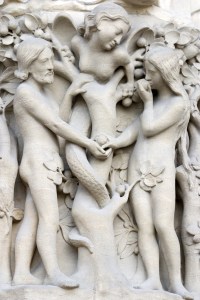
And the man and his wife were both naked and were not ashamed. (Gen. 2:25 NASB).”In the beginning, man and woman were “naked” and not ashamed. The Hebrew word for naked in the above verse is arom (ayin, rosh, mem). It comes from the verbal root aram (same Hebrew letters as arom), which means, “to make bare, to be subtle, crafty, or cunning.”[1] This is interesting because in the next chapter of Genesis, actually in the very next verse on the scroll, the serpent is introduced. He is more subtle, crafty, or cunning that any BEAST of the field that YHWH had made.

Now the serpent was more crafty than any beast of the field which the LORD God had made. And he said to the woman, “Indeed, has God said, ‘You shall not eat from any tree of the garden’?” (Gen. 3:1)

As I’m sure you have guessed, the Hebrew word used to describe the serpent as crafty is from the same Hebrew word above. It is the passive participle form of aram, pronounced arum (again same Hebrew letters as arom).[2] Thus, like many Hebrew words, arom is actually a contranym (a word that is its own opposite).[3] To be naked is akin to being transparent with nothing hidden. On the contrary, to be cunning or crafty, something is definitely hidden or concealed.

In the case of Adam and Chavah (Eve) before the fall, their nakedness wasn’t something in which they should be ashamed. They were transparent with nothing to hide. Their nakedness was virtuous at this point. They had no need of being covered in the hair of a beast, nor did they need a covering of fur for protection. (Obviously, the converse was true for the serpent, but we explore him in a later post.)

Skins of Light

There are traditions from both Jewish and Christian sources that teach that before the fall, the skin of Adam and Chavah was luminous. In other words, they were “covered” by divine light and would “glow,” so to speak. I hope this triggers your mind to make some connections to Moses’ face and Messiah, but we will get there soon enough.

© Karen Harding | Dreamstime.com

This idea or tradition isn’t random. The Hebrew language is VERY idiomatic, metaphoric, and figurative. Contranyms, homonyms (sound alike words), parables, and many other literary devices are used heavily to help one understand spiritual concepts through the experience of natural things.[4] Hebrew speaks through our senses and imagination. It draws simple “pictures” that even a child can understand. As the old adage goes, “a picture is worth a thousand words.” In our case, it is neither coincidence nor chance that the Hebrew word for light and for skin sound exactly the same: ohr. Look carefully at the following:

אוֹר Light (aleph, vav, resh)

עוֹר Skin (ahyin, vav, resh)

The only difference is the first letter (read from right to left). Light begins with aleph, a letter heavily associated with God,[5] and skin begins with ahyin, the letter that also means eye. Both aleph and ahyin are silent letters. They have no sound aside from the vowel associated with them. In our words above, the vowel is shown by the letter vav with the dot on top, which is called a cholem vav. The last letter is a resh, an “r” sound that pictographically means “a man’s head.”

By simply looking at the pictographic meaning of these words, both have a heart that connects. Vav means to link, connect, or hook together. It is also the number 6, the creation day for both beast and man. In the verses above in Genesis, the text presents us with a beast (snake) that speaks like a man.

The other Hebrew letters for each word reveals what light and skin connects or links one with. In the case of light, the head (resh) is connected to God (aleph), the Father. But in the case of skin, the head (resh) is connected to only what one’s eyes (ahyin) can see (flesh/natural).

Dr. Alewine in The Creation Gospel Workbook Four: The Scarlet Harlot and the Crimson Thread has this to say:

“Rabbinic insight is that the clothing of Adam and Eve was glory, or radiance (or with an aleph), a white light invisible to the human eye that was replaced with a covering of skins (or with an ayin). The white light is the same covering of the Bride of Messiah in Revelation. The Bride reflects the Lamp of the New Jerusalem, the Lamb. In terms of the menorah, there was a spiritual covering over the first couple’s earthly bodies, a covering or radiance pictured when Moses spoke with Adonai on the mountain, receiving the Torah covenant for Israel. Like the Holy One in whose image they were made, they had corresponding covers of light like garments.” (p. 175)

Roaming Eyes

Do you recall what organ tempted Chavah (Eve) to fall into deception?

The serpent said to the woman, “You surely will not die! “For God knows that in the day you eat from it your eyes will be opened, and you will be like God, knowing good and evil.” (Gen. 3:4-5) 

The serpent, the one that was arum (cunning), was implying that Adam and Chavah were “blind” in some way. Recall, that at this point, Adam and Chavah were naked, arom, but had no shame. Before sin, their covering was the spiritual light of Elohim (God). Again, notice below the association with EYES.

When the woman saw that the tree was good for food, and that it was a delight to the eyes, and that the tree was desirable to make one wise, she took from its fruit and ate; and she gave also to her husband with her, and he ate. Then the eyes of both of them were opened, and they knew that they were naked; and they sewed fig leaves together and made themselves loin coverings. (Gen. 3:6-7)

Chavah SAW the Tree of Knowledge of Good and Evil and found that it delighted her eyes, and had the potential to make one WISE. Folks, our eyes are what typically deceive us. Imagine with me all the sins that begin by looking at someone or something with our eyes: coveting, jealousy, lust, greed, envy, judgment, false witness or testimony, etc. It has been this way since the beginning. Our eyes can be deceitful because they are a part of our flesh/nephesh. They need a constant physical and visual reminder that will refocus our attention back to the heavenly and spiritual reality. This is one reason YHWH gave the commandment to wear tzit-tziyot (fringes) on the four corners of one’s garments. Again, notice the EYES.

“It shall be a tassel for you to look at and remember all the commandments of the LORD, so as to do them and not follow after your own heart and your own eyes, after which you played the harlot, so that you may remember to do all My commandments and be holy to your God. (Num. 15:39-40)

Leaves that Kill, Leaves that Heal

When Adam and Chavah ate from the Tree of Knowledge, they forfeited the Light (of God) as their covering. In other words, they took upon themselves a different authority. Once they transgressed YHWH’s command, they immediately realized that their heavenly garments were missing. They were “bare” or naked without this covering (of light). Like them, we would probably scramble to find a replacement for such a great loss. In fact, this realization is what caused them to fear, and it is the reason they hid from Elohim. (Gen. 3:8)

© Ben Renard-wiart | Dreamstime.com

So, why do you think they chose fig leaves? I believe that prior to sin, the Tree of Life provided Adam and Chavah with their garments or skins of Light. Often used as an idiom for the Torah or Law of God and Wisdom, the Tree of Life indeed produces light, life, healing, fruit, and blessings. I encourage you to do a concordance search and find your own associations.

Then he showed me a river of the water of life, clear as crystal, coming from the throne of God and of the Lamb, in the middle of its street. On either side of the river was the tree of life, bearing twelve kinds of fruit, yielding its fruit every month; and the leaves of the tree were for the healing of the nations. (Rev. 22:1-2)

The leaves from the Tree of Life HEALS the nations. Perhaps, Adam and Chavah thought that the leaves from the Tree of Knowledge (their new tree of choice) would do the same. But what they discovered is that the Tree of Knowledge of Good and Evil only leads to darkness, exile, death, sickness, fleshly desires, and curses. It is the exact antithesis to the Tree of Life. So what did God do?

The LORD God made garments of skin (ohr) for Adam and his wife, and clothed them. (Gen. 3:21)

What Kind of Skin?

We typically assume that God slaughtered an animal and made coverings of fur for the first couple. But the text doesn’t explicitly say that this is what God did. There is no mention of Him slaughtering an animal. Our old assumption isn’t necessarily wrong, but the skin (ohr) that God made could have been of (mortal) human skin. The verse literally says that God made (asah) ohr (skin) and clothed Adam and Chavah with it. Perhaps, after losing their garments of Light, God made them garments of (mortal human) skin. This is a viable possibility in the Hebrew and one to consider.

Whether or not Adam and Chavah once had literal garments of Light that were forfeited when they sinned isn’t the point. God did make for them skins (human or animal) in which to cover their nakedness. Maybe their nakedness wasn’t physical. Or perhaps, it was both physical and spiritual. Either way, this series will explore the figurative or spiritual side of this coin.

Much more to explore in upcoming articles. Click here for Part II


[1] See Strong’s definitions for H6174 and H6191.

[2] H6175

[3] A contranym (also spelled contronym) is sometimes called an auto antonym. Like Hebrew, the English language has many terms that fall into this category. Think of the word cleave. It can mean to cling to tightly or to cut into as to divide into pieces. Other examples are as follows:

Bolt: To secure, or to flee

Bound: Heading to a destination, or restrained from movement

Buckle: To connect, or to break or collapse

Clip: To fasten, or detach

Screen: To present, or to conceal

Splice: To join, or to separate

Transparent: Invisible, or obvious

[4] 1 Cor. 15:46

[5] This is based on the many words that begin with aleph: for example, Elohim, Abba, El, etc. Moreover, the ancient Hebrew pictograph means a strong leader, strength, power, ox, etc.

For more great insight into the first couple and the serpent in the garden, please see Rabbi David Fohrman’s book, The Beast that Crouches at the door.

Categories: Biblical Symbols, Messianic Issues | Tags: , , , , , , , , , , | 7 Comments

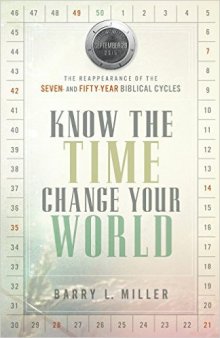
Book Review: Know the Time Change Your World

Barry Miller Book

Is it just me, or does time seem to be moving at an accelerated speed? The summer has flown by in a blink of the eye. I know people say that time seems to move faster the older you get, but as of late, even young people have been expressing a sense of not having enough time. Perhaps we are all too busy? Or maybe time encompasses more than we realize.

I’ve certainly had very little time for writing (for that I apologize), but I have managed to squeeze in some reading. And that’s what I want to bring to your attention today. Speaking of TIME, Barry Miller was kind enough to give me an advanced copy of his new book, Know the Time Change Your World: The Reappearance of the Seven and Fifty Year Biblical Cycles. (You can find a copy HERE on Amazon or HERE at Barnes Noble.)

I have enjoyed his book immensely and I’ve learned a lot. Those of you familiar with the Creation Gospel by Dr. Alewine will especially find Mr. Miller’s book intriguing. Know the Time Change Your World is based in the patterns and rhymes first given to us in the seven Creation days and extends into the feasts of the LORD. But where Dr. Alewine takes these cycles and actions deeper into the Spirit realm, everyday life, and Biblical interpretation, Mr. Miller reveals yet another facet in the business and financial aspects of life. For me, they are two sides of ONE coin. He teaches us not only how to discern these patterns in our own economy, but also in our personal finances.

I first met Mr. Miller through my blog and email correspondence. After visiting and reading his blog (see his new website here), I was amazed by how the Holy Spirit had been revealing the patterns of seven to Barry in a similar fashion as Dr. Alewine. Now, don’t misunderstand. The Creation Gospel and Barry’s book are VERY different. They are related because both use the Creation model for their foundation. (Which is where all good hermeneutics and teachings should begin… in the beginning.) Thus, one would expect to find connections because the ONE Holy Spirit has inspired, stirred, and moved the same way from Day One.

Many of us are searching for how to properly handle our finances and business dealings from a Hebraic (Biblical) perspective. Having spent years in the business sector and in Bible study, Barry Miller has some unique insights that should be appealing to not only Hebraic Roots followers but also to the Christian church at large. By giving friends and family members Know the Time Change Your World to help them make wiser financial choices, you will also be introducing them to the LORD’s Sabbath, calendar, and Torah. It’s a win-win in my opinion!

Have you ever wondered about the seven-year gap between the economic struggles of 2001 and 2008? What does Joseph have to teach us about personal finance today? Is YHWH’s (the LORD’s) calendar more than antiquated ritual? Does it have significance in not only my spiritual life but also in my secular life? Mr. Miller carefully takes us through the Bible and history to show us that the Beginning indeed has set the precedent for all time, even the end. (Is. 46:10)

The many “sevens” and even the greater cycles of “fifty” do matter just as much for us today as they did for ancient Israel. And I believe the church is becoming ripe for this message. Consider all the recent teachings and books on the blood moons and the Shemmitah years. Some are being called back to the cycles, patterns, and rhythms of our Creator. The unrest and immorality of the world are shaking many out of their complacency. And our great Elohim (God) is using people such as Mr. Miller to get His Word out to the masses.

As most of my readers are aware, obedience to the King of the Universe brings blessings. I haven’t met one person that doesn’t desire for the Creator to bless them in every aspect of their life. The problem is that too many of us are ignorant of the principles and laws set forth by YHWH (the LORD) that will cause us to reap such benefits.[1] We lack wisdom and thus make poor decisions that cause us setbacks in many areas of life, one of which is our finances.

After reading Miller’s book, I looked back through my life with the seven-year cycle in mind. I could clearly see how my lack of knowledge of the Creator’s calendar resulted in poor financial/business decisions. But not anymore. Know the Time Change Your World has sharpened the tools I already have acquired from Torah study. But even better, I have gained new ones!

Know the Time Change Your World is divided into three parts. In my opinion, Part III alone is worth the cost of the book. (But without the foundation of Part I and II, you’d be lost, lol!) Seven chapters will take you deep into the story of Joseph and the seven and fifty-year biblical cycles. It is EYE opening! Even seasoned Torah keepers will find a deeper revelation of not only Joseph but of themselves. Buy this book and share it with friends and family; you will not be disappointed!

Do you need an economic reset? Do you need to move from chaos to rest? Would you like to be able to make better decisions and have better discernment? God’s creation and His calendar have all the answers! Allow Barry Miller to give you the simple keys to this understanding in his new book.


See more about the book and Barry Miller at 7and50rhymes.com

[1] My people are destroyed for lack of knowledge. Because you have rejected knowledge, I also will reject you from being My priest. Since you have forgotten the law of your God, I also will forget your children. (Hosea 4:6)

Categories: News Flash, Study Helps | Tags: , , , , , , , | 1 Comment

Month of Av: Tisha B’Av and Tu B’Av

“The Lord has rejected all my strong men In my midst; He has called an appointed time [moed] against me to crush my young men; The Lord has trodden as in a wine press The virgin daughter of Judah. (Lam. 1:15 NASB)
Chodesh AvThe month of Av is the eleventh month on the Hebrew civil calendar and the fifth month on the Hebrew biblical calendar. This corresponds to July/August. Av literally means “father” (aleph-beht). It is customary to add the name Menachem to Av, which means “comforter” when speaking about this month because it is associated with many tragic events, yet our Father brings comfort. Thus, many refer to this month as “Menachem Av” (Comforting Father). We will explore this in more detail below.

According to tradition, each of the twelve (or thirteen) months on the Hebrew calendar correspond to one of the tribes of Israel. The month of Av is associated with Simeon (Shimon). Shimon’s name means to “hear.”[1] By examining the themes of the month of Av, it becomes increasingly obvious that one’s sense of hearing (or lack thereof) is the vehicle by which one will find themselves mourning or rejoicing. The question and consequent meditation for the month of Av is:

 “Will we heed the voice (Word) of YHWH? Or will we listen to evil reports and the desires of the flesh?

History and tradition records many events where the Children of Israel’s “hearing” was tested in the month of Av. Sadly, the testimony is usually a lack of hearing which resulted in great judgment. Consider the following list that is said to have occurred on the ninth of Av or Tisha B’Av.

  • During the time of Moses, the people believed the evil report of the 10 Spies, and the decree was issued forbidding them from entering the Land of Israel. (1312 BCE)
  • The First Temple was destroyed by the Babylonians, led by Nebuchadnezzar. 100,000 Israelites were slaughtered and millions more exiled. (586 BCE)
  • The Second Temple was destroyed by the Romans, led by Titus. Some two million Jews died, and another one million were exiled. (70 CE)
  • The Bar Kochba revolt was crushed by Roman Emperor Hadrian. The city of Betar – the Jews’ last stand against the Romans – was captured and liquidated. Over 100,000 Jews were slaughtered. (135 CE)
  • The Temple area and its surroundings were plowed under by the Roman general Turnus Rufus. Jerusalem was rebuilt as a pagan city – renamed Aelia Capitolina – and access was forbidden to Jews.
  • The Spanish Inquisition culminated with the expulsion of Jews from Spain on Tisha B’Av in 1492.
  • World War One broke out on the eve of Tisha B’Av in 1914 when Germany declared war on Russia. German resentment from the war set the stage for the Holocaust.
  • On the eve of Tisha B’Av 1942, the mass deportation began of Jews from the Warsaw Ghetto, en route to Treblinka.

These details from history makes one wonder if the timing of these calamities is mere coincidence. Does the LORD have an appointed time to “break” us?[2] According to Jewish tradition, He does, and that date is associated with the ninth of Av. Reread the verse from Lamentations quoted at the beginning of this post. In Hebrew, YHWH indeed has a “moed” or appointed time to break His wayward people. The LORD allows these calamities to come upon those that are His in order to bring them to repentance. It is our rebellions, shortcomings, and stiff-necks that provokes His hand against us. Like any loving parent, YHWH uses punishment in order to guide, teach, and protect His children. And like Him, we often set aside a particular time to mete out certain reprimands to our own children.

Just as a father has compassion (mercy) on his children, So the LORD has compassion on those who fear Him. (Ps. 103:13) 

Though the month of Av is connected with judgment and tragedy, it is equally linked to God’s mercy. The good news is that even when we are stiff necked or have closed ears, YHWH still loves us. So, though the focus of Tisha B’Av is denying oneself and repentance, there should be a transition in the observer from mourning to celebration.  One may grieve over past tragedies and rebellions, but hope is always in the Menachem Av (Comforting Father). It is His divine mercies that give one a hope for a good future. This is the essence of Tish b’Av. Remember the past, but move forward with an attitude of gratitude and a burning hope for a better future.

How to Listen

Most of my readers are aware of what it means in Hebrew to Shema. It means to hear/listen AND obey what is heard. The Jewish response to the tragedies enumerated above was to mark this infamous date as a day of fasting and repentance. It is important that one remembers, so they do not repeat the mistakes of our predecessors. But, one’s attitude in these matters is paramount. Listen to the question YHWH asks in Zechariah:

“Say to all the people of the land and to the priests, ‘When you fasted and mourned in the fifth and seventh months these seventy years, was it actually for Me that you fasted? ‘When you eat and drink, do you not eat for yourselves and do you not drink for yourselves? (Zec. 7:5-6) 

Our mourning, fasting, and rejoicing must be sincere. Notice how hearing and a lack thereof leads to punishment and exile in the rest of this passage:

Then the word of the LORD came to Zechariah saying, “Thus has the LORD of hosts said, ‘Dispense true justice and practice kindness and compassion each to his brother; and do not oppress the widow or the orphan, the stranger or the poor; and do not devise evil in your hearts against one another.’ “But they refused to pay attention and turned a stubborn shoulder and stopped their ears from hearing. “They made their hearts like flint so that they could not hear the law and the words which the LORD of hosts had sent by His Spirit through the former prophets; therefore great wrath came from the LORD of hosts. “And just as He called and they would not listen, so they called and I would not listen,” says the LORD of hosts; “but I scattered them with a storm wind among all the nations whom they have not known. Thus, the land is desolated behind them so that no one went back and forth, for they made the pleasant land desolate.” (Zec. 7: 8-14)

It seems that most every Word from the LORD leads back to the two greatest commandments: Love YHWH and love your neighbor. You want to really listen? You want to really hear the LORD? You want “ears that hear”? The Torah, the commandments, and the Word teach how to love YHWH and one’s neighbor. But, one must be humble enough to heed His voice.

How Not to Listen

Shimon, as the tribe of Av, and the name associated with hearing, has much to teach this month. Let’s see if we can learn from Shimon’s and his descendant’s mistakes. I find it fascinating that the man whose name means to “hear” seemed to often have closed ears. It seems ironic, but is it? Are we any different?

First, if you will recall, it was Shimon and Levi that decided to take justice into their own hands when Shechem violated their sister Dinah.[3] This enraged Jacob and he reprimanded his sons for their rash behavior.[4] Later, when Jacob blessed his sons, Shimon and Levi receive more of a rebuke than a blessing:

“Simeon and Levi are brothers; Their swords are implements of violence. “Let my soul not enter into their council; Let not my glory be united with their assembly; Because in their anger they slew men, And in their self-will they lamed oxen. “Cursed be their anger, for it is fierce; And their wrath, for it is cruel. I will disperse them in Jacob, And scatter them in Israel. (Gen. 49:5-7)

Notice that Jacob’s rebuke is similar to YHWH’s edicts against us when we are wayward. Exile or scattering, is one result of sin. Shimon and Levi acted in unholy anger when they attacked the Shechemites. We must be careful when someone kindles anger in us (right or wrong), for more often than not, we become the greater sinner when we allow our actions to be ruled by inflamed flesh. A reddened face full of rage makes one more like an Esau (red), and no better than a hairy beast. This will only bring wrath upon our own head and division in our camps.

Later, it seems that the Levites find favor from HaShem; but, as the LORD’s inheritance, they remained scattered throughout the tribes. When Moses hands out the tribal blessings, he says of Levi:

Of Levi he said, “Let Your Thummim and Your Urim belong to Your godly man, Whom You proved at Massah, With whom You contended at the waters of Meribah; Who said of his father and his mother, ‘I did not consider them’; And he did not acknowledge his brothers, Nor did he regard his own sons, For they observed Your word, And kept Your covenant. “They shall teach Your ordinances to Jacob, And Your law to Israel. They shall put incense before You, And whole burnt offerings on Your altar. “O LORD, bless his substance, And accept the work of his hands; Shatter the loins of those who rise up against him, And those who hate him, so that they will not rise again.” (Dt. 33: 8-11)

Shimon doesn’t fair quite as well. Moses skips over Simeon altogether when he blesses the tribes of Israel.[5] Rashi says that this is because of what happened in Shittim when Israel played the harlot with the daughters of Moab. Two particular characters in this drama were Zimri (a Simeonite) and Cozbi (a Midianite). They were in the throes of passion when Pinchas skewered them at the doorway of the Tent of Meeting, which stayed the plague. (Numbers 25)

Again, we see the one that should have had ears to hear given over to the passions of the flesh. Instead of boiling with anger, this time we see a Simeonite inflamed with a perverted sexual desire. Can you see a pattern developing here? The one that should have ears to hear is deaf to the instructions of the Creator. He is ruled by desire, his lower nature, making him no better than a beast of the field.

Unlike the other tribes (save Levi), Shimon didn’t receive a separate neighboring portion in the Promised Land. Instead, Shimon was scattered in various towns and cities within Judah’s allotment.[6] Jacob’s rebuke held true for both Levi and Shimon. Some of our actions have long lasting and dire consequences, even though we have found forgiveness.  This takes us back to the other themes for this month (Av): mourning, repentance, remembrance, and finally, joy. The good news is that one day, YHWH will turn all of our fast days into joyful celebrations for those that love truth and peace.

“Thus says the LORD of hosts, ‘The fast of the fourth, the fast of the fifth, the fast of the seventh and the fast of the tenth months will become joy, gladness, and cheerful feasts for the house of Judah; so love truth and peace.’ (Zec. 8:19)

Meanwhile, We Remember

Interestingly, there is only one person that the Torah records the exact date of their death. That man was the High Priest, Aaron.

Then Aaron the priest went up to Mount Hor at the command of the LORD, and died there in the fortieth year after the sons of Israel had come from the land of Egypt, on the first day in the fifth month. (Num. 33:38) 

Aaron passed from this life on the new moon of the fifth month of Av. It seems that from this point forward, Av would be associated with mourning. Since Aaron is directly connected to the Tabernacle and later Temple, I find it incredible that both Solomon’s and Herod’s Temples were later destroyed in the very month that her original High Priest passed away. There are many reasons for us to mourn these losses, but there are also reasons to wipe our tears away and look forward to a better hope/future.

The move from mourning to celebration is mirrored in the traditional haftarah reading for the Shabbat following Tisha B’Av. This Sabbath is called “Shabbat Nachamu” or the Sabbath of Comforting. The haftarah reading is from Isaiah 40: 1-26 and speaks of comforting God’s people after their suffering.

Moreover, by the time the moon gets full during the month of Av, another traditional holiday emerges: Tu B’Av (fifteenth of Av). After all the mourning of Tisha B’Av, the people begin to rejoice. Like the ninth of Av, there are several events that are associated wih this date in history; but instead of destruction, this date brought great reprieve and comfort to the people.

The first mention of Tu b’Av is in the Mishna (Taanit), where it says , “There were no better days for the people of Israel than the Fifteenth of Av and Yom Kippur, since on these days the daughters of Jerusalem go out dressed in white and dance in the vineyards. What they were saying: Young man, consider who you choose (to be your wife).” (Taanit 4:8). According to the Gemara, on this day the “tribes of Israel were permitted to mingle with each other.” (Taanit 30b)

Here are few things that are said to have occurred on Tu B’Av:

  • The death of the generation that left Egypt ended. (Ending the judgment for believing the report of the 10 evil spies.)
  • The daughters of Zelophehad were granted an inheritance like sons.
  • Members of the Tribe of Benjamin were readmitted to the community (Judges 19-21)
  • King Hosea, the king of the Northern Kingdom, removed the restrictions of King Jeroboam that prohibited the northerners from making pilgrimages to Jerusalem.
  • The Romans permitted the Jews to bury their dead who fell at Beitar.

As you can see, the month of Av ebbs and flows with the themes of destruction (judgment) and renewal. While Jews refrain from marrying during the mourning period of Av, the later part of the month, beginning with the fifteenth, marks a strong transition in their countenance. So much so, that many do marry on or just after this date. (Or new courtships are started.) This is the epitome of mourning turning into joy! As such, Tu B’Av is said to be a festival of love, quite a contrast to Tisha B’Av.

I encourage you to do your own research on Chodesh Av, Tisha B’Av, and Tu B’Av. There is a wealth of information at your fingertips you need only use them. For now, I thought it best to leave you with a few bullet points for ways to celebrate and meditate during the Rosh Chodesh of Av and the fast of Tisha B’Av.

Chodesh Av

  • Meaning: Av means Father. Mazel for this month is aryeh (the lion).[7] (A clever eye will notice that this month pictures both the Father and the Son.)
  • Major theme: Destruction and Renewal.
  • Meditation: Hear (Shema) the voice of Adonai. Discern between the voice of YHWH and the desires of the nephesh (flesh). Misplaced zeal can quickly become the latter.
  • Remember: The Tabernacle, fallen Temples, and other rebellions of the past. Learn from them.
  • Look Forward: To our heavenly High Priest, Yeshua, the third Temple, and the eventual New Jerusalem.

Tisha B’Av

  • Fast from sundown to sundown on the ninth of Av (unless it falls on Shabbat, then fast the following day). Feel free to look up other traditional things to avoid during the fast such as not wearing leather shoes, perfume, and avoiding baths. (These are ways to “afflict your soul/nephesh” as you focus on lamenting and repentance.)
  • Confess your sins and the sins of our forefathers. (Remember that many of the atrocities that happened to the Jewish people on Tisha B’Av came by the hand of Christians.) Daniel 9 gives a model of confessing the sins of others.
  • Read through Lamentations.
  • Search for Scriptures that speak about God’s mercy on His people and passages that deal with fasting and repentance.


For more understanding of why nine (Tisha B’Av) is associated with both judgment and blessings click here and here. For more on the significance of five, as in the fifth month and fifteenth day (Tu B’Av), click here and here


[1] Gen. 29:33

For the month of Av being associated with Shimon, see Artscroll’s Wisdom in the Hebrew Months.

[2] The Hebrew word translated as “crush” in the Lamentations verse above is Strong’s number: H7665. It literally implies breaking or brokenness. Brown, Driver, and Brigg’s Hebrew defines it thusly:

שׁבר

shâbar

BDB Definition:

1) to break, break in pieces

1a) (Qal)

1a1) break, break in or down, rend violently, wreck, crush, quench

1a2) to break, rupture (figuratively)

1b) (Niphal)

1b1) to be broken, be maimed, be crippled, be wrecked

1b2) to be broken, be crushed (figuratively)

1c) (Piel) to shatter, break

1d) (Hiphil) to cause to break out, bring to the birth

1e) (Hophal) to be broken, be shattered

[3] Gen. 34:25

[4] Gen. 34:30

[5] Dt. 33. Shimon is absent from the blessings.

[6] It appears to me that Judah takes authority and care over the Simeonites. This is likened to Yeshua taking care of and covering us for our sinful mistakes. In other words, we didn’t “shema,” hear.

[7] This is NOT astrology! The enemy has twisted the monthly constellations into a perverted way to divine the future and/or disposition of a person. But, YHWH says the stars were put in the sky to mark the seasons (moedim), to be as signs, to distinguish day and night, and to give LIGHT upon the earth. The heavens declare the glory of God. This includes the stars and the constellations. A careful look at the Creator’s handiwork will reveal that the constellations proclaim the Gospel, and were never meant to divine one’s personal finances, love life, or the like.

Categories: Moedim | Tags: , , , , , , | 12 Comments

Blog at WordPress.com.