Torah Portions

The Rivers of Eden

Why does Torah portion Bereshit seem to interrupt the natural flow of the creation narrative to interject the telling of the rivers of Eden? Does this break in the story seem strange to you? In her commentary on Bereshit in The Creation Gospel Workbook 5 Volume 1, Dr. Hollisa Alewine expounds on the odd placement (or is it?) of the details of the one river that divides into four in Genesis chapter two. Dr. Alewine’s commentary on Bereshit delves deeply into the rivers of Eden (about 50 pages worth!).  Obviously, this is a much more comprehensive treatment than I will offer here. If you have the time, I urge you to study the Creation Gospel model and her commentary on Bereshit. I hope to give you a summary of these fascinating rivers and a taste of Dr. Alewine’s work along with some thoughts of my own.

Gen 2:10-14  Now a river flowed out of Eden to water the garden; and from there it divided and became four rivers.  (11)  The name of the first is Pishon; it flows around the whole land of Havilah, where there is gold.  (12)  The gold of that land is good; the bdellium and the onyx stone are there.  (13)  The name of the second river is Gihon; it flows around the whole land of Cush.  (14)  The name of the third river is Tigris; it flows east of Assyria. And the fourth river is the Euphrates.

One River

First, what is a river in Hebrew? In our passage above, the Hebrew word translated as river is nahar. According to Brown, Driver, and Briggs’ Hebrew Definitions, nahar is a stream, river, or underground stream. It comes from the root verb nahar meaning to shine, beam, light, burn, be radiant, to flow, and stream. Please keep this imagery of a river as flowing water and flowing light at the forefront of your mind as we continue.

From the Garden of Eden (paradise) the “head” or beginning of the ONE river divided into four other rivers. Before we get into the details of these four rivers, let’s first explore what we know about the number four. As I’ve explained in other places on this blog, four can be a representation of seven or completeness. Day four of creation establishes for us the “governing” aspect of this number.

Other examples:

  • There are four corners of the earth.
  • Four corners (horns) are on the brazen altar.
  • Four living creatures surround the Throne.
  • Four seasons mark the year.
  • The fourth commandment is about Shabbat, the seventh day.
  • Four gospels testify of Messiah.
  • The fourth born son, Judah, receives the scepter (authority, government, rule).
  • Four horsemen complete judgment in the earth.
  • Four species are waved at Sukkot, the seventh feast (Lev. 23).
  • Four corners of a garment carry tzit-tziot (fringes) representing all the commandments.

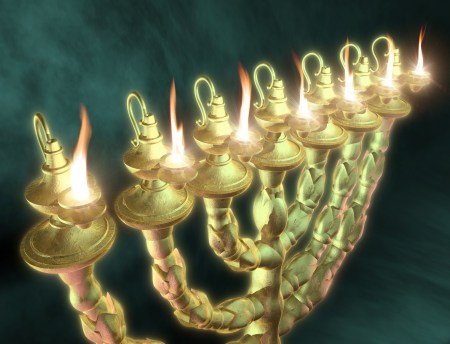
There are many places in the creation (nature) and the Holy Scriptures that speak to the imagery of four depicting completeness and authority much in the way that the number seven does. The seven branched menorah displays this imagery (in the natural) better than any other motif. Consider that the source or center branch is the fourth branch no matter which direction you begin your count. Messiah Yeshua stands at the center of this lampstand as He is the source from which all things flow. This brings us back to the beginning or Bereshit.

John 1:1-5  In the beginning was the Word, and the Word was with God, and the Word was God.  (2)  He was in the beginning with God.  (3)  All things came into being through Him, and apart from Him nothing came into being that has come into being.  (4)  In Him was life, and the life was the Light of men.  (5)  The Light shines in the darkness, and the darkness did not comprehend it.

It is through the divine Light of Messiah (He as our menorah) that all things came into being and are held together. As the source of LIGHT, He rescues us from the darkness and redeems and saves us. He is the beginning of “in the beginning.

Col. 1:13-18  For He rescued us from the domain of darkness, and transferred us to the kingdom of His beloved Son,  (14)  in whom we have redemption, the forgiveness of sins.  (15)  He is the image of the invisible God, the firstborn of all creation.  (16)  For by Him all things were created, both in the heavens and on earth, visible and invisible, whether thrones or dominions or rulers or authorities–all things have been created through Him and for Him.  (17)  He is before all things, and in Him all things hold together.  (18)  He is also head of the body, the church; and He is the beginning, the firstborn from the dead, so that He Himself will come to have first place in everything.

As LIGHT, He is the source branch or trunk of the menorah tree, and the fullness thereof extending into the six branches for a completion of “seven.”

Rev 1:12-15  Then I turned to see the voice that was speaking with me. And having turned I saw seven golden lampstands;  (13)  and in the middle of the lampstands I saw one like a son of man, clothed in a robe reaching to the feet, and girded across His chest with a golden sash.  (14)  His head and His hair were white like white wool, like snow; and His eyes were like a flame of fire.  (15)  His feet were like burnished bronze, when it has been made to glow in a furnace, and His voice was like the sound of many waters.

Rev. 2:1  “To the angel of the church in Ephesus write: The One who holds the seven stars in His right hand, the One who walks among the seven golden lampstands

The primordial Light of day one in Genesis 1:3 was not the natural light of the sun, moon, and stars (created later on day 4), but was the glorious spiritual Light of Messiah. He is the Light in the darkness and the Life of men.

While “light” is certainly a symbol for God given in Genesis 1:3, there is another symbol that precedes this primordial “light.” In Genesis 1:2, the Spirit of God is hovering or moving upon the face of the waters. This movement in Hebrew is rachaf (H7363), which is the brooding, fluttering motions a mother bird makes over her nest. From the beginning, the Spirit of God is characterized by movement, the nurturing care a mother bird has for her young, and with WATER. Does Messiah have any associations with water? The Beloved disciple John, the one who points us to the beginning and the primordial light, also points us to the ancient waters as the source for eternal life.

John 4:10  Jesus answered and said to her, “If you knew the gift of God, and who it is who says to you, ‘Give Me a drink,’ you would have asked Him, and He would have given you living water.” (see also vs. 14)

John 7:37-38  Now on the last day, the great day of the feast, Jesus stood and cried out, saying, “If anyone is thirsty, let him come to Me and drink.  (38)  “He who believes in Me, as the Scripture said, ‘From his innermost being will flow rivers of living water.'”

Modern Day Mikvah Mk17b, CC BY-SA 4.0, via Wikimedia Commons

Immersing in living waters, mayim chayim, removes ritual impurity, marks a change of status, and figures being born anew (conversion). In the days of the Temple, one couldn’t approach the Temple without first entering a mikvah (baptismal pool). The picture shows a modern mikvah in NY. When Yeshua was immersed in the Jordan River in the first century, the Holy Spirit alighted on Him like a dove, a bird, just like the hovering action of Day One of creation.

Matthew 3:16-17 (CJB) As soon as Yeshua had been immersed, he came up out of the water. At that moment heaven was opened, he saw the Spirit of God coming down upon him like a dove, [17] and a voice from heaven said, “This is my Son, whom I love; I am well pleased with him.”

As the image of the invisible God, Yeshua is also the source for the living waters of eternal life. Jeremiah declares that these living waters are from the beginning and find their source in the glorious throne of YHWH.

Jer. 17:12-14  A glorious throne on high from the beginning Is the place of our sanctuary.  (13)  O LORD, the hope of Israel, All who forsake You will be put to shame. Those who turn away on earth will be written down, Because they have forsaken the fountain of living water, even the LORD.  (14)  Heal me, O LORD, and I will be healed; Save me and I will be saved, For You are my praise. (See also Jer. 2:13)

Thus, we see the Living waters in the beginning… before all things. Time doesn’t run on some infinite straight line, it is a circle or a cycle according to the witness of creation, Hebraic thought, and the Bible. What is happening in the beginning will also happen at the end, completing the divine pattern or cycle. What do we see at the end?

Rev. 7:17  for the Lamb in the center of the throne will be their shepherd, and will guide them to springs of the water of life; and God will wipe every tear from their eyes.”

Rev. 21:6  Then He said to me, “It is done. I am the Alpha and the Omega, the beginning and the end. I will give to the one who thirsts from the spring of the water of life without cost.

Rev. 22:1  Then he showed me a river of the water of life, clear as crystal, coming from the throne of God and of the Lamb,

Though the river in Genesis chapter two isn’t named, I bet you can guess what it is called. It is the Source, the Head, and the Beginning. It is none other than the River of Life. The Holy Spirit inspired Scriptures captures this imagery in a perfect circle from beginning to end. The River of Life (like Messiah) is, was, and is to come. It has always been there flowing from the Throne of YHWH. Does the Genesis narrative about the rivers have a little bit more significance in your mind now? Perhaps learning about them can bring greater insight into not only the beginning, but the end.

The River that pours forth from Eden (paradise) and the Throne of YHWH divides into four other heads. Now, let’s go back to our menorah motif again. Imagine the River of Life as the source or center branch, fueling or feeding the outer six branches, giving them Life. In the natural, this river would be the Euphrates. Now, this doesn’t mean that the Euphrates IS the River of Life; instead, it is a metaphor for it.

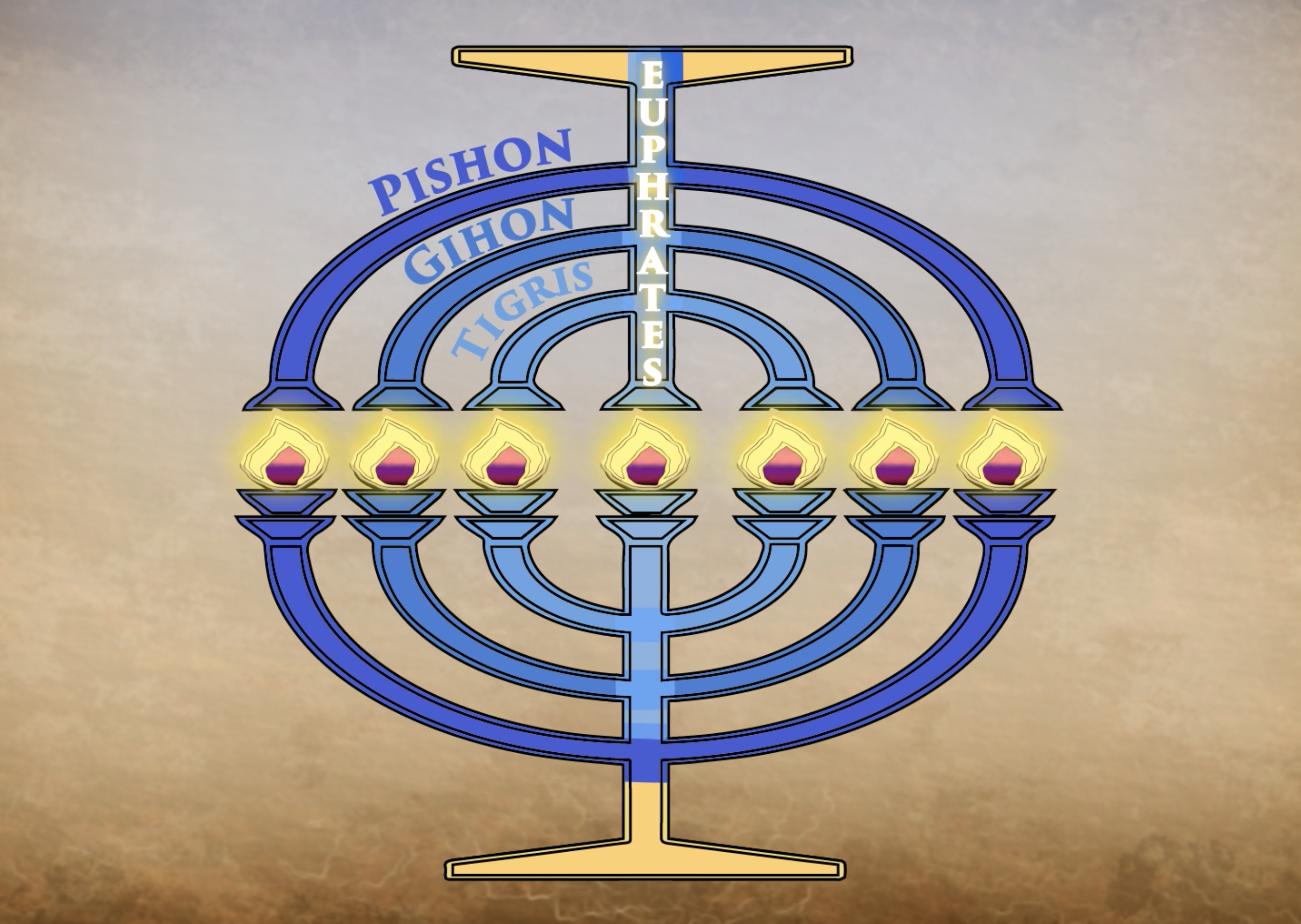
The rivers are given in the following order in Genesis chapter two: Pishon, Gihon, Tigris, and Perat (Euphrates). Every word, and every letter, is divinely placed in the Torah by the Holy Spirit. The order of the four rivers is no exception. Again, imagining a menorah, Pishon would be on the first branch, Gihon on the second, the Tigris on the third, and the Euphrates on the fourth branch. Since four represents the whole or seven, the first three rivers connect chiastically to their counterpart on the other side of the menorah. Creation Gospel students will understand this from their study in Workbook 1, but for clarity, look at this graphic:
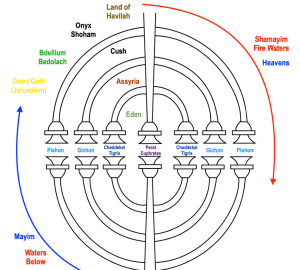
 

Notice how one and seven mirror one another as do two and six and three and five. Moreover, you can trace with your finger how they are indeed connected at the base; yet the source for them all is the Messiah or the River of Life. By the way, this “mirroring” or chiastic structure is also true for the seven days of creation, the seven Spirits of God, the seven feast days, and the many sevens found in the Book of Revelation. You can learn all about these fascinating truths by studying the Creation Gospel by Dr. Hollisa Alewine. If you are interested in joining a study group with a Trainer, email me at: kisha@graceintorah.net

Perhaps it is a little clearer now why Moses gave more information about the river Pishon than he did for the other three rivers. Looking at the graphic again, you can see how the Pishon encompasses the entire menorah as the outer shell or boundary, showing the complete or whole menorah. Before we move onto the meaning of the names
© The Creation Gospel, Hollisa Alewine

of each river and their significance, look at the graphic one more time. Now, imagine if there were a second menorah upside down on the top of this one. What would you see then? It would be a complete circle with smaller circles on the inside! Perhaps a wheel in the middle of a wheel? (That connection is a whole other study in itself.) For now, it is important to see the complete picture or the whole circle or cycle. In fact, two of the rivers of Eden are described with Hebrew words that mean to surround, encompass, and circle. For another example, google pictures of complete rainbows. They are a circle when viewed from an elevated (heavenly) perspective. On earth, we only see “half” of it – a “bow” that very much looks like a menorah with seven branches or colors. But a true rainbow makes a complete circle like the menorah on top of a menorah graphic above.

Euprates (Perat)

Do you recall from the beginning of this post how in Hebrew a river is not only water, but a mechanism for carrying light? Do you also remember the crystal clear waters flowing from the throne of God? (Dan. 7:10) Could these same “fiery” waters be life to the righteous and yet a “lake of fire” to the wicked? This is something to consider since the end has been declared from the beginning. Moreover, fire and water are paired together in multiple places in the Bible as symbols for God and for judgment.[1] For our study, consider that these waters from Eden are both flowing fire and water. Whether they burn or cleanse is determined by whether you are wicked or righteous. These flowing waters from Eden are like the Holy Spirit blowing and flowing around, among, and in His people. Like with Daniel and his companions, the fiery furnace of the Holy Spirit is a cool cleansing heat from heaven that protects the righteous, but burns the wicked.

Instead of starting with the first river listed in Genesis, we will begin with the last or what sits at the center of the menorah. This is the River Euphrates or in Hebrew Perat. The word perat comes from the word pri, or fruit. (You might recall the latter from the Kiddush blessing.) The source branch (river) on the menorah is meant to represent the Holy Spirit of Messiah. It is akin to the moed (feast) of Shavuot (Pentecost), the feast of first FRUITS.

The Bible doesn’t describe “how” the Perat flows, but the other three are described. Why? Perhaps this emphasizes the hidden action of the Holy Spirit. We cannot see Him, but we can feel His presence like the wind. Perat means “breaking forth.” Power and permanence are two words that would describe this river and the Holy Spirit. For now, think of Perat as the source, head, fruitfulness, and increase. The other rivers will reinforce these ideas.

Tigris (Cheddekel)

Moving to the third and fifth branches on the menorah, we come to the third river mentioned, the Tigris or in Hebrew, the Cheddekel. This river is said to be “going” or quite literally in Hebrew, “walking.” Creation Gospel students will draw the connection to the “running feet” of the birds and fish created on day five. Cheddekel means rapid, roaring, or noisy. This river isn’t a quiet, gentle stream – it is noisy and loud and fast moving! This should also remind you of the shouting and blowing of trumpets during the fifth feast of Rosh HaShanah that arouses sleepers from spiritual slumber and even from the grave in resurrection. Connected to this fifth branch is the third day and third feast when Yeshua rose from the grave with great power. Dry bones rattle and move as God brings them to life like the River Cheddekel!

Think of noisy movement, awakening from sleep, and (the Spirit of) power when you think of the Tigris.

Gihon (Gichon)

Again working toward the beginning, we next come to the River Gihon. It resides on the second and sixth branches on the menorah. Gihon means to burst forth, give birth, or to gush. In Hebrew, this river encompasses (savav) the whole land of Ethiopia (Cush). Do you see the circling or surrounding aspect of this river? Cush means dark or black. It can easily symbolize the darkness of burial as pictured in the Messiah’s burial during the days of Unleavened Bread. Moses, the one “drawn forth” from the water, married a Cushite woman. This is likened to the Torah being drawn from the eternal waters of Eden and the Bride being, “black, but comely.[2] We are truly in darkness until our bridegroom redeems us with His Light and Fire. Only then can we be portrayed with white linen like the High Priest wore on Yom Kippur. The surrounding flow of the Gihon washes and renews us like the watery grave of baptism, which are mirrored in the second and sixth feasts of Matzah and Yom Kippur.

Remember to associate the surrounding flow of the Gihon and its ability to transform from darkness to light like its gushing/birthing name implies.

Pishon

The Pishon sits on the outer edges of our menorah motif, correlating to branch one and seven. We are given more information about this river than all of the others combined. Seeing that it encompasses or surrounds the entire menorah, this isn’t surprising.

Within the Hebrew word Pishon, we have the idea of dispersing, spreading, scattering, or as Brown, Driver, and Briggs’ Hebrew Definitions notes for H6376, increases.[3] Notice that this river flows around (encompasses) the whole land of Havilah, where there is good gold, bdellium, and onyx.

Havilah and its root, chul, are defined as: to circle, twist, writhe, travail, dance, or whirl. Within this word is the idea of birth pangs and tribulation. But like the Israelites travail in Egypt, the more they were afflicted, the more they increased and spread out. This led to the birth of the nation of Israel in the exodus to the wilderness. These themes are associated with the first and last feasts of Pesach and Sukkot. Moreover, to make this connection even more apparent, the rabbinical teachings say that Pishon is synonymous with the Nile River in Egypt.[4]

But what is the point in telling us about the good gold, bdellium, and onyx?

Gold (Zahav)

I probably don’t have to reiterate what many have done before me in explaining the Biblical significance of gold. What Dr. Alewine astutely points out is that the text specifies that the gold is GOOD in Havilah. Why does this matter? Because for all the “good” symbolism the Bible has for refined gold, it does have a contranym (a word meaning its own opposite). Gold may very well represent heaven, spiritual wealth, and the removal of impurities, but conversely it can represent idolatry as seen in the golden calf or Nebuchadnezzar’s gold statue. The gold in Havilah was GOOD. In other words, like the pilgrimage festivals of Pesach, Shavuot, and Sukkot, the impurities of leaven and sin have been removed. There is no malice; the streams are pure and gather together the pilgrims to the Holy City of Gold: Jerusalem. (Ever hear the song Jerusalem of Gold?) And let’s not forget that the golden menorah we have been using as a model for all of our fours and sevens is also made from pure gold (Ex. 25).

Bdellium (Bedolach)

Bdellium is a fragrant gum much like myrrh. It comes from a thorn tree which produces a small particle of resin that appears to “tear” or liquefy when the sun (light) shines upon it. Does this description remind you of anything or anyone? Wasn’t Yeshua a sweet smelling aroma to the nostrils of His Father as He died on the tree? Did Yeshua not weep for us before His appointed time?

This special resin in Hebrew literally means to divide, separate, distinguish, or even be set apart. Day one and two of creation and the first two feasts of Pesach and Unleavened Bread mirror this separation process. Like the good gold, impurities are what need to be removed or separated. But this process isn’t GOOD unless it leads to gathering together of like kind and like mind as fulfilled in the Jerusalem of Gold. While this is a glorious prospect, it may also be painful as it requires the weeping tears of repentance to enter.

Rashi likened bedolach with crystal and its ability to take pure white light and separate it into the seven colors of the rainbow or visible light.[5] Can you see this same picture on the menorah? One source (Light) streaming into seven beautiful colors that surround the entire menorah like the light refracted from a prism.  Aren’t we told that there truly is such a rainbow encompassing the throne of God? (Rev. 4:3) Could this rainbow of Light be revealed in the seven festivals of gathering in Jerusalem? Is that not their purpose; to bring light unto His people and clear paths for them to walk in?

Dr. Alewine also points out that the manna from heaven had a white look and appeared as dew upon the ground. Have you ever seen light refracted in the tiny water droplets of dew? Do you suppose it was any different when the children of Israel picked their manna up every morning? Could this have been a reminder to the children of Israel of  the Throne of God and its rainbow canopy? In a sense, they were consuming both bread and light at the same time! After all, Yeshua is said to be both!

Onyx (Shoham)

Shoham comes from a word that means to “blanch” or “make white.” What an oxymoron! The onyx stone is usually black or dark in color. Spiritually speaking, this “whitening” is the process of sanctification or holiness. This idea is similar to the land of Cush mentioned earlier. Dr. Alewine compares this whitening to the “bleached” linen garments of the priests. These garments were made of shesh (shin, shin). Figuratively this connects the priests’ linen garments with man (six –shesh) and with fire (shin aysh).

Do you recall what the high priest wore on his shoulders? Yes, two onyx stones! These were connected to the breastplate by GOLD chains. When we are told that the government will rest on the shoulders of our Messiah (and High Priest), these onyx stones should come to mind. Engraved on these stones are the names of the twelve tribes of Israel. These are the holy ones that testify to Yeshua’s government of heaven and earth. And it is He alone that takes what was once inscribed in darkness and turns it into light. These will be robed in white, for they have washed their (dark) robes and made them white in the blood of the Lamb. (Rev. 7:14)

Is the River of Life pictured in the four rivers of Eden, the seven days of creation,  the seven Spirits of God, and the seven moedim (feast days) for Gentiles as well as Jews?

Rev 7:9-10  After these things I looked, and behold, a great multitude which no one could count, from every nation and all tribes and peoples and tongues, standing before the throne and before the Lamb, clothed in white robes, and palm branches were in their hands;  (10)  and they cry out with a loud voice, saying, “Salvation to our God who sits on the throne, and to the Lamb.”

Yes! Dr. Alewine points one to John 10:16.

“I have other sheep, which are not of this fold; I must bring them also, and they will hear My voice; and they will become one flock with one shepherd.

She goes on to say:

“Did Yeshua come to dismiss his Gentile flock from the appointed feasts? Did Yeshua come to create division between or among the folds at the appointed times, or did he come to make them one flock with one shepherd?” [6]

The rivers of Eden are one more testimony that from the beginning, YHWH has declared the end. The first letter of the Bible is an ENLARGED beht, meaning house or tent. From the onset of all things, the Father’s desire is to build and enlarge His House. Within the rivers and moedim (feast days) the good news of the gospel is proclaimed. This is the only place where the nations will find their healing and rest.

Conclusion

The rivers of Eden surround and flow around the creation days, feasts, spirits of God, and our menorah motif. But they are meant to flow and move through you and me too! By keeping the appointed times set by the Creator on day four, we are equipped to produce the good gold of Havilah (increase). This refining process is a sweet smelling aroma (bedolach) to our Father as we are proclaiming His government (onyx) throughout the earth.

Moving inward to the surrounding river of Gihon, the darkness (Cush/Ethiopia) is pierced as the sons of God prepare to burst forth in their unveiling. By the time the Tigris (Cheddekel) begins to flow through us, we are primed for new life and resurrection; because like the Tigris, we “walk” in the paths of the Creator. The gospel moves with rapid force throughout the earth.

Finally, the Perat (Euphrates) produces abundance and fruitfulness as a great multitude from every tribe and tongue wave palm branches at the great Feast of Sukkot in worship of the King of kings! These are those that will rejoice with the four living creatures under the rainbow canopy of God’s Throne. Below the Throne, the River of Life flows freely to nourish and cleanse the righteous with the cool fire waters of heaven. The wicked will experience the same flow of this river, but it will be unto them a lake of fire (judgment). The end is the beginning and the beginning is the end! Selah.


[1] Examples: Baptism of water and fire, earth destroyed with water and later with fire, God was a pillar of cloud (water) and a pillar of fire to Israelites in the desert, the Hebrew word for heavens is shemayim, a word that literally means “fire-water”, etc.

[2] See the Song of Songs 1:5 and Dr. Alewine’s Creation Gospel Workbook 5 Volume 1, p. 16

[3] Brown, Driver, and Briggs’ Hebrew Definitions: H6376 פּישׁון pee-shone’ From H6335; dispersive; Pishon, a river of Eden: – Pison.

H6335 פּוּשׁ poosh A primitive root; to spread; figuratively act proudly: – grow up, be grown fat, spread selves, be scattered.

[4] See Dr. Alewine’s Creation Gospel Workbook 5 Volume 1, pages 15 and 20.

[5] See Dr. Alewine’s Creation Gospel Workbook 5 Volume 1, p. 18.

[6] Dr. Alewine’s Creation Gospel Workbook 5 Volume 1, pages 34-35.

Categories: Biblical Symbols, Moedim, Torah Portions | Tags: , , , , , , , | 15 Comments

The Teaching of Balaam

This article was originally a Torah commentary. Because of the flow of the story, it actually involves three portions, Balak, Pinchas, and Mattot. You can see all the scripture references in this footnote.[1] The entire focus of this study is on the Teaching of Balaam. Thus, I felt it was better suited as topical article. I fully believe that the teachings of Balaam are alive and well in our assemblies and we are unaware. My desire here is to look at what the Word has to say on this subject so that we are empowered to remove this wickedness from our own hearts and assemblies. Those of you familiar with Dr. Alewine’s Creation Gospel model will also find this article helpful as it is the foundation behind my thinking.

The Story

Near the holy place, where the Ark dwelt, an Israelite sees a beautiful woman. Her eyes tell him everything he wants to know. He approached her; and as they say,

© Maryna Kriuchenko | Dreamstime.com

the rest is history.” Out of nowhere, a holy man named Pinchas bounds toward the couple with a spear raised high in the air. The couple, already in the throes of passion, doesn’t even see him coming. Pinchas releases the spear with great force and it skewers the couple like a human kabob; first the Israelite and then the woman beneath his naked body. The deadly plague grinds to a halt and the masses are spared.

Torah portion Balak ends like the scene out of a graphic action/drama movie. It’s pretty explicit, but that’s exactly how the drama is presented to us in the Hebrew text. This Bible story is definitely for mature audiences only!

Yet this brazen act by Pinchas not only stayed the plague that had broken out on the people, but earned him a permanent covenant of peace and a covenant of perpetual priesthood before YHWH. Wow. The seriousness of the peoples’ sin is illustrated by the harsh and detailed judgment mete out by Pinchas. Thankfully, we know who and what placed Israel in this position. Balaam could not curse what YHWH had blessed, but he sure knew how to work around the system or find the loopholes.

If you only read parsha Balak, it may not be very clear exactly what the prophet Balaam did that was horrible enough to earn him a name that is forever associated with wickedness. (Micah 6:5, 2 Peter 2:1-22, Jude 11, Revelation 2:14-15) After all, YHWH did let Balaam go to Balak and he only blessed the Children of Israel. Surely, there is more to this prophet than hearing a talking ass. So, what happened? We learn the rest of the story two portions later in Mattot.

Num. 31:15-16  And Moses said to them, “Have you spared all the women?  (16)  “Behold, these caused the sons of Israel, through the counsel of Balaam, to trespass against the LORD in the matter of Peor, so the plague was among the congregation of the LORD.

At some point in his dealings with Balak, Balaam gave him some wicked advise. The fees for divination and recognition are indeed a mighty snare. Balaam found a way (so he thought) to have his cake and eat it too. Balaam could truly hear the voice of YHWH, but he did not fear or reverence the Holy One. He obviously told the Midianite king how to get around the Word of YHWH. What do you do when you want to curse what God has blessed? You put a stumbling block before the other person’s feet; a temptation that is almost irresistible. And there has never been a greater temptation for a man than a scintillating woman.

Causing a brother or sister to stumble, especially on purpose, is equivalent to high treason in YHWH”s economy. Balaam may have earned the respect and the wealth of a pagan king, but YHWH brought judgment to his door rather swiftly. Again from Torah portion Mattot:

Num. 31:8  They killed the kings of Midian along with the rest of their slain: Evi and Rekem and Zur and Hur and Reba, the five kings of Midian; they also killed Balaam the son of Beor with the sword.

Jos 13:22  The sons of Israel also killed Balaam the son of Beor, the diviner, with the sword among the rest of their slain.

The Israelites ended up killing Balaam with the sword. Now, let’s fast forward all the way to Book of Revelation. Yeshua has some interesting things to say to the assembly at Pergamum.[2] This is a little lengthy, but I urge you to read each verse and notice the parallels of word usage.

Rev 2:12-17  “And to the angel of the church in Pergamum write: The One who has the sharp two-edged sword says this:  (13)  ‘I know where you dwell, where Satan’s throne is; and you hold fast My name, and did not deny My faith even in the days of Antipas, My witness, My faithful one, who was killed among you, where Satan dwells.  (14)  ‘But I have a few things against you, because you have there some who hold the teaching of Balaam, who kept teaching Balak to put a stumbling block before the sons of Israel, to eat things sacrificed to idols and to commit acts of immorality.  (15)  ‘So you also have some who in the same way hold the teaching of the Nicolaitans.  (16)  ‘Therefore repent; or else I am coming to you quickly, and I will make war against them with the sword of My mouth.  (17)  ‘He who has an ear, let him hear what the Spirit says to the churches. To him who overcomes, to him I will give some of the hidden manna, and I will give him a white stone, and a new name written on the stone which no one knows but he who receives it.’

What sort of judgment comes to our door when we go the way of Balaam? A quick and piercing double edged sword. The sword of Truth is in Yeshua’s mouth; it is the Holy Word of God.

Heb. 4:11-12  Therefore let us be diligent to enter that rest, so that no one will fall, through following the same example of disobedience.  (12)  For the word of God is living and active and sharper than any two-edged sword, and piercing as far as the division of soul and spirit, of both joints and marrow, and able to judge the thoughts and intentions of the heart.

The corrupt couple was pierced by the Word of YHWH (sword) by the hand of Pinchas. Balaam received the same judgment as those he placed a stumbling block before and it came swiftly. There was no mercy for either party. Wow, that all sounds so harsh. I’m not writing to put an unholy fear in your bones, but to point out the actual sin and penalty that occurred in these portions. The Holy One included quite few verses warning us about the teaching of Balaam; therefore, His desire is that we learn from these examples in order to avoid this type of judgment.

So, what did Balaam teach?

Yeshua says he taught the people to “eat food sacrificed to idols and to commit acts of immorality.” Fortunately, we have more clues given to us in 2 Peter and Jude.

2Pe 2:15-17  forsaking the right way, they have gone astray, having followed the way of Balaam, the son of Beor, who loved the wages of unrighteousness;  (16)  but he received a rebuke for his own transgression, for a mute donkey, speaking with a voice of a man, restrained the madness of the prophet.  (17)  These are springs without water and mists driven by a storm, for whom the black darkness has been reserved.

Balaam wanted a REWARD. He had a problem with a lust for recognition and wealth. This lust caused the prophet to try and profit off the people of YHWH. Let’s look at the metaphors that Peter uses to describe the followers of Balaam. What is a spring without water? It is a natural well that fails to give forth the waters of Life. Wells, springs, and water are all idioms for the Holy Spirit, Wisdom, and the righteous woman (Bride). In other words, there is indeed a spirit at play here; it’s just not the Holy Spirit. It brings death rather than life. Mists driven by a storm gives us a similar picture. Jude uses equivalent expressions in his warning; thus, the action/spirit we are to avoid is definitely cohesive in the minds of the writers of the Holy Bible.

Jude 1:11-13  Woe to them! For they have gone the way of Cain, and for pay they have rushed headlong into the error of Balaam, and perished in the rebellion of Korah.  (12)  These are the men who are hidden reefs in your love feasts when they feast with you without fear, caring for themselves; clouds without water, carried along by winds; autumn trees without fruit, doubly dead, uprooted;  (13)  wild waves of the sea, casting up their own shame like foam; wandering stars, for whom the black darkness has been reserved forever.

Again, we see that reward or pay is what drives the spirit of Balaam. But what is scary is that these followers of Balaam are not outside the assembly; they are in the midst of even our feast celebrations! These people lack sacrificial love and only really care for themselves. Like Peter, Jude compares them to something that should bring life and water, but they do not. They are “clouds without water”. Instead of being driven by the wind of the Ruach HaKodesh, they are powered by another wind/spirit. Thus, they are incapable of producing holy fruit. They are not the “stars” of Abraham’s seed; in fact, they are the tares among the wheat — ready to be burned and reserved for black darkness.

So, if all this is true, we should be able to pick a follower of Balaam out in heartbeat, right? Wrong. If it were that easy, there would be no need for all the warnings given to us in Scripture. I believe there is a very specific reason why it is so difficult. And, most of you won’t like my answer. The difficulty we have, or you might say our lack of discernment in this area, is because we each struggle with the same temptations that are encompassed in Balaam. I will let Jude explain:

Jude 1:14- 19 (14)  It was also about these men that Enoch, in the seventh generation from Adam, prophesied, saying, “Behold, the Lord came with many thousands of His holy ones,  (15)  to execute judgment upon all, and to convict all the ungodly of all their ungodly deeds which they have done in an ungodly way, and of all the harsh things which ungodly sinners have spoken against Him.”  (16)  These are grumblers, finding fault, following after their own lusts; they speak arrogantly, flattering people for the sake of gaining an advantage.  (17)  But you, beloved, ought to remember the words that were spoken beforehand by the apostles of our Lord Jesus Christ,  (18)  that they were saying to you, “In the last time there will be mockers, following after their own ungodly lusts.”  (19)  These are the ones who cause divisions, worldly-minded, devoid of the Spirit.

I don’t know about you, but I’ve ran into many grumblers, fault finders, and divisions in those groups returning to YHWH’s Torah. As a matter of fact, I have to admit that in my earlier years of this walk, I even participated in such things all in the name of holiness. I know it’s terrible, but it’s the sad truth. At the time, I would have thought I was anything but a follower of Balaam!

What I have learned (and often write about) is this very dichotomy between the Truth and a Lie. Between a man and the beast. Between the harlot and the righteous woman. Between the Spirit and the flesh/evil inclination or a wicked spirit. Between a Prophet and a Diviner. Between a Sheep and Goat. Between the Wheat and Tare. You get the point. As it turns out, the difference is often “subtle” and the battle ground is most often within — not outside of a person.

Close, But No Cigar

There are seven wicked spirits that counterfeit the seven holy spirits of YHWH (Pr. 6:16-19, Is. 11:2). In Holy Writ, we are constantly forced to deal with two brothers, two women, two houses, two “ways”. One is always righteous and one is always wicked. Nevertheless, they often can be found in the same places, doing similar things, wearing similar clothes, and calling to the same people. King Solomon the Wise, tried in earnest to teach his son and us this very simple truth. The enemy truly masquerades as an angel of light. (2 Cor. 11:14)

But what is not always immediately apparent is that this duplicity is within us! Overt wickedness is easy to detect if you know the Word. But, a heart set on self-righteousness, pride, and grandeur is not always so obvious. This is because we cannot escape our flesh or nephesh — the part of us that is shared with the beasts of field. Like them, we have instincts and a desire to survive at all costs. We get hungry, thirsty, tired, and sexually aroused and seek to gratify these appetites. At our core, the flesh seeks to preserve self.

Contrary to the old Greek philosophers, this does not mean that the nephesh is evil. It serves a godly purpose even in the lives of a holy people. Without it, we’d be no earthly good. We must eat, drink, sleep, and procreate or our species would die off. But, these passions are not to be what rules a child of the Most High; the Holy Spirit must sit at the helm of our ships.

Balaam was ruled by an unholy spirit fueled by his flesh/nehpesh. Though there was a part of him that could hear YHWH’s voice, the desire to please his own desires was much stronger. Have you ever “given in” to the desires of your flesh? I know I have and sadly sometimes still do. No one is exempt from this dilemma. It is a daily battle.

Let’s take the story of Balaam for example. How many of you read this story, realized the utter wickedness of his actions, and associated YOURSELF with Balaam? I would gander that very few, if any, of you did. Our nephesh always makes excuses or justifies its actions. It’s never wrong in its own eyes. This is why it’s so hard to come to a place of repentance or even “hear” the gospel unto salvation. The flesh is always concerned that it will be uncomfortable, restricted, or robbed of pleasure and fun.

The real lesson we are to learn from Balaam is to recognize these “negative” attributes in ourselves, correct them, and help others to do the same. The Bible brings correction, but it is mostly to us as individuals. Rarely is our job to point the finger at another. There is a time for this (which we see in Pinchas), but having a burning desire to do so more often exposes a nephesh ruled person. The nephesh always wants negative attention to be on someone else, because self-preservation is all it really cares about.

Thus, I put together the following chart for your personal introspection. If all you can “see” when perusing it is someone else’s sin, then you’ve just revealed the one seated on the throne of your heart. Here’s a clue, it’s not the Holy Spirit; it is the beast (nephesh). But fret not, you are not alone. Kick the beast down and bring it into obedience to the Ruach HaKodesh!

Balaam/Beast                                                                   vs.                             Holy Spirit/Man

Lusts for profit


Seeks to produce godly fruit


Desires recognition from others


Seeks to please YHWH


Looks for loopholes to obedience


Hears and obeys because of love


Urges others to compromise or conversely to be rigid and merciless (in the name of holiness) Strong sensations of either greasy grace, or a controlling Torah Terrorist. Extremist on either side of the scale.
Urges others to obey, but is tempered with compassion, mercy, and patience. Constantly seeking balance in all things. Allows freedom within the boundaries of Torah.

Killed by the Sword


Lays flesh on the altar by allowing the Sword of the Word to purify the heart.


Tries to get YHWH do go along with his desires/will.


Accepts the will of the Sovereign of the Universe and knows it is best even if it hurts.


Appears righteous (clouds without rain)


Does righteousness (joins the great cloud of witnesses)


Speaks blessings to others, but counsels curses in the dark.


Speaks blessings to others and means it.


Hears and turns into the way of the harlot.


Hears and turns into the way of wisdom (righteous woman).


Takes pleasure in immorality. May even participate behind closed doors. (hidden/dark)


Runs from immorality. (Like Joseph)


Uses flattery for personal gain/promotion.


Speaks truth, allows YHWH to promote them.


Grumbles and Complains (gossip/slander) which drags others into their derision against people, leadership, and assemblies. This happens under the banner of no compromise, holiness, and righteousness.


Turns from gossip/slander/lashon Hara. Knows that complaining about the way things are done, the leadership, other people, or families is only following the way of Cain, Korah, and Balaam.


Brings strife and division as a result of the above. Seeks to attract others unto themselves. Desires cookie cutter versions of belief and thought with Self as the head. They split and divide families, friends, and assemblies in the name of holiness. No unity. The house is continually being torn down. New group often latter splits again as a result of the same spirit at work. Strong sensation of feeling unwelcome, unholy, and condemnation. Run!


Seeks mercy, compassion, loving-kindness, and patience with family, friends, leadership, and assembly. Manages to disciple and mature new comers rather than condemn them for ignorance in matters of obedience. Seeks to build others up. (A wise woman builds her house) There is an overt sense of love, belonging, and warmness in these groups. Critical and judgmental spirits are not welcome.


Loves the wages of unrighteousness. Loves being right. Loves putting others in “their place”. Looks for ways to profit from the sheep.


Loves YHWH and the Body. Seeks to produce the fruit of the Spirit: love, joy, peace, patience, kindness, goodness, faithfulness, gentleness, and self-control.


In a nutshell, Balaam teaches you to turn in to the house of the harlot[3] by appeasing the appetites of the flesh. What feels good and right is truth to a Balaam. Going the way of Balaam is serving or demanding to have your own preferences, desires, wants, and gain. It is the opposite of a humble, caring, patient, and loving servant of the Most High.

If we recognize the teaching of Balaam in our own lives (no matter how miniscule), we need to repent and put YHWH back on the throne of our hearts. I have found a great tool that helps me to keep the “beast” or nephesh/flesh in its proper place. That tool is the Jewish practice of Mussar. If you’ve ever used a Chesbon Nephesh (accounting of the Soul) chart to help you find hidden or forgotten sin in your life before Yom Kippur, then you have had a tiny taste of Mussar.

Mussar means correction and is a simple daily practice that guides you to develop or strengthen godly traits such as gratitude, compassion, honor, simplicity, generosity, loving-kindness, responsibility, trust, faith, etc. It only takes a few minutes a day, but the payoff is immense! Hopefully by now, you have a much better understanding of what the teaching of Balaam actually was/is. In closing, I will link to some Mussar resources that are sure to keep Balaam at bay! Don’t wait until you have to hear it from an ass…

Websites:

Riverton Mussar

Aish.org 

Books:

Everyday Holiness by Dr. Alan Morinis

Mussar with the Messiah by Vickie Howard

Expect to see more articles from me on the teachings of mussar in the future. (:


[1] Balak: Num. 22:2- 25:9; Micah 5:6- 6:8; 2Pet. 2:1-22; Jude 11; Rev. 2:14-15

Pinchas: Num. 25:10- 29:40; 1 Kings 18:46-19:21; Ps. 106; John 2:13-22

Mattot: Num. 30:1 -32:42, Jer. 1:1- 2:3, Mt. 5:33-37

[2] Note to Creation Gospel students: Notice that Pergamum is the 2nd assembly. It is on the stem of “separation”. The question becomes, separated unto what? Balaam causes separation unto division — leading to death. We know that separation is only good if it leads to gathering like the third day of creation and the spirit of resurrection.  We see this same picture with the sharp double edged sword. The Word separates the righteous unto life and the wicked, like Balaam, unto death.

[3] Proverbs 7

Categories: Messianic Issues, Torah Portions | Tags: , , , , , , , , | 7 Comments

Torah Portion: Emor

© Ampersandmiami | Dreamstime.com

“Speak”

Lev. 21:1- 24:23; Rom. 7-8

Holiness Laws

This portion continues from last week with the instructions in holiness (or set apartness) to YHWH. There is a definite escalation that takes place as YHWH gives these commands to Moses. Last week in Kedoshim,[1] the laws of holiness began with the people in general. The entire camp of Israel is to be holy to YHWH.

Lev. 19:2  “Speak to all the congregation of the sons of Israel and say to them, ‘You shall be holy, for I the LORD your God am holy.”

But as the text moves forward, the sphere and requirements for holiness becomes more exacting and severe. In Emor, we learn that the Levite line is expected to live a stricter lifestyle than the other tribes. But within this restricted circle, we find that the kohanim (priesthood) must lead and live by the most stringent manner of all Israel. In other words, there are levels to holiness. It’s not that one is better than the other; it’s that YHWH has different expectations for those that serve His people and His House. Those expectations (instructions, commandments) are more stern than those He gives for the average Joe (Israelite). This reminds me of James (Ya’akov’s) warning to those that teach the Word.

Jam. 3:1  Let not many of you become teachers, my brethren, knowing that as such we will incur a stricter judgment.

The accountability and expectations are higher for one that ministers to the body in matters of worship, teaching, and counsel. It seems as though those that are a “mouth” or mediator (priest) in the body are meant to live by a stricter standard. On the one hand, we are all called to be holy and servants of YHWH. On the other hand, those that have more influence on the masses, no matter the role, will be judged more stringently. This is because their actions directly affect multiple people (as did the Levites and the priests). People look up to, watch and mimic their leaders. This makes even me, a blog poster, shutter with awe and renewed vision to be diligent and cautious with my words.


Holiness Defined

Exactly what is it that makes us holy (kadosh)? Unlike the English word holy, being kadosh is simply the state of being set apart (from all the rest) for a special function. Thus, you can be set apart for something good or something wicked. This is why the same Hebrew word can be used for a harlot and holy ones. (qof, dalet, shin) You see, a harlot is set apart to fulfill their special function. What we are called to be is set apart unto YHWH. This requires us to walk as He instructs; not as we feel, not as we deem appropriate, and not as someone else suggests. And the requirements aren’t too difficult for us. They are near to us; and if we’ve been born from above, they are in our hearts and in our mouths.

Dt. 30:11-16  “For this commandment which I command you today is not too difficult for you, nor is it out of reach.  (12)  “It is not in heaven, that you should say, ‘Who will go up to heaven for us to get it for us and make us hear it, that we may observe it?’  (13)  “Nor is it beyond the sea, that you should say, ‘Who will cross the sea for us to get it for us and make us hear it, that we may observe it?’  (14)  “But the word is very near you, in your mouth and in your heart, that you may observe it.  (15)  “See, I have set before you today life and prosperity, and death and adversity;  (16)  in that I command you today to love the LORD your God, to walk in His ways and to keep His commandments and His statutes and His judgments, that you may live and multiply, and that the LORD your God may bless you in the land where you are entering to possess it.

Since the last two week’s portions give us specific instructions in holiness, you may come away from reading them thinking, “Without the Levitical Priesthood and the Temple, how is it possible to follow these commandments?” While it is true that these sections often speak directly to the Temple and Priesthood, there are plenty of instructions that we can observe physically and others we can seek to uphold spiritually. Without a Temple or functioning Levitical Priesthood however, there are numerous commandments that we simply cannot keep. (This eliminates quite a chunk from the 613 if you’re keeping count.)

For example, reverencing your mother and father and keeping YHWH’s Sabbath’s (Lev. 19:3) do not require a Temple. But, offering an animal sacrifice in any way other than the manner described would be a sin itself. These types of physical sacrifices require a Priesthood and Temple.

However, we CAN look at the sacrifices of our lips and deeds. Are they being offered without blemish or defect? In this way, we can still hold to the “heart” of these instructions and see that they are in fact applicable to us in a different way. The point is not to “skim over” these issues because they appear to be foreign or outdated. I assure you that the Word of YHWH is never invalid or archaic! Our peon brains and lustful flesh may desire to sweep all these particulars under the rug, but be careful where you stand, lest you fall!

Our loving Elohim (God) is Good. His Word, Commandments, and Statutes are also Good. And they are, if anything, spiritual!

Rom. 7:14  For we know that the Law is spiritual, but I am of flesh, sold into bondage to sin.

The real scary truth about holiness is that you can be holy and just not be set apart unto YHWH. If you are ruled by your flesh, you will disregard the Creator’s Commandments. Flesh prefers the bondage of sin. And we ALL have flesh! So, in this state, we are set-apart (made holy) unto sin, death, and destruction. While it seems crazy to think that anyone would choose this type of holiness (which is harlotry), multitudes do it every day. I still have many areas that need improvement and if you are honest, you do too! This is why we need the Torah so badly! How can we change or improve if we won’t read and heed the instructions? How do we know the depth of our depravity unless we are shown with the Light of the Word? As Paul says in the same passage as above, “Who will set me free from the body of this death?” (Rom. 7:24)

Paul clearly illustrates the quandary common to all of mankind. The Law of YHWH is holy and good and teaches us how to bear proper fruit. (Rom. 7:4-5, 7:12-13) But it becomes evident that there is more than one law at work in our members. On the one hand there is the Law of God showing us what sin is. On the other hand, there is the Law of Sin that wages war against the good we know to do.

Rom. 7:21-23  I find then the principle that evil is present in me, the one who wants to do good.  (22)  For I joyfully concur with the law of God in the inner man,  (23)  but I see a different law in the members of my body, waging war against the law of my mind and making me a prisoner of the law of sin which is in my members.

Praise Yah for the blood of Messiah Yeshua! He has made the way for us to be set free from the Law of Sin. (Rom. 8:1-4) Are you free from sin? Or is there still a war waging in your members? I freely admit that the war wages on in my life. I must battle my flesh (nephesh) every single day. However, I’ve actually met “believers” that claim that they no longer sin. Not surprisingly, it was obvious just in conversation that the war wages on in their lives as well —- though they deny it.

Denying the battle would certainly strip you of your armor and weaken your faith. You would have to be wondering what the hell was going on in your life all the time. Because it would indeed be “hell”, and you’d be losing! You might even accuse Yeshua of not holding up His end of the deal (Yah Forbid!) This was the evidence I saw in the couple that claimed to be “free from sin”. A devastating circumstance had happened in their lives. The woman was so overcome with grief that she sat in the kitchen of a stranger (me) and cried —- searching for an answer. She was vulnerable and under great condemnation. Which ironically, is spoken about in the verse preceding their “pet” proof text.

Rom. 8:1-2  Therefore there is now no condemnation for those who are in Christ Jesus.  (2)  For the law of the Spirit of life in Christ Jesus has set you free from the law of sin and of death.

Are you living in condemnation? If you are in Messiah and feel overwhelmed, overcome, defeated, or condemned, your flesh (nephesh) is at the helm of your ship! Choose Life! You have every tool you need to fight this battle. Quit letting your mind, feelings, and flesh dictate your emotional state and daily life. We are NOT called to be ruled by the beast (our flesh), but by the Spirit of the Living Elohim (God)! This is what being holy is all about. CHOOSE, on purpose, to get back on the path whether you lost your way, took a wrong turn, or someone kicked you to the curb. Persevere!


Slaying the Beast

Slaying the beast (the flesh) is easier said than done, especially if it has had uncontested reign for a long time. Sadly, most believers are not ruled by the Spirit. This is why we have so many problems such as strife, envy, backbiting, jealousy, lust, divisions, slander, and gossip within the body and in our assemblies. This is also why there is a lack of love, mercy, kindness, humility, patience, gratitude, order, honor, and responsibility. We are like the beasts of the field doing what comes natural to our flesh and demanding that everyone around us accept that this is just the way we are. Or equally as repulsive, we may expect those around us to cater to our poor, pitiful, and pathetic life —- yet we wouldn’t dare to lift a finger to change our mindset, emotions, or estate. Flesh likes attention any way it can get it. CHOOSE differently!

I apologize if my words are harsh, but this message is “a burning in my bones!”[2] We ARE supposed to be overcomers! We are to walk in the Light and not in the darkness. We need to learn how to truly walk in the Spirit. We need to learn how to think like the Spirit. We need to act like the Spirit! Believe it or not, the choice is ours to make every single day.

One sure fire way to determine whether the beast (your flesh) or the Spirit is sitting on the throne is to evaluate your thought and conversational life.

Rom. 8:5-8 For those who are according to the flesh set their minds on the things of the flesh, but those who are according to the Spirit, the things of the Spirit.  (6)  For the mind set on the flesh is death, but the mind set on the Spirit is life and peace,  (7)  because the mind set on the flesh is hostile toward God; for it does not subject itself to the law of God, for it is not even able to do so,  (8)  and those who are in the flesh cannot please God. 

Where is your mind? What things do you think on? What sort of things do you talk about or “dwell” on? Are you victorious or are you defeated? The flesh is HOSTILE to the Law of God. The flesh is focused on SELF. Me, myself, and I. (My, my, my.) What is one of the first words of child? “MINE!”

Dear one, the biggest battle you will ever fight is with YOURSELF. (And it’s a daily war!) Outside circumstances and people are just that. They are “outside.” You have no control over them. And you never have. And you never will. There is only ONE thing you are supposed to take control of: YOUR NEPHESH (flesh).

Can you imagine how different our homes, families, and assemblies would be if we stopped trying to control other people and our circumstances? What if instead of complaining about so-in-so or our lot in life we CHOSE to do something about our own outlook, disposition, and actions. What if we chose to actually REJOICE in all things?[3] If we did this, do you think we would have all the hurt, strife, and division that we currently see?


Burning Flesh on the Altar

© Maryna Kriuchenko | Dreamstime.com

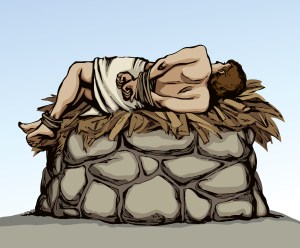
Have you ever noticed that most of the sacrifices were flesh and blood beasts (clean animals)? I’m sure you have. Mankind and beasts were both created on day 6 of creation.[4] Therefore, the number of man and the number of the beast are both 6. Have you ever considered that we share a lot of commonalties with these beasts of the field? After all, within the sacrificial system they are dying in the place of us! What can we learn from this? We have some flesh that NEEDS to be placed on the altar. And this process needs to take place on a DAILY basis.

But the flesh doesn’t want to die. It rebels. It rebukes. It makes excuses. It justifies. It throws tantrums. It runs. It hides. Your flesh will do just about anything to keep itself on the throne. One of its preferred tactics is to blame anyone, but itself. It’s all somebody else’s fault that I’m this way or that I did this or that. “If only” is also a favored phrase. “If only I had this or if s/he would do that, then… then I’ll be happy. Then, I’ll be satisfied.” Beloved, the flesh is NEVER satisfied. It cannot be satiated. There is always another dangling carrot for it to aimlessly chase.

I want to slay this beast and lay it on the altar. Though I know it will hurt and it won’t “feel” good, I want the fat to burn up in smoke as a sweet smelling aroma before my Adonai and King. I know that you do too! Let’s do it together!

So in light of all this, what do you think the tests, trials, and tribulations in life are all about? What about all those hard-to-deal-with people? They each are an opportunity for YOU to offer your beast (your flesh) upon the Holy Altar. By choosing to slay the beast, you are gaining LIFE!

Rom. 8:10-11  If Christ is in you, though the body is dead because of sin, yet the spirit is alive because of righteousness.  (11)  But if the Spirit of Him who raised Jesus from the dead dwells in you, He who raised Christ Jesus from the dead will also give life to your mortal bodies through His Spirit who dwells in you.

Too many of us only really look inward occasionally. Maybe at one of the appointed times. Maybe after a test has knocked us off our high horse. But, the flesh was offered on the altar EVERYDAY. I think the biggest stumbling block we have is that we look “outside” of ourselves all the time. Yes, our eyes are like marbles rolling here and there. We look at people and circumstances. We may even look at our “outward” obedience and check it often. But, we fail where it matters most. We fail to discern the difference between the man and the beast, which is the Spirit of the Living God.


Back to Emor

This was supposed to be a Torah commentary on Emor. Holiness in the Priesthood. The Holy Moedim (Feast Days). The Holy Menorah. But none of this matters if we have no self-control. Holiness requires reverence. A selfish (flesh ruled) person only reverences himself.

2Cor. 7:1 Therefore, having these promises, beloved, let us cleanse ourselves from all defilement of flesh and spirit, perfecting holiness in the fear of God.

We can either have it our way or His Way. To fear the LORD is the beginning of wisdom. If we want to be a holy vessel, we must empty ourselves and be filled with the Spirit of God. Both the outside AND the inside must be clean. And our “flesh” (inside) can NEVER please Him.[5] I think the reason I’ve been “stuck” in Romans 7-8 while trying to study and write on Emor is no accident.

Emor shows us what holiness looks like on the outside. If we look closely, we will also see that it shows us the inside as well. The calendar you keep will inevitably govern your day to day life. Leviticus 23 clearly outlines the appointed times and Sabbaths of the Creator. Most people would prefer the world’s calendar —- it “appears” easier because everyone is doing it. Others go to the other extreme and set out to “find” the perfected calendar of YHWH. (Can you just hear their pompous flesh demanding to be elevated for such a lofty discovery? Can you also hear their flesh condemning everyone else who isn’t as right as they are? You will know them by their fruit.) Thus, even Torah keepers can become “good” at keeping the outside of the cup clean while the inside is full of filth and abominations.

We are to be salt and light. The holy menorah should be burning within us! If so, the trials and tribulations of life will press and crush us like an olive and give way to pure oil that will keep the heavenly lamp aish tamid (burning eternally). And like the daily sacrifice, it must be tended to every morning and every evening. If we neglect this duty, the holy lamp will burn low and the fiery heat of our (unslain) nephesh will grow stronger instead.

Perhaps this is why Emor ends on a rather tragic note. An Israelite’s son blasphemed the Name of Adonai. At first glance, it seems as though this story is misplaced. But alas, it is a prime example of what happens when we fail to reverence God. When we fail to offer our flesh on the altar. When we fail to be governed by the Creator’s calendar. When we fail to tend the holy menorah.

Lev. 24:22-23  ‘There shall be one standard for you; it shall be for the stranger as well as the native, for I am the LORD your God.‘”  (23)  Then Moses spoke to the sons of Israel, and they brought the one who had cursed outside the camp and stoned him with stones. Thus the sons of Israel did, just as the LORD had commanded Moses.

There is one standard, one mishpat. In Hebrew, this word is “judgment”. There is one judgment for blasphemers. One verdict. Only someone acting out in the flesh could commit such a crime. In fact, verses 15-21 give us some examples of what type of behavior is being dealt with in this passage. Most of these deal with mistreating your fellowman and his property. So even here, we can see the underlining heart of the matter: to love Adonai and love our neighbor. The Torah teaches us how to do both. The flesh desires to do neither; instead it wants only to pleasure itself.

So, how does one become holy? It’s more than “Jesus makes me holy.” Yeshua certainly sets us apart when we accept Him as Lord and Savior. But if we CHOOSE to remain in the flesh, well then that’s our choice. Freewill doesn’t disappear when you make a confession of faith. Real holiness is separating your flesh from the throne and laying it on the altar of our holy Elohim! It is a choice.

  “You shall be holy, for I, Adonai your God, am holy.”


[1] Lev. 19:1- 20:27

[2] Jer. 20:9  But if I say, “I will not remember Him Or speak anymore in His name,” Then in my heart it becomes like a burning fire Shut up in my bones; And I am weary of holding it in, And I cannot endure it.

[3] Philippians 4:4

[4] For a detailed look at the flesh, nephesh, and the beast, please see Dr. Hollisa Alewine’s complete works in the Creation Gospel series of workbooks. Much of my insight into these analogies have been gleaned by her anointed work and ministry to YHWH’s people.

[5] Rom. 8:8  and those who are in the flesh cannot please God.


Categories: Torah Portions | Tags: , , , | 4 Comments

Deborah the Bee Part I

© Wirakorn Deelert | Dreamstime.com

The Hebrew word for bee is Devorah (Deborah). This is also the feminine form of the word davar (literally: Word). Another derivative from this Hebrew root is midbar or wilderness. Jeff Benner has this to say about our root word:

The root word is ‘davar’ and is most frequently translated as a thing or a word. The original picture painted by this word to the Hebrews is the arrangement of things to create order. Speech is an ordered arrangement of words. In the ancient Hebrew mind words are ‘things’ and are just as ‘real’ as food or other ‘things’. When a word is spoken to another it is ‘placed in the ears’ no different than when food is given to another it is ‘placed in the mouth’. The Hebrew name Devorah (Deborah) means ‘bee’ and is the feminine form of the word davar. Bees are a community of insects which live in a perfectly ordered arrangement. The word ‘midvar’ meaning wilderness is actually a place that exists as a perfectly arranged order as its ecosystem is in harmony and balance.[1]

Bees are fascinating little creatures. The structure of their colonies are perfectly ordered much like the wilderness and the Word of God. The pollination that they provide for our crops is vital to our very survival. Is it any wonder that Adonai chose the humble honey bee as a natural picture of His spiritual Torah? Both provide Life! Even more interesting is that while the bee is an unclean insect, the sticky sweet honey that they produce is not.

Perhaps that is because we are supposed to be similar to a bee. We should be building the house (colony) in unity and with order. Moreover, much of the time we are ritually unclean and/or spiritually unclean due to sin. Nevertheless, we are told to remedy our dilemma by the cleansing of the blood of the Lamb. Once we do, we can venture into the fields like the worker bees to build the Kingdom by gathering pollen from the flowers of the earth. Our efforts should produce golden sweet honey that attracts all the “whosoevers,” which is living the Word with love.

Ironically, as the world slips further away from the Creator’s Word and closer to death, the natural honey bee population is also dying.[2] This should cause us great concern because bees are directly responsible for one out of every three bites of food that you ingest![3]

“If the bee disappeared off the face of the earth, 
man would only have four years left to live.” 
― Maurice Maeterlinck, The Life of the Bee

We need to be praying not only for our nation and the world to turn back to Adonai, but also for the survival of the honey bee. But this post isn’t about the physical bee as much as it is about the spiritual picture that they represent.

Deborah the Bee and Nurse

The Book of Judges enumerates the most well-known biblical woman with the name Deborah, but before we explore her story, there is another more obscure Deborah mentioned in the Torah that I’d like to highlight. The reference is in the middle of the passage below. Please read all five verses so you can see the beauty of the context.

Gen. 35:6-10 So Jacob came to Luz (that is, Bethel), which is in the land of Canaan, he and all the people who were with him. (7) He built an altar there, and called the place El-bethel, because there God had revealed Himself to him when he fled from his brother. (8) Now Deborah, Rebekah’s nurse, died, and she was buried below Bethel under the oak; it was named Allon-bacuth. (9) Then God appeared to Jacob again when he came from Paddan-aram, and He blessed him. (10) God said to him, “Your name is Jacob; You shall no longer be called Jacob, But Israel shall be your name.” Thus He called him Israel.

This isn’t the only reference to Deborah the nurse of Rebekah. She makes a brief appearance in Genesis 24 when Abraham’s servant finds Isaac’s wife, Rebekah, at the well. When her family sends her away to marry Issac, she doesn’t go alone. They send her nurse, Deborah, with her.

Gen. 24:59 Thus they sent away their sister Rebekah and her nurse with Abraham’s servant and his men.

Though the nurse isn’t named in this passage, most of the Christian and Jewish commentaries[4] that I referenced believe that this nurse was none other than the Deborah mentioned a little later in Genesis 35. Rashi cites a tradition that Rebekah had sent Deborah to Aram to tell Jacob that it was now safe to return.[5] I find this interesting given the name of the Torah Portion this passage is found in: Vayishlach “And He Sent” (Gen. 32:4-36:43).

Genesis 35[6] comes after Jacob wrestled all night with the “angel,” his reunion with Esau, and Dinah’s violation by Shechem. Jacob has literally gone from the “fire” to the “frying pan” and back again. Life is hard. He has made both good and bad decisions and is living the consequences. Adonai tells him to return to Bethel (House of God) and build an altar. Bethel is where Adonai first revealed Himself to Jacob. It is as if Adonai is bringing Jacob full circle.

At this point in the narrative, the story is interrupted by a blurb about the nurse named Deborah. We are not given much information about her life, but the fact that the Torah mentions her at all is very telling. Deborah was Rebekah’s nurse; Rebekah is Jacob’s mother. Apparently, Deborah had been with Jacob all these years at her request. As a nurse, Deborah would have been a nurturer to Jacob, his wives, and his children. It is doubtful that this woman was married and had children of her own. Instead, she lived a life devoted to Abraham’s seed. She was like one of the worker bees ensuring the survival of the colony. I believe that Rebekah sent her nurse to watch over Jacob and to ensure his prophetic future.

Once Adonai brings Jacob back to where their relationship began, Deborah dies.[7] The importance of her role is revealed in the place and name of where she was buried: Allon-Bacuth. She’s buried under an oak tree in the land of Bethel. The people called this place “The Oak of Weeping/Mourning.” I can only imagine that for Deborah to have a permanent mention in the Torah that she was indeed a Mighty Oak in the eyes of the family. She was no mere nurse or servant. Her name implies hard diligent service in producing the sweet honey of the WORD.

Before Jacob returnsed to Bethel, he was a little reckless and immature. A person with a nature such as this needs a counselor, a guide, a helper, and a nurturer. Though the Torah doesn’t explicitly state that Deborah embodied these things to Jacob, I believe the “hints” are undeniable. Let’s look at some of the imagery.

  • Deborah = bee (busy/unity) and Word (as in Word of Elohim).
  • Nurse = (yanaq) to give milk or sustenance to the immature.
  • Oak = tree (etz) and counsel (etzah) trees are pictures of counsel and the righteous.
  • Bethel = House of El (God).

The nurse Deborah is greatly mourned because she was a mother figure, teacher of the Word, and counselor to Jacob and his family. As a woman of valor,[8] she had been a picture of the gentle guidance of the Holy Spirit in the lives of young Israel.

When Adonai brought Jacob’s life full circle, he was more mature and ready for the stronger boundaries of the Father. After Deborah dies, Adonai  “appeared” to Jacob again to reestablish the Promise and Covenant. Jacob’s sojourning had prepared him for this day. The change in his nature is marked by the change of his name. He is no longer a supplanter or heel catcher;[9] he is Israel (One who struggles/overcomes with God). As such, he no longer needed his mother’s Torah[10] (the imagery of Deborah); he was ready to walk with his Father. Nevertheless, this process is bittersweet. In this Torah Portion[11] where Deborah meets her demise, Rachel and Isaac also pass away. Thus, Jacob’s promotion comes on the heels of losing a mother figure[12], his beloved wife, and his earthly father.


Meanwhile, Back at the Hive

© Wolfhound911 | Dreamstime.com

The heart of any beehive is its queen. The hive does not exist without her. She literally builds the colony as “a wise woman builds her house.”[13] The queen releases pheromones (an aroma) that keeps the hive thriving and humming in unison. This is like the aroma of the anointing oil, and the Holy Spirit. This sweet fragrance should also be discernible on us when we meet others. I’m not one to read many Bibles that “paraphrase” the Scriptures, but I couldn’t resist these verses:

2Co 2:14-15 I am grateful that God always makes it possible for Christ to lead us to victory. God also helps us spread the knowledge about Christ everywhere, and this knowledge is like the smell of perfume. (15) In fact, God thinks of us as a perfume that brings Christ to everyone. For people who are being saved, this perfume has a sweet smell and leads them to a better life… (CEV)

I happen to follow a blog that is all about bee keeping or apiculture. Recently, an article caught my attention, but for far different reasons than the author intended. The name of the post is Roar of a Queenless Hive.[14] The bee keeper had inadvertently removed a panel from one of his hives that had a queen on it. After a few minutes, the hive began to roar with chaos and loud buzzing. He knew that he must have mistakenly removed the queen which sent the hive into a panic. His point was to warn fellow bee keepers of making the same mistake and to “listen” as well as “look” at their hives. But it was his words that really struck me with a startling revelation.

A queenless hive will most certainly roar in a way that you rarely hear otherwise.[15]

I could not help but wonder if this natural picture of bees is also true for the body of Messiah. Like the humble bee, we should be an example of the (Living) Word. The Word produces sweet honey, not bitterness or condemnation in our lives. But there seems to be something amiss from our hives. Have we been trying to build a colony without a queen?

In Judaism, the Sabbath and the Divine Presence (Shekinah) are likened to a queen or a woman. (This is also true of the Holy Spirit and Wisdom.) If physical women are to reflect these aspects of the Creator and we are limiting, restricting, or suppressing this reflection, are we not also in effect quenching the role and work of the Holy Spirit? Is this why our “hives” are often roaring with disunity and disharmony? Women are “mothers” who set boundaries to keep peace between siblings. They nurture and nurse growing babes and ensure they reach maturity.

Perhaps the Messianic movement is similar to Jacob. Adonai is turning us back full circle to where He first appeared to us at Bethel. But like Jacob, Deborah will nurse us until we fully reach the land of milk and honey. Interestingly, it is at this point that the Genesis account shifts focus from Jacob to his progeny – especially Joseph. Since Joseph prefigures the Messiah and the last days, it is reasonable to conclude that our Mashiach will return to the scene once Jacob is ready to become Israel. (A prepared Bride)

Until then, we require the “mothering” of Deborah (Holy Spirit). I suppose the real question is, “Where are we on the journey as a Body?” Are we still slaving for Laban? Are we running from Esau? Are we wrestling with the messenger (angel)? Or have we remained silent after the violation of Dinah?

Song of Songs 4:11 “Your lips, my bride, drip honey; honey and milk are under your tongue, and the fragrance of your garments is like the fragrance of Lebanon.”

More about Deborah the Judge in Part II.


Disclaimer[16]


[1] http://www.ancient-hebrew.org/27_wilderness.html

[2] http://www.ars.usda.gov/News/docs.htm?docid=15572 In a nutshell, bees are dying at an alarming rate and this has worldwide effects on our food crops. This process is called Colony Collapse Disorder.

[3] Ibid.

[4] Here is an example: Deborah had either been sent by Rebekah to take care of her daughters-in-law and grandsons, or had gone of her own accord into Jacob’s household after the death of her mistress. The mourning at her death, and the perpetuation of her memory, are proofs that she must have been a faithful and highly esteemed servant in Jacob’s house. (Keil & Delitzsch Commentary on the O.T.)

[5] See the Etz Hayim Torah and Commentary under Genesis 35:8.

[6] We are told of three deaths in this chapter of Genesis. First, the nurse Deborah, then Rachel dies in childbirth, and finally Isaac passes at a ripe old age.

[7] The mention of Deborah’s death in the Torah is extremely puzzling especially since the Torah fails to indicate how or when Rebekah herself dies. This leads many Jewish commentator’s (such as Ramban) to conclude that this was a veiled announcement of Rebekah’s death. See the Etz Hayim Torah and Commentary under Genesis 35:8.

[8] See Proverbs 31 and my post The Biblical Role of Women Part IV.

[9] These are the meanings of the name Jacob.

[10] Pr. 1:8 Hear, my son, your father’s instruction (musar) And do not forsake your mother’s teaching (Torah).

[11] Parashat Vayishlach “And He Sent”. Genesis 32:4 – 36:43.

[12] See footnote 7.

[13] Pr. 14:1 The wise woman builds her house, But the foolish tears it down with her own hands.

[14] http://organictruths.wordpress.com/2014/03/28/roar-of-a-queenless-hive/

[15] Ibid.

[16] I am NO way implying that God is a woman or that women are gods with these questions. I abhor the new age sacred feminine and goddess worship. My point is to get the reader to look into the original language and context. The Ruach HaKodesh (Holy Spirit) is always in the feminine form in Hebrew; this is true for many of the emanations of His Presence. The One (genderless) Elohim is portrayed in the Bible with both male and female attributes. This is why we are repeatedly told that it takes BOTH a man and a woman to reflect the image of God. Sadly, centuries of biased Biblical interpretation and direct misogyny have clouded our view of not only women, but also of the Holy Spirit. My desire is to bring restoration. Adonai desires us to be in Unity and to walk in Fullness. We cannot do this unless we walk in complete Truth by shaking off manmade traditions and antiquated doctrines of men. However, I believe that this also requires diligence and caution. There are a myriad of ways we can distort this message of restoration as we have seen in the mystery religions from the beginning. We must carefully weigh all things. My point is to keep the baby and toss out the bath water. Nevertheless, the motivation cannot come from a place of fear, but from the One True plumb line (Torah). In our age of information, we have no excuse to not search these things out to see if they are so. To refuse is paramount to negligence, of which we one day will have to answer.

Categories: Torah Portions, Women | Tags: , , , , , , , , | 19 Comments

Blog at WordPress.com.