Torah Portions

Haftarah: Vayera

Prophetic Portion to Vayera (And He Appeared)

Genesis 18:1-22:24, 2 Kings 4:1-37

This week’s haftarah portion covers two miraculous accounts performed by the prophet Elisha. Both center around women and their children, which not only relates to the Torah portion, but spiritually to the future and the prophetic realm.[1] Elisha asks each woman:

“What can I do for you?”

Read that again.

Let the question resonate with your spirit.
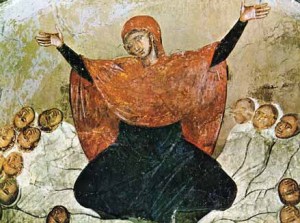
Macedonian Encyclopedia, MANU, 2009, p., Public domain, via Wikimedia Commons

I wonder how many long to hear those words from the “man of God.” What need, dream, or great desire of yours has not been met? In both the Torah and haftarah portions this week, God meets the needs and desires of women in extraordinary ways. He is FOR you, even when – especially when – things are impossible in the natural world.

I wonder how many tears Sarah, the widow, and the Shunammite shed over their predicaments? I suspect most of their pain was shielded from others with the mask of hard work, determination, and service to others. All three women exude a quiet strength in their narratives. They are not portrayed as women that easily give up or go silently into the night. But even the strongest and stalwart among us FEELS, and deeply so. Real strength doesn’t negate or despise feelings, dreams, and great hope for the future. Such things faith rests upon, and they are good, and lovely, and godly.

Hebrews 11:1-2 (NKJV) Now faith is the substance of things hoped for, the evidence of things not seen. 2 For by it the elders obtained a good testimony.

Sarah might have mockingly laughed at the prospect of having a son in her old age (the natural), but that doesn’t mean that she lacked the faith (spiritual) that God would give her this good pleasure. Upon the birth of Isaac, Sarah laughed again, and this time it was in wonderment and jubilation.

Genesis 21:6-7 (TLV) “God has made laughter for me! Everyone who hears will laugh with me.” 7 She also said, “Who would have said to Abraham, ‘Sarah has nursed children’? For I have given birth to a son in his old age!”
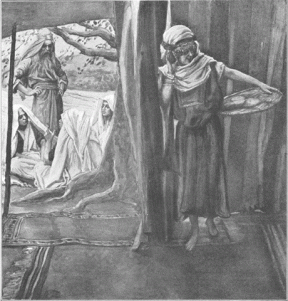
James Tissot, Public domain, via Wikimedia Commons

I imagine the widow and the Shunammite laughing with Sarah. In fact, I see every Eshet Chayil laughing at the future. Their laughter is not a mockery; it is a rejoicing in the goodness and faithfulness of God. They have trained their eyes to see past the veil of flesh. They know that this world is simply a shadow of the world to come. Though this present age is full of strife, pain, and disappointment, the Word and Promises of Adonai stand firm. They will never pass away. So, right now, in this momentary affliction, they open their mouth with Wisdom, and use their tongue to teach the Torah of Chesed (kindness).

Proverbs 31:25-26 (TLV) Strength and dignity are her clothing, and she laughs at the days to come. 26 She opens her mouth with wisdom—a lesson (Torah) of kindness is on her tongue.

Abraham and Sarah opened their tent with great hospitality. They welcomed, nourished, and taught so many that is said that they “made souls.” (Gen. 12:5) In other words, they were known for their great chesed, like the Proverbs 31 woman. They taught the world about faith, hope, and the future. They taught us to trust in the promises of God, even though they are not always manifest in our lifetime.

Hebrews 11:8-13 (NKJV) By faith Abraham obeyed when he was called to go out to the place which he would receive as an inheritance. And he went out, not knowing where he was going. 9 By faith he dwelt in the land of promise as in a foreign country, dwelling in tents with Isaac and Jacob, the heirs with him of the same promise; 10 for he waited for the city which has foundations, whose builder and maker is God. 11 By faith Sarah herself also received strength to conceive seed, and she bore a child when she was past the age, because she judged Him faithful who had promised. 12 Therefore from one man, and him as good as dead, were born as many as the stars of the sky in multitude—innumerable as the sand which is by the seashore. 13 These all died in faith, not having received the promises, but having seen them afar off were assured of them, embraced them and confessed that they were strangers and pilgrims on the earth.

Abraham was waiting for the city which has foundations, whose builder is God, the New Jerusalem. As sons and daughters of Abraham and Sarah, we await the same. They died in faith, as will many of us. And like them, our Torah of Chesed includes the message that we are strangers and pilgrims on the earth. Look up! His promise will come to pass.

So, how do the widow and the Shunammite proclaim this same truth?

The Widow and the Cruse of Oil

2 Kings 4 begins with a widow of the b’nei nevi’im, or sons of the prophets. Abraham was the first named prophet in the Bible. (Gen. 20:7) Thus, the hint is that she and her sons belong to father Abraham. She is destitute, and a creditor has threatened to take her two sons as slaves to satisfy the debt she and her late husband accrued. According to tradition, the woman is Obadiah’s widow. (Rashi)

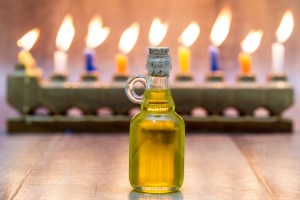
Elisha, the man of God, tells her to ask her neighbors for “empty” vessels. Then, very specifically, she and her sons were to shut the door behind them. She poured while her sons brought vessel after vessel to fill from the one cruse of oil she had in the house. People are sometimes compared to vessels in Scripture.[3] An empty vessel is in desperate need of purpose, hope, and the filling of the Holy Spirit. Worse, an empty vessel can imply someone that is dead. This family thought they had nothing, when in fact, they had the oil of anointing, one cruse of oil that could light many, many lamps.
© Natushm | Dreamstime.com

Adonai deeply cares for the widows and the fatherless. Josephus and Rashi comment that this family’s debt was accrued because the late prophet Obadiah had borrowed money to feed the prophets that hid in the cave, and that the creditor was Jehoram the son of Ahab. If this is true, the chesed of Obadiah was great, and Elisha desired that chesed be returned upon Obadiah’s house. Hence, the miracle of oil.

In truth, we all have debt that we cannot pay back. We all have sons and daughters that have inherited the same fate. But we also have hope, even if all we have left is one little vessel of oil. If one finds herself in this this place, it is time to go into the House and shut the door. And then, pour every last drop of oil from your vessel into as many empty vessels as you can find. Oil and anointing is acquired through suffering. Olives must be pressed with a heavy Stone to produce oil. The widow and her son’s suffering turned into precious oil that paid off their debt, and provided sustenance for the future.

A wise virgin knows that Obadiah’s widow has the best oil in town. If you’re feeling sleepy, best get to her house as fast you can. Paying chesed to her will ensure that your vessel is full of golden liquid for the future when the Bridegroom comes calling.

The Great Woman from Shunem

The Shunammite’s story echoes Abraham and Sarah’s narrative in several ways.

  • Both were promised a son after showing chesed in the form of hospitality to a messenger of God.
  • Both reacted with astonishment and even a bit of unbelief at this prospect.
  • Both Abraham and the Shunammite’s husband were advanced in years.
  • Both were told that “at this season next year” you will have a son.
  • Both promised sons died (at least figuratively).
  • Both were resurrected (at least figuratively).

Thus, it is easy to see why this prophetic portion was chosen to accompany Vayera. But, this year, as I reread these passages, chesed leaped off the pages of Holy Writ like a neon sign. Adonai has been drawing my attention to chesed since Passover. Chesed is the exact opposite of the traits currently being lauded and paraded in media, social media, and educational institutions. And sadly, the result has been fear, hate, division, mockery, pride, and perverted justice.

Love is growing cold, and this ought not be so – especially if one claims to be a son or daughter of Abraham and Sarah. The father and mother of our faith were KNOWN for their great chesed, as was the Shunammite woman. Chesed is given to everyone – even those that do not deserve it. Especially to those that do not deserve it! Chesed is what woos one to turn back to Adonai. (Jer. 31:3) Chesed is what gives one a spirit of repentance. (Rom. 2:4) Chesed ALWAYS precedes truth and justice in Scripture. If we reverse that pattern, death and chaos reign.

Proverbs 10:12 (NASB) Hatred stirs up strife, but love covers all transgressions.

1 Peter 4:8-9 (NASB) Above all, keep fervent (zealous) in your love for one another, because love covers a multitude of sins. 9 Be hospitable to one another without complaint.

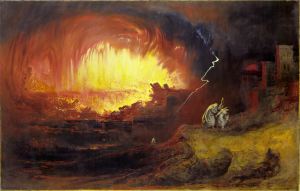
If chesed comes first – if it is the foundation – then, and only then, will one see the pattern conveyed in Vayera in one’s own life. Vayera means, “And He appeared,” a reference to Adonai appearing to Abraham after he was circumcised. It was the “heat of the day.” Likely, Abraham was in great pain and the sun was punishingly hot in the sky. Yet, he arose quickly to serve his guests. The three messengers were not only there to bring the good news that a son would be born to Abraham and Sarah, but to judge Sodom and Gomorrah. God chose to reveal His intentions toward these cities to Abraham.

Have you ever wondered why?

It certainly wasn’t to cause him distress. Or to seek his permission, God forbid. No, the reason God revealed His intentions was because:

Genesis 18:19 (NASB) “For I have chosen him, so that he may command his children and his household after him to keep the way of the LORD by doing righteousness and justice, so that the LORD may bring upon Abraham what He has spoken about him.”
John Martin, Public domain, via Wikimedia Commons

At first glance, this doesn’t seem to be a great reason to reveal to Abraham that He is going to judge the exceedingly great sin of Sodom and Gomorrah. But, carefully considering the above passage, Abraham and his descendants are to represent Adonai in the earth. They are the ones that keep the Way of the LORD by doing righteousness and justice.

If that is the legacy of Abraham, what his response? He pleaded for the innocent, the righteous, within these cities. He didn’t say, “Yeah! Go, take them all out.” (That was Jonah’s response even toward the repentant in Nineveh.) Instead, Abraham showed chesed toward these exceedingly wayward cities. It is highly likely that Adonai was testing the heart of Abraham in this matter. Would he lean toward chesed and mercy, or strict justice?

Abraham passed this test, and as his descendants, so should we. Chesed was the catalyst for not only miraculous births and supernatural provision, but also for resurrection! This demonstrates that acts of kindness are intricately woven into the garments of salvation and the robes of righteousness. They are the essence of the Creator of the Universe. In Jeremiah 3:2, God says, “I am gracious.” That is, chasid, the noun form of chesed. He is chesed!

The Chesed of the Shunammite

The Shunammite woman proves to be a true daughter of Abraham. Stories of women and children are typically prophetic. In this case, where a prophet is directly involved, the prophetic theme is intensified or “doubled.” A match for the prophet that received a double portion of his predecessor’s mantle, Elijah.

Now there came a day when Elisha passed over to Shunem, where there was a prominent woman, and she persuaded him to eat food. And so it was, as often as he passed by, he turned in there to eat food. She said to her husband, “Behold now, I perceive that this is a holy man of God passing by us continually. (2 Kings 4:8-9)

 The place where this great woman lived was called Shunem, meaning double resting place. It was located in Issachar, which implies that the Shunammite was from this tribe or had married a man of Issachar. She told her husband that she knew (ידע – yada) that Elisha was a holy man. She showed him great hospitality by ensuring that he had bread to eat, and by building a resting place for the prophet.

“Please, let us make a little walled upper chamber and let us set a bed for him there, and a table and a chair and a lampstand; and it shall be, when he comes to us, that he can turn in there.” One day he came there and turned in to the upper chamber and rested. Then he said to Gehazi his servant, “Call this Shunammite.” And when he had called her, she stood before him. (2 Kings 4:10-12)

The Shunammite is at the center of the narrative and activity. She is the one that recognizes the need of the prophet, feeds him, and requests a place be built for him. While her husband doesn’t oppose her efforts, and even fulfills her requests, he is content with his passive role in this story. Whether he simply had different gifting or preferred to serve with his hands, we don’t know. He might have had great faith or none at all. Either way, he doesn’t chastise his wife for her boldness, generosity, or more prominent public role. Instead, they work together in the strengths that they have. Thus, when the promise of a son comes, they both are the beneficiaries.

When the boy tragically dies, the Shunammite doesn’t tell her husband. Instead, she places his body on the bed they had made for Elisha, and then shuts the door behind him. This is interesting considering that Elisha told the widow a few verses earlier to do the same while she poured oil into the empty vessels.

2 Kings 4:21 (NASB) She went up and laid him on the bed of the man of God, and shut the door behind him and went out.

The Shunammite asks her husband to give her a servant and a donkey because she is going to see the man of God. This perplexes him and he asks:

“Why will you go to him today? It is neither new moon nor Sabbath.” And she said, “It will be well.” 2 Kings 4:23 (NASB)

The Shunammite had a custom of visiting the man of God on the new moon and the Shabbat, and this day was neither. It is intriguing that it is the woman, and not her husband, that had this custom. If you find yourself in a similar boat, take heart! Keep doing what you know to do as you serve the LORD. Adonai and the man of God recognized her kindnesses and her husband was blessed along with her. May it be so for you as well.

The Shunammite’s husband again fulfilled the request of his wife. She saddled her ass and headed to Mount Carmel. It was obvious to Elisha that she was distressed. When he learns that the boy is near death or dead, he sends Gehazi ahead with his staff to lay on the boy. But, the woman wouldn’t leave him. In fact, she quotes the same words that Elisha spoke to Elijah before the heavenly chariots took him:

2 Kings 4:30 (NASB) The mother of the lad said, “As the LORD lives and as you yourself live, I will not leave you.” And he arose and followed her.

The staff failed to awaken the boy, so Gehazi returned to them with this news. When Elisha entered his room, he shut the door behind them both and prayed to the LORD. This is the third time in this chapter that a door is shut behind the people inside.

2 Kings 4:33-35 (NASB) So he entered and shut the door behind them both and prayed to the LORD. 34 And he went up and lay on the child, and put his mouth on his mouth and his eyes on his eyes and his hands on his hands, and he stretched himself on him; and the flesh of the child became warm. 35 Then he returned and walked in the house once back and forth, and went up and stretched himself on him; and the lad sneezed seven times and the lad opened his eyes.

This is a very mystical passage, and there are many ways to analyze it. Since Elisha first prayed, I assume that Adonai told him what to do. He laid on top of the boy, eye to eye, mouth to mouth, hands to hands. It’s almost like a transference of life occurred, which even warmed the flesh of the child. After doing this once more, the lad sneezed seven times and woke up. Sneezes require deep inhalations of breath, and then powerful expulsions through the nose and mouth. This indicates a strong breath of life – emphasized by the number seven as he resurrects to life.

Both the Torah portion and the haftarah close with stories of sons who miraculously resurrect from the dead. While Isaac’s death is implied, the Shunammite’s son is explicit. God’s promises and His chesed prevails – even overcoming the grave! These are glimpses into the world to come, the olam haba, and the future of all of Abraham’s seed.

To conclude, think back to the three instances in the haftarah where a door is being shut behind those with faith. There are a couple of places in the Brit Chadashah that this phrase occurs. One is in the parable of the Ten Virgins. The other is in the message to the church at Philadelphia, the assembly of “brotherly love.” As you review them, notice the correlation with extra vessels of oil, and how the believers in Philadelphia follow the path of Abraham. They keep the Word of the LORD with patient endurance and have not denied His Name. What other connections do you see?

Matthew 25:1-13 (TLV) “Then the kingdom of heaven will be like ten virgins who took their lamps and went out to meet the bridegroom. 2 Five of them were foolish, and five were wise. 3 For when the foolish ones took their lamps, they took no oil with them. 4 But the wise ones took oil in jars along with their lamps. 5 Now while the bridegroom was taking a long time, they all got drowsy and started falling asleep. 6 But in the middle of the night there was a shout, ‘Look, the bridegroom! Come out to meet him!’ 7 Then all those virgins got up and trimmed their lamps. 8 Now the foolish ones said to the wise, ‘Give us some of your oil, since our lamps are going out.’ 9 But the wise ones replied, ‘No, there won’t be enough for us and for you. Instead, go to those who sell, and buy some for yourselves.’ 10 But while they were going off to buy, the bridegroom came. And those who were ready went in with him to the wedding feast, and the door was shut. 11 Now later, the other virgins came, saying, ‘Sir, Sir, open up for us!’ 12 But he replied, ‘Amen, I tell you, I do not know you.’ 13 Therefore stay alert, for you know neither the day nor the hour.”

Revelation 3:7-13 (TLV) To the angel of Messiah’s community in Philadelphia write: “Thus says the Holy One, the True One, who has the key of David, who opens and no one will shut, and who shuts and no one opens: 8 I know your deeds. Behold, I have set before you an open door that no one is able to shut—because you have little power, but you have kept My word and have not denied My name. 9 Behold, I will cause those of the synagogue of satan—who say they are Jewish and are not, but lie—behold, I will cause them to come and bow down before your feet, so that they acknowledge that I have loved you! 10 Because you have kept My word about patient endurance, I will also keep you from the hour of trial that is coming upon the whole world to test those who dwell on the earth. 11 I am coming soon—hold on to what you have, so that no one will take away your crown. 12 The one who overcomes, I will make him a pillar in the Temple of My God, and he will never leave it. And on him I will write the name of My God and the name of the city of My God—the New Jerusalem, which comes down out of heaven from My God—and My own new Name. 13 He who has an ear, let him hear what the Ruach is saying to Messiah’s communities.”


[1] Role of Women 
[2] 1 Th. 4:3-6, Rom. 9:21, 2 Cor. 4:7-14, 2 Tim. 2:20-26 

Categories: Torah Portions, Women | Tags: , , , , , , , , , , , , , | 8 Comments

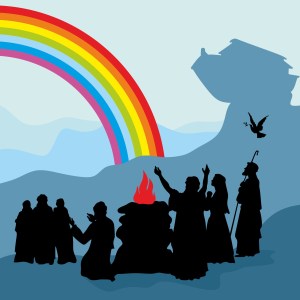
Like the Days of Noah

© Radek Procyk | Dreamstime.com

The Haftarah Cycle: A Brief Introduction

In this new Torah cycle,[1] I’m devoting special attention to the prophetic portion or the haftarah. Thus, I will share little nuggets with my readers when I have time. But first, I offer a review of the history of the haftarah for those new to the Torah cycle.

Haftarah comes from a Hebrew root that means to end or conclude. (It does not mean “half!”) The haftarah portion is a selection of verses from the prophets or the writings in the Tanakh.[2] This selection is thematically connected to the weekly Torah Portion about a third of the time, but there are special haftarot (pl.) related to the calendar such as Feast days or Rosh Chodesh, or for historical events such as the destruction of the Temples and the subsequent exile.

For example, from the first Sabbath after Tammuz 17th, until the turn of the year at Rosh Hashanah, the haftarah portions shift from being thematically connected to the Torah Portions to reflecting the historical events that occurred at that season. (For more information see: The Three Weeks or watch “The Dire Straits: This Season in Tradition,” a message I delivered at Revive 2020.)

The institution of the haftarah cycle varies, depending on the source. There are several theories about how this custom began. The most common one suggests that it began during the reign of Antiochus Epiphanes, who outlawed Jews from reading the Torah, but allowed the other writings. Another theory says that the haftarah was established in response to the Samaritans, who denied the inspiration of the prophets and writings, but followed the Law of Moses.

Interestingly, the oldest reference to the haftarah cycle is found in the Brit Chadashah (New Testament). In the first century, there was a custom to read from the Torah and the Prophets on the Sabbath day in the synagogues:

Luke 4:16-21 (TLV) And He came to Natzeret, where He had been raised. As was His custom, He went into the synagogue on Shabbat, and He got up to read. 17 When the scroll of the prophet Isaiah was handed to Him, He unrolled the scroll and found the place where it was written, 18 “The Ruach Adonai is on me, because He has anointed me to proclaim Good News to the poor. He has sent me to proclaim release to the captives and recovery of sight to the blind, to set free the oppressed, 19 and to proclaim the year of Adonai’s favor.” 20 He closed the scroll, gave it back to the attendant, and sat down. All eyes in the synagogue were focused on Him. 21 Then He began to tell them, “Today this Scripture has been fulfilled in your ears.”

Acts 13:14-16 (NASB) But going on from Perga, they arrived at Pisidian Antioch, and on the Sabbath day they went into the synagogue and sat down. 15 After the reading of the Law and the Prophets the synagogue officials sent to them, saying, “Brethren, if you have any word of exhortation for the people, say it.” 16 Paul stood up, and motioning with his hand said, “Men of Israel, and you who fear God, listen.”

While the yearly Torah cycle covers every word in the Torah or Books of Moses, only a small selection from the prophets and writings are read through each year. In fact, only two prophetic books are read completely as haftarot in the modern order: The Book of Obadiah and the Book of Jonah.

There are differences between the reading selections of haftarot in Ashkenazi, Sephardi, and Yemenite communities, though they are similar. Historically, though the Jewish people had a custom of reading from the prophets after the Torah portion, there wasn’t a set order. Until more recent times, random selections were chosen. Moreover, in the old triennial (3 year) Torah cycle, there were naturally many more haftarah portions. So, those that suggest that the Jewish people purposeful removed certain prophecies from Isaiah to keep people away from Yeshua are completely ignorant of the haftarah’s history. Don’t fall into their traps.

There are traditional blessings recited before reading the haftarah, and afterwards.

Blessing Before Reading Haftarah

Barukh attah Adonai eloheinu melekh ha’olam asher bachar binvi’im tovim ve-ratzah ve-divreihem hane’emarim be’emet. Barukh attah Adonai ha-bocher ba-torah uv’Moshe avdo uv-Yisra’el amo, uvinvi’ey ha-emet va-tzedek.

Blessed are you, O LORD, our God, King of the universe, Who has chosen good prophets, and was pleased with their words spoken in truth. Blessed are you, LORD, who has  chosen the Torah, and his servant Moses, and his people Israel, and the prophets of truth and righteousness.

Blessing After Reading the Haftarah

Barukh attah Adonai eloheinu melekh ha’olam, tzur kol ha-olamim, tzaddik be-khol ha-dorot, ha-El hane’eman ha’omeir v’oseh, hamdabeir u’makiyem, shekol devarav emet ve-tzedek. Ne’eman attah Adonai eloheinu, ve-ne’emanim devarekha, ve-davar echad midevareykha achor lo yashuv reikam, ki El melekh ne’eman ve-rachaman attah. Barukh attah Adonai, ha-El hane’eman be-khol devarav.

Blessed are You, Adonai our God, King of the Universe, Rock of all eternities, righteous in all generations, the faithful God, who says and does, who speaks and fulfills, all of whose words are true. Faithful are you, LORD our God, and faithful are your words. Not one of your words turns back unfulfilled, for You, O God, are a faithful and compassionate King. Blessed are You, LORD, the God who is faithful in all His words.

Further Reading

The JPS Bible Commentary: Haftarot by Michael Fishbane

The Haftarah Commentary by W. Gunther Plaut

The Women’s Haftarah Commentary: New Insights from Women Rabbis on the 54 Weekly Haftarah Portions, the 5 Megillot & Special Shabbatot by multiple authors

The Book of Haftarot: An Easy-to-Read Haftarah Translation by Sol Scharfstein

Book of Haftaros – Gutnick Edition by Rabbi Chaim Miller


Like the Days of Noach

Prophetic Portion to Noach:[3] Isaiah 54:1 – 55:5

The context of this portion is decades of Babylonian captivity. Can you imagine spending decades in exile away from your land and your home? In a sense, we are currently in exile in a spiritual Babylon. Will Adonai leave us here forever?

© Javier Cruz Acosta | Dreamstime.com

This haftarah portion floods the reader with the theme of redemption from exile. God has not forgotten us or our children. In fact, He beckons us to partake freely of His water, bread, and wine – His teachings – because they are life. Our disgrace for disobedience has an end, and it is rapidly approaching. Adonai describes His anger as a momentary flood, but His chesed as everlasting.

Isaiah 54:8 (LITV) In a flood of wrath (be-shetzef ketzef) I hid My face from you for a moment; but I will have pity on you with everlasting kindness, says Jehovah your Redeemer.

It is in that context that He says this is “like the days of Noah to me.” Adonai’s anger (judgment) is like the waters that destroyed the earth in Noah’s day; but His promise to take Israel back is even more powerful than the great deluge. While the flood of His anger was temporary, His promises are forever. We can count on them to engulf us with His goodness.

Isaiah 54:9 (NASB) “For this is like the days of Noah to Me, When I swore that the waters of Noah Would not flood the earth again; so I have sworn that I will not be angry with you nor will I rebuke you.”

From Adonai’s perspective, “like the days of Noah” reminds Him not of His anger, but of His mercy and promise. Israel had sinned against her Maker, breaking the covenant agreed upon at Mt. Sinai. After enduring the curses for her unfaithfulness, Adonai promised Israel a new start just as He had promised Noah and his descendants. The entire prophetic portion floods an underserving Israel with God’s boundless chesed (loving-kindness).

Isaiah 54:10-14 (TLV) Though the mountains depart and the hills be shaken, My love will not depart from you, nor will My covenant of peace be shaken, says Adonai who has compassion on you. 11 Afflicted one, storm-tossed, unconsoled, behold, I set your stones in antimony, lay your foundations with sapphires, 12 make your pinnacles of rubies, your gates of crystal, and all your walls of precious stones. 13 All your children will be taught by Adonai. Your children will have great shalom. 14 In righteousness you will be established. You will be far from oppression—for you will not fear—and from terror—for it will not come near you.

The phrase “like the days of Noah” only occurs in a few places in Scripture. When Messiah uses this phrase in Matthew 24, most connect it with the judgment that Adonai wrought upon the whole earth because of the evil hearts of men, violence, and corruption. Hopefully, the link to Messiah’s words about the coming of the Son of Man, the end of days, and the evil that will be prevalent at that time is clear. He does not let the guilty go unpunished…

© Ronstik | Dreamstime.com

However, He also abounds in chesed and forgives iniquity, transgression, and sin. (Ex.34:4-9) This is a two-sided coin. And, “like the days of Noah” is a two-sided phrase. On the one hand, blatant disobedience and sin must be punished – like a flood of fiery wrath. On the other hand, God is gracious, merciful, and abounding in chesed – like a gushing river of life. Both are true.

Noach received favor or grace as a righteous one in his generation. His name (nun, chet), if read backwards, even spells grace (chen – chet, nun), which gives us a clue. Perhaps, the phrase “like the days of Noah” has dual meanings as well. After all, Biblical real estate is precious. There are no words or phrases that are superfluous. The prophetic portion of Noach nearly overwhelms the hearer with the gushing love of God. His promises flow out in a torrential down pour that sound too good to be true. Especially, to a people that have been unfaithful to her Maker and Husband.

How could it be that after all we have done, after all our unfaithfulness, after all our selfish choices, after multitudes of sins, derisions, and infidelities, that the Creator of the Universe, the God of Israel, Builder of Zion, will take us back to Himself? Can this be true? Peter compares God bringing Noach and his family through the flood waters to baptism and a clean conscience. (1 Peter 3:18-22) Adonai promises as sure as He promised to never flood the earth again that He WILL remove our disgrace, enlarge our tent, fill our wombs, comfort us, and quench our thirst and hunger. This is the Good News of the Kingdom!

© Biblebox | Dreamstime.com

In this sense, “like the days of Noah” distinctly refers to God’s everlasting chesed, mercy, and love. He makes a Way where there is no way. Isaiah 53 precedes Isaiah 54. This is Adonai’s everlasting covenant of peace, and He is eager to share it with each one of us. Thus, when we read Matthew 24 or Luke 17 where the Messiah draws our attention back to “the days of Noah,” don’t just focus on the judgment or the flood of His wrath. Instead, look up for the Coming Kingdom and Promises fulfilled! These portions should bring us comfort in the days ahead, just as Noah’s father proclaimed:

Genesis 5:29 (TLV)  And he named him Noah saying, “This one will comfort us from our work and from the pain of our hands because of the ground which Adonai cursed.”


[1] First Fruits of Zion has a beautiful online and printable schedule for the yearly Torah cycle: https://torahportions.ffoz.org I also love their yearly calendar: https://ffoz.com/eretz-yisrael-wall-calendar.html

[2] Tanakh is an acronym that stands for the Torah (Books of Moses), the Nevi’im (Prophets), and the K’tuvim (Writings). Altogether, these three make up the complete Jewish Bible or the complete Old Testament for Christians.

[3] Torah Portion Noach (Noah): Gen. 6:9 – 11:32; Haftarah:  Is. 54:1 – 55:5

Categories: Musings, Torah Portions | Tags: , , , , , , , , | 12 Comments

Shabbat Shirah

Ps. 145:21 (NASB) My mouth will speak the praise of the LORD, And all flesh will bless His holy name forever and ever.

© Vlastas | Dreamstime.com

In this week’s Torah portion, Beshalach[1], we read the Song at the Sea; and in the haftarah, the Song of Deborah. Because of this, Jewish tradition dubs this Shabbat: Shabbat Shirah, or the “Sabbath of Song.” In each of these songs, YHWH is highly exalted as Israel’s deliverer. The enemy has been defeated, and we rejoice!

Beshalach always coincides with Tu B’Shevat (Shevat 15th), or the New Year for Trees. There is an interesting connection between the splitting of the Reed Sea and trees, found here. As the sap begins to rise in the trees so that they blossom and bud with new life, the birds that nest in their branches begin their migrations. Up to 500 million part the sky as they fill Israel’s air space twice a year, with the spring movement beginning in Shevat (February/March).[2] The birds flow and move to the beat of their own moedim, retelling their own type of exodus.

Jer. 8:7 (KJV) Yea, the stork in the heaven knoweth her appointed times (moedim); and the turtle and the crane and the swallow observe the time of their coming; but my people know not the judgment of the LORD.

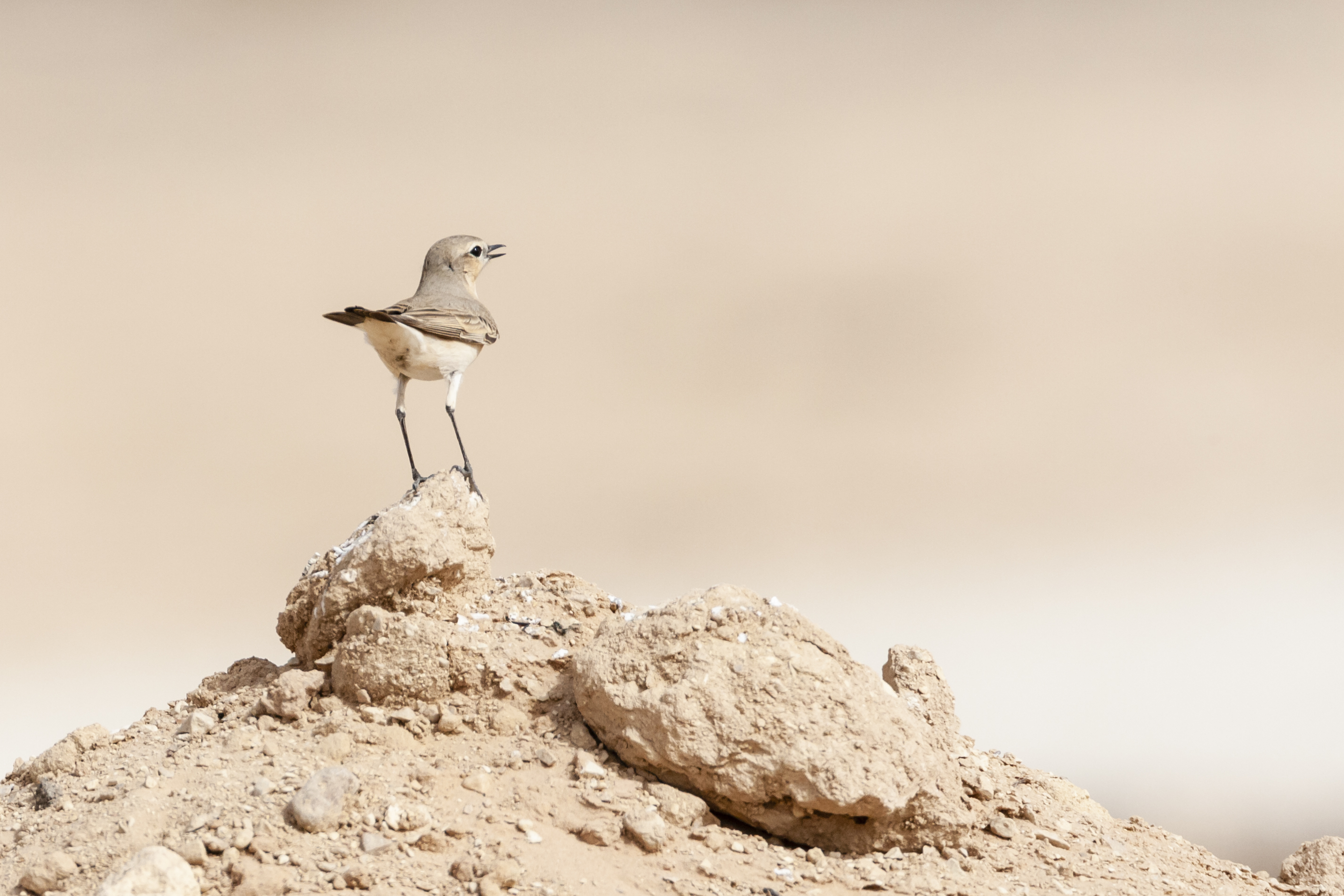
Singing Isabelline Wheatear spring migration in Israel. © Agami Photo Agency | Dreamstime.com

Along their journey, they fill the air with something else: songs of praise! Their tiny lungs fill with the air of heaven to release it in a song like no other creatures on earth. Their chirps, squawks, tweets, and peeps harmonize to glorify the LORD. For this reason, a custom developed in Ashkenazi communities to feed these praise singers on Shabbat Shirah.[3]

Ezek. 17:22-24 (TLV) Thus says Adonai Elohim: “I, even I, will take from a sprig from the top of the lofty cedar and will plant it. I will crop off a tender twig from the topmost of its young shoots, and I will plant it on a tall and prominent mountain. 23 I will plant it on Israel’s high mountain. It will bring forth branches, bear fruit and be a magnificent cedar. Birds of every kind will nest under it—they will nest in the shade of its branches. 24 Then all the trees of the field will know that I, Adonai, have brought down the high tree, exalted the lowly tree, dried up the green tree, and made the dry tree flourish. I, Adonai, have spoken and I will do it.”[4]

The Song of the Sea is read every morning in the prayer service (Shacharit) in the Pesukei D’Zimrah, or Verses of Song. The Shacharit begins with blessings and psalms specifically chosen to invoke kavanah or focus and awe for the Holy One in the person praying. The Pesukei D’Zimrah is full of songs and praise, which prepares one to recite the Shema and Amidah. “Know before Whom you stand.”[5] Only after acknowledging and praising Adonai as the Holy One of Israel, can one properly seek Him for requests and desires.

There is another possible meaning of zimrah (song/melody) that emphasizes this point and connects it to the month of trees, in which Beshalach and the Song of the Sea is read. The Hebrew root zemer means “to prune.”[6] The psalms, including the Song of the Sea, are verses of pruning! These melodies act like a type of pruning shear that cuts off wild and unruly growths from one’s tree or mind/heart. Healthy branches receive more nourishment, and hindrances to heartfelt prayer are removed. In this way, the songs and melodies of Scripture (and even modern worship songs/music) lift, align, and unify one with Adonai and fellow worshipers.

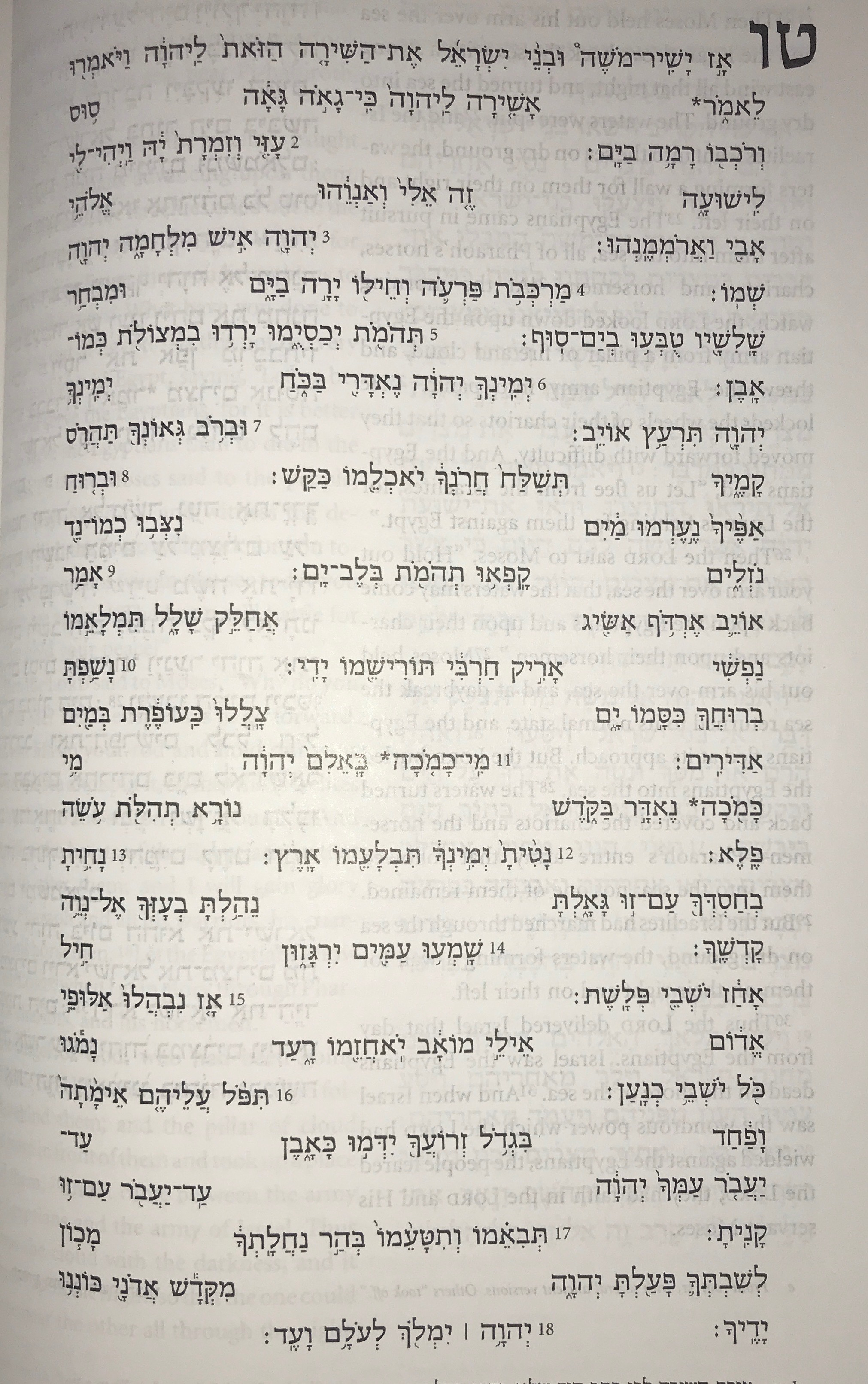
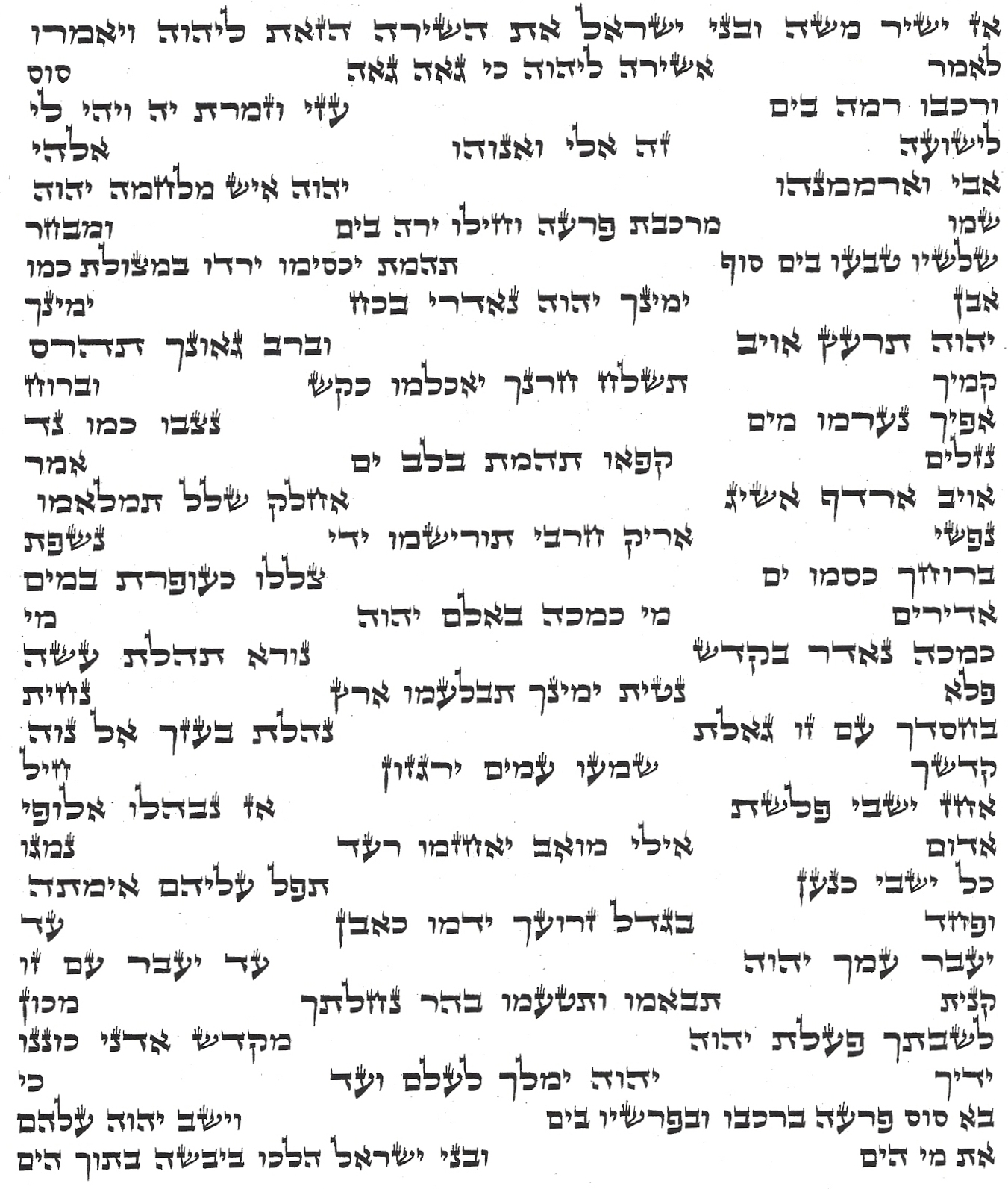
This is even figured on the Torah Scroll. The Song at the Sea is written in a brickwork pattern of three interlocking columns, which makes it stand out on the leaf (page of Torah.)[7] This arrangement mimics the congealed columns of water and the Children of Israel walking between them on dry ground, united or interlocked. It is one of only two places in the Torah written in a different layout. The other is the Song of Moses. (Dt. 32) The Song of Deborah follows this same brickwork pattern. (See examples below.)

Song of the Sea © K. Gallagher

Song of Deborah © K. Gallagher

The imagery of the early spring season in Shevat, birds migrating through the Land, splitting the heavens with wings and song, the Torah cycle retelling the exodus and the parting of the sea in the month of trees, all proclaim a loud message. Can you discern the bird’s song? It’s the same message from the beginning. Moses and the children sang it at the sea. Deborah recalled it in Judges 5. David repeats it in Psalm 68. Every morning it is recounted in the synagogue. The last book, Revelation, has flying angels proclaiming it to the whole earth.

Ex. 15:1-2 (NASB) Then Moses and the sons of Israel sang this song to the LORD, and said, “I will sing to the LORD, for He is highly exalted; The horse and its rider He has hurled into the sea. 2 “The LORD is my strength and song, and He has become my salvation (Yeshua); This is my God, and I will praise Him; My father’s God, and I will extol Him.”

Jdg. 5:1-4, 31 (NASB) Then Deborah and Barak the son of Abinoam sang on that day, saying, 2 “That the leaders led in Israel, That the people volunteered, Bless the LORD! 3 “Hear, O kings; give ear, O rulers! I—to the LORD, I will sing, I will sing praise to the LORD, the God of Israel. 4 “LORD, when You went out from Seir, when You marched from the field of Edom, the earth quaked, the heavens also dripped, even the clouds dripped water.” … “Thus let all Your enemies perish, O LORD; but let those who love Him be like the rising of the sun in its might.”

Ps. 68:1-4 (NASB) For the choir director. A Psalm of David. A Song. Let God arise, let His enemies be scattered, and let those who hate Him flee before Him. 2 As smoke is driven away, so drive them away; As wax melts before the fire, so let the wicked perish before God. 3 But let the righteous be glad; let them exult before God; Yes, let them rejoice with gladness. 4 Sing to God, sing praises to His name; lift up a song for Him who rides through the deserts, whose name is the LORD, and exult before Him.

Rev. 14:6-8 (NASB) And I saw another angel flying in midheaven, having an eternal gospel to preach to those who live on the earth, and to every nation and tribe and tongue and people; 7 and he said with a loud voice, “Fear God, and give Him glory, because the hour of His judgment has come; worship Him who made the heaven and the earth and sea and springs of waters.” 8 And another angel, a second one, followed, saying, “Fallen, fallen is Babylon the great, she who has made all the nations drink of the wine of the passion of her immorality.”

© Gracel21 | Dreamstime.com

This Shabbat Shirah, I encourage you to read all the above chapters. (Ex. 15, Jdg. 5, Ps. 68, Rev. 14) See how many thematic connections you can make, and declare The Message to others. The result should cause great jubilation, praise, and awe of the Almighty. If it doesn’t, perhaps one needs to undergo the pruning shears first. To align one’s heart with Adonai, look to the birds. Fill your lungs – even if they feel low on breath– with air and sing, chirp, and tweet about His Greatness. This will lift you up on wings like an eagle, deliverance that only God can achieve.

It is interesting to note that in Hebrew it says that Moses and the sons of Israel will sing, az yashir, but the portion of the song attributed to Miriam and the women is in the present tense, plural imperative: shiru l’Adonai, sing to Adonai (now).

Ex. 15:20-21 (NASB) Miriam the prophetess, Aaron’s sister, took the timbrel in her hand, and all the women went out after her with timbrels and with dancing. 21 Miriam answered them, “Sing to the LORD, for He is highly exalted; the horse and his rider He has hurled into the sea.”

I’ll never forget an evening of prayer with some local women a few years ago. We had just finished a spiritually tough, but encouraging Bible study on a section in the Book of Revelation. I had shown everyone a slide of an artist’s depiction of the harlot riding the red, seven headed beast with four shady horse and riders in the backdrop of smoke and chaos. The picture spoke a thousand words of defeat and oppression. The point of the lesson was overcoming this false image in our own hearts. (See The Scarlet Harlot and the Crimson Thread by Dr. Hollisa Alewine.)

When we prayed, the Spirit was so strong, flowing freely in our midst. Suddenly, my mind was flooded with images of the Song at the Sea. The Words of triumph and joy were so vivid that I began to jump as I recounted Miriam’s words: “Sing to the LORD, for He is highly exalted; the horse and his rider He has hurled into the sea.”

© Duffloop | Dreamstime.com

Beloved, we sing because He has already overcame the world. Though Pharaoh or the Whore of Babylon is riding close at our heels, we already know the end of the story. The horsemen, their chariots, and beasts of burden are stopped with a single blast of the Almighty’s nostrils. Their wheels will get stuck in the very mud in which they wallow. So, don’t wait to sing. Like Miriam and the great host of women, Sing now!

Ps. 68:11-12 (NASB) The Lord gives the command; The women who proclaim the good tidings are a great host: 12 “Kings of armies flee, they flee, and she who remains at home will divide the spoil!”

Ps. 150:6 (NASB) Let everything that has breath praise the LORD. Praise the LORD!

                          Masada © Kisha Gallagher


[1]Exodus 13:17–17:16, Judges 4:4–5:31.

[2]https://www.birds.org.il/en/article-page.aspx?articleId=124 Retrieved 2/7/2020.

[3]There are several explanations given for this tradition. For example, see this article: https://schechter.edu/why-is-shabbat-shirah-for-the-birds-2/

[4]Mat. 3:31-32 (TLV) He presented to them another parable, saying, “The kingdom of heaven is like a mustard seed, which a man took and planted in his field. 32 It’s the smallest of all seeds; yet when it’s full grown, it’s greater than the other herbs. It becomes like a tree, so that the birds of the air come and nest in its branches.”

[5]This phrase is inscribed on the ark (that houses the Torah Scroll) in many synagogues. It is drawn from: Ex.3:4-6 When Adonai saw that he turned to look, He called to him out of the midst of the bush and said, “Moses, Moses!” So he answered, “Hineni.” 5 Then He said, “Come no closer. Take your sandals off your feet, for the place where you are standing is holy ground.” 6 Moreover He said, “I am the God of your father, the God of Abraham, Isaac and Jacob.” So Moses hid his face, because he was afraid to look at God. (TLV)

[6]For example, see The Seif Edition Artscroll Hebrew/English Siddur on Pesukei D’Zimrah.

[7]Torah scrolls are penned on kosher (clean) animal skins and spooled onto a wooden post called an Etz chayim or Tree of Life. The Torah Scroll has much in common with trees and people. Like a tree, it is alive, has leaves, and bears fruit. Like a person, it has a crown, wears a sash or belt and an outer garment, and has a yad or hand. For more, see The Unity of the Scroll.

Categories: Biblical Symbols, Torah Portions | Tags: , , , , , , | 1 Comment

In the Beginning: LIGHT

It’s a new year with a renewed Torah cycle. The human soul craves new beginnings, do-overs, fresh starts, and restoration. The Creator knows this well and has built many such renewals into His calendar. We have a renewal every day, week (Shabbat), and month (new moon). Renewals occur at various points throughout each year (moedim), and especially at the new year, in the seven year cycle (Shemittah), and in the fifty year rotation (Jubilee/Yovel).

At the turn of the year (7thmonth), the weekly Torah Portion cycle begins anew with Genesis. This year (5780), is the fifth year of the current Shemittah cycle.[1] As I’ve consulted with others, prayed, and meditated on this upcoming cycle, many things have been on my lev (heart/mind). The creation days in this week’s portion, B’reishit, are the foundation of all things. They especially inform the many other sets of sevens found throughout the Bible.[2]

The year that just went out was a year four, which mirrored day four of creation, the day that natural light from the sun, moon, and stars was separated from the darkness. Their mandate was to rule the day and night, and to be heavenly governors and calendar markers for those that dwell upon the earth. Spiritually speaking, they represent God’s authority of not only creation and man, but of time. What or who governs your clock, calendar, and time? Did you receive “light” on these issues in the previous year?

The Light of the World is Messiah:

John 8:12 (TLV) Yeshua spoke to them again, saying, “I am the light of the world. The one who follows Me will no longer walk in darkness, but will have the light of life.”

The Torah (Law) is Light:

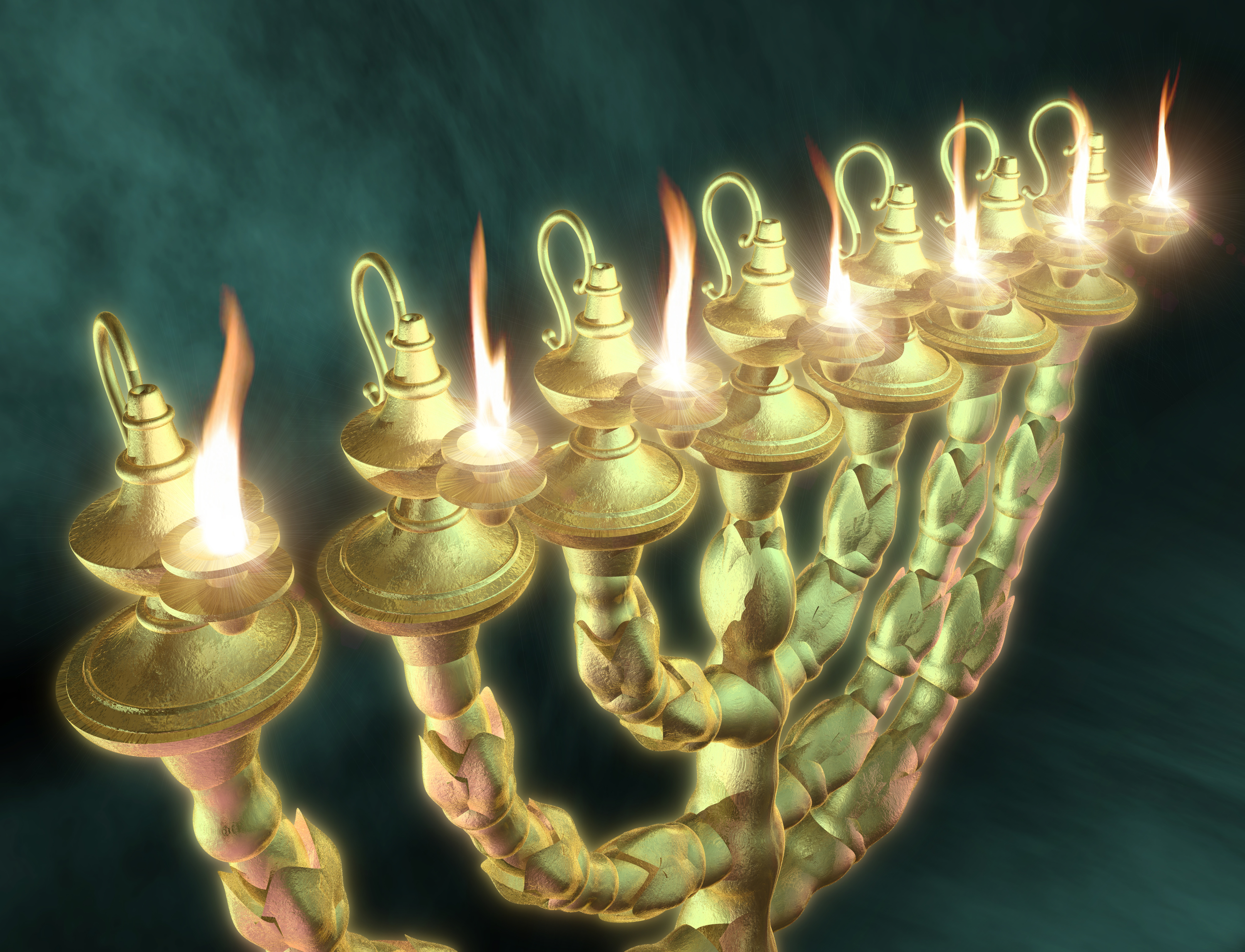
© Ampersandmiami | Dreamstime.com

Ps. 119:105 (TLV) Your word is a lamp to my feet and a light to my path.

Pr. 6:23 (TLV) For the mitzvah is a lamp, Torah a light, and corrective discipline the way of life.

Followers of Messiah and His Torah are also Light:

Mat. 5:14-16 (TLV) You are the light of the world. A city set on a hill cannot be hidden. 15 Neither do people light a lamp and put it under a basket. Instead, they put it on a lampstand so it gives light to all in the house. 16 In the same way, let your light shine before men so they may see your good works and glorify your Father in heaven.”

Has the authority that Adonai gave you to be one of His “lights” been challenged? I have certainly witnessed those dead set on hiding the “light” of others in year four with the promise to continue to do so in the fifth year. Light and authority go hand in hand as the proclamation of day four of creation. Challenging authority is challenging Light. Oppressing a brother or sister by denying their authority to be a light to the world is akin to hiding their light.

This has always been the mind and intent of the enemy. His heart is set on enslavement, bondage, and taking captives. His desire to rule, reign, and govern is a false light that is really darkness. He proclaims to be light. He masquerades as light. He proclaims himself holy, righteous, and good. But, he rules by fear and scare tactics. He wants you to be afraid, to question what God has said, and to be fearful to walk in your calling. His focus is to subject, dominate, silence, and make himself the head. (Isaiah 14 – King of Babylon) It seems that we should recognize him easily, but we don’t. Messiah warns that false light is difficult to discern. In fact, it is possible that the light we think we have is really darkness.

Luke 11:33-36 (NASB) “No one, after lighting a lamp, puts it away in a cellar nor under a basket, but on the lampstand, so that those who enter may see the light. 34 The eye is the lamp of your body; when your eye is clear, your whole body also is full of light; but when it is bad, your body also is full of darkness. 35 Then watch out that the light in you is not darkness. 36 If therefore your whole body is full of light, with no dark part in it, it will be wholly illumined, as when the lamp illumines you with its rays.”

The Spirit of Messiah stands in stark contrast to those that seek to oppress and hide the true light. He says:

Luke 4:18-19 (TLV) “The Ruach Adonai is on me, because He has anointed me to proclaim Good News to the poor. He has sent me to proclaim release to the captives and recovery of sight to the blind, to set free the oppressed, 19 and to proclaim the year of Adonai’s favor.”

The body has two eyes, not one. THEY are the lamp of the body. This is akin to the Torah and the Messiah. It is also like a man and a woman as one flesh, the male and female created on day 6. Each is an “eye” in their unity. The man and woman (as echad) should be filled with the Light of Torah and Messiah. This is also the message of day and year four. The Light of the Torah and the Spirit were given on the fourth feast day: Shavuot or Pentecost.

Two eyes and two equal yet different perspectives, like the two tablets and two loaves waved before Adonai on Shavuot. These prepare one to walk properly in the Spirit of Power of day and year five to move rapidly throughout the earth like the birds and fish to spread the Seed (Gospel). If they fulfill their mandate and move within their (wind) currents of purpose, they will be judged favorably in year (day) six.

What are these two eyes on the ONE body (man and wife)? They are the Torah of Chesed (lovingkindness) and the Torah of Emet (Truth). The woman teaches the Torah of Chesed and the man the Torah of Truth. Both are equally important. Hiding or covering one eye partially blinds the body and the family unit. The lamp becomes dim and darkness encroaches. When light is suppressed, the people are oppressed. Praise Adonai that Messiah recovers sight to the blind – both eyes are able to function properly. (Is. 61, Luke 4:18)

Rabbi Sacks has an excellent video explaining the role of men and women as the Torah of Kindness and Truth.[3] I pray it enlightens your Torah cycle this year!

Ps. 118:24-29 (TLV) This is the day that Adonai has made! Let us rejoice and be glad in it! 25 Hoshia-na! Please, Adonai, save now! We beseech You, Adonai, prosper us! 26 Baruch haba b’Shem Adonai—Blessed is He who comes in the Name of Adonai. We bless you from the House of Adonai. 27 Adonai is God, and He has given us light. Join the festival with branches, up to the horns of the altar. 28 You are my God, and I praise You. You are my God—I exalt You! 29 Praise Adonai, for He is good, for His lovingkindness endures forever.


[1]Leviticus 25

[2]For an in-depth thematic study of this, see The Creation Gospel: The Foundation Workbook One by Dr. Hollisa Alewine. And, Know the Time, Change Your World by Barry Miller.

[3]Thank you, Barry Miller, for bringing this video to my attention!

Categories: Torah Portions, Women | Tags: , , , , , , , , , , , | 4 Comments

Blog at WordPress.com.