new moon

The Change of the Year

       © Brett Critchley | Dreamstime.com

The Eighth Day

Gen. 1:4-5 (NASB) God saw that the light was good; and God separated the light from the darkness. 5 God called the light day, and the darkness He called night. And there was evening and there was morning, one day.

The first seven months on Adonai’s calendar includes all the moedim (feast days), and the harvests of the year. If the year were a twenty-four day, then the feast and harvest cycle would be the “daylight” of the year. Figuratively speaking, that’s exactly what the moedim or feast days do; they spread spiritual light.

But there is one more festival that occurs at the end of Sukkot, Shemini Atzeret, the eighth day. This is day is both the “end” or “going out” of the year, and the beginning of a new cycle, one day.

Ex. 23:16 (KJV) And the feast of harvest, the firstfruits of thy labours, which thou hast sown in the field: and the feast of ingathering, which is in the end of the year, when thou hast gathered in thy labours out of the field.

Ex. 34:22 (TLV) “You are to observe the Feast of Shavuot, which is the firstfruits of the wheat harvest, as well as the Feast of Ingathering at the turn of the year.

Dt. 14:28 (NASB) “At the end of every third year you shall bring out all the tithe of your produce in that year, and shall deposit it in your town. (Context of previous verses places this in the fall.)

Dt. 31:10-11 (NASB) Then Moses commanded them, saying, “At the end of every seven years, at the time of the year of remission of debts, at the Feast of Booths, 11 when all Israel comes to appear before the LORD your God at the place which He will choose, you shall read this law in front of all Israel in their hearing.

Rather than arguing that the above verses are in competition with the Head of Months in Nisan (Aviv – Ex. 12:2), Tishrei marks a change or turn of the year in a different way. There is no contradiction in Abba’s Word. He says what He means and means what He says. The only fault is man’s understanding and limited logic (especially in the west with dominant Greek thinking).

The seventh month is akin to the erev (evening) of the day. Spiritually, much is hidden and difficult to discern at this season. We see only dimly. By the time Sukkot is coming to a close, it is growing dark. Just after Sukkot, the planting season begins. Seeds are sown in the dark soil awaiting their time to sprout with the “light” and warmth of spring.

In Genesis chapter one, each day begins with darkness or the evening. Thus, it should be no surprise that the greater cycles of new moons (months) and years begin the same way. Even the first verses of the Bible depict this truth. First there was darkness, chaos, formlessness, then Light and order.

Gen. 1:1-3 (NASB) In the beginning God created the heavens and the earth. 2 The earth was formless and void, and darkness was over the surface of the deep, and the Spirit of God was moving over the surface of the waters. 3 Then God said, “Let there be light”; and there was light.

Our Creator is a God of order, cycles, and patterns. Those that teach cycles contrary to His order (changing the timing of the day starts, weeks, months, and years) are deceived and so they deceive. While they might think they’ve stumbled upon some “new” light or revelation, they have fallen for the folly of darkness, seeking to draw others to themselves like a moth to the flame.

One of the appellations for Rosh HaShanah or Yom Yeruah (Trumpets) is Yom HaKeseh or the Hidden Day. Things hidden can be compared to darkness, just like the darker night one experiences during the new moon sliver, which this festival celebrates. Sadly, the physical darkness (new moon) of this hearld of the fall feasts, has become a point of confusion and controversy even in name and observance. Do you think this is a coincidence?

The fall feasts look forward to the coming return of Messiah, resurrection, and the Day of the Lord. All of these glorious things, including the revelation of Yeshua the Messiah and the Throne of God are associated with darkness.[1]BUT, this is not to be confused with evil. There is a hiddenness, a concealment, a covering, a cloudiness in this season. Like the erev of the evening, there is a mixture of light and darkness.

In the erev, it is harder for humans to see in the natural. We should expect no less to be true in the spiritual. Thus, I encourage you not to get involved with the many disputes that arise at this season. They are fruitless deceptions dressed in false humility, righteousness, and holiness.

© Ig0rzh | Dreamstime.com

If the first seven months of the year are the light or daytime of the year, then the coming months of the year are a time of night or darkness. Creation is a witness to this truth. The trees and plants release their leaves to rest and prepare for a new “day” in the spring. Some animals go into hibernation, a deep sleep, awaiting the “day.” In winter, there is less light, and (spiritual) food is more difficult to find unless one stored up treasures while it was still day (spring/summer/feast cycle).

Pondering upon these things, and considering the struggle many have in grasping hold of the “joy” that we are commanded to have during Sukkot, inspired this writing. Since this season should be marked by rejoicing and joy, one should expect to be tested in this area at Sukkot. I’ve spoken to several people that have a sense of foreboding, cloudy vision, and a bit of terror or worry because they are wrestling with finding “joy” right now. If you identify with this battle, I hope this post will encourage you. Just because we find ourselves in a battle with darkness, doesn’t always mean that we have sinned, are being punished, or have missed the mark.

Fear was the first emotion felt after the fall, so it will always be one’s first inclination in matters that appear “dark” or hidden to us (change, the unknown). Humans fear the dark, and the year is turning or changing toward the night at this season. If you sense a change, shift, or if your spirit seems to be in a state of “unrest,” perhaps it is due to the natural and spiritual rhythms of Adonai’s calendar.

Do not despair. Remember that this is the season that the soil is turned up and seeds are sown in the dark, rich soil. By looking at what the Bible says about light and darkness, we can gain confidence, encouragement, and insight into these coming months; and we can know that we have nothing to fear in the darkness.

The Dichotomy of Light & Darkness

© Mreco99 | Dreamstime.com

On the surface, the difference between light and darkness is obvious. Light equals good and darkness equals bad. We are told that the Torah is a Light (Pr. 6:23), just as the Living Torah, Yeshua, is the Light (John 1, Luke 1:79). We are to be a light to the world just as our Master is the Light of the World (Mt. 5:14, John 8:12). If we are Messiah’s, then we are the children of light (Eph. 5:8)

The forces of darkness are evil, but God is the Light that pierces the darkness (John 1:5). Darkness is often equated with the lost, sin, ignorance (blindness), a troubled soul, sorrow, prison, trouble, pestilence, rebellion, death (the grave), evil, judgment, and stinginess. (Job 10:21, Ps. 82:5; Ps. 88, Ps. 91:6, Ps. 107: 10-14, Ps. 143:3, Pr. 2:13; 4:19, Ecc. 2:14; 5:17, Is. 5:30; 8:22; 29:18; 42:7; 59:9-10, Jer. 13:16; 23:12, Lam. 3:1-2, Ezek. 32:8, Amos 4:13, Mt. 6:23, etc.)

That seems black and white, easy peasy, light = good, darkness = bad, right? While most of the time this is true, it is not always the case. We must consider the entire counsel of God or we will make some grave errors in judgment, which leads to fear and condemnation.

Remember that we are in a fallen world where deception is prevalent and the enemy masquerades as an “angel (messenger) of light.” We live in a culture where there are those that who call evil good, and good evil; who substitute darkness for light and light for darkness; who substitute bitter for sweet and sweet for bitter and deceive many. (Is. 5:20) This is why we so desperately need the wisdom and understanding from the Spirit of God.

Is Darkness Ever Good? 

When Abram received the covenant of pieces, it was EREV, when the sun was going down. As darkness approached, our father of the faith FELT horror and dread.

Gen. 15:12 (NKJV) Now when the sun was going down, a deep sleep fell upon Abram; and behold, horror and great darkness fell upon him.

Obviously, this account was not evil, but it was ominous for Abram, though wonderful at the same time. When Adonai walked through the pieces, Abram was in a “deep sleep,” a prophetic state, an awesomeness. (For more on this, click here.) Normally, man sleeps when it is dark. But this is also a time when God speaks to man in dreams and visions. Sometimes dreams are terrifying. Do not be quick to assume that these are of the enemy.

Job 7:14 (NASB) Then You frighten me with dreams And terrify me by visions.

Job 33:14-18 (NASB) “Indeed God speaks once, Or twice, yet no one notices it. 15 “In a dream, a vision of the night, When sound sleep falls on men, While they slumber in their beds, 16 Then He opens the ears of men, And seals their instruction, 17 That He may turn man aside from his conduct, And keep man from pride; 18 He keeps back his soul from the pit, And his life from passing over into Sheol.

© Marcos Calvo Mesa | Dreamstime.com

Feeling horror or fear is not always an indicator of judgment or something evil. Abram was receiving the covenant and he was afraid! If the father of our faith felt fear when in the presence of HaShem, how much more so will we feel fear in His weighty presence?

Fallen man, including those that have been redeemed, often perceive God’s Presence as “darkness.” Not that it’s evil, but it is heavy and glorious (kavod), difficult to perceive, hidden- yet felt, cloudy and thunderous. In a word, it is AWESOME.

Ex. 20:20-21 (NKJV) And Moses said to the people, “Do not fear; for God has come to test you, and that His fear may be before you, so that you may not sin.” 21  So the people stood afar off, but Moses drew near the thick darkness where God was.

Our God dwells in thick darkness. He speaks and gives His covenant from this cloudy mist! Moses reminds the children of this account in Deuteronomy.

Dt. 4:10-13 (NKJV) Especially concerning the day you stood before the LORD your God in Horeb, when the LORD said to me, ‘Gather the people to Me, and I will let them hear My words, that they may learn to fear Me all the days they live on the earth, and that they may teach their children.’ 11 “Then you came near and stood at the foot of the mountain, and the mountain burned with fire to the midst of heaven, with darkness, cloud, and thick darkness. 12 And the LORD spoke to you out of the midst of the fire. You heard the sound of the words, but saw no form; you only heard a voice. 13 So He declared to you His covenantwhich He commanded you to perform, the Ten Commandments; and He wrote them on two tablets of stone.

Dt. 5:22-24 (NKJV) “These words the LORD spoke to all your assembly, in the mountain from the midst of the fire, the cloud, and the thick darkness, with a loud voice; and He added no more. And He wrote them on two tablets of stone and gave them to me. 23 “So it was, when you heard the voice from the midst of the darkness, while the mountain was burning with fire, that you came near to me, all the heads of your tribes and your elders. 24 And you said: ‘Surely the LORD our God has shown us His glory and His greatness, and we have heard His voice
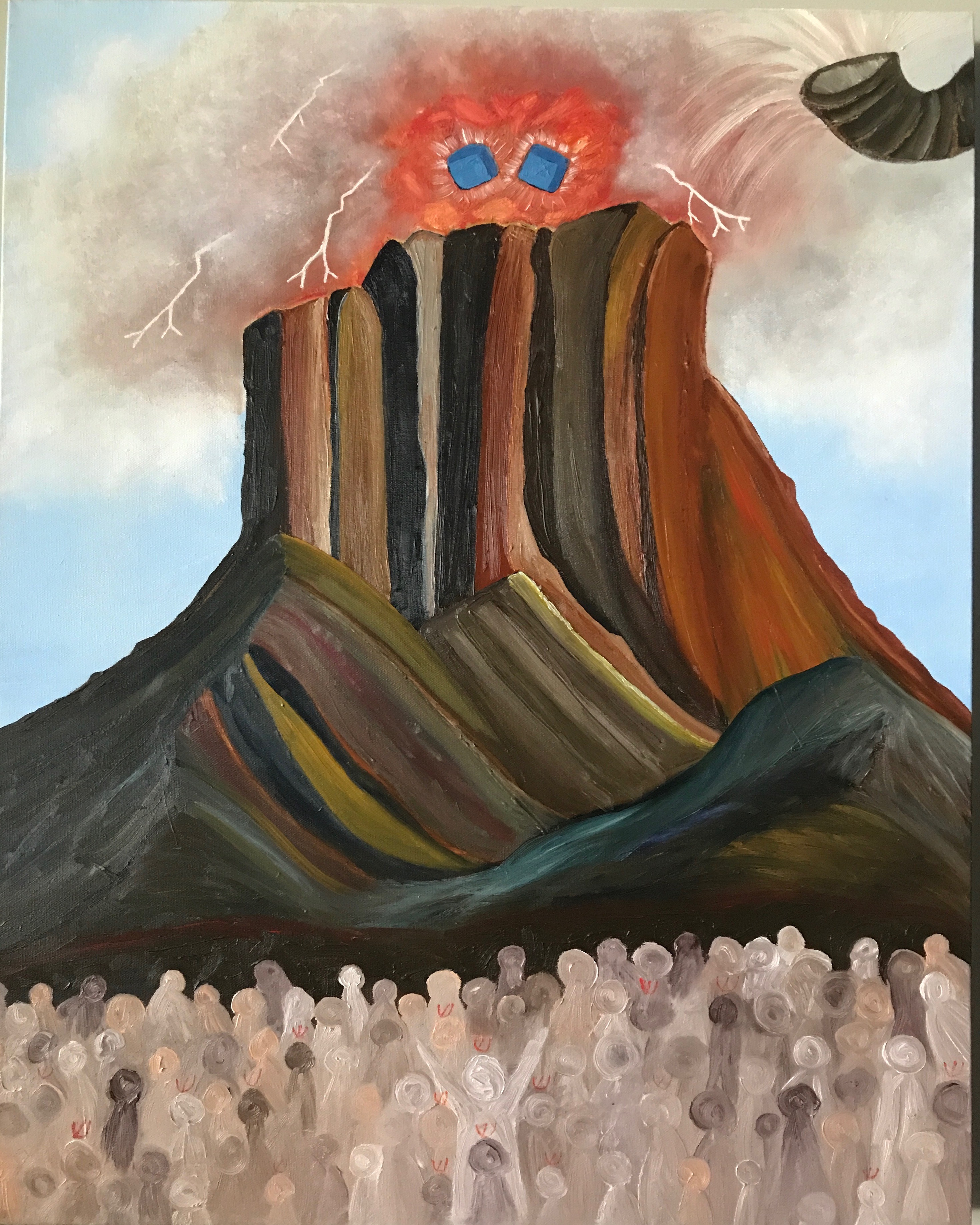
“Luchot HaBrit” Painting by Kisha Gallagher 2018

from the midst of the fire. We have seen this day that God speaks with man; yet he still lives.

David recalls this account this way:

2 Sam. 22:10-14 (NKJV) He bowed the heavens also, and came down with darkness under His feet. 11 He rode upon a cherub, and flew; and He was seen upon the wings of the wind. 12 He made darkness canopies around Him, dark waters and thick clouds of the skies. 13 From the brightness before Him Coals of fire were kindled. 14 “The LORD thundered from heaven, and the Most High uttered His voice.

 Ps. 18:9-11 (NKJV) He bowed the heavens also, and came down with darkness under His feet. 10 And He rode upon a cherub, and flew; He flew upon the wings of the wind. 11 He made darkness His secret place; His canopy around Him was dark waters and thick clouds of the skies.

 This kind of darkness depicts how God and His Throne are concealed from man. He is unknowable and difficult to perceive; and yet, He chooses to reveal Himself, His voice, His covenant, His Torah, because He loves us. The darkness that surrounds Him protects us from being consumed by the brilliance of His glory and righteousness.

Ps. 97:1-2 (NKJV) The LORD reigns; Let the earth rejoice; Let the multitude of isles be glad! 2 Clouds and darkness surround Him; Righteousness and justice are the foundation of His throne.

Seeds grow while buried in the darkness of earth. Beasts and mankind grow in the dark waters of the womb. Adonai, the Great Sower and Giver of Life, knows each one as they form and mature to sprout from the ground and burst from the womb. Dark places are where life grows!

Ps. 139:12-13 (NKJV) Indeed, the darkness shall not hide from You, But the night shines as the day; The darkness and the light are both alike to You. 13 For You formed my inward parts; You covered me in my mother’s womb.

Is. 45:3-7 (NKJV) I will give you the treasures of darkness And hidden riches of secret places, That you may know that I, the LORD, Who call you by your name, Am the God of Israel.

4  For Jacob My servant’s sake, And Israel My elect, I have even called you by your name; I have named you, though you have not known Me.

5  I am the LORD, and there is no other; There is no God besides Me. I will gird you, though you have not known Me,

6  That they may know from the rising of the sun to its setting That there is none besides Me. I am the LORD, and there is no other;

7  I form the light and create darkness, I make peace and create calamity; I, the LORD, do all these things.’

Hidden things, secret things, concealed things are all a type of darkness. These things are like treasures buried in the earth, formed by great heat and pressure, priceless jewels and metals awaiting the time that one will carve them out of the dirt, stones, and mountains. Once polished and cut to precision, what was once concealed in deep darkness shines and sparkles with the ability to refract glorious light. This is what good teachers, like the Chazal, do for us. They take what was a rough, dull, and cloudy stone, and turn into a prism that refracts the light into streams that we can glean from and understand, so we are transformed and renewed.

Dan. 2:22-23 (NKJV) He reveals deep and secret things; He knows what is in the darkness, And light dwells with Him. 23 “I thank You and praise You, O God of my fathers; You have given me wisdom and might, And have now made known to me what we asked of You, For You have made known to us the king’s demand.”

Is. 42:16 (NKJV) I will bring the blind by a way they did not know; I will lead them in paths they have not known. I will make darkness light before them, And crooked places straight. These things I will do for them, and not forsake them.

Do not fear the darkness. Do not fear the change that is in the air. Do not fear dreams of the night. This coming season is for digging into the dark depths to uncover what is concealed. Enter the dark cloud and let the Word wash and transform your face to reflect His glorious light.

Pr. 25:2-5 (NASB) It is the glory of God to conceal a matter (davar –word), But the glory of kings is to search out a matter (davar). 3 As the heavens for height and the earth for depth, So the heart of kings is unsearchable. 4 Take away the dross from the silver, and there comes out a vessel for the smith; 5 Take away the wicked before the king, and his throne will be established in righteousness.

This is the Eighth Day; an end and a beginning. The scroll of the davar (word) is rolled back to the Beginning. The cycle starts in the darkness in Genesis 1, and the erev of the year. But, it is faithful to the Creator’s rhythm of Light piercing the darkness, renewal, and revelation. Be altogether joyful!


[1]Consider Joel 2:2, Amos 5:18-20, Zeph. 1:15, also look up the revelation on Mt. Sinai, and the revealing of God’s Throne in the Book of Revelation. All involve darkness, clouds, and thunder.

Categories: Biblical Symbols, Moedim, new moon | Tags: , , , , , , , , , , , | 7 Comments

The Month of Etanim (7th Month)

1 Kings 8:2 (NASB) All the men of Israel assembled themselves to King Solomon at the feast, in the month Ethanim, which is the seventh month.

The above verse is the only instance in the Bible where the seventh month or Tishrei is called by another name, Etanim. Interestingly, the context is King Solomon dedicating the permanent House or Temple of YHWH. I used the adjective “permanent” intentionally. The Temple’s predecessor, the Tabernacle or Mishkan, was a moveable tent-like dwelling. It moved, and the people followed. In other words, the dwelling place of Adonai was first characterized by “movement.” This recalls the first instance of the Holy Spirit in Genesis one, where the Ruach moves or hovers over the faces of the waters. God is not stationary or static.

© Danflcreativo | Dreamstime.com

However, the Dwelling Place that Solomon built was a fixed structure, a Bayit, a House. Building Abba’s House was the dream of King David, the Beloved.

2 Sam. 7:1-2 (NASB) Now it came about when the king lived in his house, and the LORD had given him rest on every side from all his enemies, 2 that the king said to Nathan the prophet, “See now, I dwell in a house of cedar, but the ark of God dwells within tent curtains.”

David, the man that spent many years on the run from King Saul, was finally settled. He must’ve felt a pang of guilt that he, the representative of the Kingdom, lived in a beautifully appointed house, while God, the King of the Universe, dwelled in a simple tent. God tells Nathan the prophet to report back to David:

2 Sam. 7:5-7 (NASB) “Go and say to My servant David, ‘Thus says the LORD, “Are you the one who should build Me a house to dwell in? 6 “For I have not dwelt in a house since the day I brought up the sons of Israel from Egypt, even to this day; but I have been moving about in a tent, even in a tabernacle. 7 “Wherever I have gone with all the sons of Israel, did I speak a word with one of the tribes of Israel, which I commanded to shepherd My people Israel, saying, ‘Why have you not built Me a house of cedar?'”‘

YHWH is not at all disturbed by His circumstances. The word translated above as “moving about” is the Hebrew word halak. This text literally says, “I have been walking in a tent and a tabernacle.”[1] God is moving, even in the tent. I don’t know about you, but I’m thrilled to serve a God and King that MOVES and WALKS. He is not like the deaf and dumb idols of darkness.

But if that’s the case, wouldn’t building a “permanent” House for YHWH detract from this metaphor and the characteristic “movement” of the Holy Spirit from the beginning? After all, movement is the opposite of something permanent. Or is it?

Etanim is a significant term to use for the 7thmonth. I encourage you to read all of 1 kings chapter 8 for context, but also as a lesson for this season, the 7thmonth. Below, is Brown Driver Brigg’s definition of Etanim followed by Strong’s.

BDB Definition H388: איתנים ‘êythânı̂ym

Ethanim = “enduring”

1) seventh Jewish month, corresponding to modern Oct. to Nov.; so named because permanent streams still flowed.

Part of Speech: noun proper masculine A Related Word by BDB/Strong’s Number: plural of H386

Strong’s H388 אֵיתָנִים’êythânı̂ym Plural of H386; always with the article; the permanent brooks; Ethanim, the name of a month: – Ethanim. Total KJV occurrences: 1

Word Study H388

H386 אֵיתָןēytān: A masculine noun indicating strength, permanence, endurance. Figuratively, it describes the usual, constant position of a stream or sea (Exo 14:27).

Etanim is the plural of eytan. The verbal root means to endure or to continue. Obviously, King Solomon’s desire was for the House of YHWH to perpetually endure, just as God promised King David that his house (dynasty/throne) would continue or endure. Allusions to eternity begin to form with this one well placed word.

© Gijsvdabeele | Dreamstime.com

The number seven also alludes to something eternal. It is the number of rest, Shabbat, completion, and dedication of the House (Temple). In the 2 Samuel passage quoted above, David was at rest (7) when he desired to build Adonai a House (7). Likewise, when King Solomon dedicates the House of YHWH, he and Israel are also at rest (7).

1 Kings 8:55-56 (NASB) And he stood and blessed all the assembly of Israel with a loud voice, saying: 56 “Blessed be the LORD, who has given rest to His people Israel, according to all that He promised; not one word has failed of all His good promise, which He promised through Moses His servant.

The seventh day and the seventh month are figures of the Messianic Age and Kingdom. Thus, the fall feast days in this season are prophetic of the same. The definitions of Etanim are just another hint to this truth. Permanence, strength, and endurance are true descriptors of the King and His Kingdom. But Etanim is also associated with moving water.

Moving water. Movement AND perpetuity. Ever-flowing springs. Rivers of Living Waters. There is no contradiction. YHWH’s permanent, stationary House is also moving. Out from His Throne flow rivers of water. This is Etanim. This is the seventh month, the turn of the year when the traditional water pouring ceremony takes place. But there is more.

Where is the first mention of water? In the very beginning.

Gen. 1:1-4 (NASB) In the beginning God created the heavens and the earth. 2 The earth was formless and void, and darkness was over the surface of the deep, and the Spirit of God was moving over the surface of the waters. 3 Then God said, “Let there be light”; and there was light. 4 God saw that the light was good; and God separated the light from the darkness.

© Wavebreakmedia Ltd | Dreamstime.com

At the foundation of the world, there was water, deep waters.

Job 38:4-7 (NASB) “Where were you when I laid the foundation of the earth? Tell Me, if you have understanding, 5 Who set its measurements? Since you know. Or who stretched the line on it? 6 “On what were its bases sunk? Or who laid its cornerstone, 7 When the morning stars sang together and all the sons of God shouted for joy?

The fullness of the seventh month is not just about the end, it is also about the beginning, because they are one. When the foundations of the earth were laid, the sons of Elohim shouted for joy. “Shouted” in Hebrew is ruah, the root of t’ruah, as in Yom T’ruah, the feast of trumpets or shouting.

Wisdom was with Elohim even before the deep waters, and she too, celebrated creation.

Pro. 8:22-31 (NASB) “The LORD possessed me at the beginning of His way, Before His works of old. 23 “From everlasting I was established, From the beginning, from the earliest times of the earth. 24 “When there were no depths I was brought forth, when there were no springs abounding with water. 25 “Before the mountains were settled, Before the hills I was brought forth; 26 While He had not yet made the earth and the fields, Nor the first dust of the world. 27 “When He established the heavens, I was there, When He inscribed a circle on the face of the deep, 28 When He made firm the skies above, When the springs of the deep became fixed, 29 When He set for the sea its boundary so that the water would not transgress His command, When He marked out the foundations of the earth; 30 Then I was beside Him, as a master workman; And I was daily His delight, Rejoicing always before Him, 31 Rejoicing in the world, His earth, And having my delight in the sons of men.

© Maryna Kriuchenko | Dreamstime.com

Wisdom was rejoicing before YHWH. The Hebrew word for rejoice in the above verse is actually the word for laugh, shachak. In this context, her laugh was one of jubilation and celebration. It is used in a similar context in these verses:

Pro. 31:25 (TLV) Strength and dignity are her clothing, and she laughs at the days to come.

Jer. 30:18-19 (TLV) Thus says Adonai, “Indeed, I will return Jacob’s tents from exile, and have compassion on his dwellings… 19 Out of them will come thanksgiving and the sound of celebration. I will multiply them, so they will not decrease. I will also honor them, so they will not be insignificant.

 Jer. 31:4 (NKJV) Again I will build you, and you shall be rebuilt, O virgin of Israel! You shall again be adorned with your tambourines, And shall go forth in the dances of those who rejoice.

The verses above are prophetically speaking about the end; whereas Wisdom was doing the same at the beginning. In the seventh month, we are told to rejoice. I pray that we can truly celebrate with Wisdom’s shachak (laughter), and not the mocking spirit that this word can also indicate.[2]

When the exiles from Babylon returned to the Land, Rosh Hashanah or Yom T’ruah was the first feast that they celebrated. I believe this was prophetic of what is to come in a future ingathering. Notice that they are standing at the “Water Gate,” an allusion to returning to the creation waters, and the foundation, Torah.

Neh. 8:1-3 (NASB) And all the people gathered as one man at the square which was in front of the Water Gate, and they asked Ezra the scribe to bring the book of the law of Moses which the LORD had given to Israel. 2 Then Ezra the priest brought the law before the assembly of men, women and all who could listen with understanding, on the first day of the seventh month. 3 He read from it before the square which was in front of the Water Gate from early morning until midday, in the presence of men and women, those who could understand; and all the people were attentive to the book of the law.

The text records the response of the people:

Neh. 8:9-12 (NASB) Then Nehemiah, who was the governor, and Ezra the priest and scribe, and the Levites who taught the people said to all the people, “This day is holy to the LORD your God; do not mourn or weep.” For all the people were weeping when they heard the words of the law. 10 Then he said to them, “Go, eat of the fat, drink of the sweet, and send portions to him who has nothing prepared; for this day is holy to our Lord. Do not be grieved, for the joy of the LORD is your strength.” 11 So the Levites calmed all the people, saying, “Be still, for the day is holy; do not be grieved.” 12 All the people went away to eat, to drink, to send portions and to celebrate a great festival, because they understood the words which had been made known to them.

On the new moon of the 7thmonth, the people HEARD and UNDERSTOOD the Torah. They wept. I wonder how many exiles will not be able to hear or understand the Torah until YHWH gathers them again? And, I wonder even more if those that hear and understand the Torah now will respond as the Levites did.

© R. Gino Santa Maria / Shutterfree, Llc | Dreamstime.com

The Levites calmed and quieted the tears of these grieved souls. Then, they encouraged them to go eat, drink, share with others, and celebrate the feast! We could learn a few things from Nehemiah and Ezra. This was truly a new beginning, a new moon, and a new year for the people. This is Etanim!

Ps. 36:8-9 (NKJV) They are abundantly satisfied with the fullness of Your house, And You give them drink from the river of Your pleasures. 9 For with You is the fountain of life; In Your light we see light.

Beloved, I pray that you will celebrate the beginning and the end, the enthronement of Adonai, the creation, you as a new creation, and that you will shout with joy at the River of Life in the month of Etanim. To YHWH be the glory!


[1]By the way, this same form of halak, mithalek, is used in Genesis 3:8:

“They heard the sound of the LORD God walking in the garden in the cool of the day, and the man and his wife hid themselves from the presence of the LORD God among the trees of the garden.”

[2]H7832 שָׂחַקśāḥaq: A verb meaning to laugh; to celebrate; to rejoice; to mock. It refers to a strong expression of joy: of celebration (Jer 30:19); of making merry, rejoicing (2Sa 6:5, 2Sa 6:21; Jer 15:17); it means to play, to sport, to have fun (Psa 104:26). But it is often used in a context where ridicule or mockery is directed at someone or something (Jdg 16:25). It is used in parallel with mocking (Pro 1:26). Great kings mocked at lesser kings (Hab 1:10). Samson was forced to serve as a tragic comedian for the Phplistines (Jdg 16:27). It is used figuratively of wisdom personified, laughing, rejoicing at God’s creation (Pro 8:30-31). The teacher taught that there is a time for genuine laughter (Ecc 3:4). It has the sense of playing, enjoying life, in some contexts, especially in the prophet’s vision of a restored people of God (Zec 8:5). It means to sing and indicates singing women (1Sa 18:7). It means to play a sport, to hold a contest or a match (2Sa 2:14). In its causative stem, it means to cause laughter toward persons, to mock them (2Ch 30:10).

Categories: Moedim, new moon | Tags: , , , , , , , , , , , , | 6 Comments

Chodesh Elul 2018

This post is a little early for the upcoming month of Elul, but I have already transitioned my notes into an article. I look forward to hearing what Abba is telling you this year!

  • © Kisha Gallagher

    Month 6 (12thor last month on civil calendar)

  • Tribe: Gad, meaning “an invading troop”
  • Mazel: Betulah or Woman, the Virgin or Virgo
  • Sense: Action To act requires both thought and deed. It connects the head (thought/speech) to the arm/hand (fruit/deeds) and the feet (one’s walk).

Questions to ponder from last month, Av:

  1. Did you fight major spiritual warfare from Tammuz 17th– Av 9th?
  2. Were these battles particularly to prevent some type of destruction in a family, assembly, physical body, or physical house (all types of the Temple)?
  3. Did you experience a shift or release after the 9thof Av (Tisha B’Av)?
  4. Have you experienced some comfort from the Father (doesn’t mean that the test or trial is over) on or after the 15thof Av (Tu B’Av)?
  5. Were you tested in “hearing”? (See this post for clarity.)

Chodesh Elul

As the sixth month, expect to see parallels to day six of creation, and other implications of six. See my post on numbers, for more themes that relate to the number six.

Just as Friday, the sixth day, is the preparation day for the coming seventh day Shabbat, Elul, the sixth month, is the preparation for the seventh month, Tishrei. Not surprisingly, the sense for the month of Elul is action. One needs to act. And, one acts out what they really believe. Preparation certainly requires action in thought, word, and deed.

© Pascal Deloche | Dreamstime.com

This is the month to prepare for the upcoming High Holy Days and Sukkot. While it is necessary to make physical arrangements to celebrate the fall festivals, the primary preparation is inward and spiritual, one of the heart.

The idea of organization and preparation correlates perfectly with the tribe of Elul: Gad. Gad was the seventh son born to Jacob. Seven is the letter zayin, which looks like a plowshare or a sword. Shabbat and other sevens are tools for harvest AND instruments of war. Gad means “an invading troop.” Compare the blessings of Jacob and Moses for this tribe:

Gen. 49:19 (TLV) Gad—attackers will attack him, but he will attack their heels.

Dt. 33:20-21 (TLV) For Gad he said, ‘Blessed is the one who enlarges Gad. Like a lion he crouches, and tears off an arm or even the crown of a head.  21 He chose the best for himself, for there a marked portion was reserved. He came with the heads of the people. He carried out Adonai’s justice and His judgments for Israel.’

Gad is tribe of war. 1 Chronicles 5:18 describes them as “men who bore shield and sword and shot with bow and were skillful in battle.” It requires great preparation and organization to amass a troop and train them for combat. Gadites know where to strike, because they have trained well. They attack the heel (lower nature/nephesh/appetites/ego), the arm (deeds/power/strength), and the head (the source, leader, authority). When David fled from King Saul, the mighty men of Gad joined him in the wilderness. 1 Chronicles 12:8 describes them this way:

From the Gadites there came over to David in the stronghold in the wilderness, mighty men of valor, men trained for war, who could handle shield and spear, and whose faces were like the faces of lions, and they were as swift as the gazelles on the mountains. (NASB)

How does the month of teshuvah or repentance relate to this aspect of the tribe of Gad? Each day of this month, leading up to Yom Kippur is a training day. There is a battle, but it is not necessarily with an external enemy. The preparation of Elul is a time to search the depths of one’s heel (nephesh), arm (power- intentions and actions), and head (are you at the helm or is Elohim?).

Such great battle tactics might seem excessive for searching or judging one’s self, but in my experience (both personal and observing others) SELF is the last place most people desire to search, examine, and judge. It’s much easier to point the finger and blame others or one’s circumstances for bad behavior. This is the question that six (especially day six of creation) asks of us. Are you a beast or are you a man/woman made in the image of Elohim? In the sixth month, the same question is posited as one prepares for the High Holy Days.

Banner of Gad © Pascal Deloche | Dreamstime.com

Last month (Av), we mourned the destruction of the Temple, the House of God. The second Temple was destroyed because of “baseless hatred among brothers.” The political climate in the U.S. is alarming. How people treat others in general is out of control. The golden rule has been left in the dust. It is time to consider what we say (or type) about other people, regardless of their actions or words. This isn’t a call to stick one’s head in the sand or to subvert justice; rather, it is a call to treat other people (even enemies) as those made in the image of Elohim. They are His shadow in the earth, even when they aren’t acting like it. We can speak of and to them with honor and respect, and do so without condoning a wicked behavior.

I’m working on a series about lashon hara, or proper speech. The mouth or tongue is an unruly member that can quickly send one on a spiral of chaos and destruction. With the tongue (or keyboard), we have become murderers, accusers of the brethren. During Elul, we have an opportunity to make amends with those we have offended before we reach the altar on Yom Kippur.

Mat. 5:21-24 (TLV) “You have heard it was said to those of old, ‘You shall not murder, and whoever commits murder shall be subject to judgment.’ 22 But I tell you that everyone who is angry with his brother shall be subject to judgment. And whoever says to his brother, ‘Raca’ shall be subject to the council; and whoever says, ‘You fool!’ shall be subject to fiery Gehenna. 23 “Therefore if you are presenting your offering upon the altar, and there remember that your brother has something against you, 24 leave your offering there before the altar and go. First be reconciled to your brother, and then come and present your offering.

Lamentations says, “Let us examine and test our ways, and let us return to Adonai.” (3:40 TLV) That is the heart of Elul. Self examination, deep introspection, and yes, judging one’s own heart, is the 40 step process during the days of teshuvah. I wonder if we can avoid looking at other’s sins for forty whole days while we clean our own house? This is true preparation for the seventh month, and also the “turn of the year[1]” on the civil calendar. It’s as if one is getting ready to enter a new time, a new realm, a new day… that’s because beginning with Rosh Hashanah (the Hidden Day), the head of the year[2], we are!

The Torah portions that fall during the month of Elul mirror this conclusion. They are Shoftim (Judges), Ki Tetze (When You Go Forth), Ki Tavo (When You Come In), and Nitzavim (Standing). Judges, when you go forth, when you come in, stand. These portions give disciples instruction for the Season of Teshuvah. (Collectively, this is Deuteronomy 16:18 – 30:20) The highlights from each section or portion[3], will inform a careful eye with the themes for the month Elul. These are things that you will battle with and walk through as you prepare for the fall feasts. Here is a sample:

  1. Adonai expects His people to set up righteous judges that will execute righteous judgement. The people are expected to obey their rulings.
  2. A prophet like unto Moses will arise, look for Him, but also beware of false prophets.
  3. Laws for cities of refuge and the accidental man slayer. (More on this below.)
  4. How to deal with false witnesses.
  5. Rules of warfare, mind the fruit trees (people), and respect the female captives.
  6. Laws concerning sexual immorality, and falsely accusing one’s virgin bride.
  7. Laws concerning divorce and levirate marriage.
  8. Offering firstfruits and tithes.
  9. Mount Ebal – curses and blessings.
  10. Covenant renewed at Moab.
  11. Repentance & Forgiveness
  12. Choice of Life or Death.

These portions cover a lot of territory, but if you look closely, they are a microcosm of our journey! The cities of refuge jumped out this year in relation to Elul. Three cities are to be in the Land He is giving them to possess and three more when He expands their territory for a total of six. Elul is the sixth month. In Chassidic teachings, Elul is the city of refuge in the yearly cycle. The thinking behind this is that we are ALL guilty of being a “man-slayer.” (Didn’t Yeshua say as much in Matthew 5:43-48? See also Proverbs 18:21) Whether we realize it or not, we have killed ourselves and others… with words. (Action)

It is in this season, a space in time if you will, that we contemplate past thoughts, words, and deeds, and rectify wrong doing through heartfelt repentance. In this safe place (in time), a city of refuge, one can truly get to know what is in their heart– the good, the bad, and the ugly. In tradition, the King is said to be in the field during Elul. This implies that He is approachable and near, not as a harsh judge on the throne, but as a loving and compassionate Father ready to receive His prodigal child. Thus, Elul is also called the month of mercy and the month of forgiveness.

What to Expect in Elul

© Artur Szczybylo | Dreamstime.com

There is warfare in Elul, but it should be with your own heart. Outside enemies (spirits) will seek to distract or divert one’s attention away from self-examination. This will be especially true on “social media.” Every year at this season, hot debates pop up with people making strong judgments (shoftim) about the “correct” calendar, the names, proper observance, fasting or not fasting on Yom Kippur, and more. Whether or not the intention is to flare up flesh and emotions, the result is the same. Be a Gadite! Don’t fall for it! The focus of these issues is NOT one’s heart and repentance or making amends between brothers. It is a deception. Reread the highlights of the Torah portions. The chaos will fall into one of those categories, and the portion teaches you how to deal with it.

In reality, the many outside distractions are a flimsy fig leave trying to cover the thing we all hate to deal with – self. The root problem is the same issue the first Adam had: Fear. Hearing the voice of Adonai walking in the garden strikes fear in the heart of those that know they are naked before Him. Don’t listen to the voice of fear.

Is. 54:4-5 (NASB) “Fear not, for you will not be put to shame; And do not feel humiliated, for you will not be disgraced; But you will forget the shame of your youth, And the reproach of your widowhood you will remember no more. 5 “For your husband is your Maker, Whose name is the LORD of hosts; And your Redeemer is the Holy One of Israel, Who is called the God of all the earth.

It’s the season to exchange the fig leave with a new garment provided by Adonai. Let the Holy Spirit do the work of refining, even with fire.

2 Cor. 5:1-5, 10 (NASB) For we know that if the earthly tent which is our house is torn down, we have a building from God, a house not made with hands, eternal in the heavens. 2 For indeed in this house we groan, longing to be clothed with our dwelling from heaven, 3 inasmuch as we, having put it on, will not be found naked. 4 For indeed while we are in this tent, we groan, being burdened, because we do not want to be unclothed but to be clothed, so that what is mortal will be swallowed up by life. 5 Now He who prepared us for this very purpose is God, who gave to us the Spirit as a pledge… 10 For we must all appear before the judgment seat of Christ, so that each one may be recompensed for his deeds in the body, according to what he has done, whether good or bad.

Who doesn’t want to be washed and renewed to don fine white linen garments, like a virgin bride? Perhaps, this is why Adonai placed the betulah or virgin as the mazel to appear in the heavens at this season. The Bride makes herself ready (preparation) before the coming scales of justice in Tishrei (Libra).

© Moshe Chaim Katz | Dreamstime.com

In the Torah portions this month, there is a warning to those that falsely accuse a virgin bride. She has a cloth garment with the evidence of blood that proves she is innocent. Beloved, if you are Messiah’s, so do you. BUT, so is your believing/faithful neighbor, even if you disagree on certain points of halachah. Be careful with your accusations. It is the duty of the Ruach HaKodesh to bring each to the place of groaning as He refines one as heavenly gold. No one gets to escape His process of sanctification, which is the point of the festivals. Have compassion for one another as we travail together.

Virgin daughters of Zion, your King is Coming to you! May your righteous acts, the sense for the month of Elul, be bright and clean fine linen at His return at the fall feasts!

Rev. 19:6-9 (NASB) Then I heard something like the voice of a great multitude and like the sound of many waters and like the sound of mighty peals of thunder, saying, “Hallelujah! For the Lord our God, the Almighty, reigns. 7 “Let us rejoice and be glad and give the glory to Him, for the marriage of the Lamb has come and His bride has made herself ready.”  8 It was given to her to clothe herself in fine linen, bright and clean; for the fine linen is the righteous acts of the saints.  9 Then he *said to me, “Write, ‘Blessed are those who are invited to the marriage supper of the Lamb.'” And he *said to me, “These are true words of God.”

For more on Elul:

Elul

The Vinedresser, the True Vine, and the Branches

A Woman Will Encompass (Eclipse) a Man


[1]How do we know that the turn or change of the year occurs in the fall? Ask Moses. He gives at least five witnesses (see 5thone in footnote 2):

Ex. 23:16 (KJV)  And the feast of harvest, the firstfruits of thy labours, which thou hast sown in the field: and the feast of ingathering, which is in the end of the year, when thou hast gathered in thy labours out of the field.

Ex. 34:22 (TLV) “You are to observe the Feast of Shavuot, which is the firstfruits of the wheat harvest, as well as the Feast of Ingathering at the turn of the year.

Dt. 14:28 (NASB)  “At the end of every third year you shall bring out all the tithe of your produce in that year, and shall deposit it in your town. (Context of previous verses places this in the fall.)

Dt. 31:10-11 (NASB)  Then Moses commanded them, saying, “At the end of every seven years, at the time of the year of remission of debts, at the Feast of Booths,  11  when all Israel comes to appear before the LORD your God at the place which He will choose, you shall read this law in front of all Israel in their hearing.

[2]For those that take issue with the use of the Rabbinical idea of the Feast of Trumpets being dubbed Rosh Hashanah, please see the above footnote. Two of the quotes are from the book of Exodus, which also tells us:

Ex. 12:1-2 (KJV) And the LORD spake unto Moses and Aaron in the land of Egypt, saying, 2 This month shall be unto you the beginning of months: it shall be the first month of the year to you.

Verse two doesn’t call Nisan or Aviv the “Head of the Year” or “Rosh Hashanah.” Instead, it calls Nisan the “Head of the Months” or “Rosh Chodeshim.” It shall be the first (rishon) month (chodesh) of the year (shana) to you. I know this irks the Greek, western mindset. I know this because it used to irk me too, lol. But Abba has broadened my understanding, especially with seeming paradoxes such as this. Regardless of your stance on this topic, it is perfectly acceptable in Hebraic thought and in Biblical interpretation to believe (like classic Judaism) that Adonai continued to mark the “year’s” turn or change in the fall, as Moses goes on to do in Exodus 23 and 34 and in Deuteronomy 14 and 31. One can believe this and yet still believe that He marked the head or start for the months in the spring. The four verses in footnote 1 and the Yovel (Jubliee –Lev. 25:8-11) beginning on Yom Kippur, all point to the change and renewal of the shanim (years) in the fall, or seventh month. The question isn’t which is it, spring or fall; rather the answer is yes – both! I love Hebrew thought! It’s so freeing! If this is struggle for you, I pray that your heart and mind are enlarged like Gad.

[3]I love the outline that First Fruits of Zion creates for the weekly Torah portions: https://torahportions.ffoz.org/torah-portions/. (If you use their outline, there is a mistake/typo with Nitzavim as of this writing. The outline listed is actually for the following portion, Vayelech.)


Categories: Moedim, new moon, Torah Portions | Tags: , , , , , , , , , , | 12 Comments

Chodesh Av 2018

I wanted to get this posted at the beginning of the month of Av, but I’ve been too busy to edit! Every year as I am intentional about celebrating the Moonthly Cycle, Abba has me focus on a particular area, a lot of which is not in my book on celebrating the New Moon. I plan to share my monthly notes from our local gatherings with you, but changing my notes to a blog post that makes sense to a reader requires quite a bit of editing. Better late than never! 

          © Kalina Vova | Dreamstime.com

Chodesh Av

  • Month: Five (11th month on civil calendar)
  • Tribe: Shimon
  • Sense: Hearing
  • Seasons/Feasts: Three Weeks (Dire Straits – from Tammuz 17 to Av 9), Transition by Tu B’Av (Av 15), Fast on Av 9.
  • Theme: From destruction and mourning to comfort and joy, especially in relation to the House of Adonai.

Month five has correlations with day five of creation. That is the day that the birds and fish were created to swim and fly through the wind and water currents of the earth. These are also those that rapidly spread Seed from continent to continent. Seeds can be likened to words or even THE Word. Words can destroy or words can bring Good News, a comfort to the world. In the following offering, see if you can pick out the themes of day five of creation.

Months four and five are connected by the Three Weeks. The sense of Tammuz was sight/seeing/vision, and the sense of Av is hearing/listening. Let’s consider the differences. The sense of seeing is more akin to having spiritual vision or being able to “see” the truth and promises of God despite what one’s circumstances and natural vision suggests. (Ex. The evil report of the ten spies. Joshua and Caleb saw the same thing as the other spies; and yet, Caleb declared, “Let us go up at once and take possession, for we are well able to overcome it.”   [Num. 13:30, Jos. 14:6-15])

This implies that we will face spiritual forces, like giants that have fortified cities, which are people and circumstances that are much stronger than we are during Av (beginning in Tammuz). And yet, the lesson to be learned is to choose to believe the promises of YHWH despite what one sees or hears in the natural. The One in you is stronger than any enemy or circumstance. Fear not.

In light of that, I have a few questions for you to ponder from last month.

  1. How many of you were tested in the sense of “seeing” during the month of Tammuz?
  2. What giant did you face?
  3. What enemy within a fortified (strong) city sought to discourage you?
  4. Based on the Torah portions of Tammuz, did you struggle with proper or improper authorities?

From Seeing to Hearing

Gen. 29:33 (NASB) Then she conceived again and bore a son and said, “Because the LORD has heard that I am unloved, He has therefore given me this son also.” So she named him Simeon.

Shimon means to hear, shema. “We will hear and we will do.” The irony of the sense of seeing coming before hearing in the months is that we cannot see without hearing first. Even a baby in the womb hears before he sees. Biblical or Spiritual vision is the ability to see what is heard: the WORD of YHWH.

       © Nipa74 | Dreamstime.com

What voice have you been listening to? Protect your ears! When things “look” bad in the natural do you hear a voice that says that you deserve calamity? That says, you are worthless, that you are not good enough, that you are UNLOVED by your Husband, like Leah?

If so, it’s time to give birth to Shimon. Adonai hears you, you must hear Adonai. In the Torah, Simeon and Levi act rashly with their swords on account of their sister Dinah. This cost each of these tribes a true portion or inheritance in the Land. They would be scattered in Israel. (Gen. 49) Thus, patience and waiting for the authority over us to give instruction is a test in one’s “hearing.” Just because you know something, doesn’t mean you have the authority to be the judge and executioner. A much better example of a godly Shimon is found when baby Yeshua is presented in the Temple or House of Adonai:

Luke 2:25-35 (NASB) And there was a man in Jerusalem whose name was Simeon; and this man was righteous and devout, looking for the consolation (comfort) of Israel; and the Holy Spirit was upon him.  26 And it had been revealed to himby the Holy Spirit that he would not see death before he had seen the Lord’s Christ.  27  And he came in the Spirit into the temple; and when the parents brought in the child Jesus, to carry out for Him the custom of the Law,  28  then he took Him into his arms, and blessed God, and said,  29  “Now Lord, You are releasing Your bond-servant to depart in peace, According to Your word;  30  For my eyes have seen Your salvation,  31  Which You have prepared in the presence of all peoples,  32  A LIGHT OF REVELATION TO THE GENTILES, And the glory of Your people Israel.”  33 And His father and mother were amazed at the things which were being said about Him.  34 And Simeon blessed them and said to Mary His mother, “Behold, this Child is appointed for the fall and rise of many in Israel, and for a sign to be opposed—  35 and a sword will pierce even your own soul—to the end that thoughts from many hearts may be revealed.”

In the above passage, there is a righteous man named Simeon, one who hears. Simeon believed what he HEARD. Go back and look at the bolded and underlined words and phrases above. Do you “see” the words associated with hearing and seeing? Shimon was LOOKING for the consolation of Israel, that is their comfort, which ties perfectly into the themes of the Three Weeks, and the consolation of Tu B’Av. By following the moonthly cycle, we practice and prepare for this flow of time (that is, was, and is to come) in the seasons each year. Consider these verses:

Jer. 31:9-14 (NASB) “With weeping they will come, and by supplication I will lead them; I will make them walk by streams of waters, on a straight path in which they will not stumble; For I am a father to Israel, And Ephraim is My firstborn.”  10 Hear the word of the LORD, O nations, and declare in the coastlands afar off, and say, “He who scattered Israel will gather him and keep him as a shepherd keeps his flock.” 11 For the LORD has ransomed Jacob and redeemed him from the hand of him who was stronger than he.  12 “They will come and shout for joy on the height of Zion, and they will be radiant over the bounty of the LORD—Over the grain and the new wine and the oil, and over the young of the flock and the herd; And their life will be like a watered garden, and they will never languish again. 13 “Then the virgin will rejoice in the dance, And the young men and the old, together, For I will turn their mourning into joy and will comfort them and give them joy for their sorrow.  14 “I will fill the soul of the priests with abundance, And My people will be satisfied with My goodness,” declares the LORD.

 From weeping and mourning to consolation and joy. That is the connection between Tammuz and Av. We should expect our own walk each year to reflect the same. Simeon’s reward for believing and obeying – true HEARING-  the Word of God was that he could SEE the Comforter, Yeshua, the Consolation of Israel. And even then, the revelation was not complete as we are still awaiting His return and the fullness of the passage above. Until then, we practice. We remember. We see, and we hear.

Destruction of the House

Closely related to the above is remembering the destruction of the Temple, mourning its loss, and believing for its renewal. Thus, I offer a little review. According to tradition, the first Temple was destroyed because of idolatry, and the second Temple was destroyed on account of baseless hatred among brothers. Essentially, this is God’s people breaking the two greatest commandments of loving Him and our neighbor as ourselves. Not doing so, destroys His House and ours!

            © Liorpt | Dreamstime.com

Since Tammuz 17th marks the beginning of the Three Weeks leading up Tisha B’Av (9thof Av), the date that both Temples were destroyed, we should expect to have tests and trials in this area, at this season.

What is the “House” or “Temple”?

  • The Body of Messiah
  • Our physical bodies
  • The Temple Mount/Zion/place of physical Temple
  • Your family
  • Your Assembly

Were any of you tested (or still being tested) in one of these areas? Have you been in a battle to keep these things from being destroyed? What is the purpose in this testing?

The Hidden Goodness in Av

When we see war, calamity, destruction, and unfavorable circumstances with people or life in general, we have a choice to make. If God is truly for us, and we really believe that, then we must adjust our vision, outlook, and attitude to align with the Good News that we have HEARD.

Ps. 119:91-92 (NASB) They stand this day according to Your ordinances, For all things are Your servants.  92 If Your law had not been my delight, Then I would have perished in my affliction.

 Mat. 19:26 (NASB) And looking at them Jesus said to them, “With people this is impossible, but with God all things are possible.”

 Eph. 1:11 (NASB) also we have obtained an inheritance, having been predestined according to His purpose who works all things after the counsel of His will

Do we really believe that ALL things are in God’s hands and control? That even the bad and hard things serve His purposes and are meant for our good, BECAUSE He loves us? There is a story in the Mishnah about a certain Rabbi called Nahum Gamzu that can help one adjust their attitude. I’ve written in other places about the month of Av being referred to as Menachem Av, or Comforting Father. The rabbi in the story below shares this name, Nachum, comforter. It is meant to not only redirect one’s vision or perception of life’s circumstances, but bring one consolation or comfort.

The Gemara inquires: And why did they call him Naḥum of Gam Zu? The reason is that with regard to any matter that occurred to him, he would say: This, too, is for the good [gam zu letova]. Once, the Jews wished to send a gift [doron] to the house of the emperor. They said: Who should go and present this gift? Let Naḥum of Gam Zu go, as he is accustomed to miracles. They sent with him a chest [sifta] full of jewels and pearls, and he went and spent the night in a certain inn. During the night, these residents of the inn arose and took all of the precious jewels and pearls from the chest, and filled it with earth. The next day, when he saw what had happened, Naḥum of Gam Zu said: This, too, is for the good.

When he arrived there, at the ruler’s palace, they opened the chest and saw that it was filled with earth. The king wished to put all the Jewish emissaries to death. He said: The Jews are mocking me. Naḥum of Gam Zu said: This too is for the good. Elijah the Prophet came and appeared before the ruler as one of his ministers. He said to the ruler: Perhaps this earth is from the earth of their father Abraham. As when he threw earth, it turned into swords, and when he threw stubble, it turned into arrows, as it is written in a prophecy that the Sages interpreted this verse as a reference to Abraham: “His sword makes them as the dust, his bow as the driven stubble” (Isaiah 41:2).

There was one province that the Romans were unable to conquer. They took some of this earth, tested it by throwing it at their enemies, and conquered that province. When the ruler saw that this earth indeed had miraculous powers, his servants entered his treasury and filled Naḥum of Gam Zu’s chest with precious jewels and pearls and sent him off with great honor.

When Naḥum of Gam Zu came to spend the night at that same inn, the residents said to him: What did you bring with you to the emperor that he bestowed upon you such great honor? He said to them: That which I took from here, I brought there. When they heard this, the residents of the inn thought that the soil upon which their house stood had miraculous powers. They tore down their inn and brought the soil underneath to the king’s palace. They said to him: That earth that was brought here was from our property. The miracle had been performed only in the merit of Naḥum of Gam Zu. The emperor tested the inn’s soil in battle, and it was not found to have miraculous powers, and he had these residents of the inn put to death. – Taanit 21a

 If we want to transition to the comfort of Av, or find the joy that comes after mourning, we must be able to “see” the world with eyes like Nachum Gamzu. Can we really say, “This, too, is for the best”? In every situation? Even the bad ones?

We currently see only dimly. We must mourn destruction and exile (both physically and spiritually). But we must also try to “hear” the goodness that is hidden in the bitterness of any destruction we encounter in this life and KNOW that Mashiach will come to comfort us, One Day showing us how “this too was really for the best.”

Paul mirrors this sentiment in Second Corinthians. Tu B’Av or the fifteen of Av just passed a few days ago on the calendar. I hope that you are beginning to see the Light after a period of darkness and heavy trials. Be encouraged dear one, in ALL things, rejoice, O daughter of Zion, for your King is Coming to you!

And in ALL things, be able to say, “Gam zu l’tovah!” (This, too, is for the good!)


            © Samrat35 | Dreamstime.com

2Co 4:7-18 (NASB) But we have this treasure in earthen vessels, so that the surpassing greatness of the power will be of God and not from ourselves; 8 we are afflicted in every way, but not crushed; perplexed, but not despairing; 9 persecuted, but not forsaken; struck down, but not destroyed; 10 always carrying about in the body the dying of Jesus, so that the life of Jesus also may be manifested in our body.  11 For we who live are constantly being delivered over to death for Jesus’ sake, so that the life of Jesus also may be manifested in our mortal flesh.  12 So death works in us, but life in you.  13 But having the same spirit of faith, according to what is written, “I BELIEVED, THEREFORE I SPOKE,” we also believe; therefore, we also speak, 14 knowing that He who raised the Lord Jesus will raise us also with Jesus and will present us with you.  15 For all things are for your sakes, so that the grace which is spreading to more and more people may cause the giving of thanks to abound to the glory of God.  16 Therefore we do not lose heart, but though our outer man is decaying, yet our inner man is being renewed day by day.  17 For momentary, light affliction is producing for us an eternal weight of glory far beyond all comparison, 18 while we look not at the things which are seen, but at the things which are not seen; for the things which are seen are temporal, but the things which are not seen are eternal.


*** By the way, those of you that decided to share your journal of the months with me, please feel free to email me at gracentorah@gmail.com with your monthly results. (I will not make you or your notes public.) Please do not include personal names or organizations when describing trials, issues, or circumstances. Thank you!


Categories: Moedim, new moon | Tags: , , , , , , , | 3 Comments

Blog at WordPress.com.