Monthly Archives: August 2013

Hoshiana!

Save us!

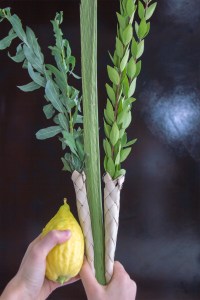
Spiritual Imagery of the Lulav & Etrog

© Dreamstimelirika
| Dreamstime.com


In Jewish tradition, the 7th day of Sukkot is called the “Great Hoshana (Hosanna)” or Hoshana Rabbah. There is a special Hoshana service on this day with song and chanted prayers. In the hands of each worshiper are the branches from “goodly” trees as Leviticus 23 commands. These branches are waved and shook as worshipers move in a procession shouting, “Hoshi a na!” This heartfelt cry is translated as “Save us now!”

The arba minim (branches/4 species/ lulav and etrog) are directly associated with this cry and the service prayers. We can see this type of exclamation by the Psalmist in Psalm 118: 25-26:

(Hoshi’ana) Save
now, I pray, O LORD;
O LORD, I pray, send now prosperity.
Blessed is he who comes in the name of the
LORD!
We have blessed you from the house of the LORD.

If we look carefully, we can see the relationship of the people waving palm branches[1] and crying “hosanna” when Yeshua rode into Jerusalem for Pesach (Passover). Although this custom was reserved for the season of Sukkot (Tabernacles), the people nonetheless were compelled to honor Yeshua in this manner.

The untrained eye may see the people’s reaction as disconnected; but, the real beauty of their demonstration is made clear in the simple recording of what Sukkot commemorates.[2] The fall moedim (feasts) look forward to the coronation of our Lord and King. Sukkot particularly portrays the culmination of our faith as it also looks back to the beginning of our redemption with the Pesach sacrifice. Yeshua IS the Lamb that was slain on our behalf and one day we will see Him crowned as our King! The following is the customary imagery attributed to the  arba minim. Examine each “species” carefully.


SPECIES TYPE IMAGERY
Etrog sweet taste & smell, (Citron- a citrus fruit that looks like a lemon) People who read Torah (the Word) and do good.
Lulav Sweet taste no smell (Date palm branches/ leaves) People who read Torah (the Word) but don’t do good.
Hadas no taste sweet smell (Myrtle branches/leaves) People who don’t read Torah (the Word) but do good.
ARaVah no taste or smell (Willow branches/leaves) People who don’t read Torah (the Word) or do good.

This seems to mirror the Parable of the Sower[3] and the four different types of soil or people. The Seed is the Word of God. The Sower is the Messiah. Therefore, the Sower and that which is sown are the same thing. Carefully examine the types of soil mentioned in this parable and compare them to the 4 species above.

Seed Type Imagery
1. Seeds fell by the roadside and birds ate the seed. Person doesn’t perceive the Word and the enemy steals anything that may have been sown in their heart. Aravah
2. Seeds fell on rocky places and they sprang up, but died due to lack of roots. Person receives Word with joy, but having no root (Yeshua, i.e.Life), affliction or persecution causes them to fall away. Hadas
3. Seeds fell among the thorns and the thorns choked the new seedlings. Person hears the Word, but the worries of the world or the deceitfulness of wealth chokes the Word, and it produces no fruit (no good deeds). Lulav
4. Seeds fell on good soil and produced 100, 60, and 30-fold. Person hears the Word, understands it and brings forth fruit (good deeds). Etrog

Clearly, the imagery of the Etrog (the fruit) and its Seed that fell on good soil are the “people” that we desire to be. We want to release a pleasing aroma, taste sweet in the mouth, and yield many more seeds that will produce the same fruit. That fruit and its beginning, the Seed, is Yeshua. When we are obedient to the Word, we are a living testimony of His goodness. If we’ve truly received the Seed, then we will naturally begin to produce the fruit!

2012-10-08 18.33.07

©Kisha Gallagher

Joshua Aaron has a beautiful song called Hoshiana:


[1] Mt. 21, Mark 11, Jn. 12. Read in context, this was clearly the time of Pesach (Passover).

[2] Lev. 23:39-44

[3] Mt. 13, Mark 4, Lk. 8

Categories: Moedim | Tags: , , , , , , , , | 4 Comments

Overcome by a Rainbow

© Kelly Headrick
| Dreamstime.com

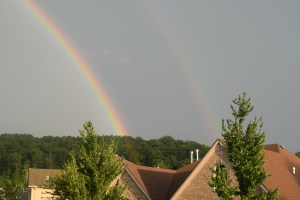
I can’t help myself. I have to explore the glorious rainbow a little further. I stumbled across a video on YouTube that left me speechless. The man’s reaction in the video is… contagious. His unbridled emotions upon seeing, or better yet, EXPERIENCING a double rainbow moved me so deeply that I have to extend this topic. PLEASE take the time to watch this 3 minute video and ask yourself if you’ve ever been so completely overwhelmed by God’s creation. I think the only time I’ve ever came this close was with the birth of a child.

Here is the link: http://www.youtube.com/watch?v=OQSNhk5ICTI

Did you notice his question? While overcome with the majesty of God’s bow, he kept repeating, “What does it mean?” This man realizes that the rainbow was placed in the heavens just for him. He is humbled and awed to TEARS. The wonderment he experiences overcomes him completely.

While I couldn’t see this double bow in all its vividness and glory due to the camera’s limitations, this man’s response was so passionate, so worshipful, that tears poured down my face as well. While my research has deeply affected my thoughts on rainbows, this man’s response will forever be etched into my soul.

We know what the rainbow “means.” It is the sign of Adonai’s covenant with us. It is a picture of God’s glory, His majesty, His essence. But perhaps even more striking is that it is the closest thing on earth to standing in His presence at His throne!

What will our response be when we stand in His presence? I think it will be similar to this man’s reaction to the rainbow, with one exception. Our response will be far more exuberant… wow. Even those that never knew the King of Glory in this life will buckle to the ground in awe and adoration. And they will be pierced through with what it all “means” and will also be screaming, “OH MY GOD!”

Categories: Biblical Symbols, Musings | Tags: , , | 6 Comments

Elul

(In 2013, Elul began on the evening of August 6th)

The Season of Teshuvah                                          
ID 22677036
© Katerinalin| Dreamstime.com

Elul is the 6th month on the biblical calendar; it precedes the 7th month of Tishrei that contains the yamim noraim, the Awesome Days, we often refer to as the High Holy Days. Elul typically begins in August or September on the Gregorian calendar. In the year 2011, the 1st of Elul begins on the evening of August 30th. In Hebraic tradition, Elul begins the process of preparing ourselves for the coming yamim noraim (High Holy Days). While the traditions associated with Elul are not specified in the Bible, each custom has been carefully drawn from scripture to assist us in spiritual preparation for the upcoming Holy Days. The Word of G-d clearly admonishes us to be prepared for our coming King[1]. Therefore, it can only profit us to use every tool at our disposal.

 Mat 3:2-3  “Repent, for the kingdom of heaven is at hand.”  (3)  For this is the one referred to by Isaiah the prophet when he said, “THE VOICE OF ONE CRYING IN THE WILDERNESS, ‘MAKE READY THE WAY OF THE LORD, MAKE HIS PATHS STRAIGHT!'”

Elul is called “the month of repentance,” “the month of mercy,” and “the month of forgiveness.” It follows the two previous months of Tammuz and Av, traditionally the months of the two great sins of Israel, the sin of the golden calf and the sin of the spies.  There are exactly 40 days from Elul 1st until Yom HaKippurim (the Day of Atonement) in our yearly feast cycle. Tradition states that Moses’ first trip up to Mt. Sinai (Ex. 24:18) was on Shavuot (Pentecost) at the giving of the Ten Commandments. 40 days later, he smashes the tablets in response to the sin of the golden calf and then returns back up the mountain for an additional 40 days (Dt. 9:18,25) to plead for the lives of the Israelites on account of their sin. Moses returns a third time (Ex. 34: 28) for 40 days up the mountain to receive the second set of tablets on the 1st of Elul, returning on the 10th of Tishri, which is also Yom Kippur.

During Moses’ third 40 day period on the mountain, he requested to see to see YHWH’s glory (Ex. 33:18-23). And mercifully, YHWH complied, but with the stipulation, “You cannot see my face”. It was during this encounter that YHWH proclaimed His divine characteristics unto Moses. (Ex. 34: 6-7). Our Jewish brothers have broken these into the 13 attributes listed below.

Ex. 34:6-7  Then the LORD passed by in front of him and proclaimed, “The LORD, the LORD God, compassionate and gracious, slow to anger, and abounding in lovingkindness and truth;  (7)  who keeps lovingkindness for thousands, who forgives iniquity, transgression and sin; yet He will by no means leave the guilty unpunished, visiting the iniquity of fathers on the children and on the grandchildren to the third and fourth generations.”

1. YHWH! –G-d is merciful even before a person sins. Even though He is aware that future evil lies dormant within him.
2. YHWH! –G-d is merciful even after the sinner has gone astray.

3. G-d (El)–a title that denotes power as ruler over nature and humankind, indicating that G-d’s mercy sometimes surpasses even the degree indicated by this name.
4. Compassionate (rahum)—G-d is filled with loving sympathy for human frailty and does not put people into situations of extreme temptation, and eases the punishment of the guilty.
5. Gracious (v’hanun)—G-d shows mercy even to those who do not deserve it; consoling the afflicted and raising up the oppressed.
6. Slow to anger (ereh apayim)—G-d gives the sinner ample time to reflect, improve, and repent.
7. Abundant in Kindness (v’rav hesed)—G-d is kind toward those who lack personal worth, providing more gifts and blessings than they deserve; if one’s personal behavior is evenly balanced between virtue and sin, G-d tips the scales of justice toward the good.
8. Truth (v’emet)—G-d never reneges on His word to reward those who serve Him.
9.  Preserver of kindness for thousands of generations (notzeir hesed la-alafim)—G-d remembers the deeds of the righteous for the benefit of their less virtuous generations of offspring (thus we constantly invoke the merit of the Patriarchs).
10. Forgiver of iniquity (nosei avon)—G-d forgives intentional sin resulting from an evil disposition, as long as the sinner repents.
11. Forgiver of willful sin (pesha)—G-d allows even those who commit a sin with the malicious intent of rebelling against and angering Him the opportunity to repent.
12. Forgiver of error (v’hata’ah)—G-d forgives a sin committed out of carelessness, thoughtlessness, or apathy.
13. Who does NOT pardon (lo yenaḳeh )— This is considered a good quality, since through punishment man is moved to repentance, after which he is pardoned and pure. G-d is merciful, gracious, and forgiving, wiping away the sins of those who truly repent.

Since Moses was given the revelation of YHWH’s glorious traits during the month of Elul which precedes the Day of Judgment and Atonement, it has been customary to incorporate the reciting of the 13 attributes during Elul. It is said[2] that this is the month that “the King is in the field”, instead of His Royal Palace. Therefore, “everyone whosoever desires is permitted to meet him, and he receives them all with a cheerful countenance and shows a smiling face to them all.” Although G-d always watches over the world, and is always waiting for our “return,” He is more accessible during the 40-day period beginning with the start of Elul and culminating in the first ten days of the Month of Tishrei. Why? Because He is looking forward to the yearly appointments He has with us during the fall feasts. In order to come into His presence we must first turn (repent). He must be anxiously waiting to hear our voice; ready to forgive us and sweep us into His loving arms.

Hence, it is easy to see that the primary purpose and theme during these 40 days is teshuvah (repentance). We are sinners in need of redemption; we throw ourselves on the mercy of the gracious King and grab hold of His salvation (Yeshua). This way, when our yearly appointed time (moed) to meet our maker arrives, we have prepared ourselves for His coming. We submit ourselves before our King and right any wrongs to our fellowman and our Father. Both play dominate roles in Elul’s activities. Maybe you think that you have no need of repenting; you believe you have no sin. If so, I urge you to use this time to humble yourself, search your heart, and ask the Father to reveal any hidden sin in your life.

Customs

Blowing the Shofar

There are several customs that are designed to assist us in our humbling process and to lead us to teshuvah (repentance). In Jewish synagogues and transversely in Torah observant believer’s homes, the shofar (ram’s horn) is blown and heard as a call to repentance throughout the forty days of repentance. The shofar confuses HaSatan (the enemy), the prince and power of the air. When we blow the shofar, we release into the air (the enemy’s kingdom) a likeness of the voice of Yah[3]. This causes the enemy to scatter and confuses his camp. Likewise, it causes the faithful to come to repentance, calls us to battle, calls us to assemble, and will one day call us to resurrection[4]!

Reading Psalm 27

It has become a tradition to read Psalm 27 every morning and evening throughout the forty days of repentance. At first glance it may not be obvious as to why this particular Psalm was chosen; however, upon a close inspection, the motive becomes most transparent. The following rather long quote comes from an article on MyJewishLearning.com. Rabbi Benjamin J. Segal has offered us a brilliant and contemplative explanation on Elul and Psalm 27. (Emphasis mine)

“… The first three verses increase numerically: two parallel phrases of five [Hebrew]words each, then six, then seven (that number hinting at completion). There follows the central word of the psalm, One. Facing all these threats, the psalmist feels the peace of unity, and throughout this first half the reader senses no doubt, no real threat.

How strange it is that the second half of the psalm depicts a world so totally opposite. Here we find a desperate search, a constant request, a pleading before the Holy One (“do not hide Your face … do not thrust [me] aside … do not forsake me, do not abandon me”). The author is abandoned by parents and surrounded by enemies. At the apex of this section, the psalmist cries out in agony, with a sentence he cannot finish, for it depicts the worst of all: “Had I not the assurance that I would enjoy the goodness of the Lord in the land of the living ….”

Throughout the second half, the reader hears the echo of the central term: One. The psalmist cries out, demands, asks and pleads that his two worlds are one. I, the sufferer, depressed to the ultimate limits, am that same one who trusts, who is safe, who sits in the presence of the Lord.

Before we can approach repentance or the joy of the Holiday [fall feasts], we must honestly confront again our own faith and belief. Ever since our father Abraham, we have anticipated the rewards of God’s protection, but too often we have seen our trials and tribulations as challenges to our faith. The psalmist testifies once again that love of the Holy One is achieved, not by closing one’s eyes, but, even as with less significance loves, through effort, honesty, and open confrontation.

…The psalmist challenges us, for he did not hide from life’s troubles on one hand, and yet lives within a framework of faith on the other. Reciting this psalm demands that twice a day we struggle with ourselves and our faith, in expectation that we will arrive at the Days of Awe ready for repentance, ready to celebrate on the holiday with a full heart before the Lord…”

We can each find ourselves in David’s shoes and cry out this Psalm to our Maker. After meditating on these words day and night for forty days, one cannot help but find hope in our seemingly paradoxical human condition.

On the one hand, we trust YHWH with complete confidence in faith, but on the other hand we have another side at war with our faith. Our sin and/or the trials of life causes doubt to well up and threatens to overtake us. We cry out to Yah and plead that He hear our cry and never leave our side. In the end, we must realize that like David, we must take courage, look to, and wait upon YHWH. Aren’t these the very thoughts of the Apostle Paul?

Rom. 7:19-25  For the good that I want, I do not do, but I practice the very evil that I do not want.  (20)  But if I am doing the very thing I do not want, I am no longer the one doing it, but sin which dwells in me.  (21)  I find then the principle that evil is present in me, the one who wants to do good.  (22)  For I joyfully concur with the law of God in the inner man,  (23)  but I see a different law in the members of my body, waging war against the law of my mind and making me a prisoner of the law of sin which is in my members.  (24)  Wretched man that I am! Who will set me free from the body of this death?  (25)  Thanks be to God through Jesus Christ our Lord! So then, on the one hand I myself with my mind am serving the law of God, but on the other, with my flesh the law of sin.

This is what Elul and the forty days of repentance are all about. It is our preparation. Searching the depths of our own hearts and confronting the battle in our minds between our spirits and flesh, naturally brings us to repentance and thus prepared to boldly stand in our King’s presence at the moedim (appointed times/feasts).

Selichot Prayers

Another primary custom is to rise early and recite the Selichot, a series of penitential prayers and liturgy, up until Yom Teruah (Feast of Trumpets). Because YHWH showed favor to the children of Israel during this time (forgiving them of the sin of the golden calf) then, it is considered a favored time, and one in which our prayers are readily listened to and answered. We therefore say Selichot during this time, asking the Father for forgiveness and to find favor with us, so we can start the coming fall Holy Days in confidence.

The Selichot prayers are based on Moses’ 3rd trip up onto Mt. Sinai when YHWH revealed His primary characteristics, it has hints of Psalm 27, and tenderly refers to the Father as “Beloved” as in Song of Songs 6:3. We look to YHWH, for He is our salvation (Yeshua) and our Beloved. The following is a sample of the Selichot prayers.

May You forgive our iniquities and our errors and make us Your heritage. Forgive us, our Father, for we have erred; pardon us, our King, for we have willfully sinned; for You, my Adonai, are good and forgiving and abundantly kind to all who call upon You.

Let us lift our hearts with our hands to God in heaven. Let the groan of the prisoner come before You, as befits the greatness of Your power, release those condemned to die. To Yahweh our Elohim belong compassion and forgiveness, for we have rebelled against Him.

As a Father has mercy on his children, so YHWH, may You have mercy on us. Salvation (Yeshua) is YHWH’s, upon Your people is Your blessing. Selah. YHWH, Master of Legions, is with us, a stronghold for us is the God of Jacob, Selah. Yahweh, Master of Legions, praiseworthy is the person who trusts in You. YHWH, save (Yeshua)! May the King answer us on the day that we call.

O Elohim, You are known in Israel to be great. You are YHWH, our Father are You. Whenever we call upon You, draw us close; You are exalted and uplifted among us. You have done us favors despite our guilt, not because of our righteousness and the uprightness of our heart. Our Beloved, though we have been forsaken, redeem us for we are servants. Our sins have brought us to the point of disintegration; our soul is impatiently awaiting You. Where are Your earlier kindnesses with us—that were faithful forever and ever? We have borne anger and our strength has ebbed— O Elohim, do not rebuke us in Your anger.

Forgive, though our sins testify against us; help us, for we depend on You. Bend our stiff neck to be subservient to You, so that we can serve and honor You with love and reverence. Those who think of You have sanctified designated fasts, their awareness is too limited to request their needs. May their whispered prayer come to You, heal every person’s wound and pain. The voice of Jacob moans from Your depths, may You hear in heaven the abode of Your dwelling.

We have become guilty; we have betrayed; we have robbed; we have spoken slander; we have caused perversion; we have caused wickedness; we have sinned willfully; we have extorted; we have accused falsely; we have given evil counsel; we have been deceitful; we have scorned; we have rebelled; we have provoked; we have turned away; we have been perverse; we have acted wantonly; we have persecuted; we have been obstinate; we have been wicked; we have corrupted; we have been abominable; we have strayed; You have let us go astray.

We have turned from Your commandments and from Your good laws but to no avail. Yet You are righteous in all that has come upon us, for You have acted truthfully while we have caused wickedness. Inspire our heart to abandon the path of evil and hasten salvation (Yeshua) for us, as it is written by Your prophet: May the wicked one abandon his way and the vicious man his thoughts; may he return to Yahweh and He will show him mercy, and to our God, for He is abundantly forgiving.

Answer us, YHWH, answer us; answer us, our Elohim, answer us, our Father, answer us, our Creator, answer us; answer us, our Redeemer, answer us; answer us, You who searches us out, answer us; answer us, the faithful God, answer us; answer us… The merciful One Who answers the poor, may He answer us. The Merciful One who answers the brokenhearted, may He answer us. The Merciful One who answers the humble of spirit, may He answer us. O Merciful One, answer us. O merciful One, pity. O Merciful One, redeem. O merciful One, deliver. O Merciful One, have mercy on us—now, swiftly and soon.

While these prayers are an excerpt from a Sephardi siddur, and they don’t believe Yeshua is the Messiah, it is obvious to me that they know YHWH is the only Savior[5] and that there is no sacrifice in the sacrificial system for willful sin. Willful sin requires us to throw ourselves on the mercies of G-d. We can only find hope in His precious grace. This concept isn’t “new” to the Brit Chadashah (New Testament), it is a truth that runs from Genesis to Revelation. Therefore, may we also seek the Father on behalf of our Jewish brethren in this season to see YHWH’s salvation (Yeshua).

These prayers are very lengthy (as what is offered here is a small tidbit) and cover more areas of repentance than any one of us could recall in one sitting. How many believers do you know that diligently seek the Father with such devotion and detail on a regular basis[6]? These prayers aren’t “vain repetition” as some falsely accuse. Rather they are designed to aid us, to keep us focused, to keep our minds from wandering, to help us remember, and to help us repent.

We must not forget that YHWH is King and deserves reverence and respect. Many would go through extensive preparation to meet the president of the United States; learning proper ways to greet him, practicing proper etiquette in all areas of speech, dress, and manners. They would rearrange their schedules and obligations in order to have such an honored meeting.  How much more should we prepare to meet the King of Kings! The selichot prayers are one tool to help us in our endeavor.

I am my Beloved’s and my Beloved is mine     
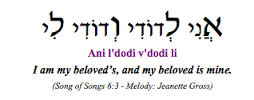
elul-3The four letters of the name Elul are an acronym for the initial letters of the phrase in the Song of Songs (6:3): “I am to my beloved and my beloved is to me.” “I am to my beloved” in repentance and complete desire to return to YHWH. “And my beloved is to me” with the Divine expression of grace found in His forgiveness.

Ani l’dodi v’dodi li (I am my Beloved’s and my Beloved is mine), is a common phrase on wedding bands and other religious articles. If we are YHWH’s, then we are His bride. He desires an intimate relationship with us; one as familiar as a man and wife. When we sin, we are breaking our wedding vows (covenant) to our husband. The penalty should be death, but our husband is merciful, praise YHWH!

He bore our punishment for us on the tree. This is the most merciful act in the history of the world! We would be hopeless without His sacrifice. The Word became flesh and dwelt among us, and offered Himself for us—-His Beloved! He didn’t do this to give us new wedding vows, but to renew the one’s we broke. His vows (commandments) were perfect the first time around. The problem wasn’t with the vows, but with us—-our hearts. He promises to give us new hearts; hearts with the vows (Torah) written upon them.[7]

As we seek Him during the days of Elul, may we never forget that He is our King and we shall treat Him as such—-with great fear and reverence, but He is also our Husband, our kinsmen Redeemer, and our Savior. He loves us fervently and desires us to return (repent) to Him and spend eternity in His arms.

Ideas for Celebrating the Forty Days of Repentance

  1. Blow the shofar daily, or at least hear a recording of the shofar blast online.
  2. Read Ps. 27 every morning and every night.
  3. Set aside fast days once or twice a week (not on Shabbat) if you are physically able
  4. Pray and seek the Father for repentance. Ask Him to reveal hidden sin, sins against Him and our brothers/sisters. Make amends with the people we may have intentional or unintentional offended
  5. If you have an orthodox siddur, find the selichot prayers (sometimes transliterated as selichos) and read through them in your prayer time or use the small excerpt in this writing as a guide for your own free-will prayer. It may be helpful to write your prayers to keep your focus on YHWH

[1] Is. 57:14-15;Mt. 25; and countless other places in the scripture

[2] Rabbi Schneur Zalman of Liadi

[3] Num. 10:9;  Judges 7: 21-22; Joshua 6:20; 2 Sam. 6: 15; Neh. 4:20; Ezek. 33: 3-6; Eph. 2:2; Rev. 1:10, 4:1

[4] 1 Thes. 4:16

[5] Is. 43:11

[6] These prayers are also used for days of fasting, which many Jews and Torah keepers do often, even weekly.

[7] Jer. 31:31-33; Hebrews 8: 8-12
Categories: Moedim | Tags: , , , , , , , | 10 Comments

The Light of the World Part III

Rainbows and the Throne of Glory

Rainbow Science

Before we look at the majestic rainbow in Scripture, let’s review what modern science teaches about this unparalleled display of “colorful” LIGHT. In order for a rainbow to occur, three particular criteria have to be met. The sun has to be shining “behind” you. A rain cloud or moisture in the air must be in “front” of you. And, the sun’s rays have to shine through the cloud at an anti-solar point of 42 degrees. (The anti-solar point is where the shadow of your head is)

When a beam of sunlight passes through a water droplet it slows down and spreads out, separating each color that makes up white light. The process of light refracting or bending can be more accurately described as the process of light changing speed as it moves through different densities. The reason why rainbows appear as an arc is because of the bending of and dispersing of light through millions of water droplets. The colors will always display in the same order due to the fact that each color has its own wavelength or intensity.

The most common rainbow is called a primary rainbow. It shows red on the outside with violet on the inside. Often this “bow” of light will have another larger but fainter arc above it. We typically call this a “double rainbow”, but scientists call it a secondary rainbow. The double bow occurs when the water droplets in the primary rainbow reflect light TWICE. Since it is the reflection of the primary bow, the colors are reversed. The “double” bow occurs at 50-53 degrees from your anti-solar point.


Adonai’s Rainbow

Gen. 9:11-17  “I establish My covenant with you; and all flesh shall never again be cut off by the water of the flood, neither shall there again be a flood to destroy the earth.”  (12)  God said, “This is the sign of the covenant which I am making between Me and you and every living creature that is with you, for all successive generations;  (13)  I set My bow in the cloud, and it shall be for a sign of a covenant between Me and the earth.  (14)  “It shall come about, when I bring a cloud over the earth, that the bow will be seen in the cloud,  (15)  and I will remember My covenant, which is between Me and you and every living creature of all flesh; and never again shall the water become a flood to destroy all flesh.  (16)  “When the bow is in the cloud, then I will look upon it, to remember the everlasting covenant between God and every living creature of all flesh that is on the earth.”  (17)  And God said to Noah, “This is the sign of the covenant which I have established between Me and all flesh that is on the earth.” (NASB)

The rainbow, according to the Creator, is THE sign of His covenant with every living creature that He will never again destroy all flesh with water. So…were their no rainbows before the flood of Noah’s day? Many Creation Scientists believe the evidence points to the possibility that before the flood it had never rained on the earth. For example, Walt Brown[1], director of the Center for Scientific Creation in Phoenix postulates that rain as we know it was unknown to preflood peoples[2]. If this theory is true, it would have been impossible for a rainbow to form “in the cloud” since there were no clouds. However, this question is not a new one. The ancient sages debated this among themselves for centuries and they likewise considered modern “science” of their day.

The Biblical commentator Ramban argued that a simple experiment proved easily enough that a rainbow is the result of light being refracted through water, which was enough proof in his mind that they were present from creation forward. He never believed that the verses we quoted above, upon close inspection, contradicted science. He states, “Whether the rainbow was created now or whether it had always been a part of nature, the reason for it representing the sign remains the same.”[3]

Regardless of whether rainbows existed pre-flood or not, the Creator plainly stated that it was AFTER the flood that He “set” His bow in the clouds as the SIGN of His covenant.

Keshet   קשׁת

The Bow and the Throne

In Biblical Hebrew, a bow as in “rainbow” and a bow as in a “bow and arrow” are the same word, keshet. The mindset behind this is similar to our English idea: they both BEND. In Noah’s day, Adonai sovereignly chose to judge the earth with a weapon or “bow” of water. Therefore, it is fitting that God chose the rain “bow” as the sign of His promise to never again judge the earth. The rainbow points toward heaven instead of earth as a sign of peace. Bible commentator John Gill puts it this way: “Though it is a bow, yet without arrows, and is not turned downwards towards the earth, but upwards towards heaven, and so is a token of mercy and kindness, and not of wrath and anger.”[4]

The Ramban (Nahmanides) has a similar idea for Adonai’s choice of a rainbow: “Ancient cultures fought their wars with the bow and arrow, and the side which surrendered, pursuing peace instead of war, would express their will to do so by raising an inverted bow that the enemy could see. Similarly, G-d places an inverted bow in the heavens as a sign that He is no longer warring against humanity.”

In most places, the word keshet denotes a bow of archery or the archers who handle bows. I could only find three[5] other references to the majestic seven colored rainbow in the Scriptures. In most of these verses, the bow is found surrounding the throne of the LORD. The first place is in Ezekiel’s vision of the FOUR living creatures. I highly suggest you read all of chapter one for context. Also, be sure to take note of all the words associated with light; there are many!

Ezek. 1:26-28  Now above the expanse that was over their heads there was something resembling a throne, like lapis lazuli in appearance; and on that which resembled a throne, high up, was a figure with the appearance of a man.  (27)  Then I noticed from the appearance of His loins and upward something like glowing metal that looked like fire all around within it, and from the appearance of His loins and downward I saw something like fire; and there was a radiance around Him.  (28)  As the appearance of the rainbow in the clouds on a rainy day, so was the appearance of the surrounding radiance. Such was the appearance of the likeness of the glory of the LORD. And when I saw it, I fell on my face and heard a voice speaking.

The vision must have been amazing! Can you imagine what this must have been like for Ezekiel? First, notice the reference to the “expanse” or as some translations say, the “firmament”. This should remind you of day 2 of creation when God placed an expanse or firmament between the heavenly and earthly waters. (Gen. 1:6-8) God’s throne and the One with “the appearance of a man” are seen ABOVE this “expanse.”

The One with the likeness of man is oddly described from His loins and upward and His loins and downward, yet both resemble fire – a form of LIGHT. This radiance is said to “surround” Him as a rainbow of colorful light. Thus, we can imagine that seeing Adonai is like seeing bright white light refracted into the 7 colors of the rainbow. Perhaps the color or refracted light is seen because our eyes cannot perceive His full nature as pure white (spiritual) light. It must be refracted, bent, or slowed down in order for our “eyes” to see it. This is something to think about. We must remember that the natural world teaches us spiritual truth.

The remaining two verses about Adonai’s throne and the rainbow are both found in the Book of Revelation.

Rev. 4:2-3  Immediately I was in the Spirit; and behold, a throne was standing in heaven, and One sitting on the throne.  (3)  And He who was sitting was like a jasper stone and a sardius in appearance; and there was a rainbow around the throne, like an emerald in appearance.

Rev. 10:1  I saw another strong angel coming down out of heaven, clothed with a cloud; and the rainbow was upon his head, and his face was like the sun, and his feet like pillars of fire.

In these verses, we get to explore the Greek word for rainbow, iris[6]. We get such words as iris, iridescent, iridium, and iridology from this Greek word. These cognates are named due to their association with a colorful appearance. What I find most interesting about this Greek word is that it is found one time in the Septuagint.[7] It is used in the recipe for the Holy Anointing Oil.

Ex. 30:22-25  Moreover, the LORD spoke to Moses, saying,  (23)  “Take also for yourself the finest of spices: of flowing myrrh five hundred shekels, and of fragrant cinnamon half as much, two hundred and fifty, and of fragrant cane two hundred and fifty,  (24)  and of cassia (iris) five hundred, according to the shekel of the sanctuary, and of olive oil a hin.  (25)  “You shall make of these holy anointing oil, a perfume mixture, the work of a perfumer; it shall be holy anointing oil.

So, the question becomes: What does the spice cassia have to do with an iris or a rainbow? The Hebrew word for cassia is kiddah and means to roll, shrivel, or contract. The spice is made from the bark of the cassia tree. Sections are rolled and dried from both sides toward the center so that they end up resembling scrolls. This rolling like a scroll is hint of creation day 2 and the expanse or firmament between the earthly and heavenly waters. One day instead of being stretched out (Is. 42:5) like a rainbow, the heavens will be rolled up like a scroll. (Is. 34:4, Rev. 6:14)

But our Hebrew word kiddah most often means bowing the head in worship or in great respect. (i.e. Gen. 24:26) Since Hebrew is a very action or verb based language, the verb form of kiddah gives us insight into why the Rabbis translating the Hebrew Tanakh into Greek chose this particular word in reference to the cassia spice.

Cassia is the FOURTH ingredient in the holy anointing oil. I don’t think it is a coincidence that the Rabbis used “iris” for “kiddah” in reference to the Holy Anointing Oil. Four is another picture of completeness or seven[8]. Yeshua the Messiah comes from the house of Judah, Jacob’s 4th son. He is the Anointed One standing in the midst of the 7 branched menorah, representing the Light of God[9]. If you read my previous two posts on the Light of the World, you also recall that the menorah is the perfect motif for not only the 7 Spirits of God, but also for light’s 7 forms in the electromagnetic spectrum and its 7 colors of visible light. The rainbow’s 7 colors is a perfect (natural) display of the splendor of His Kingdom and throne.

As a side note, this should really open our eyes to the blasphemy of His glory and Kingdom when the homosexual community uses this motif as a symbol of their rebellion. While it may appear bright and cheery, it is in reality a counterfeit wicked lamp[10] of darkness.

The Rainbow Was Upon His Head

In Revelation 10:1, we are told of a strong messenger with a rainbow upon his head. Some would envision something like a halo. But the halo doesn’t originate in Scripture. It comes from ancient sun god deities[11], the oldest form of false worship. Nevertheless, we have many places in the Bible where a shining or glowing light, even fire, emanates from either God or a person[12]. I freely admit that it is possible that this “rainbow” upon the messenger’s head in Revelation 10:1 may actually be similar to a halo. Please allow me to explain why.

A rainbow actually forms a full circle around the point directly opposite of the observer from the light source. Since the light source is usually the sun, the center of the circle is the anti-solar point (the observer’s shadow). Most often only a portion of the circle is above the ground so that the visible part is an arc or bow. When the observer is located at a considerably higher altitude, like an airplane or mountain top, the full circle of the rainbow can be seen. The picture below was taken while the observer was skydiving.


© Sureshcg1979
| Dreamstime.com

Could this circular rainbow be an allusion as to why Moses’ face shone with light after his encounter with YHWH on the mountain top? In other words, when Moses ascended up to that lofty point on the earth, his shadow didn’t block any of YHWH’s glorious light! Don’t we see this same marvel when Yeshua takes Peter, James, and John up to the mountain of transfiguration?

Mat. 17:1-6  Six days later Jesus took with Him Peter and James and John his brother, and led them up on a high mountain by themselves.  (2)  And He was transfigured before them; and His face shone like the sun, and His garments became as white as light.  (3)  And behold, Moses and Elijah appeared to them, talking with Him.  (4)  Peter said to Jesus, “Lord, it is good for us to be here; if You wish, I will make three tabernacles here, one for You, and one for Moses, and one for Elijah.”  (5)  While he was still speaking, a bright cloud overshadowed them, and behold, a voice out of the cloud said, “This is My beloved Son, with whom I am well-pleased; listen to Him!”  (6)  When the disciples heard this, they fell face down to the ground and were terrified.

Do you suppose that the faces of Moses and Yeshua were similar when they “shone”?

Ex. 34:29-30  It came about when Moses was coming down from Mount Sinai (and the two tablets of the testimony were in Moses’ hand as he was coming down from the mountain), that Moses did not know that the skin of his face shone because of his speaking with Him.  (30)  So when Aaron and all the sons of Israel saw Moses, behold, the skin of his face shone, and they were afraid to come near him.

I find it fascinating that in the natural, one must be at a high altitude, such as a mountain top in order to “see” a complete rainbow —- a picture of God’s covenant. I personally believe that the shining faces of both Yeshua and Moses would have been similar to the circular rainbow. Yeshua is the one standing in the “midst” of God’s menorah. He IS the Light of YHWH, but at the time of the transfiguration, He was not yet glorified. In other words, it is possible that the light was still “veiled” or refracted (bent or slowed down) and this enabled His disciples to perceive it — and Him.

A rainbow in all its fullness is not just a “bow” or arc, it is a circle! For those of you that have been studying the Hebraic mindset, this shouldn’t be too surprising. God and His creation, His calendar, and His Word are all cyclical in nature. Do you recall our first passage in Ezekiel with the living creatures? Earlier in chapter one, these beings are said to be powered by great sparkling “wheels” or circles.

Ezek. 1:15-20  Now as I looked at the living beings, behold, there was one wheel on the earth beside the living beings, for each of the four of them.  (16)  The appearance of the wheels and their workmanship was like sparkling beryl, and all four of them had the same form, their appearance and workmanship being as if one wheel were within another.  (17)  Whenever they moved, they moved in any of their four directions without turning as they moved.  (18)  As for their rims they were lofty and awesome, and the rims of all four of them were full of eyes round about.  (19)  Whenever the living beings moved, the wheels moved with them. And whenever the living beings rose from the earth, the wheels rose also.  (20)  Wherever the spirit was about to go, they would go in that direction. And the wheels rose close beside them; for the spirit of the living beings was in the wheels.

These shining wheels with rims full of eyes (a symbol of Adonai’s Spirit) are what powered or gave energy to the beings. This can be none other than Adonai’s Light, His Spirit that is symbolized beautifully in the 7 days of creation, the 7 Spirits of God (Is. 11:1-2), and in the 7 Feasts! This is why the 7 branched menorah and the 7 visible colors function as a LIGHT display. Creation Gospel students will instinctively perceive why there are 4 living creatures, for this is a picture of 7!

How fitting it is that the LORD chose a rainbow as the first[13] sign of the covenant with mankind and all the creatures of earth! There are more “types” of rainbows than I mentioned in this post. It is a fascinating subject to explore; I urge you to do your own research and see where it takes you. I hope we are all fortunate enough to see a rainbow very soon and take in all its symbolic glory! Imagine the shining faces of Moses and Yeshua and the gleaming Throne Room of the Most High. I leave you with a traditional blessing for when you do see one.

Blessing When Seeing a Rainbow

“Blessed are you, Adonai, our God, King of the universe, Who remembers His covenant, is trustworthy in His covenant, and fulfills His word.”

Related Post: Overcome by a Rainbow

Go back to Part I or Part II


[2] Article, “Did It Rain before the Flood? “ http://www.creationscience.com/onlinebook/FAQ29.html (7/31/13)

[4] John Gill’s Exposition of the Entire Bible, from my e-sword.org bible program on Genesis 9:13.

[5] Including the first rainbow of Noah’s day, this totals FOUR biblical references to the rainbow. Creation Gospel students will recognize once again that 4 is another picture of 7!

[6] Yes, in case you were wondering, our flower by the same name does come from this Greek word! It is aptly named because the iris flower grows in a “rainbow” of colors.

[7] The Septuagint is the Greek version of the Tanakh or Old Testament.

[8] Four also stands for the servant, government, authority, kingdom, the Feast of Shavuot (Pentecost), the door, and the fullness of the Holy Spirit. (For more information on why this is true please seek out a Creation Gospel trainer)

[9] Rev. 1:12-14  Then I turned to see the voice that was speaking with me. And having turned I saw seven golden lampstands;  (13)  and in the middle of the lampstands I saw one like a son of man, clothed in a robe reaching to the feet, and girded across His chest with a golden sash.  (14)  His head and His hair were white like white wool, like snow; and His eyes were like a flame of fire.

[10] Pr. 21:4  Haughty eyes and a proud heart, The lamp of the wicked, is sin.

[12] Ex. 34:29, Mt. 7:2, Mark 9:2, Heb. 1:3, Rev. 1:14-15, etc.

[13] While many theologians declare that YHWH’s first covenant was with Adam, Scripture doesn’t use the Hebrew word for covenant, brit, until Genesis chapter six with Noah. Many commentators assert that Noah’s covenant was merely an expanded form of God’s covenant with Adam, and perhaps this is true. Regardless of whether God’s first covenant was with Adam or Noah, the first SIGN of the covenant is the rainbow.

Categories: Biblical Symbols, Musings | Tags: , , , , , , , , , , , , , , , , , , , , , , , | 1 Comment

Blog at WordPress.com.