Posts Tagged With: women

The Biblical Role of Women Part IX

Role of Women Main Page

Builder or Destroyer?

In Part VIII, we looked at how men are the strong foundation of the House, but our focus was on women as “builders.” A woman builds with the Holy Spirit of Binah or understanding –discernment. (Is. 11:2) She builds upon the firm foundation of the Word, the Son of Man, and her husband. Once again, here is the Proverb’s verse that speaks to this:

The wise woman builds her house, But the foolish tears it down with her own hands. (Pr. 14:1)

Before we look at the first builders of the Torah and the Gospel, I would be remiss if I didn’t deal with the second half of this verse in Proverbs. If a woman is not a builder of the house, she can only be one other thing — a fool that “tears the house down with her own hands.” I’ve mentioned the duality found in the female before. Dr. Alewine deals with this concept extensively in her Creation Gospel workbooks.

In the Bible, we are often faced with two women, one righteous and one wicked. A Bride and a Harlot. The problem is that as humans, we have a difficult time discerning which is which. These women are easy to confuse if we are ignorant of the written Word, are immature in the faith, or if we operate in pride. (That latter one is nearly inescapable; we must diligently search our hearts for pride.)

But do not be deceived! Even a sincere follower of the God of Israel can confuse the two — just ask Judah about Tamar. One very important concept that will help us to grasp the difference between the two is to realize that when we are acting contrary to the Word of God, we ARE the harlot. It also may be helpful to research the term “harlot” in a concordance. Most of its references are used to refer to God’s wayward people. And much of the time, the people actually believed that they were righteous —everything was “okay” in their own eyes. We become the fools if we think it is any different for us today.

I believe this why our verse in Proverbs refers to the woman that “tears down” her house as a fool. She doesn’t realize what she is doing. A woman that tears down is actually a destroyer. Does this indicate who her master might be? It definitely reveals what “spirits” light her lamp. They are the seven abominations of Proverbs 6:16-19. If I’ve learned anything from studying the seven Spirits of God and the seven abominations, it is this: our hearts are desperately wicked. We are ALL capable of operating in the wicked lamp. (Pr. 6:16-19) Our “good intentions” can often just be a cover so that our flesh can get what it desires. But wisdom is still calling from every corner. She knows the Way to our freedom.

“Wisdom has built her house, She has hewn out her seven pillars.” (Pr. 9:1)

Wisdom’s seven pillars are the seven Spirits of God and the seven Holy Moedim (feasts). If you want to know what fuels your lamp, you must take an honest look at your own heart. This exercise must be an ongoing endeavor. The moment we think we’ve “arrived” or have it all figured out, is the moment pride (the first wicked spirit) has entered our hearts. Both the harlot and the righteous woman (wisdom) call to us daily. We must learn the difference between the two. One appeals to your desires, your lower nature. Her call is very pleasing and can be good. But like the tree of knowledge of good and evil — she cannot produce LIFE.

Keep the notion of the woman being a contranym (a word that can mean its own opposite) at the forefront of your mind. We will continue unpacking the duality of the woman throughout this series. For now, remember that as a woman you are either a builder or a destroyer. Men do not get to escape this duality, because both men and women are found within the woman, the wife, the harlot, the virgin, or the bride. At the end of our days, we will be revealed as righteous or wicked.

There is one other important point to grasp in this duality. It is not happenstance that God compares His people to a “woman.” Both men and women are meant to deal with the body like a mother deals with an infant. If tender mercies and nurturing the immature fails to shine through our Torah keeping, then we are not “builders.” How many young (new-to-Torah) in the faith have been “destroyed” by Torah terrorists? I suspect far too many. These “terrorists” may have a lot of “knowledge,” but they do not operate with the Holy Spirit of Da’at (sacrificial love). The Holy Spirit of Da’at is willing to die for wayward sheep like Moses and Yeshua. (Ex. 32:32; Rom. 5:8) The righteous or unrighteous stance of the people isn’t what mattered. They were willing to die for those even in their sin. The question is: are you?

How far are you willing to go? Will you leave the 99 sheep to rescue the one? Can you reserve judgment when necessary? Do you know the difference? There is not a black and white answer to these questions. God is love. Binah (the Spirit that builds the House) requires you to discern the difference between compromise and love. Our lower (nephesh/flesh) nature will choose judgment and justice over mercy every time. It likes to point the finger. It secretly relishes in condemning others. It’s much easier to be a destroyer. But beloved, you are called to build! You can be LONG suffering and merciful without compromising, never let anyone tell you any different.

If you struggle with your past, bad circumstances, pain, contentment, depression, self-pity, or the like, my article  Repairer of the Breach will offer some realistic solutions to repair or rebuild what has been breached.

Key #1 You are either a builder or a destroyer of God’s House. 
Often, the difference is difficult to discern.

Women, the First to Receive the Torah?

Interestingly, in Jewish tradition and understanding, the women were the first to receive the Torah from Moses.[1] Their reasoning is two-fold. First, notice how the Torah words the following verse:

Moses went up to God, and the LORD called to him from the mountain, saying, “Thus you shall say to the house of Jacob and tell the sons of Israel:” (Ex. 19:3)

The Sages explain that the phrase “house of Jacob” refers to the women; whereas, the “sons of Israel” refers to the men. Based on what we discovered in Part VIII, you should be able to discern with a Hebraic lens why they make this inference from the text. Women are associated with the HOUSE. But, why would the Torah reference the women before the men? Ah, that’s the other side of their reasoning and there are conflicting opinions as to “why” this is so. Below, is an example from Mechilta on Exodus 20:1.

G-d told Moses to relate the “general principles” of the Torah to the women, and its “exacting particulars” to the men. The woman relates to the Torah’s all-inclusive essence, while the man relates to the detail, specific law and particular applicationMoses went to the women first because the Torah’s revelation unfolds from the general to the particular, from the supra-spatial point of concept to the breadth and depth of the law.

Pay very close attention to the bolded print from the above quote. The Sages believe that the women received the Torah first because there is a natural process of how people learn and grow. In Part VIII, we essentially deduced the same conclusion. Babies (physical and spiritual) require their mother’s “milk” before they can eat the “meat” at the Father’s table. This in no way diminishes the intellectual capacity of women or their ability to eat meat for themselves. But what it does imply is that women are endowed with the unique ability to ingest MEAT and then transform it into a substance (milk) that can give a baby the nourishment it needs to thrive.

This natural/physical reality is also true in the spiritual realm. The writer of the Book of Hebrews, Peter, and Paul all mention the “milk” of the Word in the Brit Chadashah (N.T.). They associate those that need milk with immature infants. What makes it obvious that they are spiritual babies? Look at these passages:

And I, brethren, could not speak to you as to spiritual men, but as to men of flesh, as to infants in Christ. I gave you milk to drink, not solid food; for you were not yet able to receive it. Indeed, even now you are not yet able, for you are still fleshly. For since there is jealousy and strife among you, are you not fleshly, and are you not walking like mere men? (1 Cor. 3:1-3 NASB)

For though by this time you ought to be teachers, you have need again for someone to teach you the elementary principles of the oracles of God, and you have come to need milk and not solid food. For everyone who partakes only of milk is not accustomed to the word of righteousness, for he is an infant. But solid food is for the mature, who because of practice have their senses trained to discern good and evil. Therefore leaving the elementary teaching about the Christ, let us press on to maturity, not laying again a foundation of repentance from dead works and of faith toward God, of instruction about washings and laying on of hands, and the resurrection of the dead and eternal judgment. (Heb. 5:12 – 6:2)

Since you have in obedience to the truth purified your souls for a sincere love of the brethren, fervently love one another from the heart, for you have been born again not of seed which is perishable but imperishable, that is, through the living and enduring word of God… Therefore, putting aside all malice and all deceit and hypocrisy and envy and all slander, like newborn babies, long for the pure milk of the word, so that by it you may grow in respect to salvation. (1 Pet. 1:22- 2:2)

Spiritual babies haven’t learned how to allow the Spirit to rule over their nephesh (flesh). In other words, they are controlled by their feelings, emotions, and personal experiences (past). The evidence is found in outbursts of jealousy, anger, strife, malice, deceit, hypocrisy, envy, and slander. Emotion and personal feelings are king to a toddler, but they are also king to immature Believer.

Gen. 4:3-8 (NASB) So it came about in the course of time that Cain brought an offering to the LORD of the fruit of the ground. 4 Abel, on his part also brought of the firstlings of his flock and of their fat portions. And the LORD had regard for Abel and for his offering; 5 but for Cain and for his offering He had no regard. So Cain became very angry and his countenance fell. 6 Then the LORD said to Cain, “Why are you angry? And why has your countenance fallen? 7 If you do well, will not your countenance be lifted up? And if you do not do well, sin is crouching at the door; and its desire is for you, but you must master it.” 8 Cain told Abel his brother. And it came about when they were in the field, that Cain rose up against Abel his brother and killed him.

Cain was the firstborn son of Adam and Chavah. He is the archetype of the (firstborn) flesh nature of every human being, epitomized by jealous anger toward God and the second born son, Abel, which leads him to become the first murderer. One’s countenance  is their faces (paniym), plural. This is a Hebrew idiom for one’s emotions, which are revealed through many facial expressions.

It is very easy to become a destroyer when emotions rule one’s heart. A spiritual mother teaches one with a mindset of Cain, that if he/she does well (learns discernment, personal responsibility, and self sacrifice [da’at]), it will go well for them. But if they choose to persist in their “feelings” of unfairness, jealousy, and anger, sin will master them, leading to a literal or figurative murder.

The “milk” verses were written to encourage these babies to GROW, learn to OBEY, PRACTICE training their SENSES, and to seek after genuine love for the brethren. Once these precious ones learn (through practice) to overcome and tame the beast (their flesh), only then can they truly walk in the maturity of Da’at or sacrificial love.

According to the Rabbis, women have a natural ability to help these “babies” mature. If the details, particulars, and depth of the Torah is placed in the hands of the immature, judgment will be levied without the tender mercies learned by receiving the mother’s milk first. This brings destruction, not growth. Rabbi Yaakov Hillel, in Ascending Jacob’s Ladder, puts it this way:

“If you learn Torah, it will make you big. But in what it will make you big depends upon what you plant. If you plant seeds of good middot [character traits] Torah will make you a great tzaddik [righteous one]. If you don’t work on your middot [character traits], Torah will make you big — but you will be a big monster.” (Brackets and bolding mine.)

The middot are character traits. By studying and practicing the attributes of God, one learns to become more like Him. Without this type of intentional living, a disciple will live life based on animal-like instincts. But, from the beginning, God has ordained that we rule over this side of our nature. The Jewish exercise of building godly character traits is called mussar. I wrote a little introduction to mussar here.

The whole point of practicing mussar is to gain the upper hand over your nephesh (flesh). Rabbi Hillel already knows what those returning to Torah are just starting to understand: an immature (flesh ruled) person that learns Torah will grow, but instead of growing in righteousness (salvation), only his monster (beast) will get bigger.

This makes him a destroyer, not a builder. Mussar is practiced throughout one’s lifetime. As a human, your lower nature will always seek the upper hand. But, if you do well, shall you not be accepted? and if you do not well, sin lies at the door. And to you shall be his desire, and you shall rule over him. (Gen. 4:7)


Key #2 The Torah was first received and taught by the women, 
the House of Jacob.
Key #3 Learning Torah will make you big. 
Will you be a big tzaddik or a big monster?

Women, the First to Proclaim the Gospel?

It is important to note right here that my pointing out or alluding to women being the “first” (at anything) is in no way meant to disparage men or their role. God has painted a masterpiece with the two genders. Sadly though, we often miss the true beauty of His work because we constantly want to separate what He has meant to be ONE. (Unified)

Both men and women are revealed in “the woman” in the Bible. (Think: wife, bride, virgin.) For century after century women have been oppressed and silenced. If this is true in the natural, then it is also true in the spiritual realm. By living according to the design of the Creator instead of perpetuating the curse, women are elevated to their coequal status with men. In this process, men are edified and made whole in ways that we never imagined. The bottom line is that if women are bound, then men (as the other half) are also bound.

The Bible is full of stories and parables that hint at this “hidden” reality. The Holy Spirit is revealing these things in our day because the time is short. One little nugget that opens up this truth is to simply look at the gospels anew. This time, pay very close attention to the women.
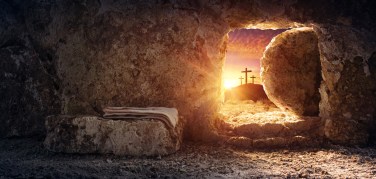
It was the women who first proclaimed the good news of “He is Risen!” I reblogged a post by Jane Diffenderfer on this very topic called: Firstfruits and the Women Who First Preached the Good News.  I encourage you to read it.

Why does it matter that Yeshua entrusted women with the gospel first? Does it have any significance? After all, even the disciples didn’t “believe” the report of the women, so why should we? Are women unreliable witnesses? Are women prohibited from proclaiming the Good News? Did Yeshua make a mistake by giving this vital message to the women first?

We must answer these questions. Your tradition, upbringing, culture, and personal opinions about the proper role of women (and men) will be reflected back to you if you honestly seek the answers from the Word of God. You will find yourself either aligned with the Word or aligned with what you want the Word to say. And then, you have to answer one last question: What is it that I fear will happen if women are coequal with men?

I’ve witnessed men actually leave the room when a woman gets up to bring forth the Good News to the assembly. They really believe that it is sinful to listen to her. But isn’t that exactly what the disciples did with the report of the women from the tomb? By not listening to these women, they remained in unbelief UNTIL Messiah Himself appeared to them. One thing is certain: Yeshua charged the women first to proclaim the Good News! Carefully read His words and then consider the reaction of His disciples:

Now after He had risen early on the first day of the week, He first appeared to Mary Magdalene, from whom He had cast out seven demons. She went and reported to those who had been with Him, while they were mourning and weeping. When they heard that He was alive and had been seen by her, they refused to believe it. (Mark 16:9-11)

I believe that everything Yeshua did was intentional. He consistently challenged tradition and cultural norms. He wasn’t surprised that the women were the first to find the empty tomb, and He certainly didn’t make a mistake by entrusting them with the Gospel. The message He gave to the women was meant to reveal the hearts of His disciples. Notice that Mary Magdalene had had SEVEN demons cast from her. Could these have been the seven wicked abominations of Proverbs 6: 16-19? Regardless, she was a new creation through Messiah Yeshua, yet the disciples refused to believe her report. Here is the same account from Luke:

And as the women were terrified and bowed their faces to the ground, the men said to them, “Why do you seek the living One among the dead? He is not here, but He has risen. Remember how He spoke to you while He was still in Galilee, saying that the Son of Man must be delivered into the hands of sinful men, and be crucified, and the third day rise again.” And they remembered His words, and returned from the tomb and reported all
Photo by salia on Unsplash

these things to the eleven and to all the rest. Now they were Mary Magdalene and Joanna and Mary the mother of James; also the other women with them were telling these things to the apostles. But these words appeared to them as nonsense, and they would not believe them. (Luke 24: 5-11)

I wonder how many treasures YHWH has entrusted to His daughters that men have considered nonsense throughout the centuries? History does repeat itself, and there is nothing new under the sun. My hope is that by reconsidering these two accounts in the Gospels that it has pricked your heart to reevaluate the numerous other accounts in the Bible regarding women. The last thing we would desire is to not believe a report given by our Master because we deem the vessel of His choice unworthy or less than optimal.

It’s time to build and not destroy. We each have various materials, textiles, and tools to build up the House of Adonai. All are needed.


Key #4 The Gospel was entrusted to the women first, 
but the apostles failed to believe their report.

Part X and the Repairer of the Breach. You can access past articles in this series here.

Recap of the four keys in this post:

Key #1 You are either a builder or a destroyer of God’s House. Often, the difference is difficult to discern.

Key #2 The Torah was first received and taught by the women, the House of Jacob.

Key #3 Learning Torah will make you big. Will you be a big tzaddik or a big monster?

Key #4 The Gospel was entrusted to the women first, but the apostles failed to believe their report.


[1] See this “Ask Moses” article for more information: http://www.askmoses.com/en/article/108,2217159/Ladies-First.html#articlepageinformation:

Categories: Women | Tags: , , , , , , | 11 Comments

Biblical Equality

john McKee

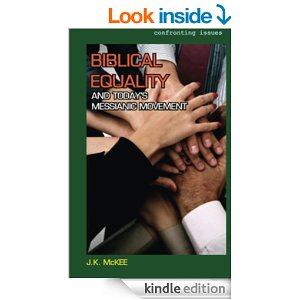
I just finished a short ebook by J.K. McKee of Outreach Israel Ministries and TNN Online called “Biblical Equality and Today’s Messianic Movement”. It is fantastic and I highly urge you to forgo a $3 coffee to buy this informative document. You will be glad you did. This post will explore some of Mr. McKee’s insights and some of my thoughts that he helped tie together.

Mr. McKee focuses on Galatians 3:28:

There is neither Jew nor Greek, there is neither slave nor free man, there is neither male nor female; for you are all one in Messiah Yeshua.

Notice that there are three categories of people mentioned in this verse. Most people understand that this verse is emphasizing the equality and freedom we have in Messiah. And, this is true. However, there is more to the story, as explained below.

For now, consider some of our most outspoken disagreements within the whole of Messianic circles. Number one centers on the identity and separation/inclusion of Jews and Gentiles (Greeks). Some Messianic Jewish leaders just released a scathing treatise against those that are for inclusion and equality between these groups back in January 2014. One of their most notable battle cries was IDENTITY markers for Jews, which (they believe) Gentiles should not infringe upon. In their mind, Sabbath, dietary laws, and the moedim (feast days), are those markers. (For a response to this treatise, click here)

They have an unwarranted and unholy fear of Gentiles actually being obedient to the Covenant. In their mind, if there isn’t a line drawn in the sand to separate these racial groups, the Jewish people will cease to exist or be overrun by Gentiles. Thus, they claim that followers of the God of Israel that come from Gentile backgrounds should not seek to keep the Creator’s calendar and Torah, lest they become vile practitioners of supersessionism. What they fail to realize, is that by demanding such, they have placed themselves as the overlords and gate keepers of the covenant. You can’t be the light, draw people in, to only turn them away.

Ungodly fear is at the root of this type of thinking. To lose (perceived) control can be a very compelling goad. Their scare tactics have succeeded somewhat and they have managed to persuade some into their hypocrisy. Sadly, if they would only open a genuine dialogue with those that “see” differently, their fears would be alleviated. In over ten years, I haven’t met one single person from a Gentile background that desires to keep the Torah and cling to the God of Israel that has any notions of usurping Judah, overtaking Israel, or replacing Jews in any form or fashion. Instead, I see a people that would pick up a sword any day of the week to defend Judah, Jews, and the Land. This, even when their name and faith is continually slandered, rebuked, and denied legitimacy by the former.

Mr. McKee posits a poignant question in his book:

What happens in a religious culture that emphasizes distinctions first, rather than common faith and belief in the Lord Yeshua? What will commonly be manifest in such an environment are rivalry, suspicion, self-superiority, factionalism, and division, to be then followed by resentment and bitterness.[1]

Do we not see these things happening right now in those returning to the Torah and their Jewish roots? While non-Jewish believers have been crying out for acceptance and equality in the Body, many have forgotten the last third of Galatians… there is neither male nor female.

Restoring women is a missing key to this equation. Those bent on complementarianism rather than equality or egalitarianism among the sexes are denying the complete restoration and a full return to Edenic values. Mr. McKee puts it this way:

“The LORD God of Israel is not going to honor the request of a Messianic non-Jewish man, to be treated as a welcomed equal in Messianic Judaism, if such a man’s wife might not be treated as an equal, co-leader of the family along with him.”

Mr. McKee observes that the three groups mentioned in Galatians 3:28 are all interconnected. We can’t isolate one group and that be one’s only focus of restoration, for they actually reflect one another. They are each a picture of the other two. Thus, if we desire to seek true freedom and equality, there are three categories that must be simultaneously considered.

Many of my readers are aware that when I began to diligently seek out the biblical role of women, the Father dropped a hidden bombshell on my lap, by revealing the issues of modern day slavery (trafficking). I grasped the connection immediately; and I believed I was seeing the other side of the coin. But, I now realize that what He was actually showing me is more akin to a wicked tripod that supports and gives strength to oppression and domination in all forms. Isn’t it written somewhere that a threefold cord is not quickly broken? (Ecc. 4:12)

dreamstimelarge_22045424

© Christianm | Dreamstime.com

In light of Galatians 3:28, where there are issues of race, there will be issues of slavery and domination. Where there are issues of slavery, there will issues of gender equality and repression. One begets the other. Do you think it is a coincidence that Woman Suffrage, Equal rights, and the abolition of slavery are all intertwined in (recent) United States history? I think Paul saw this link a long time ago.

This is why now more than ever, those returning to the Torah and keeping the Testimony of Yeshua should be breaking the legs of this wicked tripod and uplifting and restoring the marginalized groups back to the original state: Eden.

But how can we accomplish such a feat? Where do we begin? How does a society and a Body entrapped in the dogma of authority, dominance, and control shift gears and do a 180 degree turn?

What many fail to elucidate when examining the issues of race, slavery, and gender equality, is our world’s proclivity toward male oriented authority, dominance, and control. Which are all, by the way, traits that the Creator especially endowed in the masculine side of His Creation. When these characteristics are tempered by the Holy Spirit and the feminine side of Creation, they bring balance and security.

But what happens if these masculine qualities dominate without the opposite, yet complimentary, traits of the feminine? We would expect to see a world entrenched in a power grab for dominance, authority, and control. Is that not the world we live in? On a smaller scale, we see the same thing happening within the Body of Messiah. The scales are tipped too far in the direction of the hard masculine. The Jewish sages, particularly the Chassidic sect, see this unjust scale and foresee a transition coming.

As with the general scheme of the cosmos, so with man and woman and the human consciousness. The history of humankind can be seen this way: A transition from male to female values, from authority to dialogue, from dominance to persuasion, from control to nurture.[2]

Do you hear the heart of this rabbi? He can clearly see the problem… and the solution. Dialogue, persuasion, and nurture are needed for reform. All of these qualities are feminine. But if we continue to deny females to operate in their God given abilities; or worse, deny their legitimacy to minister to the Body altogether, we can expect a continual struggle with race, slavery, and gender. What a vicious cycle!

I have great hope that we are on the cusp of real restoration. It has taken us a long, long time to get to where we are today. There is still much struggle and resistance to change (restoration). But I cannot help but to also recognize another connection to the three groups mentioned in Galatians 3:28.

With the reestablishment of the state of Israel in 1948, came also a theological paradigm shift. Israel and the Jewish people have a God given right to exist and flourish. For many Christians, seeing this took a sincere desire to reexamine the Scriptures in light of current events. Old traditions, dogma, and pride had to be laid on the altar of Truth.

Do you believe that it is a coincidence that the Civil rights movement quickly came on the heels of this restoration? And with that, the beginnings of a return of both believing Jews and Gentiles to the Torah of YHWH? Like it or not, all these happenings are CONNECTED.

Now, don’t get me wrong, there is also another spirit that likes to work contemporarily with the Truth and offer the naïve a counterfeit. Sometimes core truths are twisted into a tree that no longer resembles the seed from which it sprang in ideologies such as liberal progressivism and secular feminism. Nevertheless, each started with “good intentions.” If only we could step back and look at the bigger picture of what is happening. We have a problem that begins with IDENTITY.

Identity Crisis

Let’s back up for a minute and reexamine Galatians 3:28.

There is neither Jew nor Greek, there is neither slave nor free man, there is neither male nor female; for you are all one in Messiah Yeshua.

Mr. McKee pointed out something else in his paper that hadn’t resonated with me before. Was Paul refuting traditions found both in 1st century Judaism and other surrounding cultures on some pretty ingrained social norms in Galatians 3:28?

There is a morning blessing in the orthodox siddur (prayer book) that seems a little offensive without understanding its true background. The prayers in question are in the shacharit.[3]

 “Blessed are you, Hashem, King of the Universe, for not having made me a Gentile.”

“Blessed are you, Hashem, King of the Universe, for not having made me a slave.”

“Blessed are you, Hashem, King of the Universe, for not having made me a woman.”

Before I address the traditional justification for these prayers, I’d first like you to notice that these prayers are not only the exact same “social” classes mentioned by Paul in Gal. 3:28, but they are also in the same order. Is this a coincidence?

I don’t believe Paul’s declaration in Galatians 3:28 was countering these three blessings in the Jewish siddur. As a matter of fact, Judaism wasn’t the only religion or society that held social class views on these subgroups in the first century. The language of the three blessings echoes Greek prayers. In his later years, Plato is reported to have said, “I thank God that I was born Greek and not barbarian, free and not slave, male and not female, but above all that I was born in the age of Socrates.”[4]

Again, is the striking similarity of this proclamation to the Jewish prayer and Paul’s declaration just a coincidence?

It is human nature to compare ourselves to others. We encounter the good and bad results of this in today’s world just as much as they did in the 1st century. Social psychology has developed a theory called social comparison that attempts to explain this tendency. Social comparison centers on the belief that there is a drive within individuals to gain accurate self-evaluations. The theory explains how individuals evaluate their own opinions and abilities by comparing themselves to others in order to reduce uncertainty in these domains, and learn how to define the self.[5] In other words, we compare and distinguish ourselves from others to determine our own IDENTITY. Pay close attention to that last sentence, for it is at the root of much of our quarreling and division.

The common apologetic for the three “blessings” mentioned above from the Siddur is that these three classes of people – gentile, slave, and woman – are not sociological classes, but mitzvah classes. The apologetic insists that the prayer has nothing to do with the equality of these individuals. Instead, they are meant to be expressions of gratitude for the mitzvot (commandments), and each of the people mentioned in each blessing has more mitzvot to fulfill than the one preceding.

While this explanation is compelling, it still stands to reason that this section of the Siddur could have been influenced by the Greek culture of the first century. I am not alone in this assumption. Many Jewish scholars conclude the same thing.

I believe Paul was calling the people to recognize that in a redeemed or restored state, we must forgo our old social comparisons. Our identity is not found in comparing ourselves to others, but in the finished work of the Messiah. Our destiny and proper “social” status is not found in modern society, not in the Middle Ages, not in the first century, and not even in the age of the patriarchs. We must seek to return to our first estate and that place is most akin to the Garden of Eden, before the fall. For it is there where we have no Jew or Greek, no slave or freeman, no male or female; we have perfect oneness and unity!

If we could grasp the Hebraic concept of the cyclical nature of time, seasons, and restoration, instead of a progressive linear view of supersessionism, then the social comparison tendency would have to fall to the wayside. While our propensity remains to be a preoccupation with authority and patriarchalism, Yeshua tried to steer us BACK toward the beginning, to the place of mutual submission, sacrificial love, and servanthood.

Mat. 20:25-28  But Jesus called them to Himself and said, “You know that the rulers of the Gentiles lord it over them, and their great men exercise authority over them.  (26)  “It is not this way among you, but whoever wishes to become great among you shall be your servant,  (27)  and whoever wishes to be first among you shall be your slave;  (28)  just as the Son of Man did not come to be served, but to serve, and to give His life a ransom for many.”

There should be mutual equality, respect, and submission between men and women in the Body based upon the gifts that the Spirit gives to each (male and female) believer. (Acts 2:15-21; Gal. 3:28) Likewise, there should be a mutual equality, respect, and submission within the home between husband and wife. (Eph. 5:21-33)

Mr. Mckee persuasively pointed out WHY the Edenic model is not only powerful, but so desperately needed in the Body of Messiah today. His proposition not only resonated with my heart, but baffled me as to why we have such a hard time seeing this, for it is pure simplicity.

In order to fully realize this, let’s look at the Galatians 3:28 one more time:

There is neither Jew nor Greek, there is neither slave nor free man, there is neither male nor female; for you are all one in Messiah Yeshua.

Until we jump down from our high horse of social comparison and pick up the lens of the Messiah, we are doomed to repeat the millennia of mistakes of all those that have gone before us. We must exchange our desire for dominance and control with a heart for service, servanthood, and sacrificial love; or we are not fulfilling the law of our King.

Perhaps this is why FLESH was a daily offering. We cannot look out for numero uno (number one) and win the race of the Kingdom. All of God’s children of every race, tribe, and tongue, both genders, are equal and one in the Kingdom of Heaven. What are we waiting for? Why don’t we start living out this principle now?


[1] McKee, John Kimball Biblical Equality and Today’s Messianic Movement, 2014. Kindle file.

[2] http://www.chabad.org/library/article_cdo/AID/2918/ShowFeedback/true

[3] Shacharit = Morning Prayers. The name is derived from the Temple service offerings: http://www.myjewishlearning.com/texts/Liturgy_and_Prayers/Siddur_Prayer_Book/weekdayprayer.shtml

[4] http://www.cliffsnotes.com/literature/e/euthyphro-apology-crito-and-phaedo/plato-biography

See also the classical work: Vitae Philosophorum 1.33

[5] http://en.wikipedia.org/wiki/Social_comparison_theory

Categories: Messianic Issues, Women | Tags: , , , , , , | 14 Comments

Deborah the Bee Part II

Part I

Now Deborah, a prophetess, the wife of Lappidot, was judging Israel at that time. (Jdg. 4:4)

The Flaming Bee

© Ampersandmiami | Dreamstime.com

The fourth judge of Israel was Deborah, a woman of flames/torches/lamps/lightning.[1] This is according to the bolded phrase above when viewed in the Hebrew (eshet lappidot). I find it captivating that the Hebrew uses such fiery connotations when it presents this unique woman in the Bible. All this imagery is lost and falls flat with the transliterated word Lappidot for those that do not know Hebrew. Blazing torches and fire brands are much more exciting and unpredictable – another reason I love the holy tongue! Have you ever thought of Deborah as fiery? This is how the Bible describes her. Not only that, but she was a prophetess and a judge. Talk about a woman with weighty responsibility! I even imagine her with flaming red locks to accompany her “sparky” introduction.

Lappidot is usually designated as Deborah’s husband in most translations. But the Hebrew phrase eshet lappidot could easily be rendered as “Woman of Torches.” This has led some scholars[2] to conclude that this phrase is descriptive of Deborah’s character, or that it refers to her occupation as a wick maker. The latter is particularly interesting as it denotes that she was tasked with providing the wicks that kept the eternal flames of the holy menorah burning. Other Jewish scholars think this phrase connects Deborah to Barak, for his name actually means “lightning.”[3] The inference is that Barak was her husband. No matter which way you slice this pie, Deborah is connected with fire and lights.


The Palm of Judgment

She used to sit under the palm tree of Deborah between Ramah and Bethel in the hill country of Ephraim; and the sons of Israel came up to her for judgment. (Jdg 4:5)

© Kisha Gallagher

As a judge, Deborah not only had judicial power, but she commanded the military. This was the function of Israel’s judges. I believe one reason that Deborah is connected to fire and flames is her ranking number among Israel’s judges. As the fourth judge of Israel, Deborah was unique in several ways. She is the only judge of Israel that was female. She was also the only judge to have a dual role as a prophet (aside from Samuel), and she was the only judge that was cast in a totally positive light in the narrative. In fact, the judges succeeding her are depicted with a decline in virtue until Samuel (the last judge) was raised up.[4]

Amazingly, I have read and heard some teachers diminish the “judging” aspect of Deborah because she was a female. Apparently, to maintain continuity in their theology, they must regulate the actual role and function of this female prophet and judge. (She wasn’t really making Torah judgments over men, was she?) This not only requires some theological gymnastics, but a stubborn refusal to allow the Word to speak literally. Those less persistent in their preconceived notions grant that she only held this position because there wasn’t a man willing to step up and fulfill this role, but that isn’t found, or even hinted at, in the text.

In Part I, we saw how Rebekah’s nurse Deborah was associated with a tree (etz) and here there is palm tree associated with Deborah the Judge. A judge gives counsel (etzah), which is the feminine form of the word for tree (etz). Do you remember where the nurse Deborah was buried? It was in Bethel under an oak tree. Notice that the judge Deborah sits in the seat of judgment and counsel not very far from her predecessor’s grave. In fact, many commentators suggest that the palm of Deborah and the oak tree where the Deborah the nurse was buried are one and the same. Either way, these women are connected.

The sons (benai) of Israel came up (aliyah) to her for judgment (mishpat). What sort of judgment calls was Deborah making? Strong’s defines misphat as:

H4941 משׁפּט mishpâṭ From H8199; properly a verdict pronounced judicially, especially a sentence or formal decree of divine law, including the act, the place, the suit, the crime, and the penalty.[5]

It comes from the root shaphat (again defined by Strong’s):

H8199 שׁפט shâphaṭ A primitive root; to judge, that is, pronounce sentence (for or against); by implication to vindicate or punish; by extension to govern; passively to litigate.[6]

These Hebrew words for judgment are used in verses such as these:

Ex. 18:15-16 Moses said to his father-in-law, “Because the people come to me to inquire of God. (16) When they have a dispute, it comes to me, and I judge between a man and his neighbor and make known the statutes of God and His laws.”

Dt. 16:18 “You shall appoint for yourself judges and officers in all your towns which the LORD your God is giving you, according to your tribes, and they shall judge the people with righteous judgment.”

Nothing about these definitions diminishes Deborah’s role as a judge of Israel. She decided cases of Torah law and halachah, as was required of all appointed judges. There is no indication that the men of Israel had any problem with the fact that she was a woman. They neither were shamed by her gender, nor did they fear that she had usurped a male-only position. The Body of Messiah could learn a thing or two from this Biblical example.

Four & the Hidden Woman

       © Maksim Prochan | Dreamstime.com

I’ve mentioned several times that Deborah was the fourth judge of Israel. This is significant because the number four is indicative of authority and government. Those of you familiar with The Creation Gospel will pick up the theme immediately. For example, the fourth day of creation is associated with the governing action of the sun, moon, and stars. The fourth son of Jacob, Judah, was given authority to rule over Israel. There are four corners of the altar. Palm branches (associated with Deborah) are one of the four species waved at the four corners of the earth during Sukkot. The fourth commandment is to keep Shabbat. The fourth feast is Shavuot (Pentecost). The fourth disciple called by Yeshua was John, and so on.

Essentially, four is similar to seven, or the whole, but with an emphasis on government. This can be visualized if you imagine a seven branched menorah (lampstand) folded in half. The center stem is not only the source for the six outer branches, but it is also the hinge on which the others hang. In the folded menorah, you distinctly see four stems instead of seven, yet the whole is still present. (You can learn all about this by studying The Creation Gospel model by Dr. Hollisa Alewine)

The governing aspect of the number four is also portrayed in Deborah’s prophetic song that comprises the whole of chapter five. Before Deborah “rose up” there was disorder and strife in Israel (vs.6-11). Apparently, this is why Adonai chose to raise up a “mother” in Israel. Deborah realizes the significance of her role in bringing unity and order to Israel. Do you remember the root and meaning of Deborah from Part I? Truly her name is indicative of her persona and character as one who brings order to disorder. This IS what the Word, davar, of Adonai does, which is the root of her name. Deborah’s association with the number four only magnifies this truth.


She Speaks

© Branislav Ostojic | Dreamstime.com

The song of Deborah demonstrates her gift of prophecy. There can be no doubt that Deborah’s primary weapon was words as testified by her name (lit. dibberah: “she speaks”). I cannot help but to wonder what would have happened if she had been silenced or ignored due to her gender. Deborah, a woman on fire with the Word, spoke! Her words brought righteous judgment and order to chaos. The “ways” of the people were crooked and the “watering” places became a place of division and war…UNTIL Deborah arose!

Jdg 5:6-11 “In the days of Shamgar the son of Anath, In the days of Jael, the highways were deserted, and travelers went by roundabout ways. (7) The peasantry ceased, they ceased in Israel, Until I, Deborah, arose, Until I arose, a mother in Israel. (8) New gods were chosen; then war was in the gates. Not a shield or a spear was seen among forty thousand in Israel. (9) My heart goes out to the commanders of Israel, the volunteers among the people; Bless the LORD! (10) You who ride on white donkeys, You who sit on rich carpets, and you who travel on the road – sing! (11) At the sound of those who divide flocks among the watering places, there they shall recount the righteous deeds of the LORD, the righteous deeds for His peasantry in Israel. Then the people of the LORD went down to the gates.”

Deborah not only “roused” herself, but calls the remnant of the faithful in Israel to arise and battle for truth and the God of Truth, YHWH. As usual, the call is to “Wake Up!”

Jdg. 5:12-13 “Awake, awake, Deborah; Awake, awake, sing a song! Arise, Barak, and take away your captives, O son of Abinoam. (13) Then survivors came down to the nobles; the people of the LORD came down to me as warriors.”

Does this not remind you of another prophecy in the Torah regarding Israel?

Num. 24:8-9 “Elohim who has brought him out of Egypt is for him like the lofty horns of the wild ox; he shall eat up the nations that are his foes, and shall break their bones in pieces, and shall pierce them through with his arrows. (9) He has crouched; he has lain down like a lion, and like a lioness; who shall rouse him up? Blessed is everyone that blesses you, and cursed is everyone that curses you.” (HRB)

Dr. Tikva Frymer Kensky beautifully illustrates how the alternate meaning of Deborah, a bee, ties all of this together:

Like the queen bee, she raises up the swarm for battle, sending out the drones to protect the hive and conquer new territory.[7]

The Song

Deborah’s song describes three particular women. The first, of course, is Deborah herself. I believe we already have a good understanding of the fact that she clearly represents both the activity of the Holy Spirit and of the righteous assembly of Adonai. The second woman is Yael (Jael). It was by her hand that King Sisera met his demise. Yael means “to ascend” and “mountain goat.” An ideal wife will be to her husband a fountain (notice the woman/water imagery) and a graceful hind (mountain goat).

Pr. 5:18-20 “Let your fountain be blessed, and rejoice in the wife of your youth. (19) As a loving hind and a graceful doe, let her breasts satisfy you at all times; be exhilarated always with her love. (20) For why should you, my son, be exhilarated with an adulteress and embrace the bosom of a foreigner?”

Since Proverbs 31 depicts the Eshet Chayil or Woman of Valor as a Warrior,[8] it’s not surprising that a woman named “Yael” was given the honor of defeating Israel’s enemy. She is a fountain of living waters[9] to her husband and a mother to Israel (like Deborah). She was a warrior woman like the women who served at the doorway to the Tent of Meeting.[10] And her bravery ascends up to heaven like the sweet aroma of the goat Olah sacrifice.

It is for these reasons that I find it intriguing that Sisera asks Yael for water, but she instead gives him milk. Ponder this. A woman is a picture of life giving waters; Yael has anything but life in mind for Sisera. Like a baby, she gives him milk and he falls asleep between her thighs. This is when she hammers a tent peg through his temple. Again, with the “tent peg,” we see the imagery of a woman… she builds her house. Obviously, Sisera is a threat to the expanding of her tent or home. Yael may appear to be acting like a harlot, but in reality she is a righteous warrior of her home and for the people of Israel.

The third woman in Deborah’s song illustrates the other side of the coin. Remember, we are constantly shown the dichotomy of a righteous woman and a harlot in the Scriptures. They call to the same people, sit in the same places, and often wear similar colors. It is our job to discern which one we are dealing with, or which one we are acting like (this is true for men and women). Yael appeared to be a harlot by calling Sisera into her tent, but in the end, she is revealed to be righteous.

The unnamed mother of Sisera is the third woman mentioned, and she is depicted as anxiously looking (seeing/false prophecy) for her son to return home with the spoils of war. Notice that part of the expected “spoil” is the daughters of Israel. The Hebrew term used for these Israeli maidens is racham (wombs)![11] The enemy, the harlot, and the dragon desire to devour the offspring of the (righteous) woman.[12] Moreover, the other spoils of war mentioned are dyed and embroidered works. These “works” are associated with the righteous women of Israel who provided them to cover and beautify the Tabernacle or Dwelling Place of Adonai (Ex. 35:25, Pr. 31:22). The enemy wants to capture, destroy, and rape the daughters and prevent or pervert their righteous acts.

Can you see the poetic justice between Yael and Sisera’s mother? Sisera desires to steal the “wombs” of Israel, but instead he dies between the thighs of the righteous woman (Yael). If you aren’t paying close attention, you just might miss this point. Or worse, you may misinterpret the actions of Yael and accuse of her of unsavory character. While this story makes the actions of the righteous woman more clear, other stories utilizing this same dichotomy are more subtle. For example, consider Tamar, Rahab, or Ruth. Each of their actions could be misconstrued if you’re not reading carefully.

But why all this emphasis on the women? In the eyes of Adonai, His people are the daughter, the sister, the wife, the bride, and the woman. If our view of natural women is skewed, then our prophetic outlook on the whole Body will also be out of kilter. So in that sense, when we look into the narratives and lives of the women, we are really investigating the sons of Adonai too. The Hidden Ones (both men & women) are revealed in the Woman. Look for her!

In the natural, women have been oppressed throughout secular and religious history. I believe this is a picture of what’s happening in the spiritual realm as well. It is a woman that both men and women are compared to in the Scriptures. When we liberate and restore natural women, the WHOLE (spiritual) Body is restored. If the enemy can steal the wombs of Israel, we are weakened and the tent fails to expand. To produce LIFE, it takes both a man and a woman. May the Deborah’s in Adonai’s camp ignite the hive to proclaim Truth and battle all the Sisera’s of our day.


Footnotes:

[1] The phrase (the wifeH802 of Lapidoth,H3941 )is the following two Hebrew words respectively defined by Strong’s:

H802 ish-shaw’, naw-sheem’ The first form is the feminine of H376 or H582; the second form is an irregular plural; a woman (used in the same wide sense as H582).: – [adulter]ess, each, every, female, X many, + none, one, + together, wife, woman.

H3941 lap-pee-doth’ Feminine plural of H3940; Lappidoth, From an unused root probably meaning to shine; a flambeau, lamp or flame: – (fire-) brand, (burning) lamp, lightning, torch, the husband of Deborah: – Lappidoth.

[2] Eshet lapidot could be translated “wife of Lapidot,” but it also means “woman of torches.” Lapidot, “torches,” comes where we would ordinarily expect a husband’s name, but it is a strange‑sounding name for a man and, moreover, does not have the standard patronymic “son of.” (Dr. Frymer-Kensky) http://www.myjewishlearning.com/texts/Bible/Prophets/Former_Prophets/Book_of_Judges/Deborah.shtml?p=1

[3] http://biblehub.com/topical/l/lappidoth.htm

[4] When looking into the number of Israel’s judges, there is not a unanimous opinion on how many there actually were. The number usually falls between 12 and 15. This is due to the fact that some “rulers” like Abimelech aren’t directly referred to as a “judge”, but ruled Israel all the same. No matter whom you include in your count, Deborah is the fourth in order.

[5] Emphasis mine. Definition shortened in order for easier reading.

[6] See footnote 2.

[7]http://www.myjewishlearning.com/texts/Bible/Prophets/Former_Prophets/Book_of_Judges/Deborah_Prn.shtml

[8] See The Biblical Role of Women Part IV.

[9] See The Cup of Miriam Part III.

[10] See The Mirror Waters and the Gatekeepers.

[11] Jdg. 5:30 ‘Are they not finding, are they not dividing the spoil? A maiden (racham), two maidens (racham) for every warrior; To Sisera a spoil of dyed work, A spoil of dyed work embroidered, Dyed work of double embroidery on the neck of the spoiler?’

[12] Rev 12:4 And his tail *swept away a third of the stars of heaven and threw them to the earth. And the dragon stood before the woman who was about to give birth, so that when she gave birth he might devour her child. Rev 12:17 So the dragon was enraged with the woman, and went off to make war with the rest of her children, who keep the commandments of God and hold to the testimony of Jesus.

Categories: Women | Tags: , , , , , , , , , , , | 19 Comments

The Mirror Waters and the GateKeepers

As I was writing Part II of Deborah the Bee, my study took me in an unexpected direction. So, humor me and I promise to post Part II next time. (:


© Biblebox | Dreamstime.com

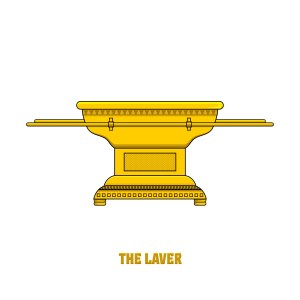
Ex. 38:8 Moreover, he made the laver of bronze with its base of bronze, from the mirrors of the serving women who served at the doorway of the tent of meeting.

While it’s probably not news to you that the bronze laver was made from the mirrors of the women, the role or service of these women just might be — it was to me. However, for the sake of those that haven’t considered the links of the laver, water, and women, let’s explore that first.

In my posts on the Cup of Miriam, we took a long hard look at why women are so closely associated with water. It is just like our Elohim to use articles from women to build the one piece of furniture in the Tabernacle that contained water. Even more significant is the fact that mirrors are used to reflect an image. Thus, we often hear how the waters in the laver were there so the priests could “see” the dirt and wash their hands and feet.

But it’s more than that. A mirror reflects beauty and defects. The Word of Elohim also reveals both when we look into it.[1] This is why we need the constant washing of the water of the Word.[2] The Hebrew word for mirror or looking glass is marah[3], but this word is ONLY elsewhere translated as “vision” — as in I saw a vision.[4]

You can see the connection with seeing “into” something. In other words, the purpose of the laver was to give spiritual insight about the state of a person’s heart. The washing was more symbolic than a remedy to physical dirt. In order to serve the King, you must be washed by His Water, which is the Word. Only the Torah can show you at once how beautiful and precious you are in the Father’s eyes and at the same time reveal your unsightly blemishes and spots. The Water of the Word is meant to cleanse us of these marks as James so aptly remarks in 1:25.

This idea is expanded by the Hebrew word for laver, keeyor. This word means a furnace and also to purify. Once again we see the dichotomy of fire and water, both cleanse and purify. But who are these “serving” women at the doorway of the tent of meeting? The answer to this question is what provoked me to write this post.

Translator’s (both Jewish and Christian) have a terrible tendency to diminish the roles or service of women. We have become so accustomed to this that we read right through a verse such as Exodus 38:8 and focus on the bronze (or brass if you prefer) laver and/or the mirrors. Yet, we know that there is not an idle word in the Torah. These women were important; and I for one, am ashamed that I never noticed their position until now. But, that’s what I’ve come to expect: the woman is always hidden! And I know that YHWH had divine intent and purpose for that as you will begin to see in my post on Deborah the Bee Part II.

The Hebrew phrase for “the serving women who served” is hatzovot asher tzaveu. You can probably see the repetition of the Hebrew verb tzvah, which means to go forth, wage war, fight, and serve. It is directly related to YHWH Tz’vaot (LORD of Hosts). It carries strong military connotations. This should remind us of the eshet chayil or woman of valor.[5] She too, is often obscured by translation and softened from a warrior to a woman of virtue, goodness, worth, or excellence. Why?

Would it surprise you to know that tz’vaot is feminine? When we call on the God of Armies (YHWH tz’vaot), we are really saying God of (women) warriors. Apparently, the women who “served” at the doorway to the Tent of Meeting were warriors! Now, considering the context of their station, it would appear as though this was more of a “spiritual” guardianship. After all, the laver was made from their “visions” or “mirrors”. I imagine these women to be warriors of the faith, prophetesses, prayer warriors, and guardians of the Water of the Word. I believe there is evidence of this with the prophetess Anna.

Luke 2:36-37 And there was a prophetess, Anna the daughter of Phanuel, of the tribe of Asher. She was advanced in years and had lived with her husband seven years after her marriage, (37) and then as a widow to the age of eighty-four. She never left the temple, serving night and day with fastings and prayers.

Of course, we also have a witness as to what happens when these women are either taken advantage of or in outright rebellion.

1Sa 2:22 Now Eli was very old; and he heard all that his sons were doing to all Israel, and how they lay with the women who served at the doorway of the tent of meeting.

In this verse, their role has been perverted; these women have become like the harlot mentioned in Proverbs instead of the righteous woman. Whether or not these women were manipulated, forced, or were the seducers themselves is not mentioned. I believe we have evidence of all these possibilities happening in our assemblies still today. Regardless of the reason these women strayed, we see the male counterparts in this story also falling away from their purpose.

1Sa 3:1-2 Now the boy Samuel was ministering to the LORD before Eli. And word from the LORD was rare in those days, visions were infrequent. (2) It happened at that time as Eli was lying down in his place (now his eyesight had begun to grow dim and he could not see well).

There can be no coincidence that as the Word of God and visions began to diminish, so did Eli’s eyesight. What is not immediately apparent is that the women are also related to the reduced visions by their association with the mirrors (visions) of the laver and the doorway. The proverbial “chicken or the egg” question might pop into your head. We want someone to blame. But, I believe the point is that improper worship, negligence, perversion, and the like is the culprit here. Lack of the Word means lack of vision and eyesight (insight, foresight, and hindsight). Torah is our One True Mirror! Without it we perish in our perversion.

Since women are often associated with vision and the prophetic, these next verses shouldn’t surprise you.

John 18:15-17 Simon Peter was following Jesus, and so was another disciple. Now that disciple was known to the high priest, and entered with Jesus into the court of the high priest, (16) but Peter was standing at the door outside. So the other disciple, who was known to the high priest, went out and spoke to the doorkeeper, and brought Peter in. (17) Then the slave-girl who kept the door *said to Peter, “You are not also one of this man’s disciples, are you?” He *said, “I am not.”

The Greek indicates that this “slave girl” was actually a bond-servant. Notice that Peter has to go through HER to get inside. She is the gate-keeper to get to the court of the high priest. And what does she do? She immediately “sees” right through Peter. She knows that he is one of Yeshua’s disciples! But he lies, and this becomes the first of three denials he makes of the Master.

This happens with wives and their husbands as well. A woman meets her man at the door to question him on some issue and if he lies or denies the thing —- she can usually “see” right through him! Since women were created to be managers and guardians of the home, we shouldn’t be surprised that YHWH gave women this role in His House as well.

If we lack vision, perhaps we need to visit the laver. What do you see when you look into the mirror waters? Look closely and allow the waters to fully reveal the good, the bad, and the ugly. Once revealed, true beauty emerges.

     © Giovanni Triggiani | Dreamstime.com


[1] James 1:25 But whoso looketh into the perfect law of liberty, and continueth therein, he being not a forgetful hearer, but a doer of the work, this man shall be blessed in his deed. (KJV)

[2] Eph. 5:25-27 Husbands, love your wives, just as Christ also loved the church and gave Himself up for her, (26) so that He might sanctify her, having cleansed her by the washing of water with the word, (27) that He might present to Himself the church in all her glory, having no spot or wrinkle or any such thing; but that she would be holy and blameless.

[3] H4759 from H4758 (mareh) meaning view or appearance.

[4] H4759: Total KJV Occurrences: 9 visions, 5 Gen.46:2, Eze.1:1, Eze.8:3, Eze.43:2-3 (2) vision, 3 Dan.10:7-8 (3) lookingglasses, 1 Ex.38:8 (2)

[5] For more information, see my post The Biblical Role of Women Part IV, which defines the Eshet Chayil or Woman of Valor.

Categories: Biblical Symbols, Women | Tags: , , , , , , , , | 2 Comments

Blog at WordPress.com.