Role of Women Main Page
Please view Part I, II, III, and IV for context.
Proverbs 31
In Judaism, the Proverbs 31 woman is often taught as an allegory for the Holy Spirit (Ruach HaKodesh), Wisdom, Torah, the Shekinah (Divine Presence), Shabbat, and/or the soul. At first glance this might seem odd, but most Jewish scholars and teachers read, write, and speak Hebrew. This knowledge opens the Biblical text in ways that English cannot. We will focus on two of these allegories in particular: Wisdom and the Holy Spirit.
Wisdom
“Wisdom” is the primary character in the Book of Proverbs, and she is personified as a woman. If this is a foreign concept to you, take some time to read through this book. Proverbs depicts two women, one righteous and one wicked, to contrast two types of people (or ways of thinking and behaving). These two “ways” are within every human being. Sometimes they are referred to as the good and evil inclinations[1] or spiritual battle between the spirit and the flesh. King Solomon personifies good and evil in order to teach his son (and us) discernment. Adonai and Solomon instruct one to choose to follow their good inclination (or one’s spirit [in Messiah], rather than the flesh).
In Hebrew, the Spirit of God and other spirits are written in the feminine form.[2] At first, it may seem strange or even blasphemous to refer to God in the feminine. But your Bible does so over and over again in reference to His Spirit in the Hebrew language. This is not goddess worship; rather, this is simply how the Hebrew language works. God is neither a man nor a woman, yet He has attributes of both genders. This is why it takes a male and a female to properly display His image.[3]
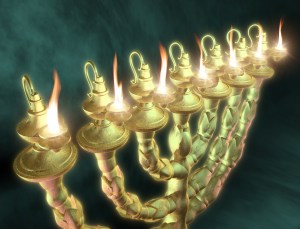
The Holy Spirit displays the feminine attributes of Adonai. Isaiah describes the Spirit of God like a tree with seven branches or characteristics (Isaiah 11:1-2). This is not to be confused with the fruit of the Spirit. The fruit is the result of or what comes forth from this seven branched tree. In other words, fruit results from the tree; it is the goal – what secures the future. We can use a biblical motif to describe these seven facets. In the Tabernacle in the wilderness, Adonai told
© Ampersandmiami
| Dreamstime.com
Moses to construct a menorah (lamp stand) with seven branches. The menorah was to be made of ONE piece of beaten gold.[4] The menorah would illuminate the Holy Place that leads one into the Holy of Holies. There is only ONE central branch with three branches on either side. The six outer branches are out-workings of the main, central branch. The Bible often uses the symbolism of this magnificent menorah to describe God’s Holy Spirit (Ruach HaKodesh), and for those who operate in or who are filled with His Spirit.
Like the seven branches on the ONE golden Menorah, Isaiah, Zechariah, Yeshua (Jesus), and John all write about the Holy Spirit having seven attributes (branches). If you wish to learn about the seven spirits of God in depth, I can pair you with a Creation Gospel[5] trainer who can guide through Dr. Alewine’s thematic workbook. Here are some of the verses that attest to the seven.
The Spirit of the LORD will rest on Him, The spirit of wisdom and understanding, The spirit of counsel and strength, The spirit of knowledge and the fear of the LORD. (Is. 11:2)
He said to me, “What do you see?” And I said, “I see, and behold, a lampstand all of gold with its bowl on the top of it, and its seven lamps on it with seven spouts belonging to each of the lamps which are on the top of it…Then he said to me, “This is the word of the LORD to Zerubbabel saying, ‘Not by might nor by power, but by My Spirit,’ says the LORD of hosts…”For who has despised the day of small things? But these seven will be glad when they see the plumb line in the hand of Zerubbabel–these are the eyes of the LORD which range to and fro throughout the earth.” (Zec. 4:2, 6, 10)
Out from the throne come flashes of lightning and sounds and peals of thunder. And there were seven lamps of fire burning before the throne, which are the seven Spirits of God; (Rev 4:5 see also Rev. 1:4; 3:1; 5:6)
Wisdom is not only the first of the seven manifestations of God’s Spirit, but is also personified as a woman in the Bible. It is for this reason that the Jewish Sages reading the Proverbs 31 text see the eshet chayil (Woman of Valor, Strength, Might) as a metaphor for the Holy Spirit. This may come as a relief to many women. Thank goodness! I was feeling pretty inadequate compared to this “perfect” woman.
Holy Spirit
The Holy Spirit shows one the way of wisdom which leads into the fullness of all seven Spirits of God (Is. 11:2). It teaches one not only the proper role of women, but also the strength (chayil) of her role. If we allow God’s Spirit to have reign in our hearts and lives, we will naturally produce the fruit of the Spirit mentioned in Galatians 5:22. Do you remember how the woman is designed to be an ezer, a helper? Do you know of another “helper” in scripture?
Behold, God is my helper; The Lord is the sustainer of my soul. (Ps. 54:4)
But the Helper, the Holy Spirit, whom the Father will send in My name, He will teach you all things, and bring to your remembrance all that I said to you. (Jn. 14:26)

© Gracel21
| Dreamstime.com
The Holy Spirit operates as a type of helper in the life of a believer. Sometimes He is our aid, but sometimes He opposes us in order to turn us in a different direction. This is the same function the woman often plays (on a much smaller scale) in the life of her husband. Think about the following roles that the Holy Spirit plays in our lives and compare them to the role of woman. (Note: these are generalities. Some women will function strongly in one of these roles and struggle in others. Conversely, there are men who can and do function well in some of these aspects – especially when they are filled with the Spirit of God. The point of looking at this comparison is to realize that God, who is neither a man or woman, has both masculine and feminine attributes.)
Actions
- The Holy Spirit comforts and nurtures; so does a woman.
- He teaches and instructs; so does woman.
- He displays mercy and grace; so does a woman.
- He encourages; so does a woman.
- He leads and speaks; so does a woman.
- He’s the unseen One; so often this is also true of the woman (she’s behind the scenes working).
- He prepares and empowers; so does a woman.
- He intercedes, testifies, and reproofs; so does a woman.
If you want to know what your duties are as a woman, all you have to do is consider the feminine attributes of God; for you were created as a female image bearer of the Creator of the Universe. This is also true for men. They are a male image bearer of the Creator. Men should consider masculine attributes of Adonai and mirror them in the earth. BUT, both sexes must always remember that both sides, both genders, both masculine and feminine attributes working together and in unison is required for the actual image of God to be reflected in the earth. All masculinity or all femininity will result in a lopsided, perverted understanding of the Creator.
We never find YHWH in a control battle with His Spirit; they are ONE. Therefore, male and female image bearers should work together in harmony, each displaying a facet of the image of our perfect Elohim (God). One does not dominate the other. There is no power struggle because there is no need for one. Power struggles are a sure sign of the flesh ruling and reigning, which is a false image. To break this down into easier to digest parts, we might say that males better image the Father, and females better image the Holy Spirit. And when they become one, they figure the Son, Yeshua, the last Adam (Rom. 8:29, 2 Cor. 3:18).
Atmosphere & Eshet Chayil
Like the Ruach HaKodesh, women often set the tone for the atmosphere of the home, fellowship, workplace, school, etc. When women are ruled by their emotions, mood, or fleshy desires it affects everyone around them in a negative sense. One is a true warrior of God, an eshet chayil, when she chooses to crucify her flesh and walk according to Word and the example of the Holy Spirit, instead of how their flesh feels or thinks. Any time a woman is present, she will influence the spiritual climate of that space. Thus, the fruit of self-control is something vital for women to learn (this is true for men as well, but our focus here is on the role of women).
The lower, sinful nature of men and women (especially if they are immature in physical age or spiritual maturity) often manifests as a desire turned into a demand to have their way. They will use their God given strengths, such as strong emotions and intuition, in an unhealthy and destructive way. For example, women often can intuit through their feelings, but they do not know how to express their concerns in a helpful and healthy way. Rather than being a help to their opposite, they can become a hindrance or stumbling block. Generally, whether male or female, the lower nature rises up and tries to dominate through some type of force, including manipulation, passive aggressive words or actions, outright aggression, emotional meltdowns (tantrums), etc. If fear driven or frustrated, inflamed, or offended flesh speaks, the result will be destruction.
Pro 10:11-14 (NASB) The mouth of the righteous is a fountain of life, But the mouth of the wicked conceals violence. 12 Hatred stirs up strife, But love covers all transgressions. 13 On the lips of the discerning, wisdom is found, But a rod is for the back of him who lacks understanding. 14 Wise men store up knowledge, But with the mouth of the foolish, ruin is at hand.
Pro 11:9-12 (NASB) With his mouth the godless man destroys his neighbor, but through knowledge the righteous will be delivered. 10 When it goes well with the righteous, the city rejoices, and when the wicked perish, there is joyful shouting. 11 By the blessing of the upright a city is exalted, but by the mouth of the wicked it is torn down. 12 He who despises his neighbor lacks sense, but a man of understanding keeps silent.
James 3:13-18 (NASB) Who among you is wise and understanding? Let him show by his good behavior his deeds in the gentleness of wisdom. 14 But if you have bitter jealousy and selfish ambition in your heart, do not be arrogant and so lie against the truth. 15 This wisdom is not that which comes down from above, but is earthly, natural, demonic. 16 For where jealousy and selfish ambition exist, there is disorder and every evil thing. 17 But the wisdom from above is first pure, then peaceable, gentle, reasonable, full of mercy and good fruits, unwavering, without hypocrisy. 18 And the seed whose fruit is righteousness is sown in peace by those who make peace.

© Digitalstormcinema | Dreamstime.com
Your everyday walk requires you to be a warrior. Suite up in the armor of God, for your battle is most often with yourself! Examine your fruit: your actions and words. Also consider your surroundings. Are you fostering shalom and growth, or are you contributing to the chaos and drama? Are you deeply wounded and unable to deal with others in a healthy way? Seek godly counseling. Is there a repeated pattern of fractured relationships in your life? This is a red flag that you need some healing to function as a healthy ezer. Begin by using your tongue in a healthy way – cry out to Adonai in confession and repentance, then seek counselors or mentors who can model healthy, godly fruit as a woman or man of God. Often we can’t “do” better until we “learn” better, and sadly too many were only modeled the false image, so that is what they reflect to the world. But, there is hope for real change! That is Good News. We are BEING conformed into the image of the last Adam, Yeshua, and Adonai promises to bring us to completion.
An excellent wife (eshet chayil) is the crown of her husband, But she who shames him is like rottenness in his bones. (Pr. 12:4)
Many daughters have done virtuously (chayil, valiantly, mightily), but thou excellest them all. (Pr. 31:29)
Learning more about the Biblical role of women (and men) helps one to overcome so that relationships can thrive. We will consider some Biblical examples of an ezer kenegdo next in Part VI.
[1] Christians might refer to this as the battle between the spirit and the flesh.
[2] In Hebrew, all things have either a masculine or feminine gender. There is no neuter or neutral gender like there is in English.
[3] Gen 1:27, God created man in His own image, in the image of God He created him; male and female He created them.

 the fall of 2017 at a women’s retreat at her congregation in Ohio called Beth Tikkun. There, she serves along side her husband, Grant Luton. I was immensely impressed with the entire assembly. Grant and Robin have fostered a thriving Torah keeping, Messiah rooted, people loving community. I often frequent their website’s audio section to hear good, sound teaching.




 GRACE in TORAH