Posts Tagged With: nephesh

Chewing the Cud

Between work, homeschooling, Passover week, and a vacation, I haven’t had a lot of time for writing. I actually started several posts on the Torah portions, but failed to complete them in time. ): This article was taken from my draft on portion Shemini and deals with Leviticus 11. Enjoy!

© Ecophoto | Dreamstime.com

Distinguishing Between the Clean and Unclean

There are many books and articles out today that are great apologetics for why we should follow God’s food laws as outlined in Leviticus 11 and Deuteronomy 14. (Some examples can be found in this footnote.[1]) After all, it is in the context of the dietary laws where YHWH commands us “you shall be holy, for I am holy”. (Lev. 11:45) To be holy is to be set apart. Adonai cares very much about what we put into our mouths and as the Creator of our bodies, I believe He knows exactly what that should and shouldn’t be.

We must consume food in order to stay alive. It is not just a desire, but a true need. Yet, people start squirming in their seats when you mix “diet” with “Bible.” Our nephesh/flesh wants to eat what it likes – period. “Ain’t nobody gonna make me give up my bacon.” (I’ve actually heard that one.) If you’ve ever worked in the food service industry, you know all too well how irrational and emotional people can get over their food not being just the way they like it. Perhaps this is because ingesting physical food is one of the areas where the nephesh/flesh gets to satisfy itself. It wants what it wants when it wants it. But like all other things pertaining to the flesh, the Creator in His immense wisdom has given us dietary boundaries to follow that will promote holiness and abundant life.

There are fewer things more intimate to us than food. We ooh and ahh over the sights, smells, and tastes of decadent desserts or succulent meats. We think about what we are going to eat at least three times in a day whether our stomachs growl or not. We imagine unique ways to mix things together to tantalize our taste buds in new and exciting ways. We even moan and close our eyes in bliss while tasting something scrumptious. We spend fortunes (at least in the U.S.) at the super market trying to feed our families and ourselves healthy, yet tasty meals. Yes, food is necessary for life, but like all functions of the nephesh, it can become a problem area. Sins related to eating can and do abound where the nephesh is in control. The nephesh will always tell you, “But I HAVE to eat or I will die.” Being the great justifier and exaggerator, the nephesh has certainly won this battle in the west.

Even so, that’s not what this post is about. I want to offer you a completely different take on the dietary laws than you may have ever heard before. You see, I was just talking about the desires of your flesh, which is your nephesh. As my readers are aware, this part of your humanity is shared with the beasts and animals created on day 6 with Adam and Eve. We each have a beast of desire like the animals. Like them, we desire to eat, sleep, play, procreate, and expand our territory. These things aren’t evil in and of themselves, but to be a HUMAN created in the image of God requires that we follow His instructions and live within the boundaries that He has set for us. Otherwise, we start to live like the beasts of the field and follow our own instincts and desires, which leads us to sin.

Have you ever looked through Leviticus 11 and considered the differences between the clean and unclean animals, birds, and fish? Most of us have contemplated that the creatures that are natural predators, trash collectors, and filters are on the “unclean” list. And those that are clean to eat are generally herd driven plant eaters. But have you ever compared these creatures with yourself, the Assembly, and the world? Leviticus 11 was written with more than the surface (literal) level examples of discerning between the holy and the profane. These animals can also teach us how to discern between clean and unclean people, attitudes, behaviors, and mindsets. Revelation in this area just might bring you to your senses when you realize the beastly behavior you’ve been portraying. (Think Nebuchadnezzar in Daniel 4.)

Are You a Beast?

Both man and beast were created on the same day of creation (6). I think that if we are open-minded, we will be able to find many similarities between them and us. Knowing this, let’s think back to the numerous Biblical comparisons where God likens mankind to particular animals. Off the top of my head, I can recall man being compared to the following creatures:

  • A wild ass
  • A lion’s whelp, lion, and lioness
  • A wolf
  • A dove
  • A serpent/viper
  • A sheep/lamb
  • A goat
  • A gazelle
  • A hind

Why do you suppose that God uses the animal kingdom to describe His people or the nations? What lesson are we to learn from these comparisons? Is it possible that beyond the literal level of Leviticus 11 and Deuteronomy 14 there is an even deeper level that can reveal the heart of man?

When God compares us to the beasts of the field, context determines whether the analogy is positive or negative. Like all things Hebraic, animals (and we) are contranyms (a word meaning its own opposite). For example, the Messiah is called the Lion of Judah, an obvious reference to His power and authority. But the enemy is also compared to a lion, except it is one that devours and destroys. Both examples depict the nature of a lion; the question is which character trait is being portrayed? Our job is to look closely at the behavior of the creature, because like them, we also have a nephesh. In like manner, a donkey can be a beast of burden or a stubborn ass and a sheep can be a diligent disciple or a blind follower.

Thus, the nature of animals, including those declared clean and unclean in Leviticus 11, can teach us these same types of analogies. What are the primary differences in behavior between the clean and unclean animals? Which ones are harder to discern? And what lessons can we learn from this?

Chew On This

Since people have the most in common with the land dwelling animals, we will explore their characteristics in some detail. Land dwelling beasts must both chew the cud and have split hooves in order to be “clean” or fit for consumption. The cud is food that has been partly digested by the first stomach, but is then regurgitated into the mouth for further chewing. Ruminant animals such as cattle and sheep are all plant-eating creatures. They thoroughly chew their food instead of swallowing it whole like carnivores. (Check out the video at the end of this article for more information.)

The dense grasses they eat require several stages of digestion. Though they may fill up by grazing for hours, the plant matter must be regurgitated and chewed again. An analogy can easily be drawn for us in this process. Spiritually speaking, we may consume (graze) on the Word and become quite full in the process, but if we fail to then unpack, study, meditate, or chew on what we have received, we are not behaving like a “clean” creature.

© Yaroslaf | Dreamstime.com

Having a split hoof can teach us a similar lesson. What do feet usually symbolize in Scripture? In Genesis chapter 3, the serpent strikes at the heels or feet. Feet are the lowest part of our bodies. They are what come into contact with the dirt and dust of the earth and they carry us in the way we walk. In other words, our feet are the epitome of our nephesh. As our lower (fleshy) nature, they are the beasts of burden that carry us where the HEAD leads. If ruled by our feet, we can be sure that they will run quickly to filth and evil. (Gen. 4:6-7, Pr. 6:18)

But why a cloven hoof? Is this division of toes not a picture of being separate? Remember it is in the context of Leviticus 11 that YHWH says, “Be holy (set-apart), for I am holy (set-apart)”. Our head must teach our feet to rightly divide the Word of Truth and then WALK in it. This is why the head (mouth) must chew or ruminate on what it ingests. It shouldn’t listen to the feet (nephesh); instead, it carefully chews the cud in order to separate the holy from the profane by the ruach (spirit). In a sense, both the head (mouth) and the feet are meant to discern between the flesh and the spirit.

This same line of thinking is Biblically depicted by the serpent. A serpent crawls on its belly and touches the dust of the earth, like our feet. The serpent lives solely by instinct and desire or the nephesh. It gives no regard to the ruach (spirit). The serpent deceived Chavah (Eve) by getting her to listen to her lower fleshy desires. As a result, she and Adam walked in the image of a beast, not Elohim (God). The serpent, perhaps, is easier to discern as an unclean animal because it neither chews the cud nor has cloven hooves. A snake might hiss out smooth and enticing words with its forked tongue, but if we are even remotely paying attention, we should be able to spot a viper. The same could be said of the sideways scampering of a crab, or the writhing motions of the alligator. Their “walk” does not follow a straight path like the well worn trails of the herds in pasture.

So what about creatures that meet some of Adonai’s requirements for being clean? Swine after all, do have cloven hooves, but they do not chew the cud. In my opinion, a pig is far more dangerous than a snake. Swine have the “appearance” of being holy if you aren’t paying attention. They SEEM to be able to “separate” or divide the Word of Truth with their nephesh (feet), but their head swallows anything and everything without ruminating. Dr. Hollisa Alewine says “the pig is like a serpent who walks and talks Torah out of context”. [2] She has a great commentary on parsha Shemini that will give you enough to chew on for weeks. For now, I hope you will use these few creatures as a model to compare and contrast the many others listed in Leviticus 11.

Wild or Tame

There is one more area I’d like you consider as you ruminate over the differences between the clean and unclean beasts. There are quite a few animals that God declared fit for food, but not for sacrifice. Again, using our head (mouth) to direct our nephesh (cloven feet), we are to discern the difference and learn a lesson. It doesn’t take much meditation to discover that the animals fit for the altar were easily domesticated. In other words, they weren’t wild or rebellious. They were tame and submissive. They didn’t buck against authority or need to declare themselves king of the mountain.

If we examine ourselves and the greater body, it becomes apparent that many of us, though clean, haven’t yet perfected our faith or love.[3] We must willingly SACRIFICE our flesh for God AND our brothers and sisters. We might be doing the first, but our constant state of divisions, bickering, unrighteous judgment, and foul treatment of one another is a testament to our lack of sacrificial love.

 15 Let us therefore, as many as are perfect, have this attitude; and if in anything you have a different attitude, God will reveal that also to you; 16 however, let us keep living by that same standard to which we have attained. 17 Brethren, join in following my example, and observe those who walk according to the pattern you have in us. 18 For many walk, of whom I often told you, and now tell you even weeping, that they are enemies of the cross of Christ, 19 whose end is destruction, whose god is their appetite, and whose glory is in their shame, who set their minds on earthly things. 20 For our citizenship is in heaven, from which also we eagerly wait for a Savior, the Lord Jesus Christ; 21 who will transform the body of our humble state into conformity with the body of His glory, by the exertion of the power that He has even to subject all things to Himself. (Phil. 3:15-21 NASB)

Deer, gazelle, hind, elk, and the like are all clean beasts, but they were never sacrificed on the Holy Altar. Those that live like these creatures are wild. Some prefer to build their own kingdom or have their own excluded mountain. Others hate being penned in with the sheep. They long for the “perceived” freedom of the open range. Maybe they feel safer tucked away in the deep wilderness with a small herd. Perhaps, they’ve grown to love butting heads with the rams. Or maybe they believe the further they separate themselves the better.

But discernment, separation, and holiness that does not lead to gathering, can only lead to death. If you find yourself acting like any of the beasts we’ve mentioned in this article, I hope you will come to your senses like King Nebuchadnezzar. Actually, I believe every single one of us can be likened to one beast or another. I pray that we all become like obedient sheep, quickly heeding the Master’s Voice.

Meanwhile, may every morsel we consume be by the direction of the Word of God and rightly divided to fulfill the two most important commandments: Love Adonai, Love our Neighbor.


[1] Here are some great examples:

Online articles at Messianic Publications by Robert Roy

Did Jesus Declare All Foods Clean? A Hebraic Perspective on Mark 7:19

A Hebraic Perspective on Peter’s Vision (Acts 10)

Jim Staley’s Video

To Eat or Not to Eat 

John K. McKee ‘s ebook

 Kashrut: Kosher for Messianic Believers 

[2] The Creation Gospel Workbook 5, The Torah Portions Volume 3, Vayikra. See portion Shmini, page 77.  Many of the ideas I’ve outlined in this article were first introduced to me by Dr. Alewine either from her written material in the Creation Gospel or by speaking with her. I’ve been “ruminating” on these things for a while and hope that you will too. 🙂

[3] James 1, 1 John 4


Categories: Creation Gospel, Musings, Torah Portions | Tags: , , , , , , , , , | 4 Comments

The Repairer of the Breach

I promised this article in The Biblical Role of Women Part IX. Though this post is directly related to the building/destroying discussed in my last two posts on women, I felt this post was important enough to warrant its own title. I hope it brings you renewal.

Before I get into the meat of this post, I have to tell you something that happened as I was writing this article. I had just finished writing five pages and I hit the “print” button to proofread what I had written. I then hit “save” and POW, the entire document changed into a strange mixture of Asian symbols, English letters, and Arabic numerals. Someone more computer savvy than myself might be able to explain this odd phenomenon with computer science. I, however, have no idea how or why this happened. I searched and tried to recover the document to no avail. All my “saves” were contaminated with the gibberish I mentioned above.

But I did have the intact document in that single print I made. I would have to retype the whole thing to post it on the blog. My husband and children were witnesses to this fiasco and all were sorry for me, LOL. But I believe it happened for a reason. You see, in the original article I had written a lot about how we “react” to life’s interruptions and seeming setbacks. That cannot be a coincidence! I’ve pondered on this and have set out to do more than retype the original. Being a repairer of the breach requires more than a rebuild. It requires strengthening the area where the breach occurred.

What is a Breach?

Photo 16657749 / Breach Wall © Oleg Shipov | Dreamstime.com

A breach is a gap in a wall, barrier, or defense. In warfare or agriculture, a breach is a place where the enemy comes in to destroy or where the sheep break out and get lost. It’s that one weak spot in the levy that gives way to the flood. It doesn’t take much digging to discover that God’s House is to be maintained, and that includes repairing breaches. The accounts of King Jehoash,[1] King Josiah,[2] and the rebuilding of the wall in Jerusalem in Nehemiah all teach us about how and why we are to rebuild what has been breached. And sometimes, due to great opposition, we must rebuild with a sword in one hand and our tools in the other.

Those who were rebuilding the wall and those who carried burdens took their load with one hand doing the work and the other holding a weapon. (Neh. 4:17)

If you’ve read my latest articles on the Biblical Role of Women Part VIII and Part IX, then you know that their themes are related to building. Sometimes, a breach occurs in the walls we have built. This implies two things. First and foremost we must GUARD what we have been building. If watchmen were/are needed in the natural, you better believe that they are needed in the spiritual realm. And secondly, we must be prepared to maintenance or repair any weak areas or outright breaches. We are fools if we don’t think this will be an ongoing endeavor in our lives. Thus, we must diligently search and inspect our building projects. Sometimes, things can be improved or strengthened. All of this is to prevent the enemy from having opportunity and to prevent us from straying.

Who is the Repairer of the Breach?

In my mind, I’ve always thought of Yeshua as being the Repairer of the Breach. And this is true; He does indeed mend what has been broken. He applies the salve we need to endure and the comfort we desire from the battle. However, it is YOU and I that are called to be His hands and feet in the earth! As His followers, we are meant to be the ones that shore up the holes in the wall. We are to repair His House! Our focal passage in this post is from Isaiah 58. Let’s begin by looking at the first eight verses. These serve as the context of our focus, so please don’t skip over them.

Is. 58:1-8  “Cry loudly, do not hold back; Raise your voice like a trumpet, And declare to My people their transgression And to the house of Jacob their sins.  (2)  “Yet they seek Me day by day and delight to know My ways, As a nation that has done righteousness And has not forsaken the ordinance of their God. They ask Me for just decisions, They delight in the nearness of God.  (3)  ‘Why have we fasted and You do not see? Why have we humbled ourselves and You do not notice?’ Behold, on the day of your fast you find your desire, And drive hard all your workers.  (4)  “Behold, you fast for contention and strife and to strike with a wicked fist. You do not fast like you do today to make your voice heard on high.  (5)  “Is it a fast like this which I choose, a day for a man to humble himself? Is it for bowing one’s head like a reed And for spreading out sackcloth and ashes as a bed? Will you call this a fast, even an acceptable day to the LORD?  (6)  “Is this not the fast which I choose, To loosen the bonds of wickedness, To undo the bands of the yoke, And to let the oppressed go free And break every yoke?  (7)  “Is it not to divide your bread with the hungry And bring the homeless poor into the house; When you see the naked, to cover him; And not to hide yourself from your own flesh?  (8)  “Then your light will break out like the dawn, And your recovery will speedily spring forth; And your righteousness will go before you; The glory of the LORD will be your rear guard.

Do you recall from Part IX how that the rabbis often infer from the text that the HOUSE is a reference to the women? If that is true in this case, then the “people” are in rebellion, but the House or women are in sin. Women can represent the intimacy of a relationship. In this passage, YHWH is truly speaking about intimacy or the lack thereof. The people desperately want to know why their cries and worship are not bringing YHWH near or close.

The problem, as YHWH has pointed out, is a heart issue. They may be doing what is required, but their motive is all wrong. Even their fasting has been for selfish reasons. YHWH goes on to delineate the true reason for fasting. I love these verses and have recounted them often. But now, I’m wondering if some of my own fasts have also been for the wrong reasons. Yah help me! So that we can recognize how we are to be repairers of the breach, I will enumerate the true reasons for fasting:

  1. To loosen the bonds of wickedness.
  2. To undo the bands of the yoke.
  3. To let the oppressed go free; to break every yoke.
  4. To divide your bread with the hungry.
  5. To bring the homeless poor into the House.
  6. To cover the naked.
  7. To not hide yourself from your own flesh.

I’m not going to analyze these seven things, but I would like you to notice the fourth reason – it is directly related to repairing the breaches in our own lives. Bread is more than physical sustenance. As we know, “man shall not live by bread alone, but by every word that proceeds out of the mouth of YHWH”.[3] Interestingly, this quote from Deuteronomy also mentions humbling ourselves and our clothing (coverings).

Now for the key verses:

Is. 58:9-12 “Then you will call, and the LORD will answer; You will cry, and He will say, ‘Here I am.’ If you remove the yoke from your midst, The pointing of the finger and speaking wickedness,  (10)  And if you give yourself to the hungry And satisfy the desire of the afflicted, Then your light will rise in darkness And your gloom will become like midday.  (11)  “And the LORD will continually guide you, And satisfy your desire in scorched places, And give strength to your bones; And you will be like a watered garden, And like a spring of water whose waters do not fail.  (12)  “Those from among you will rebuild the ancient ruins; You will raise up the age-old foundations; And you will be called the repairer of the breach, The restorer of the streets in which to dwell.

I wonder how many of us consistently call out to YHWH and feel that He is not listening. I wonder how many of us stumble through life in the darkness of depression, oppression, and “gloominess”. How many of us wallow in self-pity, without direction or satisfaction? What is missing? Why don’t we know what to do with ourselves? Why are we unsatisfied, lonely, and afraid? Why do we believe that everyone else “has it together” when we do not? Isaiah 58 has some answers if we are willing to receive it.

How Do I Get YHWH to Answer Me?

I think that too many of us stumble from one stream of chaos to the next. We are tossed to and fro; and we are tired. What is the root behind all this despair? We have a “breach” in our wall and we’ve not repaired it! The truth is that every single person will have to deal with one or more major “breaches” in their life. Sadly, many of these occur in our childhood and have left us maimed for decades. These gaping holes have left us less than whole. Every relationship is colored by our past experiences and our wounds just won’t seem to heal. The destruction from the breach continues to wreak havoc in our thought life and our relationship with God and others.

So, we cry out to YHWH and beg Him to take the pain away! But sometimes the pain remains, why? What are we missing? Based on our passage in Isaiah, there is something WE must do. Sure, God could supernaturally take it all away in one clean brush stroke. So, why doesn’t He? Perhaps, Isaiah can help us.

There are four things mentioned for us to do in verses 9-12. The text says, “IF” we do these things, “THEN”, our darkness and gloom will become as bright as the midday. The question is: do you want to get out of that pit? If so, let’s follow these words of our King and not only find that quench for our own thirst, but become the spring that never fails. Here are the four:

  1. Call upon Adonai.
  2. Remove the yoke from your midst (heart).
  3. Stop pointing the finger of blame and speaking wickedly.
  4. Give yourself to the hungry and the afflicted.

Call Upon Adonai

If you have a relationship with Abba, I’m sure you’ve been acting on number one rather frequently. That is, unless you are bitter with the Almighty. And you know if you are. If you can’t even bring yourself to worship or cry out to the King, then you will remain in that pit. You must forgive God for that breach. He didn’t cause it, and He hasn’t forsaken you. We live in a fallen world where hurting people hurt other people. It’s a nasty, vicious, and unholy cycle. And, it’s not fair. But, it isn’t God’s fault. He is still the Redeemer, Deliverer, and Savior. Whether your breach was caused by the loss of a loved one, sickness, abuse, disappointment, or some other major struggle, God can and will bring you to a place of renewal, if you are willing. But, in order to get to that place, the first step is forgiving God (see also comments below).

Sometimes, we don’t even realize that our hearts have been harboring unforgiveness toward Adonai. Here are a few signs that you are: 1. You believe that God loves others more than you. 2. You expect good things to happen to other people, but not you. 3. You feel worthless and deserving of the bad things that have happened to you.

If you believe one or more of the above, you are in bondage to a lie(s). Your heavenly Father is no respecter of persons. He is not partial, like beings of flesh. That is the truth of, “it is written.” He would leave the 99 sheep, just to go find you. Our wounds and immense pain make this especially difficult to internalize, because it feels like we have been singled out for misery, not the joy of our salvation. If this is you, step one requires you not to simply call upon Adonai, but to forgive Him for anything you’ve accused Him of that isn’t from “it is written,” and instead has come from the realm of “I think, I feel.”

I know this isn’t simple. But the reason it is not, is for one reason: flesh and the pride of life. I know that stings, because the last thing a dejected, wounded person feels is pride. But pride also manifests as self-pity, which is the opposite of the humbleness of wisdom. Both self-pity and wisdom perceive the obstacles we have faced (or are facing), but they react to these challenges quite differently. Wisdom chooses to believe that God is Sovereign and Good, and that He will enable us to overcome if we trust Him. Self-pity chooses to not even try; and instead, focuses on how worthless and powerless one is. It even goes as far as to think (consciously or subconsciously) that God wants me fail – to hurt – to remain in pain. Self-pity makes endless excuses to remain in the pits of despair, because it knows nothing else. One feels entitled and righteous in their victimhood, but this is a frozen, cold place of being. The trap prevents one from taking responsibility for what they can and from escaping the broken record in their mind that endlessly repeats the stories of blame and shame.

The only way out of the self-pity cycle is to repent for the pride of believing such lies. Make haste. Don’t wait for your feelings to catch up with, “it is written,” or the cycle will continue to suck you under. Step one is to call upon Adonai – even if you don’t feel like.  Call upon Him in your pain and grief over life. Worship Him even though you don’t feel like it. (Especially if you don’t feel like it!) By making your FLESH do what your spirit knows to do, you are mastering your lower, beastly nature. Eventually, if you’re consistent, your flesh will fall in line with your spirit. Though your past won’t change, how you perceive it will. How you go forward in life will change for the better too. Like a strong and wild stallion, your flesh can be mastered. And true release will come!

Remove the Yoke from Your Midst

A yoke is a devise used to pair two beasts together at the neck to carry a load or plow a field. The Bible uses the imagery of yoke to explain what it is that controls us or directs our heads. There is the yoke of the enemy and the yoke of Yeshua. The former is nothing but slavery and bondage; whereas, the latter is light and easy. Yeshua’s yoke brings the protection of the Master’s House. His Kingdom has boundaries, but His walls ensure our safety and security. In order to receive His protection, we must choose to be lifelong bond-servants. For it truly is better in the Master’s House!

Photo by Paul Jai on Unsplash

But, to become His bond-servant, we must remove any other yoke we have attached ourselves to. Did you notice that the first verses of Isaiah 58 on fasting also mentions “undoing the bands of wickedness and the yoke?” Adonai is serious about this. When we fast, it is our FLESH that must suffer. Fasting is one way in which our spirits can take back the upper hand and rule over our beast (flesh). Our flesh doesn’t like to feel hungry. It wants to RULE where we turn our heads. And it is the primary “enemy” you will deal with until death.

Beloved, the more I study, and the more I pursue a life in Torah, the more I realize that after coming into relationship with YHWH, everything is about this. The question of whether you will be a beast or a man (in the image of God) created on Day 6 of Creation is in nearly every single story of the Bible, culminating in the Book of Revelation with the “woman” and the “harlot who rides the beast.” The harlot gives her power to the beast.[4] But, God’s people have taken authority over (their) beast (flesh). They instead, have taken upon the yoke of Messiah.

Whip that flesh into submission! (I’m speaking to myself here as much as I am to you!) Force it to conform into the image of the Messiah. This is our calling. Go back and read the epistles in the Brit Chadashah. (N.T.). Notice the constant call to stop being carnal. Grow up by making your flesh submit. It’s time to build and no longer destroy. (As I’ve mentioned before, mussar is an awesome tool to help you “tame” your beast!)

Stop Pointing the Finger of Blame and Speaking Wickedly

The blame game. We all play it from time to time. The flesh ALWAYS has an excuse for its rotten behavior. Our favorite scapegoat is…  everyone else. They’re not doing what they should be doing; thus, I’m justified in my own stinking actions. I was provoked. They hurt me. They won’t stop doing this or that. They always make me feel… you fill in the blank. They take advantage of me. They made fun of me. They… this or that. There is always a reason that we don’t do what we know to do.

The problem is that “they” are not who we are supposed to master. We aren’t responsible for “their” behavior, no matter how crappy they treat us. YHWH says, “STOP!” Just stop pointing the finger. No matter what happened to you at the hands of some other person, we cannot use them as an excuse for our own bad actions. Go back and look at number seven in the list of fasting requirements. It says, do not hide yourself from your own flesh. While this can mean not to neglect the needs of your own spouse/family, it can also be read as a literal directive to not hide from your own flesh nature. Don’t justify your own carnal nature while pointing out everyone else’s failures. That is being a hypocrite. Mercy is nonexistent in these scenarios.

The second clause in this statement is also true. If you’re pointing the finger, you are also running your big, fat mouth. You’re telling anyone and everyone “why” you are the way you are. And it’s all someone else’s fault. STOP. You will never find the healing and deliverance you so desperately seek while engaging in this relentless behavior. Hurting people hurt people. If you’re hurting right now, please stop and consider your actions. Don’t continue this cycle of chaos and destruction. Choose differently.

Either Messiah has set you free or He hasn’t. You either wear His light yoke or you keep yourself yoked to your lower nature (flesh). Who is steering your head? Who dictates where you walk and what you say with your mouth? Who is at the helm of your ship?

STOP, says YHWH. Turn back and REPENT!

Give Yourself to the Hungry and the Afflicted

I’m not sure if you noticed this or not, but in the first verses of Isaiah 58 on fasting, and in our focal verses on becoming the repairer of the breach, the fourth thing required is to give bread to the hungry. Creation Gospel students understand the “authority” and “governing” aspect of the number four. It is actually a picture of seven and wholeness. You can read my article on The Rivers of Eden, to learn a little more about this number.

Photo 108323831 © Denis Andreev | Dreamstime.com

Four is also a picture of the fullness of the Holy Spirit and the feast of Shavuot (Pentecost). Not surprisingly, this firstfruits festival involves the offering of TWO baked loaves of wheat bread. After you have called upon Adonai, removed the evil yoke, and stopped the blame game, the next requirement is to give yourself to the hungry and the afflicted. How do we give ourselves to the hungry? The passage on fasting says to “divide” our bread with the hungry. Do you have a loaf to spare for your neighbor?

We’ve already mentioned that man does not live by bread alone, but by every word that proceeds out of the mouth of God. But, in order to train our flesh, giving real physical bread is necessary. Our nephesh would rather keep as much for itself as possible. Like a child, anything in its reach is “MINE!” It doesn’t like to share. It doesn’t really care about its neighbor or being in one accord at the feast of Shavuot (Pentecost).

Thank heavens, Adonai does care. The final test for our flesh is in whether or not we will give ourselves to the hungry and the afflicted. As the last step, it will be the most challenging. Giving yourself to another person requires great vulnerability. In order to give yourself over to or to love your neighbor, you must place yourself in a position to get hurt, again. Getting hurt is what caused the breach in the first place. It’s why you’ve built the walls (of sand) around your heart. It’s why you blame, it’s why you complain, and it’s why you’re in pain.

Does Adonai really expect me to risk it all, again? The answer in an unequivocal: YES! And if you get hurt again, then you get hurt. God can mend you again. He risked everything for us. We are to risk everything for our brothers and sisters, because we are to be one. Scars, bumps, bruises, and all. This is perfect love. For every heart break and every disappointment we endure for the building and expansion of Adonai’s House, He is right there with us. We are His hands and feet.

These things are the IF. Now let’s look at YHWH’s promised, THEN.

Then, YHWH

Then your light will rise in darkness And your gloom will become like midday.  (11)  “And the LORD will continually guide you, And satisfy your desire in scorched places, And give strength to your bones; And you will be like a watered garden, And like a spring of water whose waters do not fail.  (12)  “Those from among you will rebuild the ancient ruins; You will raise up the age-old foundations; And you will be called the repairer of the breach, The restorer of the streets in which to dwell. (Is. 58:10-12)

By making our flesh submit its “feelings,” we will eventually line up with the Word. Depression, apathy, and gloom will be replaced with the brightness of God’s Light.

ID 24244811 © Miguel Nicolaevsky | Dreamstime.com

Verse eleven is especially significant. “And Adonai will continually guide you.” Do you lack direction? Are you unsure of which way or where to go? Perhaps, all we need to receive this precious instruction is to give ourselves to our (imperfect) brothers and sisters. Strength will return to the body when we do. Notice that our “bones” or the frame of the House is restored. We become the builder we are meant to be. The living waters of the Holy Spirit are ever present in our midst.

Those willing to risk everything are given a name. Oh, how I want to be called by this name! Those that rebuild the ruins and raise up those old foundations are called “The Repairer of the Breach!” The Kingdom and House have been restored and there we shall dwell in peace. Sigh. This is so awesome! All it will take is a little humility. We can do it!

One last note, the remaining two verses of Isaiah 58 speaks directly about the Shabbat. We are to deny our flesh, and delight in the Sabbath by resting in Adonai’s finished work. Real Sabbath delight requires gathering with our brothers and sisters – blemishes and all. Build, and do not destroy. Repair what has been breached. I hope to see you there. Shabbat Shalom!


[1] 2 Kings 12

[2] 2 Kings 22

[3] Dt. 8:2-6  “You shall remember all the way which the LORD your God has led you in the wilderness these forty years, that He might humble you, testing you, to know what was in your heart, whether you would keep His commandments or not.  (3)  “He humbled you and let you be hungry, and fed you with manna which you did not know, nor did your fathers know, that He might make you understand that man does not live by bread alone, but man lives by everything that proceeds out of the mouth of the LORD.  (4)  “Your clothing did not wear out on you, nor did your foot swell these forty years.  (5)  “Thus you are to know in your heart that the LORD your God was disciplining you just as a man disciplines his son.  (6)  “Therefore, you shall keep the commandments of the LORD your God, to walk in His ways and to fear Him.

[4] Rev 17:13-16  “These have one purpose, and they give their power and authority to the beast.  (14)  “These will wage war against the Lamb, and the Lamb will overcome them, because He is Lord of lords and King of kings, and those who are with Him are the called and chosen and faithful.”  (15)  And he *said to me, “The waters which you saw where the harlot sits, are peoples and multitudes and nations and tongues.  (16)  “And the ten horns which you saw, and the beast, these will hate the harlot and will make her desolate and naked, and will eat her flesh and will burn her up with fire.

Categories: Messianic Issues, Women | Tags: , , , , , , , | 14 Comments

Matters of the Heart Part III

Mussar 101

How do we prepare and practice in order 
to pass the myriad of life’s tests for our souls?

I ended Part II of Matters of the Heart with the above question. In this post, I will attempt to answer it. The battlefield may be in the mind (lev), but unless our minds are renewed, we are doomed to make the wrong choice again and again. Sadly, many of us are only aware of one way of doing things, one way of feeling, and one way of responding when our Father presents us with a test. Thus, we often find ourselves in similar situations and circumstances making the same mistakes in every relationship we have.  And worse, because of our narrow mindedness, we blame these patterns on anything and everything except for our own choices, behaviors, and attitudes. It’s always someone else’s fault that I’m this way or that I acted this way or that I said what I did.

While it may be true that someone else provoked you or that they really aren’t doing what they should be doing, you have control and authority over one thing: yourself. You are not responsible for the behavior, attitude, or short-comings of any other soul besides yourself. (Obviously, child rearing is another story not covered here. But, even as their guardians, you still do not “control” them.) God did not grant humans with the authority to control their circumstances or other people. And yet, every single person tries to do both, because that is the nature of fallen man (the old man/flesh/nephesh).

So, the real issue is YOU and your heart. In Part II, I mentioned the idea that we have “two” hearts or what the rabbis call the good and evil inclination. Christians may refer to this dichotomy as the battle between the spirit and the flesh. But the latter view often demonizes the flesh, which is not exactly accurate. True balance is found when our spirit man rules over the older beastly/fleshly nature. Remember the advantage a man has in working the field with a trained beast? There is much POWER and DIRECTION (purpose) found in ruling the nephesh, beast, flesh, or evil inclination.

“He who has not yet ruled over his evil inclination is like one lost along the paths [of the maze] unable to differentiate between them.” – The Path of the Just, Rabbi Moshe Chaim Luzzatto

In the DreamWorks production How to Train Your Dragon, a dragon, Toothless, and young Viking, Hiccup, are the protagonists. This unlikely duo discovers that warring against each other does nothing to conquer the real enemy: the great dragon that has enslaved them all. I cannot help but to see this story as a parable for real life. Like Hiccup, we have a real dragon or beast/nephesh. He is NOT our enemy. With a little training or taming, we can achieve great heights together! And best of all, when we harmonize this relationship, we are equipped to truly fight the real enemy of our souls, the great dragon, that serpent of old (Rev. 12:9).

So, how do we TRAIN our personal dragon, or beast/nephesh? Obviously, the first step is to submit ourselves over to the King of kings. But then, what? Does Adonai automatically give us a new heart (levav)? Based on my personal experience and the testimony I see in the lives of every believer I’ve ever met, the answer is yes… and no. God can certainly change and renew our hearts to serve Him, but that doesn’t imply that we have no choice after this initial change. Freewill isn’t tossed out the window once we place the blood of the Lamb on our doorposts. Sinai is still there, giving us the instructions of life. And like the Israelites’ of old, we will be tested in the wilderness. Even after the advent of Yeshua, we are daily offered the choice of life or death.

2Ti 2:22-26 (NAS95) Now flee from youthful lusts and pursue righteousness, faith, love and peace, with those who call on the Lord from a pure heart. 23 But refuse foolish and ignorant speculations, knowing that they produce quarrels.

24 The Lord’s bond-servant must not be quarrelsome, but be kind to all, able to teach, patient when wronged,

25 with gentleness correcting those who are in opposition, if perhaps God may grant them repentance leading to the knowledge of the truth,

26 and they may come to their senses and escape from the snare of the devil, having been held captive by him to do his will.

Each day presents a multitude of opportunities for one to choose. The good news is that if you have a personal relationship with the Yeshua, every tool you need to choose life is at your disposal. The problem is that many of us who have this relationship still have no idea how to use a such a power tool or even where they are kept. This is where the Jewish practice of mussar has helped me the most.[1] It’s as if someone finally turned a light on in the garage and I can now see the toolbox and blueprints to build (character/fruit) more clearly.

How to Train Your DragonBeast

Do you remember Pharaoh’s hard heart that we discussed in Part I? The converse of this pattern is also true. First Pharaoh hardened his own heart, which led to YHWH eventually handing him over to his own (wicked) desires. If this is true, could it also be said that if we continue to submit and humble our hearts toward Adonai that He will strengthen that choice? I believe He does; and we will explore this notion by reading some of Paul’s writings in a bit.

Php. 4:13  I can do all things through Him who strengthens me.

Indeed, God can strengthen us in a positive way just as He strengthened Pharaoh in a negative way.[2] The determining factor is the state of our heart. By continuing in sin, we become strengthened to sin more. By continuing to practice righteousness, we are strengthened to act more righteously.

Rom. 6:16  Do you not know that when you present yourselves to someone as slaves for obedience, you are slaves of the one whom you obey, either of sin resulting in death, or of obedience resulting in righteousness?

This truth has long been understood by the rabbis. The whole of Jewish ethics is based in this principle. Mussar, which literally means “correction,” is about holding your own soul/nephesh/heart accountable to God. It requires one to be mindful and intentional about every thought one has, because what happens in the mind eventually comes to fruition in the form of words and deeds. Thus, mussar is a meditation and a practice in the realm of personal accountability. The goal is to become more like Adonai, and less like fallen Adam by examining one’s own fruit. What am I producing? If my words and actions do not align with “it is written,” then my fruit is not of the Tree of Life. Nor am I projecting the image of Messiah to the world.

“For though we walk in the flesh, we do not war according to the flesh, for the weapons of our warfare are not of the flesh, but divinely powerful for the destruction of fortresses. We are destroying speculations and every lofty thing raised up against the knowledge of God, and we are taking every thought captive to the obedience of Christ, and we are ready to punish all disobedience, whenever your obedience is complete.” (2Co 10:3-6, NAS95)

Mussar helps one cross the great divide between the man/woman of God one desires to be, and the one they currently are. We can only change or transform if we know where we are failing or weak. We can’t repent and turn and walk a different way if we refuse to look at the thing(s) that are causing us to stumble. Mussar lifts the window shades of our hearts and allows the Light of Adonai to gently reveal the areas of our lives that we haven’t given over to His authority. It is hard and painful, but also so liberating!

“The heart is deceitful above all things, and incurable—who can know it? I Adonai search the heart, I try the mind, to give every man according to his ways, according to the fruit of his deeds.” (Jer 17:9-10, TLV)

King Solomon wrote the Book of Proverbs in order to teach his son (and us) mussar; and thus, we see this Hebrew word most often in this book.

Pro. 1:3-5  To receive instruction (mussar) in wise behavior, righteousness, justice and equity; (4) to give prudence to the naive, to the youth knowledge and discretion, (5) a wise man will hear and increase in learning, and a man of understanding will acquire wise counsel…

H4148  (Brown-Driver-Briggs) מוּסר mûsâr Definition: 1) discipline, chastening, correction. 1a) discipline, correction. 1b) chastening. Part of Speech: noun masculine. A Related Word by BDB/Strong’s Number: from H3256

Notice that our correction or instruction (mussar) is for the purpose of wise behavior. Solomon goes on to say that it is only fools that reject such instruction/mussar.

Pro. 1:6-7  To understand a proverb and a figure, the words of the wise and their riddles. (7) The fear of the LORD is the beginning of knowledge; fools despise wisdom and instruction (mussar).

Mussar, therefore, is meant to instruct, correct, and in some cases even reprove our walk. I don’t know about you, but I can certainly use all the help I can get. Long before the Jewish Sages developed the practice of mussar, King Solomon, the wisest man on earth, was teaching this method. If you look closely, you will see that Yeshua and even the Apostle Paul encouraged us to practice mussar. (We will look at an example from Paul’s writings later in this post.)

So, what is Jewish mussar? It can be simply defined as a spiritual practice that enables one to refine one’s character traits, allowing us to transform ourselves, to move toward wholeness, to realize our highest spiritual potential and to live everyday life with happiness, trust and love.[3].

Character traits? What do they have to do with anything? Actually, they have to do with EVERYTHING!

Perhaps a better expression for Christians would be “examining one’s fruit.” In the Bible, spiritual fruit is described as abstract traits, attributes, and emotions such as love, joy, peace, patience, kindness, goodness, faithfulness, gentleness, and self-control (Gal. 5:22-23). Adonai Himself is described with various traits, attributes, and emotions.

“For since the creation of the world His invisible attributes, His eternal power and divine nature, have been clearly seen, being understood through what has been made, so that they are without excuse.” (Rom 1:20, NAS95)

“Then Adonai passed before him, and proclaimed, ‘Adonai, Adonai, the compassionate and gracious God, slow to anger, and abundant in lovingkindness and truth, showing mercy to a thousand generations, forgiving iniquity and transgression and sin, yet by no means leaving the guilty unpunished…’” (Exo 34:6-7, TLV)

Bad fruit or works of the flesh are likewise traits, feelings, and the actions that result from them: immorality, impurity, sensuality, idolatry, sorcery, enmities, strife, jealousy, outbursts of anger, disputes, dissensions, factions, envying, drunkenness, etc. (Gal. 5:19-21)

Spiritually speaking, our “fruit” is what we say and what we do. Whatever is in our hearts will issue out into the physical world in one of these two ways, revealing what is our lev. So, intentional examination of our fruit is crucial to whether we have abundant life or are nothing more than the walking dead. Paul described our struggle and why renewing or setting our minds (lev) on the things of God is critical in Romans 7-8.

Romans 8:5-8 (NASB) For those who are according to the flesh set their minds on the things of the flesh, but those who are according to the Spirit, the things of the Spirit. 6 For the mind set on the flesh is death, but the mind set on the Spirit is life and peace, 7 because the mind set on the flesh is hostile toward God; for it does not subject itself to the law of God, for it is not even able to do so, 8 and those who are in the flesh cannot please God.

How can mussar help us to do this? There are three stages to “practicing” mussar. I say “practice” because this easy and non-time consuming method is meant to prepare you for life’s exams. If one studies for a test, they are much more likely to do well (tov). Think of mussar practice as the study guide you’ve been missing all these years. Mussar isn’t about doctrine, tradition, or Halacha (how to keep the commandments). You won’t find your faith in Yeshua challenged or lessened by doing mussar. Instead, you’ll become of aware of what is in your heart, and how you can choose to break out of patterns, habits, and cycles that have plagued you all your life. Your relationship with Adonai and others will be strengthened and changed for the better, and despite your circumstances, you will discover shalom and steadfastness in the midst of life’s many storms.

“The wisdom of the wise is to understand his way, but the foolishness of fools is deceit.” (Pro 14:8, LITV)

“Brothers and sisters, do not be children in your thinking; yet in evil be infants, but in your thinking be mature.” (1Co 14:20, NASB)

Mussar Stages

Stage 1: Sensitivity

Mussar begins with you being completely honest with yourself and the choices you make. In a sense, it’s becoming AWARE of who you are, what you say, what you do, and how you feel. Denial is the antithesis to sensitivity. This process will require you to really open yourself up to the gentle correction and revelation of the Holy Spirit. The more open you are to allow the truth of what’s in your heart to be revealed, the more progress you’ll make towards shalom. Thus, repenting for what HaShem shows you is vital. This leads to stage two, which incidentally, is the next step in repentance.

“So I turned my heart to understand, to search and seek out wisdom and an explanation of things and to know the stupidity of wickedness and madness of folly.” (Ecc 7:25, TLV)

Stage 2: Self- Restraint

Once you become aware of your own choices, attitudes, feelings, and actions, and have repented for those that are incorrect, you must make a conscious effort to stop the wrong behavior. Teshuvah (repentance) means “to turn” away from the bad activity. This is not always easy, don’t give up! Mussar recognizes, but does not condemn failures. Instead, you are encouraged to repent again, and try to do better in the next test. Mussar would also have you recognize those actions, feelings, and behaviors that are good and godly in order to continue their growth.

Proverbs 24:16 (NASB) For a righteous man falls seven times, and rises again, but the wicked stumble in time of calamity.

Stage 3: Transformation

The more we practice the two stages above, we gradually change or “renew our minds.” As you will soon discover, the traits focused on are from the Word, and it really does have transformative power! You will find yourself in yet another repetitive situation, and for the first time, you will know how to respond appropriately and godly! It’s as if door number two has been there all along, you just couldn’t “see” it in order to make a better choice. Now, door number two is clearly seen and you have made the first step toward overcoming in that area in which you struggle.

Does this sound too good to be true? I thought so, too, until I started practicing mussar. It is worth pointing out that mussar is a little different for each us. This is because we do not all share the same struggles. For example, you might not have any issue with being generous (one of your good traits), whereas your neighbor may have a tendency toward being stingy. Thus, we each will have our own personal “soul” curriculum to work on. Stage one, sensitivity, should help you to discern where you lack and where you excel. And sometimes, we “think” we excel in an area, and only later discover that there was still much room for improvement.
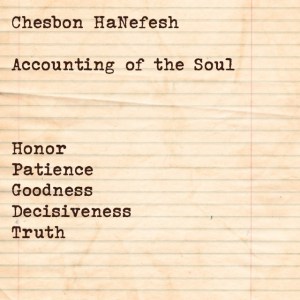
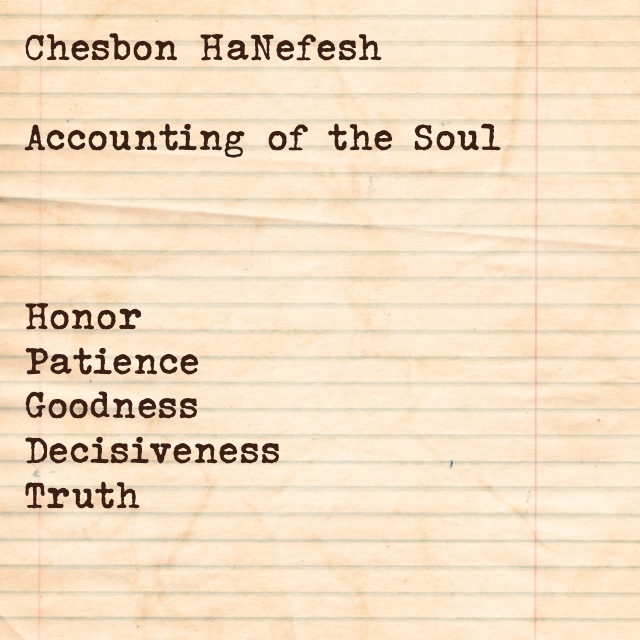
photo (7)Keep an Accounting

We begin mussar practice by keeping an “accounting of the soul” (Chesbon HaNephesh) diary or journal for a week or two. It’s simple. Every night (or morning, whichever suites your schedule) for a week, record (it doesn’t have to be lengthy) the instances in your day where you believe your lower self (beast/nephesh/flesh) had the upper hand. Be specific. It can be anything from over eating to doing or saying something you should or shouldn’t have. For example, did you find yourself behind Ms. Slowpoke with three carts at the grocery store? Did bad thoughts cross your mind? Write them down. What about traffic? Any road rage today? What about a stranger asking for money? Did you open or close your hand? Why? Did you lose your temper with your spouse or child? Did you look upon someone and judge them for what they wore or didn’t wear? Did you lust after or covet something that wasn’t yours? Be honest. No one will see your journal but you and God.

Wisdom says those who seek her daily and hear (shema) instruction (mussar) will find life:

“And now, my children, listen to me: happy are those who keep my ways. Hear (shema) instruction (mussar) and be wise, and do not neglect it. Happy is the one who listens to me, watching daily at my gates, waiting beside my doors. For whoever finds me finds life and obtains favor from the LORD;” (Pro 8:32-35, NRSV)

The areas that you need to work on can be narrowed down into one word. For example, you may find that you have a pattern of impatience. Lacking patience quickly ignites ungodly anger and rage. This area of your life is out of balance. In a word, the trait (fruit) you need to produce is patience. Perhaps you are highly critical of other people. It matters not how they’ve behaved. By criticizing them (even in your mind), you are making an unrighteous judgment that is fueled by a lack of honor and respect for a being created in the image of God. The trait you need to work on is honor. It may be very difficult to see the “good” or “holiness” in a person that lives contrary to the Word, but Yeshua died for them too. Thus, the point isn’t to overlook or condone their bad behavior, but for you to realize that they, too, were created in the image of God. The practice isn’t about them, it’s about you. Can you honor them… anyway?

This type of journaling will reveal PATTERNS in your life and areas that need to be corrected (mussar). For years now, my family has been doing this in mini fashion in preparation for Yom Kippur. An accounting of the soul[4] chart is what my family uses before we perform the tashlich service. Until rather recently, I had no idea that this accounting was part of mussar work. But, repentance and accounting should occur more than once a year, right? Start a mussar journal and you’ll find that Adonai can speak to you in your own handwriting. This isn’t mystical. In being transparent and honest with yourself, you are in effect being open and honest with the Creator and He will strengthens your heart to be the overcomer you desire to be.

Soul Traits (Middot)

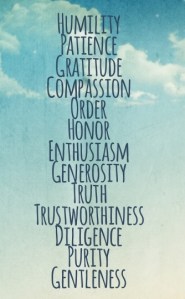
Once you’ve discovered the traits (areas) that you need to improve, you will spend one week practicing or focusing on each one. If you have a hard time making or discerning your list (curriculum), you can use a preformed chart with traits already listed. Most people begin mussar by using one of these. With practice, you will gain insight into the traits that you need to do work on more. Many mussar programs recommend starting with thirteen or eighteen traits. A list of thirteen would take you through each one four times in a year. But this is only a suggestion. You might find you need to spend several weeks in one area or a fruit or trait that you had not considered continues to pop up in your life. Work on it. (:

What do I mean by “work?” Simply being intentional in your prayer life and Bible study, and honest about what is occurring in your life and in your relationships. Take a long, hard, honest look at all of it like the serpent on the pole and be healed. Adonai promises that if we ask Him, He will answer. If we seek Him, we will find Him. And His desire is to refine and conform us into the image of Yeshua. We should desire to participate in the process and not get tossed around with every wave and trial of life.

“Ask, and it will be given to you; seek, and you will find; knock, and it will be opened to you. For everyone who asks receives, and he who seeks finds, and to him who knocks it will be opened. Or what man is there among you who, when his son asks for a loaf, will give him a stone? Or if he asks for a fish, he will not give him a snake, will he? If you then, being evil, know how to give good gifts to your children, how much more will your Father who is in heaven give what is good to those who ask Him!” (Mat 7:7-11, NAS95)

“But we all, with unveiled face, beholding as in a mirror the glory of the Lord, are being transformed into the same image from glory to glory, just as by the Spirit of the Lord.” (2Co 3:18, NKJV)

It is helpful to meditate upon and learn more about each soul trait (or attributes of God or fruit of the Spirit). You cannot improve if you do not understand what it is that is the problem. This is where a good mussar book or an online program comes in handy. My favorite book is Everyday Holiness by Alan Morinis. If you can’t spare any money, you can go through a free online course in order to get the hang of doing mussar. This program is also written by Mr. Morinis for Aish.com.

Reading about the trait/fruit you are working to improve is an exercise of your mind (lev). The Word of God is your best resource. If you are working on honor, do a concordance search for all the verses that speak about honor. Read them in context and ask the Holy Spirit to reveal how you can act and think with godly honor. I also recommend that you read an article or two during this week about honor. Riverton Mussar has some excellent articles on many soul traits from a Messianic perspective.

To help you focus throughout the days you are working on a particular trait/fruit, it is advisable to develop a phrase that will remind you of that trait. For example, for honor, Mr. Morinis suggests thinking “each one, a holy soul” to encourage one to honor their fellowman. He also recommends finding another person to practice mussar with in order to go deeper. Accountability is always helpful, and other people always have insights and perspectives that you haven’t considered. We can learn a great deal from one another. (This doesn’t mean you have to reveal your personal journal.)photo (6)
Mussar in a Nutshell

  • Work on one trait/fruit in your list for one or two weeks. Throughout the weeks, read about your trait/fruit in Scripture and other resources.
  • Every morning meditate upon the phrase you’ve chosen to remind you of that trait. Pray and ask the Father to give you an opportunity to exercise this muscle you’re trying develop. (Be prepared for this: like in exercise, your muscles/flesh may complain.) You will be surprised by how the Holy Spirit brings your phrase to mind when you are being tempted.
  • At the end of the day, record your triumphs and failings in this area. Pray and ask the Father to help you improve. You can also journal in the morning if that better suites you. The point is to do it – even if you only write a sentence or two.

This may seem too simple to warrant results. And I must admit that at first, I thought this was the case. However, that thought was quickly overruled when I was actually tested in an area I had “studied” for. Instead of reacting as I usually did, I was sensitive to my emotions and unhealthy soul patterns. Though it’s not what I wanted to do (nephesh), I chose differently and gained much better results! Moreover, I think it surprised the person I was dealing with and disarmed them from a normal escalation.

Remember, your mind (lev) can only choose differently when it is taught differently. A renewed mind/heart has been changed by a steady diet of godly instruction. But like any test, you must study the areas where you lack knowledge and understanding in order to pass. Mussar guides you to these weak areas and builds up your awareness and knowledge.

Paul’s Mussar

It is helpful to see a mussar example from the Apostolic Scriptures.  I’ve chosen to use the passage from a verse I quoted earlier. Let’s begin by looking at the context of the following verse.

Php. 4:13  I can do all things through Him who strengthens me.

The following passage is lengthy, but I urge you to read it in its entirety for the best context.

Php 4:4-9  Rejoice in the Lord always; again I will say, rejoice!  (5)  Let your gentle spirit be known to all men. The Lord is near.  (6)  Be anxious for nothing, but in everything by prayer and supplication with thanksgiving let your requests be made known to God.  (7)  And the peace of God, which surpasses all comprehension, will guard your hearts and your minds in Christ Jesus.  (8)  Finally, brethren, whatever is true, whatever is honorable, whatever is right, whatever is pure, whatever is lovely, whatever is of good repute, if there is any excellence and if anything worthy of praise, dwell on these things.  (9)  The things you have learned and received and heard and seen in me, practice these things, and the God of peace will be with you.

Paul is giving us some pretty awesome advice that is not unlike the practice of mussar. Notice the bolded words above. Each is one is a middah, soul trait, or fruit that can be meditated upon and practiced in mussar. I hardly believe this is coincidence. Best of all, Paul says that the shalom of God will guard our hearts and minds (levav) IF we do these things! The passage continues:

Php 4:10-13  But I rejoiced in the Lord greatly, that now at last you have revived your concern for me; indeed, you were concerned before, but you lacked opportunity.  (11)  Not that I speak from want, for I have learned to be content in whatever circumstances I am.  (12)  I know how to get along with humble means, and I also know how to live in prosperity; in any and every circumstance I have learned the secret of being filled and going hungry, both of having abundance and suffering need.  (13)  I can do all things through Him who strengthens me.

It was in doing these things that Paul LEARNED to be content in all circumstances – good or bad. I want to know what Paul did. How exactly could he end this discourse with “I can do all things through Him that strengthens me?” We quote this last verse all the time, but I can’t help but to wonder if we are missing something important that is revealed before Paul arrives at this summation.

Going back to the beginning of these quotes from Philippians, let’s look at the things he tells us to DO so that the peace of God guards our hearts and minds (levav).

  1. Dwell on these things. (vs. 8)
  2. Practice these things. (vs. 9)

These two points are precisely the two things ancient and modern mussar teachers emphasize in mussar practice. Number one uses the Greek word logizomai (Strong’s G3049), which literally means to “to take an inventory.” The entire point of doing Mussar is to take (or give) an accounting of your soul. You are to do this (in part) by meditating upon godly attributes, characteristics, or qualities. The King James Version of verse 8 translates logizomai as “to think on.” We are to purposefully think upon godly attributes and weigh ourselves in that balance.

The Greek word for practice in verse 9 is prassō. It means to practice or perform repeatedly or habitually. Again, this mirrors what the mussar teachers have said for centuries. Habitually comparing our hearts to the attributes of God results with change, transformation, and renewal. This doesn’t mean it will be easy. Paul’s life certainly wasn’t “easy.” But the secret he learned enabled him to proclaim real joy and liberty in the midst of great trials, persecution, and pain.

Paul mentions these particular qualities:

  1. Rejoice (This is akin to the common mussar trait of enthusiasm or zeal, vs. 4, notice that it is repeated)
  2. Gentleness (vs. 5)
  3. Trust (inferred as the opposite of being anxious, vs.6 )
  4. Thanksgiving (vs. 6)
  5. Truth (vs. 8)
  6. Honor (vs. 8)
  7. Righteousness (vs. 8)
  8. Purity (vs. 8)
  9. Love (vs. 8)
  10. Goodness (vs. 8)
  11. Excellence (vs. 8)
  12. Worthiness (vs. 8)
  13. Generosity (inferred by “concern” for another, vs. 10)

I purposely drew out thirteen qualities from this passage because most mussar programs choose this number as a starting point to begin your practice. Paul tells us to THINK upon (take an inventory of) these things and to PRACTICE these things habitually. This is mussar; and the Biblical path to overcoming, contentment, and shalom.

The result will be none other than our hearts and minds being guarded by the peace of God. Moreover, it is the SECRET, according to Paul, as to how he LEARNED to be content in ALL circumstances. If Paul had to LEARN these things, what makes us think that we won’t have to? How many of us would give just about anything for either one of these things?

 “Mussar aims to help you close the gap between your ideals and the life you actually lead.” –Alan Morinis

Doesn’t that sound wonderful? I believe mussar is the hidden power tool in our garden shed. The question is, are we willing to wield it?


[1] I would be remiss if I didn’t also mention the fantastic Creation Gospel series as the springboard that led me to mussar in the first place. Dr. Alewine’s work is incomparable in its scope to treat and remedy the whole person in the glorious light of the Messiah and His Holy Spirit.

[2] This is explained in Matters of the Heart Part I.

[3] Rabbi Rosalin Mandelberg

[4] This accounting is called an Chesbon HaNephesh.

Categories: Messianic Issues, Musings | Tags: , , , , , | 12 Comments

Matters of the Heart Part II

Two Hearts?

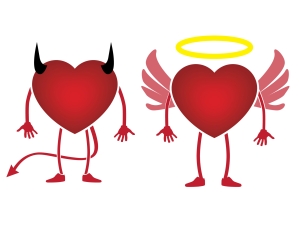
© Simi32 | Dreamstime.com - Heart Devil Or Angel Icon Photo

© Simi32 | Dreamstime.com – Heart Devil Or Angel Icon Photo

In the last post on Matters of the Heart Part I, I laid the foundation for the Hebraic and Biblical understanding of the heart or the lev/levav. As I was researching this Hebrew word, I discovered that the Rabbis have long understood the dual nature of the human heart. (No surprise there.) I mentioned in Part I that this duality is most akin to us being double-minded, since the lev is also our mind.

But the Rabbis take this a step further and make a Midrash on the fact that the Hebrew word for heart comes in two forms: lev and levav. Even looking at these transliterations, you can see that the latter form has a “doubled” vet. The Rabbis point out that we each have TWO hearts or two conflicting impulses (good and evil) at the core of our being. The lesson isn’t that we are to neglect the evil inclination and strengthen the good inclination, as we might assume. Rather, a truly righteous person will yoke both inclinations to the mitzvot or commandments of God in order to direct us toward godliness.

This may seem strange to our Greek minded nature. But the Rabbis make a point that we often miss. The evil inclination is really our nephesh. It is our fleshly desires, appetites, emotions, will, and intellect. It serves a godly purpose IF we bring it into obedience to the Word of God. The strong urge or desire to procreate is only evil when it not sought within the holy bounds of matrimony. The drive to expand our territory is good if that expansion is for the Kingdom of Heaven. Without the “evil” inclination aspect of our levav, we would have no passion, drive, or desire to accomplish anything.

Photo by Axel Holen on Unsplash

The analogy that best describes this lesson of the sages is witnessed in our domesticated beasts or animals. My son and I just finished reading Black Beauty by Anna Sewell. Many of you will be familiar with this classic, but for those of you that are not, it is a tale about the life of a horse named Black Beauty. Beauty grows up around people and learns to work hard early in life. He is a gentle and loving horse, but faces many challenges as he is bought and sold numerous times, sometimes to good men and other times to cruel ones. Beauty is the epitome of a tamed beast. He is well trained and desires to please his masters. As a matter of fact, the owners that take good care of him and show him love, mercy, and compassion only makes Beauty a better work horse and companion. Beauty grows to love and trust them and their families. His diligent service in these homes is driven by love rather than fear (of punishment).

Along his journey, Beauty meets many other horses and hears their life stories. Those that had a wild or cruel upbringing have “issues” with man. They fear giving new owners their trust and often step out of line in disobedience or ignorance. Beauty is grateful for his loving upbringing and sound instruction when he hears stories like these, for he knows that had he not known love, compassion, and gentle training when he was young, he might have the same struggles as his new friends.

While reading this old story again after many years, I have been struck by it in a profound way. We, like Beauty, are also (partially) a beast (nephesh). And like his friends, our upbringing has a great impact on our future. Those of us raised with godly parents that gently guided us have advantages, and in some cases, less “issues” than those that didn’t. This in no way implies that those less fortunate in their upbringing cannot overcome through Messiah. But I can’t help but to recall the Creator’s mandate that we are to diligently teach our children. These words aren’t arbitrary. They are purposeful and would not be in the Torah if obeying this commandment didn’t have a direct impact on the us, our children, and the earth.

But that isn’t what impressed me the most about rereading Black Beauty. Mrs. Sewell went into great detail about the proper and improper handling, training, and treatment of horses. It was as if Adonai was speaking to me through this children’s story about our “older” nature, our nephesh, the beast. Our nephesh must be broken in and tamed just like the wild stallion. We must bring it into the submission of our renewed spirit that is ruled by Messiah, the Living Word of Elohim.

All those wild passions, strengths, and desires must be broken and reforged for a NEW purpose – to serve HaShem and our fellowman. In other words, that part of your heart (levav) that likes to have its way instead of doing what you “know” to do is really an unruly and untamed BEAST. It is just as strong and powerful as the majestic Black Beauty. It must learn to serve the master (your spirit) and the Master of masters, Adonai. If this nature is brought into obedience, great things will happen. Think of how much more a man with a work horse can do in the field than one without one!

The Beast Within

The Scriptures that reference our heart, mind, and soul are meant to instruct one about how to tame the “older” nature and bring it into submission to YHWH. When taming and training a beast of the field, we understand that it is a PROCESS . It doesn’t happen overnight, but through persistent, faithful, and consistent training. This natural picture of a greater spiritual truth should bring encouragement to those who still struggle with particular areas of obedience. (Which if one is honest, is all of us!)

As I was meditating on this practice and Black Beauty, it became clear as to why it is so important to search out the “roots” behind many of our struggles. These (bad) roots would have been formed when we were young or could be a generational issue.[1] Conversely, they could form as we age as a response to unfair, abusive, or hard circumstances.

These “roots” are basically made-up of thoughts and agreements with falsehoods. In other words, our lev or levav has rooted itself with a wrong mindset which brings about incorrect feelings, actions, words, attitudes, and deeds. How can one break free and walk, live, or think another way unless he is taught with much patience and kindness? Like Black Beauty’s friends, it takes the long suffering of a good trainer to help the beast see that there is a better way to behave and that some people really can be trusted.

Photo by sue hughes on Unsplash

Although godly people are the key to one hearing and receiving the Good News, we have our own homework to do as well. Please don’t misunderstand that last statement. I’m not inferring that the Gospel isn’t enough or that it must be earned. What I am saying is that once you RECEIVE the truth, you must learn to walk in it, if you truly desire to be an overcomer with abundant life. I’ve met many people that were saved by the grace of God, but they were still living with much pain from the past, patterns of broken relationships, and remained in bondage in some areas.

Many would suggest these people are in need of deliverance and I agree with that counsel. However, most references in the Bible about deliverance are about salvation and rescue from physical enemies or adversaries. Not all of our ailments and problems come from the outside. Many are issues of our heart (lev) which have been left unchecked because we SEE no other alternative or we just don’t know HOW to get from point A to point B. We have no clue as how to rein in the beast (nephesh/flesh) and change for the better. This is where the washing of the water of the word becomes our guide to success.

Eph. 5:26-27  So that He might sanctify her, having cleansed her by the washing of water with the word,  (27)  that He might present to Himself the church in all her glory, having no spot or wrinkle or any such thing; but that she would be holy and blameless.

What I’m really speaking to here is sanctification, not deliverance. I personally believe that some people fail to receive deliverance in certain areas because the problem isn’t about an outside force or enemy, but an inward (heart) issue that is in need of cleansing and circumcision. That which is neglected is the MIND or heart, the lev or levav.

Tit. 2:11-15  For the grace of God has appeared, bringing salvation to all men,  (12)  instructing us to deny ungodliness and worldly desires and to live sensibly, righteously and godly in the present age,  (13)  looking for the blessed hope and the appearing of the glory of our great God and Savior, Christ Jesus,  (14)  who gave Himself for us to redeem us from every lawless deed, and to purify for Himself a people for His own possession, zealous for good deeds.  (15)  These things speak and exhort and reprove with all authority. Let no one disregard you.

Are you zealous for good deeds? I like to think that I am until I am tested, and then the real truth of what is in my heart comes forth. This is why we are tested in the first place, so we can what really lurks in its depths. We tend to think that “tests” are huge and obvious. Most are not. Instead, the majority of how and when we are tested is in our everyday life – those things we perceive to be non-consequential or minor.

For example, you’re running late for an appointment and every possible delay seems to prevent you from getting there on time. Each obstacle heightens your anger a little more. Eventually, you find yourself trying to enter a heavy traffic highway, and not one car is willing to let you in. Finally there is a tiny break, so you hit the gas and squeeze onto the highway. But, the packed highway only inches along. You find yourself sitting through every traffic light multiple times. Your frustration, anger, and blood pressure continues to rise. Suddenly, you see another car trying to enter the street like you did a few minutes ago. The traffic stops near them, and you have a choice to make. Do you let them in? Who knows how long they’ve sat there trying to turn? Any other day, your kindness would allow them to enter just in front of you. But today, you’ve reached the point of “beyond late” to your appointment. Do you let them pass anyhow, knowing it may cost you passage through the next stop light? Or, do you justify your selfishness because you are late for a very important date?

Does that example seem too “small” of an issue to really matter? What about this one?

It seems as though every day you have to remind your son to do what he knows to do – clean the cat box and take out the trash. Without fail, every day you are forced to remind him. This constant cycle has you immensely frustrated. Today has already been a trying day with other matters. Do you grab him by the ear and drag him to the cat box and demand he fulfill his duty? Do you scream and shout out of exasperation? Do you mete out severe punishment while furious? Or do you slip into indifference and apathy and do his job yourself? There are so many choices as to how to respond. Which one, if any, is correct and supports the notion that you are godly and zealous for good deeds? How would Yeshua respond?

How about this one? Your spouse has a bad habit that drives you up the wall. Maybe it’s leaving the toilet seat up. You’ve kicked, screamed, cried, begged, and pleaded that he do this one simple thing for you. Why won’t they just do this one thing? Do they not love me? Why? Why? Why? Today you sit down to do your business and… ker-plop! Your bottom touches the cold ceramic edges of a seatless loo and you barely miss falling into the water. Immediately your blood pressure skyrockets. As usual, your response is to rush into the other room to announce (yell) your disdain for your spouse’s carelessness. Your spouse goes on the defensive at your furious tantrum. Shalom in the home flies out the window along with any and all of your sensibilities. The evening is completely spoiled, the children have witnessed yet another verbal outburst with tears and slamming doors and the whole house is now on edge. Any plans for family time have been lost. Reading Scripture together as a family is reserved for another day. All this because your precious bottom touched a little potty water. Worst of all, you feel justified in your actions. All blame goes to the REAL guilty party: your spouse!

Photo by Giorgio Trovato on Unsplash

While it is true that your spouse needs to be more respectful of your wishes (and your tuchas), he is NOT the villain in this little tale. You are. His little oversight didn’t wreak havoc in your household and teach your children the “wrong way” to handle life’s problems. It wouldn’t be surprising if YHWH was allowing him to continually “forget” the toilet seat in order to teach you a lesson.

Now replace any of the scenarios above with issues you seem to face again and again. Who is the one in need of more training? I firmly believe that Adonai works on multiple levels. Even when it comes to correcting our children, there is an opportunity for us to be corrected as well. Repetitive issues should grab our attention the most. Apparently we are NOT passing the exam, and it’s usually because we are oblivious to our own need for “correction.” Pride and self-justification can mask a plethora of character issues. The focus shouldn’t be on our fellow man’s problem. It should be our own! Didn’t Messiah say something about this very thing?

Mat. 7:3-5  “Why do you look at the speck that is in your brother’s eye, but do not notice the log that is in your own eye?  (4)  Or how can you say to your brother, ‘Let me take the speck out of your eye,’ and behold, the log is in your own eye?  (5)  You hypocrite, first take the log out of your own eye, and then you will see clearly to take the speck out of your brother’s eye.

 Today, I will leave you to ponder the issues of you own heart during these last days of the month of repentance (Elul). The fall Moedim (feasts) are quickly approaching and they truly are all about the heart! I’ve actually written this second part multiple times over the past weeks. There are so many facets to this topic that I’ve had a hard time deciding which angle to take. The next one will hopefully expand upon this post and offer some solutions to the dilemma that seems common to us all: How do we prepare and practice in order to pass the myriad of life’s tests for our souls?

Part III


[1] My understanding of “generational curses” is more akin to the passing along of unholy thinking. For example, if all you ever learned as a child was to “deal” with life by over drinking, then you will probably mimic the actions of the parent that presented you with this “way of life.” It’s as if you see no other course of action or another way in which to go (walk). The same could be stated for issues such as abuse, depression, poor work ethics, obesity, drug abuse, thievery, anger, etc. There is a reason why we are commanded to teach our children in the way that they SHOULD go. Most children watch everything their parents do for good or for evil. Later when they are an adult themselves, when life presents them with opportunity (and it always will), most will choose to follow the path taken by their parents, even if they hated the parents actions as a child, because that is the only “way” they were taught. The mind (lev) only has experience with what it has been taught or trained for; thus, without the transforming power of the Word, most will follow the footsteps of their earthly trainers (parents/guardians). This is a vicious cycle and indeed a curse. Thank Heaven we have the Living Word to show us the way of truth, life, and blessing!

Categories: Messianic Issues, Musings | Tags: , , , , , , | 8 Comments

Blog at WordPress.com.