Posts Tagged With: Creation Gospel

Torah Portion: Mattot and Massei

Numbers 30:1- 36:13, Jer. 1:1-2:4-28, 3:4, Mt. 5:33-37, James 4:1-12

Mattot

The first of our double portion for this week’s Torah reading is Mattot. Mattot is translated as “tribe(s)” 182 times in our Tanakh (O.T.); and as rod(s) or staff another 66 times. Below is Strong’s definition followed by the Ancient Hebrew Lexicon of the Bible’s entry for this word.

Strong’s H4294

    מטּה From H5186; a branch (as extending); figuratively a tribe; also a rod, whether for chastising (figuratively correction), ruling (a sceptre), throwing (a lance), or walking (a staff; figuratively a support of life, for example bread): – rod, staff, tribe.

AHLB#: 1285-H (N)

1285) ac: Shake co: Branch: The pictograph “mem” is a picture of water, the “tet” is a picture of a basket which contains objects. Combined these mean “liquid contained”. A green branch still contains water allowing the branch to be flexible. A green branch can then be bent to the desired shape and left to dry.

Based on the light shed by our lexicons, what is it to be a tribe? Have you ever heard the phrase “When you’re green you’re growing”? According to ancient Hebrew, to be part of a tribe is to be a tree branch— a green growing branch that is still moldable or flexible. To remain green, this branch must have life giving water still flowing through it. In other words, the word picture shows us a tree (a whole complete unit) and that tree has many branches, but all the branches are a part of the one tree. I recall Yeshua using this very word picture to explain our relationship to Him in John 15.

 John 15:1-8  “I am the true vine, and My Father is the vinedresser.  (2)  “Every branch in Me that does not bear fruit, He takes away; and every branch that bears fruit, He prunes it so that it may bear more fruit.  (3)  “You are already clean because of the word which I have spoken to you.  (4)  “Abide in Me, and I in you. As the branch cannot bear fruit of itself unless it abides in the vine, so neither can you unless you abide in Me.  (5)  “I am the vine, you are the branches; he who abides in Me and I in him, he bears much fruit, for apart from Me you can do nothing.  (6)  “If anyone does not abide in Me, he is thrown away as a branch and dries up; and they gather them, and cast them into the fire and they are burned.  (7)  “If you abide in Me, and My words abide in you, ask whatever you wish, and it will be done for you.  (8)  “My Father is glorified by this, that you bear much fruit, and so prove to be My disciples. (NASB)

Branches exist for the purpose of producing leaves and fruit. The leaves absorb light/energy which is likened unto the (Torah) and this light ultimately is what powers the leaves to produce food for the whole tree. [Bread from Heaven, anyone?] The fruit however, has an entirely different purpose.

Trees produce fruit for the sole purpose of propagating seeds. And those seeds will produce the exact same tree. This is why Yeshua said, “You will know them by their fruit”. If the fruit doesn’t match the tree they are claiming to be, then we can be sure that they are liars. Trees are known by what kind of fruit they produce.

Mat. 7:15-20  “Beware of the false prophets, who come to you in sheep’s clothing, but inwardly are ravenous wolves.  (16)  “You will know them by their fruits. Grapes are not gathered from thorn bushes nor figs from thistles, are they?  (17)  “So every good tree bears good fruit, but the bad tree bears bad fruit.  (18)  “A good tree cannot produce bad fruit, nor can a bad tree produce good fruit.  (19)  “Every tree that does not bear good fruit is cut down and thrown into the fire.  (20)  “So then, you will know them by their fruits. (NASB. See also Mat. 7:16, 12:23; Luke 6:44)

Now that we understand that as a “branch” or “tribe” of Israel we should be absorbing light (learning Torah) and producing fruit (keeping Torah), is it any wonder that Paul uses the analogy of the olive tree for Yah’s family in Romans chapter 11? Please go and reread this whole chapter.

Yeshua and Sha’ul/Paul are teaching the same message. If you or I (branches) do not do what we were created to do (produce fruit) we are cut off from the tree (Messiah). However, if we do what we were created to do, then we are grafted into The Olive Tree: Yeshua. Therefore, a tribe is a branch in the house of Israel/Yeshua.

Vows

This aptly named Parashah begins by teaching us the Torah of vows in chapter 30. There is basically a simple rule for men: he must keep his vow. Period. There is no recourse for him should he break his vow or obligation. (vs. 2). But the rest of this chapter deals with vows made by women. If you’ve read any of my posts on women, you know that I seek godly restoration for the roles of men and women. That being said, most commentaries on this passage tend to use a skewed lens as they peer into the fact that while a man’s vow must be kept, a woman’s vow may be annulled by her father or husband. Sadly, too many commentators write that this is because the woman is weak, easily deceived, and acts impulsively compared to a man.

If we allow the WHOLE counsel of God to speak to this issue, we can easily see that an assessment such as this is a result of flawed theology and doesn’t even come close to connecting how YHWH created woman or how He SEES her. Remember Hagar? She is the one that proclaims that YHWH was the Elohim that sees her— El Roi[1].

I believe that YHWH not only created woman with a unique role, but with a special purpose in the restoration of all things. If we find ourselves feeling put out like Hagar, we need only to meet the Master by the well of Living Waters. There, He will allow us to SEE with new eyes. How glorious it is when we realize that the Creator of Heaven and Earth really SEES us! This passage is far from being misogynistic.  Instead, if we have eyes to SEE, it is liberating not only to women, but to the Body of Messiah.

In His most endearing of terms for His people, YHWH calls us His wife and His Bride. Both men and women have an opportunity to be included in this glorious remnant. As His special treasure, we are kept in His care. As our Master, Father, and Husband He takes responsibility for us —- flaws and all. What better hands could we ever hope to trust in? When I read this passage about the importance of vows and the glaringly obvious difference between the responsibility of men and women, I have to conclude that this passage is teaching us about YHWH and His people. You see, only He — our Father and Husband — can annul the foolish vows that we make. While it is not impossible to make good on our vows, it is improbable. What else could have motivated the Messiah and James to say the following?

Mat 5:33-37  “Again, you have heard that the ancients were told, ‘YOU SHALL NOT MAKE FALSE VOWS, BUT SHALL FULFILL YOUR VOWS TO THE LORD.’  (34)  “But I say to you, make no oath at all, either by heaven, for it is the throne of God,  (35)  or by the earth, for it is the footstool of His feet, or by Jerusalem, for it is THE CITY OF THE GREAT KING.  (36)  “Nor shall you make an oath by your head, for you cannot make one hair white or black.  (37)  “But let your statement be, ‘Yes, yes’ or ‘No, no’; anything beyond these is of evil.

Jam. 5:12  But above all, my brethren, do not swear, either by heaven or by earth or with any other oath; but your yes is to be yes, and your no, no, so that you may not fall under judgment.

I am very thankful that as my Abba and Husband, YHWH can annul vows for me. I believe men would also give a hearty A-mein to that! A bond-servant relinquishes all of his rights into the hands of his Master. The servant trusts the Master with his/her life. A servant has no need to make a vow, for he/she lives to serve/please the will of the Master. I am continually amazed by the Messiah’s presence in the volume of the Scroll[2]! It really is all about Him and His relationship with us. But like Hagar, we have to first meet Him at the well and have our eyes opened to His splendor and most tender affection for us.

Massei

This is the last parashah (portion) in the book of B’midbar (Numbers). B’midbar is a book that means “in the wilderness.” It chronicles each step and stop of the Israelites as they marched toward the Promised Land over a 40 year period. Our portion, Massei, can be defined as “pulling up stakes” as this is the word picture we are given from the Hebrew. We usually translate it as “journeys,” since a journey can convey the meaning of pulling up tent pegs to move toward another location.

At this point in the wilderness, the children of Israel are preparing to go in and take possession of the Promised Land, Canaan. YHWH instructs Moses to record each of the 42 stops or encampments that Israel made while dwelling in the wilderness. (Num. 33:2) An inexperienced Torah reader may be tempted to skim or skip over most of chapter 33’s place names. They may seem boring or even arbitrary to the untrained eye. But nothing could be further from the truth! These 42 stops have many past, present, and future implications for those that follow our Master, Yeshua, and keep His commandments.

The rabbis have long taught that each of the 42 encampments is a clue to the “journey” that we are on as we walk and sometimes limp toward the Promised Land. There can be no coincidence that there are also 42 months (3 ½ years) in the Great Tribulation. But, I’m getting ahead of myself. I’d first like to draw your attention to the number 42.

Forty-Two

The number 42 is significant for several reasons. For those of you that are familiar with the Creation Gospel model, the fact that 42 is the product of 6 x 7 will be very telling.

First, 6 x 7 is the number of man (and/or the beast) and of rest, spiritual perfection, or wholeness. Second, 6 and 7 are also representative of the Spirits of Knowledge and Reverence, the festivals of Yom Kippur and Sukkot, and the assemblies of Philadelphia and Laodicea.

These pairings suggest two similar paradigms. The first paradigm is man, as E.W. Bullinger suggests[3], working out his opposition to God. Every person is capable of acting like a man created in the image of Elohim or resorting to his/her base nature (i.e. evil inclination, flesh) that reflects the image of a beast. This inward struggle is common to all of mankind. Like Cain, we have a choice — everyday. Will we walk in the Way of Messiah and mirror His image? Or will we relent to the desires of our flesh and reveal the image of the beast? Both man and beast were created on day 6. This is why the number of the beast is also the number of man[4].

For those that deny or afflict their souls on Yom Kippur (6), sweet rest and rejoicing follows on Sukkot (7). But there is another paradigm revealed in this number as well. Consider some other instances of the number 42 in Scripture:

  • If one counts the 2 years from the original Pesach in Egypt to the evil report and 40 years from Kadesh Barnea to Jericho when Israel finally enters the Land, there is a total of 42 years.
  • Israel’s wilderness journey’s had 42 stops or stages where they sometimes cooperated with YHWH and other times they opposed Him.
  • There were young boys that mocked the ascension of Elijah to Elisha and 42 of them perished before Elisha in the Name of YHWH by 2 female bears. (2 Kings 2: 23,24)
  • The beast is given 42 months to control the earth (Rev 13:5). We also know that 42 months equals 3 ½ years.
  • In our Parashah, the number 42 comes up twice. Once in the wanderings listed above and a second time in chapter 35. The Levites were designated 42 cities among their brothers in the Promised Land, besides the 6 cities of refuge.

While the first paradigm reveals an inward struggle, the second pattern exposes a very real outward battle. Those that choose to live by their own desires will find that they are indeed enslaved by the beast. As his captives, they have a natural hatred for the servants of the Most High. We can see this pictured in the last two assemblies mentioned in the Book of Revelation. Philadelphia, the city of brotherly love, symbolizes people who are willing to sacrificially love God and others. This is the epitome of the Holy Spirit of Knowledge[5]. This intimacy is portrayed by the 42 cities given to the Levites in the Land. It is vital that Adonai’s people have an intermediary present. But as we progress to the last assembly, Laodicea, we see a very different image.

Laodicea is neither hot nor cold, so she believes she is just right. But her condition is so vile that it makes the Master want to vomit. In other words, she has no reverence or fear of the LORD — the 7th manifestation of the Holy Spirit. The white garments she should have received on Yom Kippur (6) are missing when Sukkot (7) comes around. Yet she childishly wallows in her pride and ignorance. Without sincere repentance, the beast will overtake her like the 2 bears that slew the 42 young boys who mocked the ascension of Elijah to Elisha.

Have you ever wondered why the beast is given “42” months to control the earth? Most people understand that the number 40 represents probation, trial, and chastisement for those whom YHWH loves[6]. But what happens when we add “2” to that number? Two denotes division and difference in the Bible. For example, the second day of creation DIVIDES the upper and lower waters, the second sentence in scripture speaks of chaos, and the second chapter reveals 2 trees representing life and death. These instances continue throughout the Bible in regard to the number two[7]. While it is true that the world that YHWH loves is put to the ultimate test (40) in the Apocalypse, the addition of the number 2 reveals the vehicle that YHWH will use to accomplish this task: the enemy.

Obviously, the heart of YHWH desires for us to come to repentance above all else. This is what our trials and tribulations are all about. We must tame the animal nature or beast within and choose to walk in His Way, reflecting His image. This is expressed in its fullness when we love YHWH with all our heart and love our neighbor as ourselves.

Moving with the Cloud

Our journey begins in the same place for all people living in all times——- Rameses. One thing those of us that are returning to the Torah know and know well is that all roads do not lead to Rome——– or even Egypt——- but to Babylon, or Babel. Rameses means “child of the SUN” and all false worship can be traced back to sun worship that was first concocted in Babylon.

I urge you to look up each of the 42 place names of Israel’s wilderness journeys in Hebrew. I’m certain that you will find a place name that expresses your current life situation, station, trial, or movement. Like Israel, we all are all on journey with YHWH. We may not all be at the same place at the same time, but there will be a day that we are. In the meantime, consider it another test when you are faced with brethren who are not as far down the path or who are further ahead of you in the Way. How we treat or mistreat them may dictate our next stop on the journey.

Moreover, it is clear that there is real war along the Way. One of the more pronounced foes is the Canaanites. While the Canaanites are outward enemies, the “spirit” of the Canaanites can reside in our hearts if we allow the beast within (our flesh/evil inclination) to have rule. YHWH gives us this warning:

Num. 33:55-56  ‘But if you do not drive out the inhabitants of the land from before you, then it shall come about that those whom you let remain of them will become as pricks in your eyes and as thorns in your sides, and they will trouble you in the land in which you live.  (56)  ‘And as I plan to do to them, so I will do to you.'”

This is essentially the same message He gives to us in the 42 month rule of the beast in the Book of Revelation. If we do not repent and walk after Him, we will be counted with the beast and receive its punishment.

Rev. 12:14  But the two wings of the great eagle were given to the woman, so that she could fly into the wilderness to her place, where she *was nourished for a time and times and half a time (42 months), from the presence of the serpent.

Rev. 14:9-12  Then another angel, a third one, followed them, saying with a loud voice, “If anyone worships the beast and his image, and receives a mark on his forehead or on his hand,  (10)  he also will drink of the wine of the wrath of God, which is mixed in full strength in the cup of His anger; and he will be tormented with fire and brimstone in the presence of the holy angels and in the presence of the Lamb.  (11)  “And the smoke of their torment goes up forever and ever; they have no rest day and night, those who worship the beast and his image, and whoever receives the mark of his name.”  (12)  Here is the perseverance of the saints who keep the commandments of God and their faith in Jesus.

We must willingly pull up the tent pegs when YHWH’s cloud moves our encampment. This is our perseverance as verse 12 above attests. This double portion and all of Scripture for that matter tells the same story in different ways again and again. YHWH loves us and desires for us to dwell with Him in His house. However, we have 2 interwoven enemies that battle for our affections. The first one is the beast within (our flesh, evil inclination, or fleshly desires). The second is the serpent from the beginning, who speaks to our desires. We are told that we CAN overcome the enemy by choosing the Life YHWH has offered us in Yeshua. This New Life of YHWH has House rules that keep or guard us from the beast: His commandments.

But as we live out these earthly lives, we are in a constant state of choosing. This is why our journey requires perseverance! To persevere is to persist, continue, endure, insist, proceed, stick with, etc. And with the empowerment of the free gift of the Spirit of God, we can do just that.

Chazak! chazak! V’neet’chazek!

(Be Strong! Be Strong! And let us be strengthened!)


[1] Genesis 16

[2] Hebrews 10:7

[3] Bullinger, E.W., Number in Scripture: Its Supernatural Design and Spiritual Significance, Grand Rapids: Kregel Publications, 1967, p.268

[4] Rev. 13:18. Also, The Creation Gospel Workbook 1 explores this further.

[5] Is. 11:2

[6] Bullinger, E.W., Number in Scripture: Its Supernatural Design and Spiritual Significance, Grand Rapids: Kregel Publications, 1967.

[7] For instance, even the Brit Chadashah (N.T.) displays this pattern. Consider the 2nd books of Corinthians, Thessalonians, Timothy, Peter, and 2 John; they each speak either about the enemy/antichrist or the church in ruin/apostasy.
Categories: Torah Portions | Tags: , , , , , , , , , , , | 1 Comment

Torah Portion: Shlach L’cha

Torah Portion for June 1st, 2013

Numbers 13:1-15:41; Joshua 2:1-24; Heb. 3:7-19

Hebrew Names

Anytime there is a long list of Hebrew names or genealogies given in scripture, many are tempted to just skip over them and move on to the “meat” of the story. How sadly mistaken they are! Hebrew names have meaning and they usually tell a beautiful story. The list of names given for the spies is no exception. First, the tribes are not listed in their birth order, a hint that should stand out to the reader. Here is the list with the corresponding Hebrew meaning.

  • Shamua —-  Name, character
  • Shaphat —-   To judge
  • Caleb —-     Like the heart
  • Yigal —-     He redeems
  • Hoshea —-   Salvation; saves
  • Palti —-  My deliever
  • Gadiel —-  El (God) of the assembly; troop; army
  • Gadi —- My good fortune
  • Amiel —-  El (God) of my people
  • Setur —- Hidden, concealed
  • Nakhbi —- Refuge
  • Geuel —- El (God) is exalted; lifted high

This is the story hidden in the Hebrew names of the 12 spies.

The Name of the judge of our hearts redeems and saves, for He is our deliverer. The God of our assembly is our good fortune. The God of our people conceals us in His refuge. Exalted be our El (God)!

Thus, Hebrew never ceases to amaze me….

The Spies and a Pinch of Fear

Shlach L’cha literally means “send for yourself.” In this case, it refers to Moses sending out twelve men to “spy out” the land of Canaan. The Hebrew word for “spying out” in verse two is “toor” (tav, vav, reysh). It would be better defined as “seeking out, touring, or exploring.” In fact, our English word “tour” sounds exactly like the Hebrew word in question. Could it be derived from “toor”? Perhaps. Consider for a moment the difference between touring or exploring and spying. The latter implies something much more strategic and militant while the former implies something much more casual.

The irony is that Moses actually did send the men out as “spies” on a military reconnaissance mission regardless of the true meaning of the Hebrew “toor.” (Num. 13:17-20) This mission will end up costing Israel a 40 year longer stay in the wilderness. What I hope to show you is that this mission was doomed from the start. While our portion seems to be unclear as to whose idea this mission is attributed to, Deuteronomy 1:22-23 gives more details. Once again, it was the people’s lack of faith in the promises of YHWH that cost them dearly. Even though YHWH had told them to go and take possession of the land and to do so without FEAR, they did exactly the opposite. (Just as we often do!)

Even Moses was caught up in their “fear.” In Dt. 1:23, Moses says their idea of a recon mission also pleased him. The problem was that their spiritual eyes were closed. In the natural, the people of Canaan were strong and many. Their cities were large and fortified. Yet the land was good, flowing with milk and honey, just as YHWH had promised. But, the majority couldn’t see past the obstacles. There was a GIANT stumbling block in their path: the enemy. The problem seemed too large and too difficult for them to overcome.

How often do we feel this way about various circumstances and problems in our own lives? How often are we like the ten spies after taking a survey of our own circumstances? Things seem impossible from our perspective. We justify our lack of faith by telling ourselves or saying that we are being sensible or realistic. Perhaps we even conclude that the promise isn’t really for us.

The real enemy is FEAR. This Shavuot (Pentecost 2011), Dr. Hollisa Alewine taught our congregation The Creation Gospel. One point that really stuck out for me was the seventh branch on the menorah. This branch in her thematic study corresponds to the seventh day of creation (Shabbat), the feast of Sukkot, the Spirit of Yirat Adonai (Fear of YHWH), and the church of Laodicea in the Book of Revelation. She pointed out that when we fear anything other than YHWH, we are operating from the wicked lamp.[1] In other words, when we fear man or circumstance we can only produce rotten fruit.

How I struggle with this! There is fear of the unknown, fear for the future, fear for our children, fear for our nation, fear for our finances, fear for our health, fear of death, fear of what others think, fear of ridicule, fear of weather, fear of government, fear of our enemies, fear of…  you name it. I personally suffer from occasional anxiety. This is a form of fear whether it begins with physical imbalances or not. But, we are called to be overcomers and we are told over and over in scripture to “fear not!” I dare say that this is one commandment that even Torah keepers struggle with regularly. Sadly, ungodly fear is usually justified one way or another. As Dr. Alewine said on Shavuot, “There are boogers around every corner!”

Once again we find ourselves wearing the very shoes of our Israelite counterparts. We are just like them. Although we like to think that we are like Caleb or Joshua, we really are more likely to be one of the ten bringing a bad report and causing even more of our brothers and sisters to falter with us.

There is only one remedy of our malady: we must learn to fear YHWH and fear Him alone. After all, the beginning of wisdom is the fear of YHWH. (Ps. 111:10; Pr. 9:10)

Creation Gospel’s Seventh Branch

Shabbat

This portion has caused me to mediate on the menorah and the thematic counterparts to Yirat Adonai (Fear of YHWH). I’d like to begin with Shabbat. Shabbat is the day YHWH set apart for rest. It is holy, it is a sign, and it is the seventh day of the week. Yeshua declares Himself  “Adonai (Lord) of the Shabbat day” (Mt. 12:8; Mk. 2:28; Lk. 6:5) What are we really resting in on this day? The finished work of Messiah. There can be no fear when we are resting in Him. Selah. There is nothing like entering in to worship the King of the Universe at His appointed time: Shabbat. Sure we can experience sweet worship any day and at any time, but there is something different about that worship when He appoints it, when He has declared that time sacred. There is absolutely no fear (of man & circumstance) when we adore and show our love to our King. (1 Jn. 4:18)

Sukkot

Sukkot (Feast of Tabernacles) is the seventh feast and it lasts for  seven days. Therefore, it is thematically linked to the 7th branch of the menorah and Shabbat, in The Creation Gospel model. It is not a coincidence that this feast commemorates the children of Israel living in tents or booths in the wilderness. Since the setting of our portion is the wilderness and the sin of the evil report by the ten spies, it becomes even more apparent that we need to learn from their example. (Heb 4:11; 1 cor. 10:5-6; Heb. 3:8-10)

Sukkot is also called the Season of our Joy. It is the last of the 3 pilgrimage feasts and looks forward to the future millennium when the overcomers shall rule and reign with Yeshua for 1000 years. This is pictured in Caleb and Joshua. We desire to persevere and come into the Promised Land! We cannot do this without Yirat YHWH.

Yirat YHWH

The seven spirits of God are given in:

Is. 11:1-2  And there shall come forth a rod out of the stem of Jesse, and a Branch shall grow out of his roots:  (2)  And the spirit of YHWH shall rest upon him, the spirit of wisdom and understanding, the spirit of counsel and might, the spirit of knowledge and of the fear of YHWH

These are the attributes of the one Spirit of God. As stated earlier, the fear of YHWH is the beginning of wisdom. Therefore, we cannot reach the last branch of the menorah without first experiencing the first branch: wisdom. This branch is thematically linked to Pesach (Passover), day one of creation, and the church at Ephesus. We all must first apply the lamb’s blood to our doorposts to begin our journey of redemption, sanctification, and eventual restoration.

Fear of anything other than YHWH is of the enemy. It is a lack of trust and faith in our Adonai. The following quote comes from the corresponding Deuteronomy text for our portion. Moses is recapping the mistake of the spies.

Dt. 1:28-32  Whither shall we go up? our brethren have discouraged our heart, saying, The people is greater and taller than we; the cities are great and walled up to heaven; and moreover we have seen the sons of the Anakims there.  (29)  Then I said unto you, Dread not, neither be afraid of them.  (30)  YHWH your God which goeth before you, he shall fight for you, according to all that he did for you in Egypt before your eyes;  (31)  And in the wilderness, where thou hast seen how that YHWH thy God bare thee, as a man doth bear his son, in all the way that ye went, until ye came into this place.  (32)  Yet in this thing ye did not believe YHWH your God

If the children of Israel had feared YHWH and not the inhabitants of the land, things would have been much different. How often would our circumstances have been different if we had only trusted in our God, YHWH? Perhaps we too are often left in our own wildernesses for an extended amount time when our breakthrough was just past the Canaanites that we were too afraid to fight.

Laodicea

Laodicea was the seventh and last assembly written to in Revelation. Please read Revelation 3:14-22. Laodicea means “justice of the people”. Already we have a problem; YHWH/Yeshua is our law-giver, He is our judge, and He metes out the only righteous judgment. Laodicea is thematically linked to Shabbat, Sukkot, and the spirit of the Fear of YHWH.

Notice that Yeshua mentions no clean works for this assembly. Instead, He says they are neither hot nor cold and this makes Him want to vomit. Wow. Essentially, they are lukewarm; lukewarm is a mixture of hot and cold. The Laodiceans probably feel they are “just right” or very comfortable. As a matter of fact they say just that:

Rev. 3:17-19  For you say, I am rich, I have prospered, and I need nothing, not realizing that you are wretched, pitiable, poor, blind, and naked.  (18)  I counsel you to buy from me gold refined by fire, so that you may be rich, and white garments so that you may clothe yourself and the shame of your nakedness may not be seen, and salve to anoint your eyes, so that you may see.  (19)  Those whom I love, I reprove and discipline, so be zealous and repent.

The assembly of Laodicea believes she is prospering and doing well. Sadly, she is seriously mistaken and is quite blind. Because this assembly has material wealth, their every need is met by their own works or prosperity. Having great prosperity is synonymous with godliness in the eyes of this church. (Sound familiar, America?) Yet, Yeshua couldn’t commend them on even one clean or good work.

Their worldly desire for prosperity had actually left them wretched, miserable, poor, blind, and naked. Yet they didn’t even know it!! Think about this. Yeshua is obviously speaking of their spiritual condition. They think all is well and they don’t even have clothes to wear! He encourages this church to buy “gold” (a play on their worldly lust for $$) refined by His fire.

What is this gold Yeshua speaks of?

Ps. 19:7-10    The law (Torah) of YHWH is perfect, converting the soul: the testimony of YHWH is sure, making wise the simple. (8)The statutes of YHWH are right, rejoicing the heart: the commandment of YHWH is pure, enlightening the eyes.  (9)  The fear of YHWH is clean, enduring for ever: the judgments of YHWH are true and righteous altogether.  (10)  More to be desired are they than gold, yea, than much fine gold: sweeter also than honey and the honeycomb.

It was almost as if David wrote this Psalm just for the Laodiceans. He tells us what is perfect and converts our souls: YHWH’s Law (Torah). This is because the Torah defines what sin is. Therefore, one may turn and repent. What is the remedy for blind eyes? According to David, it is the commandments of Adonai. It is apparent so far that even though the Laodiceans believed that they were “good” and lacked nothing, they didn’t have YHWH’s Torah in their hearts. Otherwise, their eyes would be open to their sin and they would realize their wretched condition and repent.

Moreover, this Psalm speaks of YHWH’s judgments. The very name of this assembly (Laodicea means “justice of the people”) speaks volumes about their source of authority: the people. The people decide what is best, what is good, what is prosperous. But, they are blind! YHWH is the only righteous judge. He decides what is good, not us. He decides what is holy, not us. He decides how He is to be worshipped, not us. Doing things His way, walking out His Torah (instructions), fearing Him and not man, and setting Him as our judge and not man or religious institutions is more desirable than much fine gold and sweeter than honey. Repent! Turn back to Him, His ways, His Torah, and receive fresh white garments and salve for your eyes.

Yeshua has more to say to Laodicea. He stands at the door and knocks and desires to “dine” with the Loadiceans. In Hebrew thought, this is a direct reference to a covenantal meal. What meal does Yeshua desire to eat with us? The marriage Supper of the Lamb at a future Sukkot. This meal is also thematically linked to the Pesach (Passover) seder, the beginning of our redemption where a meal is first shared. Passover is our redemption, Shavuot is our betrothal, and  Sukkot is our marriage and consummation. This is all three pilgrimage festivals.

Rev. 22:14  Blessed are they that do his commandments, that they may have right to the tree of life, and may enter in through the gates into the city.

Rev. 22:17  And the Spirit and the bride say, Come. And let him that heareth say, Come.

Caleb & Joshua

Caleb and Joshua saw the exact same things as the other ten spies, yet their report was positive. They tried to quiet the fear of the people with their optimism, but the people would rather wallow in their own fears. They even  prepared to stone Caleb and Joshua  just to get them to shut-up. (14:10) Misery truly does love company, and Caleb and Joshua were uninvited guests. But the people didn’t govern the lives of Caleb & Joshua; YHWH did, and it was His glory that came to their rescue.

Again, we are just like the Israelites. I know many people that truly wish to shut the mouths of those that are eternally optimistic. They would rather discuss the new scary booger they spotted on the internet and the big booger in the White House or the millions of boogers in the Middle East. Some think that big black helicopter boogers are watching their every move; others are worried about one world boogers, and even more fear famine and stock pile so green slimly boogers never touch them. Boogers are everywhere and they are big, they have fortified cities, and they even live in the Land of milk and honey. Just change booger to Canaanites or name your own favorite scary booger. They are all fear of man or circumstance.

One thing is certain: Caleb and Joshua were more afraid of YHWH than big, slimly, green boogers. They are our positive model and example. In order to be like Caleb and Joshua, we don’t have to walk around with our head in the clouds; we see everything the other ten see. The difference is in whom we fear most. If we fear YHWH more than men or our circumstances our spiritual eyes will be open and we too will say, “We should by all means go up and take possession of it, for we will surely overcome it!” (13:30)

We will also encourage our brethren, “Only do not rebel against YHWH. And do not fear the people of the land, for they are bread for us. Their protection is removed from them, and YHWH is with us; do not fear them.”

If we would fear YHWH, that obstacle would become our “bread.” It will feed us! It will give us strength and sustain us. Why? Because any time we trust YHWH we exercise our faith, which prospers one spiritually. Hence, our faith removes the shadow of protection from our enemies and we become victorious.

I know I still have much to learn in this area, but I desperately want to be like Caleb and Joshua. We can’t let our eyes deceive us or focus on what “appears” to be happening in the natural. Just because I can see that big gooey booger hanging over my head doesn’t mean that it’s there to harm me. If I start telling everyone that any day that booger is going to fall on my head, well then, it just might! I fear the booger more than YHWH.

However, if I believe YHWH loves me and has my best interest at heart and that He would never let a booger hang there day after day without a GOOD reason, then my fear is alleviated, I’m not spreading fear to my fellows, and one day YHWH might just show me that the booger was the glue that kept the chandelier from falling on my head. In this way, it sustained me (it became my bread).

The truth is that anything we fear we have made holy. We have set that thing apart. Think about something you fear or worry about often. By focusing on the circumstance and not Elohim, we have made that thing holy or set apart. It has displaced YHWH’s rightful place in our lives. When we are tempted to dwell on our circumstances we must remind ourselves that YHWH sits on the throne, not our past, not our finances, not our health, not our job, not our enemies, and not our families.

There is one last important detail about this story. After the ten evil spies died from a plague sent by YHWH, the people repented and decided they would now do what YHWH had said and take possession of the Land. BUT, the consequence to their sin was forty more years in exile in the wilderness. Actually, their lack of faith cost them the Promised Land altogether; in as much as those twenty years and older would die in the desert before their children would enter the Land.

I think this happens with us as well. YHWH tells us to do something. We are afraid. We take a survey of the situation and we are even more afraid. Boogers are everywhere; we’ll never make it. We begin telling others of the booger danger. We are out of line and in sin. We suffer because of our lack of trust. Suffering brings us to our senses and we repent. Now we think we will go and do what YHWH said. But, it’s too late. YHWH is no longer with us in this matter. He has moved on to something else. If we go anyway, the boogers will beat us down as far as Hormah. (14:45)

Tzit-tziot

We must follow the cloud. Turn when it turns, stay when it stays. In the last part of this Torah portion, the commandment of wearing the tassels, fringes, or tzit-tziot are given. This is a physical commandment about an article one wears on the four corners of their garment. YHWH is clear as to “why” He initiates this statute.

Speak to the sons of Israel, and tell them that they shall make for themselves tassels on the corners of their garments throughout their generations, and that they shall put on the tassel of each corner a cord of blue. “It shall be a tassel for you to look at and remember all the commandments of the LORD, so as to do them and not follow after your own heart and your own eyes, after which you played the harlot, so that you may remember to do all My commandments and be holy to your God. “I am the LORD your God who brought you out from the land of Egypt to be your God; I am the LORD your God.”(Num. 15:38-41)

Do you remember the Hebrew word “toor” translated as “spies” at the beginning of our portion? The high-lighted text above uses the same Hebrew word “toor” for seek, follow after, search, or go about. Moses sent men to “spy” out the land of Canaan. YHWH issues us a command to wear a cord of blue on the four corners of one’s garment, so that in seeing the blue cords one is reminded NOT to “spy” with their own hearts and eyes. Doing so makes one a harlot. When we fear anything other than YHWH it becomes our god, thus we commit spiritual adultery.

Though our eyes and hearts might perceive boogers or enticing lusts, we mustn’t stray from our God or His commandments. Wearing tzit-tziot is a physical reminder of a spiritual reality. The blue cord is a reminder of the heavenly tabernacle, our heavenly high priest, and our heritage as a kingdom of priests. Priests are witnesses to YHWH, not boogers. We can choose to see boogers or we can choose to fear YHWH our Elohim.

It is important also to realize that when we trust in YHWH our savior, He protects us. He is truly our deliverer and our refuge. Remember the story told in the Hebrew names of the spies? YHWH conceals us from all the boogers. We are His special treasure, if we will learn to fear Him.

If we look at Caleb and Joshua’s names in Hebrew, the message of the good spies is clear. Joshua is a cognate of the Hebrew word Yeshua or “salvation.” Caleb’s name (kalev) is a contraction of two words: kal, meaning all and lev meaning heart. If we put these names together, we get “Yeshua, salvation, is for all hearts.”

Caleb’s name has even deeper implications. The lev in Hebrew is not the physical blood-pumping heart but is more akin to the mind. Truly it is our minds that need saving. Joyce Meyers is right about one thing: the battle truly does begin in the mind. A saved mind CAN overcome as Joshua and Caleb did!

Even more interesting is that the name kalev (Caleb) is a derivative of the Hebrew word for ‘dog’ (kelev). Remember, Caleb’s name means “all heart.” You see, Caleb followed YHWH wholly with all his heart. Caleb’s name certainly fits his character. Is that not also the nature of (good) dogs? They always come back to their master, ready to serve Him with all their heart. Where He goes, they go, without nary a complaint.

While dogs often have negative connotations in scripture, this sheds new light on Yeshua’s comments about the “dogs eating the crumbs that fall from the master’s table.[2] Could this be an allusion to the fact that no matter who you are or where you are from, if you seek the Master with all your heart, you too, will have bread from the Master’s table? And, what about our two “good” spies, Caleb and Joshua? They are two faithful witnesses. Only their tribes, Judah and Ephraim/Israel, are mentioned by name in the New Covenant.[3] Together, their names suggest that YHWH’s witnesses follow Yeshua with all their heart!

May we become a generation of Caleb’s and Joshua’s!


[1] Proverbs 6:16-19

[2] Mt. 15:22-28; Mark 7:24-30

[3] Jer. 31:31; Hebrews 8:8 I’m not implying here that the other tribes or even those from among the nations are lost and don’t have a covenant, but rather as these verses attest, that we are joined (grafted-in) with one of these two houses of Israel which the Father is making into one New Man. (Rom. 11; Eph. 2)

Categories: Torah Portions | Tags: , , , , , , , , , , , , , , , , , , , , , | 3 Comments

The Biblical Role of Women Part VI

Role of Women Main Page 

Please see Part I, II, III, IV, and V for the best context.

Ruth

There is only one woman in the Bible that is specifically called an eshet chayil. That woman is Ruth, the Moabitess. If it has been a while since you’ve read the book of Ruth, please take the time right now to read its four short chapters. This will refresh your mind about the context of her extraordinary life.

“Now, my daughter, do not fear. I will do for you whatever you ask, for all my people in the city know that you are a woman of excellence (eshet chayil). (Ruth 3:11)

The book of Ruth may be a small book, but it has great significance for people of faith. There are many thematic nuggets we could explore within its few pages. The following list is only a sample.

  • Integrity & Kindness
  • Protection & Prosperity
  • Repentance & Redemption
  • The Feast Cycle (harvests)
  • Torah of Widows/Poor & Kinsmen Redeemer
  • Torah for Strangers/Sojourners (They also are in Covenant)
  • The Lineage of King David & Messiah Yeshua
  • Blessings over Children
  • Return from Exile & Restoration
  • Allusions to Wedding Feast of the Lamb

With all these rich themes, is it any wonder that the Book of Ruth is read during YHWH’s feast of Shavuot (Pentecost)? Creation Gospel students will recognize the significance immediately: Shavuot falls on the central (main) branch of the menorah. As such, it encompasses the whole. Shavuot stands as the “servant” to all the other moedim (feasts). A careful read of Ruth will demonstrate this fullness. We will try to stay focused only on those themes that directly link Ruth to an Eshet Chayil. With so many treasures in this book, that is going to be difficult!

What’s in a Name? רוּת

© Zatletic
| Dreamstime.com

The meaning of Ruth (Rut) is usually referred to as a friend. But, the Hebrew root for Ruth is the word for shepherd or to tend a flock. It has the idea of a neighbor or companion, often an intimate companion.

If we stop and consider Ruth’s story, we can deduce that she was indeed a shepherdess of Israel. It is her lineage that birthed King David and Messiah Yeshua, both of whom were notable shepherds. When we think of the relationship that a shepherd has with their sheep, this notion becomes even more apparent. A (good) shepherd guards, feeds, and leads their flock. They are willing to seek out the “lost” and they will fight against dangerous predators. This sounds like the traits of an ezer or an eshet chayil, does it not?

Ruth is the only woman to receive the title eshet chayil by name in scripture. She received this designation BEFORE she was a mother and while she was a poor destitute widow, and a stranger (alien) in Israel. Ruth forsook her birth place and family to join with the God of Israel and His people. Once she made this commitment, she never wavered. Her diligence caught the attention of a wealthy relative — one that could change her and her mother-in-law’s life. That relative was Boaz. It was he that declared that Ruth was an eshet chayil.

The circumstances surrounding this encounter and proclamation however, are quite risqué. Naomi instructs Ruth in a secret seduction plan to attract Boaz. Both Ruth and Naomi were already aware that Boaz favored Ruth. This could be seen when Boaz told Ruth to only glean from his fields[1]. Naomi, the admitted bitter woman, wanted to secure the future of her beloved daughter-in-law. The favoritism that Boaz showed Ruth must have provoked Naomi’s heart to “push/guide”[2] Boaz to do the right thing—– offer them redemption.

But Naomi’s plan was anything but orthodox. Ruth risked her reputation and future by approaching Boaz in the middle of the night. Her actions were a reversal of cultural norms. Ruth pursued Boaz. It is usually the man that pursues the woman, even in today’s world. Essentially, she got all dolled up and offered herself to Boaz in a secret proposal.

It happened in the middle of the night that the man was startled and bent forward; and behold, a woman was lying at his feet. He said, “Who are you?” And she answered, “I am Ruth your maid. So spread your covering over your maid, for you are a close relative.” Then he said, “May you be blessed of the LORD, my daughter. You have shown your last kindness to be better than the first by not going after young men, whether poor or rich. “Now, my daughter, do not fear. I will do for you whatever you ask, for all my people in the city know that you are a woman of excellence –eshet chayil. (Ruth 3:8-11)

Boaz knew exactly what Ruth was asking of him. Perhaps he had already considered proposing to Ruth. However, what Naomi and Ruth did was courageous and Boaz knew it. This is why he calls her an eshet chayil. She was not only an upright woman in the eyes of the people and YHWH, but she was willingly to battle (in her own feminine way) for what she desired.

I believe Ruth’s brazenness only added fuel to the fire of Boaz’s growing fascination for her. He could clearly see her attentiveness in the care of her mother-in-law. It takes a special kind of woman to CHOOSE to care for a bitter person. He could also see her strong work ethic. She was driven and steadfast. These things revealed Ruth’s heart. And when Ruth came to Boaz in the night —— well, let’s just say that the depth of her passion was revealed. Boaz probably couldn’t wait to become her husband!

© Bualong Sadsana
| Dreamstime.com

The very next day Boaz seeks out the one person who could thwart their plans — a kinsmen that was closer to Naomi by blood than he was. But when this other man discovers that he will not only have to redeem the land but also marry Ruth, he concedes to Boaz. I imagine that Boaz was rejoicing on the inside at this news.

Take note of the process Boaz goes through to acquire Ruth. He scrupulously follows the Torah (instructions/law) of YHWH. In other words, unlike fallen Adam, Boaz puts YHWH before the woman. As much as he may desire her, he faithfully obeys the proper course of action. Boaz was functioning in his “redeemed” purpose. And by the looks of things, he had no problem with allowing Ruth to function in her purpose as ezer. He realized that he had found an eshet chayil!

An eshet chayil, who can find? For her worth is far above jewels. (Pr. 31:10)

While all this is true, Ruth’s actions and intentions could be distorted very easily. Based on some carefully placed Hebrew idioms, there are those that have concluded that Ruth’s actions were anything but holy when she approached Boaz in the middle of the night. Was Ruth acting as a righteous woman or a harlot in this scene? There is a fine line to consider when it comes to discerning her role. Please ponder on the thoughts of Dr. Hollisa Alewine on this matter.

“Feet in Scripture are sometimes used as a euphemism for genitals. To lie with a man can also be used as a euphemism for intercourse. Spreading one’s skirt over a woman carries the same implication. Lest we think Ruth was inviting something improper, be assured that sometimes a foot is just a foot! The duality and ambiguity of the expressions is what is important because it inserts the question mark as to Ruth’s virtue. Boaz clearly vindicates her righteousness, and the people and elders at the gate affirm it.”[3]

The duality that Dr. Alewine brings up is an often overlooked theme in the Scriptures. There are many cases where the actions of a righteous person appear to be portraying the contrary. Generations before Boaz, Judah is placed in a similar situation with a woman from Canaan[4].

Ruth, Tamar, and Rahab

When Boaz was at the city gates before the elders claiming his right of redemption for Naomi and Ruth, the elders blessed Boaz’s obedience.

All the people who were in the court, and the elders, said, “We are witnesses. May the LORD make the woman who is coming into your home like Rachel and Leah, both of whom built the house of Israel; and may you achieve wealth in Ephrathah and become famous in Bethlehem. “Moreover, may your house be like the house of Perez whom Tamar bore to Judah, through the offspring which the LORD will give you by this young woman.” (Ruth 4:11-12)

The elders draw our attention back to Boaz’s forefather, Judah. What is so reflective about the people’s blessing is that Tamar, like Ruth, sought redemption from her kinsmen. But Judah refused to give her what was rightfully hers. If you will recall, Tamar had married two of Judah’s sons but they died before producing an heir. Judah promised his youngest son to Tamar when he came of age. However, when the time came, Judah didn’t keep his promise. Tamar ended up tricking or manipulating Judah to get him to do what he should have done all along: obey God’s Word.

Tamar accomplished her kinsmen redemption by deceiving Judah. She dressed up as a prostitute and seduced him. Later, when Judah learned she was pregnant, he wanted to have her burned alive. However, when she proved that Judah was the father of her growing womb —- he declared her more righteous than himself. As a result, Tamar secured the lineage of the Tribe of Judah. It is through the line of Tamar’s firstborn, Perez, that Boaz, Oved, Jesse, David, and eventually the Mashiach (Messiah) would come.

It came about at the time she was giving birth, that behold, there were twins in her womb. Moreover, it took place while she was giving birth, one put out a hand, and the midwife took and tied a scarlet thread on his hand, saying, “This one came out first.” But it came about as he drew back his hand, that behold, his brother came out. Then she said, “What a breach you have made for yourself!” So he was named Perez. Afterward his brother came out who had the scarlet thread on his hand; and he was named Zerah. (Gen. 38:27-30)

© Branislav Ostojic
| Dreamstime.com

Thus far, we have uncovered two women in the ancestry of Mashiach (Messiah) that have questionable identities. And the book of Ruth points to both. This dichotomy between a harlot and a righteous woman runs deeper still. There is another harlot/righteous woman in Mashiach’s line: Rahab.

Rahab was an Amorite of the city of Jericho. She was an innkeeper and a supposed prostitute that had heard great stories about the God of Israel. When the Israeli spies came to her city, she placed her allegiance with them and YHWH by helping the spies escape safely. When the Israelites came back to take Jericho, she let down a scarlet cord from her window. The men of Israel recognized this sign and she and her family were spared. They joined Israel as sojourners. Later, Rahab marries an Israelite named Salmon, who became the father of Boaz[5].

Now we have found three women connected to the Book of Ruth and the Messiah that appeared to be doing the actions of a harlot. Yet, we know that in the end they are each really righteous. Since we have already explored this same dichotomy of a harlot and a righteous woman (wisdom) in the Book of Proverbs, a question arises.

What is YHWH teaching us in this duality? Dr. Alewine has this to say:

“Because the Revelation harlot is a woman, and perhaps because it is too easy to dismiss a troublesome woman with bad names or a bad reputation, we would do well to study the foundational roles of women in the Torah. Sometimes a troublesome woman who appears to be a harlot is a virtuous woman [eshet chayil] led by the Holy Spirit, she guides [ezer] men who stray back into the straight path.”[6] [brackets and bolding are mine]

Stay tuned. In Part VII, I hope that we can bring all these revelations together and make them applicable to our lives today.


[1] Read all of Ruth 2.

[2] I hope you didn’t miss that these are the actions of an ezer and an eshet chayil.

[3] Alewine, Hollisa, PHD, The Scarlet Harlot & The Crimson Thread. London, KY: The Creation Gospel Publishing, 2012, p. 162.

[4] This is speaking of Tamar. Though the Bible doesn’t explicitly state that she was from Canaan, the majority of scholars and commentators deduce that this was indeed the case. Judah himself married a Canaanite woman and had a Canaanite friend. This and the fact that Judah was most likely residing in Canaan, all point to Tamar’s Canaanite ancestry. (Gen. 38)

[5] Salmon was the father of Boaz by Rahab, Boaz was the father of Obed by Ruth, and Obed the father of Jesse. (Mt. 1:5)

[6] Alewine, Hollisa, PHD, The Scarlet Harlot & The Crimson Thread. London, KY: The Creation Gospel Publishing, 2012, p. 54.

Categories: Women | Tags: , , , , , , , , , , , , , , , , , , , | 1 Comment

The Biblical Role of Women Part V

Role of Women Main Page

Please view Part I, II, III, and IV for context.

Proverbs 31

In Judaism, the Proverbs 31 woman is often taught as an allegory for the Holy Spirit (Ruach HaKodesh), Wisdom, Torah, the Shekinah (Divine Presence), Shabbat, and/or the soul. At first glance this might seem odd, but most Jewish scholars and teachers read, write, and speak Hebrew. This knowledge opens the Biblical text in ways that English cannot. We will focus on two of these allegories in particular: Wisdom and the Holy Spirit.


Wisdom

“Wisdom” is the primary character in the Book of Proverbs, and she is personified as a woman. If this is a foreign concept to you, take some time to read through this book.  Proverbs  depicts two women, one righteous and one wicked, to contrast two types of people (or ways of thinking and behaving). These two “ways” are within every human being. Sometimes they are referred to as the good and evil inclinations[1] or spiritual battle between the spirit and the flesh. King Solomon personifies good and evil in order to teach his son (and us) discernment. Adonai and Solomon instruct one to choose to follow their good inclination (or one’s spirit [in Messiah], rather than the flesh).

In Hebrew, the Spirit of God and other spirits are written in the feminine form.[2] At first, it may seem strange or even blasphemous to refer to God in the feminine. But your Bible does so over and over again in reference to His Spirit in the Hebrew language. This is not goddess worship; rather, this is simply how the Hebrew language works. God is neither a man nor a woman, yet He has attributes of both genders. This is why it takes a male and a female to properly display His image.[3]

The Holy Spirit displays the feminine attributes of Adonai. Isaiah describes the Spirit of God like a tree with seven branches or characteristics (Isaiah 11:1-2).  This is not to be confused with the fruit of the Spirit. The fruit is the result of or what comes forth from this seven branched tree. In other words, fruit results from the tree; it is the goal – what secures the future.  We can use a biblical motif to describe these seven facets. In the Tabernacle in the wilderness, Adonai told

© Ampersandmiami
| Dreamstime.com

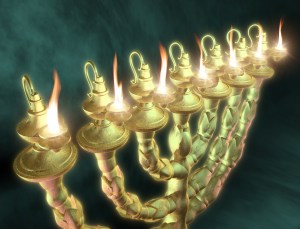
Moses to construct a menorah (lamp stand) with seven branches. The menorah was to be made of ONE piece of beaten gold.[4] The menorah would illuminate the Holy Place that leads one into the Holy of Holies. There is only ONE central branch with three branches on either side. The six outer branches are out-workings of the main, central branch. The Bible often uses the symbolism of this magnificent menorah to describe God’s Holy Spirit (Ruach HaKodesh), and for those who operate in or who are filled with His Spirit.

Like the seven branches on the ONE golden Menorah, Isaiah, Zechariah, Yeshua (Jesus), and John all write about the Holy Spirit having seven attributes (branches). If you wish to learn about the seven spirits of God in depth, I can pair you with a Creation Gospel[5] trainer who can guide through Dr. Alewine’s thematic workbook. Here are some of the verses that attest to the seven.

The Spirit of the LORD will rest on Him, The spirit of wisdom and understanding, The spirit of counsel and strength, The spirit of knowledge and the fear of the LORD. (Is. 11:2)

He said to me, “What do you see?” And I said, “I see, and behold, a lampstand all of gold with its bowl on the top of it, and its seven lamps on it with seven spouts belonging to each of the lamps which are on the top of it…Then he said to me, “This is the word of the LORD to Zerubbabel saying, ‘Not by might nor by power, but by My Spirit,’ says the LORD of hosts…”For who has despised the day of small things? But these seven will be glad when they see the plumb line in the hand of Zerubbabel–these are the eyes of the LORD which range to and fro throughout the earth.” (Zec. 4:2, 6, 10)

Out from the throne come flashes of lightning and sounds and peals of thunder. And there were seven lamps of fire burning before the throne, which are the seven Spirits of God; (Rev 4:5 see also Rev. 1:4; 3:1; 5:6)

Wisdom is not only the first of the seven manifestations of God’s Spirit, but is also personified as a woman in the Bible. It is for this reason that the Jewish Sages reading the Proverbs 31 text see the eshet chayil (Woman of Valor, Strength, Might) as a metaphor for the Holy Spirit. This may come as a relief to many women. Thank goodness! I was feeling pretty inadequate compared to this “perfect” woman.

Holy Spirit

The Holy Spirit shows one the way of wisdom which leads into the fullness of all seven Spirits of God (Is. 11:2). It teaches one not only the proper role of women, but also the strength (chayil) of her role. If we allow God’s Spirit to have reign in our hearts and lives, we will naturally produce the fruit of the Spirit mentioned in Galatians 5:22. Do you remember how the woman is designed to be an ezer, a helper? Do you know of another “helper” in scripture?

Behold, God is my helper; The Lord is the sustainer of my soul. (Ps. 54:4)

But the Helper, the Holy Spirit, whom the Father will send in My name, He will teach you all things, and bring to your remembrance all that I said to you. (Jn. 14:26)

© Gracel21
| Dreamstime.com

The Holy Spirit operates as a type of helper in the life of a believer. Sometimes He is our aid, but sometimes He opposes us in order to turn us in a different direction. This is the same function the woman often plays (on a much smaller scale) in the life of her husband. Think about the following roles that the Holy Spirit plays in our lives and compare them to the role of woman. (Note: these are generalities. Some women will function strongly in one of these roles and struggle in others. Conversely, there are men who can and do function well in some of these aspects – especially when they are filled with the Spirit of God. The point of looking at this comparison is to realize that God, who is neither a man or woman, has both masculine and feminine attributes.)

Actions

  • The Holy Spirit comforts and nurtures; so does a woman.
  • He teaches and instructs; so does woman.
  • He displays mercy and grace; so does a woman.
  • He encourages; so does a woman.
  • He leads and speaks; so does a woman.
  • He’s the unseen One; so often this is also true of the woman (she’s behind the scenes working).
  • He prepares and empowers; so does a woman.
  • He intercedes, testifies, and reproofs; so does a woman.

If you want to know what your duties are as a woman, all you have to do is consider the feminine attributes of God; for you were created as a female image bearer of the Creator of the Universe. This is also true for men. They are a male image bearer of the Creator. Men should consider masculine attributes of Adonai and mirror them in the earth. BUT, both sexes must always remember that both sides, both genders, both masculine and feminine attributes working together and in unison is required for the actual image of God to be reflected in the earth. All masculinity or all femininity will result in a lopsided, perverted understanding of the Creator.

We never find YHWH in a control battle with His Spirit; they are ONE. Therefore, male and female image bearers should work together in harmony, each displaying a facet of the image of our perfect Elohim (God). One does not dominate the other. There is no power struggle because there is no need for one. Power struggles are a sure sign of the flesh ruling and reigning, which is a false image. To break this down into easier to digest parts, we might say that males better image the Father, and females better image the Holy Spirit. And when they become one, they figure the Son, Yeshua, the last Adam (Rom. 8:29, 2 Cor. 3:18).

Atmosphere & Eshet Chayil

Like the Ruach HaKodesh, women often set the tone for the atmosphere of the home, fellowship, workplace, school, etc. When women are ruled by their emotions, mood, or fleshy desires it affects everyone around them in a negative sense. One is a true warrior of God, an eshet chayil, when she chooses to crucify her flesh and walk according to Word and the example of the Holy Spirit, instead of how their flesh feels or thinks. Any time a woman is present, she will influence the spiritual climate of that space. Thus, the fruit of self-control is something vital for women to learn (this is true for men as well, but our focus here is on the role of women).

The lower, sinful nature of men and women (especially if they are immature in physical age or spiritual maturity) often manifests as a desire turned into a demand to have their way. They will use their God given strengths, such as strong emotions and intuition, in an unhealthy and destructive way. For example, women often can intuit through their feelings, but they do not know how to express their concerns in a helpful and healthy way. Rather than being a help to their opposite, they can become a hindrance or stumbling block. Generally, whether male or female, the lower nature rises up and tries to dominate through some type of force, including manipulation, passive aggressive words or actions, outright aggression, emotional meltdowns (tantrums), etc. If fear driven or frustrated, inflamed, or offended flesh speaks, the result will be destruction.

Pro 10:11-14 (NASB) The mouth of the righteous is a fountain of life, But the mouth of the wicked conceals violence. 12 Hatred stirs up strife, But love covers all transgressions. 13  On the lips of the discerning, wisdom is found, But a rod is for the back of him who lacks understanding. 14 Wise men store up knowledge, But with the mouth of the foolish, ruin is at hand.

Pro 11:9-12 (NASB) With his mouth the godless man destroys his neighbor, but through knowledge the righteous will be delivered. 10 When it goes well with the righteous, the city rejoices, and when the wicked perish, there is joyful shouting. 11 By the blessing of the upright a city is exalted, but by the mouth of the wicked it is torn down. 12 He who despises his neighbor lacks sense, but a man of understanding keeps silent.

James 3:13-18 (NASB) Who among you is wise and understanding? Let him show by his good behavior his deeds in the gentleness of wisdom. 14 But if you have bitter jealousy and selfish ambition in your heart, do not be arrogant and so lie against the truth. 15  This wisdom is not that which comes down from above, but is earthly, natural, demonic. 16 For where jealousy and selfish ambition exist, there is disorder and every evil thing.  17 But the wisdom from above is first pure, then peaceable, gentle, reasonable, full of mercy and good fruits, unwavering, without hypocrisy. 18 And the seed whose fruit is righteousness is sown in peace by those who make peace.

© Digitalstormcinema | Dreamstime.com

Your everyday walk requires you to be a warrior. Suite up in the armor of God, for your battle is most often with yourself! Examine your fruit: your actions and words. Also consider your surroundings. Are you fostering shalom and growth, or are you contributing to the chaos and drama? Are you deeply wounded and unable to deal with others in a healthy way? Seek godly counseling. Is there a repeated pattern of fractured relationships in your life? This is a red flag that you need some healing to function as a healthy ezer. Begin by using your tongue in a healthy way – cry out to Adonai in confession and repentance, then seek counselors or mentors who can model healthy, godly fruit as a woman or man of God. Often we can’t “do” better until we “learn” better, and sadly too many were only modeled the false image, so that is what they reflect to the world. But, there is hope for real change! That is Good News. We are BEING conformed into the image of the last Adam, Yeshua, and Adonai promises to bring us to completion.

An excellent wife (eshet chayil) is the crown of her husband, But she who shames him is like rottenness in his bones. (Pr. 12:4)

Many daughters have done virtuously (chayil, valiantly, mightily), but thou excellest them all. (Pr. 31:29)

Learning more about the Biblical role of women (and men) helps one to overcome so that relationships can thrive. We will consider some Biblical examples of an ezer kenegdo next in Part VI.


[1] Christians might refer to this as the battle between the spirit and the flesh.

[2] In Hebrew, all things have either a masculine or feminine gender. There is no neuter or neutral gender like there is in English.

[3] Gen 1:27,  God created man in His own image, in the image of God He created him; male and female He created them.

[4] Read Exodus 25

[5] Please refer to Dr. Hollisa Alewine’s website: thecreationgospel.com

Categories: Women | Tags: , , , , , , , , , , , | 13 Comments

Blog at WordPress.com.