Posts Tagged With: Proverbs 31

The Biblical Role of Women Part V

Role of Women Main Page

Please view Part I, II, III, and IV for context.

Proverbs 31

In Judaism, the Proverbs 31 woman is often taught as an allegory for the Holy Spirit (Ruach HaKodesh), Wisdom, Torah, the Shekinah (Divine Presence), Shabbat, and/or the soul. At first glance this might seem odd, but most Jewish scholars and teachers read, write, and speak Hebrew. This knowledge opens the Biblical text in ways that English cannot. We will focus on two of these allegories in particular: Wisdom and the Holy Spirit.


Wisdom

“Wisdom” is the primary character in the Book of Proverbs, and she is personified as a woman. If this is a foreign concept to you, take some time to read through this book.  Proverbs  depicts two women, one righteous and one wicked, to contrast two types of people (or ways of thinking and behaving). These two “ways” are within every human being. Sometimes they are referred to as the good and evil inclinations[1] or spiritual battle between the spirit and the flesh. King Solomon personifies good and evil in order to teach his son (and us) discernment. Adonai and Solomon instruct one to choose to follow their good inclination (or one’s spirit [in Messiah], rather than the flesh).

In Hebrew, the Spirit of God and other spirits are written in the feminine form.[2] At first, it may seem strange or even blasphemous to refer to God in the feminine. But your Bible does so over and over again in reference to His Spirit in the Hebrew language. This is not goddess worship; rather, this is simply how the Hebrew language works. God is neither a man nor a woman, yet He has attributes of both genders. This is why it takes a male and a female to properly display His image.[3]

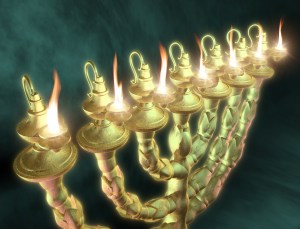
The Holy Spirit displays the feminine attributes of Adonai. Isaiah describes the Spirit of God like a tree with seven branches or characteristics (Isaiah 11:1-2).  This is not to be confused with the fruit of the Spirit. The fruit is the result of or what comes forth from this seven branched tree. In other words, fruit results from the tree; it is the goal – what secures the future.  We can use a biblical motif to describe these seven facets. In the Tabernacle in the wilderness, Adonai told
© Ampersandmiami
| Dreamstime.com

Moses to construct a menorah (lamp stand) with seven branches. The menorah was to be made of ONE piece of beaten gold.[4] The menorah would illuminate the Holy Place that leads one into the Holy of Holies. There is only ONE central branch with three branches on either side. The six outer branches are out-workings of the main, central branch. The Bible often uses the symbolism of this magnificent menorah to describe God’s Holy Spirit (Ruach HaKodesh), and for those who operate in or who are filled with His Spirit.

Like the seven branches on the ONE golden Menorah, Isaiah, Zechariah, Yeshua (Jesus), and John all write about the Holy Spirit having seven attributes (branches). If you wish to learn about the seven spirits of God in depth, I can pair you with a Creation Gospel[5] trainer who can guide through Dr. Alewine’s thematic workbook. Here are some of the verses that attest to the seven.

The Spirit of the LORD will rest on Him, The spirit of wisdom and understanding, The spirit of counsel and strength, The spirit of knowledge and the fear of the LORD. (Is. 11:2)

He said to me, “What do you see?” And I said, “I see, and behold, a lampstand all of gold with its bowl on the top of it, and its seven lamps on it with seven spouts belonging to each of the lamps which are on the top of it…Then he said to me, “This is the word of the LORD to Zerubbabel saying, ‘Not by might nor by power, but by My Spirit,’ says the LORD of hosts…”For who has despised the day of small things? But these seven will be glad when they see the plumb line in the hand of Zerubbabel–these are the eyes of the LORD which range to and fro throughout the earth.” (Zec. 4:2, 6, 10)

Out from the throne come flashes of lightning and sounds and peals of thunder. And there were seven lamps of fire burning before the throne, which are the seven Spirits of God; (Rev 4:5 see also Rev. 1:4; 3:1; 5:6)

Wisdom is not only the first of the seven manifestations of God’s Spirit, but is also personified as a woman in the Bible. It is for this reason that the Jewish Sages reading the Proverbs 31 text see the eshet chayil (Woman of Valor, Strength, Might) as a metaphor for the Holy Spirit. This may come as a relief to many women. Thank goodness! I was feeling pretty inadequate compared to this “perfect” woman.

Holy Spirit

The Holy Spirit shows one the way of wisdom which leads into the fullness of all seven Spirits of God (Is. 11:2). It teaches one not only the proper role of women, but also the strength (chayil) of her role. If we allow God’s Spirit to have reign in our hearts and lives, we will naturally produce the fruit of the Spirit mentioned in Galatians 5:22. Do you remember how the woman is designed to be an ezer, a helper? Do you know of another “helper” in scripture?

Behold, God is my helper; The Lord is the sustainer of my soul. (Ps. 54:4)

But the Helper, the Holy Spirit, whom the Father will send in My name, He will teach you all things, and bring to your remembrance all that I said to you. (Jn. 14:26)

© Gracel21
| Dreamstime.com

The Holy Spirit operates as a type of helper in the life of a believer. Sometimes He is our aid, but sometimes He opposes us in order to turn us in a different direction. This is the same function the woman often plays (on a much smaller scale) in the life of her husband. Think about the following roles that the Holy Spirit plays in our lives and compare them to the role of woman. (Note: these are generalities. Some women will function strongly in one of these roles and struggle in others. Conversely, there are men who can and do function well in some of these aspects – especially when they are filled with the Spirit of God. The point of looking at this comparison is to realize that God, who is neither a man or woman, has both masculine and feminine attributes.)

Actions

  • The Holy Spirit comforts and nurtures; so does a woman.
  • He teaches and instructs; so does woman.
  • He displays mercy and grace; so does a woman.
  • He encourages; so does a woman.
  • He leads and speaks; so does a woman.
  • He’s the unseen One; so often this is also true of the woman (she’s behind the scenes working).
  • He prepares and empowers; so does a woman.
  • He intercedes, testifies, and reproofs; so does a woman.

If you want to know what your duties are as a woman, all you have to do is consider the feminine attributes of God; for you were created as a female image bearer of the Creator of the Universe. This is also true for men. They are a male image bearer of the Creator. Men should consider masculine attributes of Adonai and mirror them in the earth. BUT, both sexes must always remember that both sides, both genders, both masculine and feminine attributes working together and in unison is required for the actual image of God to be reflected in the earth. All masculinity or all femininity will result in a lopsided, perverted understanding of the Creator.

We never find YHWH in a control battle with His Spirit; they are ONE. Therefore, male and female image bearers should work together in harmony, each displaying a facet of the image of our perfect Elohim (God). One does not dominate the other. There is no power struggle because there is no need for one. Power struggles are a sure sign of the flesh ruling and reigning, which is a false image. To break this down into easier to digest parts, we might say that males better image the Father, and females better image the Holy Spirit. And when they become one, they figure the Son, Yeshua, the last Adam (Rom. 8:29, 2 Cor. 3:18).

Atmosphere & Eshet Chayil

Like the Ruach HaKodesh, women often set the tone for the atmosphere of the home, fellowship, workplace, school, etc. When women are ruled by their emotions, mood, or fleshy desires it affects everyone around them in a negative sense. One is a true warrior of God, an eshet chayil, when she chooses to crucify her flesh and walk according to Word and the example of the Holy Spirit, instead of how their flesh feels or thinks. Any time a woman is present, she will influence the spiritual climate of that space. Thus, the fruit of self-control is something vital for women to learn (this is true for men as well, but our focus here is on the role of women).

The lower, sinful nature of men and women (especially if they are immature in physical age or spiritual maturity) often manifests as a desire turned into a demand to have their way. They will use their God given strengths, such as strong emotions and intuition, in an unhealthy and destructive way. For example, women often can intuit through their feelings, but they do not know how to express their concerns in a helpful and healthy way. Rather than being a help to their opposite, they can become a hindrance or stumbling block. Generally, whether male or female, the lower nature rises up and tries to dominate through some type of force, including manipulation, passive aggressive words or actions, outright aggression, emotional meltdowns (tantrums), etc. If fear driven or frustrated, inflamed, or offended flesh speaks, the result will be destruction.

Pro 10:11-14 (NASB) The mouth of the righteous is a fountain of life, But the mouth of the wicked conceals violence. 12 Hatred stirs up strife, But love covers all transgressions. 13  On the lips of the discerning, wisdom is found, But a rod is for the back of him who lacks understanding. 14 Wise men store up knowledge, But with the mouth of the foolish, ruin is at hand.

Pro 11:9-12 (NASB) With his mouth the godless man destroys his neighbor, but through knowledge the righteous will be delivered. 10 When it goes well with the righteous, the city rejoices, and when the wicked perish, there is joyful shouting. 11 By the blessing of the upright a city is exalted, but by the mouth of the wicked it is torn down. 12 He who despises his neighbor lacks sense, but a man of understanding keeps silent.

James 3:13-18 (NASB) Who among you is wise and understanding? Let him show by his good behavior his deeds in the gentleness of wisdom. 14 But if you have bitter jealousy and selfish ambition in your heart, do not be arrogant and so lie against the truth. 15  This wisdom is not that which comes down from above, but is earthly, natural, demonic. 16 For where jealousy and selfish ambition exist, there is disorder and every evil thing.  17 But the wisdom from above is first pure, then peaceable, gentle, reasonable, full of mercy and good fruits, unwavering, without hypocrisy. 18 And the seed whose fruit is righteousness is sown in peace by those who make peace.

© Digitalstormcinema | Dreamstime.com

Your everyday walk requires you to be a warrior. Suite up in the armor of God, for your battle is most often with yourself! Examine your fruit: your actions and words. Also consider your surroundings. Are you fostering shalom and growth, or are you contributing to the chaos and drama? Are you deeply wounded and unable to deal with others in a healthy way? Seek godly counseling. Is there a repeated pattern of fractured relationships in your life? This is a red flag that you need some healing to function as a healthy ezer. Begin by using your tongue in a healthy way – cry out to Adonai in confession and repentance, then seek counselors or mentors who can model healthy, godly fruit as a woman or man of God. Often we can’t “do” better until we “learn” better, and sadly too many were only modeled the false image, so that is what they reflect to the world. But, there is hope for real change! That is Good News. We are BEING conformed into the image of the last Adam, Yeshua, and Adonai promises to bring us to completion.

An excellent wife (eshet chayil) is the crown of her husband, But she who shames him is like rottenness in his bones. (Pr. 12:4)

Many daughters have done virtuously (chayil, valiantly, mightily), but thou excellest them all. (Pr. 31:29)

Learning more about the Biblical role of women (and men) helps one to overcome so that relationships can thrive. We will consider some Biblical examples of an ezer kenegdo next in Part VI.


[1] Christians might refer to this as the battle between the spirit and the flesh.

[2] In Hebrew, all things have either a masculine or feminine gender. There is no neuter or neutral gender like there is in English.

[3] Gen 1:27,  God created man in His own image, in the image of God He created him; male and female He created them.

[4] Read Exodus 25

[5] Please refer to Dr. Hollisa Alewine’s website: thecreationgospel.com

Categories: Women | Tags: , , , , , , , , , , , | 13 Comments

The Biblical Role of Women Part IV

Role of Women Main Page 

Woman of Valor

Please refer to Part I, II, and III of this series for the best context.

On Mother’s Day one the most quoted passages during Sunday morning services is Proverbs 31. Each mother is commended for her role as a virtuous woman. Images of Mother Theresa and other conservative humanitarian women come to mind. Most women and especially men, envision the Proverbs 31 woman to be plain, prudish, and quite frankly,  boring. Yet, both genders believe that this image of women is what God truly desires. So, we all sit in the pews extolling something that women believe they can never measure up to, and men only wish they found attractive. But no one dares to verbalize these inward thoughts. Instead, we all smile and nod and pray to God that He change our dreadful hearts.

I have some great news if you identify with my sentiments. Though the Proverbs 31 woman is often translated as the “Virtuous Woman,” that is not what the text says in Hebrew. In fact, as we investigate the original language about this “ideal” woman, you will find that she is anything but boring! Women will sigh in relief and gasp with delight in the fact that Adonai truly knows their heart. Men will rediscover that the woman Adonai made just for him is not only attractive, but exciting!


The Eshet Chayil

Who can find a virtuous woman? for her price is far above rubies. (Pr. 31:10 KJV)

The Hebrew terms for virtuous woman are “eshet chayil.” While eshet does mean woman, chayil is often translated as virtuous, excellent, good, vigorous, worthy,

© Digitalstormcinema | Dreamstime.com

capable, or valorous (valor) in this verse. Strong’s Bible definitions defines it this way: a force, whether of men, means or other resources; an army, power, might, host, wealth, virtue, valor, strength, and worth.

In nearly every one of its uses, chayil is coupled with men, particularly strong men of war. There is no room in this Hebrew term for plainness, meekness, or weakness. So why, when chayil is joined with women, do the translator’s choose to “soften the blow” with English words that hide the “strong force” of the Hebrew? What happened to all the power and might of chayil?

I submit to you that part of the reason is based in the fallen nature of Adam. Subtle (and not so subtle) misogyny has plagued the Body for far too long. The truth is that the word chayil empowers women beyond the status quo of many men’s comfort zones. I will admit however, that most of these men mean well and really believe they are in God’s will by mastering or ruling over women. They (and women) have been told and trained that this is their God given right for a very long time. My hope is to peel back the English language and centuries of church tradition to reveal the freeing reality of what YHWH and the Hebrew text really says about women.

Warrior

A chayil, in its simplest translation, is a warrior. The introduction of the Proverbs 31 woman is more accurate to the Hebrew text when it uses words like this: “Who can find a powerful, mighty, valiant woman?” This is the true “ideal” woman; but just in case you think I’m reaching, the succeeding verses (in Hebrew) reveal the same message.

Here are some examples of this courageous woman that are obscured by the English translation. In verse eleven, her husband “has no lack of gain,” the word for gain is “shalal,” which usually means booty, spoil or plunder. This is the type of gain that a warrior brings back from a successful military battle. The valorous woman knows how to prosper her family spiritually and physically. Thus, she blesses her husband and children.

In verse fifteen, “she rises while it is still night and provides food for her household,” the word translated food is “teref,” the normal word for prey. Like a lioness hunting in the night, bringing back prey for her cubs, a woman provides for her family. The suggestion of fierceness or violence adds to the woman’s portrayal as a chayil. Verse seventeen declares that “she girds herself with strength, and makes her arms strong.” The Hebrew word for strong (arms) is “amatz,” meaning courage. Can you see the warrior imagery in each instance?

© Nejron
| Dreamstime.com

Verse twenty-five is of special import to our study. The woman says, “strength and dignity are her clothing, and she laughs at the time to come.” The last phrase is yom acharon. This literally says, “She laughs in the latter days.” This is another prophetic text about the role restorations we have been exploring. This warrior woman is prepared both physically and spiritually for the last days. For as we’ve seen in the previous articles, she is most likely laughing for joy at her complete restoration in her role as ezer.

The fact that the Proverbs 31 woman is brave, mighty, valorous, and powerful cannot be denied. Think of this the next time you read this passage or are subjected to another teaching about the meek, weak, and quiet woman. God designed woman to be an ezer. Do you recall what an ezer actually is? An ezer is a help, rescuer, savior, and protector. This sounds an awful lot like an eshet chayil, does it not? What does a warrior do but fight for and protect what is theirs? This is real biblical womanhood.

Real Roles

But lest you think that all these terms are some how condoning the emasculation of men or usurping their vital role, I must explain this further. Men and women were created equal, but different. Each gender has specific roles to play in God’s design. What I have been putting forth to you is a return to God’s original plan. What must be removed are tradition, dogma, and most importantly our fallen nature if we desire to live and walk out this restoration. Our Messiah, Yeshua (Jesus), has already paved the way for us to overcome our nephesh (flesh). He has freed us from this slavery. But too often, we are still wearing shackles in the form of tradition[1] and doctrine.[2] We must choose to break free from these manmade chains.

The man is created to work and serve the creation. His domain of work or service is primarily outside of the home. He is like the man in Proverbs 31 that sits at the city gates. He is there to guard the city, give counsel, and do business. But the woman is built with the same fierceness and power as the man. Her domain or service is primarily inside the home. Her service benefits her man and her children. But what she does and how she does it is identical to the man. The difference is in the object of their service. No one gender rules or exercises dominion over the other. They are equal and equally capable both inside and outside of the home.

Deep down every woman knows she was designed to bless her husband. While he may accuse her of being a control freak or a micro manager, the truth is that she can’t help her herself. She is an ezer; and as such, she is his counselor, protector, and guide. The problem for what seems like forever is that neither the woman nor the man have known WHY she’s the way she is. I hope that by now you can answer that age old question.

In Part V, we will look at the Proverbs 31 woman on a deeper spiritual level.


[1] Mar 7:13 thus invalidating the word of God by your tradition which you have handed down; and you do many things such as that.”

[2] Mar 7:6-8 And He said to them, “Rightly did Isaiah prophesy of you hypocrites, as it is written: ‘THIS PEOPLE HONORS ME WITH THEIR LIPS, BUT THEIR HEART IS FAR AWAY FROM ME. (7) ‘BUT IN VAIN DO THEY WORSHIP ME, TEACHING AS DOCTRINES THE PRECEPTS OF MEN.’ (8) “Neglecting the commandment of God, you hold to the tradition of men.”

Categories: Women | Tags: , , , , , , , | 14 Comments

Women of Velour or Women of Valor?

I picked up my dear friend in St. Louis just before Thanksgiving. She had been travelling for over 15 hours from Hawaii and we hadn’t seen each other in over three years. We hugged as tears of joy welled in our eyes.

“Are you going to the Women of Velour Conference in January?” she asked me. We both began to roll with laughter!

Velour?” I exclaimed. “Well no, but I do plan on attending the Women of Valor conference.” I cackled.

It was obvious that her exhausted state had left her brain-mouth connection in less than perfect order. We got a great chuckle out of it nonetheless. But, her gaffe got my imagination going.

© Julija Petrovskaja
| Dreamstime.com

I could see a large conference room full of women all wearing colorful, long flowing velour dresses. The thought made me smile. “Do I have a velour skirt?” I wondered. “Do velour and valor have a connection other than similar spelling? No, not etymologically.” I mused. I dismissed this whole inner discourse and drove my friend to Tennessee where I actually live.

As the time of the conference neared and my friend was long gone back to the paradise of Hawaii, the velour/valor blunder played back into my thoughts. It obviously drew out some snickers and smiles, but also a longing for my friend’s cheery face. You see, humor is one of her gifts and I marvel at even the unintentional quips the Father gives her.

So just for giggles I decided to entertain this valor/velour mystery. Sure, I could be grasping for straws and wasting my time. But something just kept bugging me about these two words.

Velour is a closely woven fabric with a thick soft feel. It typically has a side that catches the light and makes it appear shiny, which is one reason why women tend to like it. Valor is a special type of courage; the kind that enables one to go to war or battle.

Pondering these definitions once again stirred my imagination. How many of us actually identify much more with velour than valor? I mean isn’t that one reason for a conference such as Women of Valor? Don’t we need to be encouraged in this narrow yet glorious journey we are all on?

But how many of us find ourselves feeling more like a heavy garment, catching light here and there as life twirls us about? Reading through Proverbs 31 and comparing ourselves to this woman of great virtue and valor makes most of us cringe just a little, if we are honest. I, for one, do not measure up!

Perhaps that’s the point. The Sages likened the Eshet Chayil (Woman of Valor) as a reference to the Shekinah (Divine presence), the Shabbat, the Torah, wisdom, and the soul. All these ideas are greater than I am, so that’s somewhat of a relief. I’ve also heard it taught that this woman is a metaphor for the Holy Spirit.

When we take each of this woman’s attributes into account, it makes perfect sense that THE woman of valor is indeed – our woman – the Ruach HaKodesh (Holy Spirit) within us. And no, I’m not calling God a woman, but He does have both masculine and feminine characteristics.

If we look Proverbs 31 up in the Hebrew text, we can see that each verse is arranged in an acrostic to form the entire Hebrew aleph-bet. This type of prose in the bible has always fascinated me. Like with Psalm 119 (another Hebrew aleph-bet acrostic), my mind always thinks of the poem entitled: How Do I Love Thee? (Sonnet 43) by Elizabeth Barrett Browning. Reading about the author’s life led me to the knowledge that she chose to study Hebrew in order to read the Tanakh (O.T.) in its original language. Since Hebrew letters are also numbers, aleph-bet acrostics seem to be (re)counting the way of love. Did Mrs. Browning see this connection as well?

Regardless, Proverbs 31 enumerates the many virtues of the ideal woman; just as David enumerates the majesty and grace of the Torah in Psalm 119. “Let me count the ways…” Perhaps we should not only view the Woman of Valor as the ideal role model, but also as a way to recount the awesome comforts the Holy Spirit brings into our lives. For without Him, we are reduced to simple women of velour.

A woman of velour has forgotten who she is. She can only reflect light when she is seen at certain angles. She is struggling to make it through each day and is quite frankly, worn-out. She needs fresh garments and that is what the Women of Valor conference is all about. We need each other. We need to be encouraged and challenged. We have a great responsibility to pass a life-filled baton to our children. Like the Virtuous Woman in Proverbs, we have much to do and when we unite together, we will see many great miracles to Adonai’s glory!

In closing, there is one other example of a woman of valor that I would like to examine. Her name was Ruth and she was given a new garment/covering. As I once again read these beloved passages, this time I couldn’t help but imagine that Boaz’s skirt or covering was made of beautiful shiny velour. Maybe velour isn’t so bad after all.

Ruth 3:9-11  And he said, Who art thou? And she answered, I am Ruth thine handmaid: spread therefore thy skirt over thine handmaid; for thou art a near kinsman.  (10)  And he said, Blessed be thou of the LORD, my daughter: for thou hast shewed more kindness in the latter end than at the beginning, inasmuch as thou followedst not young men, whether poor or rich.  (11)  And now, my daughter, fear not; I will do to thee all that thou requirest: for all the city of my people doth know that thou art a virtuous woman [Eshet Chayil; Woman of Valor].

We might be women that occasionally wear velour, but through God’s Spirit we are being ever changed into Women of Valor. The covering of the Holy Spirit prepares us for every possible battle and recharges our hearts to press onward. Women have a special place in the heart of God and in scripture. The Women of Valor conference is a unique opportunity for us to learn about how the Father is restoring us to serve Him in Spirit and Truth. Come and join us and be revived and equipped to fulfill the awesome role that is biblical womanhood.

I can’t wait to see all of Adonai’s women of faith arrayed for battle in velour or otherwise on January 11-13, 2013.

Categories: Women | Tags: , , , , , , , | Leave a comment

Blog at WordPress.com.