
Mussar 101
How do we prepare and practice in order
to pass the myriad of life’s tests for our souls?
I ended Part II of Matters of the Heart with the above question. In this post, I will attempt to answer it. The battlefield may be in the mind (lev), but unless our minds are renewed, we are doomed to make the wrong choice again and again. Sadly, many of us are only aware of one way of doing things, one way of feeling, and one way of responding when our Father presents us with a test. Thus, we often find ourselves in similar situations and circumstances making the same mistakes in every relationship we have. And worse, because of our narrow mindedness, we blame these patterns on anything and everything except for our own choices, behaviors, and attitudes. It’s always someone else’s fault that I’m this way or that I acted this way or that I said what I did.
While it may be true that someone else provoked you or that they really aren’t doing what they should be doing, you have control and authority over one thing: yourself. You are not responsible for the behavior, attitude, or short-comings of any other soul besides yourself. (Obviously, child rearing is another story not covered here. But, even as their guardians, you still do not “control” them.) God did not grant humans with the authority to control their circumstances or other people. And yet, every single person tries to do both, because that is the nature of fallen man (the old man/flesh/nephesh).
So, the real issue is YOU and your heart. In Part II, I mentioned the idea that we have “two” hearts or what the rabbis call the good and evil inclination. Christians may refer to this dichotomy as the battle between the spirit and the flesh. But the latter view often demonizes the flesh, which is not exactly accurate. True balance is found when our spirit man rules over the older beastly/fleshly nature. Remember the advantage a man has in working the field with a trained beast? There is much POWER and DIRECTION (purpose) found in ruling the nephesh, beast, flesh, or evil inclination.
“He who has not yet ruled over his evil inclination is like one lost along the paths [of the maze] unable to differentiate between them.” – The Path of the Just, Rabbi Moshe Chaim Luzzatto
In the DreamWorks production How to Train Your Dragon, a dragon, Toothless, and young Viking, Hiccup, are the protagonists. This unlikely duo discovers that warring against each other does nothing to conquer the real enemy: the great dragon that has enslaved them all. I cannot help but to see this story as a parable for real life. Like Hiccup, we have a real dragon or beast/nephesh. He is NOT our enemy. With a little training or taming, we can achieve great heights together! And best of all, when we harmonize this relationship, we are equipped to truly fight the real enemy of our souls, the great dragon, that serpent of old (Rev. 12:9).
So, how do we TRAIN our personal dragon, or beast/nephesh? Obviously, the first step is to submit ourselves over to the King of kings. But then, what? Does Adonai automatically give us a new heart (levav)? Based on my personal experience and the testimony I see in the lives of every believer I’ve ever met, the answer is yes… and no. God can certainly change and renew our hearts to serve Him, but that doesn’t imply that we have no choice after this initial change. Freewill isn’t tossed out the window once we place the blood of the Lamb on our doorposts. Sinai is still there, giving us the instructions of life. And like the Israelites’ of old, we will be tested in the wilderness. Even after the advent of Yeshua, we are daily offered the choice of life or death.
2Ti 2:22-26 (NAS95) Now flee from youthful lusts and pursue righteousness, faith, love and peace, with those who call on the Lord from a pure heart. 23 But refuse foolish and ignorant speculations, knowing that they produce quarrels.
24 The Lord’s bond-servant must not be quarrelsome, but be kind to all, able to teach, patient when wronged,
25 with gentleness correcting those who are in opposition, if perhaps God may grant them repentance leading to the knowledge of the truth,
26 and they may come to their senses and escape from the snare of the devil, having been held captive by him to do his will.
Each day presents a multitude of opportunities for one to choose. The good news is that if you have a personal relationship with the Yeshua, every tool you need to choose life is at your disposal. The problem is that many of us who have this relationship still have no idea how to use a such a power tool or even where they are kept. This is where the Jewish practice of mussar has helped me the most.[1] It’s as if someone finally turned a light on in the garage and I can now see the toolbox and blueprints to build (character/fruit) more clearly.
How to Train Your Dragon… Beast
Do you remember Pharaoh’s hard heart that we discussed in Part I? The converse of this pattern is also true. First Pharaoh hardened his own heart, which led to YHWH eventually handing him over to his own (wicked) desires. If this is true, could it also be said that if we continue to submit and humble our hearts toward Adonai that He will strengthen that choice? I believe He does; and we will explore this notion by reading some of Paul’s writings in a bit.
Php. 4:13 I can do all things through Him who strengthens me.
Indeed, God can strengthen us in a positive way just as He strengthened Pharaoh in a negative way.[2] The determining factor is the state of our heart. By continuing in sin, we become strengthened to sin more. By continuing to practice righteousness, we are strengthened to act more righteously.
Rom. 6:16 Do you not know that when you present yourselves to someone as slaves for obedience, you are slaves of the one whom you obey, either of sin resulting in death, or of obedience resulting in righteousness?
This truth has long been understood by the rabbis. The whole of Jewish ethics is based in this principle. Mussar, which literally means “correction,” is about holding your own soul/nephesh/heart accountable to God. It requires one to be mindful and intentional about every thought one has, because what happens in the mind eventually comes to fruition in the form of words and deeds. Thus, mussar is a meditation and a practice in the realm of personal accountability. The goal is to become more like Adonai, and less like fallen Adam by examining one’s own fruit. What am I producing? If my words and actions do not align with “it is written,” then my fruit is not of the Tree of Life. Nor am I projecting the image of Messiah to the world.
“For though we walk in the flesh, we do not war according to the flesh, for the weapons of our warfare are not of the flesh, but divinely powerful for the destruction of fortresses. We are destroying speculations and every lofty thing raised up against the knowledge of God, and we are taking every thought captive to the obedience of Christ, and we are ready to punish all disobedience, whenever your obedience is complete.” (2Co 10:3-6, NAS95)
Mussar helps one cross the great divide between the man/woman of God one desires to be, and the one they currently are. We can only change or transform if we know where we are failing or weak. We can’t repent and turn and walk a different way if we refuse to look at the thing(s) that are causing us to stumble. Mussar lifts the window shades of our hearts and allows the Light of Adonai to gently reveal the areas of our lives that we haven’t given over to His authority. It is hard and painful, but also so liberating!
“The heart is deceitful above all things, and incurable—who can know it? I Adonai search the heart, I try the mind, to give every man according to his ways, according to the fruit of his deeds.” (Jer 17:9-10, TLV)
King Solomon wrote the Book of Proverbs in order to teach his son (and us) mussar; and thus, we see this Hebrew word most often in this book.
Pro. 1:3-5 To receive instruction (mussar) in wise behavior, righteousness, justice and equity; (4) to give prudence to the naive, to the youth knowledge and discretion, (5) a wise man will hear and increase in learning, and a man of understanding will acquire wise counsel…
H4148 (Brown-Driver-Briggs) מוּסר mûsâr Definition: 1) discipline, chastening, correction. 1a) discipline, correction. 1b) chastening. Part of Speech: noun masculine. A Related Word by BDB/Strong’s Number: from H3256
Notice that our correction or instruction (mussar) is for the purpose of wise behavior. Solomon goes on to say that it is only fools that reject such instruction/mussar.
Pro. 1:6-7 To understand a proverb and a figure, the words of the wise and their riddles. (7) The fear of the LORD is the beginning of knowledge; fools despise wisdom and instruction (mussar).
Mussar, therefore, is meant to instruct, correct, and in some cases even reprove our walk. I don’t know about you, but I can certainly use all the help I can get. Long before the Jewish Sages developed the practice of mussar, King Solomon, the wisest man on earth, was teaching this method. If you look closely, you will see that Yeshua and even the Apostle Paul encouraged us to practice mussar. (We will look at an example from Paul’s writings later in this post.)
So, what is Jewish mussar? It can be simply defined as a spiritual practice that enables one to refine one’s character traits, allowing us to transform ourselves, to move toward wholeness, to realize our highest spiritual potential and to live everyday life with happiness, trust and love.[3].
Character traits? What do they have to do with anything? Actually, they have to do with EVERYTHING!
Perhaps a better expression for Christians would be “examining one’s fruit.” In the Bible, spiritual fruit is described as abstract traits, attributes, and emotions such as love, joy, peace, patience, kindness, goodness, faithfulness, gentleness, and self-control (Gal. 5:22-23). Adonai Himself is described with various traits, attributes, and emotions.
“For since the creation of the world His invisible attributes, His eternal power and divine nature, have been clearly seen, being understood through what has been made, so that they are without excuse.” (Rom 1:20, NAS95)
“Then Adonai passed before him, and proclaimed, ‘Adonai, Adonai, the compassionate and gracious God, slow to anger, and abundant in lovingkindness and truth, showing mercy to a thousand generations, forgiving iniquity and transgression and sin, yet by no means leaving the guilty unpunished…’” (Exo 34:6-7, TLV)
Bad fruit or works of the flesh are likewise traits, feelings, and the actions that result from them: immorality, impurity, sensuality, idolatry, sorcery, enmities, strife, jealousy, outbursts of anger, disputes, dissensions, factions, envying, drunkenness, etc. (Gal. 5:19-21)
Spiritually speaking, our “fruit” is what we say and what we do. Whatever is in our hearts will issue out into the physical world in one of these two ways, revealing what is our lev. So, intentional examination of our fruit is crucial to whether we have abundant life or are nothing more than the walking dead. Paul described our struggle and why renewing or setting our minds (lev) on the things of God is critical in Romans 7-8.
Romans 8:5-8 (NASB) For those who are according to the flesh set their minds on the things of the flesh, but those who are according to the Spirit, the things of the Spirit. 6 For the mind set on the flesh is death, but the mind set on the Spirit is life and peace, 7 because the mind set on the flesh is hostile toward God; for it does not subject itself to the law of God, for it is not even able to do so, 8 and those who are in the flesh cannot please God.
How can mussar help us to do this? There are three stages to “practicing” mussar. I say “practice” because this easy and non-time consuming method is meant to prepare you for life’s exams. If one studies for a test, they are much more likely to do well (tov). Think of mussar practice as the study guide you’ve been missing all these years. Mussar isn’t about doctrine, tradition, or Halacha (how to keep the commandments). You won’t find your faith in Yeshua challenged or lessened by doing mussar. Instead, you’ll become of aware of what is in your heart, and how you can choose to break out of patterns, habits, and cycles that have plagued you all your life. Your relationship with Adonai and others will be strengthened and changed for the better, and despite your circumstances, you will discover shalom and steadfastness in the midst of life’s many storms.
“The wisdom of the wise is to understand his way, but the foolishness of fools is deceit.” (Pro 14:8, LITV)
“Brothers and sisters, do not be children in your thinking; yet in evil be infants, but in your thinking be mature.” (1Co 14:20, NASB)
Mussar Stages
Stage 1: Sensitivity
Mussar begins with you being completely honest with yourself and the choices you make. In a sense, it’s becoming AWARE of who you are, what you say, what you do, and how you feel. Denial is the antithesis to sensitivity. This process will require you to really open yourself up to the gentle correction and revelation of the Holy Spirit. The more open you are to allow the truth of what’s in your heart to be revealed, the more progress you’ll make towards shalom. Thus, repenting for what HaShem shows you is vital. This leads to stage two, which incidentally, is the next step in repentance.
“So I turned my heart to understand, to search and seek out wisdom and an explanation of things and to know the stupidity of wickedness and madness of folly.” (Ecc 7:25, TLV)
Stage 2: Self- Restraint
Once you become aware of your own choices, attitudes, feelings, and actions, and have repented for those that are incorrect, you must make a conscious effort to stop the wrong behavior. Teshuvah (repentance) means “to turn” away from the bad activity. This is not always easy, don’t give up! Mussar recognizes, but does not condemn failures. Instead, you are encouraged to repent again, and try to do better in the next test. Mussar would also have you recognize those actions, feelings, and behaviors that are good and godly in order to continue their growth.
Proverbs 24:16 (NASB) For a righteous man falls seven times, and rises again, but the wicked stumble in time of calamity.
Stage 3: Transformation
The more we practice the two stages above, we gradually change or “renew our minds.” As you will soon discover, the traits focused on are from the Word, and it really does have transformative power! You will find yourself in yet another repetitive situation, and for the first time, you will know how to respond appropriately and godly! It’s as if door number two has been there all along, you just couldn’t “see” it in order to make a better choice. Now, door number two is clearly seen and you have made the first step toward overcoming in that area in which you struggle.
Does this sound too good to be true? I thought so, too, until I started practicing mussar. It is worth pointing out that mussar is a little different for each us. This is because we do not all share the same struggles. For example, you might not have any issue with being generous (one of your good traits), whereas your neighbor may have a tendency toward being stingy. Thus, we each will have our own personal “soul” curriculum to work on. Stage one, sensitivity, should help you to discern where you lack and where you excel. And sometimes, we “think” we excel in an area, and only later discover that there was still much room for improvement.
 Keep an Accounting
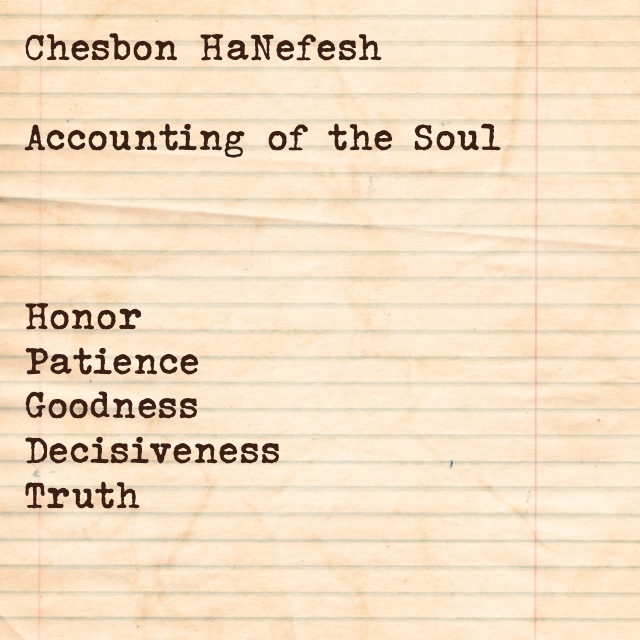
We begin mussar practice by keeping an “accounting of the soul” (Chesbon HaNephesh) diary or journal for a week or two. It’s simple. Every night (or morning, whichever suites your schedule) for a week, record (it doesn’t have to be lengthy) the instances in your day where you believe your lower self (beast/nephesh/flesh) had the upper hand. Be specific. It can be anything from over eating to doing or saying something you should or shouldn’t have. For example, did you find yourself behind Ms. Slowpoke with three carts at the grocery store? Did bad thoughts cross your mind? Write them down. What about traffic? Any road rage today? What about a stranger asking for money? Did you open or close your hand? Why? Did you lose your temper with your spouse or child? Did you look upon someone and judge them for what they wore or didn’t wear? Did you lust after or covet something that wasn’t yours? Be honest. No one will see your journal but you and God.
Wisdom says those who seek her daily and hear (shema) instruction (mussar) will find life:
“And now, my children, listen to me: happy are those who keep my ways. Hear (shema) instruction (mussar) and be wise, and do not neglect it. Happy is the one who listens to me, watching daily at my gates, waiting beside my doors. For whoever finds me finds life and obtains favor from the LORD;” (Pro 8:32-35, NRSV)
The areas that you need to work on can be narrowed down into one word. For example, you may find that you have a pattern of impatience. Lacking patience quickly ignites ungodly anger and rage. This area of your life is out of balance. In a word, the trait (fruit) you need to produce is patience. Perhaps you are highly critical of other people. It matters not how they’ve behaved. By criticizing them (even in your mind), you are making an unrighteous judgment that is fueled by a lack of honor and respect for a being created in the image of God. The trait you need to work on is honor. It may be very difficult to see the “good” or “holiness” in a person that lives contrary to the Word, but Yeshua died for them too. Thus, the point isn’t to overlook or condone their bad behavior, but for you to realize that they, too, were created in the image of God. The practice isn’t about them, it’s about you. Can you honor them… anyway?
This type of journaling will reveal PATTERNS in your life and areas that need to be corrected (mussar). For years now, my family has been doing this in mini fashion in preparation for Yom Kippur. An accounting of the soul[4] chart is what my family uses before we perform the tashlich service. Until rather recently, I had no idea that this accounting was part of mussar work. But, repentance and accounting should occur more than once a year, right? Start a mussar journal and you’ll find that Adonai can speak to you in your own handwriting. This isn’t mystical. In being transparent and honest with yourself, you are in effect being open and honest with the Creator and He will strengthens your heart to be the overcomer you desire to be.
Soul Traits (Middot)
Once you’ve discovered the traits (areas) that you need to improve, you will spend one week practicing or focusing on each one. If you have a hard time making or discerning your list (curriculum), you can use a preformed chart with traits already listed. Most people begin mussar by using one of these. With practice, you will gain insight into the traits that you need to do work on more. Many mussar programs recommend starting with thirteen or eighteen traits. A list of thirteen would take you through each one four times in a year. But this is only a suggestion. You might find you need to spend several weeks in one area or a fruit or trait that you had not considered continues to pop up in your life. Work on it. (:
What do I mean by “work?” Simply being intentional in your prayer life and Bible study, and honest about what is occurring in your life and in your relationships. Take a long, hard, honest look at all of it like the serpent on the pole and be healed. Adonai promises that if we ask Him, He will answer. If we seek Him, we will find Him. And His desire is to refine and conform us into the image of Yeshua. We should desire to participate in the process and not get tossed around with every wave and trial of life.
“Ask, and it will be given to you; seek, and you will find; knock, and it will be opened to you. For everyone who asks receives, and he who seeks finds, and to him who knocks it will be opened. Or what man is there among you who, when his son asks for a loaf, will give him a stone? Or if he asks for a fish, he will not give him a snake, will he? If you then, being evil, know how to give good gifts to your children, how much more will your Father who is in heaven give what is good to those who ask Him!” (Mat 7:7-11, NAS95)
“But we all, with unveiled face, beholding as in a mirror the glory of the Lord, are being transformed into the same image from glory to glory, just as by the Spirit of the Lord.” (2Co 3:18, NKJV)
It is helpful to meditate upon and learn more about each soul trait (or attributes of God or fruit of the Spirit). You cannot improve if you do not understand what it is that is the problem. This is where a good mussar book or an online program comes in handy. My favorite book is Everyday Holiness by Alan Morinis. If you can’t spare any money, you can go through a free online course in order to get the hang of doing mussar. This program is also written by Mr. Morinis for Aish.com.
Reading about the trait/fruit you are working to improve is an exercise of your mind (lev). The Word of God is your best resource. If you are working on honor, do a concordance search for all the verses that speak about honor. Read them in context and ask the Holy Spirit to reveal how you can act and think with godly honor. I also recommend that you read an article or two during this week about honor. Riverton Mussar has some excellent articles on many soul traits from a Messianic perspective.
To help you focus throughout the days you are working on a particular trait/fruit, it is advisable to develop a phrase that will remind you of that trait. For example, for honor, Mr. Morinis suggests thinking “each one, a holy soul” to encourage one to honor their fellowman. He also recommends finding another person to practice mussar with in order to go deeper. Accountability is always helpful, and other people always have insights and perspectives that you haven’t considered. We can learn a great deal from one another. (This doesn’t mean you have to reveal your personal journal.)
Mussar in a Nutshell
- Work on one trait/fruit in your list for one or two weeks. Throughout the weeks, read about your trait/fruit in Scripture and other resources.
- Every morning meditate upon the phrase you’ve chosen to remind you of that trait. Pray and ask the Father to give you an opportunity to exercise this muscle you’re trying develop. (Be prepared for this: like in exercise, your muscles/flesh may complain.) You will be surprised by how the Holy Spirit brings your phrase to mind when you are being tempted.
- At the end of the day, record your triumphs and failings in this area. Pray and ask the Father to help you improve. You can also journal in the morning if that better suites you. The point is to do it – even if you only write a sentence or two.
This may seem too simple to warrant results. And I must admit that at first, I thought this was the case. However, that thought was quickly overruled when I was actually tested in an area I had “studied” for. Instead of reacting as I usually did, I was sensitive to my emotions and unhealthy soul patterns. Though it’s not what I wanted to do (nephesh), I chose differently and gained much better results! Moreover, I think it surprised the person I was dealing with and disarmed them from a normal escalation.
Remember, your mind (lev) can only choose differently when it is taught differently. A renewed mind/heart has been changed by a steady diet of godly instruction. But like any test, you must study the areas where you lack knowledge and understanding in order to pass. Mussar guides you to these weak areas and builds up your awareness and knowledge.
Paul’s Mussar
It is helpful to see a mussar example from the Apostolic Scriptures. I’ve chosen to use the passage from a verse I quoted earlier. Let’s begin by looking at the context of the following verse.
Php. 4:13 I can do all things through Him who strengthens me.
The following passage is lengthy, but I urge you to read it in its entirety for the best context.
Php 4:4-9 Rejoice in the Lord always; again I will say, rejoice! (5) Let your gentle spirit be known to all men. The Lord is near. (6) Be anxious for nothing, but in everything by prayer and supplication with thanksgiving let your requests be made known to God. (7) And the peace of God, which surpasses all comprehension, will guard your hearts and your minds in Christ Jesus. (8) Finally, brethren, whatever is true, whatever is honorable, whatever is right, whatever is pure, whatever is lovely, whatever is of good repute, if there is any excellence and if anything worthy of praise, dwell on these things. (9) The things you have learned and received and heard and seen in me, practice these things, and the God of peace will be with you.
Paul is giving us some pretty awesome advice that is not unlike the practice of mussar. Notice the bolded words above. Each is one is a middah, soul trait, or fruit that can be meditated upon and practiced in mussar. I hardly believe this is coincidence. Best of all, Paul says that the shalom of God will guard our hearts and minds (levav) IF we do these things! The passage continues:
Php 4:10-13 But I rejoiced in the Lord greatly, that now at last you have revived your concern for me; indeed, you were concerned before, but you lacked opportunity. (11) Not that I speak from want, for I have learned to be content in whatever circumstances I am. (12) I know how to get along with humble means, and I also know how to live in prosperity; in any and every circumstance I have learned the secret of being filled and going hungry, both of having abundance and suffering need. (13) I can do all things through Him who strengthens me.
It was in doing these things that Paul LEARNED to be content in all circumstances – good or bad. I want to know what Paul did. How exactly could he end this discourse with “I can do all things through Him that strengthens me?” We quote this last verse all the time, but I can’t help but to wonder if we are missing something important that is revealed before Paul arrives at this summation.
Going back to the beginning of these quotes from Philippians, let’s look at the things he tells us to DO so that the peace of God guards our hearts and minds (levav).
- Dwell on these things. (vs. 8)
- Practice these things. (vs. 9)
These two points are precisely the two things ancient and modern mussar teachers emphasize in mussar practice. Number one uses the Greek word logizomai (Strong’s G3049), which literally means to “to take an inventory.” The entire point of doing Mussar is to take (or give) an accounting of your soul. You are to do this (in part) by meditating upon godly attributes, characteristics, or qualities. The King James Version of verse 8 translates logizomai as “to think on.” We are to purposefully think upon godly attributes and weigh ourselves in that balance.
The Greek word for practice in verse 9 is prassō. It means to practice or perform repeatedly or habitually. Again, this mirrors what the mussar teachers have said for centuries. Habitually comparing our hearts to the attributes of God results with change, transformation, and renewal. This doesn’t mean it will be easy. Paul’s life certainly wasn’t “easy.” But the secret he learned enabled him to proclaim real joy and liberty in the midst of great trials, persecution, and pain.
Paul mentions these particular qualities:
- Rejoice (This is akin to the common mussar trait of enthusiasm or zeal, vs. 4, notice that it is repeated)
- Gentleness (vs. 5)
- Trust (inferred as the opposite of being anxious, vs.6 )
- Thanksgiving (vs. 6)
- Truth (vs. 8)
- Honor (vs. 8)
- Righteousness (vs. 8)
- Purity (vs. 8)
- Love (vs. 8)
- Goodness (vs. 8)
- Excellence (vs. 8)
- Worthiness (vs. 8)
- Generosity (inferred by “concern” for another, vs. 10)
I purposely drew out thirteen qualities from this passage because most mussar programs choose this number as a starting point to begin your practice. Paul tells us to THINK upon (take an inventory of) these things and to PRACTICE these things habitually. This is mussar; and the Biblical path to overcoming, contentment, and shalom.
The result will be none other than our hearts and minds being guarded by the peace of God. Moreover, it is the SECRET, according to Paul, as to how he LEARNED to be content in ALL circumstances. If Paul had to LEARN these things, what makes us think that we won’t have to? How many of us would give just about anything for either one of these things?
“Mussar aims to help you close the gap between your ideals and the life you actually lead.” –Alan Morinis
Doesn’t that sound wonderful? I believe mussar is the hidden power tool in our garden shed. The question is, are we willing to wield it?
[1] I would be remiss if I didn’t also mention the fantastic Creation Gospel series as the springboard that led me to mussar in the first place. Dr. Alewine’s work is incomparable in its scope to treat and remedy the whole person in the glorious light of the Messiah and His Holy Spirit.
[2] This is explained in Matters of the Heart Part I.
[3] Rabbi Rosalin Mandelberg
[4] This accounting is called an Chesbon HaNephesh.




 GRACE in TORAH