Torah Portion for June 1st, 2013
Numbers 13:1-15:41; Joshua 2:1-24; Heb. 3:7-19
Hebrew Names
Anytime there is a long list of Hebrew names or genealogies given in scripture, many are tempted to just skip over them and move on to the “meat” of the story. How sadly mistaken they are! Hebrew names have meaning and they usually tell a beautiful story. The list of names given for the spies is no exception. First, the tribes are not listed in their birth order, a hint that should stand out to the reader. Here is the list with the corresponding Hebrew meaning.
- Shamua —- Name, character
- Shaphat —- To judge
- Caleb —- Like the heart
- Yigal —- He redeems
- Hoshea —- Salvation; saves
- Palti —- My deliever
- Gadiel —- El (God) of the assembly; troop; army
- Gadi —- My good fortune
- Amiel —- El (God) of my people
- Setur —- Hidden, concealed
- Nakhbi —- Refuge
- Geuel —- El (God) is exalted; lifted high
This is the story hidden in the Hebrew names of the 12 spies.
The Name of the judge of our hearts redeems and saves, for He is our deliverer. The God of our assembly is our good fortune. The God of our people conceals us in His refuge. Exalted be our El (God)!
Thus, Hebrew never ceases to amaze me….
The Spies and a Pinch of Fear
Shlach L’cha literally means “send for yourself.” In this case, it refers to Moses sending out twelve men to “spy out” the land of Canaan. The Hebrew word for “spying out” in verse two is “toor” (tav, vav, reysh). It would be better defined as “seeking out, touring, or exploring.” In fact, our English word “tour” sounds exactly like the Hebrew word in question. Could it be derived from “toor”? Perhaps. Consider for a moment the difference between touring or exploring and spying. The latter implies something much more strategic and militant while the former implies something much more casual.
The irony is that Moses actually did send the men out as “spies” on a military reconnaissance mission regardless of the true meaning of the Hebrew “toor.” (Num. 13:17-20) This mission will end up costing Israel a 40 year longer stay in the wilderness. What I hope to show you is that this mission was doomed from the start. While our portion seems to be unclear as to whose idea this mission is attributed to, Deuteronomy 1:22-23 gives more details. Once again, it was the people’s lack of faith in the promises of YHWH that cost them dearly. Even though YHWH had told them to go and take possession of the land and to do so without FEAR, they did exactly the opposite. (Just as we often do!)
Even Moses was caught up in their “fear.” In Dt. 1:23, Moses says their idea of a recon mission also pleased him. The problem was that their spiritual eyes were closed. In the natural, the people of Canaan were strong and many. Their cities were large and fortified. Yet the land was good, flowing with milk and honey, just as YHWH had promised. But, the majority couldn’t see past the obstacles. There was a GIANT stumbling block in their path: the enemy. The problem seemed too large and too difficult for them to overcome.
How often do we feel this way about various circumstances and problems in our own lives? How often are we like the ten spies after taking a survey of our own circumstances? Things seem impossible from our perspective. We justify our lack of faith by telling ourselves or saying that we are being sensible or realistic. Perhaps we even conclude that the promise isn’t really for us.
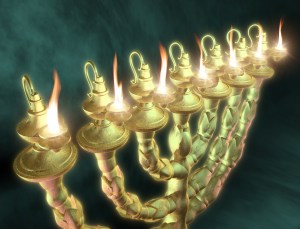
The real enemy is FEAR. This Shavuot (Pentecost 2011), Dr. Hollisa Alewine taught our congregation The Creation Gospel. One point that really stuck out for me was the seventh branch on the menorah. This branch in her thematic study corresponds to the seventh day of creation (Shabbat), the feast of Sukkot, the Spirit of Yirat Adonai (Fear of YHWH), and the church of Laodicea in the Book of Revelation. She pointed out that when we fear anything other than YHWH, we are operating from the wicked lamp.[1] In other words, when we fear man or circumstance we can only produce rotten fruit.
How I struggle with this! There is fear of the unknown, fear for the future, fear for our children, fear for our nation, fear for our finances, fear for our health, fear of death, fear of what others think, fear of ridicule, fear of weather, fear of government, fear of our enemies, fear of… you name it. I personally suffer from occasional anxiety. This is a form of fear whether it begins with physical imbalances or not. But, we are called to be overcomers and we are told over and over in scripture to “fear not!” I dare say that this is one commandment that even Torah keepers struggle with regularly. Sadly, ungodly fear is usually justified one way or another. As Dr. Alewine said on Shavuot, “There are boogers around every corner!”
Once again we find ourselves wearing the very shoes of our Israelite counterparts. We are just like them. Although we like to think that we are like Caleb or Joshua, we really are more likely to be one of the ten bringing a bad report and causing even more of our brothers and sisters to falter with us.
There is only one remedy of our malady: we must learn to fear YHWH and fear Him alone. After all, the beginning of wisdom is the fear of YHWH. (Ps. 111:10; Pr. 9:10)
Creation Gospel’s Seventh Branch
Shabbat
This portion has caused me to mediate on the menorah and the thematic counterparts to Yirat Adonai (Fear of YHWH). I’d like to begin with Shabbat. Shabbat is the day YHWH set apart for rest. It is holy, it is a sign, and it is the seventh day of the week. Yeshua declares Himself “Adonai (Lord) of the Shabbat day” (Mt. 12:8; Mk. 2:28; Lk. 6:5) What are we really resting in on this day? The finished work of Messiah. There can be no fear when we are resting in Him. Selah. There is nothing like entering in to worship the King of the Universe at His appointed time: Shabbat. Sure we can experience sweet worship any day and at any time, but there is something different about that worship when He appoints it, when He has declared that time sacred. There is absolutely no fear (of man & circumstance) when we adore and show our love to our King. (1 Jn. 4:18)
Sukkot
Sukkot (Feast of Tabernacles) is the seventh feast and it lasts for seven days. Therefore, it is thematically linked to the 7th branch of the menorah and Shabbat, in The Creation Gospel model. It is not a coincidence that this feast commemorates the children of Israel living in tents or booths in the wilderness. Since the setting of our portion is the wilderness and the sin of the evil report by the ten spies, it becomes even more apparent that we need to learn from their example. (Heb 4:11; 1 cor. 10:5-6; Heb. 3:8-10)
Sukkot is also called the Season of our Joy. It is the last of the 3 pilgrimage feasts and looks forward to the future millennium when the overcomers shall rule and reign with Yeshua for 1000 years. This is pictured in Caleb and Joshua. We desire to persevere and come into the Promised Land! We cannot do this without Yirat YHWH.
Yirat YHWH
The seven spirits of God are given in:
Is. 11:1-2 And there shall come forth a rod out of the stem of Jesse, and a Branch shall grow out of his roots: (2) And the spirit of YHWH shall rest upon him, the spirit of wisdom and understanding, the spirit of counsel and might, the spirit of knowledge and of the fear of YHWH…
These are the attributes of the one Spirit of God. As stated earlier, the fear of YHWH is the beginning of wisdom. Therefore, we cannot reach the last branch of the menorah without first experiencing the first branch: wisdom. This branch is thematically linked to Pesach (Passover), day one of creation, and the church at Ephesus. We all must first apply the lamb’s blood to our doorposts to begin our journey of redemption, sanctification, and eventual restoration.
Fear of anything other than YHWH is of the enemy. It is a lack of trust and faith in our Adonai. The following quote comes from the corresponding Deuteronomy text for our portion. Moses is recapping the mistake of the spies.
Dt. 1:28-32 Whither shall we go up? our brethren have discouraged our heart, saying, The people is greater and taller than we; the cities are great and walled up to heaven; and moreover we have seen the sons of the Anakims there. (29) Then I said unto you, Dread not, neither be afraid of them. (30) YHWH your God which goeth before you, he shall fight for you, according to all that he did for you in Egypt before your eyes; (31) And in the wilderness, where thou hast seen how that YHWH thy God bare thee, as a man doth bear his son, in all the way that ye went, until ye came into this place. (32) Yet in this thing ye did not believe YHWH your God…
If the children of Israel had feared YHWH and not the inhabitants of the land, things would have been much different. How often would our circumstances have been different if we had only trusted in our God, YHWH? Perhaps we too are often left in our own wildernesses for an extended amount time when our breakthrough was just past the Canaanites that we were too afraid to fight.
Laodicea
Laodicea was the seventh and last assembly written to in Revelation. Please read Revelation 3:14-22. Laodicea means “justice of the people”. Already we have a problem; YHWH/Yeshua is our law-giver, He is our judge, and He metes out the only righteous judgment. Laodicea is thematically linked to Shabbat, Sukkot, and the spirit of the Fear of YHWH.
Notice that Yeshua mentions no clean works for this assembly. Instead, He says they are neither hot nor cold and this makes Him want to vomit. Wow. Essentially, they are lukewarm; lukewarm is a mixture of hot and cold. The Laodiceans probably feel they are “just right” or very comfortable. As a matter of fact they say just that:
Rev. 3:17-19 For you say, I am rich, I have prospered, and I need nothing, not realizing that you are wretched, pitiable, poor, blind, and naked. (18) I counsel you to buy from me gold refined by fire, so that you may be rich, and white garments so that you may clothe yourself and the shame of your nakedness may not be seen, and salve to anoint your eyes, so that you may see. (19) Those whom I love, I reprove and discipline, so be zealous and repent.
The assembly of Laodicea believes she is prospering and doing well. Sadly, she is seriously mistaken and is quite blind. Because this assembly has material wealth, their every need is met by their own works or prosperity. Having great prosperity is synonymous with godliness in the eyes of this church. (Sound familiar, America?) Yet, Yeshua couldn’t commend them on even one clean or good work.
Their worldly desire for prosperity had actually left them wretched, miserable, poor, blind, and naked. Yet they didn’t even know it!! Think about this. Yeshua is obviously speaking of their spiritual condition. They think all is well and they don’t even have clothes to wear! He encourages this church to buy “gold” (a play on their worldly lust for $$) refined by His fire.
What is this gold Yeshua speaks of?
Ps. 19:7-10 The law (Torah) of YHWH is perfect, converting the soul: the testimony of YHWH is sure, making wise the simple. (8)The statutes of YHWH are right, rejoicing the heart: the commandment of YHWH is pure, enlightening the eyes. (9) The fear of YHWH is clean, enduring for ever: the judgments of YHWH are true and righteous altogether. (10) More to be desired are they than gold, yea, than much fine gold: sweeter also than honey and the honeycomb.
It was almost as if David wrote this Psalm just for the Laodiceans. He tells us what is perfect and converts our souls: YHWH’s Law (Torah). This is because the Torah defines what sin is. Therefore, one may turn and repent. What is the remedy for blind eyes? According to David, it is the commandments of Adonai. It is apparent so far that even though the Laodiceans believed that they were “good” and lacked nothing, they didn’t have YHWH’s Torah in their hearts. Otherwise, their eyes would be open to their sin and they would realize their wretched condition and repent.
Moreover, this Psalm speaks of YHWH’s judgments. The very name of this assembly (Laodicea means “justice of the people”) speaks volumes about their source of authority: the people. The people decide what is best, what is good, what is prosperous. But, they are blind! YHWH is the only righteous judge. He decides what is good, not us. He decides what is holy, not us. He decides how He is to be worshipped, not us. Doing things His way, walking out His Torah (instructions), fearing Him and not man, and setting Him as our judge and not man or religious institutions is more desirable than much fine gold and sweeter than honey. Repent! Turn back to Him, His ways, His Torah, and receive fresh white garments and salve for your eyes.
Yeshua has more to say to Laodicea. He stands at the door and knocks and desires to “dine” with the Loadiceans. In Hebrew thought, this is a direct reference to a covenantal meal. What meal does Yeshua desire to eat with us? The marriage Supper of the Lamb at a future Sukkot. This meal is also thematically linked to the Pesach (Passover) seder, the beginning of our redemption where a meal is first shared. Passover is our redemption, Shavuot is our betrothal, and Sukkot is our marriage and consummation. This is all three pilgrimage festivals.
Rev. 22:14 Blessed are they that do his commandments, that they may have right to the tree of life, and may enter in through the gates into the city.
Rev. 22:17 And the Spirit and the bride say, Come. And let him that heareth say, Come.
Caleb & Joshua
Caleb and Joshua saw the exact same things as the other ten spies, yet their report was positive. They tried to quiet the fear of the people with their optimism, but the people would rather wallow in their own fears. They even prepared to stone Caleb and Joshua just to get them to shut-up. (14:10) Misery truly does love company, and Caleb and Joshua were uninvited guests. But the people didn’t govern the lives of Caleb & Joshua; YHWH did, and it was His glory that came to their rescue.
Again, we are just like the Israelites. I know many people that truly wish to shut the mouths of those that are eternally optimistic. They would rather discuss the new scary booger they spotted on the internet and the big booger in the White House or the millions of boogers in the Middle East. Some think that big black helicopter boogers are watching their every move; others are worried about one world boogers, and even more fear famine and stock pile so green slimly boogers never touch them. Boogers are everywhere and they are big, they have fortified cities, and they even live in the Land of milk and honey. Just change booger to Canaanites or name your own favorite scary booger. They are all fear of man or circumstance.
One thing is certain: Caleb and Joshua were more afraid of YHWH than big, slimly, green boogers. They are our positive model and example. In order to be like Caleb and Joshua, we don’t have to walk around with our head in the clouds; we see everything the other ten see. The difference is in whom we fear most. If we fear YHWH more than men or our circumstances our spiritual eyes will be open and we too will say, “We should by all means go up and take possession of it, for we will surely overcome it!” (13:30)
We will also encourage our brethren, “Only do not rebel against YHWH. And do not fear the people of the land, for they are bread for us. Their protection is removed from them, and YHWH is with us; do not fear them.”
If we would fear YHWH, that obstacle would become our “bread.” It will feed us! It will give us strength and sustain us. Why? Because any time we trust YHWH we exercise our faith, which prospers one spiritually. Hence, our faith removes the shadow of protection from our enemies and we become victorious.
I know I still have much to learn in this area, but I desperately want to be like Caleb and Joshua. We can’t let our eyes deceive us or focus on what “appears” to be happening in the natural. Just because I can see that big gooey booger hanging over my head doesn’t mean that it’s there to harm me. If I start telling everyone that any day that booger is going to fall on my head, well then, it just might! I fear the booger more than YHWH.
However, if I believe YHWH loves me and has my best interest at heart and that He would never let a booger hang there day after day without a GOOD reason, then my fear is alleviated, I’m not spreading fear to my fellows, and one day YHWH might just show me that the booger was the glue that kept the chandelier from falling on my head. In this way, it sustained me (it became my bread).
The truth is that anything we fear we have made holy. We have set that thing apart. Think about something you fear or worry about often. By focusing on the circumstance and not Elohim, we have made that thing holy or set apart. It has displaced YHWH’s rightful place in our lives. When we are tempted to dwell on our circumstances we must remind ourselves that YHWH sits on the throne, not our past, not our finances, not our health, not our job, not our enemies, and not our families.
There is one last important detail about this story. After the ten evil spies died from a plague sent by YHWH, the people repented and decided they would now do what YHWH had said and take possession of the Land. BUT, the consequence to their sin was forty more years in exile in the wilderness. Actually, their lack of faith cost them the Promised Land altogether; in as much as those twenty years and older would die in the desert before their children would enter the Land.
I think this happens with us as well. YHWH tells us to do something. We are afraid. We take a survey of the situation and we are even more afraid. Boogers are everywhere; we’ll never make it. We begin telling others of the booger danger. We are out of line and in sin. We suffer because of our lack of trust. Suffering brings us to our senses and we repent. Now we think we will go and do what YHWH said. But, it’s too late. YHWH is no longer with us in this matter. He has moved on to something else. If we go anyway, the boogers will beat us down as far as Hormah. (14:45)
Tzit-tziot
We must follow the cloud. Turn when it turns, stay when it stays. In the last part of this Torah portion, the commandment of wearing the tassels, fringes, or tzit-tziot are given. This is a physical commandment about an article one wears on the four corners of their garment. YHWH is clear as to “why” He initiates this statute.
“Speak to the sons of Israel, and tell them that they shall make for themselves tassels on the corners of their garments throughout their generations, and that they shall put on the tassel of each corner a cord of blue. “It shall be a tassel for you to look at and remember all the commandments of the LORD, so as to do them and not follow after your own heart and your own eyes, after which you played the harlot, so that you may remember to do all My commandments and be holy to your God. “I am the LORD your God who brought you out from the land of Egypt to be your God; I am the LORD your God.”(Num. 15:38-41)
Do you remember the Hebrew word “toor” translated as “spies” at the beginning of our portion? The high-lighted text above uses the same Hebrew word “toor” for seek, follow after, search, or go about. Moses sent men to “spy” out the land of Canaan. YHWH issues us a command to wear a cord of blue on the four corners of one’s garment, so that in seeing the blue cords one is reminded NOT to “spy” with their own hearts and eyes. Doing so makes one a harlot. When we fear anything other than YHWH it becomes our god, thus we commit spiritual adultery.
Though our eyes and hearts might perceive boogers or enticing lusts, we mustn’t stray from our God or His commandments. Wearing tzit-tziot is a physical reminder of a spiritual reality. The blue cord is a reminder of the heavenly tabernacle, our heavenly high priest, and our heritage as a kingdom of priests. Priests are witnesses to YHWH, not boogers. We can choose to see boogers or we can choose to fear YHWH our Elohim.
It is important also to realize that when we trust in YHWH our savior, He protects us. He is truly our deliverer and our refuge. Remember the story told in the Hebrew names of the spies? YHWH conceals us from all the boogers. We are His special treasure, if we will learn to fear Him.
If we look at Caleb and Joshua’s names in Hebrew, the message of the good spies is clear. Joshua is a cognate of the Hebrew word Yeshua or “salvation.” Caleb’s name (kalev) is a contraction of two words: kal, meaning all and lev meaning heart. If we put these names together, we get “Yeshua, salvation, is for all hearts.”
Caleb’s name has even deeper implications. The lev in Hebrew is not the physical blood-pumping heart but is more akin to the mind. Truly it is our minds that need saving. Joyce Meyers is right about one thing: the battle truly does begin in the mind. A saved mind CAN overcome as Joshua and Caleb did!
Even more interesting is that the name kalev (Caleb) is a derivative of the Hebrew word for ‘dog’ (kelev). Remember, Caleb’s name means “all heart.” You see, Caleb followed YHWH wholly with all his heart. Caleb’s name certainly fits his character. Is that not also the nature of (good) dogs? They always come back to their master, ready to serve Him with all their heart. Where He goes, they go, without nary a complaint.
While dogs often have negative connotations in scripture, this sheds new light on Yeshua’s comments about the “dogs eating the crumbs that fall from the master’s table.”[2] Could this be an allusion to the fact that no matter who you are or where you are from, if you seek the Master with all your heart, you too, will have bread from the Master’s table? And, what about our two “good” spies, Caleb and Joshua? They are two faithful witnesses. Only their tribes, Judah and Ephraim/Israel, are mentioned by name in the New Covenant.[3] Together, their names suggest that YHWH’s witnesses follow Yeshua with all their heart!
May we become a generation of Caleb’s and Joshua’s!
[1] Proverbs 6:16-19
[2] Mt. 15:22-28; Mark 7:24-30
[3] Jer. 31:31; Hebrews 8:8 I’m not implying here that the other tribes or even those from among the nations are lost and don’t have a covenant, but rather as these verses attest, that we are joined (grafted-in) with one of these two houses of Israel which the Father is making into one New Man. (Rom. 11; Eph. 2)



 GRACE in TORAH