The Light of the World Part II

The mystery of light still baffles modern scientists and theologians alike. We explored some of the reasons why in The Light of World Part I. In this post, I hope to take the scientific and spiritual dynamics a step further.

The Electromagnetic Spectrum

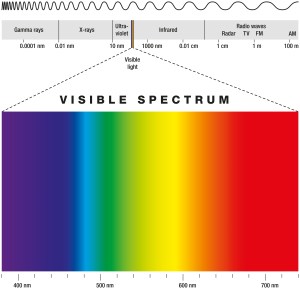
The electromagnetic spectrum is the term used by scientists to describe the entire range of natural light. This spectrum is broken into seven specific regions.
© Peter Hermes Furian
| Dreamstime.com

Subdividing into smaller spectra is done mostly on the basis of how each region of electromagnetic waves interacts with matter. The diagram below depicts the electromagnetic spectrum’s seven regions.

As the graphic above shows, visible light only comprises about 1.5% of the entire light spectrum. Thus, we could say that we are “blind” to the vast majority of light. And the only reason we can see visible light is because God built special receivers right into our heads: our eyes.

If the natural world teaches us about the spiritual world, then we can deduce that (left to ourselves) we are “blinded” to at least 98.5% of spiritual light as well. Since light in the Bible is often synonymous with the Torah (Law), Word, and Yeshua (Jesus), is it any wonder that God compares us to a blind person when we reject His Law, Word, and/or Yeshua? Consider the following Scripture verses:


The Torah (law), the Word and Yeshua are LIGHT

Thy word is a lamp unto my feet and a light unto my path.  (Ps.119:105)

The entrance of thy words give light; it gives understanding to the simple. (Ps.119:130)

For the commandment is a lamp; and the law (Torah) is light; and reproofs of instruction are the way of life: (Pr. 6:23)

To the law (Torah) and to the testimony: if they speak not according to this word, it is because there is no light in them. (Is. 8:20)

“This is the judgment, that the Light has come into the world, and men loved the darkness rather than the Light, for their deeds were evil.  (20)  “For everyone who does evil hates the Light, and does not come to the Light for fear that his deeds will be exposed.  (21)  “But he who practices the truth comes to the Light, so that his deeds may be manifested as having been wrought in God.” (Jn. 3:19-21) 

“I have come as Light into the world, so that everyone who believes in Me will not remain in darkness. (Jn. 12:46)


What the above verses teach us is that God’s light is the only true light. Only His light can illuminate our darkness. Therefore, it is vital that we receive His light. Sadly, many of those that claim to follow Yeshua (Jesus) reject His Torah or law, and replace it with traditions of their own making. According to Isaiah (8:20), there is no light in this type of worldview.

Perhaps Israel (God’s people — including both Jews and Gentiles), truly are “blind in part” as Paul stated in Romans 11. Something is missing. But this is a lengthy discussion best treated with its own set of posts. For now, consider that God uses the Torah (law), the Word and Yeshua as equivalent expressions throughout Scripture. Each of these concepts is what YHWH judges to be His LIGHT.  And they are NOT mutually exclusive of one another no matter what modern theology claims.

It is no coincidence that the electromagnetic spectrum has SEVEN ranges or types of natural light. Spiritually speaking, this is a perfect picture of the SEVEN branched menorah — the epitome of God’s Spiritual light that radiates through and by our Messiah, Yeshua.

Visible Light

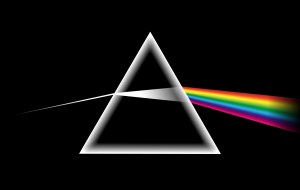
If all the different wavelengths of visible light fall on the eye at the same time, white light is seen. However, if that light is refracted, there are SEVEN (that number keeps popping up!) possible colors visible to the human eye as shown in the figure below.


ROY-G-BIV is the acronym that represents all of the colors in the visible spectrum of light. R (red) – O (orange) – Y (yellow) – G (green) – B (blue) – I (indigo) – V (violet). Not only are those the colors we can see as humans, but they are also in the right order. Red has the longest wavelength and violet has the shortest. In other words, red is the least energetic and violet is the most energetic of the visible spectrum[1]. We will look more closely at these colors when we explore the “rainbow” in a later post.
© Vectortatu
| Dreamstime.com

The prophet Ezekiel was blessed with a colorful vision of heaven. In the verses below, notice the many colored stones, the mention of fire (a form of light), and the reference to the rainbow. All these images are given to us by the prophet to describe the throne room and glory of YHWH.

Ezek. 1:26-28  And above the firmament that was over their heads was the likeness of a throne, as the appearance of a sapphire stone: and upon the likeness of the throne was the likeness as the appearance of a man above upon it.  (27)  And I saw as the color of amber, as the appearance of fire round about within it, from the appearance of his loins even upward, and from the appearance of his loins even downward, I saw as it were the appearance of fire, and it had brightness round about.  (28)  As the appearance of the rainbow that is in the cloud in the day of rain, so was the appearance of the brightness round about. This was the appearance of the likeness of the glory of YHWH. And when I saw it, I fell upon my face, and I heard a voice of one that spake.

In a like manner, the Beloved disciple John was also given a vision of the throne room. Notice the similarities and the reference to colors and light.

Rev 4:2-3  And immediately I was in the spirit: and, behold, a throne was set in heaven, and one sat on the throne.  (3)  And he that sat was to look upon like a jasper and a sardine stone: and there was a rainbow round about the throne, in sight like unto an emerald.

Ezekiel and John could see a rainbow (refracted light) surrounding the throne of the LORD, which means the one at its center, must be pure white light. Also notice Ezekiel’s description of seeing amber. Amber has a GOLDEN look and sheen. Can you think of a symbol in scripture that is amber or golden in color and also displays light?

The Menorah
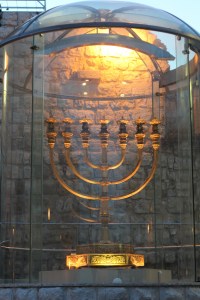
© Amigo3070
| Dreamstime.com

There is no better symbol in all of scripture to encompass the theme of “YHWH/Yeshua as Light” than the Menorah. The menorah was first described to us through Moses when YHWH gave him instructions for the furnishings of the holy place in the tabernacle. Menorah is the Hebrew word for a candlestick or lamp stand. This word literally denotes the means by which light comes or that which bears light. The menorah had a very specific design. Speaking of this holy piece of furniture, YHWH said:

Ex. 25:31-39  And thou shalt make a candlestick of pure gold: of beaten work shall the candlestick be made… (32)  And six branches shall come out of the sides of it; three branches of the candlestick out of the one side, and three branches of the candlestick out of the other side:  (33)  Three bowls made like unto almonds, with a knop and a flower in one branch; and three bowls made like almonds in the other branch, with a knop and a flower: so in the six branches that come out of the candlestick… (37)  And thou shalt make the seven lamps thereof: and they shall light the lamps thereof, that they may give light over against it…(39)  Of a talent of pure gold shall he make it, with all these vessels.

While other implements of the sanctuary were to be overlaid with gold, ONLY the menorah was to be made of ONE solid piece of PURE gold. In three passages of scripture, the menorah is called “the pure menorah”[2]. All the tabernacle furnishings were to be made precisely as YHWH showed Moses on the mountain[3], but He repeats the instruction only in reference to the menorah emphasizing its significance.

Ex. 25:40  “So see, and do according to the pattern which was shown to you on the mountain”

Let’s look at some facts about the menorah[4]:

  • It is fashioned out of ONE piece of hammered gold.
  • It’s designed to resemble and almond tree. (Notice its decorations)
  • It has ONE central shaft with 3 out workings on each side. (7 Branches)
  • Common Israelites, not the priests, provided the pure olive oil that kept the menorah continually burning. (Ex. 27:20-21)

One Piece of Hammered Gold

The menorah was the only piece of holy furniture that was made solely of pure gold. Even the Ark of the Covenant in the Most Holy Place was made of acacia wood overlaid in gold. The fact that it took one piece of gold measuring a talent to make the menorah speaks to the oneness of this set apart object. Since the Holy Place was completely covered, the menorah would be the only light source for the priests to perform their duties. When you look at or think of the golden menorah, your first thought should be the on its first description: One. Which is UNITY.

Dt. 6:4  “Hear, O Israel! The LORD is our God, the LORD is one.”

Almond Tree
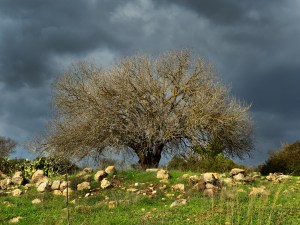
© Nika Lerman | Dreamstime.com

God’s instructions for the menorah included decorations from the almond tree. In Hebrew, the almond is called esh’kedia, which literally translated means “to be alert, watchful, and to be awake”. Interestingly, the almond tree is the first tree to bloom or “wake-up” in Israel in the early spring. Moreover, an almond is shaped like the human eye, thus in Hebrew it is named after the function of the eye. Jeremiah has a passage that illustrates these concepts beautifully.

Jer. 1:11-12  Moreover the word of YHWH came unto me, saying, Jeremiah, what seest thou? And I said, I see the branch of an almond tree [esh kedia]. (12) Then said YHWH unto me, “Thou hast well seen: for I am watching [sho’ked] over my word to perform it.”

In this passage, YHWH uses something very tangible (the almond tree) to picture something abstract (His watchful eyes). Zechariah confirms this image.

Zec. 4:2-6  And he said to me, “What do you see?” I said, “I see, and behold, a menorah all of gold, with a bowl on the top of it, and seven lamps on it, with seven lips on each of the lamps that are on the top of it.  (3)  And there are two olive trees by it, one on the right of the bowl and the other on its left.”  (4)  And I said to the angel who talked with me, “What are these, my lord?”  (5)  Then the angel who talked with me answered and said to me, “Do you not know what these are?” I said, “No, my lord.”  (6)  Then he said to me, “This is the word of YHWH to Zerubbabel: Not by might, nor by power, but by my Spirit, says YHWH of hosts.

The angel goes on to further explain the vision.

Zec. 4:10 For whoever has despised the day of small things shall rejoice, and shall see the plumb line in the hand of Zerubbabel. “These seven are the eyes of Yahweh, which range through the whole earth.”

The seven flames of the golden Menorah are like seven eyes proceeding from YHWH (the LORD), that scan to and fro throughout the earth. In both Jeremiah and Zechariah, the emphasis is on seeing and YHWH’s continual watchfulness over the fulfillment of His Word.

Ps. 121:4 Behold, He who keeps Israel Will neither slumber nor sleep.

This motif also suggests that YHWH is the Light (the menorah itself) and that the branches are truly His eyes. These are the seven spirits that John describes in Revelation[5]. In nature, it is through the one pure white channel of visible light refracting into six branches that we are able to see glorious color; and so it is through the one main shaft of the menorah branching into six other flames that we see the glory of our Holy God. Perhaps this why Isaiah says of the BRANCH (Messiah):

Is. 11:1-2  There shall come forth a shoot from the stump of Jesse, and a BRANCH from his roots shall bear fruit.  (2)  And the Spirit of YHWH shall rest upon him, the Spirit of wisdom and understanding, the Spirit of counsel and might, the Spirit of knowledge and the fear of YHWH.

The 7 Branches and 7 Spirits of Adonai

Like the Menorah’s seven branches, there are seven Spirits of God. The fullness of the Spirit of Adonai is represented in the main shaft of the golden menorah. All the other 6 branches are rooted and spring forth from this single shaft: wisdom, understanding, counsel, power, knowledge and reverence (fear). Each of these manifestations of God’s Spirit operates as creative forces or agents in creation, restoration and renewal from Genesis to Revelation.

As I’ve mentioned in several other places on this blog, Dr. Hollisa Alewine’s The Creation Gospel explores these spirits in detail. If I could recommend one thematic study or biblical paradigm for you to learn, The Creation Gospel would be at the top of the list every time. This study helps you to build understanding by showing you how the smaller pictures found in the Scriptures fits into the greater picture. For now, consider that the 7 Spirits of God are like the 7 tongues of fire that illuminate the golden menorah.

Imagine the electromagnetic spectrum transposed with a likeness of the tabernacle menorah. The visible spectrum’s 7 colors would come forth from the main stem (central) of “white” light. Remember the heavenly throne room pictured by Ezekiel and John? What better symbolism could have been given to these men to illustrate the majesty of the God of LIGHT? He truly covers Himself with light as a garment!

  Ps. 104:2  Who coverest thyself with light as with a garment: who stretchest out the heavens like a curtain.
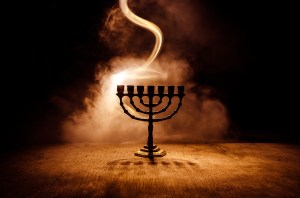
Conclusion

  • The electromagnetic spectrum depicts 7 forms of light. Of these 7, we can only see 1 tiny sliver equaling 1.5% of the spectrum.
  • Visible white light refracts into 7 seven colors or wavelengths that increase in intensity.
  • YHWH uses a 7 branched golden menorah to symbolize His Light.
  • Imagery in Scripture equates YHWH’s Light with the Torah (Law), His Spirit, Messiah, His Word, His Eyes, His Power, etc.

Do you think it is a coincidence that “science” describes natural light with 7 “manifestations” long after YHWH established this fact in Scripture with the menorah?

More to come on the Rainbow and Adonai’s Throne, The Menorah, the Tree of Life, Mt. Moriah and Resurrection. Click here for Part III.


[1] Creation Gospel students will find this truth rather fascinating because the “spring” side of the menorah deals more with families and individuals while the “fall” side deals with a nation or the nations. There is a direct increase in intensity as the spring feasts of YHWH progress into the fall festivals. This mimics increase in intensity of the colors energy wavelengths as they progress on the spectrum.

[2] Ex. 31:8, 39:37, Lev. 24:4

[3] Ex. 25:9

[4] Valerie Moody has an excellent workbook on the menorah called: Secrets of the Menorah. Even seasoned Hebraic Roots followers will find some treasures in its pages. Although I didn’t see this particular book at her website, you can contact her about possibly obtaining a copy. http://www.vmoody.com/

[5] Rev. 1:4

Categories: Biblical Symbols, Musings | Tags: , , , , , , , , , , , , , , | 6 Comments

Torah Portion: Mattot and Massei

Numbers 30:1- 36:13, Jer. 1:1-2:4-28, 3:4, Mt. 5:33-37, James 4:1-12

Mattot

The first of our double portion for this week’s Torah reading is Mattot. Mattot is translated as “tribe(s)” 182 times in our Tanakh (O.T.); and as rod(s) or staff another 66 times. Below is Strong’s definition followed by the Ancient Hebrew Lexicon of the Bible’s entry for this word.

Strong’s H4294

    מטּה From H5186; a branch (as extending); figuratively a tribe; also a rod, whether for chastising (figuratively correction), ruling (a sceptre), throwing (a lance), or walking (a staff; figuratively a support of life, for example bread): – rod, staff, tribe.

AHLB#: 1285-H (N)

1285) ac: Shake co: Branch: The pictograph “mem” is a picture of water, the “tet” is a picture of a basket which contains objects. Combined these mean “liquid contained”. A green branch still contains water allowing the branch to be flexible. A green branch can then be bent to the desired shape and left to dry.

Based on the light shed by our lexicons, what is it to be a tribe? Have you ever heard the phrase “When you’re green you’re growing”? According to ancient Hebrew, to be part of a tribe is to be a tree branch— a green growing branch that is still moldable or flexible. To remain green, this branch must have life giving water still flowing through it. In other words, the word picture shows us a tree (a whole complete unit) and that tree has many branches, but all the branches are a part of the one tree. I recall Yeshua using this very word picture to explain our relationship to Him in John 15.

 John 15:1-8  “I am the true vine, and My Father is the vinedresser.  (2)  “Every branch in Me that does not bear fruit, He takes away; and every branch that bears fruit, He prunes it so that it may bear more fruit.  (3)  “You are already clean because of the word which I have spoken to you.  (4)  “Abide in Me, and I in you. As the branch cannot bear fruit of itself unless it abides in the vine, so neither can you unless you abide in Me.  (5)  “I am the vine, you are the branches; he who abides in Me and I in him, he bears much fruit, for apart from Me you can do nothing.  (6)  “If anyone does not abide in Me, he is thrown away as a branch and dries up; and they gather them, and cast them into the fire and they are burned.  (7)  “If you abide in Me, and My words abide in you, ask whatever you wish, and it will be done for you.  (8)  “My Father is glorified by this, that you bear much fruit, and so prove to be My disciples. (NASB)

Branches exist for the purpose of producing leaves and fruit. The leaves absorb light/energy which is likened unto the (Torah) and this light ultimately is what powers the leaves to produce food for the whole tree. [Bread from Heaven, anyone?] The fruit however, has an entirely different purpose.

Trees produce fruit for the sole purpose of propagating seeds. And those seeds will produce the exact same tree. This is why Yeshua said, “You will know them by their fruit”. If the fruit doesn’t match the tree they are claiming to be, then we can be sure that they are liars. Trees are known by what kind of fruit they produce.

Mat. 7:15-20  “Beware of the false prophets, who come to you in sheep’s clothing, but inwardly are ravenous wolves.  (16)  “You will know them by their fruits. Grapes are not gathered from thorn bushes nor figs from thistles, are they?  (17)  “So every good tree bears good fruit, but the bad tree bears bad fruit.  (18)  “A good tree cannot produce bad fruit, nor can a bad tree produce good fruit.  (19)  “Every tree that does not bear good fruit is cut down and thrown into the fire.  (20)  “So then, you will know them by their fruits. (NASB. See also Mat. 7:16, 12:23; Luke 6:44)

Now that we understand that as a “branch” or “tribe” of Israel we should be absorbing light (learning Torah) and producing fruit (keeping Torah), is it any wonder that Paul uses the analogy of the olive tree for Yah’s family in Romans chapter 11? Please go and reread this whole chapter.

Yeshua and Sha’ul/Paul are teaching the same message. If you or I (branches) do not do what we were created to do (produce fruit) we are cut off from the tree (Messiah). However, if we do what we were created to do, then we are grafted into The Olive Tree: Yeshua. Therefore, a tribe is a branch in the house of Israel/Yeshua.

Vows

This aptly named Parashah begins by teaching us the Torah of vows in chapter 30. There is basically a simple rule for men: he must keep his vow. Period. There is no recourse for him should he break his vow or obligation. (vs. 2). But the rest of this chapter deals with vows made by women. If you’ve read any of my posts on women, you know that I seek godly restoration for the roles of men and women. That being said, most commentaries on this passage tend to use a skewed lens as they peer into the fact that while a man’s vow must be kept, a woman’s vow may be annulled by her father or husband. Sadly, too many commentators write that this is because the woman is weak, easily deceived, and acts impulsively compared to a man.

If we allow the WHOLE counsel of God to speak to this issue, we can easily see that an assessment such as this is a result of flawed theology and doesn’t even come close to connecting how YHWH created woman or how He SEES her. Remember Hagar? She is the one that proclaims that YHWH was the Elohim that sees her— El Roi[1].

I believe that YHWH not only created woman with a unique role, but with a special purpose in the restoration of all things. If we find ourselves feeling put out like Hagar, we need only to meet the Master by the well of Living Waters. There, He will allow us to SEE with new eyes. How glorious it is when we realize that the Creator of Heaven and Earth really SEES us! This passage is far from being misogynistic.  Instead, if we have eyes to SEE, it is liberating not only to women, but to the Body of Messiah.

In His most endearing of terms for His people, YHWH calls us His wife and His Bride. Both men and women have an opportunity to be included in this glorious remnant. As His special treasure, we are kept in His care. As our Master, Father, and Husband He takes responsibility for us —- flaws and all. What better hands could we ever hope to trust in? When I read this passage about the importance of vows and the glaringly obvious difference between the responsibility of men and women, I have to conclude that this passage is teaching us about YHWH and His people. You see, only He — our Father and Husband — can annul the foolish vows that we make. While it is not impossible to make good on our vows, it is improbable. What else could have motivated the Messiah and James to say the following?

Mat 5:33-37  “Again, you have heard that the ancients were told, ‘YOU SHALL NOT MAKE FALSE VOWS, BUT SHALL FULFILL YOUR VOWS TO THE LORD.’  (34)  “But I say to you, make no oath at all, either by heaven, for it is the throne of God,  (35)  or by the earth, for it is the footstool of His feet, or by Jerusalem, for it is THE CITY OF THE GREAT KING.  (36)  “Nor shall you make an oath by your head, for you cannot make one hair white or black.  (37)  “But let your statement be, ‘Yes, yes’ or ‘No, no’; anything beyond these is of evil.

Jam. 5:12  But above all, my brethren, do not swear, either by heaven or by earth or with any other oath; but your yes is to be yes, and your no, no, so that you may not fall under judgment.

I am very thankful that as my Abba and Husband, YHWH can annul vows for me. I believe men would also give a hearty A-mein to that! A bond-servant relinquishes all of his rights into the hands of his Master. The servant trusts the Master with his/her life. A servant has no need to make a vow, for he/she lives to serve/please the will of the Master. I am continually amazed by the Messiah’s presence in the volume of the Scroll[2]! It really is all about Him and His relationship with us. But like Hagar, we have to first meet Him at the well and have our eyes opened to His splendor and most tender affection for us.

Massei

This is the last parashah (portion) in the book of B’midbar (Numbers). B’midbar is a book that means “in the wilderness.” It chronicles each step and stop of the Israelites as they marched toward the Promised Land over a 40 year period. Our portion, Massei, can be defined as “pulling up stakes” as this is the word picture we are given from the Hebrew. We usually translate it as “journeys,” since a journey can convey the meaning of pulling up tent pegs to move toward another location.

At this point in the wilderness, the children of Israel are preparing to go in and take possession of the Promised Land, Canaan. YHWH instructs Moses to record each of the 42 stops or encampments that Israel made while dwelling in the wilderness. (Num. 33:2) An inexperienced Torah reader may be tempted to skim or skip over most of chapter 33’s place names. They may seem boring or even arbitrary to the untrained eye. But nothing could be further from the truth! These 42 stops have many past, present, and future implications for those that follow our Master, Yeshua, and keep His commandments.

The rabbis have long taught that each of the 42 encampments is a clue to the “journey” that we are on as we walk and sometimes limp toward the Promised Land. There can be no coincidence that there are also 42 months (3 ½ years) in the Great Tribulation. But, I’m getting ahead of myself. I’d first like to draw your attention to the number 42.

Forty-Two

The number 42 is significant for several reasons. For those of you that are familiar with the Creation Gospel model, the fact that 42 is the product of 6 x 7 will be very telling.

First, 6 x 7 is the number of man (and/or the beast) and of rest, spiritual perfection, or wholeness. Second, 6 and 7 are also representative of the Spirits of Knowledge and Reverence, the festivals of Yom Kippur and Sukkot, and the assemblies of Philadelphia and Laodicea.

These pairings suggest two similar paradigms. The first paradigm is man, as E.W. Bullinger suggests[3], working out his opposition to God. Every person is capable of acting like a man created in the image of Elohim or resorting to his/her base nature (i.e. evil inclination, flesh) that reflects the image of a beast. This inward struggle is common to all of mankind. Like Cain, we have a choice — everyday. Will we walk in the Way of Messiah and mirror His image? Or will we relent to the desires of our flesh and reveal the image of the beast? Both man and beast were created on day 6. This is why the number of the beast is also the number of man[4].

For those that deny or afflict their souls on Yom Kippur (6), sweet rest and rejoicing follows on Sukkot (7). But there is another paradigm revealed in this number as well. Consider some other instances of the number 42 in Scripture:

  • If one counts the 2 years from the original Pesach in Egypt to the evil report and 40 years from Kadesh Barnea to Jericho when Israel finally enters the Land, there is a total of 42 years.
  • Israel’s wilderness journey’s had 42 stops or stages where they sometimes cooperated with YHWH and other times they opposed Him.
  • There were young boys that mocked the ascension of Elijah to Elisha and 42 of them perished before Elisha in the Name of YHWH by 2 female bears. (2 Kings 2: 23,24)
  • The beast is given 42 months to control the earth (Rev 13:5). We also know that 42 months equals 3 ½ years.
  • In our Parashah, the number 42 comes up twice. Once in the wanderings listed above and a second time in chapter 35. The Levites were designated 42 cities among their brothers in the Promised Land, besides the 6 cities of refuge.

While the first paradigm reveals an inward struggle, the second pattern exposes a very real outward battle. Those that choose to live by their own desires will find that they are indeed enslaved by the beast. As his captives, they have a natural hatred for the servants of the Most High. We can see this pictured in the last two assemblies mentioned in the Book of Revelation. Philadelphia, the city of brotherly love, symbolizes people who are willing to sacrificially love God and others. This is the epitome of the Holy Spirit of Knowledge[5]. This intimacy is portrayed by the 42 cities given to the Levites in the Land. It is vital that Adonai’s people have an intermediary present. But as we progress to the last assembly, Laodicea, we see a very different image.

Laodicea is neither hot nor cold, so she believes she is just right. But her condition is so vile that it makes the Master want to vomit. In other words, she has no reverence or fear of the LORD — the 7th manifestation of the Holy Spirit. The white garments she should have received on Yom Kippur (6) are missing when Sukkot (7) comes around. Yet she childishly wallows in her pride and ignorance. Without sincere repentance, the beast will overtake her like the 2 bears that slew the 42 young boys who mocked the ascension of Elijah to Elisha.

Have you ever wondered why the beast is given “42” months to control the earth? Most people understand that the number 40 represents probation, trial, and chastisement for those whom YHWH loves[6]. But what happens when we add “2” to that number? Two denotes division and difference in the Bible. For example, the second day of creation DIVIDES the upper and lower waters, the second sentence in scripture speaks of chaos, and the second chapter reveals 2 trees representing life and death. These instances continue throughout the Bible in regard to the number two[7]. While it is true that the world that YHWH loves is put to the ultimate test (40) in the Apocalypse, the addition of the number 2 reveals the vehicle that YHWH will use to accomplish this task: the enemy.

Obviously, the heart of YHWH desires for us to come to repentance above all else. This is what our trials and tribulations are all about. We must tame the animal nature or beast within and choose to walk in His Way, reflecting His image. This is expressed in its fullness when we love YHWH with all our heart and love our neighbor as ourselves.

Moving with the Cloud

Our journey begins in the same place for all people living in all times——- Rameses. One thing those of us that are returning to the Torah know and know well is that all roads do not lead to Rome——– or even Egypt——- but to Babylon, or Babel. Rameses means “child of the SUN” and all false worship can be traced back to sun worship that was first concocted in Babylon.

I urge you to look up each of the 42 place names of Israel’s wilderness journeys in Hebrew. I’m certain that you will find a place name that expresses your current life situation, station, trial, or movement. Like Israel, we all are all on journey with YHWH. We may not all be at the same place at the same time, but there will be a day that we are. In the meantime, consider it another test when you are faced with brethren who are not as far down the path or who are further ahead of you in the Way. How we treat or mistreat them may dictate our next stop on the journey.

Moreover, it is clear that there is real war along the Way. One of the more pronounced foes is the Canaanites. While the Canaanites are outward enemies, the “spirit” of the Canaanites can reside in our hearts if we allow the beast within (our flesh/evil inclination) to have rule. YHWH gives us this warning:

Num. 33:55-56  ‘But if you do not drive out the inhabitants of the land from before you, then it shall come about that those whom you let remain of them will become as pricks in your eyes and as thorns in your sides, and they will trouble you in the land in which you live.  (56)  ‘And as I plan to do to them, so I will do to you.'”

This is essentially the same message He gives to us in the 42 month rule of the beast in the Book of Revelation. If we do not repent and walk after Him, we will be counted with the beast and receive its punishment.

Rev. 12:14  But the two wings of the great eagle were given to the woman, so that she could fly into the wilderness to her place, where she *was nourished for a time and times and half a time (42 months), from the presence of the serpent.

Rev. 14:9-12  Then another angel, a third one, followed them, saying with a loud voice, “If anyone worships the beast and his image, and receives a mark on his forehead or on his hand,  (10)  he also will drink of the wine of the wrath of God, which is mixed in full strength in the cup of His anger; and he will be tormented with fire and brimstone in the presence of the holy angels and in the presence of the Lamb.  (11)  “And the smoke of their torment goes up forever and ever; they have no rest day and night, those who worship the beast and his image, and whoever receives the mark of his name.”  (12)  Here is the perseverance of the saints who keep the commandments of God and their faith in Jesus.

We must willingly pull up the tent pegs when YHWH’s cloud moves our encampment. This is our perseverance as verse 12 above attests. This double portion and all of Scripture for that matter tells the same story in different ways again and again. YHWH loves us and desires for us to dwell with Him in His house. However, we have 2 interwoven enemies that battle for our affections. The first one is the beast within (our flesh, evil inclination, or fleshly desires). The second is the serpent from the beginning, who speaks to our desires. We are told that we CAN overcome the enemy by choosing the Life YHWH has offered us in Yeshua. This New Life of YHWH has House rules that keep or guard us from the beast: His commandments.

But as we live out these earthly lives, we are in a constant state of choosing. This is why our journey requires perseverance! To persevere is to persist, continue, endure, insist, proceed, stick with, etc. And with the empowerment of the free gift of the Spirit of God, we can do just that.

Chazak! chazak! V’neet’chazek!

(Be Strong! Be Strong! And let us be strengthened!)


[1] Genesis 16

[2] Hebrews 10:7

[3] Bullinger, E.W., Number in Scripture: Its Supernatural Design and Spiritual Significance, Grand Rapids: Kregel Publications, 1967, p.268

[4] Rev. 13:18. Also, The Creation Gospel Workbook 1 explores this further.

[5] Is. 11:2

[6] Bullinger, E.W., Number in Scripture: Its Supernatural Design and Spiritual Significance, Grand Rapids: Kregel Publications, 1967.

[7] For instance, even the Brit Chadashah (N.T.) displays this pattern. Consider the 2nd books of Corinthians, Thessalonians, Timothy, Peter, and 2 John; they each speak either about the enemy/antichrist or the church in ruin/apostasy.

Categories: Torah Portions | Tags: , , , , , , , , , , , | 1 Comment

The Light of the World Part I


Science and nature will not deny that every living thing depends on light either directly or indirectly to maintain life. This natural parable has a mighty lesson to teach us about the immense spiritual world around us. So, what is light? I hope to show you through the scientific exploration of  light and the Scriptures that our Elohim (God) is truly the “Light of the World.”[1]

What is Light?

Scientists give varied answers. Even with the many technological advantages that we have today, light remains a scientific mystery.[2] As soon as scientists think they’ve figured it out, light surprises them again. Perhaps this is what provoked Albert Einstein to say:

“For the rest of my life I want to reflect on what light is.”

© Tomert
| Dreamstime.com

Quantum physics and the theory of Relativity, two of modern physics great paradigm shifts, started from anomalies in the behavior of light. Both thoughts led to radical new understandings of the nature of light. It seems that light occupies a very special place in the universe. In some ways, it is more fundamental than space, time or matter. The biggest question of light is whether it is a wave, a particle, or both. The classical description of light defines it as an electromagnetic wave. This means that it is a varying electric and magnetic field, which spreads out from one place to another. Light doesn’t have physical mass; instead, it is “energy.” The modern quantum mechanical description says that light can also be considered to be particles called photons. These photons carry energy and momentum but they have no mass.

Science defines light as having no physical substance or mass, yet it is carried by a very real and observable means. Adonai described Himself as “Light” thousands of years before modern science knew anything about how light functions. Like light, Adonai has no physical substance; He is a Spirit.[4] Yet, He has also given us an “observable” substance: His Word. It is the Word that took upon flesh to show us His Light in the form of Yeshua.[5]

Ps. 27:1 The LORD is my light and my salvation…

Jn. 8:12  Then spake Yeshua (Jesus) again unto them, saying, I am the light of the world…

1Jn. 1:5  This then is the message which we have heard of him, and declare unto you, that God is light, and in him is no darkness at all.

Jn. 4:24  God is a Spirit: and they that worship him must worship him in spirit and in truth.

Quantum mechanics teaches that matter cannot exist without light and all matter consists of invisible particles. Thus, light is necessary not only for life, but for any form of matter. The first recorded speech of Elohim (God) in our Bible’s is “Let there be Light.” This is the Hebrew word אור “ohr.” It shares its root with the Hebrew word for order and box. In Hebrew thought, a box helps keep things in order. Therefore, light is also necessary to maintain order.[6] Even the English word order begins with this same sound “ohr.” Thus, light is a sort of containment for the structure of our universe. As good science teaches, light is what “holds” quanta particles together and all matter consists of invisible particles. Thus, light literally holds our universe together.

Rom. 1:20  For the invisible things of him from the creation of the world are clearly seen, being understood by the things that are made, even his eternal power and Godhead; so that they are without excuse:

Col. 1:17  And he (Yeshua) is before all things, and by him all things consist[7] [are held together].

According to Wikipedia, “Light is electromagnetic radiation of a wavelength that is visible to the human eye (in a range from about 380 or 400 nanometers to about 760 or 780 nm). In physics, the term light sometimes refers to electromagnetic radiation of any wavelength, whether visible or not.[8]

Light is a form of what we call radiation. The electromagnetic waves produced by light move in a manner similar to the waves produced by a stone dropped in a pool of water. The transverse waves of light from a light source spread out in expanding circles much like the waves in a pool. However, the waves in the pool are very slow and awkward in comparison with light, which travels approximately 186,000 miles per second.

Scientists have come to the conclusion that the speed of light has not only observed to be constant, but that it does not even make any sense to say that it varies.[9] The speed of light is constant or eternal, because it never stops traveling.[10] Thus, our God of Light is also constant or eternal and does not vary. Natural light teaches us about the spiritual reality of Adonai.

Dt. 33:27  The eternal God is thy refuge, and underneath are the everlasting arms: and he shall thrust out the enemy from before thee; and shall say, Destroy them.

Mic. 5:2  But thou, Bethlehem Ephratah, though thou be little among the thousands of Judah, yet out of thee shall he come forth unto me that is to be ruler in Israel; whose goings forth have been from of old, from everlasting.

Einstein’s theories of Special and General Relativity also describe light in respect to time and space. Time is relative to the observer. As an object accelerates, time slows down relative to that object. In other words, time and speed come together at the speed of light. We can imagine this if we think of a person riding a beam of light. Relative to everyone else, he would appear to be frozen in time. He could travel for several million years without aging a single second. However, to himself, time appears normal; it’s just that the rest of the universe seems to be aging infinitely quickly. Like God, anything traveling at the speed of light does not change. Just as God exists outside of the laws of time and space, time as we know it does not exist at the speed of light.

Ps. 90:1-4 [[A Prayer of Moses the man of God.]] Lord, thou hast been our dwelling place in all generations. Before the mountains were brought forth, or ever thou hadst formed the earth and the world, even from everlasting to everlasting, thou [art] God. Thou turnest man to destruction; and sayest, Return, ye children of men. For a thousand years in thy sight [are but] as yesterday when it is past, and [as] a watch in the night.

Mal.  3:6 For I [am] the LORD (Yahweh), I change not; therefore ye sons of Jacob are not consumed.

2 Pt. 3:8 But, beloved, be not ignorant of this one thing, that one day [is] with the Lord as a thousand years, and a thousand years as one day.

Dan. 2:22 He revealeth the deep and secret things: he knoweth what [is] in the darkness, and the light dwelleth with him.

Jas. 1:17-18 Every good gift and every perfect gift is from above, and cometh down from the Father of lights, with whom is no variableness, neither shadow of turning. Of his own will begat he us with the word of truth, that we should be a kind of firstfruits of his creatures.

I am not a scientist by any means, so those of you that are more scientifically minded may find my post very elementary, sorry. My husband is highly intrigued by the scientific world and it is my understanding of his studies that I offer here. As he digs deeper into the natural things, we are always amazed by the accuracy of Scripture. The heavens and creation never fail to declare the glory of the LORD! And the natural things really are a witness of the Creator and the spiritual realm.

In future posts, I hope to cover the electromagnetic spectrum, the menorah, rainbows, and much more. Read more in Part II.


[1] John 8:12; 9:5

[3] Yahweh, the four letter tetragrammaton in Hebrew (yod, hey, vav, hey). This is the Most Holy Name of God. Often translated as The LORD in English bibles.

[4] John 4:24

[5] Read all of John chapter 1

[6] See Jeff Benner’s Ancient Hebrew Lexicon of the Bible under entry H216

[7] See Strong’s number G4921

[10] This is proved by Einstein’s theory of Special Relativity.

Categories: Biblical Symbols, Creation Gospel, Musings | Tags: , , , , , , , | 7 Comments

Torah Portion: Korach

Numbers 16:1-18:32; 1 Sam. 11:14-12:22; 2 Tim. 2:8-21; Jude 1-25   (K. Gallagher 2011)


Korach’s Rebellion

Do we sometimes feel that YHWH has been unfair to us? I shamefully have at times. We know from reading the p’shat or literal meaning of this portion that Korach’s desire is wicked and rebellious. Yet, Korach felt that he was a better choice to lead the people. I’ve been around people like Korach; they desire a form of the priesthood also. They are those that always find fault with leadership and as a result they begin to vocalize their opinions to others in the congregation. Whether they realize it or not, like Korach, they are drawing others unto themselves.

Those that participate in such activities usually do so under the banner of holiness or righteousness. They accuse the leadership in place of not being as righteous or as holy as they should be. Perhaps they accuse the leadership of not being as Torah observant as themselves. They forget that those leaders have been allowed to operate and function by YHWH Himself. Sure there are some legitimate reasons to confront a leader – like when there is proof of blatant or unrepentant sin. However, far more often than not, that leader is functioning just as YHWH has planned. Among Messianics, there is usually a family or group of families that comes against the leadership because of particular halachah (specific ways a community keeps a commandment) and not sin. And thus, I must wonder if they are in the rebellion like Korach.

Korach felt that he and all Israel were holy. While it is true that those that follow the Elohim of Israel and keep His commandments are holy, the real question is holy for what? In Hebrew the word for holy is “kadosh;” it means to be set-apart for something. But that something can be good or wicked. Kadosh doesn’t function like our English word for holy. This is why in Hebrew a harlot is also called holy; she is set apart for her task or god. The question is to what or to whom are you set apart? We must strive to be “kadosh l’YHWH,” Holy unto Adonai. There is a big difference.

One striking thing that cannot be overlooked is the condition of the camp at the time this rebellion took place. Last week, the Israelites learned that their lack of fear and trust in the God of Israel would cost their generation the Promised Land. They believed the report given by the 10 negative spies and once again grumbled against Moses and Aaron. The consequences of their sin must have seemed unbearable. Emotions had to be running high in the camp as they pondered their predicament: They would spend the rest of their earthly lives in the wilderness.

With a judgment like that looming over your head, Korach’s message would have been enticing to say the least. Thoughts would race through your mind possibly like the following: “Perhaps, Moses heard wrong. Maybe Korach is right. YHWH loves us too, right? He said we were holy. Look where Moses and Aaron have gotten us—nowhere! It’s not as if Moses and Aaron are perfect. They make mistakes too! Perhaps He will start all over with us! Yes, that’s it! We will get to the Promised Land; glory to God, A-men!” And on and on it would go. You see, it would feel like the right thing to do because it would make your flesh feel better about your lot in life. When YHWH says we don’t get to go somewhere or we don’t get to do something – He means it. We must learn to rest in His sovereignty and FEAR Him and Him alone. YHWH always has us right where He wants us. Whether or not we like it doesn’t matter. Our duty is to fear Him and Keep His commandments and to do so with a spirit of joy! It is possible… with Him. (Mt. 19:26)

Back Up

Let’s rewind this story a bit and ensure that we don’t find ourselves wearing the shoes of rebellion. The first spark of dissent happens after the people (20 years and older) realize that their dreams of entering the Land will NEVER be grasped. People that have had their dreams or agendas crushed are dangerous. Sadly, their fate is a consequence of their own making (sin). Instead of accepting the Creator’s sovereign ruling, the people want someone to blame. They look to the earthly leadership and plan a mutiny, even though the real culprits are their own evil inclinations and mistakes. Do you suppose that we are any different today?

Moses realizes the enormity of the people’s actions and humbly tries to quiet their emotions by bowing with his face to the ground before Adonai (he has a servant heart!) and reasoning with the people. He then devises a plan for all those in rebellion and the current leadership to offer incense before YHWH. By this, Adonai would affirm His choice of leadership. But Moses’ words of wisdom do not appease the people. As a matter of fact, they have become so prideful that they continue the onslaught of accusations against Moses and refuse to come when he requests their presence. (vs. 12)

Instead of looking at the real problem (their own evil hearts), they blame Moses. I believe this occurs again and again in our own assemblies. And, in other areas of our life. In 16:13-14, it becomes obvious that the people have deluded themselves into believing that their punishment is Moses’ fault. While it is most apparent to us that their accusations are completely unwarranted, the people feel justified in their actions.

When issues of halachah surface in our assemblies, often the accusers are simply rebelling as Korach did. They refuse to submit to the ruling of the leadership under the guise of “holiness.” These people, like Korach, really believe that their interpretation of halachah is more divine or biblical than the community’s current standards. And somehow they feel that it is their duty to “set everyone else straight.” They become the Torah police, controlling the people. When the leadership humbly tries to reason with the accusers, they puff-up in pride and usually spew verbal bullets (scripture proof texts) in retaliation. Is this not exactly what Korach and his company did?

You see, like Korach and his cohorts, we often react in similar fashion when we don’t get our way. Like little children, we kick and scream and blurt out false accusations toward leadership. Our evil inclinations can conjure up a myriad of threats, allegations, and blame. If the accused tries to humbly squelch the outrage, the people usually respond as Dathan and Abriam and refuse to make amends. I believe that by this point, pride has such a hold on the person or persons that they cannot repent. Like Korach, pride has completely blinded them to the truth and to reason. Sadly, what results is usually a sharp division of fellowship. But, the leadership cannot allow this spirit to proliferate. Like Moses, they must turn them over to YHWH.

The thing I don’t want you to miss is how “subtle” Korach’s initial argument was. In 16:3, everything Korach said about the people was true: the people were holy and YHWH was in their midst. This was the hook Korach used to drag the people away in his revolt. In reality, the people and Korach didn’t like the judgment YHWH made about their sin. They wanted to leave the wilderness and enter the Land. Realizing that they would never get there with “Moses” as leader, they decided that just perhaps, another leader would get them there.

In our assemblies today, this same thing plays out again and again. The “people” have a set desire (and that desire may not be wrong in and of itself). Upon realizing that the current leadership is not going to get them there or submit to what they perceive is the best halachah; they begin mouthing these things to other assembly members. Some with similar aspirations become carried away with the Korachs. Eventually, there is a “meeting” challenging the leadership. If the leadership refuses their demands, they throw a tantrum and leave the assembly, usually dragging others with them.

This saddens me very deeply. Even worse, looking back, I realize that I have been a cohort with a Korach before. I was so blinded by my “righteous” aspirations that I failed to recognize the authority that YHWH had placed in our midst. What resulted was a split and broken relationships. And guess what? When YHWH’s timing was right, that assembly did walk out the very thing that we aspired to! So the real lacking was my own humility and patience. We forget how powerful pride actually is. Pride’s favorite disguise is a form of godliness, holiness, and righteousness. Rarely is it overtly evil.

Since I’ve had a bad experience with a Korach, I really have to check myself when things aren’t done the way “I” believe they should be. When emotions are running high, we are primed for the enemy to slither in and plant seeds of dissent. We can be so zealous for YHWH, His Torah, and Mashiach, that we often forget the two most vital keys to unity: humility and authority. When everyone is his own master, serving others is nonexistent.

We must get to a place where loving YHWH and loving others trumps our pet doctrines and halachah. This is not compromise, it is humility. Too often our desire to be right far exceeds our desire to love, exercise mercy, and live in unity. Moreover, we have a real issue with authority. Where are the people that are willing to commit, lift up, serve, and stand with today’s leaders? Sure they aren’t perfect; yes they will make some mistakes. If you think (like Korach) that you would be a better leader — you are deluded by your own pride and rebellion.

Or perhaps you believe that you must isolate yourself and family from the main assemblies. Many that do this fear contamination, opposing doctrine. or halachah. This, too, is pride, because the negative side of pride is fear of man and circumstances.

This may sound harsh, but when I look around our “movement”, instead of seeing steadfast believers walking in unity, I see too many fickle and inconsistent people. Today, I doubt that their would be an Aaron or a Hur to help Moses hold his hands up to defeat an Amalek[1]

This is to our shame. My prayer is that we wake-up and mature. We have to accept the fact that we are each in different places in our restoration. We cannot demand that everyone be exactly where we are in our walk. Nor can we demand that everyone become a cookie-cutter version of ourselves in matters of halachah. If you dislike diversity (in halachah), then you need to reevaluate the creation and get over yourself. Prayerfully find an assembly. Stick with them. Support the leadership. Be steadfast. Serve the community with humility. Crucify your own desires and agendas and flow with the camp.

For which do you believe that YHWH will judge more harshly: having incorrect halachah and submitting to an imperfect leader or refusing to serve and love His people in unity?


[1] Ex. 12:8-13

Categories: Torah Portions | Tags: , , , , , , , , , , , , | 2 Comments

Blog at WordPress.com.